Science
Killer whales are killer whales, right? It might be a lot more complicated than that

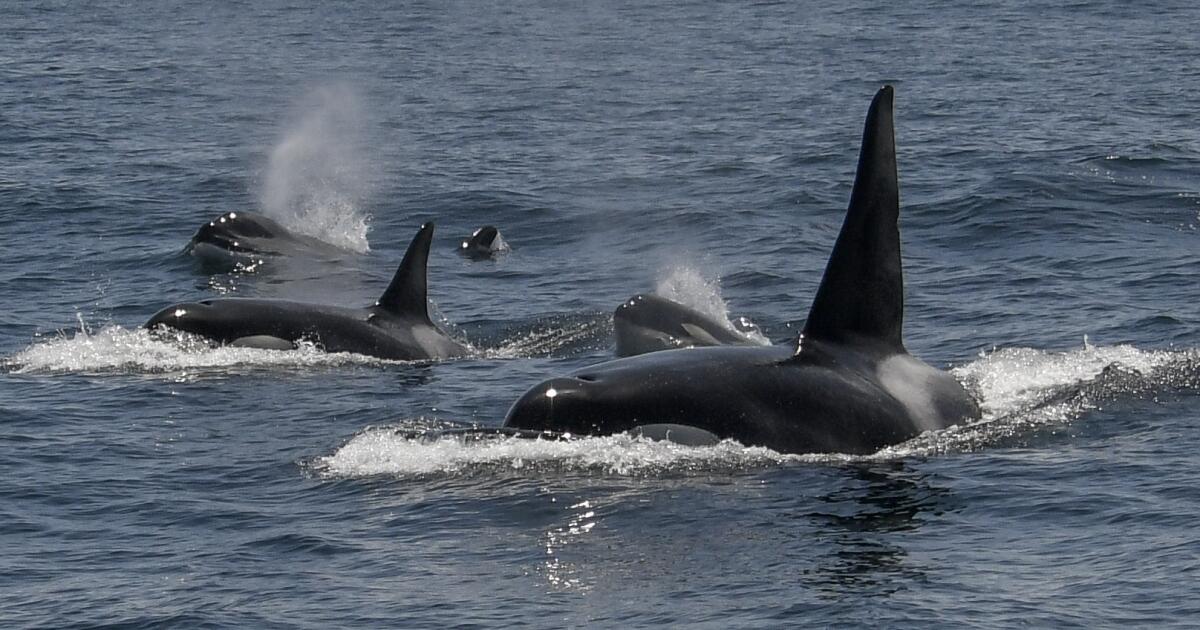
More than 150 years ago, a San Francisco whaler noticed something about killer whales that scientists may be about to formally recognize — at least in name.
Charles Melville Scammon submitted a manuscript to the Smithsonian in 1869 describing two species of killer whales inhabiting West Coast waters.
Now a new paper published in Royal Society Open Science uses genetic, behavioral, morphological and acoustic data to argue that the orcas in the North Pacific known as residents and transients are different enough to be distinct species. They propose using the same scientific names Scammon is believed to have coined in the 19th century.
Aggressive and impactful reporting on climate change, the environment, health and science.
Killer whales, found in all oceans, are currently considered one global species. The new proposed species would mark the first split of the ferocious apex predators, which, if approved, could have significant conservation and scientific implications — in addition to furthering a decades-long quest to properly classify the whales.
The two proposed species may look indistinguishable to the untrained eye, but there are subtle differences in their fins and markings — and many more unseen ones. They don’t speak the same “language” or nosh on the same food. And they have no interest in hanging out with one another, despite often dwelling in the same waters. Most significantly, researchers say, their DNA shows clear distinction.
Transients — also called Bigg’s killer whales — hunt seals and other marine mammals in small packs in expansive waters stretching from Southern California to the Arctic Circle. And they’re not very chatty while they sneak up on prey — they need to maintain stealth. They sport pointy, triangle-shaped dorsal fins with a solid white “saddle patch” behind it.
Residents, meanwhile, stick to fish — primarily Chinook salmon. They love to gab and hang out with the family. In fact, most offspring stay with their mothers their entire lives. Because fish don’t hear very well, they’re free to chatter as they chow down. Residents hew closer to coastlines, from Central California to southeast Alaska, where salmon congregate. Their fins tend to curve back toward the tail and intrusions of black sometimes extend into their saddle patches.
A third type of killer whale roams the Pacific, but less is known about it; these offshore whales live farther out and prey on sharks and other large fish. A recent study found evidence of another, previously unknown group in the open ocean.
Taxonomy, the scientific discipline of naming and classifying animals, is how we break down critters into species. It’s an intellectual exercise that has real-world consequences.
“We’re facing a global conservation crisis, losing species that we don’t even know exist,” said Phillip Morin, the new study’s lead author and a marine mammal geneticist at the National Oceanic and Atmospheric Administration’s Southwest Fisheries Science Center.
If you think of killer whales as one species — a big pie — then killing some of them off here might not be a cause for concern, Morin said. But if you start parsing out species and subspecies — slices of the pie — then it’s suddenly possible to lose a unique, irreplaceable group.
A portion of the fish-eating resident killer whales — known as Southern Residents — is already listed as endangered in the U.S. and Canada. Salmon depletion from overfishing and habitat destruction has starved them, and only about 75 are left now. But if they’re designated as part of a species, the International Union for Conservation of Nature will assess them (and transients) separately.
Study co-author Thomas Jefferson, a marine mammal biologist, also with NOAA’s Southwest Fisheries Science Center in La Jolla, believes the residents would probably be categorized on the conservation union’s Red List as threatened or endangered, possibly even critically endangered.
About 20 years ago, when Morin first began his foray into the world of marine mammal genetics, he said there was agreement that the taxonomy of cetaceans — which includes whales, dolphins and porpoises — was “really poor.”
Classification of land animals is often done by measuring bones, but water dwellers are hard to collect and store. Researchers don’t have extensive collections of whale skulls in museums from around the world, and it isn’t necessarily ethical to acquire them. They needed other tools — such as better genetics, drone recordings and satellite tagging — which didn’t exist yet.
“The genetics has now finally come to the point where we can do this on a broad scale and get the kind of resolution and information that we didn’t have,” Morin said.
Over two decades, researchers went from analyzing thousands to billions of base pairs of DNA from individual killer whales. The enhanced detail has allowed scientists to “look back through time,” Morin said, and answer questions about which killer whale populations are closely related — or not — and when differences emerged.
Based on their genetic analyses, Morin and his team estimate that transients diverged from other orcas between 200,000 and 300,000 years ago, while residents began to split off about 100,000 years ago.
Only a small tissue sample is needed to analyze killer whale DNA to tell a big genetic story.
“We can actually go out with a crossbow and collect a little teeny bit of tissue from a living whale — just shoot a little dart at it and collect a little bit of skin,” Jefferson said.
Of course, scientists in the 19th century dedicated to describing and categorizing whales didn’t have access to this cutting-edge technology.
Virtually nothing was known about marine mammals of the West Coast of North America in the mid-1800s, when Charles Melville Scammon, the whaler, began meticulously documenting and measuring cetaceans, Jefferson said. (Scammon bears no relation to Herman Melville, author of whale-centric “Moby Dick.”)
When Scammon’s paper from 1869 describing a variety of cetaceans of the West Coast, including orcas, made it to the Smithsonian, he had “every reason to believe that his article would be well received,” according to “Beyond the Lagoon,” a biography of the seaman. He knew things no other zoologist did because of his proximity to the whales and keen eye.
In a paper penned three years later, Scammon paints a vivid picture of killer whales, from their “beautifully smooth and glossy skin” to their “somewhat military aspect,” even including drawings. He recounts a gruesome attack, seen in “Lower California,” by a trio of killer whales on a gray whale and her baby.
The orcas assaulted the pair for at least an hour, eventually killing the younger whale while exhausting the mother. “As soon as their prize had settled to the bottom, the trio band descended, bringing up large pieces of flesh in their mouths, which they devoured after coming to the surface,” Scammon wrote. “While gorging themselves in this wise, the old whale made her escape, leaving a track of gory water behind.”
What Scammon didn’t know was that his earlier manuscript would fall into the hands of Edward Drinker Cope, a naturalist who had a reputation for being overly ambitious and warring with colleagues for credit.
Cope, secretary of the Academy of Natural Sciences of Philadelphia, slapped his own introduction on the paper with descriptions and Latin names of the orcas inhabiting the Northern Pacific.
Because of rules governing the scientific naming of animals, Cope would forever be credited with the names believed to have been chosen by Scammon. Nevermind that Cope probably never saw a living killer whale.
The paper also misidentified Scammon and gave him little credit. When the whaler saw it, he was furious, according to the biography.
“It‘s a really, really strange and very weird and dramatic episode in the history of marine mammal biology, how these names came about,” Jefferson said.
Many of Scammon’s observations turned out to be erroneous. Often he logged differences between male and female killer whales rather than differences between species, said Michael Milstein, a spokesperson for NOAA. But his inquiry set the stage for more rigorous research to come.
Morin and his research team propose using the same Latin names from more than a century ago for the species they identified in their recent study.
The researchers call transients Orcinus rectipinnus, noting that, in Latin, “recti means right or upright, and pinna means fin, feather, or wing, most likely referring to the tall erect dorsal fin of males.”
Residents, meanwhile, are labeled Orcinus ater. Ater means black or dark, according to the study, “which probably refers to the largely black color of this species.”
All killer whales are currently classified as Orcinus orca, a macabre nod to their vicious reputation. Some say Orcinus means “of the kingdom of the dead,” a reference to Orcus, a Roman god of the underworld.
There are also common, or informal names, to consider.
The researchers suggest sticking with “Bigg’s” for transients, honoring Michael Bigg, the father of modern-day orca research.
The team plans to consult tribes who have a connection to the resident whales, including the Lummi Nation and Tulalip tribes of the Northwest, before settling on a common name, according to Milstein.
“They decided not to try to rush it to match the paper, but to take the time to make sure it is done in a way that everyone understands and believes in,” Milstein said.
John Durban, an associate professor with Oregon State University’s Marine Mammal Institute and co-author of the new study, said he supports using the name “Blackfish,” which is used by some tribes in the Pacific Northwest.
Complex rules govern the discipline of taxonomy, and typically a specimen must be designated as a reference point when it’s first named.
However, the original specimens studied by Scammon were destroyed or disappeared. According to Jefferson, one at the California Academy of Sciences in San Francisco was wiped out by the historic 1906 earthquake and subsequent fire. Another, believed to have been in Scammon’s personal possession, can’t be found.
So the researchers found stand-ins at the Smithsonian.
Whether the broader community of marine mammal biologists will accept the researchers’ findings — and adopt Scammon’s and Cope’s names — will soon be determined.
The proposal is slated to go before a committee from the Society for Marine Mammalogy, which will vote in a few months on whether to greenlight designation of the species. Jefferson and another author of the new study sit on the committee and will recuse themselves from the vote.
Even today, Scammon has to contend with detractors.
Robert Pitman, a marine ecologist with Oregon State University who was not involved in the study, isn’t “entirely happy” with the names put forth.
The names were conceived “before science, by and large, especially biological science, had any rigor,” Pitman said. “And then the descriptions that [Scammon] puts with those names are just so vague. I’m kind of doubtful that those names will stand.”
Names aside, he expects most marine mammalogists will be on board with the proposed species; many have suspected species-level differences among the well-studied whales of the Pacific Northwest. He said the case for splitting off the mammal-eating transients is particularly strong.
The newly identified species are believed to be harbingers of more to come.
Pitman, who has studied killer whales in Antarctica for over 10 years, said there’s a similar divide between mammal- and fish-eating killer whales in those waters.
There are five identified types, and Pitman thinks at least one will turn out to be a different species. Some look dramatically different.
“And it’ll probably be easier now that somebody’s already made the first step in saying, ‘There’s more than one species out there.’”


new video loaded: NASA Announces Artemis III Crew
transcript
transcript
NASA Announces Artemis III Crew
NASA announced the crew of Artemis III mission, which will fly to low-Earth orbit to test rendezvous and docking maneuvers with one or two lunar landers.
-
“I am excited to welcome you as the next crew in the Artemis journey to successfully return to the moon — this time to stay.” “I’m honored by the role that I’ve been given. I’m also very humbled by the task in front of us. But first and foremost, I’m grateful.” “So with that, the Artemis II crew, comrade, hands you the baton. You got the controls.” “As you know, we had a significant anomaly at our Launch Complex 36A on May 28. We’ve redoubled our efforts and are moving forward.”
By Alisa Shodiyev Kaff
June 9, 2026
Science
Santa Monica Mountains’ last steelhead trout survived the Palisades fire — and even had babies

Scientists feared the Santa Monica Mountains’ last remaining steelhead trout were dead, smothered by debris flows unleashed by the Palisades fire.
But the endangered fish surprised them: A team of biologists recently spotted 30 of the rare trout — and 21 babies — in Topanga Creek.
“There was a lot of happy dancing in the creek,” said Rosi Dagit, principal conservation biologist for the Resource Conservation District of the Santa Monica Mountains, which works with public and private landowners to conserve natural resources.
That’s because the steelhead here are endangered, at both the state and federal levels. Once, they swam in most streams of the Santa Monicas, but their numbers plummeted amid overfishing and coastal development. Increasingly frequent wildfire has further stressed their habitat. Topanga Creek, a biodiversity hot spot, is home to their last known population in the mountains that stretch from the Hollywood Hills to Point Mugu in Ventura County.
The trout that were spotted, including this one, are part of a distinct Southern California population that’s listed as endangered at the state and federal levels.
(RCDSMM Stream Team)
The California Department of Fish and Wildlife spearheaded a complex mission to rescue trout threatened by the Palisades fire that sparked in January 2025.
Time was of the essence. The fire hadn’t yet been fully contained. But rain was on the way, which would sweep massive amounts of sediment from the denuded hillsides into the water. Fish are often killed this way.
Crews stunned the fish with electricity, scooped them up in buckets, trucked them to a hatchery and ultimately moved them to Arroyo Hondo Creek in Santa Barbara County.
Within days, Topanga Creek was choked with mud. Some assumed the fish left behind were goners.
But in March, the conservation district’s team found four. The following month, when water conditions were clearer, they saw more.
“These fish continue to amaze me,” said Kyle Evans, environmental program manager for the state Department of Fish and Wildlife, who had seen the damage to the creek. “I had seen populations get wiped out in similar situations. So when I heard, I was thrilled.”
Evans surmises the fish that survived were in an area of the creek where less charred material and sediment were swept in.
“These fish likely hunkered down, were hiding under some rocks or places to try to get away from the main concentration of flow,” he said. “And luckily they weren’t buried.”
The ones that were spotted were fairly small, around 6 to 14 inches. Rainbow trout and steelhead trout are the same species, but with different lifestyles. If the fish remain in freshwater, they’ll be considered rainbows. However, they can migrate to the ocean and become steelhead, where they typically grow larger before returning to their natal waters to spawn.
Topanga Creek hasn’t fully recovered from the damage it sustained, but scientists say it’s looking better. Surveys last year were “so depressing,” Dagit said, with very few animals, and stretches that were essentially transformed into flat roads from all the sediment buildup. Some of the riparian canopy burned right down to the creek.
Then came 32 inches of rain over the last nine months, scouring out and moving sediment, creating deeper pools. Dagit said they recently found newt egg masses for the first time in years, as well as a few adult newts and many frogs. Plants that provide cover are starting to recover.
She provided photos comparing certain pools last year and this year, some dramatically transformed. In September 2025, the Shrine Pool could have been an overgrown hiking trail. This April, it was filled with shallow water.

The Shrine Pool in September 2025, left, and the same location in April 2026, right, with RCDSMM’s Isaac Yelchin donning a wetsuit.
(RCDSMM Stream Team)
Topanga Creek is home to another endangered fish, the small but hardy northern tidewater goby, often described as cute. Not long before the trout operation, Dagit led a rescue of hundreds of these fish too. Many were repatriated to the lagoon at the mouth of the creek in a moving ceremony last June.
There’s still the matter of what to do with the trout that were moved to Santa Barbara County last year. Evans would like to bring them home to the Santa Monicas at some point, but isn’t sure if it will happen. On one hand, they could bolster the small, genetically isolated surviving population. On the other, they might inadvertently bring in a disease or bacteria. There is some time to decide. Evans estimates the creek still needs to recover for two to three more years.
For now, the fish are functioning fine in their adopted creek. Experts worried the trauma wrought by the move would disrupt their spawning process, but they had babies that spring. This year, they spawned again.

The Pacifica Municipal Pier was shut down and taped off Thursday after city workers noticed cracks running through the landmark structure and concrete chunks falling into the ocean.
It’s just one of many coastal California structures that have recently crumbled under pressure from a rising and relentless ocean.
Officials from the small, beach city south of San Francisco said the pier was closed due to “cracking, separation, and displacement of the concrete walkway and structural elements.”
It will stay closed while structural engineers asses its safety.
Photos taken by city employees show a wide crack that runs from top to bottom and across the structure as well. Other photos show a large horizontal crack under the foundation of a small restaurant on the pier, the Chit Chat Cafe.
The cafe was also shut down.
This is not the first time the 53-year-old pier has shown signs of stress. In 2021, part of it was shut down after handrails along the edge collapsed. And in 2023, after a series of storms pummeled the Central California coast, damaging parts of the pier, the structure was partially closed for more than year.
Those same storms caused extensive damage in Aptos and Capitola, 70 miles south, where piers and waterfront infrastructure were swept away or damaged.
In 2024, a 150- to 180- foot section of the Santa Cruz wharf was ripped off by powerful waves.
At least 10 of the state’s dozens of coastal public piers were closed for part or all of 2024 due to structural damage sustained in winter storms since 2022. At least five others have longer-term upgrades planned to address structural issues.
“These things are costly to maintain,” said Zach Plopper, senior environmental director at Surfrider. “They are a part of our California coastal culture in many ways, but we’re going to need to reckon with, one, the state that they’re in, and two, the continuous and worsening threats they’re going to experience,”
He said most of the piers were constructed in the early 1900s, and they weren’t built to withstand decades of rough seas, storms and rising sea level.
“With this incoming El Niño, which is forecasted to be significant, and this marine heat wave we’re in the midst of, we’re kind of in uncharted waters as far as what this winter could bring in terms of storms and swells to the California coast, and we’re likely going to see a lot more damage,” he said. “Not just piers, but roads and other coastal infrastructure up and down the state.”
There was no storm in Pacifica earlier this week, so no single event could be blamed for the destruction.
However, a 2025 report from an outside engineering firm, GHD, found that several sections of the pier were in “poor” or “serious” condition, and they recommended closure before anticipated storms or events that could “subject the piles to high winds, swells and large waves.”
The firm found several areas of the pier where concrete was missing and rebar was exposed and corroding.
“The pier has continued to experience high winds and large waves in a harsh marine environment,” the engineers wrote in the report, noting that continuous exposure to seawater or marine spray was “detrimental” to the structure.
A 2023 city report estimated it would cost $19 million to repair.
That same year, a state law was enacted to require local governments along the California coast to plan for sea level rise in the coming decades.
Sea level has risen some 8 inches, on average, along the coast in the past 150 years, Plopper said, and researchers anticipate another foot in the next 25 years.
“We’re going to see profound shifts on our coastline, none that we have ever experienced before, and building static structures on the coast just doesn’t work all that well,” he said. “We’re going to have to make some really hard decisions.”
-

 Sports45 seconds ago
Jordan Staal’s two-goal night lifts Hurricanes past Golden Knights, evening Stanley Cup Final series
-

 Technology8 minutes ago
Android fake call detection warns you about scams
-
 Business11 minutes ago
Primm is a spooky shell of its former self. But the gambling oasis may have found a savior
-
 Entertainment16 minutes ago
Hiker who died in Runyon Canyon ID’d as Hollywood screenwriter, pal of Caitlyn Jenner
-
 Politics26 minutes ago
Supporters of L.A. County healthcare sales tax declare victory
-
 Sports38 minutes ago
USC freshman linebacker Talanoa Ili joins lawsuit seeking to upend new NIL system
-

 World46 minutes ago
Who has the most and fewest judges in the EU?
-
 News1 hour ago
In Nevada, Trump’s policies are making things tough for Republican Gov. Joe Lombardo

