Science
Is this “slow” strength training method the fountain of youth? L.A.'s 90-year-olds say yes

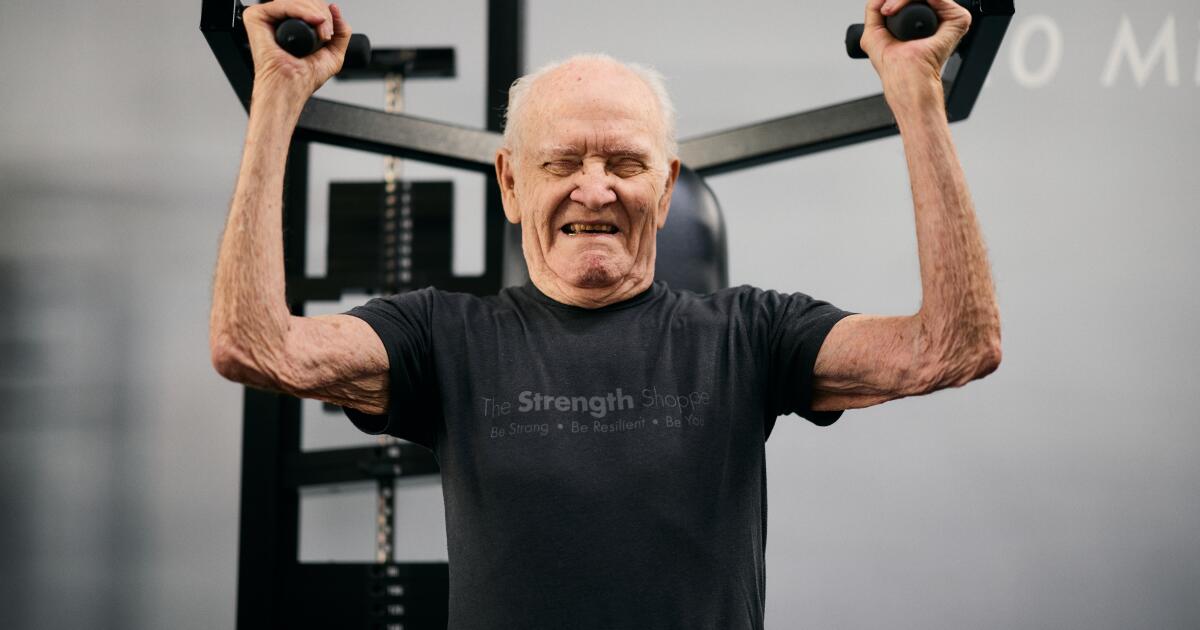
DeLoyce Alcorn is 92 years old — and pressing nearly four times that in weight at the gym.
On a recent Wednesday afternoon, Alcorn — dressed in a T-Shirt that read “Be Strong. Be Resilient. Be You.” — slid into the leg press machine, which was set at a whopping 312 pounds. He gripped the handlebars, closed his eyes and “got zen,” as he says. Then he pressed his legs forward very slowly.
“Slower, slower, smoooooth ….” urged his his trainer, standing by his side.
The retired aerospace engineer, who lives in Sierra Madre, did about four reps before his teeth clenched, his legs trembled and he let out short puffs of air through pursed lips. The exercise was just one minute and thirty-three seconds long. When it was over, Alcorn sprung to his feet, beaming triumphantly.
“I used to do 400 pounds!” he boasted. “But the COVID, it put me back. I’m working my way back.”
Alcorn was in the midst of his weekly workout at the Strength Shoppe in Echo Park, where he and his wife, Patricia Alcorn, 88, have been training for 12 years. They’re devotees of an exercise called slow-motion strength training. Often referred to as SuperSlow or Power of Ten, the resistance training technique involves lifting weights very slowly and methodically, with 10 seconds each spent on the lifting and lowering motions of the exercise. Doing so eliminates momentum and is therefore easier on the joints and connective tissue — one reason many fans of slo-mo training are in their golden years.
Patricia Alcorn, 88, works out with her trainer, Melinda Hughes, at the Strength Shoppe.
(Marcus Ubungen/Los Angeles Times)
The workout is typically done using MedX equipment, weight machines that were developed in the 1980s for rehabilitative purposes. They’re still used in physical therapy clinics, hospitals and gyms around the country.
Recently, strength training has become a hot topic in the world of exercise, in part because research continues to show its benefits for health and longevity. It builds muscle strength and bone density and is good for cardio metabolic health, especially for women. But slow-motion strength training, in particular, is beneficial for older exercisers, people healing injuries or those who are new to or returning to exercise because the slow cadence and focus on form — always with one-on-one supervision — reduces the chance of injury.
The method has also caught the attention of the wider exercise community because of its efficiency: a slow-motion workout is just 20 minutes long, once a week. It shouldn’t be done more than that, so the body has time to recover, says Melinda Hughes, co-owner of the Strength Shoppe. Slowing down the movement, eliminating momentum and not stopping to rest during an exercise set puts the muscle under greater tension for a longer period of time, forcing it to work harder, so exercisers may see greater benefit in less time compared with traditional strength training. Muscles typically fatigue from the exercise in just one to two minutes.
“Whereas traditional strength training takes three times the amount of time, with more reps and sets,” Hughes says, “and you don’t get to the level of intensity that you do with slow-motion strength training, where you just do one set to failure.”

Lai-San Ho on the rowing torso machine at the Workout Revolution with trainer Lorena Ortiz.
(The Workout Revolution )
“It’s only 20 minutes. I can go on my lunch break!” says Lai-San Ho, a 33-year-old TV editor. She started slow-motion strength training at the Workout Revolution in Studio City after tearing her ACL in 2022 — it provided a low-impact way to exercise while recovering. But she stuck with it to stay fit.
“I could tell I was getting stronger in all areas of my body,” Ho says. “I’ve noticed certain aches and pains in my upper back, after a year, went away. I can’t imagine not doing it because I feel so many benefits.”
Jason Zaremski, a sports medicine physician at the University of Florida, says the technique is “legit, the real thing.”
“Any weight training is great for older individuals, but this routine reduces risk of injury while still gaining benefit,” he says. “There’s no jerky motions or throwing of weights. And it can increase your circulation — you get greater blood flow while activating your muscles. So you’re adding a cardiovascular benefit for something that’s typically anaerobic.”
Even so, other experts are skeptical about the technique.
“Sets going to failure, with a long time under tension, is a very uncomfortable, unnecessarily painful workout,” Casey Johnston, author of the weightlifting newsletter “She’s a Beast,” said. “It’s not necessarily more effective. So much of lifting is about coordination, neuromuscular activity in your body and stabilization and that’s not present using machines the way it is with free weights.”
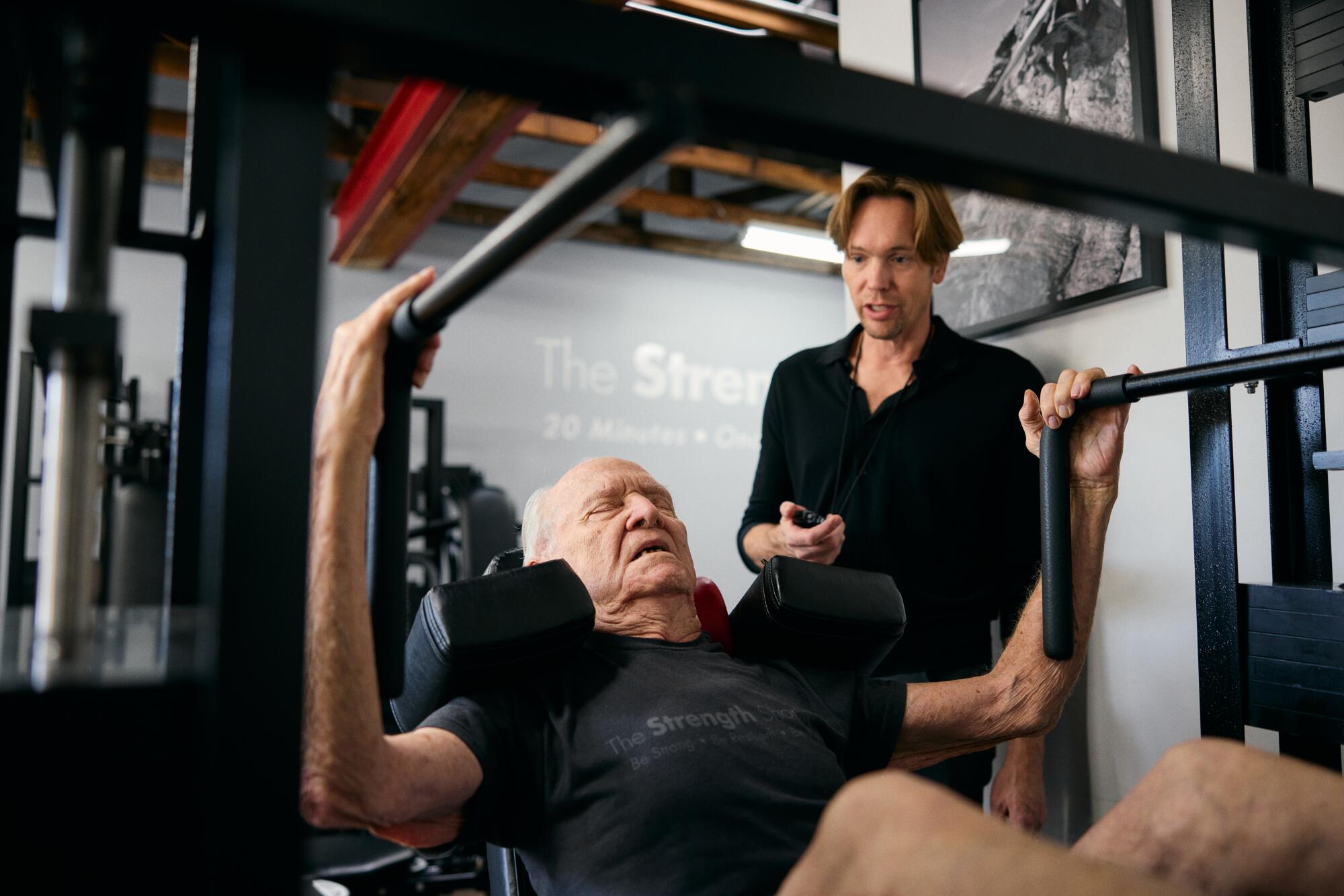
DeLoyce Alcorn and his trainer, Arjen van Eijmeren, at the leg press machine.
(Marcus Ubungen/Los Angeles Times)
There are about a dozen boutique fitness studios in L.A. that specialize in slow-motion strength training, as well as larger chains like the Perfect Workout. Though many of them have been around for decades, momentum around this subset of exercise picked up during the COVID-19 pandemic, Hughes says, adding that by 2022, the Strength Shoppe had doubled its staff at both its Pasadena and Echo Park locations and this month opened a Mid-City location. While gyms and fitness studios closed during early stay-at-home orders, many slow-motion strength training studios remained open because they offered an essential rehabilitative service: weight-bearing physical therapy for pain management, osteoporosis and other conditions.
Word got out. Then, after restrictions lifted, those looking for in-person studios with strong COVID protections found their way to slow-motion strength training. The environment of a typical studio is quieter and more intimate than a bustling gym. No more than two clients and their trainers are typically allowed in the space at once. The temperature is set at a chilly 68-70 degrees, because body heat rises with such strenuous exertion. There are typically no group classes offered and no music over the loudspeakers.
“It’s so absolute attention can be paid to form and alignment,” Hughes says, adding that her clientele ranges from age 12 to 93. “I, and other trainers who work with this, call it ‘the fountain of youth.’ We lose muscle and bone density as we age. It’s cumulative. When you gain — or regain muscle mass — you feel younger, your body is more supported.”

Melinda Hughes and Arjen van Eijmeren, owners of the Strength Shoppe.
(Marcus Ubungen/Los Angeles Times)
At SuperSlowLA in Brentwood, which opened 25 years ago, the clientele ranges from age 15 to 89. But the studio specializes in the health of postmenopausal women, who make up 80% of its business (90% of its clients are female).
“Women get osteoporosis and osteopenia and other related health issues because of hormonal changes,” says owner Benjamin Fisher. “A lot of our clients are afraid of walking down the street and breaking a hip. The methodology of what we do, we keep bone loss at bay. We give them the strength to be more active and independent.”
Leona Katz, an 80-year-old attorney who has been training at SuperSlowLA for five years, calls the results “miraculous.”
“I was very overweight and had hip problems and blood pressure problems,” Katz says. “After my husband passed away, I made some life changes and lost more than 100 pounds. My kids call me Leona 2.0.”
At Myogenics Fitness, which opened in West Hollywood in 1998, the atmosphere is clean, simple and functional. Occasionally the studio will play white noise to help exercisers focus. Trainers coach clients on how to keep their breathing open and fluid while they lift.
“A lot of people compare it to mediating,” owner Chad Morris says of the workout.

Marty Waldman, 96, performs pull-downs at Myogenics Fitness.
(Carlin Stiehl/For The Times)
Marty Waldman, 96, has been training at Myogenics for about six years, which has been “very gratifying but also exhausting” as a nonagenarian, he says. He was a runner, skier and long-distance biker when he was younger, and is in relatively good shape today but for a heart condition and “two bad knees and shoulders.” But the retired businessman began slo-mo strength training because he wanted to feel stronger.
“It’s allowed me to do things I wouldn’t ordinarily do,” he says. “We just got back from a rigorous trip with the gorillas in Rwanda — there’s no way I could have done that if I hadn’t been in reasonably decent shape.”

Chad Morris, owner of Myogenics Fitness, holds a stopwatch while training Marty Waldman, 96.
(Carlin Stiehl/For The Times)
Though slow-motion strength training has delivered clear results for many of its participants, those results come with a price: Sessions must be done with a trainer and typically cost between $80 and $100, so that a month’s worth of sessions are more than a monthly gym membership.
There are safety precautions too.

Marty Waldman’s progress is recorded on his workout chart at Myogenics Fitness.
(Carlin Stiehl/For The Times)
“You can’t do the same amount of weight that you’d do with a traditional routine,” says sports medicine physician Zaremski. “You may have to drop the weight because your muscles will fatigue quicker — they’re under tension for a longer period. Your form also needs to be especially accurate.”
Still, devotees say the cost is worth it.
“You cannot put a price on health,” says Blake Boyd, a 58-year-old actor-producer and former fitness trainer who came to the Strength Shoppe six years ago after having been diagnosed with arthritis in his neck. “It’s effective, it works. I’ll do it for the rest of my life.”
Rick Staddon, owner of Vitality Personal Training in Calabasas, says his clients comment that getting stronger has been a game-changer.
“I often hear: ‘I can carry groceries up the stairs now,’ ‘I can cut the grass,’ he says. “The simple things are very meaningful for a lot of people.”
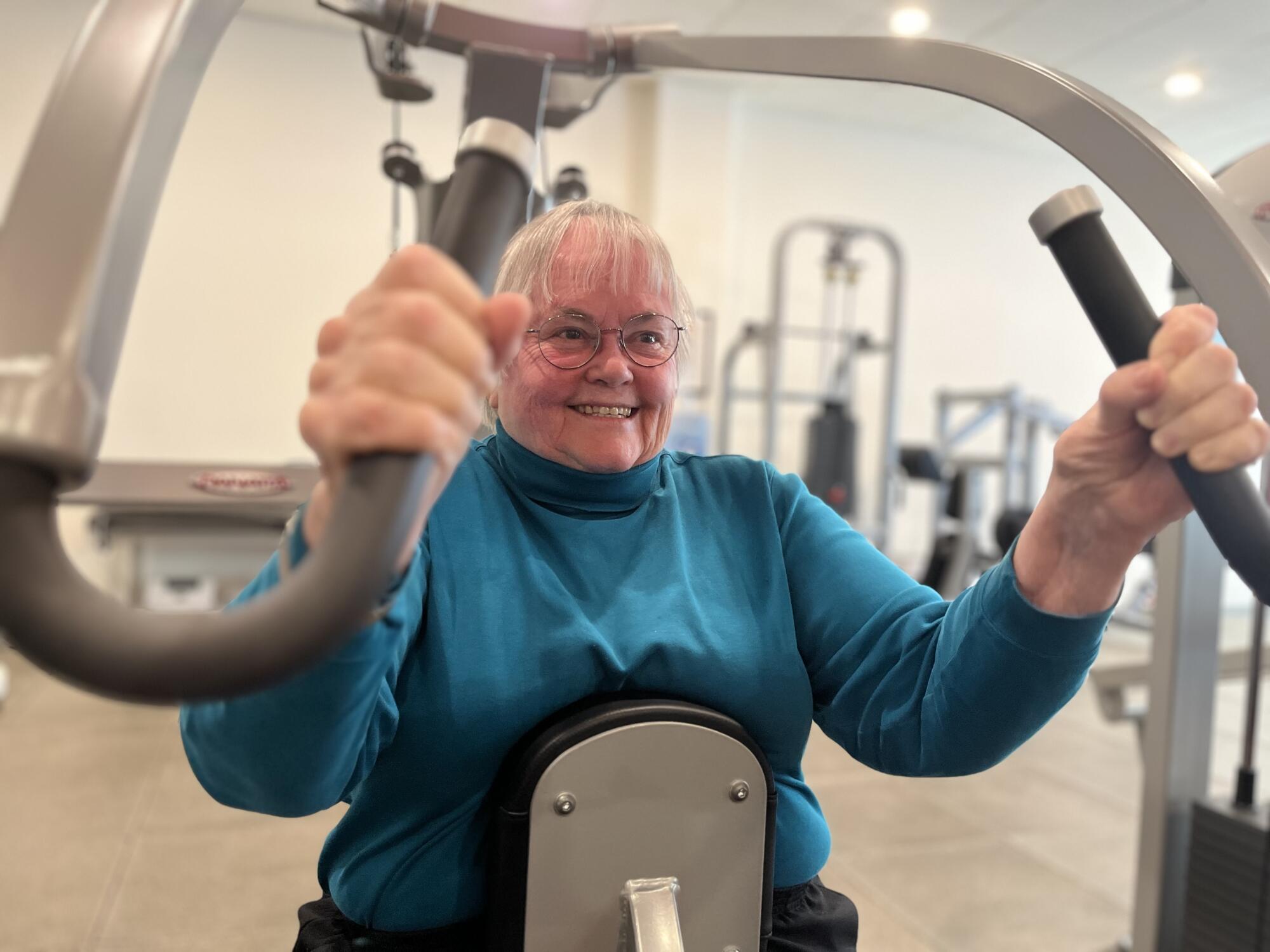
Alanna Kathleen Brown lifts weights at Pure Strength in Studio City.
(Deborah Vankin/Los Angeles Times)
For Alanna Kathleen Brown, an 80-year-old retired English professor, slow-motion strength training has turned her into a “walking miracle,” she says, climbing onto the seat of the High Row machine at Pure Strength in Studio City.
“I have osteoarthritis, I deal with obesity, I have blood pressure issues and GERD,” Brown says. “But I do weights. I’m strong. I’ve avoided surgeries.”
Then she lifts and lowers the weight very slowly until her cheeks are flushed pink.
“For me, doing slow weights is right up there with paying all the bills,” she says. “I’d give up a lot of things before I’d give this up. Because it’s quality of life — and independence.”


new video loaded: NASA Announces Artemis III Crew
transcript
transcript
NASA Announces Artemis III Crew
NASA announced the crew of Artemis III mission, which will fly to low-Earth orbit to test rendezvous and docking maneuvers with one or two lunar landers.
-
“I am excited to welcome you as the next crew in the Artemis journey to successfully return to the moon — this time to stay.” “I’m honored by the role that I’ve been given. I’m also very humbled by the task in front of us. But first and foremost, I’m grateful.” “So with that, the Artemis II crew, comrade, hands you the baton. You got the controls.” “As you know, we had a significant anomaly at our Launch Complex 36A on May 28. We’ve redoubled our efforts and are moving forward.”
By Alisa Shodiyev Kaff
June 9, 2026
Science
Santa Monica Mountains’ last steelhead trout survived the Palisades fire — and even had babies

Scientists feared the Santa Monica Mountains’ last remaining steelhead trout were dead, smothered by debris flows unleashed by the Palisades fire.
But the endangered fish surprised them: A team of biologists recently spotted 30 of the rare trout — and 21 babies — in Topanga Creek.
“There was a lot of happy dancing in the creek,” said Rosi Dagit, principal conservation biologist for the Resource Conservation District of the Santa Monica Mountains, which works with public and private landowners to conserve natural resources.
That’s because the steelhead here are endangered, at both the state and federal levels. Once, they swam in most streams of the Santa Monicas, but their numbers plummeted amid overfishing and coastal development. Increasingly frequent wildfire has further stressed their habitat. Topanga Creek, a biodiversity hot spot, is home to their last known population in the mountains that stretch from the Hollywood Hills to Point Mugu in Ventura County.
The trout that were spotted, including this one, are part of a distinct Southern California population that’s listed as endangered at the state and federal levels.
(RCDSMM Stream Team)
The California Department of Fish and Wildlife spearheaded a complex mission to rescue trout threatened by the Palisades fire that sparked in January 2025.
Time was of the essence. The fire hadn’t yet been fully contained. But rain was on the way, which would sweep massive amounts of sediment from the denuded hillsides into the water. Fish are often killed this way.
Crews stunned the fish with electricity, scooped them up in buckets, trucked them to a hatchery and ultimately moved them to Arroyo Hondo Creek in Santa Barbara County.
Within days, Topanga Creek was choked with mud. Some assumed the fish left behind were goners.
But in March, the conservation district’s team found four. The following month, when water conditions were clearer, they saw more.
“These fish continue to amaze me,” said Kyle Evans, environmental program manager for the state Department of Fish and Wildlife, who had seen the damage to the creek. “I had seen populations get wiped out in similar situations. So when I heard, I was thrilled.”
Evans surmises the fish that survived were in an area of the creek where less charred material and sediment were swept in.
“These fish likely hunkered down, were hiding under some rocks or places to try to get away from the main concentration of flow,” he said. “And luckily they weren’t buried.”
The ones that were spotted were fairly small, around 6 to 14 inches. Rainbow trout and steelhead trout are the same species, but with different lifestyles. If the fish remain in freshwater, they’ll be considered rainbows. However, they can migrate to the ocean and become steelhead, where they typically grow larger before returning to their natal waters to spawn.
Topanga Creek hasn’t fully recovered from the damage it sustained, but scientists say it’s looking better. Surveys last year were “so depressing,” Dagit said, with very few animals, and stretches that were essentially transformed into flat roads from all the sediment buildup. Some of the riparian canopy burned right down to the creek.
Then came 32 inches of rain over the last nine months, scouring out and moving sediment, creating deeper pools. Dagit said they recently found newt egg masses for the first time in years, as well as a few adult newts and many frogs. Plants that provide cover are starting to recover.
She provided photos comparing certain pools last year and this year, some dramatically transformed. In September 2025, the Shrine Pool could have been an overgrown hiking trail. This April, it was filled with shallow water.

The Shrine Pool in September 2025, left, and the same location in April 2026, right, with RCDSMM’s Isaac Yelchin donning a wetsuit.
(RCDSMM Stream Team)
Topanga Creek is home to another endangered fish, the small but hardy northern tidewater goby, often described as cute. Not long before the trout operation, Dagit led a rescue of hundreds of these fish too. Many were repatriated to the lagoon at the mouth of the creek in a moving ceremony last June.
There’s still the matter of what to do with the trout that were moved to Santa Barbara County last year. Evans would like to bring them home to the Santa Monicas at some point, but isn’t sure if it will happen. On one hand, they could bolster the small, genetically isolated surviving population. On the other, they might inadvertently bring in a disease or bacteria. There is some time to decide. Evans estimates the creek still needs to recover for two to three more years.
For now, the fish are functioning fine in their adopted creek. Experts worried the trauma wrought by the move would disrupt their spawning process, but they had babies that spring. This year, they spawned again.

The Pacifica Municipal Pier was shut down and taped off Thursday after city workers noticed cracks running through the landmark structure and concrete chunks falling into the ocean.
It’s just one of many coastal California structures that have recently crumbled under pressure from a rising and relentless ocean.
Officials from the small, beach city south of San Francisco said the pier was closed due to “cracking, separation, and displacement of the concrete walkway and structural elements.”
It will stay closed while structural engineers asses its safety.
Photos taken by city employees show a wide crack that runs from top to bottom and across the structure as well. Other photos show a large horizontal crack under the foundation of a small restaurant on the pier, the Chit Chat Cafe.
The cafe was also shut down.
This is not the first time the 53-year-old pier has shown signs of stress. In 2021, part of it was shut down after handrails along the edge collapsed. And in 2023, after a series of storms pummeled the Central California coast, damaging parts of the pier, the structure was partially closed for more than year.
Those same storms caused extensive damage in Aptos and Capitola, 70 miles south, where piers and waterfront infrastructure were swept away or damaged.
In 2024, a 150- to 180- foot section of the Santa Cruz wharf was ripped off by powerful waves.
At least 10 of the state’s dozens of coastal public piers were closed for part or all of 2024 due to structural damage sustained in winter storms since 2022. At least five others have longer-term upgrades planned to address structural issues.
“These things are costly to maintain,” said Zach Plopper, senior environmental director at Surfrider. “They are a part of our California coastal culture in many ways, but we’re going to need to reckon with, one, the state that they’re in, and two, the continuous and worsening threats they’re going to experience,”
He said most of the piers were constructed in the early 1900s, and they weren’t built to withstand decades of rough seas, storms and rising sea level.
“With this incoming El Niño, which is forecasted to be significant, and this marine heat wave we’re in the midst of, we’re kind of in uncharted waters as far as what this winter could bring in terms of storms and swells to the California coast, and we’re likely going to see a lot more damage,” he said. “Not just piers, but roads and other coastal infrastructure up and down the state.”
There was no storm in Pacifica earlier this week, so no single event could be blamed for the destruction.
However, a 2025 report from an outside engineering firm, GHD, found that several sections of the pier were in “poor” or “serious” condition, and they recommended closure before anticipated storms or events that could “subject the piles to high winds, swells and large waves.”
The firm found several areas of the pier where concrete was missing and rebar was exposed and corroding.
“The pier has continued to experience high winds and large waves in a harsh marine environment,” the engineers wrote in the report, noting that continuous exposure to seawater or marine spray was “detrimental” to the structure.
A 2023 city report estimated it would cost $19 million to repair.
That same year, a state law was enacted to require local governments along the California coast to plan for sea level rise in the coming decades.
Sea level has risen some 8 inches, on average, along the coast in the past 150 years, Plopper said, and researchers anticipate another foot in the next 25 years.
“We’re going to see profound shifts on our coastline, none that we have ever experienced before, and building static structures on the coast just doesn’t work all that well,” he said. “We’re going to have to make some really hard decisions.”
-
News1 second ago
July 1 brings big student loan changes. Here’s what you need to know
-

 Los Angeles, Ca1 hour ago
Los Angeles High School locked down as police search for armed juvenile
-

 Detroit, MI2 hours ago
‘Diarra From Detroit’ sets date for second season on Paramount+
-

 San Francisco, CA2 hours ago
San Francisco police release video of shootout that critically wounded officer
-

 Dallas, TX2 hours ago
3 Dallas educators among FIFA World Cup volunteers
-

 Miami, FL2 hours ago
Miami Gardens man arrested after fleeing Florida Keys deputies at 125 mph, sheriff says
-

 Boston, MA2 hours ago
Boston gives update on plans for 3 a.m. last call at bars, outdoor drinking areas during World Cup
-

 Denver, CO2 hours ago
One Invitation Can Change a Life: Called By Name Campaign Inspires Future Priests For a Second Year in Denver

