Science
Is bird flu in cattle here to stay?

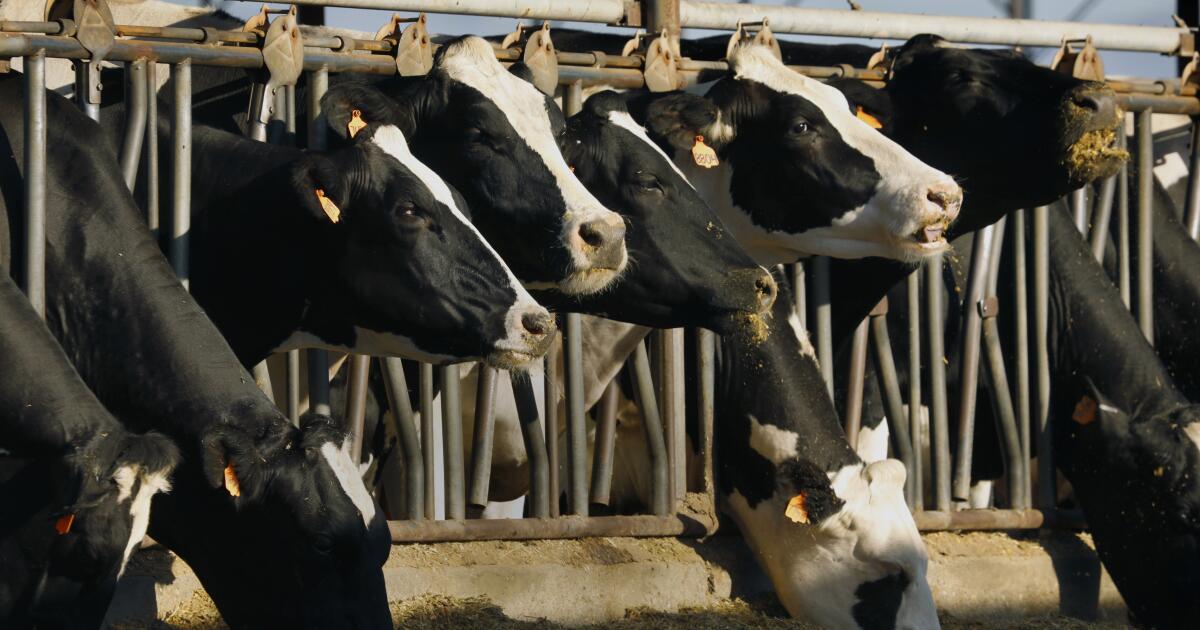
Despite assurances from the federal government that bird flu will be eradicated from the nation’s dairy cows, some experts worry the disease is here to stay.
Recently, Eric Deeble, USDA acting senior advisor for H5N1 response, said that the federal government hoped to “eliminate the disease from the dairy herd” without requiring vaccines.
Since the disease was first publicly identified in dairy cattle on March 25, there have been 129 reports of infected herds across 12 states. In the last four weeks, there has been a surge — jumping from 68 confirmed cases on May 28 to nearly twice that many as of June 25. There are no cases in California.
So far, however, the dairy industry has proved reluctant to work with state and federal governments to allow for widespread testing of herds.
To some epidemiologists, this lack of close herd surveillance is a problem. They worry that the virus is spreading unchecked among dairy cows and other animals, and has taken up permanent residence.
David Topham, a professor of microbiology and immunology at the University of Rochester’s Center for Vaccine Biology and Immunology, said he considers H5N1 to be “endemic in animals in North America” — citing its prevalence in wild bird populations as well as its long staying power in domestic poultry.
No one knows how widespread it is in cattle, Topham said, because testing has largely targeted symptomatic cows and herds. “But I suspect the closer we look, the more we’ll find, and I don’t know if we’re going to cull our entire cattle herds and start over again.”
Topham said he understands the industry’s reluctance to permit government scientists onto farms “because we’re going to want to see everything, and we’re going to report everything that we see, and that might be bad for business. … But until we have all that information, I don’t think we will have control.”
Federal officials have announced a pilot bulk milk testing program that includes Kansas, Nebraska, New Mexico and Texas. Farmers in these states can voluntarily enroll to have bulk milk samples tested for the virus. If their samples test negative for three weeks, they will be able to move their herds across state lines without additional testing — something they are currently unable to do.
So far, only one herd in each state has signed up.
A USDA “strike force” investigated 15 infected Michigan dairy herds as well as eight turkey flocks in early April. It worked with the state of Michigan as well as individual farmers.
The investigation was launched after local researchers identified a “spillover” event that went from infected cattle to a nearby poultry plant. The state — and farmers — wanted to know how it happened.
What the team found suggests the “control” Topham referred to may be elusive.
From surveys and observations, they found that cats and chickens were free to walk around without containment — potentially migrating between nearby dairies and poultry farms. Some of these animals had become infected; several died.
Asked about their practices regarding isolation of newly introduced cattle, three out of 14 farms said they always isolated, another three said they never isolated, and the remainder didn’t respond.
Then there was the dumping of unpasteurized, contaminated milk into the open waste lagoons on several of the farms. And the feeding of non-pasteurized milk to calves on three farms. Or the potentially contaminated manure that was stored, composted or applied to nearby fields. In one case, a farmer reported they had sold or given away potentially contaminated manure.
Finally there was the issue of humans: On every farm, there were visitors, carcass removal companies, milk suppliers, veterinarians and employees — many of whom traveled between farms.
For instance, of the 14 dairies that reported information about their employees, three had employees that worked at other dairies, one had employees that worked at a poultry farm, and one had an employee who also worked at a swine farm. At four dairies, some of the employees were reported to have their own livestock at home.
As the authors reported, “transmission between farms is likely due to indirect epidemiological links related to normal business operations … with many of these indirect links shared between premises.”
They noted there was no evidence to suggest waterfowl had introduced the virus to the Michigan herds.
Michael Payne, researcher and outreach coordinator at UC Davis’ School of Veterinary Medicine Western Institute for Food Safety and Security, said there was no one to blame for the lack of containment.
He said in the weeks and months before the disease was identified in cattle, researchers from across the nation scrambled to figure out what was happening to dairy cows in Texas that appeared listless and had diminished milk production.
“It’s not like people weren’t aware or concerned and trying to figure it out,” he said. And then once it was identified, and it didn’t seem to cause too much illness in cows or transfer to humans quickly, while there was urgency, the system fell into a series of “incremental” solutions — negotiated among dozens of federal and state agencies.
He and Topham agree that no one can say for sure what the virus will do — and where it will go — next.
If it becomes endemic in cattle and is renamed “bovine influenza,” vaccines are likely to follow, as well as continuous surveillance and testing of dairy products.
Topham said that the biggest concern among epidemiologists now is how the virus will evolve as it continues to move — largely unabated and undetected — through cattle herds, resident farm animals and people.
There have been three human cases of H5N1 in U.S. dairy workers since March.
One key worry is that the virus may move with a dairy employee onto a small farm and then recombine inside a pig, dog or cat that is harboring another flu virus.
He and Payne agree that officials need to remain alert to signs that the virus is adapting in ways that could hurt humans.
Wastewater is one way to detect the location of the virus.
As of Tuesday, data from the academic research organization WastewaterSCAN show that levels of H5 influenza have been rising in wastewater samples from a facility in Boise, Idaho.
Asked about whether the region’s health department was investigating, or if there was any idea where the H5 was coming from, Surabhi Malesha, communicable disease program manager at Central District Health in Idaho, said there was no way to know if the H5 signal was from H5N1 or another influenza subtype.
She said testing for H5 in wastewater had only recently started and therefore “there is no way to compare this data from last year or the year before, and so we don’t know what a baseline detection of H5 looks like.”
“Maybe we see H5 detections like this on a regular basis, and it is not of public health significance or importance. … How do we define normalcy when we have nothing to compare the data to?”
She said the findings were “not a public health concern” and her agency and the state “do not need to really investigate into this, because this could be H5N1, or could be any other H5 strains, and it really does not affect the public in general.”
Dennis Nash, distinguished professor of epidemiology and executive director of City University of New York’s Institute for Implementation Science in Population Health, said that given the current situation, the wastewater sample should be considered H5N1 “until proven otherwise. The only other H5 we know about is H5N2. And a man in Mexico City just died from that.”
Nash said health officials should be trying to determine the source of the virus found in the wastewater: a nearby dairy herd, a milk processing site or raw milk that was dumped down the drain.
Idaho has reported 27 infected herds, although according to Malesha, none has been reported in the Central District.
“You want to do everything you can to prevent these types of viruses from emerging, because once they do, we don’t have a whole lot of control over them,” Topham said. “Because when the horse is out of the barn, it’s gone. So I think the question is, what do we need to do to keep this in check?”


Last summer, a NASA-funded asteroid impact warning system detected a mysterious object speeding through the solar system.
Scientists determined the object had entered the solar system from deep space, making it the third known object to have come from another star system.
NASA called it Comet 3I/ATLAS and said it didn’t pose a threat. But its discovery in July led to wild speculation that the object was a piece of extraterrestrial technology — maybe even an alien spacecraft.
The SETI Institute, a nonprofit that explores the origins of life and searches for extraterrestrial intelligence, said this week that a team of scientists had used a radio telescope to try to detect signals that could indicate extraterrestrial life on the comet.
But they found none.
“While observations strongly indicate that 3I/ATLAS is a natural object, interstellar visitors are also compelling technosignature targets because an artificial object — however unlikely — could represent detectable extraterrestrial technology and potentially provide the first evidence of life beyond Earth,” the institute said in a news release.
SETI scientists said they used the Allen Telescope Array at the Hat Creek Radio Observatory in Northern California to scan the object for seven hours, covering a spectrum of 1 to 9 gigahertz.
“This broad range allows scientists to search for narrowband radio signals, which are not produced in nature and would be evidence of technology,” the news release said.
The institute said the team identified nearly 74 million narrowband signals, but ultimately traced them back to technology on the Earth’s surface or orbiting satellites.
“The results from 3I/ATLAS show how realistic it is to detect a signal with the technology we have today,” said Valeria Garcia Lopez, one of scientists on the SETI team. “That is why it is important to keep searching for technosignatures, even from objects we might not expect to have signals.”
The institute said the researchers also can learn more about the natural properties of interstellar objects as they travel through our solar system.
“As more interstellar objects are discovered, each offers a new opportunity to probe the cosmos for technosignatures, advancing our understanding of both natural and possible technological phenomena beyond our Solar System,” the SETI statement said.
Science
Emergency room visits during heat waves available to the public in ‘near-real time’ in L.A. County

For the first time, Los Angeles County residents can see how many people are ending up in emergency rooms, their bodies pushed past the limit, during heat waves.
The county Department of Public Health says its new Heat-Related Illness and Mortality Dashboard will provide heat illness counts in “near real time,” which means weekly. That might seem like a lag, but until now the data were only provided upon request and in ad hoc reports.
Heat is the leading cause of weather-related death in the United States and heat waves are only getting more frequent and intense as the climate changes.
Public health experts called the tracker a meaningful step toward assessing how well county programs are addressing heat risks.
“It’s showing the county’s commitment to reducing the burden of heat on people’s health,” said David Eisenman, director of UCLA’s Center for Public Health and Disasters. “As the county puts more resources into that, this is a metric that allows the public to judge the effectiveness of the work.”
“There’s a handful of other places that also do this, but they’re all relatively new,” said Bharat Venkat, director of the UCLA Heat Lab, noting as examples Imperial and Riverside counties in California, Harris County in Texas and Maricopa County in Arizona. “It is very much welcome.”
The tracker takes heat illness data from patient complaints and doctor diagnoses provided by a countywide monitoring project that was previously available only to public health officials. The website says that what it provides is an undercount. The records often fail to count people when heat exacerbates more obvious health problems.
“Heat piggybacks off of preexisting health conditions,” Venkat said. “Say you go to the ER and you’re experiencing an intense psychotic episode, or a heart attack or a stroke. It’s very likely that the doctor is going to diagnose that as a psychotic episode, heart attack or stroke, and less likely that they’ll note that heat is contributing to that.”
Heat-related deaths are counted from death certificates, which present similar issues for undercounting. Those numbers will be reported monthly on the dashboard.
L.A. County has a recently approved heat action plan that aims to educate the public and reduce indoor and outdoor temperatures with strategies such as opting for shade and air conditioning.
The new tracker breaks down daily heat-related emergency room visits and deaths by age group, geography, and race and ethnicity.
It shows that people over 65 are more vulnerable to heat illness. For Black residents, heat is disproportionately fatal. And people in the San Fernando, San Gabriel, and Antelope valleys see the most heat-related emergency room visits.
Kelly Turner, a professor of urban planning at UCLA, stressed that heat sickness tracks closely with social inequality and is preventable.
“A heat death or heat illness is dependent on who you are and what assets you have,” Turner said. “If you have air conditioning or not, if you work outside or you don’t, all of those factors factor in.”
She noted that there is more risk in the San Fernando and San Gabriel valleys because of the combination of hotter days and more people who are unprotected. “When you map those two things on top of each other, you get a hot spot of vulnerability,” she said.
California already has a tool called CalHeatScore that uses historical hospital records and temperatures to forecast risk for different ZIP Codes in the state during heat events.
Public health officials hope to use the new dashboard to target messaging and public outreach when extreme heat strikes.
“If we’re having an extended heat event we can show that, ‘Hey, we’re having heat impacts’ as they’re happening,” said Dr. Nicole Quick, chief science officer at the L.A. County Department of Public Health.
Venkat said he would like to see the tool become more robust, in line with Maricopa County’s dashboard, widely viewed as the current gold standard for heat illness and mortality tracking. He said the Arizona county, which includes Phoenix, dives deeper into health records and conditions surrounding hospitalizations and deaths to better reflect the role of heat.
“They do scene investigations and send someone out to take notes about where the body was found,” Venkat said. “What was going on? Did they have air conditioning? Were they outside? Did they have access to water? What medications were they taking? All those things provide important context.”
Eisenman said he would like to see the county train physicians on recording heat-related illness, as it has been “clear for a long time” that doctors don’t make the diagnosis enough.
“It would have to be more than just a handout or a few slides. You’d really have to have each institution make some effort to change physicians’ behaviors,” Eisenman said. He added that it probably hasn’t been done because of the costs involved.

Facing higher premiums and the loss of federal subsidies, 374,000 people with health insurance from the state marketplace known as Covered California canceled their coverage in the first three months of the year, according to government statistics.
The cancellations amount to 19% of those who had renewed their policies on the state marketplace during open enrollment, state officials said. Those cancellations are higher than in the past three years when they ranged from 13% to 15% of those who renewed.
Jessica Altman, executive director of Covered California, attributed the jump in cancellations to the expiration of enhanced federal subsidies that caused the cost of a plan to leap for most middle-class Californians.
“We expect coverage losses to increase through the year,” she said.
Overall, Covered California had 1.8 million enrollees in February, down from 1.94 million the year before — a decline of 7%.
Altman said monthly enrollment numbers are delayed because consumers have a three-month grace period to resume their premium payments before the insurance carriers end their coverage for nonpayment.
This year, many middle-class Californians who depend on the state-run insurance marketplace created under the Affordable Care Act faced annual costs that were hundreds of dollars higher than last year because of the end of enhanced federal subsidies that began during the COVID-19 pandemic.
In 2021, Congress voted to temporarily boost the amount of subsidies Americans could receive for an ACA plan.
The law also expanded the program to families who had more money. Before that 2021 vote, only Americans with incomes below 400% of the federal poverty level — currently $62,600 a year for a single person or $128,600 for a family of four — were eligible for ACA subsidies. The 2021 vote eliminated the income cap and limited the cost of premiums for those higher-earning families to no more than 8.5% of their income.
On top of the loss of the enhanced federal subsidies, the average premium charged by insurers this year for a Covered California plan rose by more than 10% because of fast-rising medical costs.
The decline in ACA plan enrollees, however, has been greater in some other states. California has tried to keep people insured by using state tax money to fill in the gap for lower-income families.
This year, the state budgeted $190 million for premium subsidies for people with incomes of up to 165% of the federal poverty level.
In his budget plan, Gov. Gavin Newsom proposed spending $300 million on those state subsidies in 2027. That would expand the subsidies to enrollees with incomes up to 200% of the federal poverty level, or $31,920 for an individual or $66,000 for a family of four.
“We may actually see a number of Covered California enrollees paying less in 2027” because of the additional state subsidies, Altman said.
In May, Newsom also proposed in his budget that an additional $27 million in state money be used to help enrollees pay for the cost of gender-affirming care. That amount is an increase to the $30 million that he earlier proposed be spent this year and next to defray those costs for Covered California enrollees, according to state officials.
Last year, federal health officials enacted a rule that said the federally subsidized ACA plans could no longer cover gender-affirming care because it was no longer considered an “essential health benefit.”
Newsom’s proposed budget still faces debate in Sacramento and approval by the state Legislature.
The state marketplaces, created by the Affordable Care Act, also known as Obamacare, were meant to help those who don’t have access to an employer’s health insurance plan and have incomes too high to qualify for Medi-Cal, the government-paid insurance for the poor and disabled.
Because of the higher cost this year, more people are choosing the lower-priced Bronze plans. Those plans have higher co-pays and deductibles than the more expensive plans.
“We’re very concerned with the large shift to Bronze,” Altman said. “When you have higher cost-sharing, you’re more likely to defer care.”
-

 Atlanta, GA2 minutes ago
Suspect on the run after ‘targeted’ shooting on MARTA train, police say
-

 Minneapolis, MN9 minutes ago
Minneapolis will pay $1.4M for ‘coaching’ between mayor, council members
-

 Indianapolis, IN12 minutes ago
Saints winning streak comes to an end vs. Indianapolis
-

 Pittsburg, PA17 minutes ago
Pittsburg State Track and Field’s Blakelee Winn named National Women’s Field Athlete of the Year
-

 Augusta, GA24 minutes ago
Downtown Augusta construction accelerates as parking becomes scarce
-

 Washington, D.C27 minutes ago
New Mexico veterans return home after Honor Flight to Washington D.C.
-

 Cleveland, OH32 minutes ago
New Ohio City Farm Store Now Open
-

 Austin, TX39 minutes ago
Second New World Screwworm case confirmed in Texas

