Science
Incurable silicosis cost a countertop cutter his lungs. Are these companies at fault?

From morning to evening, six days a week, Gustavo Reyes Gonzalez spent his days cutting engineered stone, a man-made product that has become a popular choice for kitchen and bathroom countertops.
The glossy slabs resist stains, are highly durable and come in many colors. They are also rife with crystalline silica: tiny particles that can irreparably scar the lungs when inhaled.
By the time Reyes Gonzalez had reached his 33rd birthday, his lungs had been ravaged by silicosis, an incurable disease. He was forced to rely on an oxygen tank and grew thin and weak. At one point, he said, he asked God to take his life so that his suffering would end.
His doctor says the 34-year-old is only alive today because both his lungs were replaced in a transplant — and that painstaking surgery may only buy him another six years.
“We don’t know how long he has with that lung,” his wife Wendy Torres Hernandez said in a Los Angeles courtroom. In the wake of his transplant, he must take a barrage of medications, restrict his diet and keep a close eye on his blood pressure and sugar levels.
All of those measures, she said, are “going to continue until he passes away.”
In Los Angeles County, a jury will weigh a question that could reverberate through the stone industry: Are corporations that manufacture or distribute engineered stone at fault?
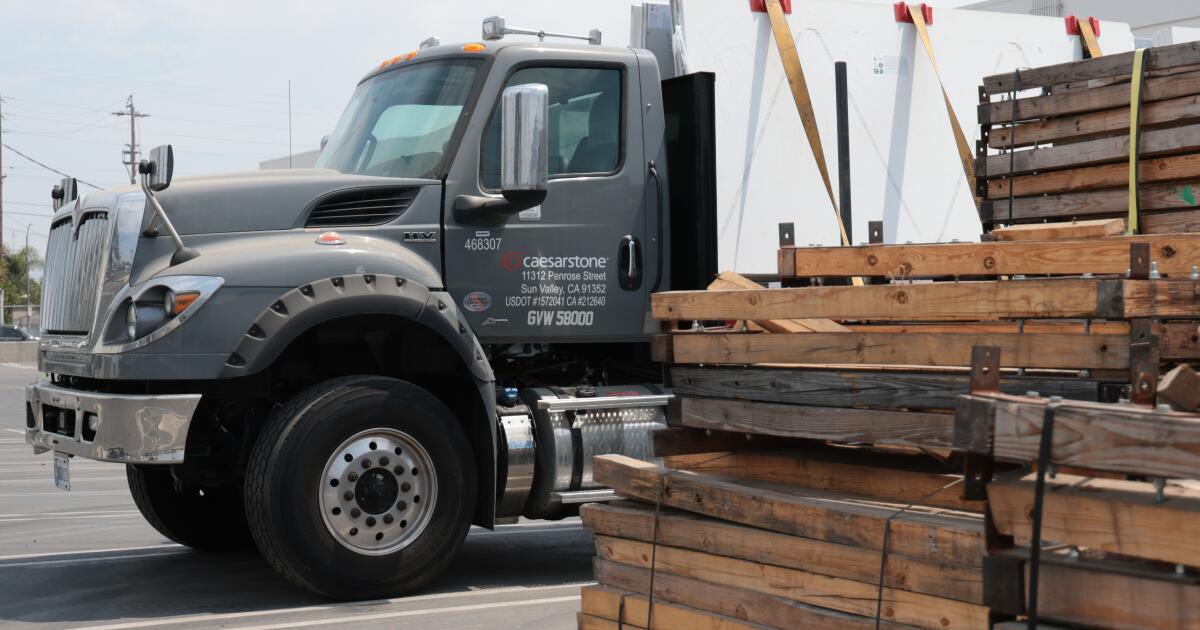
Health researchers have tied the surge in silicosis cases among countertop cutters to the booming popularity of engineered or artificial stone, which is typically much higher in silica than natural marble or granite. In California, dozens of workers with silicosis have lodged lawsuits against companies like Cambria and Caesarstone.
Reyes Gonzalez is the first of them to go to trial, according to his attorneys. The L.A. County civil case poses a test of whether companies that make engineered stone could be held responsible amid the devastating eruption of silicosis, which has killed more than a dozen countertop cutters across California in recent years.
Dr. Robert Harrison, a professor of occupational medicine at UC San Francisco who has done research on silicosis among countertop cutters, said a decision for the plaintiff would “send a message to manufacturers that they are accountable for producing a toxic product like engineered stone.”
Regardless of the outcome, Harrison said the court case “shines a spotlight on the workers behind the products that we buy.” That could bolster public awareness that “there are workers who make our products who get sick and die,” he said — and hopefully inspire new efforts to stop it.
Marissa Bankert, executive director of the International Surface Fabricators Assn., which represents businesses that cut slabs, said that “irrespective of the outcome of this case, it is essential that all companies engaged in surface fabrication and their employees are educated on, and adhere to, safety practices.”
In a trial that has stretched for weeks, lawyers for Reyes Gonzalez have argued that engineered stone manufacturers failed to give proper warnings about the dangers of their product. Attorney Gilbert Purcell called it “terribly toxic and dangerous” and “defective in design,” arguing that its risks far outweigh its benefits.
The question is, “why not eliminate this product altogether? Society doesn’t need this product,” Purcell told jurors. “It certainly doesn’t need the carnage it causes.”
Attorneys for engineered stone manufacturers countered that the blame lay with the operators of the Orange County workshops where Reyes Gonzalez worked. Such “fabrication shops” cut the slabs made by manufacturers.
“We know that this product is safe,” Cambria‘s attorney, Lindsay Weiss, said, “when handled safely.”
Reyes Gonzalez testified that he worked in a string of Orange County shops cutting slabs of engineered stone. At times, he said, the air was so dusty that it looked like fog. His mask grew “very filthy,” he testified. Even when he used water while cutting, Reyes Gonzalez said that after it dried, “a lot of dust would come off.”
Caesarstone argued in court that the company had given the shops all the information they needed to protect workers, including guidance on ventilation and wet cutting to tamp down dust. Its attorney, Peter Strotz, said what happened to the worker was a tragedy, but a preventable one.
It could have been prevented if those “who owned and operated the fabrication shop where he worked had done what Caesarstone asked them to do,” Strotz argued.
He and other attorneys representing engineered stone manufacturers sought to turn the focus to members of the Silverio family, who had paid Reyes Gonzalez for his work at the Orange County shops.
Lawyers for the worker argued the Silverios were not his employers and that Reyes Gonzalez was an independent contractor. Fernando Silverio Soto, who set up Silverio Stone Works, testified that all he knew about the dangers was what he was told: To minimize risk by wearing masks and using water while cutting.
Strotz showed the courtroom a Caesarstone form that Silverio had signed, which stated he had received safety information and an instructional movie. In court, Silverio denied having seen such materials.
Jon Grzeskowiak, Cambria’s executive vice president of research and development and process operations, said the company offers free training to stonecutters and that safety information for its products was available on its website. Fernando Silverio Soto said during his testimony that he hadn’t seen that website, nor had he gone to the Caesarstone website for such information.
“I was never told that I needed to do that,” he said of the Caesarstone website.
Defense attorneys also brought forward expert witnesses who testified that engineered stone could be cut and polished safely with the effective use of workplace safeguards. Attorneys for Reyes Gonzalez, in turn, turned to experts who disputed that measures such as masks or using water while cutting were adequate.
Among them was industrial hygienist Stephen Petty, who testified that an N95 mask was insufficient to protect a worker from the dust generated by grinding artificial stone.
Petty said even the best kind of respirator available, which supplies a worker with clean air from a tank, would not work well in the long term because it is so uncomfortable that workers tend to adjust it, breaking the seal.
Harrison of UCSF, who did not testify in the case, said it is very difficult to protect workers cutting engineered stone. “It takes a lot of money and a pretty sophisticated, knowledgeable employer with a lot of expensive machines and ventilation systems to protect workers from exposure to artificial stone dust.”
Safety regulators across the globe have grappled with the risks of engineered stone as its popularity has soared. In Australia, the government ultimately banned the artificial slabs amid a public uproar over stonecutters falling ill and dying. Workplace safety regulators there called it “the only way to ensure that another generation of Australian workers do not contract silicosis from such work.”
In California, government regulators have stopped short of a ban, instead enacting tighter rules on silica exposure in the workplace. Another proposal that would have clamped down on which businesses could perform stonecutting was held this summer by its author, Assemblymember Luz Rivas (D-North Hollywood), who said state regulators were “not receptive” to creating a tracking system for licensed shops.
Cal/OSHA officials have warned in the past that if tightening the rules does not show results, they could press forward with a ban on engineered stone. In a recent report, however, the agency said it had so far rejected the idea because a ban could fuel “the creation of illegal fabrication shops that are hidden from regulators.”


new video loaded: NASA Announces Artemis III Crew
transcript
transcript
NASA Announces Artemis III Crew
NASA announced the crew of Artemis III mission, which will fly to low-Earth orbit to test rendezvous and docking maneuvers with one or two lunar landers.
-
“I am excited to welcome you as the next crew in the Artemis journey to successfully return to the moon — this time to stay.” “I’m honored by the role that I’ve been given. I’m also very humbled by the task in front of us. But first and foremost, I’m grateful.” “So with that, the Artemis II crew, comrade, hands you the baton. You got the controls.” “As you know, we had a significant anomaly at our Launch Complex 36A on May 28. We’ve redoubled our efforts and are moving forward.”
By Alisa Shodiyev Kaff
June 9, 2026
Science
Santa Monica Mountains’ last steelhead trout survived the Palisades fire — and even had babies

Scientists feared the Santa Monica Mountains’ last remaining steelhead trout were dead, smothered by debris flows unleashed by the Palisades fire.
But the endangered fish surprised them: A team of biologists recently spotted 30 of the rare trout — and 21 babies — in Topanga Creek.
“There was a lot of happy dancing in the creek,” said Rosi Dagit, principal conservation biologist for the Resource Conservation District of the Santa Monica Mountains, which works with public and private landowners to conserve natural resources.
That’s because the steelhead here are endangered, at both the state and federal levels. Once, they swam in most streams of the Santa Monicas, but their numbers plummeted amid overfishing and coastal development. Increasingly frequent wildfire has further stressed their habitat. Topanga Creek, a biodiversity hot spot, is home to their last known population in the mountains that stretch from the Hollywood Hills to Point Mugu in Ventura County.
The trout that were spotted, including this one, are part of a distinct Southern California population that’s listed as endangered at the state and federal levels.
(RCDSMM Stream Team)
The California Department of Fish and Wildlife spearheaded a complex mission to rescue trout threatened by the Palisades fire that sparked in January 2025.
Time was of the essence. The fire hadn’t yet been fully contained. But rain was on the way, which would sweep massive amounts of sediment from the denuded hillsides into the water. Fish are often killed this way.
Crews stunned the fish with electricity, scooped them up in buckets, trucked them to a hatchery and ultimately moved them to Arroyo Hondo Creek in Santa Barbara County.
Within days, Topanga Creek was choked with mud. Some assumed the fish left behind were goners.
But in March, the conservation district’s team found four. The following month, when water conditions were clearer, they saw more.
“These fish continue to amaze me,” said Kyle Evans, environmental program manager for the state Department of Fish and Wildlife, who had seen the damage to the creek. “I had seen populations get wiped out in similar situations. So when I heard, I was thrilled.”
Evans surmises the fish that survived were in an area of the creek where less charred material and sediment were swept in.
“These fish likely hunkered down, were hiding under some rocks or places to try to get away from the main concentration of flow,” he said. “And luckily they weren’t buried.”
The ones that were spotted were fairly small, around 6 to 14 inches. Rainbow trout and steelhead trout are the same species, but with different lifestyles. If the fish remain in freshwater, they’ll be considered rainbows. However, they can migrate to the ocean and become steelhead, where they typically grow larger before returning to their natal waters to spawn.
Topanga Creek hasn’t fully recovered from the damage it sustained, but scientists say it’s looking better. Surveys last year were “so depressing,” Dagit said, with very few animals, and stretches that were essentially transformed into flat roads from all the sediment buildup. Some of the riparian canopy burned right down to the creek.
Then came 32 inches of rain over the last nine months, scouring out and moving sediment, creating deeper pools. Dagit said they recently found newt egg masses for the first time in years, as well as a few adult newts and many frogs. Plants that provide cover are starting to recover.
She provided photos comparing certain pools last year and this year, some dramatically transformed. In September 2025, the Shrine Pool could have been an overgrown hiking trail. This April, it was filled with shallow water.

The Shrine Pool in September 2025, left, and the same location in April 2026, right, with RCDSMM’s Isaac Yelchin donning a wetsuit.
(RCDSMM Stream Team)
Topanga Creek is home to another endangered fish, the small but hardy northern tidewater goby, often described as cute. Not long before the trout operation, Dagit led a rescue of hundreds of these fish too. Many were repatriated to the lagoon at the mouth of the creek in a moving ceremony last June.
There’s still the matter of what to do with the trout that were moved to Santa Barbara County last year. Evans would like to bring them home to the Santa Monicas at some point, but isn’t sure if it will happen. On one hand, they could bolster the small, genetically isolated surviving population. On the other, they might inadvertently bring in a disease or bacteria. There is some time to decide. Evans estimates the creek still needs to recover for two to three more years.
For now, the fish are functioning fine in their adopted creek. Experts worried the trauma wrought by the move would disrupt their spawning process, but they had babies that spring. This year, they spawned again.

The Pacifica Municipal Pier was shut down and taped off Thursday after city workers noticed cracks running through the landmark structure and concrete chunks falling into the ocean.
It’s just one of many coastal California structures that have recently crumbled under pressure from a rising and relentless ocean.
Officials from the small, beach city south of San Francisco said the pier was closed due to “cracking, separation, and displacement of the concrete walkway and structural elements.”
It will stay closed while structural engineers asses its safety.
Photos taken by city employees show a wide crack that runs from top to bottom and across the structure as well. Other photos show a large horizontal crack under the foundation of a small restaurant on the pier, the Chit Chat Cafe.
The cafe was also shut down.
This is not the first time the 53-year-old pier has shown signs of stress. In 2021, part of it was shut down after handrails along the edge collapsed. And in 2023, after a series of storms pummeled the Central California coast, damaging parts of the pier, the structure was partially closed for more than year.
Those same storms caused extensive damage in Aptos and Capitola, 70 miles south, where piers and waterfront infrastructure were swept away or damaged.
In 2024, a 150- to 180- foot section of the Santa Cruz wharf was ripped off by powerful waves.
At least 10 of the state’s dozens of coastal public piers were closed for part or all of 2024 due to structural damage sustained in winter storms since 2022. At least five others have longer-term upgrades planned to address structural issues.
“These things are costly to maintain,” said Zach Plopper, senior environmental director at Surfrider. “They are a part of our California coastal culture in many ways, but we’re going to need to reckon with, one, the state that they’re in, and two, the continuous and worsening threats they’re going to experience,”
He said most of the piers were constructed in the early 1900s, and they weren’t built to withstand decades of rough seas, storms and rising sea level.
“With this incoming El Niño, which is forecasted to be significant, and this marine heat wave we’re in the midst of, we’re kind of in uncharted waters as far as what this winter could bring in terms of storms and swells to the California coast, and we’re likely going to see a lot more damage,” he said. “Not just piers, but roads and other coastal infrastructure up and down the state.”
There was no storm in Pacifica earlier this week, so no single event could be blamed for the destruction.
However, a 2025 report from an outside engineering firm, GHD, found that several sections of the pier were in “poor” or “serious” condition, and they recommended closure before anticipated storms or events that could “subject the piles to high winds, swells and large waves.”
The firm found several areas of the pier where concrete was missing and rebar was exposed and corroding.
“The pier has continued to experience high winds and large waves in a harsh marine environment,” the engineers wrote in the report, noting that continuous exposure to seawater or marine spray was “detrimental” to the structure.
A 2023 city report estimated it would cost $19 million to repair.
That same year, a state law was enacted to require local governments along the California coast to plan for sea level rise in the coming decades.
Sea level has risen some 8 inches, on average, along the coast in the past 150 years, Plopper said, and researchers anticipate another foot in the next 25 years.
“We’re going to see profound shifts on our coastline, none that we have ever experienced before, and building static structures on the coast just doesn’t work all that well,” he said. “We’re going to have to make some really hard decisions.”
-

 Austin, TX5 minutes ago
Karmelo Anthony sentenced to 35 years in fatal stabbing of Austin Metcalf at Frisco track meet | Houston Public Media
-
 Alabama8 minutes ago
Alabama now making push for in-state 6-foot-5 offensive lineman
-

 Alaska13 minutes ago
Land transfer to Alaska Native corporation preserves stretch of Nome River
-

 Arizona20 minutes ago
Texas-based Buc-ee’s reveals opening date for first Arizona store
-

 Arkansas23 minutes ago
Arkansas lands grant to battle deadly cattle tick disease
-

 California28 minutes ago
Operation Hands Down disrupts Central California gangs – Inside CDCR
-

 Colorado35 minutes ago
$25.7M Colorado private ski mountain property heads to auction
-

 Connecticut38 minutes ago
Connecticut driver spots snake in car while driving, police say

