Science
Humpback Whales Sing the Way Humans Speak


The English language is full of wonderful words, from “anemone” and “aurora” to “zenith” and “zodiac.”
But these are special occasion words, sprinkled sparingly into writing and conversation. The words in heaviest rotation are short and mundane. And they follow a remarkable statistical rule, which is universal across human languages: The most common word, which in English is “the,” is used about twice as frequently as the second most common word (“of,” in English), three times as frequently as the third most common word (“and”), continuing in that pattern.
Now, an international, interdisciplinary team of scientists has found that the intricate songs of humpback whales, which can spread rapidly from one population to another, follow the same rule, which is known as Zipf’s law.
The scientists are careful to note that whale song is not equivalent to human language. But the findings, they argue, suggest that forms of vocal communication that are complex and culturally transmitted may have shared structural properties.
“We expect them to evolve to be easy to learn,” said Simon Kirby, an expert on language evolution at the University of Edinburgh and an author of the new study. The results were published on Thursday in the journal Science.
“We think of language as this culturally evolving system that has to essentially be passed on by its hosts, which are humans,” Dr. Kirby added. “What’s so gratifying for me is to see that same logic seems to also potentially apply to whale song.”
Zipf’s law, which was named for the linguist George Kingsley Zipf, holds that in any given language the frequency of a word is inversely proportional to its rank.
There is still considerable debate over why this pattern exists and how meaningful it is. But some research suggests that this kind of skewed word distribution can make language easier to learn.
If these word distributions evolved because they helped learning, scientists might also expect to find similar patterns in other complex, culturally transmitted communication systems. “And whale song is a great place to look,” said Inbal Arnon, an expert on language acquisition at Hebrew University and an author of the new study.
Male humpback whales sing long, elaborate songs, which are composed of a variety of sounds strung together in repeated phrases and themes. All the male whales in a particular humpback population sing the same song, but that song evolves over time — sometimes gradually and sometimes all at once.
“We have song revolutions, and that’s when a song is introduced from a neighboring population,” said Ellen Garland, an expert on humpback whale songs at the University of St. Andrews and an author of the new paper. “So the song type turns up, and then it completely takes over.”
Precisely how that happens remains a mystery, and whale song researchers face a challenge that human language researchers don’t: They’re not native speakers.
So the scientists’ first challenge was to divide the songs into meaningful units, determining where one “word” ended and another began. To do so, they used a quantitative approach inspired by human babies. Infants, research suggests, use basic statistical reasoning to identify discrete words in a continuous stream of human speech; syllables that occur together are likely to be part of the same word.
The researchers transformed humpback whale songs, recorded over eight years in the waters around New Caledonia, into long sequences of basic sound elements, including various types of squeaks, grunts, whistles, groans and moans. Then, they identified “subsequences” of sounds that frequently occurred together — such as a short ascending whistle followed by a squeak — and might be roughly analogous to a word.
The frequency with which these subsequences were used followed Zipf’s law, the researchers found. In 2010, for instance, groan-groan-moan was the most common subsequence, appearing about twice as often as the next most common sequence, which was a moan followed by three ascending cries. The most frequently used subsequences were also generally shorter than the rarer ones.
Humans and humpback whales are not closely related, and whale song does not carry the same semantic meaning that human language does, Dr. Garland said. But both communication systems are culturally transmitted, learned from others in the community and passed down over the generations. “So this really points to the crucial role of learning and transmission in the emergence of structure,” she said.
Shane Gero, a marine biologist who was not involved in the research, said that he found the study “elegant” and convincing. The results raise the possibility that linguistic laws derived from studies of human communication may actually be broader biological principles, he said.
“The fact that maybe they generalize if we know enough and we study long enough, then that’s really interesting,” said Dr. Gero, who is a scientist-in-residence at Carleton University. “Anytime we look deeper and listen longer, we find interesting complexity.”
Indeed, the next step is to determine whether the phenomenon extends to other animals with similar communication systems.
“We should find these statistical properties in any culturally transmitted system of sequential signaling,” Dr. Arnon said. “So we have bats to look at, we have songbirds to look at, we have elephants, maybe, to look at.”
The findings dovetail with another paper published this week, which found that the vocalizations produced by 11 species of dolphins and whales follow one of the efficiency rules observed in human language. The rule, known as Menzerath’s law, holds that the longer a sequence becomes, the shorter its individual components tend to be; long sentences, for instance, tend to have shorter words.
The study, which was published in Science Advances on Wednesday, documented this same pattern in a diverse array of cetaceans, including humpbacks, which produce melodic songs; sperm whales, which issue sequences of clicks; and bottlenose dolphins, which are known for their whistles.
“Regardless of what their vocalizations are used for, they all seem to try to communicate as efficiently as they can,” said Mason Youngblood, a postdoctoral researcher at Stony Brook University and the author of the study.
The pattern, which has also been documented in birds and nonhuman primates, may have evolved as a way to reduce the costs of communication.
“Things like bird song and whale song are very hard to learn,” Dr. Youngblood said. “And then when you sing, it’s very energetically costly. It can attract the attention of predators. And so because of that, you would expect communication systems to evolve to cut those costs wherever it’s possible.”



new video loaded: NASA Astronauts Discuss Surprise Moment on Artemis II Mission
transcript
transcript
NASA Astronauts Discuss Surprise Moment on Artemis II Mission
During a NASA news conference on Thursday, the Artemis II commander Reid Wiseman recapped a startling moment from the mission: A smoke detector went off in the spacecraft tens of thousands of miles away from Earth.
-
We had a few cautions and warnings that came up from time to time. And those — always — they always get your attention. We had a smoke detector go off on the next to last day. I mean, you want to get somebody’s attention really quick, make the fire alarm go off in your spacecraft when you’re still about 80,000 miles from home. And that starts off an automated sequence of shutting down the ventilation and the power system. And that was — it was tense. It wasn’t scary, but it was tense for a few minutes until we got things reconfigured.

April 16, 2026

California in 2026 has already seen its highest number of annual measles cases in seven years, health officials said, amid an ongoing resurgence of a notoriously infectious disease once considered effectively eliminated in the United States.
The looming new domestic beachhead for the disease comes as vaccination rates have tumbled nationwide in recent years — in some areas falling well below the herd immunity threshold experts say is necessary to keep it from spreading.
“There are pockets of vulnerability, like in communities, that can really lead to outbreaks going wild,” said Dr. Peter Chin-Hong, a UC San Francisco infectious diseases expert.
So far this year, there have been at least 40 confirmed measles cases in California. That’s well above the 25 recorded in all of 2025, according to Dr. Eric Sergienko, chief of the state Department of Public Health’s communicable disease control division. It’s also already the state’s highest single-year tally since 2019, when there were 73.
The latest measles case was announced Wednesday: an infant from San Francisco who was too young to be vaccinated and picked up the virus during an international trip. It was San Francisco’s first measles case since 2019. (The infant’s family was all vaccinated.)
The spread of the highly infectious virus is largely occurring among unvaccinated individuals, particularly children and younger adults, state health data show. Of the first 39 measles cases reported this year in California, 95% were among people who were unvaccinated or had an unknown immunization status, and 85% were in individuals under age 20, Sergienko said in a briefing to health professionals this week.
The measles vaccine — usually referred to as MMR, as it also conveys protection against two other once-common childhood illnesses, mumps and rubella — is considered to be 97% effective at preventing illness after getting the recommended two doses, and 93% effective after a single shot. There is a small chance that vaccinated people can still get measles, though they tend to have milder illness, according to the U.S. Centers for Disease Control and Prevention.
It was only a generation ago, in 2000, when the U.S. declared that ongoing transmission of measles had been eliminated — a public health success credited to a robust immunization effort following the disease’s resurgence from 1989 to 1991.

But some experts now fear the U.S. is in danger of allowing the virus to regain a foothold. Nationwide, there have been at least 1,714 confirmed measles cases so far this year, nearing the total of 2,287 reported in all of 2025, according to the CDC.
The number of cases recorded in 2025 was the highest single-year tally since 1991. An overwhelming majority of them, 90%, were linked to an outbreak.
Out of every 10,000 people who get measles, 500 children are statistically likely to get pneumonia, and up to 30 of them could die, Sergienko said.
Three measles deaths were reported nationally last year — two among unvaccinated school-age children in Texas and one in an unvaccinated adult in New Mexico.

Los Angeles County in September reported the death of a school-age child from a complication of measles. The child had been infected as an infant when they were too young to be vaccinated, and years later developed subacute sclerosing panencephalitis, or SSPE, a fatal disease that targets the brain.
Children typically receive their first MMR dose when they are 12 to 15 months old and the second when they are 4 to 6 years old, according to the CDC.
Babies age 6 months to 11 months and traveling internationally should get a dose, but should still get the standard two-dose series after their first birthday, the CDC says.
There have been three outbreaks fueling the spread of measles in California so far this year: one in Riverside County, involving three people infected in a single family; one in Shasta County, infecting nine people among a church group; and an ongoing outbreak in Sacramento County and neighboring Placer County, Sergienko said.
The outbreak in the Sacramento Valley was first identified in February, when officials reported that an unvaccinated toddler contracted measles after returning from South Carolina — where an outbreak centered in Spartanburg County has been linked to about 1,000 cases, health officials said. It is considered one of the largest outbreaks in the U.S. in more than 30 years.
Measles was then found in three siblings from a different household in Placer County who had contact with the traveling toddler.
Then, in early March, another measles case was identified in a child from the same community who attended what authorities described as an educational enrichment program, potentially exposing as many as 130 children to the virus, California health officials said. The organizers of the educational program agreed to close their facility temporarily.
L.A. County has reported four measles cases this year so far — all among those who recently traveled internationally. The most recent case involved someone aboard a Singapore Airlines flight that landed at Los Angeles International Airport on Feb. 9.
Orange County has reported a measles case in a young adult who potentially exposed people at a gym and urgent care center in Ladera Ranch, as well as a case in a toddler. They also reported two measles cases among travelers to Disneyland, one on Jan. 22 and the other on Jan. 28.
San Bernardino County reported a measles case in an unvaccinated child traveling from another state. San Diego County said an unvaccinated traveler who lives out of state potentially exposed people while visiting the emergency room of a local hospital in mid-March.
In the Bay Area, health officials reported a case of measles in a vaccinated Santa Clara County resident who recently returned from international travel, and potentially exposed people at a restaurant in Burlingame on Feb. 23 and Feb. 24.
Measles is one of the most contagious viruses known to humans. It can spread through coughing and sneezing, and remain infectious in the air up to two hours after an infected person has left a room. If infected, an individual will typically begin to show measles symptoms seven to 21 days after exposure.
Officials expect the Sacramento Valley measles outbreak to continue for at least the next few weeks.
“With four new cases coming up over the last week, we anticipate that this outbreak will be going on for at least another incubation period, for 21 days or so, as we look at potentially some undocumented transmission occurring within the impacted community,” Sergienko said Tuesday.
Nationally, measles vaccination rates among kindergartners have been declining. During the 2019-20 school year, 95.2% of children that age were fully vaccinated, but that slipped to 92.5% for the 2024-25 school year — below the herd-immunity target of 95%, according to the CDC.
The measles vaccination rate for California kindergartners was 96.1% in 2024-25, among the highest in the nation. Some of the states that have undergone big breakouts have rates for kindergartners below the 95% goal — Texas was 93.2%; New Mexico, 94.8%; and South Carolina, 91.2%.
California has sweeping vaccination requirements as a condition of enrollment in public and private schools, as well as daycare centers, with exceptions only for medical reasons. Parents who opt not to vaccinate due to their beliefs can homeschool their children and enroll them in independent study, provided they do not “receive classroom-based instruction.”
But, as a Times story last year noted, California’s laws don’t define what “classroom-based instruction” means, including whether students need to be vaccinated if they attend some in-person classes or school-sanctioned activities like field trips, soccer practice or prom. Opponents of school vaccination requirements are also working to pressure states like California to weaken them.
Anti-vaccine advocates have been emboldened in recent years with the rise of Health and Human Services Secretary Robert F. Kennedy Jr., a longtime vaccine skeptic.
In March 2025, Kennedy issued a statement that noted vaccines’ effectiveness in preventing measles’ spread, but stopped short of outright recommending that parents vaccinate their children.
Yet as the year went on, Kennedy and the agencies he leads upended the nation’s vaccine delivery system, while publicly sharing misleading and inaccurate information about immunizations.
As recent outbreaks show, measles can spread quickly if it gets into pockets of unimmunized communities, and babies too young to be vaccinated can be at risk for serious illness and death.
One such example was the Disneyland measles outbreak of December 2014 to April 2015, which resulted in 131 cases among Californians, and spread to people in six other states, as well as Canada and Mexico. Among the measles cases in California, at least 12 of those infected were infants too young to be vaccinated.
Measles symptoms don’t usually start with the telltale rash, Sergienko said. The disease begins with a mild-to-moderate fever, then a cough, runny nose and red, watery eyes. It takes two or three days later before tiny white lesions, known as Koplik spots, appear inside the mouth, and an additional fever may spike, with temperatures that can exceed 104 degrees.
A couple of days later, the red measles rash emerges, starting at the hairline and moving downward, Sergienko said.
Officials urge people who suspect they or their child have measles call their healthcare provider. Healthcare providers are advised to evaluate a suspected measles patient in a way that doesn’t expose other patients to the virus.
Health officials urged people to get up to date on the measles vaccine if they haven’t done so.
“We all need to work together to share the medical evidence, benefits, and safety of vaccines to provide families the information they need to protect children and our communities,” Dr. Erica Pan, director of the California Department of Public Health, said.
Science
A cracked heat shield rattled NASA after Artemis I. Now, Artemis II will put the fix to the test
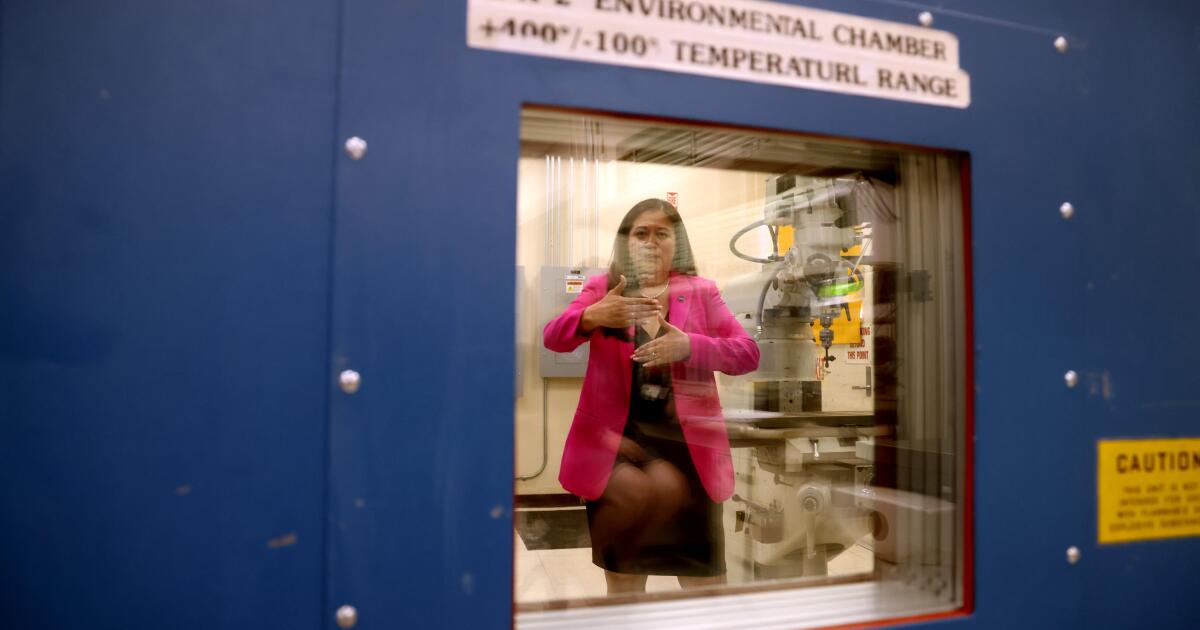
EDWARDS, Calif. — The Artemis II astronauts are scheduled to return Friday from their trip to the moon. When they do, they will slam into Earth’s atmosphere at over 32 times the speed of sound — and will do so using a reentry technique that has yet to be tested in real-world scenarios.
In 2022, NASA sent the uncrewed Artemis I test mission to the moon. As it pierced through the Earth’s atmosphere on return, the capsule suffered unexpected damage to its heat shield, prompting NASA scientists to rethink what’s needed to keep the homeward-bound Artemis II astronauts safe.
There’s been a ton of work done to prepare for this moment — but the reality is, scientists won’t know exactly how the heat shield will behave until they test it in a bona fide reentry.
-
Share via
That’s why a team of NASA and Department of Defense scientists and test pilots stand at the ready to collect detailed data on how the heat shield performs as the capsule streaks through the sky, turning the atmosphere around it into a bright fireball about half as hot as the surface of the sun before splashing down off the coast of San Diego.
Test pilots stationed at Southern California military bases will take turns chasing the capsule in a complex, high-speed relay: first a NASA business jet, then a Navy surveillance aircraft, followed by another NASA jet, and finally a NASA weather research aircraft. Crews on the ground will monitor the Artemis II capsule and send those test pilots precise speeds and coordinates to hit as they follow the fireball in the sky. Meanwhile, researchers in the back of the planes will track the capsule with telescopes and sensors.

Center Director Bradley C. Flick, left, gives project manager Robert Navarro a high five at the NASA Armstrong Flight Research Center on Edwards Air Force Base on March 18.
(Genaro Molina / Los Angeles Times)
“It’s an exciting job threading the needle multiple times,” said Robert Navarro, project manager at NASA’s Armstrong Flight Research Center in Edwards, Calif., which is in charge of the critical third segment of the relay. “It has to be precise, simply because of the short window of time that they need to collect that data. They have to be exactly right on the mark.”
After splashdown, a separate Armstrong Flight Research Center team will collect a fortified sensor affixed to the exterior of the capsule that is designed to study the heat shield up close.
“I’m really excited that my team is a part of such an important mission,” said Patty Ortiz, deputy project manager for the capsule sensor project at the center. “Having worked on it since 2019, it’s definitely a full-circle moment for me.”
The center has pushed the limits of human flight for decades — and collected a lot of data doing so.
“We consider our airplanes flying labs — we’re going to go do things that maybe haven’t been done before,” said Brad Flick, who retired as director of the center March 20 after nearly four decades at the research facility.

Armstrong Flight Research Center project manager Robert Navarro walks past a Gulfstream III airplane that will be used in the Artemis II mission.
(Genaro Molina / Los Angeles Times)
In the 1960s, engineers at the Flight Research Center helped design and test a mock-up of the Apollo lunar landing vehicle that Neil Armstrong used for landing practice on Earth before he flew to the moon. (The center was later renamed after him, the first person to walk on the lunar surface.)
The center has been preparing to study the Artemis II reentry for years, but the work became even more important after NASA discovered issues with the heat shield after the Artemis I test mission.
NASA guided the Artemis I capsule to first only graze the Earth’s atmosphere before briefly popping back up into space, then completing the final reentry. This novel approach reduced the forces that astronauts would experience on reentry and helped NASA to more precisely maneuver the capsule to its landing point in the Pacific — regardless of where or when it comes back from the moon.
That mission seemed like a success, but when crews began inspecting the heat shield on the bottom of the uncrewed capsule after splashdown, they noticed a problem.

After NASA’s Orion spacecraft was recovered at the conclusion of the Artemis I test flight and transported to NASA’s Kennedy Space Center in Florida, its heat shield was removed from the crew module inside the Operations and Checkout Building and rotated for inspection.
(NASA)
The heat shield is designed to slowly erode (or “ablate,” in NASA parlance) away during reentry to keep conditions in the capsule livable while the air a few inches away can reach nearly 5,000 degrees Fahrenheit: The outside layer of the shield routinely heats up, then sloughs off in the form of gas and pieces of char, which carry that heat away from the capsule as they disperse into the atmosphere around the capsule.
The problem with Artemis I was that the new reentry approach NASA had attempted seemed to disrupt this ablation process.
Because Artemis I went back into space between the first dip into the atmosphere and the final reentry, there was a brief respite in its heat exposure — that meant that the hot interior of the heat shield kept producing gases, but the exterior was no longer shedding material fast enough to allow those gases to escape. Pressure built up, which cracked the heat shield and ultimately resulted in larger pieces chipping off during the final reentry.
NASA scientists determined that had a crew been onboard, they would have survived — but they didn’t want to expose the Artemis II astronauts to unnecessary risk.
That left two options: First, replace the already-built Artemis II heat shield with a new design in the works that could handle the reentry path attempted with Artemis I. Second, change the reentry path to skip the first dip into the atmosphere and just go straight in to eliminate the conditions that created the problem in the first place.
The agency ultimately deemed replacing the Artemis II heat shield too much of a logistical headache and opted for the latter, simpler approach. On Friday, NASA astronauts will put that decision to the test. Armstrong Flight Research Center scientists are standing by to watch.

A giant cell tower is going to space this weekend

Australia’s most decorated veteran walks free on bail on war crimes charges related to Afghan deaths

Minnesota Republicans reveal which far-left candidate they want to challenge in open Senate race

Doctors warn of ‘looksmaxxing’ dangers after influencer’s livestream emergency

WWE star Chelsea Green should be WrestleMania ‘headliner,’ Alba Fyre says

Florida High School Football Rankings: Top 25 teams – Oct. 21

How old is Bo Nix? What to know about Oregon quarterback ahead of 2024 NFL Draft

Cleary's 21 help Le Moyne down Central Connecticut State 69-64 in OT

99th annual Pony Swim held in Virginia

Indiana Members Credit Union announced as new anchor tenant at Bottleworks District
Minnesota Republicans reveal which far-left candidate they want to challenge in open Senate race

Swedish rights groups slam ‘honest living’ criteria for migrants

Orbán’s defeat is a win for democracy and a warning to Trump, some say

Firefighters Likely Had Limited View of Approaching Plane in LaGuardia Crash

Tennessee governor signs nuclear family month resolution as critics push back on exclusions
-

 Ohio3 days ago
‘Little Rascals’ star Bug Hall arrested in Ohio
-

 Georgia1 week ago
Georgia House Special Runoff Election 2026 Live Results
-

 Arkansas7 days ago
Arkansas TV meteorologist Melinda Mayo retires after nearly four decades on air
-

 Austin, TX1 week ago
ABC Kite Fest Returns to Austin for Annual Celebration – Austin Today
-

 Politics3 days ago
Dem fundraising giant in the hot seat as GOP lawmakers demand answers over dodged subpoena
-

 Politics6 days ago
Trump blasts Spanberger ahead of Virginia meetings, says state faces tax base exodus like New York, California
-

 Health1 week ago
Woman discovers missing nose ring traveled to her lungs, causing month-long cough
-

 San Francisco, CA5 days ago
President Trump terminates Presidio Trust