Science
How to best filter your L.A. tap water based on your ZIP Code

Nearly a year ago, I scribbled “Replace Brita filter” on my to-do list. But the errand perpetually fell by the wayside. There were so many more pressing tasks to complete.
“Oh, it’s fine,” I thought. “How bad can it be?”
Let’s just say that a day into reporting this story, I ran out to the market and bought a three-pack.
We reach for our water taps more than almost any other object in our homes — to brush our teeth, wash our faces, make coffee or tea in the morning. To cook meals, rinse dishes and wipe countertops. To water the plants, do laundry and fill our pets’ bowls. To shower and shave. And most often for a drink.

In L.A., water rules everything around us. Drink up, cool off and dive into our stories about hydrating and recreating in the city.
But how much do you really know about what’s in your tap water? And if you filter it, are you using the right technology? Many of us may not be fully aware of where our water even comes from.
That’s because the water that flows into our homes in the L.A. area can be surprisingly different, ZIP Code to ZIP Code. The level of arsenic found in Compton’s tap water may differ wildly from that found in Glendale. Malibu’s tap water may have more hexavalent chromium while Pasadena’s doesn’t have any. One tap does not fit all.
“Where you are, the location, it really makes a difference in your water quality,” said Tasha Stoiber, a senior scientist at the Environmental Working Group, a nonprofit research and advocacy group focusing on environmental health.
We went to the source, so to speak — experts in the realms of science, academia and water filtration — to help you navigate the often complicated, ever-fluid world of residential tap water, so that you can make smarter and more informed choices about how to purify your H20.
L.A.’s water sources | Federal and state protections | Determining your water quality | How to test | How to filter | The bare minimum
L.A.’s water sources
Like most major cities, the Greater Los Angeles area is served by a dizzying number of community water systems. In California, there are 2,913 of them to serve about 39.025 million people — and those are just the larger ones that operate year-round, according to the EWG’s Tap Water Database.
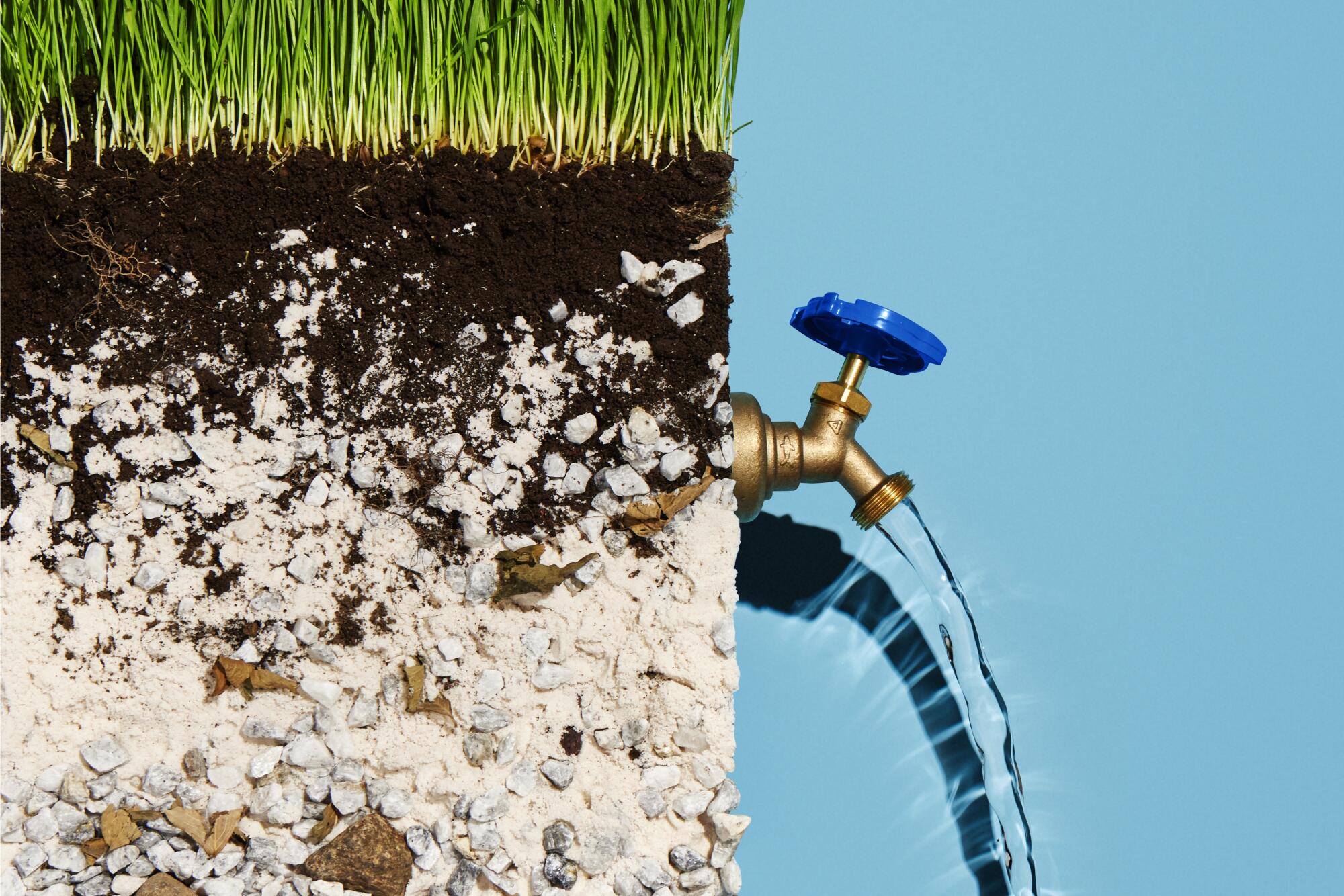
Each utility company treats the water in its assigned municipality differently before it flows through consumers’ faucets. That’s because each draws from different water sources. One area’s tap may be coming from rivers and lakes (otherwise categorized as “surface water”) while another’s could be pumped from wells from beneath layers of rock and sediment (categorized as “groundwater”).
Depending on where the water travels, it may pick up different undesirable contaminants. Surface water, for example, could have runoff that includes nitrate used to fertilize land in agricultural areas. Groundwater could have naturally occurring chemical elements, such as arsenic, that come from bedrock.
More often than not, L.A. area tap water comes from a mix of these sources. Our utility companies draw from different aqueducts, those large, often concrete ditches or canals that extend from the source to the water treatment plant. From there it flows through pipes, underground, to your home.
In 2023, the Los Angeles Department of Water and Power — which serves about 4 million people throughout the city of Los Angeles — sourced its tap water from the Los Angeles Aqueduct, the California Aqueduct and the Colorado River Aqueduct as well as from local groundwater, according to its most recent drinking water quality report.
The specific geographic location of a water source also determines what ends up in your tap water. A lake near a highly industrial area risks containing more pollutants than water coming from a lake in the High Sierras.
Another reason the water might be different between ZIP Codes: Utility companies have different resources at their disposal.
“The size of the drinking water system can be an indicator of the drinking water quality,” Stoiber said. “It’s based on economy of scale. The larger ones have more resources for treatment. Smaller systems can be at a bit more of an economic disadvantage.”
Federal and state water protections
There are federal regulations that require utility companies to stay below maximum contaminant levels for more than 90 pollutants in drinking water. They’re also required to publish an annual consumer confidence report with information about contaminant levels and water sources.
“But many of our drinking water regulations were set in the ’70s and ’80 and are not as protective as they should be,” Stoiber said. “There are contaminants in your drinking water that don’t have regulations around them.”
How harmful these contaminants are, and how much you’d have to ingest over time to affect your health, is contested. But in general, however many pollutants you might find in L.A.’s tap water, there are not enough to make you seriously ill in one gulp.
Some good news: In April, the U.S. Environmental Protection Agency finalized new regulations around a family of about 15,000 chemicals known as PFAS. They’re often referred to as the “forever chemicals” because they don’t break down in the environment. California also voted in April to finalize a limit for hexavalent chromium, or “Chrome 6,” which many people know as the carcinogenic chemical that the Pacific Gas and Electric Co. contaminated residents’ groundwater with, from 1952 to 1966, in Hinkley, Calif. — the legal upshot of which was depicted in the film “Erin Brockovich.” But those changes won’t be immediate.
“Upgrading water treatment plants is expensive and takes years,” said USC’s Daniel McCurry, who researches water supply and treatment. “Most smaller utilities, especially, just won’t have the money to make the upgrades in the initial time frame.”
2027, McCurry notes, is the deadline for utilities to complete their “initial monitoring” before the new regulations for PFAS go into effect in 2029.
(Henry Hargreaves / For The Times)
How to determine your water quality
So where to start? It’s easier than it might seem. First, search for your consumer confidence report on your utility company’s website. You can then cross-reference that information with EWG’s free Tap Water Database, which allows you to type in your ZIP Code (look for the prompt “Is your water safe?”). It then will populate your water utility company and the number of people it serves. From there, you can click on “View Utility” to produce an easy-to-decipher report listing the source of your water and contaminants detected in it.
When I typed my own Silver Lake ZIP Code in for a water quality analysis, the results did not put me at ease. It listed nine contaminants detected in my water, among them bromate and uranium. Some of these were found at levels that far exceeded the standards of the EWG but were still below the legal limit.
I called the LADWP to make sense of what I’ve found.
“There’s no health concern,” LADWP’s director of water quality, Jonathan Leung, said of my findings, stressing that the contaminants were far below the federally mandated legal limit. “That’s where, collectively, all the toxicologists and water quality specialists and scientists have worked together to set national standards. As a water quality utility, that’s what we set our sights on. The public should take confidence that the legal limits are protective of public health — and we strive to do better than that.”
McCurry added that the EWG and EPA have different standards for the amount of contaminants found in water.
“When the EPA sets a water contaminant limit, it’s a balance between protecting public health while staying realistic about the treatment technology we have and how much it costs,” McCurry said. “Everyone’s perception or tolerance of risk is different, but for me, personally, I drink water straight from the tap and don’t worry about it. It’s very unlikely you’ll get sick from tap water, assuming the tap water meets federal regulations.”
How to test your water at home
Whatever your personal tolerance level, you can improve both the quality and taste of your tap water by choosing the right filter, experts say.
But, given the array of filtration products and techniques on the market, that’s easier said than done. Choosing from options like “ion-exchange demineralization,” “ultraviolet sterilization” and “chemical feed pumps” can be intimidating.
Take a breath. Then step back. Filtering should be a tailored approach, said Brian Campbell, founder of Water Filter Guru, which lab-tests and reports on residential water treatment methods and products.
“There’s no such thing as a one-size-fits-all water treatment solution,” Campbell said.
He added that even after reading utility consumer reports and nonprofit chemical analyses, you still may need to know more.
“[Those reports] will give you a general sense but not the whole picture, Campbell said. “Because water can be recontaminated after it leaves the treatment plant — like if your home has old plumbing with lead piping. But it’s a start.”
You can test your home’s water quality yourself using fairly affordable water test strips, available for about $15 in stores such as Home Depot. These, Campbell said, will “give you an indication of a handful of the most common 12 to 15 contaminants like lead, arsenic, chromium, nitrate possibly.” However it will only give you a range of those aforementioned contaminants, not the exact concentration in your water.
If you want specific information about the chemical levels, you can run a more in-depth test. The best way to do that, Campbell said, is through a certified lab, where the cost ranges from roughly $100 to more than $1,000 depending on how comprehensive you want to get.
How to choose a filter
Once you know what’s in your water, you’ll be able to choose the right filter technology to treat it, Campbell said. Here’s what he suggests using for some of the most common issues.
PFAS. This is the family of about 15,000 chemicals used for their water repellent and oil repellent properties, such as in nonstick pans or fast food packaging. “The most studied filtration method for this is activated carbon adsorption,” Campbell said. “It’s the most common technology used in pitcher filtration. Even the most simple water pitcher filters should theoretically reduce PFAS.” Reverse osmosis filtration systems also will address PFAS — it’s one of the most thorough techniques and includes activated carbon as one of its stages. Historically, these pricy systems were installed directly into sink pipes, but countertop versions now are available for renters.
Microplastics. “They get into the environment and break down into smaller and smaller pieces — so small you’d need a microscope to see them,” Campbell said. The best technique to address those — because they are suspended particles, floating in the water and not dissolved — is mechanical filtration, he said. The technology removes suspended particles, like pipe rust or sand and grit coming from a hot water heater. Reverse osmosis also would work. Distillation would be effective as well and is, per Campbell, one of the best to get rid of nearly all common contaminants. But, Campbell warned, “It requires a massive amount of energy and time to treat and distill a relatively small volume of water — so not the most practical.”
Disinfection byproducts. This is a group of chemicals created when common water disinfectants — typically chlorine — interact with organic matter (such as dirt or rust) that’s already present in the pipes that run from the distribution plant to your home or office, Campbell said. “Activated carbon adsorption is the best way to deal with this. Reverse osmosis will also deal with them because a component of that [technique] is activated carbon.”
Pesticides, herbicides and fertilizer. “This is more of an issue in agricultural areas,” Campbell said. Typically, he added, they can be treated using activated carbon and reverse osmosis.
Fluoride. Tap water is fluoridated in many areas because of its dental health benefits. But recent research suggests that prenatal exposure to fluoride may be linked to increased risk of neurobehavioral problems in children at age 3. “Reverse osmosis would be the best treatment for this, but there are a few adsorption media that can reduce fluoride, like a filter using bone char carbon (activated carbon that comes from animal bones) or a filter using activated alumina media, another adsorption media,” said Campbell.
Heavy metals. Lead is obviously the most infamous heavy metal water contaminant, but consumers also should watch out for arsenic (primarily from groundwater) and chromium 6 (which comes from industrial manufacturing). “Typically, for metals, reverse osmosis is the best option,” said Campbell. “Activated carbon works for chromium 6 but not for arsenic. Distillation, again, gets rid of everything but it’s not practical.”
Hard water. Hard water is caused by mineral buildup, which isn’t bad for your health but can create limescale on appliances like your water heater. It also can affect your beauty routine. “Soap doesn’t lather as well with hard water,” said Campbell. “Your hair might feel brittle and it can irritate skin issues like eczema.” He recommends treating the issue at the water point of entry to the home with cation exchange resin, a type of ion exchange.
The best way to know if a product is actually capable of doing what it claims to do, Campbell said, is to look up its performance certifications. “You can do that in databases through the Water Quality Assn., the National Sanitation Foundation and the International Assn. of Plumbing and Mechanical Officials.”
The bare minimum
If nothing else, Stoiber urged consumers to peruse the EWG’s guide to countertop filters — and to purchase one.
Though McCurry is content drinking from the tap, he agreed it couldn’t hurt. “If you have reason to believe there are, say, PFAS above the future regulation target, then yeah, get a Brita filter,” he said.
Needless to say, that task is no longer on my to-do list.


new video loaded: NASA Announces Artemis III Crew
transcript
transcript
NASA Announces Artemis III Crew
NASA announced the crew of Artemis III mission, which will fly to low-Earth orbit to test rendezvous and docking maneuvers with one or two lunar landers.
-
“I am excited to welcome you as the next crew in the Artemis journey to successfully return to the moon — this time to stay.” “I’m honored by the role that I’ve been given. I’m also very humbled by the task in front of us. But first and foremost, I’m grateful.” “So with that, the Artemis II crew, comrade, hands you the baton. You got the controls.” “As you know, we had a significant anomaly at our Launch Complex 36A on May 28. We’ve redoubled our efforts and are moving forward.”
By Alisa Shodiyev Kaff
June 9, 2026
Science
Santa Monica Mountains’ last steelhead trout survived the Palisades fire — and even had babies

Scientists feared the Santa Monica Mountains’ last remaining steelhead trout were dead, smothered by debris flows unleashed by the Palisades fire.
But the endangered fish surprised them: A team of biologists recently spotted 30 of the rare trout — and 21 babies — in Topanga Creek.
“There was a lot of happy dancing in the creek,” said Rosi Dagit, principal conservation biologist for the Resource Conservation District of the Santa Monica Mountains, which works with public and private landowners to conserve natural resources.
That’s because the steelhead here are endangered, at both the state and federal levels. Once, they swam in most streams of the Santa Monicas, but their numbers plummeted amid overfishing and coastal development. Increasingly frequent wildfire has further stressed their habitat. Topanga Creek, a biodiversity hot spot, is home to their last known population in the mountains that stretch from the Hollywood Hills to Point Mugu in Ventura County.
The trout that were spotted, including this one, are part of a distinct Southern California population that’s listed as endangered at the state and federal levels.
(RCDSMM Stream Team)
The California Department of Fish and Wildlife spearheaded a complex mission to rescue trout threatened by the Palisades fire that sparked in January 2025.
Time was of the essence. The fire hadn’t yet been fully contained. But rain was on the way, which would sweep massive amounts of sediment from the denuded hillsides into the water. Fish are often killed this way.
Crews stunned the fish with electricity, scooped them up in buckets, trucked them to a hatchery and ultimately moved them to Arroyo Hondo Creek in Santa Barbara County.
Within days, Topanga Creek was choked with mud. Some assumed the fish left behind were goners.
But in March, the conservation district’s team found four. The following month, when water conditions were clearer, they saw more.
“These fish continue to amaze me,” said Kyle Evans, environmental program manager for the state Department of Fish and Wildlife, who had seen the damage to the creek. “I had seen populations get wiped out in similar situations. So when I heard, I was thrilled.”
Evans surmises the fish that survived were in an area of the creek where less charred material and sediment were swept in.
“These fish likely hunkered down, were hiding under some rocks or places to try to get away from the main concentration of flow,” he said. “And luckily they weren’t buried.”
The ones that were spotted were fairly small, around 6 to 14 inches. Rainbow trout and steelhead trout are the same species, but with different lifestyles. If the fish remain in freshwater, they’ll be considered rainbows. However, they can migrate to the ocean and become steelhead, where they typically grow larger before returning to their natal waters to spawn.
Topanga Creek hasn’t fully recovered from the damage it sustained, but scientists say it’s looking better. Surveys last year were “so depressing,” Dagit said, with very few animals, and stretches that were essentially transformed into flat roads from all the sediment buildup. Some of the riparian canopy burned right down to the creek.
Then came 32 inches of rain over the last nine months, scouring out and moving sediment, creating deeper pools. Dagit said they recently found newt egg masses for the first time in years, as well as a few adult newts and many frogs. Plants that provide cover are starting to recover.
She provided photos comparing certain pools last year and this year, some dramatically transformed. In September 2025, the Shrine Pool could have been an overgrown hiking trail. This April, it was filled with shallow water.

The Shrine Pool in September 2025, left, and the same location in April 2026, right, with RCDSMM’s Isaac Yelchin donning a wetsuit.
(RCDSMM Stream Team)
Topanga Creek is home to another endangered fish, the small but hardy northern tidewater goby, often described as cute. Not long before the trout operation, Dagit led a rescue of hundreds of these fish too. Many were repatriated to the lagoon at the mouth of the creek in a moving ceremony last June.
There’s still the matter of what to do with the trout that were moved to Santa Barbara County last year. Evans would like to bring them home to the Santa Monicas at some point, but isn’t sure if it will happen. On one hand, they could bolster the small, genetically isolated surviving population. On the other, they might inadvertently bring in a disease or bacteria. There is some time to decide. Evans estimates the creek still needs to recover for two to three more years.
For now, the fish are functioning fine in their adopted creek. Experts worried the trauma wrought by the move would disrupt their spawning process, but they had babies that spring. This year, they spawned again.

The Pacifica Municipal Pier was shut down and taped off Thursday after city workers noticed cracks running through the landmark structure and concrete chunks falling into the ocean.
It’s just one of many coastal California structures that have recently crumbled under pressure from a rising and relentless ocean.
Officials from the small, beach city south of San Francisco said the pier was closed due to “cracking, separation, and displacement of the concrete walkway and structural elements.”
It will stay closed while structural engineers asses its safety.
Photos taken by city employees show a wide crack that runs from top to bottom and across the structure as well. Other photos show a large horizontal crack under the foundation of a small restaurant on the pier, the Chit Chat Cafe.
The cafe was also shut down.
This is not the first time the 53-year-old pier has shown signs of stress. In 2021, part of it was shut down after handrails along the edge collapsed. And in 2023, after a series of storms pummeled the Central California coast, damaging parts of the pier, the structure was partially closed for more than year.
Those same storms caused extensive damage in Aptos and Capitola, 70 miles south, where piers and waterfront infrastructure were swept away or damaged.
In 2024, a 150- to 180- foot section of the Santa Cruz wharf was ripped off by powerful waves.
At least 10 of the state’s dozens of coastal public piers were closed for part or all of 2024 due to structural damage sustained in winter storms since 2022. At least five others have longer-term upgrades planned to address structural issues.
“These things are costly to maintain,” said Zach Plopper, senior environmental director at Surfrider. “They are a part of our California coastal culture in many ways, but we’re going to need to reckon with, one, the state that they’re in, and two, the continuous and worsening threats they’re going to experience,”
He said most of the piers were constructed in the early 1900s, and they weren’t built to withstand decades of rough seas, storms and rising sea level.
“With this incoming El Niño, which is forecasted to be significant, and this marine heat wave we’re in the midst of, we’re kind of in uncharted waters as far as what this winter could bring in terms of storms and swells to the California coast, and we’re likely going to see a lot more damage,” he said. “Not just piers, but roads and other coastal infrastructure up and down the state.”
There was no storm in Pacifica earlier this week, so no single event could be blamed for the destruction.
However, a 2025 report from an outside engineering firm, GHD, found that several sections of the pier were in “poor” or “serious” condition, and they recommended closure before anticipated storms or events that could “subject the piles to high winds, swells and large waves.”
The firm found several areas of the pier where concrete was missing and rebar was exposed and corroding.
“The pier has continued to experience high winds and large waves in a harsh marine environment,” the engineers wrote in the report, noting that continuous exposure to seawater or marine spray was “detrimental” to the structure.
A 2023 city report estimated it would cost $19 million to repair.
That same year, a state law was enacted to require local governments along the California coast to plan for sea level rise in the coming decades.
Sea level has risen some 8 inches, on average, along the coast in the past 150 years, Plopper said, and researchers anticipate another foot in the next 25 years.
“We’re going to see profound shifts on our coastline, none that we have ever experienced before, and building static structures on the coast just doesn’t work all that well,” he said. “We’re going to have to make some really hard decisions.”
-

 Kansas1 minute ago
Kansas boy discovers 15-foot marine reptile fossil from 85 million years ago during geology field trip
-

 Kentucky6 minutes ago
What states spend the most on fast food? Kentucky ranks among the top
-

 Louisiana13 minutes ago
Winnsboro woman dies in single-vehicle crash on LA Highway 867
-

 Maine16 minutes ago
Live updates: Midterms take shape in California, Maine, S.C. and Nevada; Trump to sign ICE bill
-

 Maryland21 minutes ago
Alert Days Wednesday through Friday for severe weather risk, intense heat in Maryland
-

 Michigan28 minutes ago
Trieu: For Michigan State targets, visits, in-state decisions loom
-

 Massachusetts31 minutes ago
Make Father’s Day memorable with these 10 activities in Massachusetts
-

 Minnesota36 minutes ago
Strong winds, downed trees hit Twin Cities, cutting power to 50,000 in Minnesota

