Science
How a 'light bulb moment' in an Arkansas barn made Ryan Crouser a shot put juggernaut

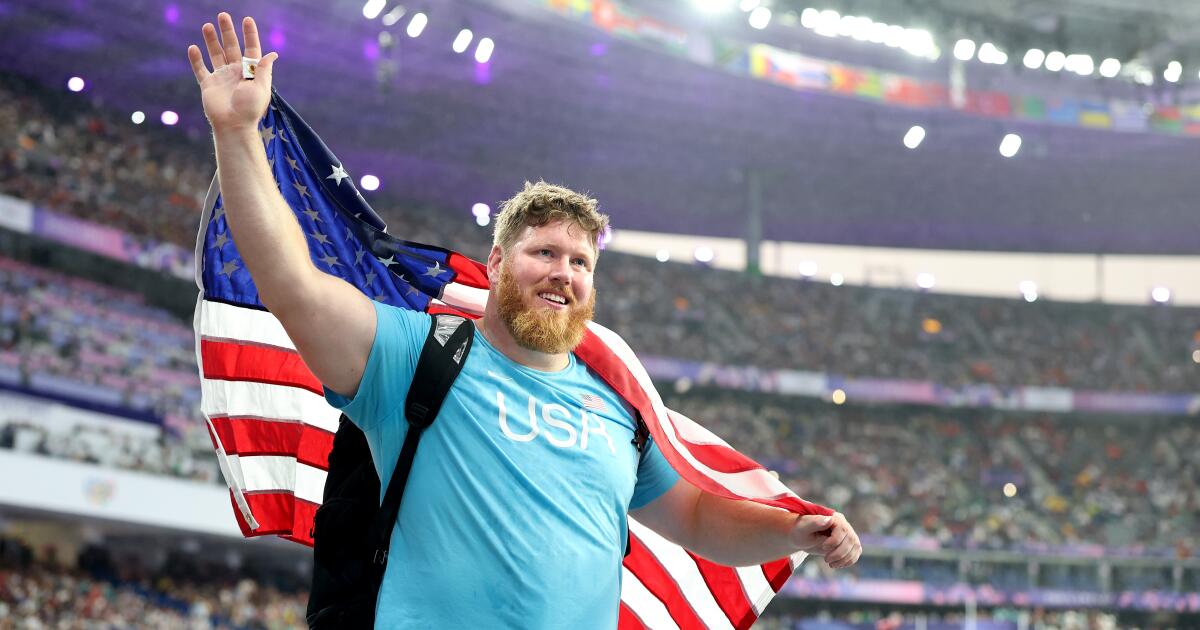
It sounds like the plot to a cheesy black-and-white movie from the 1940s.
A lunk of a guy goes out to the barn behind his house every night and tosses a metal ball as far as he can. Over and over. He tries shifting his feet, turning his body in different directions, tinkering.
And, just like that, he revolutionizes the sport of shot put.
But this isn’t a Hollywood story. Ryan Crouser used his innovative “Crouser Slide” to make history at the 2024 Paris Olympics this weekend, joining a select group of athletes who have dominated their event thoroughly enough to win gold at three consecutive Games.
The 31-year-old native of Boring, Ore., called it “kind of a testament to the total dedication and hard work that has gone into it … it’s a 365-day a year job.”
With all the superstars competing here in the last few days — gymnast Simone Biles, swimmer Katie Ledecky, sprinter Noah Lyles — it might be easy to overlook Crouser. It would also be a mistake.
His story exemplifies the best aspect of the Olympics: The range of obscure and semi-obscure sports filled with athletes who devote their lives to something with no guarantee of fortune or fame.
To fully appreciate what Crouser accomplished, it helps to know more about the shot put.
The only way to heave a 16-pound ball more than 70 feet is to generate momentum by spinning your way to the release, which can be especially tricky for very large people trapped inside a seven-foot ring.
So it makes sense that, despite all their girth and grunting, shot putters tend to be science geeks.
Rather than focus on brute force, they obsess over the physics of lateral velocity, rotational radius and acceleration paths. The biomechanically optimal angle of release — 36 degrees? 38 degrees? — can be a topic for debate.
“So it’s constantly changing and evolving,” Crouser says. “Kind of under the assumption of how do we maximize potential energy creation while minimizing room for error.”
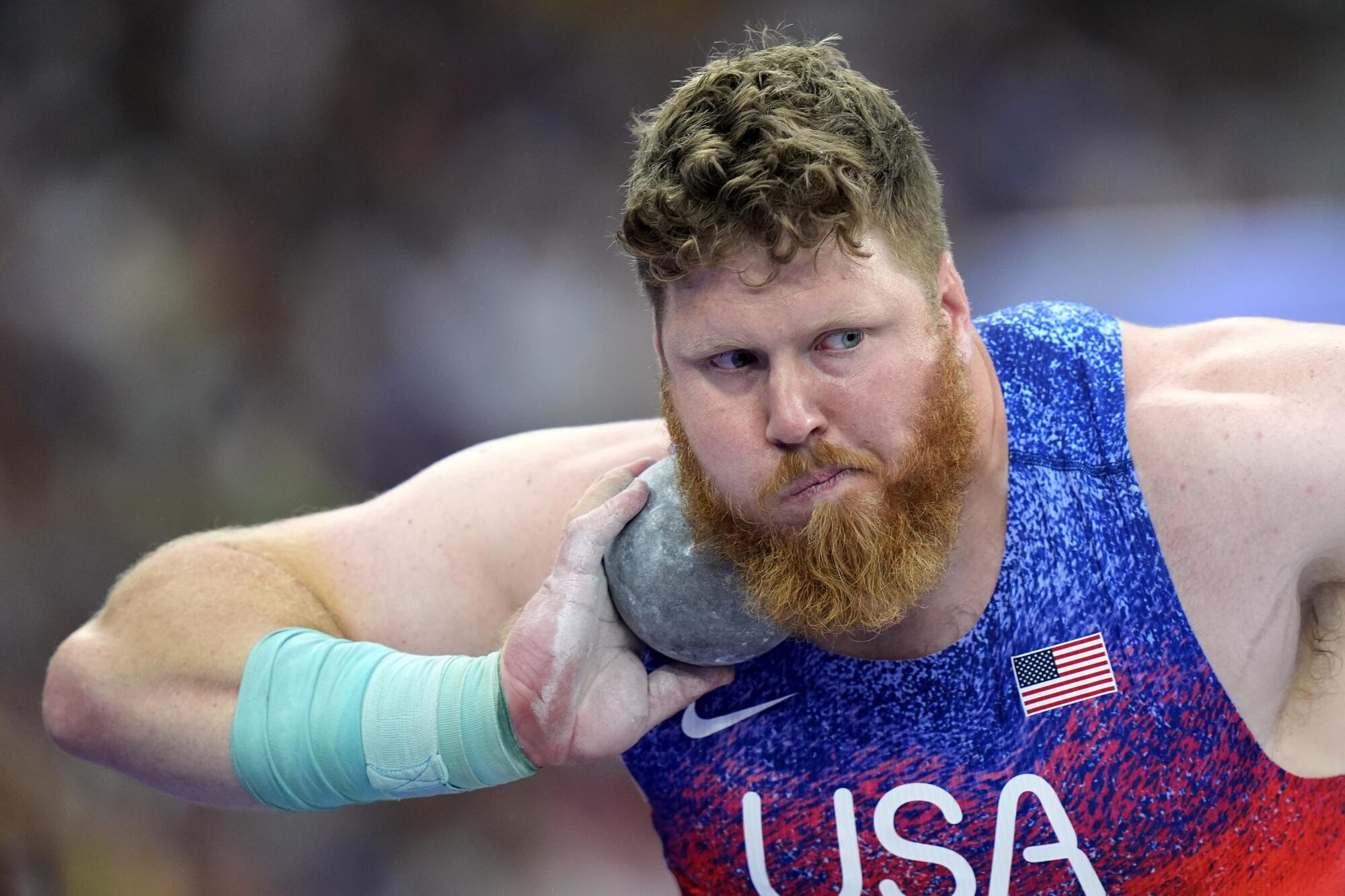
American Ryan Crouser competes in the men’s shot put final at the Paris Olympics on Saturday.
(Matthias Schrader / Associated Press)
Throwing runs in his blood. His father, Mitch, was an alternate on the 1984 U.S. Olympic discus team and uncle Brian threw javelin at two Games. After excelling at shot put in high school, Crouser won four NCAA championships for the University of Texas.
His first gold at the 2016 Rio de Janeiro Games came shortly after graduation.
In a sport where many top athletes stand about 6 feet tall, Crouser uses his 6-foot-7 frame for more leverage and force on throws. But height also makes him vulnerable to committing a foul by stepping outside of that claustrophobic ring.
In his early years at the international level, he employed a fairly standard technique, working to control his body by moving precisely. In 2021, he broke Randy Barnes’ 31-year-old record with a throw of more than 76 feet at the U.S. Olympic trials, then won his second gold at the Tokyo Games.
Still, he wasn’t content.
“I feel like I experimented for a number of years just with different techniques,” he recalls. “I try to think of a rational explanation for why it would help my throw and then I’ll implement it.”

The “Fosbury Flop,” the back-roll technique made famous by Dick Fosbury at the 1968 Summer Olympics, forever changing the high jump, ranks as track’s best-known stylistic breakthrough. Though subtler, the “Crouser Slide” has been revolutionary.
Restless for something better, the self-coached Crouser searched the internet for information and applied concepts from upper-level engineering courses he took in college before switching his major to economics.
All his tinkering, spread across thousands of practice throws, led to a “light bulb moment” in that Arkansas barn in December 2022. It was about 8 p.m. and he recalls thinking “Yeah, let’s try something new just to engage myself because shot put can be extremely monotonous.”
He focused on altering the conventional starting point, which has shot putters standing at the back of the ring, facing away from the field. Crouser shifted over to the right side of the circle, creating room to his left.
The adjustment allowed him to start his motion with a quick “slide step” to the left. It made his spin a little faster and gave his right leg more space to swing around. As he explained: “Speed is king in the shot put.”
Speed can also be unwieldy, so there were problems with consistency. But within a few months, at a springtime meet in Los Angeles, he became the first man to throw beyond 77 feet.
“It’s good for the sport,” rival Tom Walsh told reporters in his home country of New Zealand. “But we’ve got to keep our end of the bar up and keep pushing him, keep challenging him, because when someone is too dominant, the sport gets a bit dull.”
During the past 10 or so years, Crouser has amassed five of the top six — and 14 of the top 25 — throws ever.
As important as technique and mental approach can be, the shot put remains — at its core — physical and brutal.
“Throwing a 16-pound ball for a living beats you up,” Crouser said.
Doctors found two blood clots in his leg last summer. Cleared to fly at the last moment, he traveled to Budapest to defend his world championship.
Since then, a torn pectoral muscle and nagging elbow injury have forced him to adjust his practice routine. Sometimes he throws hard and takes a few days off, other times he strings together light workouts.
“I have had a bit of difficulty recognizing that I am getting older,” he says. “It makes me cherish this Olympic experience even more because I can see that I cannot do this forever.”

2024 Paris Summer Olympic Games
Heading into Saturday night’s final in Paris, it wasn’t clear if the elbow could hold up for six rounds. Rather than build his distances gradually, Crouser chased big throws early — a gamble — hoping his opponents might tighten up if they fell behind.
Throwing 74 feet 3 inches on his first attempt, he raised his arms and worked the crowd. His lead had widened by the third round, at which point nature intervened.
A storm blew in, drenching the stadium and making the shot put ring treacherously slippery. One after another, competitors started attempts only to have their feet slip and their throws fall harmlessly. U.S. teammate and longtime rival Joe Kovacs unleashed a gutty try in the final round but, for a third consecutive Olympics, finished with silver.
Speaking in the mixed zone, Crouser reflected on years of eating right, getting nine hours of sleep each night and forgoing alcohol except for a 10-day vacation at the end of each track season. He mused about winning a fourth gold at the 2028 Summer Games in Los Angeles.
If his body lasts. If he can keep thinking up improvements for his technique.
A reporter asked him about a moment from earlier in the evening. Before the finals, the shot putters emerged from a tunnel, one by one, pausing in front of a television camera. Crouser dropped to one knee in an homage to French sculpture.
His pose? The Thinker.


new video loaded: NASA Announces Artemis III Crew
transcript
transcript
NASA Announces Artemis III Crew
NASA announced the crew of Artemis III mission, which will fly to low-Earth orbit to test rendezvous and docking maneuvers with one or two lunar landers.
-
“I am excited to welcome you as the next crew in the Artemis journey to successfully return to the moon — this time to stay.” “I’m honored by the role that I’ve been given. I’m also very humbled by the task in front of us. But first and foremost, I’m grateful.” “So with that, the Artemis II crew, comrade, hands you the baton. You got the controls.” “As you know, we had a significant anomaly at our Launch Complex 36A on May 28. We’ve redoubled our efforts and are moving forward.”
By Alisa Shodiyev Kaff
June 9, 2026
Science
Santa Monica Mountains’ last steelhead trout survived the Palisades fire — and even had babies

Scientists feared the Santa Monica Mountains’ last remaining steelhead trout were dead, smothered by debris flows unleashed by the Palisades fire.
But the endangered fish surprised them: A team of biologists recently spotted 30 of the rare trout — and 21 babies — in Topanga Creek.
“There was a lot of happy dancing in the creek,” said Rosi Dagit, principal conservation biologist for the Resource Conservation District of the Santa Monica Mountains, which works with public and private landowners to conserve natural resources.
That’s because the steelhead here are endangered, at both the state and federal levels. Once, they swam in most streams of the Santa Monicas, but their numbers plummeted amid overfishing and coastal development. Increasingly frequent wildfire has further stressed their habitat. Topanga Creek, a biodiversity hot spot, is home to their last known population in the mountains that stretch from the Hollywood Hills to Point Mugu in Ventura County.
The trout that were spotted, including this one, are part of a distinct Southern California population that’s listed as endangered at the state and federal levels.
(RCDSMM Stream Team)
The California Department of Fish and Wildlife spearheaded a complex mission to rescue trout threatened by the Palisades fire that sparked in January 2025.
Time was of the essence. The fire hadn’t yet been fully contained. But rain was on the way, which would sweep massive amounts of sediment from the denuded hillsides into the water. Fish are often killed this way.
Crews stunned the fish with electricity, scooped them up in buckets, trucked them to a hatchery and ultimately moved them to Arroyo Hondo Creek in Santa Barbara County.
Within days, Topanga Creek was choked with mud. Some assumed the fish left behind were goners.
But in March, the conservation district’s team found four. The following month, when water conditions were clearer, they saw more.
“These fish continue to amaze me,” said Kyle Evans, environmental program manager for the state Department of Fish and Wildlife, who had seen the damage to the creek. “I had seen populations get wiped out in similar situations. So when I heard, I was thrilled.”
Evans surmises the fish that survived were in an area of the creek where less charred material and sediment were swept in.
“These fish likely hunkered down, were hiding under some rocks or places to try to get away from the main concentration of flow,” he said. “And luckily they weren’t buried.”
The ones that were spotted were fairly small, around 6 to 14 inches. Rainbow trout and steelhead trout are the same species, but with different lifestyles. If the fish remain in freshwater, they’ll be considered rainbows. However, they can migrate to the ocean and become steelhead, where they typically grow larger before returning to their natal waters to spawn.
Topanga Creek hasn’t fully recovered from the damage it sustained, but scientists say it’s looking better. Surveys last year were “so depressing,” Dagit said, with very few animals, and stretches that were essentially transformed into flat roads from all the sediment buildup. Some of the riparian canopy burned right down to the creek.
Then came 32 inches of rain over the last nine months, scouring out and moving sediment, creating deeper pools. Dagit said they recently found newt egg masses for the first time in years, as well as a few adult newts and many frogs. Plants that provide cover are starting to recover.
She provided photos comparing certain pools last year and this year, some dramatically transformed. In September 2025, the Shrine Pool could have been an overgrown hiking trail. This April, it was filled with shallow water.

The Shrine Pool in September 2025, left, and the same location in April 2026, right, with RCDSMM’s Isaac Yelchin donning a wetsuit.
(RCDSMM Stream Team)
Topanga Creek is home to another endangered fish, the small but hardy northern tidewater goby, often described as cute. Not long before the trout operation, Dagit led a rescue of hundreds of these fish too. Many were repatriated to the lagoon at the mouth of the creek in a moving ceremony last June.
There’s still the matter of what to do with the trout that were moved to Santa Barbara County last year. Evans would like to bring them home to the Santa Monicas at some point, but isn’t sure if it will happen. On one hand, they could bolster the small, genetically isolated surviving population. On the other, they might inadvertently bring in a disease or bacteria. There is some time to decide. Evans estimates the creek still needs to recover for two to three more years.
For now, the fish are functioning fine in their adopted creek. Experts worried the trauma wrought by the move would disrupt their spawning process, but they had babies that spring. This year, they spawned again.

The Pacifica Municipal Pier was shut down and taped off Thursday after city workers noticed cracks running through the landmark structure and concrete chunks falling into the ocean.
It’s just one of many coastal California structures that have recently crumbled under pressure from a rising and relentless ocean.
Officials from the small, beach city south of San Francisco said the pier was closed due to “cracking, separation, and displacement of the concrete walkway and structural elements.”
It will stay closed while structural engineers asses its safety.
Photos taken by city employees show a wide crack that runs from top to bottom and across the structure as well. Other photos show a large horizontal crack under the foundation of a small restaurant on the pier, the Chit Chat Cafe.
The cafe was also shut down.
This is not the first time the 53-year-old pier has shown signs of stress. In 2021, part of it was shut down after handrails along the edge collapsed. And in 2023, after a series of storms pummeled the Central California coast, damaging parts of the pier, the structure was partially closed for more than year.
Those same storms caused extensive damage in Aptos and Capitola, 70 miles south, where piers and waterfront infrastructure were swept away or damaged.
In 2024, a 150- to 180- foot section of the Santa Cruz wharf was ripped off by powerful waves.
At least 10 of the state’s dozens of coastal public piers were closed for part or all of 2024 due to structural damage sustained in winter storms since 2022. At least five others have longer-term upgrades planned to address structural issues.
“These things are costly to maintain,” said Zach Plopper, senior environmental director at Surfrider. “They are a part of our California coastal culture in many ways, but we’re going to need to reckon with, one, the state that they’re in, and two, the continuous and worsening threats they’re going to experience,”
He said most of the piers were constructed in the early 1900s, and they weren’t built to withstand decades of rough seas, storms and rising sea level.
“With this incoming El Niño, which is forecasted to be significant, and this marine heat wave we’re in the midst of, we’re kind of in uncharted waters as far as what this winter could bring in terms of storms and swells to the California coast, and we’re likely going to see a lot more damage,” he said. “Not just piers, but roads and other coastal infrastructure up and down the state.”
There was no storm in Pacifica earlier this week, so no single event could be blamed for the destruction.
However, a 2025 report from an outside engineering firm, GHD, found that several sections of the pier were in “poor” or “serious” condition, and they recommended closure before anticipated storms or events that could “subject the piles to high winds, swells and large waves.”
The firm found several areas of the pier where concrete was missing and rebar was exposed and corroding.
“The pier has continued to experience high winds and large waves in a harsh marine environment,” the engineers wrote in the report, noting that continuous exposure to seawater or marine spray was “detrimental” to the structure.
A 2023 city report estimated it would cost $19 million to repair.
That same year, a state law was enacted to require local governments along the California coast to plan for sea level rise in the coming decades.
Sea level has risen some 8 inches, on average, along the coast in the past 150 years, Plopper said, and researchers anticipate another foot in the next 25 years.
“We’re going to see profound shifts on our coastline, none that we have ever experienced before, and building static structures on the coast just doesn’t work all that well,” he said. “We’re going to have to make some really hard decisions.”
-

 Iowa2 minutes ago
Here’s what to know as another year brings another watering ban
-

 Kansas5 minutes ago
Kansas boy discovers 15-foot marine reptile fossil from 85 million years ago during geology field trip
-

 Kentucky10 minutes ago
What states spend the most on fast food? Kentucky ranks among the top
-

 Louisiana17 minutes ago
Winnsboro woman dies in single-vehicle crash on LA Highway 867
-

 Maine20 minutes ago
Live updates: Midterms take shape in California, Maine, S.C. and Nevada; Trump to sign ICE bill
-

 Maryland25 minutes ago
Alert Days Wednesday through Friday for severe weather risk, intense heat in Maryland
-

 Michigan32 minutes ago
Trieu: For Michigan State targets, visits, in-state decisions loom
-

 Massachusetts35 minutes ago
Make Father’s Day memorable with these 10 activities in Massachusetts

