Science
'Enough is enough': Scientists from UCLA, USC protest Trump's policy changes


Hundreds of scientists marched under sunny skies in front of federal offices in Los Angeles on Friday as part of a day of nationwide protests against Trump administration policies.
Pushing back against perceived threats to research and science, they bore on-theme signs, including one that read “What would Albert do?” accompanying a photo of Einstein.
The rally outside the Wilshire Federal Building drew graduate students and professors from USC and UCLA and was held under the banner of the Stand Up for Science movement, which drew inspiration from the March for Science held in 2017 shortly after Trump began his first term.
Many scientists once again feel under attack. In a matter of weeks, the second Trump administration has slashed jobs at science agencies — including the National Institutes of Health, National Science Foundation and National Oceanic and Atmospheric Administration — pulled the U.S. out of the Paris climate agreement (again), clawed back research papers under review at scientific journals to scrub terms that the political right has railed against, such as “transgender,” and terminated funding for global health programs. The administration has also attempted to block grants and reduce funding for research institutions.
Protesters hold up science-related signs to express their discontent. The Los Angeles rally was one of at least 32 Stand Up for Science demonstrations held nationwide on Friday.
(Myung J. Chun / Los Angeles Times)
“We have seen incredible disarray and attempts to dismantle a very effective research infrastructure in this country. And we have to say, enough is enough,” Judith Currier, a professor of medicine at UCLA, said at the demonstration, that took place in the shadow of offices for agencies including Veterans Affairs.
At least 32 coordinated rallies were held across the country Friday, anchored by a march on the National Mall in Washington, D.C., attended by thousands.
Duke Han, a professor of psychiatry and family medicine at USC, said that although he wasn’t as involved in the March for Science movement during Trump’s first stint in the White House, he chose to participate in these protests because the level of interference has grown in significance. Science has historically been considered nonpartisan, but events in recent years have galvanized those in the field to speak out.
“A lot of us are trying to figure out what we can do,” Han said. “A number of us are becoming more politically active, or politically active for the first time.”
For Han, the impact isn’t theoretical. He says his institution has become more cautious about giving offers to graduate students. A grant that was supposed to fund research he’s involved with to identify early signs of Alzheimer’s disease is five weeks late. He reached out to contacts at NIH but believes “it’s something that’s happening above them.”

The rally outside the federal building in Westwood drew professors, graduate students and others.
(Myung J. Chun / Los Angeles Times)
Several people at the protest said that the money used to fund scientific work pays dividends — and that losing it can have disastrous consequences for biomedical research, pharmaceutical development and more. Younger scientists shared the concern at the event. An international student at UCLA said the reason she came to the United States was for the “great opportunities” for research. “But look at the situation now,” said the 21-year-old undergrad, originally from India, who declined to provide her name because of how it might affect her immigration status.
Katherine Karlsgodt, an associate professor at UCLA in the psychology and psychiatry departments, who helped organize the Los Angeles rally, said she was “very upset” by the barrage of changes and concerned about their ramifications.
Alterations to science agency funding “have the potential to just completely derail scientific research and medical research [and] have a huge impact on universities and university budgets and our ability to train students and do research and basically everything that we do.”
Karlsgodt caught wind of the Stand Up for Science effort but was disappointed when she didn’t see a local rally on the books. Then some people at UCLA and USC got to talking, she said. One of her students — Dylan Hughes, a PhD student in the clinical psychology program at UCLA — booked the site and they began trying to spread the word. By the evening before the event, 300 people had RSVP’d.

“This is a really dark time for science and for humanity,” said Dylan Hughes, a UCLA graduate student who helped organize the Los Angeles rally, “but there’s an energy that we’ve created here that’s really helpful and has the power to change the world.”
(Myung J. Chun / Los Angeles Times)
Expressions of anger and alarm intermingled with hope and solidarity at the rally. Sam Cooke’s “A Change Is Gonna Come” played as scores of attendees mingled and flashed pithy signs to cars speeding down Wilshire Boulevard. Honks elicited cheers. A dog in the crowd sported a sign announcing, “Dogs against DOGE,” around its neck, a reference to the so-called Department of Government Efficiency, headed by Elon Musk, who has led much of the Trump administration’s cost-cutting efforts.
What’s now a national movement began as a Bluesky post.
On. Feb. 8, Colette Delawalla, a graduate student in psychology at Emory University, announced online that she was planning a national protest for science, according to the New York Times. It hit a collective nerve, and other scientists quickly hopped on board, evolving into Stand Up for Science.
Behind the rallies are policy goals outlined on the group’s website, including ending political interference and censorship; restoring and expanding research funding; and defending diversity and accessibility.
Back in L.A., Hughes, the UCLA PhD student, who helped spearheaded the local event, urged people to take in the moment.
“This is a really dark time for science and for humanity,” Hughes said, “but there’s an energy that we’ve created here that’s really helpful and has the power to change the world.”

The Stand Up for Science movement drew inspiration from the 2017 March for Science.
(Myung J. Chun / Los Angeles Times)



Science
Fourth measles case confirmed in L.A. County; person visited LAX, restaurants while infectious
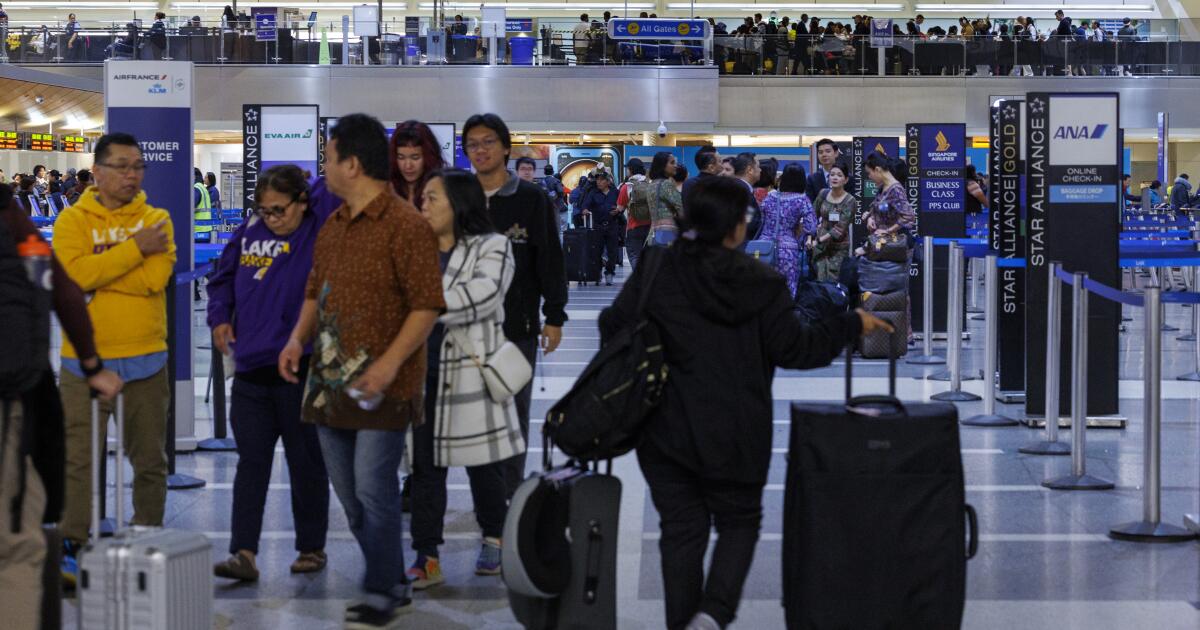
A fourth measles case has been confirmed in Los Angeles County, prompting renewed calls from health officials for residents to ensure they are protected against the highly contagious virus.
The infected individual flew from Singapore to Los Angeles International Airport on Feb. 9 aboard Singapore Airlines Flight 38. The plane landed at about 7 p.m. following a 14-hour journey, according to the L.A. County Department of Public Health.
Over the following days, the individual visited a few San Gabriel Valley fast food restaurants, potentially exposing others to the measles virus.
“As measles cases increase, it is important that residents take steps to make sure they are fully protected,” L.A. County Health Officer Dr. Muntu Davis said in a statement. “The [measles-mumps-rubella] vaccine is the safest and most reliable way to prevent measles and protect yourself, your family, and your community.”
The health department did not respond to questions from The Times regarding the sex or age of the infected individual, who was described in a statement as “a resident who recently traveled internationally.”
After arriving at and leaving the Tom Bradley International Terminal, the individual visited restaurants and convenience stores throughout Whittier and Montebello.
The individual ate at a Burger King in Montebello, 1212 West Beverly Blvd., on Feb. 10 between 5:30 and 7 p.m. The next day, the person dined at Taqueria El Atacor, 11156 1/2 Whittier Blvd. in Whittier, between 3 and 5 p.m.
The final two stops in Montebello were at Domino’s Pizza, 803 West Whittier Blvd., between 4 p.m. and 5:15 p.m. on Feb. 12; and 7-Eleven, 1106 West Beverly Blvd., on Feb. 13 between 4:30 p.m. and 5:45 p.m.
Those who were in the Bradley Terminal (Terminal B) on Feb. 9 from 7:30 p.m. to 9:40 p.m., or in the eateries above during the aforementioned time windows, may have been exposed to the measles virus.
Symptoms typically develop anywhere from seven to 21 days after exposure, according to the health department.
Concerned individuals should confirm whether they have protection against the virus, either through past measles vaccinations or infections.
Those who are not immunized or are unsure of their status should monitor themselves closely for signs of infection. Common symptoms include fever, cough, runny nose or red eyes, as well as a rash.
Those with such symptoms are encouraged to stay home and avoid school, work and any gatherings. They should also call a healthcare provider immediately, but not go into a healthcare facility without informing them.
The monitoring deadline for symptoms ranges from March 2 at LAX until March 6 at 7-Eleven for individuals who visited those spaces around the same time as the infected person.
Davis said the most effective way to protect against measles is to take the MMR vaccine. Children age 1 year and older are considered fully immunized after receiving two doses.
“Measles spreads easily and can lead to serious complications, including pneumonia, brain swelling, and even death,” Davis said. “We urge everyone to confirm their immunity and get the MMR vaccine if needed, especially before traveling. Taking this simple step helps safeguard your health and strengthens protection for our entire community.”
Previous cases confirmed in L.A. County so far this year also involved individuals who had traveled internationally. One of those individuals ventured to Sherman Oaks on Jan. 24, another to Woodland Hills on Jan. 30. The first case had no identified public exposure locations in L.A. County.
Measles cases have increased in the United States as vaccination rates have fallen in recent years, allowing the highly contagious virus to spread in communities with lower vaccine coverage.
According to the U.S. Centers for Disease Control and Prevention, there were 2,280 confirmed measles cases in the U.S. last year, the highest annual total since 1991. As of Feb. 12, 910 cases had already been confirmed nationwide this year — including 15 in California.

Shark attacks returned to near-average levels in 2025 after a dip the previous year, according to the latest report from the Florida Museum of Natural History’s International Shark Attack File, published Wednesday.
Researchers recorded 65 unprovoked shark bites worldwide last year, slightly below the 10-year average of 72, but an increase from 2024. Nine of those bites were fatal, higher than the 10-year average of six fatalities.
The United States once again had the highest number of reported incidents, accounting for 38% of global unprovoked bites when assessed on a country by country basis. That said, it’s actually a decline from recent years, including 2024, when more than half of all reported bites worldwide occurred off the U.S. coast.
In 2025, Florida led all states with 11 recorded attacks. California, Hawaii, Texas and North Carolina accounted for the remaining U.S. incidents.
But California stood out in another way: It had the nation’s only unprovoked fatal shark attack in 2025.
A 55-year-old triathlete was attacked by a white shark after entering the water off the coast of Monterey Bay with members of the open-ocean swimming club she co-founded. It was the sole U.S. fatality among 25 reported shark bites nationwide.
It’s not surprising that the sole U.S. shark-related death occurred in California, said Steve Midway, an associate professor of fisheries at Louisiana State University. “In California, you tend to have year-to-year fewer attacks than other places in the U.S. and in the world,” Midway said. “But you tend to have more serious attacks, a higher proportion of fatal attacks.”
The difference lies in species and geography, Midway said. Along the East Coast, particularly in Florida, many bites involve smaller coastal sharks in shallow water, which are more likely to result in nonfatal injuries. California’s deeper and colder waters are home to larger species, such as the great white shark.
“Great whites just happen to be larger,” Midway said. “You’re less likely to be attacked, but if you are, the outcomes tend to be worse.”
Whether measured over 10, 20 or 30 years, average annual shark bite totals globally are actually very stable.
“The global patterns change only slightly from one year to the other,” said Gavin Naylor, director of the Florida Program for Shark Research.
Those annual fluctuations are influenced by a combination of shark biology, ocean conditions and the number of people in the water at any given time in any given place, researchers say.
At the same time, global shark populations remain far below historical levels. Naylor categorizes about 30% of shark species as endangered, largely due to overfishing. In some countries, including the United States and Australia, stronger protections have allowed certain shark populations to recover.
Nevertheless, the risk of being bitten by a shark remains extremely low. The report notes that drowning is a far more common cause of death worldwide — and, if it helps you sleep (or swim), the data show that you are much more likely to be killed by lightning than you are by a shark.

Within hours of the expiration last week of the final arms control treaty between Moscow and Washington, the State Department sent its top arms diplomat, Thomas G. DiNanno, to Geneva to lay out Washington’s vision for the future. His public address envisioned a future filled with waves of nuclear arms buildups and test detonations.
The views of President Trump’s administration articulated in Mr. DiNanno’s speech represent a stark break with decades of federal policy. In particular, deep in the speech, he describes a U.S. rationale for going its own way on the global ban on nuclear test detonations, which had been meant to curb arms races that in the Cold War had raised the risk of miscalculation, and war.
This annotation of the text of his remarks aims to offer background information on some of the specialized language of nuclear policymaking that Mr. DiNanno used to make his points, while highlighting places where outside experts may disagree with his and the administration’s claims.
What remains unknown is the extent to which Mr. DiNanno’s presentation represents a fixed policy of unrestrained U.S. arms buildups, or more of an open threat meant to spur negotiations toward new global accords on ways to better manage the nuclear age.
Read the original speech.
New York Times Analysis
Next »
1
Established in 1979 as Cold War arsenals grew worldwide, the Conference on Disarmament is a United Nations arms reduction forum made up of 65 member states. It has helped the world negotiate and adopt major arms agreements.
2
In his State Department role, working under Secretary of State Marco Rubio, Mr. DiNanno is Washington’s top diplomat for the negotiation and verification of international arms accords. Past holders of that office include John Bolton during the first term of the George W. Bush administration and Rose Gottemoeller during Barack Obama’s two terms.
3
This appears to be referring to China, which has 600 nuclear weapons today. By 2030, U.S. intelligence estimates say it will have more than 1,000.
4
Here he means Russia, which is conducting tests to put a nuclear weapon into space as well as to develop an underwater drone meant to cross oceans.

New York Times Analysis
« Previous Next »
5
In this year’s federal budget, the Trump administration is to spend roughly $90 billion on nuclear arms, including basic upgrades of the nation’s arsenal and the replacement of aging missiles, bombers and submarines that can deliver warheads halfway around the globe.
6
A chief concern of many American policymakers is that Washington will soon face not just a single peer adversary, as in the Cold War, but two superpower rivals, China and Russia.
New York Times Analysis
« Previous Next »
7
The 1987 Intermediate-Range Nuclear Forces Treaty or I.N.F. banned all weapons capable of traveling between 500 and 5,500 kilometers, or 310 and 3,420 miles, whether armed with nuclear or conventional warheads. The Trump administration is now deploying a number of conventionally armed weapons in that range, including a cruise missile and a hypersonic weapon.
8
The destructive force of the relatively small Russian arms can be just fractions of the Hiroshima bomb’s power, perhaps making their use more likely. The lesser warheads are known as tactical or nonstrategic nuclear arms, and President Vladimir V. Putin of Russia has repeatedly threatened to use them in Ukraine.
9
Negotiators of arms control treaties have mostly focused on long-range weapons because the delivery vehicles and their deadly warheads are considered planet shakers that could end civilization.
New York Times Analysis
« Previous Next »
10
This underwater Russian craft is meant to cross an ocean, detonate a thermonuclear warhead and raise a radioactive tsunami powerful enough to shatter a coastal city.
11
The nuclear power source of this Russian weapon can in theory keep the cruise missile airborne far longer than other nuclear-armed missiles.
12
Russia has conducted test launches for placing a nuclear weapon into orbit, which the Biden administration quietly warned Congress about two years ago.
13
The term refers to the five permanent members of the United Nations Security Council—China, France, Russia, the United Kingdom and the United States.
New York Times Analysis
« Previous Next »
14
A top concern of American officials is that Beijing and Moscow might form an alliance to coordinate their nuclear forces. Their joint program to develop fuel for atom bombs is seen as an indication of this emerging threat.
15
This Trump administration plan is dated November but was made public in December.
16
Released last year, this Chinese government document sought to portray Beijing as a leader in reducing the global threat of nuclear weapons.
17
Typically, arms control treaties have not required countries to destroy warheads so their keepers put them into storage for possible reuse. The United States retains something on the order of 20,000 small atom bombs meant to ignite the larger blasts of hydrogen bombs.
18
An imminent surge centers on the nation’s Ohio-class submarines. The Trump administration has called for the reopening of submarine missile tubes that were closed to comply with the New START limits. That will add as many 56 long-range missiles to the fleet. Because each missile can hold multiple arms, the additional force adds up to hundreds more warheads.
19
This refers to weapons meant for use on a battlefield or within a particular geographic region rather than for aiming at distant targets. It is often seen as synonymous with intermediate-range weapons.
20
Here, the talk turns to the explosive testing of nuclear weapons for safety, reliability and devising new types of arms. The United States last conducted such a test in 1992 and afterwards adopted a policy of using such nonexplosive means like supercomputer simulations to evaluate its arsenal. In 1996, the world’s nuclear powers signed a global ban on explosive testing. A number of nations, including the United States and China, never ratified the treaty, and it never officially went into force.
21
In new detail, the talk addresses what Mr. Trump meant last fall when he declared that he had instructed the Pentagon “to start testing our Nuclear Weapons on an equal basis” in response to the technical advances of unnamed foreign states.
22
Outside experts say the central issue is not whether China and Russia are cheating on the global test ban treaty but whether they are adhering to the U.S. definition. From the treaty’s start in 1996, Washington interpreted “zero” explosive force as the compliance standard but the treaty itself gives no definition for what constitutes a nuclear explosion. Over decades, that ambiguity led to technical disputes that helped block the treaty’s ratification.
23
By definition, all nuclear explosions are supercritical, which means they split atoms in chain reactions that become self-sustaining in sufficient amounts of nuclear fuel. The reports Mr. DiNanno refers to told of intelligence data suggesting that Russia was conducting a lesser class of supercritical tests that were too small to be detected easily. Russian scientists have openly discussed such small experiments, which are seen as useful for assessing weapon safety but not for developing new types of weapons.
24
This sounds alarming but experts note that the text provides no evidence and goes on to speak of preparations, not detonations, except in one specific case.
New York Times Analysis
« Previous
25
The talk gave no clear indication of how the claims about Russian and Chinese nuclear testing might influence U.S. arms policy. But it repeated Mr. Trump’s call for testing “on an equal basis,” suggesting the United States might be headed in that direction, too.
26
The talk, however, ended on an upbeat but ambiguous note, giving no indication of what Mr. DiNanno meant by “responsible.” Even so, the remark came in the context of bilateral and multilateral actions to reduce the number of nuclear arms in the world, suggesting that perhaps the administration’s aim is to build up political leverage and spur new negotiations with Russia, China or both on testing restraints.

Campaign finance data shows most Anchorage Assembly races are close on fundraising

How brain exercises can help lower the risk of dementia

Hey Balwanth Movie Review – Gulte
Trump Considers Building a Military Base in Gaza as Peace Plans Clash With Reality

Video: OpenAI and Anthropic Rivals Share Awkward Moment at A.I. Summit

Florida High School Football Rankings: Top 25 teams – Oct. 21

Cleary's 21 help Le Moyne down Central Connecticut State 69-64 in OT

How old is Bo Nix? What to know about Oregon quarterback ahead of 2024 NFL Draft

99th annual Pony Swim held in Virginia

Indiana Members Credit Union announced as new anchor tenant at Bottleworks District

Buttigieg, Newsom, AOC top three in new 2028 poll in key presidential primary state
French far right asks European Parliament to mark death of activist Quentin Deranque

U.S. figure skater Alysa Liu said she didn’t care if she medaled. She won gold

Former Prince Andrew arrested on suspicion of misconduct in public office | Global News Podcast

DC Mayor Bowser declares emergency over Potomac sewage spill, asks for federal help
-

 Oklahoma2 days ago
Wildfires rage in Oklahoma as thousands urged to evacuate a small city
-

 Health1 week ago
James Van Der Beek shared colorectal cancer warning sign months before his death
-
 Science1 week ago
A SoCal beetle that poses as an ant may have answered a key question about evolution
-
![“Redux Redux”: A Mind-Blowing Multiverse Movie That Will Make You Believe in Cinema Again [Review]](https://i1.wp.com/www.thathashtagshow.com/wp-content/uploads/2026/02/Redux-Redux-Review.png?w=400&resize=400,240&ssl=1 "“Redux Redux”: A Mind-Blowing Multiverse Movie That Will Make You Believe in Cinema Again [Review]")
![“Redux Redux”: A Mind-Blowing Multiverse Movie That Will Make You Believe in Cinema Again [Review]](https://i1.wp.com/www.thathashtagshow.com/wp-content/uploads/2026/02/Redux-Redux-Review.png?w=80&resize=80,80&ssl=1 "“Redux Redux”: A Mind-Blowing Multiverse Movie That Will Make You Believe in Cinema Again [Review]") Movie Reviews1 week ago
Movie Reviews1 week ago“Redux Redux”: A Mind-Blowing Multiverse Movie That Will Make You Believe in Cinema Again [Review]
-

 Technology1 week ago
HP ZBook Ultra G1a review: a business-class workstation that’s got game
-
 Politics1 week ago
Culver City, a crime haven? Bondi’s jab falls flat with locals
-

 Politics1 week ago
Tim Walz demands federal government ‘pay for what they broke’ after Homan announces Minnesota drawdown
-

 Fitness1 week ago
‘I Keep Myself Very Fit’: Rod Stewart’s Age-Defying Exercise Routine at 81