Science
Ed Stone, JPL director and top scientist on Voyager mission, dies at 88


Ed Stone, the scientist who guided NASA’s breakthrough Voyager mission to the outer planets for 50 years and led the Jet Propulsion Laboratory when it landed its first rover on Mars, died Tuesday. He was 88.
A physicist who got in on the ground floor of space exploration, Stone played a leading role in NASA missions to Mars, Jupiter, Saturn, Uranus and Neptune. The discoveries made under his watch revolutionized scientists’ understanding of the solar system and fueled humanity’s ambition to explore distant worlds.
Carolyn Porco, who worked on imaging on JPL’s Voyager and Cassini missions, called Stone “a thoroughly lovely man” who was “as close to perfect as a project scientist could ever be.”
“When two science teams were in contention over some spacecraft resource, and Ed had to decide between the two, even the guy who lost went away thinking, ‘Well, if this is what Ed has decided, then it must be the right answer,’” Porco said by email Tuesday. “I feel blessed to have known Ed. And like many people today, I’m very sad to know he’s gone.”
Stone was a 36-year-old Caltech physics professor in 1972 when he was asked to serve as chief scientist for an audacious plan to send a pair of spacecraft to explore the solar system’s four giant planets for the first time.
It was the opportunity of a lifetime, but he wasn’t sure he wanted the gig.
“I hesitated because I was a fairly young professor at that point. I still had a lot of research I wanted to do,” he recalled 40 year later.
He took it anyway, and from the mission’s first encounter with Jupiter in 1979 to its final flyby of Neptune in 1989, Stone became the scientific face of the Voyager mission. He guided the science agenda and helped the public make sense of revolutionary images and data not just from Jupiter, Saturn, Uranus and Neptune, but from many of their fascinating moons.
Stone and his more than 200 science collaborators were the first to discover lightning on Jupiter and volcanoes on its moon Io. They spotted six never-before-seen moons around Saturn and found evidence of the largest ocean in the solar system on Jupiter’s moon Europa, as well as geysers on Neptune’s moon Triton.
“It seemed like everywhere we looked, as we encountered those planets and their moons, we were surprised,” Stone told the Los Angeles Times in 2011. “We were finding things we never imagined, gaining a clearer understanding of the environment Earth was part of. I can close my eyes and still remember every part of it.”
The Voyager 1 spacecraft became the first manmade object to reach interstellar space in 2012, and Voyager 2 followed suit in 2018.
Stone, pictured with a model of the Voyager spacecraft, said the discovery of volcanoes on Io was a highlight of the mission.
(NASA)
The twin probes continue to send weekly communications to Earth from interstellar space. Stone retired in 2022 on the mission’s 50th anniversary.
“A part of Ed lives on in the two Voyager spacecraft. The fingerprints of his dedication and keen leadership are woven into the Voyager mission,” said Linda Spilker, who joined the mission in 1977 and succeeded him as project scientist.
The Voyager mission was Stone’s crowning achievement, but hardly his only one.
He was a principal investigator on nine NASA missions and a co-investigator on five others, including several satellites designed to study cosmic rays, the solar wind and the Earth’s magnetic field.
He became director of the Jet Propulsion Laboratory in La Cañada Flintridge in 1991, a role he held for a decade.
It was an era of cost-cutting at NASA, but Stone still managed to launch Galileo’s five-year mission to Jupiter and send the Cassini spacecraft to Saturn. He was also at the agency’s helm when Mars Pathfinder delivered the Sojourner rover to the Red Planet. It marked the first time that humans had put a robotic rover on the surface of another planet.
Throughout his tenure at JPL, Stone continued to work and teach at Caltech, even teaching freshman physics during some of Voyager’s long cruise times between planets.
He also served as chairman of the board of the California Assn. for Research in Astronomy, which is responsible for building and operating the W.M. Keck Observatory and its two 10-meter telescopes on Mauna Kea, Hawaii.
Edward Carroll Stone Jr. was born in Iowa on Jan. 23, 1936, and grew up in Burlington, where his father ran a small construction business and his mother kept the company books.
The eldest of two brothers, Stone was attracted to science from a young age. Under his father’s watchful eye, he learned how to take apart and reassemble all varieties of technology, from radios to cars.
“I was always interested in learning about why something is this way and not that way,” Stone told an interviewer in 2018. “I wanted to understand and measure and observe.”
After studying physics at Burlington Junior College, he received his master’s and doctorate at the University of Chicago. Shortly after he began his graduate studies, news broke in 1957 that the former Soviet Union had launched Sputnik, the world’s first artificial satellite.
“Just like that, because of the Cold War and our need to match Sputnik, a whole new realm absolutely opened up,” he said.
Stone built a device for measuring the intensity of solar energetic particles above the atmosphere that hitched a ride to space aboard an Air Force satellite in 1961. Unfortunately the spacecraft’s transmitter didn’t work, so only a very limited quantity of data was returned to Earth. However, it was still enough to indicate that the intensity of the particles was lower than expected.
Despite the transmitter glitch, Stone said the project was thrilling. “We were taking the first steps in a whole new area of research and exploration,” he said. “We were right at the beginning.”
He joined the faculty at Caltech in 1964 and created more space experiments, this time for NASA.
Stone’s particular area of interest was cosmic rays — high-speed atomic nuclei that can originate from explosive events on the sun or from violent events beyond the solar system.
One of his cosmic-ray experiments was included among the 11 major Voyager experiments.
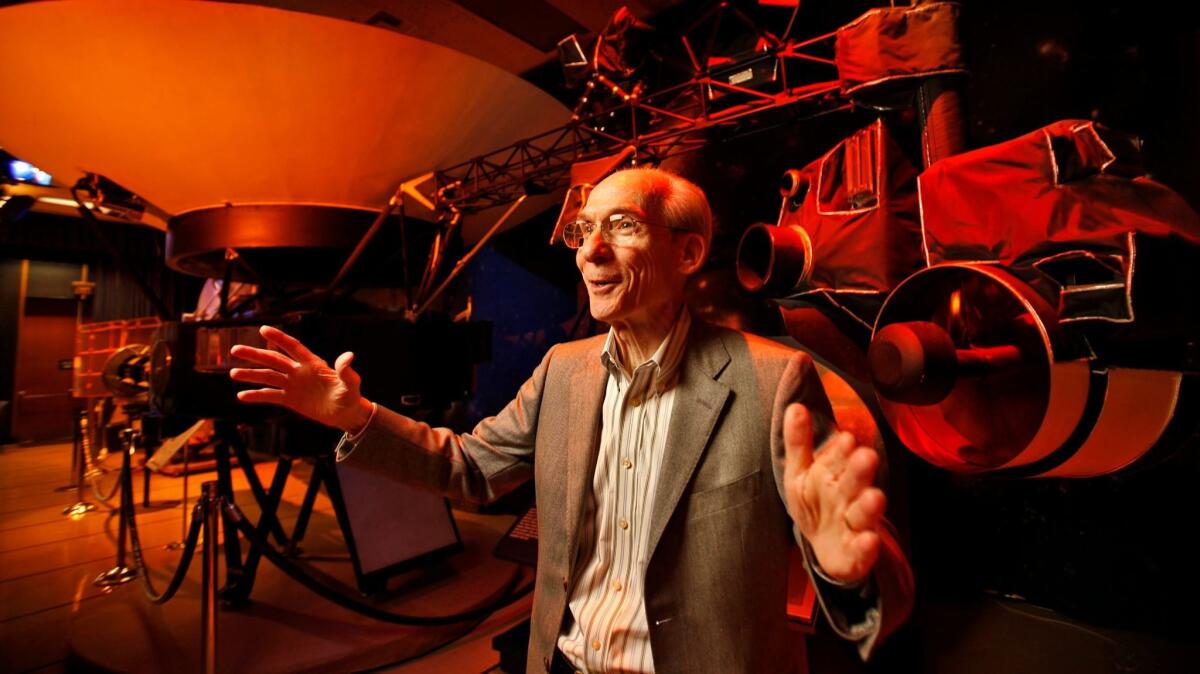
Ed Stone in 2011, about a year before Voyager 1 entered interstellar space.
(Al Seib / Los Angeles Times)
Colleagues praised Stone for his leadership of the Voyager science team.
“He was a great hero, a giant among men,” said Porco, adding that Stone was known to treat everyone — from top scientists to graduate students — with respect.
Voyager team scientist Thomas Donahue put it this way: “Over the years, Ed Stone has proved to be remarkably adept at keeping a bunch of prima donnas on track.”
Stone was elected to the National Academy of Sciences in 1984 and received the National Medal of Science from President George H.W. Bush in 1991 in recognition of his leadership of the Voyager mission. He won the Shaw Prize in Astronomy in 2019, an honor that comes with a $1.2-million award. In 2012 his hometown of Burlington, Iowa, named its new middle school after him.
“This is truly an honor because it comes from the community where my exploration journey began,” Stone told a local newspaper.
Decades after Voyager’s launch he was asked to select his favorite moment from the mission. He chose the discovery of volcanoes on Jupiter’s moon Io.
“Finding a moon that’s 100 times more active volcanically than the entire Earth, it’s really quite striking,” he said. “And this was typical of what Voyager was going to do on the rest of its journey through the outer solar system.
“Time after time, we found that nature was much more inventive than our models,” he said.
His wife, Alice, whom he met on a blind date at the University of Chicago and married in 1962, died in December. The couple are survived by their two daughters, Susan and Janet Stone, and two grandsons.



Science
Santa Monica Mountains’ last steelhead trout survived the Palisades fire — and even had babies

Scientists feared the Santa Monica Mountains’ last remaining steelhead trout were dead, smothered by debris flows unleashed by the Palisades fire.
But the endangered fish surprised them: A team of biologists recently spotted 30 of the rare trout — and 21 babies — in Topanga Creek.
“There was a lot of happy dancing in the creek,” said Rosi Dagit, principal conservation biologist for the Resource Conservation District of the Santa Monica Mountains, which works with public and private landowners to conserve natural resources.
That’s because the steelhead here are endangered, at both the state and federal levels. Once, they swam in most streams of the Santa Monicas, but their numbers plummeted amid overfishing and coastal development. Increasingly frequent wildfire has further stressed their habitat. Topanga Creek, a biodiversity hot spot, is home to their last known population in the mountains that stretch from the Hollywood Hills to Point Mugu in Ventura County.
The trout that were spotted, including this one, are part of a distinct Southern California population that’s listed as endangered at the state and federal levels.
(RCDSMM Stream Team)
The California Department of Fish and Wildlife spearheaded a complex mission to rescue trout threatened by the Palisades fire that sparked in January 2025.
Time was of the essence. The fire hadn’t yet been fully contained. But rain was on the way, which would sweep massive amounts of sediment from the denuded hillsides into the water. Fish are often killed this way.
Crews stunned the fish with electricity, scooped them up in buckets, trucked them to a hatchery and ultimately moved them to Arroyo Hondo Creek in Santa Barbara County.
Within days, Topanga Creek was choked with mud. Some assumed the fish left behind were goners.
But in March, the conservation district’s team found four. The following month, when water conditions were clearer, they saw more.
“These fish continue to amaze me,” said Kyle Evans, environmental program manager for the state Department of Fish and Wildlife, who had seen the damage to the creek. “I had seen populations get wiped out in similar situations. So when I heard, I was thrilled.”
Evans surmises the fish that survived were in an area of the creek where less charred material and sediment were swept in.
“These fish likely hunkered down, were hiding under some rocks or places to try to get away from the main concentration of flow,” he said. “And luckily they weren’t buried.”
The ones that were spotted were fairly small, around 6 to 14 inches. Rainbow trout and steelhead trout are the same species, but with different lifestyles. If the fish remain in freshwater, they’ll be considered rainbows. However, they can migrate to the ocean and become steelhead, where they typically grow larger before returning to their natal waters to spawn.
Topanga Creek hasn’t fully recovered from the damage it sustained, but scientists say it’s looking better. Surveys last year were “so depressing,” Dagit said, with very few animals, and stretches that were essentially transformed into flat roads from all the sediment buildup. Some of the riparian canopy burned right down to the creek.
Then came 32 inches of rain over the last nine months, scouring out and moving sediment, creating deeper pools. Dagit said they recently found newt egg masses for the first time in years, as well as a few adult newts and many frogs. Plants that provide cover are starting to recover.
She provided photos comparing certain pools last year and this year, some dramatically transformed. In September 2025, the Shrine Pool could have been an overgrown hiking trail. This April, it was filled with shallow water.

The Shrine Pool in September 2025, left, and the same location in April 2026, right, with RCDSMM’s Isaac Yelchin donning a wetsuit.
(RCDSMM Stream Team)
Topanga Creek is home to another endangered fish, the small but hardy northern tidewater goby, often described as cute. Not long before the trout operation, Dagit led a rescue of hundreds of these fish too. Many were repatriated to the lagoon at the mouth of the creek in a moving ceremony last June.
There’s still the matter of what to do with the trout that were moved to Santa Barbara County last year. Evans would like to bring them home to the Santa Monicas at some point, but isn’t sure if it will happen. On one hand, they could bolster the small, genetically isolated surviving population. On the other, they might inadvertently bring in a disease or bacteria. There is some time to decide. Evans estimates the creek still needs to recover for two to three more years.
For now, the fish are functioning fine in their adopted creek. Experts worried the trauma wrought by the move would disrupt their spawning process, but they had babies that spring. This year, they spawned again.

The Pacifica Municipal Pier was shut down and taped off Thursday after city workers noticed cracks running through the landmark structure and concrete chunks falling into the ocean.
It’s just one of many coastal California structures that have recently crumbled under pressure from a rising and relentless ocean.
Officials from the small, beach city south of San Francisco said the pier was closed due to “cracking, separation, and displacement of the concrete walkway and structural elements.”
It will stay closed while structural engineers asses its safety.
Photos taken by city employees show a wide crack that runs from top to bottom and across the structure as well. Other photos show a large horizontal crack under the foundation of a small restaurant on the pier, the Chit Chat Cafe.
The cafe was also shut down.
This is not the first time the 53-year-old pier has shown signs of stress. In 2021, part of it was shut down after handrails along the edge collapsed. And in 2023, after a series of storms pummeled the Central California coast, damaging parts of the pier, the structure was partially closed for more than year.
Those same storms caused extensive damage in Aptos and Capitola, 70 miles south, where piers and waterfront infrastructure were swept away or damaged.
In 2024, a 150- to 180- foot section of the Santa Cruz wharf was ripped off by powerful waves.
At least 10 of the state’s dozens of coastal public piers were closed for part or all of 2024 due to structural damage sustained in winter storms since 2022. At least five others have longer-term upgrades planned to address structural issues.
“These things are costly to maintain,” said Zach Plopper, senior environmental director at Surfrider. “They are a part of our California coastal culture in many ways, but we’re going to need to reckon with, one, the state that they’re in, and two, the continuous and worsening threats they’re going to experience,”
He said most of the piers were constructed in the early 1900s, and they weren’t built to withstand decades of rough seas, storms and rising sea level.
“With this incoming El Niño, which is forecasted to be significant, and this marine heat wave we’re in the midst of, we’re kind of in uncharted waters as far as what this winter could bring in terms of storms and swells to the California coast, and we’re likely going to see a lot more damage,” he said. “Not just piers, but roads and other coastal infrastructure up and down the state.”
There was no storm in Pacifica earlier this week, so no single event could be blamed for the destruction.
However, a 2025 report from an outside engineering firm, GHD, found that several sections of the pier were in “poor” or “serious” condition, and they recommended closure before anticipated storms or events that could “subject the piles to high winds, swells and large waves.”
The firm found several areas of the pier where concrete was missing and rebar was exposed and corroding.
“The pier has continued to experience high winds and large waves in a harsh marine environment,” the engineers wrote in the report, noting that continuous exposure to seawater or marine spray was “detrimental” to the structure.
A 2023 city report estimated it would cost $19 million to repair.
That same year, a state law was enacted to require local governments along the California coast to plan for sea level rise in the coming decades.
Sea level has risen some 8 inches, on average, along the coast in the past 150 years, Plopper said, and researchers anticipate another foot in the next 25 years.
“We’re going to see profound shifts on our coastline, none that we have ever experienced before, and building static structures on the coast just doesn’t work all that well,” he said. “We’re going to have to make some really hard decisions.”

The first five months of 2026 in Southern California have been the smoggiest — with the highest number of unhealtful air days — in more than a decade, according to statewide air monitoring.
So far this year, the South Coast air basin, which includes Los Angeles, Orange, Riverside and San Bernardino counties, has seen 39 days when the concentration of lung-irritating ozone (commonly known as smog) exceeded the federal standard, according to preliminary state air quality data.
That’s even worse than the infamously hot and hazy 2017, when Greater Los Angeles had 36 unhealthful air days by June 4 and ultimately saw 145.
Many of the roughly 18 million people who live in the air basin have been subjected to unhealthful levels of ozone, a highly corrosive gas that triggers asthma attacks and a wide range of respiratory illnesses. This has taken many by surprise since successive days of smog more commonly happen in summer, when heat waves and intense sunlight convert man-made pollution into ozone.
“If we have this many violations by this time, this could be a really awful year for air quality,” said Adrian Martinez, director of Earthjustice’s Right to Zero campaign, an initiative calling for the transition away from fossil fuels. “We’re already the worst place in the country for summertime smog pollution. So it could be one of the worst years in one of the worst places in the country.”
The pollution has been especially severe in valleys. On April 18, an air monitor in Reseda in the San Fernando Valley measured the second highest spike in hourly ozone levels in the last decade.
Greater Los Angeles has seen more high-smog days so far in 2026 than any other year in the past decade.
(Courtesy of South Coast Air Quality Management District)
The South Coast Air Quality Management District says the high ozone levels are due to early heat waves. Officials said they were not aware of any increase in the pollutants — most of them from different kinds of exhaust — that lead to ozone formation.
Local temperatures have been well above normal, climbing into the mid-80s and high 90s between January and April, breaking several daily high temperature records, according to the National Weather Service.
March in particular was the warmest on record in California. Riverside had an unprecedented 13 days of temperatures above 90 degrees, the weather service said.
“It was really that heat wave — conditions we typically see in July or August, we saw them in March,” said Sarah Rees, deputy executive officer of the air district. “That put us ahead of the curve in terms of how much ozone we got.”
Air district officials urged residents to monitor pollution levels on the agency’s website and mobile app, and spend only limited time outdoors when smog levels are high.
“People generally know when there’s a wildfire, because you see the smoke and smell it,” said Scott Epstein, the air district’s manager of planning and rules. “Then, it’s like, I’ve got to take precautions. Ozone, you can’t really tell.”
Southern California has been particularly susceptible to smog formation because of its millions of gas-powered cars releasing tons of tailpipe emissions each day. The region’s sunshine acts as a catalyst for smog formation. Then the mountains trap this pollution over densely populated communities.
For nearly half a century, state and local air regulators have made rules designed to alleviate this pollution, enacting the nation’s first tailpipe emission standards in 1966 and requiring catalytic converters in 1975.
Smog-forming pollution has been dramatically reduced over the last two decades, but the region still does not meet federal air quality standards for ozone.
At an air district meeting Friday in Diamond Bar, the governing board held a moment of silence for William Burke, a former longtime chair. During his tenure, the agency enacted nearly 270 rules that are credited with reducing smog-forming pollution by hundreds of tons per day. Burke, who also founded the Los Angeles Marathon, died in May at 87.
“Those are just emission reductions,” air district Chair Michael Cacciotti said at the Friday meeting. “But what it doesn’t tell you is how many kids, families, seniors were prevented from going to the hospital from an asthma attack, didn’t get cancer or other respiratory problems.”
Several residents from the Inland Empire, which suffers some of the worst smog pollution, expressed their appreciation for the air district’s efforts. But they also stressed the need for more progress.
“I’m old enough to remember growing up in the ‘70s and ‘80s … and not being able to see the mountains for weeks and months at a time,” said Erik Morden, one of several residents who spoke at the meeting.” I know things have improved, and I want to thank all of you for all the hard work that you’re doing. But there’s a lot of invisible stuff that you don’t see, that’s still out there — a lot of particulates in the ozone and chemicals that are causing a lot of problems.”
Martinez, the Earthjustice attorney, said the abnormally early outbreak of smog should be a wake-up call to government regulators that there’s work to be done, including offering more incentives to help residents and businesses transition to zero-emission appliances.
“We shouldn’t over-complicate it. We’ve got a lot of heat, we’ve got a lot of pollution,” Martinez said. “Our contention is, this agency can’t control the weather. But the one thing it can control is the pollution.”
-

 Michigan3 minutes ago
Port Huron artist named finalist in Michigan ‘I Voted’ sticker contest
-

 Massachusetts6 minutes ago
Massachusetts Man Arrested On Gun, Drug, Carjacking And More Charges: Cops
-

 Minnesota11 minutes ago
Minnesota Ranks Fifth for Child Well-Being, But Education Scores Continue to Slide
-

 Mississippi18 minutes ago
Manhunt ends after brothers arrested in Covington County deputy shooting
-

 Missouri21 minutes ago
Paragould woman airlifted after rollover crash in Missouri
-

 Montana26 minutes ago
Expanded Great Northwest Challenge set for Montana This Weekend
-

 Nebraska33 minutes ago
Nebraska officials warn of downside to CWS crowds, urge lookout for human trafficking
-

 Nevada36 minutes ago
Nevada House District 2 Primary Election Live Results 2026 – NBC News

