Science
Deadly overdoses fell in U.S. for first time in five years, new estimates show

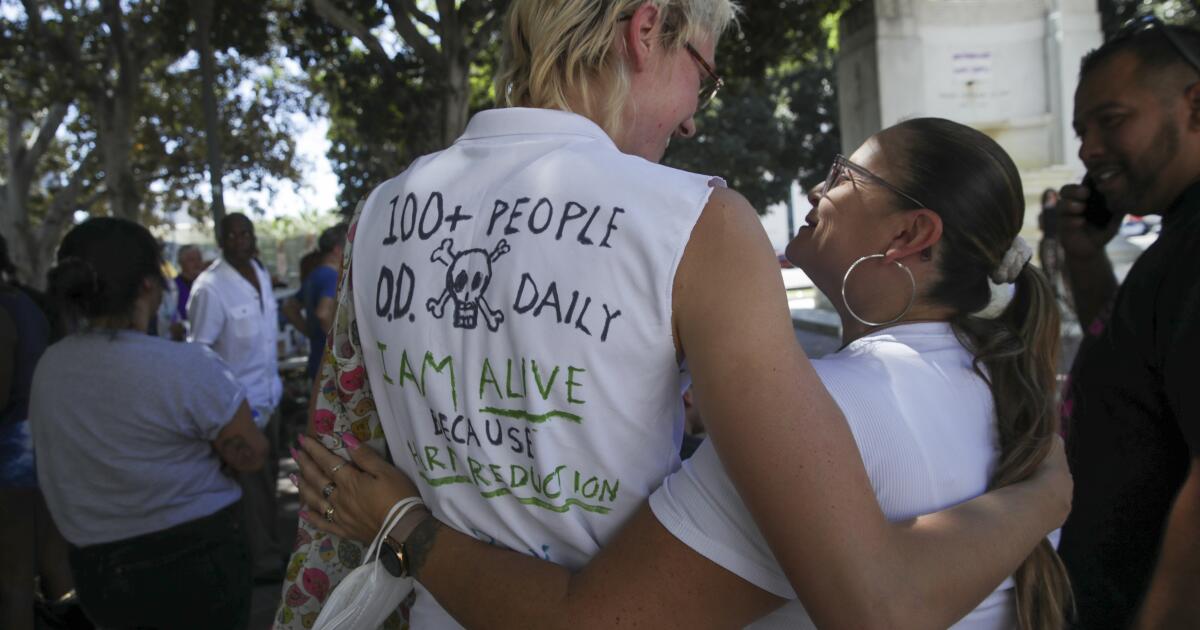
Deaths from drug overdoses fell last year in the United States as fewer people lost their lives to fentanyl and other opioids, marking the first time the death toll had dropped in five years, according to newly released estimates from the Centers for Disease Control and Prevention.
Federal officials said the numbers show a 3% decline in the estimated overdose fatalities between 2022 and 2023. That downturn equates to nearly 3,500 fewer deaths across the U.S. than the year before.
The new figures are tentative and could still be updated. Even a slight decline could be a balm for a country where drug overdoses have taken a devastating toll: In one survey, more than 40% of adults said they knew someone who lost their life to a drug overdose, according to a Rand study published this year.
“I’m thrilled that there wasn’t an increase, but we’re still talking about 107,000 people dying, which is completely unacceptable,” said Beau Kilmer, co-director of the Rand Drug Policy Research Center. Kilmer said better data on drug use are needed to untangle exactly what is driving the changes.
Community groups and health officials grappling with the devastating toll of fentanyl have pushed to equip more people with naloxone, a medicine that can stop opioid overdoses and is commonly sold as a nasal spray under the brand name Narcan. Los Angeles County officials, for instance, credited an effort to hand out Narcan on the streets when they announced last week that overdose deaths had stopped surging among homeless people. To try to reduce the deadly risks, people who use drugs have also turned to test strips to detect fentanyl and avoided using drugs by themselves, among other strategies.
Health researchers have also noted that broader changes in the population could be affecting the numbers: Many heroin users who switched to fentanyl have died, and if fewer people are newly turning to fentanyl use, that could mean fewer people are now at risk, said Dr. Daniel Ciccarone, a UCSF addiction medicine professor.
“Based on utterly anecdotal, street-level observations, I’ll say there aren’t a lot of newbies,” Ciccarone said. “We’re looking for them, but we don’t see them. We don’t see the 22-year-old who says, ‘Hey, I want to use fentanyl.’ This is an aging cohort.”
Even as U.S. deaths linked to fentanyl and other opioids dropped between 2022 and 2023, the country saw an uptick in deaths tied to stimulants such as methamphetamine and cocaine, according to the new estimates. Drug researchers said that in recent years, many deaths involving meth have also involved opioids.
And not all parts of the country saw an overall drop in fatal overdoses. “In the East Coast and in the Midwest, we are seeing declines, but on the West Coast — particularly in the upper Northwest — we’re still seeing increases,” said Farida Ahmad, a health scientist at the National Center for Health Statistics.
The federal figures show that in California, the estimated number of overdose deaths continued to rise in 2023 compared with 2022, increasing by 4.1%. In Oregon and Washington, increases were significantly steeper — roughly 30% and 27% respectively.
Drug use can differ from region to region, shaping ensuing overdoses and deaths: Fentanyl hit the eastern U.S. before spreading west, and methamphetamine use generally has been more common on the West Coast.
Ciccarone lamented that the West Coast should have been better prepared for fentanyl after seeing it hit other parts of the country years earlier, calling it a “failure of public policy.”
“We saw this coming. So why didn’t we prepare for it better?”
Ciccarone credited states in the Midwest and East Coast that had seen notable decreases in overdose deaths, saying that although the exact reasons are unclear, there has been a panoply of efforts that could play a role, including ramping up naloxone distribution and easing access to buprenorphine to treat opioid addiction.
“These are places that were hard hit by fentanyl,” Ciccarone said. “So they’re doing something right.”
The federal estimates released Wednesday do not detail how many deaths linked to methamphetamine also involved other drugs, a phenomenon that has gained growing attention as American mix drugs both knowingly and unknowingly.
Researchers drawing on both federal and local data have found substantial overlap in methamphetamine and opioid use: In L.A. County, for instance, a recent report indicated that in 2022, nearly half of overdose deaths among homeless people involved both methamphetamine and fentanyl.
People who use fentanyl may turn to stimulants for energy to get themselves through daily activities, said Chelsea Shover, an assistant professor at UCLA’s David Geffen School of Medicine. For those facing the dangers of living outside, “you know what helps you stay up at night and stay vigilant? Meth.”
Shover said in recent years, national data have consistently shown the majority of methamphetamine deaths also involve opioids. Those findings were echoed in local research by Shover and other researchers, which found that between 2012 and mid-2021, the bulk of meth-related deaths in L.A. County also involved other drugs or medical conditions, rather than being driven solely by the stimulant.
To help prevent such deaths, “we need to keep doing what we’re doing for opioid-related deaths — because a lot of meth-involved deaths are also opioid-involved,” Shover said.
Scholars have also urged more attention to methamphetamine itself: As it stands, there are no medications approved by the Food and Drug Administration to treat addiction to meth, although some existing medicines have shown promising results, as has offering incentives such as gift cards for people to stay off stimulants.
“The massive investment in reducing overdose deaths has been almost exclusively targeted to opioids,” said Steven Shoptaw, director of the UCLA Center for Behavioral and Addiction Medicine. “There’s been no systematic investment to reduce methamphetamine deaths” — a lapse that Shoptaw said had hindered effective interventions from being widely adopted.
Americans have been eager for any signs of hope amid the overdose crisis, but experts have cautioned against declaring victory too soon in reaction to year-to-year changes in overdose deaths.
For instance, University of Pittsburgh researchers found that the last time fatal overdoses dropped nationally in 2018, the downturn coincided with stricter regulations in China on carfentanil, a highly potent synthetic opioid. The following year, deaths from drug overdoses rose again.
Dr. Donald Burke said that the estimated number of overdose deaths in 2023 was still above the level that researchers had forecast, based on the historic trajectory of such fatalities. The death numbers had jumped higher than expected during the COVID-19 pandemic, Burke said — and may just be returning to the same levels that would have happened in its absence.
“You can make a case that it’s come down, but it’s come down because the COVID impact is less now,” said Burke, dean emeritus of the University of Pittsburgh School of Public Health.
“Without knowing what are the drivers, it’s really hard to tell whether a reduction is a return to the expected trajectory or some other change,” said Dr. Hawre Jalal, an associate professor at the University of Ottawa who has partnered with Burke on such research.
Ciccarone was reluctant to even characterize the newly released estimates as a decrease in overdose deaths, instead referring to “a flattening of the curve.”
“Can we sing hosannas over that? No,” Ciccarone said. “We’re still fighting. We still have a lot of work to do to bend this overdose curve down.”



Shark attacks returned to near-average levels in 2025 after a dip the previous year, according to the latest report from the Florida Museum of Natural History’s International Shark Attack File, published Wednesday.
Researchers recorded 65 unprovoked shark bites worldwide last year, slightly below the 10-year average of 72, but an increase from 2024. Nine of those bites were fatal, higher than the 10-year average of six fatalities.
The United States once again had the highest number of reported incidents, accounting for 38% of global unprovoked bites when assessed on a country by country basis. That said, it’s actually a decline from recent years, including 2024, when more than half of all reported bites worldwide occurred off the U.S. coast.
In 2025, Florida led all states with 11 recorded attacks. California, Hawaii, Texas and North Carolina accounted for the remaining U.S. incidents.
But California stood out in another way: It had the nation’s only unprovoked fatal shark attack in 2025.
A 55-year-old triathlete was attacked by a white shark after entering the water off the coast of Monterey Bay with members of the open-ocean swimming club she co-founded. It was the sole U.S. fatality among 25 reported shark bites nationwide.
It’s not surprising that the sole U.S. shark-related death occurred in California, said Steve Midway, an associate professor of fisheries at Louisiana State University. “In California, you tend to have year-to-year fewer attacks than other places in the U.S. and in the world,” Midway said. “But you tend to have more serious attacks, a higher proportion of fatal attacks.”
The difference lies in species and geography, Midway said. Along the East Coast, particularly in Florida, many bites involve smaller coastal sharks in shallow water, which are more likely to result in nonfatal injuries. California’s deeper and colder waters are home to larger species, such as the great white shark.
“Great whites just happen to be larger,” Midway said. “You’re less likely to be attacked, but if you are, the outcomes tend to be worse.”
Whether measured over 10, 20 or 30 years, average annual shark bite totals globally are actually very stable.
“The global patterns change only slightly from one year to the other,” said Gavin Naylor, director of the Florida Program for Shark Research.
Those annual fluctuations are influenced by a combination of shark biology, ocean conditions and the number of people in the water at any given time in any given place, researchers say.
At the same time, global shark populations remain far below historical levels. Naylor categorizes about 30% of shark species as endangered, largely due to overfishing. In some countries, including the United States and Australia, stronger protections have allowed certain shark populations to recover.
Nevertheless, the risk of being bitten by a shark remains extremely low. The report notes that drowning is a far more common cause of death worldwide — and, if it helps you sleep (or swim), the data show that you are much more likely to be killed by lightning than you are by a shark.

Within hours of the expiration last week of the final arms control treaty between Moscow and Washington, the State Department sent its top arms diplomat, Thomas G. DiNanno, to Geneva to lay out Washington’s vision for the future. His public address envisioned a future filled with waves of nuclear arms buildups and test detonations.
The views of President Trump’s administration articulated in Mr. DiNanno’s speech represent a stark break with decades of federal policy. In particular, deep in the speech, he describes a U.S. rationale for going its own way on the global ban on nuclear test detonations, which had been meant to curb arms races that in the Cold War had raised the risk of miscalculation, and war.
This annotation of the text of his remarks aims to offer background information on some of the specialized language of nuclear policymaking that Mr. DiNanno used to make his points, while highlighting places where outside experts may disagree with his and the administration’s claims.
What remains unknown is the extent to which Mr. DiNanno’s presentation represents a fixed policy of unrestrained U.S. arms buildups, or more of an open threat meant to spur negotiations toward new global accords on ways to better manage the nuclear age.
Read the original speech.
New York Times Analysis
Next »
1
Established in 1979 as Cold War arsenals grew worldwide, the Conference on Disarmament is a United Nations arms reduction forum made up of 65 member states. It has helped the world negotiate and adopt major arms agreements.
2
In his State Department role, working under Secretary of State Marco Rubio, Mr. DiNanno is Washington’s top diplomat for the negotiation and verification of international arms accords. Past holders of that office include John Bolton during the first term of the George W. Bush administration and Rose Gottemoeller during Barack Obama’s two terms.
3
This appears to be referring to China, which has 600 nuclear weapons today. By 2030, U.S. intelligence estimates say it will have more than 1,000.
4
Here he means Russia, which is conducting tests to put a nuclear weapon into space as well as to develop an underwater drone meant to cross oceans.

New York Times Analysis
« Previous Next »
5
In this year’s federal budget, the Trump administration is to spend roughly $90 billion on nuclear arms, including basic upgrades of the nation’s arsenal and the replacement of aging missiles, bombers and submarines that can deliver warheads halfway around the globe.
6
A chief concern of many American policymakers is that Washington will soon face not just a single peer adversary, as in the Cold War, but two superpower rivals, China and Russia.
New York Times Analysis
« Previous Next »
7
The 1987 Intermediate-Range Nuclear Forces Treaty or I.N.F. banned all weapons capable of traveling between 500 and 5,500 kilometers, or 310 and 3,420 miles, whether armed with nuclear or conventional warheads. The Trump administration is now deploying a number of conventionally armed weapons in that range, including a cruise missile and a hypersonic weapon.
8
The destructive force of the relatively small Russian arms can be just fractions of the Hiroshima bomb’s power, perhaps making their use more likely. The lesser warheads are known as tactical or nonstrategic nuclear arms, and President Vladimir V. Putin of Russia has repeatedly threatened to use them in Ukraine.
9
Negotiators of arms control treaties have mostly focused on long-range weapons because the delivery vehicles and their deadly warheads are considered planet shakers that could end civilization.
New York Times Analysis
« Previous Next »
10
This underwater Russian craft is meant to cross an ocean, detonate a thermonuclear warhead and raise a radioactive tsunami powerful enough to shatter a coastal city.
11
The nuclear power source of this Russian weapon can in theory keep the cruise missile airborne far longer than other nuclear-armed missiles.
12
Russia has conducted test launches for placing a nuclear weapon into orbit, which the Biden administration quietly warned Congress about two years ago.
13
The term refers to the five permanent members of the United Nations Security Council—China, France, Russia, the United Kingdom and the United States.
New York Times Analysis
« Previous Next »
14
A top concern of American officials is that Beijing and Moscow might form an alliance to coordinate their nuclear forces. Their joint program to develop fuel for atom bombs is seen as an indication of this emerging threat.
15
This Trump administration plan is dated November but was made public in December.
16
Released last year, this Chinese government document sought to portray Beijing as a leader in reducing the global threat of nuclear weapons.
17
Typically, arms control treaties have not required countries to destroy warheads so their keepers put them into storage for possible reuse. The United States retains something on the order of 20,000 small atom bombs meant to ignite the larger blasts of hydrogen bombs.
18
An imminent surge centers on the nation’s Ohio-class submarines. The Trump administration has called for the reopening of submarine missile tubes that were closed to comply with the New START limits. That will add as many 56 long-range missiles to the fleet. Because each missile can hold multiple arms, the additional force adds up to hundreds more warheads.
19
This refers to weapons meant for use on a battlefield or within a particular geographic region rather than for aiming at distant targets. It is often seen as synonymous with intermediate-range weapons.
20
Here, the talk turns to the explosive testing of nuclear weapons for safety, reliability and devising new types of arms. The United States last conducted such a test in 1992 and afterwards adopted a policy of using such nonexplosive means like supercomputer simulations to evaluate its arsenal. In 1996, the world’s nuclear powers signed a global ban on explosive testing. A number of nations, including the United States and China, never ratified the treaty, and it never officially went into force.
21
In new detail, the talk addresses what Mr. Trump meant last fall when he declared that he had instructed the Pentagon “to start testing our Nuclear Weapons on an equal basis” in response to the technical advances of unnamed foreign states.
22
Outside experts say the central issue is not whether China and Russia are cheating on the global test ban treaty but whether they are adhering to the U.S. definition. From the treaty’s start in 1996, Washington interpreted “zero” explosive force as the compliance standard but the treaty itself gives no definition for what constitutes a nuclear explosion. Over decades, that ambiguity led to technical disputes that helped block the treaty’s ratification.
23
By definition, all nuclear explosions are supercritical, which means they split atoms in chain reactions that become self-sustaining in sufficient amounts of nuclear fuel. The reports Mr. DiNanno refers to told of intelligence data suggesting that Russia was conducting a lesser class of supercritical tests that were too small to be detected easily. Russian scientists have openly discussed such small experiments, which are seen as useful for assessing weapon safety but not for developing new types of weapons.
24
This sounds alarming but experts note that the text provides no evidence and goes on to speak of preparations, not detonations, except in one specific case.
New York Times Analysis
« Previous
25
The talk gave no clear indication of how the claims about Russian and Chinese nuclear testing might influence U.S. arms policy. But it repeated Mr. Trump’s call for testing “on an equal basis,” suggesting the United States might be headed in that direction, too.
26
The talk, however, ended on an upbeat but ambiguous note, giving no indication of what Mr. DiNanno meant by “responsible.” Even so, the remark came in the context of bilateral and multilateral actions to reduce the number of nuclear arms in the world, suggesting that perhaps the administration’s aim is to build up political leverage and spur new negotiations with Russia, China or both on testing restraints.
Science
Notoriously hazardous South L.A. oil wells finally plugged after decades of community pressure

California Gov. Gavin Newsom announced this week that state oil and gas regulators have permanently closed one of the most infamous drill sites in Los Angeles, bringing an end to a decades-long community campaign to prevent dangerous gas leaks and spills from rundown extraction equipment.
A state contractor plugged all 21 oil wells at the AllenCo Energy drill site in University Park, preventing the release of noxious gases and chemical vapors into the densely populated South Los Angeles neighborhood. The two-acre site, owned by the Archdiocese of Los Angeles, is located across the street from several multifamily apartment buildings and less than 1,000 feet from St. Vincent School.
For years, residents and students had repeatedly complained about acrid odors from the site, with many suffering chronic headaches and nosebleeds. The health concerns prompted a community-driven campaign to shut down the site, with some residents even pleading (unsuccessfully) with the late Pope Francis to intervene.
AllenCo, the site’s operator since 2009, repeatedly flouted environmental regulations and defied state orders to permanently seal its wells.
This month, the California Department of Conservation’s Geologic Energy Management Division (CalGEM) finished capping the remaining unplugged wells with help from Biden-era federal funding.
“This is a monumental achievement for the community who have endured an array of health issues and corporate stalling tactics for far too long,” Newsom said in a statement Wednesday. “I applaud the tireless work of community activists who partnered with local and state agencies to finish the job and improve the health and safety of this community. This is a win for all Californians.”
The land was donated to the Catholic Archdiocese of Los Angeles in the 1950s by descendants of one of the city’s early oil barons. Over the decades, the archdiocese leased the land to several oil companies including Standard Oil of California.
Much of the community outcry over the site’s management occurred after AllenCo took over the site in 2009. The company drastically boosted oil production, but failed to properly maintain its equipment, resulting in oil spills and gas leaks.
In 2013, U.S. Environmental Protection Agency officials became sick while inspecting the site. The federal investigators encountered puddles of crude oil on the facility grounds, as well as caustic fumes emanating from the facility, resulting in violations for air quality and other environmental infractions.
In 2020, CalGEM ordered AllenCo to plug the wells after if determined the company had essentially deserted the site, leaving the wells unplugged and in an unsafe condition. AllenCo ignored the order.
In perhaps the most remarkable events in the site’s history, CalGEM officials in 2022 arrived on the site with a court order and used bolt cutters to enter the site to depressurize the poorly maintained oil wells.
The AllenCo wells were prioritized and plugged this week as part of a CalGEM program to identify and permanently cap high-risk oil and gas wells. Tens of thousands of unproductive and unplugged oil wells have been abandoned across California — many of which continue to leak potentially explosive methane or toxic benzene.
Environmental advocates have long fought for regulators to require oil and gas companies to plug these wells to protect nearby communities and the environment.
However, as oil production declines and fossil fuel companies increasingly become insolvent, California regulators worry taxpayers may have to assume the costs to plug these wells. Federal and state officials have put aside funding to deal with some of these so-called “orphaned” wells, but environmental advocates say it’s not enough. They say oil and gas companies still need to be held to account, so that the same communities that were subjected to decades of pollution won’t have to foot the bill for expensive cleanups.
“This is welcome news that the surrounding community deserves, but there is much more work to be done at a much faster pace,” said Cooper Kass, attorney at the Center for Biological Diversity’s Climate Law Institute. “There are still thousands of unplugged and hazardous idle wells threatening communities across the state, and our legislators and regulators should force polluters, not taxpayers, to pay to clean up these dangerous sites.”

Man attacked with hammer before 3 men found dead in Detroit home; person of interest sought

Review: Van Morrison leans into his blues roots at San Francisco show

Dallas condo owners live for a year with no walls — just a tarp

No. 23 Miami will be Without its Star Batter for the Foreseeable Future

This Boston Marathon bombing survivor is running with Miles for Miracles

Florida High School Football Rankings: Top 25 teams – Oct. 21

Cleary's 21 help Le Moyne down Central Connecticut State 69-64 in OT

How old is Bo Nix? What to know about Oregon quarterback ahead of 2024 NFL Draft

99th annual Pony Swim held in Virginia

Indiana Members Credit Union announced as new anchor tenant at Bottleworks District

Former Prince Andrew arrested on suspicion of misconduct in public office | Global News Podcast

DC Mayor Bowser declares emergency over Potomac sewage spill, asks for federal help

Israel installed security at Epstein’s Manhattan apartment for ex-PM Barak

Iran and the US lean into gunboat diplomacy as nuclear talks hang in balance

Democrats risk FEMA disaster funding collapse as DHS shutdown hits Day 5
-

 Culture1 week ago
Try This Quiz on Passionate Lines From Popular Literature
-

 Oklahoma2 days ago
Wildfires rage in Oklahoma as thousands urged to evacuate a small city
-

 Health1 week ago
James Van Der Beek shared colorectal cancer warning sign months before his death
-
![“Redux Redux”: A Mind-Blowing Multiverse Movie That Will Make You Believe in Cinema Again [Review]](https://i1.wp.com/www.thathashtagshow.com/wp-content/uploads/2026/02/Redux-Redux-Review.png?w=400&resize=400,240&ssl=1 "“Redux Redux”: A Mind-Blowing Multiverse Movie That Will Make You Believe in Cinema Again [Review]")
![“Redux Redux”: A Mind-Blowing Multiverse Movie That Will Make You Believe in Cinema Again [Review]](https://i1.wp.com/www.thathashtagshow.com/wp-content/uploads/2026/02/Redux-Redux-Review.png?w=80&resize=80,80&ssl=1 "“Redux Redux”: A Mind-Blowing Multiverse Movie That Will Make You Believe in Cinema Again [Review]") Movie Reviews1 week ago
Movie Reviews1 week ago“Redux Redux”: A Mind-Blowing Multiverse Movie That Will Make You Believe in Cinema Again [Review]
-

 Technology1 week ago
HP ZBook Ultra G1a review: a business-class workstation that’s got game
-
 Science1 week ago
A SoCal beetle that poses as an ant may have answered a key question about evolution
-
 Politics7 days ago
Culver City, a crime haven? Bondi’s jab falls flat with locals
-

 Politics7 days ago
Tim Walz demands federal government ‘pay for what they broke’ after Homan announces Minnesota drawdown