Science
A Scientist Is Paid to Study Maple Syrup. He’s Also Paid to Promote It.


For more than a decade, Navindra Seeram, a biomedical researcher, has praised maple syrup, calling it a “hero ingredient” and “champion food” that could have wide-ranging health benefits.
Dr. Seeram, dean of the School of Pharmacy at the University of New England, has published more than three dozen studies extolling the power of maple. Much of his work has been bankrolled by Canada’s maple syrup industry and the Canadian and American governments.
At the same time, he has taken on another role: maple syrup pitchman.
“I am uniquely qualified as the world’s leading researcher on maple health benefits with the scientific reputation and credibility to promote the sales of maple products,” he has written in grant applications. He has assured leaders of the Canadian industry that he would always support maple from Quebec, according to emails obtained through a public records request.
As he straddles the realms of scientific inquiry and promotion, he has distorted the real-world implications of his findings and exaggerated health benefits, according to a review by The Examination and The New York Times of 15 years of his studies and public statements. In videos and press releases, he has suggested that consuming maple syrup may help stave off diseases including cancer, Alzheimer’s and diabetes. Other scientists told The Examination and The Times that they thought he had overstated his lab findings and made misleading claims.
Industry funding is commonplace in nutrition research and may become even more critical as scientists grapple with the Trump administration’s sweeping cuts. Dr. Seeram’s work shows the perils of intertwining science and salesmanship, propelling information that can shape consumer habits and public health.
At the University of Rhode Island, where he worked until last year, Dr. Seeram oversaw projects that were awarded $2.6 million in U.S. government funding, including a grant explicitly intended to increase maple syrup sales. That promotional work produced a stream of social media posts like, “Maple Syrup’s Benefits: Anti-Cancer, Anti-Oxidant, Anti-Inflammatory.”
In a video posted on YouTube in 2019, Dr. Seeram said nutrients in maple syrup could “potentially together prevent and/or delay the onset” of conditions such as “cardiovascular disease, metabolic syndrome, diseases of the brain and so on.”
But his studies have found something more limited: that maple syrup contains small amounts of polyphenols, compounds in plants that are generally considered beneficial. To demonstrate their effects, he tested highly concentrated maple extracts in lab settings — not people’s consumption of commercial maple syrup.
Dr. Seeram told The Examination that he believed in the power of natural medicines, which were part of his upbringing in South America. And he defended how he had spoken about his findings: “No one can go back to direct-quote from me to say, ‘It’s going to cure cancer, it’s going to cure diabetes.’”
His conclusions often include hedging language — that maple syrup “may” or “could” have meaningful health effects — or disclaimers recommending further study. But several researchers said that the caveats weren’t enough to counterbalance broad health claims, and that Dr. Seeram had leaped too far from lab findings to practical applications.
“They are framing it in a far more positive light than they should,” said Christopher Gardner, a nutrition researcher at Stanford.
In an interview, Dr. Seeram blamed a former colleague at the University of Rhode Island for stirring up what he said was unwarranted scrutiny of his work. A university official said the school had investigated and found no research misconduct.
At a maple industry conference in October, Dr. Seeram described his work as making “it simple for Mom to understand” that syrup is beneficial.
“We have to convince the consumer that this sugar is good for you,” he told an audience of maple farmers, and laid out how to reach the public: Studies like his would be published in peer-reviewed journals, leading to marketing and media coverage and inspiring consumers to buy.
The Quebec Maple Syrup Producers, an industry association that markets and regulates most of the world’s maple syrup, has long funded Dr. Seeram’s work. The association and the Canadian government have together provided at least $2.8 million for his research, according to a 2019 grant application. The association disputed that figure but would not provide details; neither would Dr. Seeram.
The association has also hired him for consulting and what it termed “PR activities” for at least a decade, according to emails and invoices. In 2023, his fees totaled $37,000, emails show.
In response to one of several emails from association officials thanking him for his work, he wrote in 2018 that he would “always work to find ways to promote maple products from Quebec.”
The maple association approached him in 2009, after the owners of POM Wonderful had funded and used some of his research on pomegranate to promote their juice during the pomegranate craze of the 2000s. (The Federal Trade Commission later issued a cease-and-desist order accusing the company of making misleading or false claims, based in part on a study he coauthored.)
Though Dr. Seeram had not previously researched maple, he told The Examination he was intrigued because he had recently moved to the Northeast, where it is an important agricultural product. Over the next couple of years, Dr. Seeram announced he had discovered dozens of polyphenols in maple syrup, including one his team named Quebecol.
Based on his lab tests of concentrated compounds, he began suggesting that maple syrup had wide-ranging applications for human health.
“Maple syrup is becoming a champion food,” he said in a 2011 press release. “Several of these compounds possess antioxidant and anti-inflammatory properties, which have been shown to fight cancer, diabetes and bacterial illnesses.”
But experts say the low levels of these compounds in syrup are unlikely to improve health. Dr. Seeram acknowledged in interviews that a person would have to consume gallons of maple syrup to get the nutritional equivalent of the extracts. He noted, as he often has, that he isn’t encouraging anyone to consume more sugar, merely to choose maple syrup over alternatives.
The U.S. Department of Agriculture, another important benefactor, awarded more than $2.6 million for Dr. Seeram’s work. This included nearly $500,000 in 2017 to study whether maple syrup extract could improve the health of obese mice. Their health did not improve, and in some cases worsened, according to study findings cited by a government website and a student dissertation. The results weren’t published in an academic journal. Dr. Seeram, who in recent weeks stopped responding to queries from The Examination and The Times, didn’t answer questions about this study.
In 2018, the U.S.D.A. awarded $500,000 to a group led by Dr. Seeram for a promotional campaign that would showcase maple research on a University of Rhode Island website. Dr. Seeram’s grant application said he would be responsible for translating the science into “lay-friendly terminology.”
The website, overseen by his team, called maple syrup “immensely healthy for you.” And though it carried disclaimers that more research was needed, it made misleading statements connecting studies of reduced-sugar maple extract to the consumption of maple syrup, such as: “Did you ever think that you could fight high blood sugar with some things as sugary and delicious as maple syrup?”
It also said the Quebecol compound could become a “potential cancer prevention drug,” noting that it looked “remarkably similar” to the breast cancer drug Tamoxifen — a comparison Dr. Seeram has also made in presentations.
In interviews, three cancer researchers called this comparison misleading. Geoffrey Greene of the University of Chicago said it was like expecting the brother of a concert violinist to also be a concert violinist because they looked similar.
When asked why he has used his research to promote maple products, Dr. Seeram said he was simply fulfilling the terms of the government grant. A U.S.D.A. spokeswoman said the University of Rhode Island was responsible for the website’s claims.
The university wouldn’t comment on the research. After inquiries from reporters, the website was taken down. The university said this was part of a broader effort to remove dormant pages.
One of Dr. Seeram’s studies involved giving maple syrup extract to genetically modified worms to examine Alzheimer’s-related effects. His team observed that some worms fared better, but on average they were worse off. Nevertheless, the top-line summary in Dr. Seeram’s paper, published in 2016 by the journal Neurochemical Research, ignored the negative results and said the syrup extract “showed protective effects” for the worms.
An industry association press release said maple syrup extract had prolonged the worms’ lives — even though on average they died sooner — with a disclaimer that more research was needed. That nuance was lost in headlines in Canada, India, England and the United States proclaiming that maple syrup could protect against Alzheimer’s.
Christopher Link of the University of Colorado Boulder, who pioneered Alzheimer’s research on that kind of worm, criticized the study, citing the lack of basic details like the number of worms tested and whether the experiment had been replicated. Dozens of plant extracts have produced positive results in similar experiments, Dr. Link said, but that doesn’t mean they have real-world applications.
In a statement, Julie Barbeau of the maple association said it adheres to strict ethics rules and has had “no influence whatsoever” on the scores of research projects it has backed.
At least a dozen of Dr. Seeram’s papers that the maple association says it funded didn’t disclose that relationship. Also not disclosed in his papers: his paid consultant role and a Canadian maple extract patent that names him and Ms. Barbeau as co-inventors.
Six publishers of Dr. Seeram’s work said they require authors to declare potential conflicts of interest. Dr. Seeram did not respond to questions about his disclosures.
In public statements, he has acknowledged receiving financial support from the maple association. And in earlier interviews, he said that industry funding is vital, because other research dollars are scarce. He also defended his patents, saying, “The driver here is not for me to get rich.” The maple association said it was protecting its intellectual property.
Last year, the association hailed a new study, which it funded, as the “first human clinical trial” of maple syrup.
Participants replaced a small amount of sugar in their diet with maple syrup — for instance, to sweeten coffee. The scientists told Newsweek that the results, published in The Journal of Nutrition, showed that maple syrup improved measures of blood sugar, blood pressure and fat, and might help lower the risk of diabetes and cardiovascular disease.
Dr. Seeram, who was not an author of the study, said the results validated his work.
But three independent experts who reviewed the research said the conclusions were overstated — emphasizing a few positive results among dozens of measures — and the study appeared to show no meaningful difference between maple syrup and refined sugar.
“They took it too far,” said Kimber Stanhope, a nutritional biologist at the University of California, Davis.
The lead researcher, André Marette of Laval University, said that while the differences between maple syrup and refined sugar were “modest,” they were meaningful. Through a public relations firm hired by the industry association, he said, “We were careful to state that the clinical relevance of the work will need to be further substantiated.”
In the meantime, the findings have reached the general public. “Sweet!” effused a headline in a women’s magazine last fall. “Maple Syrup in Coffee Could Help You Lose Weight.”
Mago Torres contributed reporting.



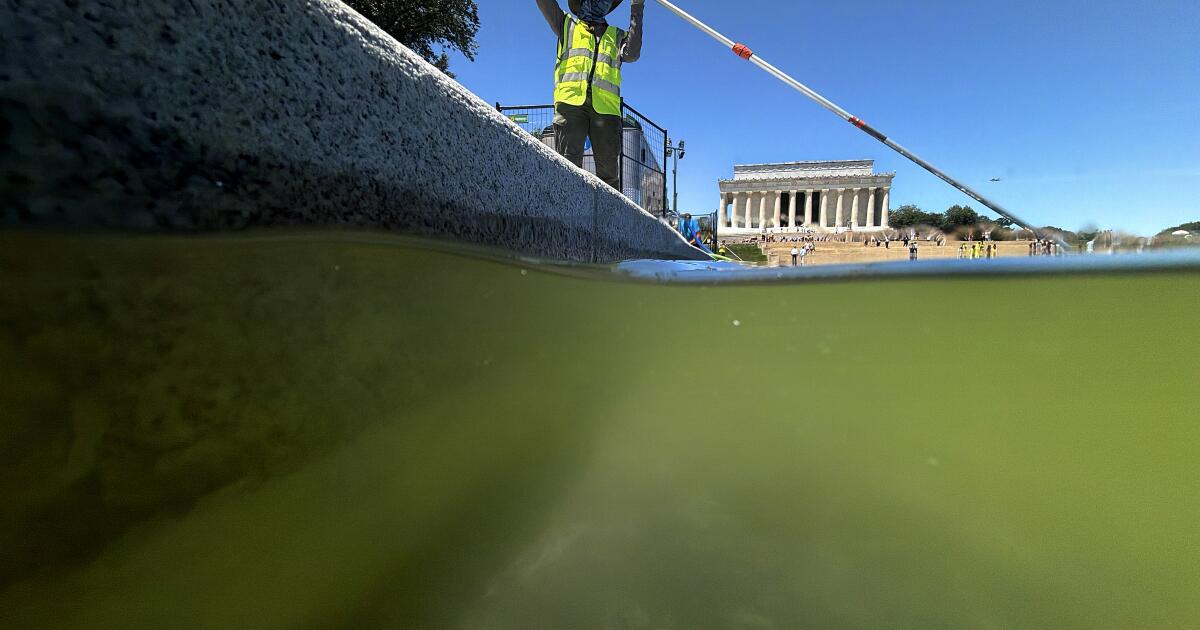
Just days after the Trump administration completed millions of dollars in renovations on the Lincoln Memorial Reflecting Pool to make it American flag-blue, residents and online users noted it had turned a phosphorescent green.
Here’s why:
The calm, still waters of the Reflecting Pool make it an ideal nursery for algae growth. Algae need nitrogen and phosphorus to grow, and the Reflecting Pool is primarily fed by the Potomac River, which gets heavy doses of those nutrients from nearby urban and agricultural lands.
The Potomac also absorbed one of the largest sewage spills in U.S. history earlier this year when a pipe burst five miles upstream of Washington, although that event probably happened too long ago to contribute to the algal bloom today.
Untreated sewage is high in nitrogen and phosphorus. When nutrient levels are high, feasting algae can quickly reproduce.
The Department of the Interior said when the algae first appeared that it was “residual,” from the supply lines to the pool.
Experts also speculate that the darker blue color may be helping the Reflecting Pool absorb more heat. The higher temperatures promote algae growth by allowing their metabolisms to shift into overdrive.
Summer temperatures in D.C. aren’t helping. This week, temperatures are as high as 95 degrees in the city, prompting a heat alert.
The combination probably explains the excessive growth, turning the water surface an opaque green and preventing onlookers from seeing the new blue hue of the concrete basin.
Algae are important and beneficial organisms when the ecosystem is in balance. They’re the base of the aquatic food chain, fed on by herbivores of all shapes and sizes, including shrimp and juvenile fish, which in turn feed organisms higher up the food chain. The single-celled organisms use the power of the sun to produce energy through photosynthesis, similar to houseplants on your balcony.
In an effort combat the algae in the Reflecting Pool, employees of the National Park Service were seen pouring in gallons of hydrogen peroxide, a chemical commonly used in pool maintenance.
The Department of the Interior also is employing a “high-tech nanobubble ozone technology” to destroy the cells of the algae.
Ozone — yes, the same irritant that is in smog — is a gas composed of three oxygen molecules, and the small size of the bubbles allow the most gas transfer into the water, where it can damage algal cells, similar to how it irritates our lungs.
This only treats the symptoms, however. Generally, ozone nanobubbling is effective as a temporary solution for algae blooms. Longer-term fixes would have to address what makes the Reflecting Pool so ideal for algae, such as its depth, darker color and inflow of nitrogen and phosphorus.
In California, ozone nanobubbles also have been used in a project to improve water quality in the Tijuana River. The 120-mile river that runs near the border in northern Mexico and Southern California was the site of a pilot study in 2025. The U.S. section of the International Boundary and Water Commission reported that the nanobubbling reduced “odors and bacteria,” but the project concluded prematurely after a flood swept some of the instrumentation into the river.

A plant extract that’s gaining popularity as a pain cure-all and has been associated with multiple California deaths in its concentrated, synthetic form has been approved for research as a treatment for opioid addiction by the federal government.
Kratom is derived from the leaves of Mitragyna speciosa, a tree native to Southeast Asia, and is commonly made into a powder or pill.
Researchers say people in the U.S. are using kratom to alleviate anxiety, treat chronic pain or as a remedy for the symptoms associated with quitting opioids, due to its ability to bind with opioid receptors in the body. But recently, public health officials have raised alarms about a component of the leaf called 7-hydroxymitragynine, also known as 7-OH, an alkaloid that has the potential for abuse and addiction in high doses.
Last year, the Los Angeles County Public Health Department linked the deaths of six county residents to the use of 7-OH mixed with other substances. The toxicology screens for some of the deceased revealed both kratom and 7-OH, leading to a countywide crackdown of products with either compound because they’re unregulated.
Although there is no scientific consensus on whether kratom has therapeutic value, the Food and Drug Administration has recommended that its potent 7-OH form be classified as a controlled substance. Consumers who use 7-OH as a pain reliever expecting an experience similar to consuming kratom are at risk, said Dr. Mason Turner, president-elect of the California Society of Addiction Medicine.
“I have a couple of patients that I work with who use 7-OH for chronic pain management, not realizing the potential of the medication, and then developed an opioid use disorder,” Turner said. “I think in that case it was very clear they were seeking it for the chronic pain, not to get high, not to have some kind of experience, but really to reduce their pain.”
About two decades ago, Turner said, the healthcare industry started acknowledging the limits and risks of prescribing opioids for chronic pain. Some doctors pulled back on prescriptions, recognizing the potential for abuse.
That led some patients to find alternative solutions, he said.
“Maybe they don’t get a good benefit, or maybe the benefit from some of the other treatments is not as robust as what they got from opioids,” Turner said. “So they seek out some of these illicit products … or they look for kratom or 7-OH to be able to mitigate the pain.”
Turner said he supports further research into kratom and regulation because “it could be worth exploring as a treatment for chronic pain.”
On June 1, the National Institutes of Health announced that researchers from the University of Florida would begin the first phase of clinical trials on kratom to evaluate it as a potential treatment for opioid addiction. The research would be done with the FDA’s approval, according to officials.
“This … is a major step toward expanding treatment options for the millions of Americans struggling with opioid use disorder, which has contributed to historically high overdose mortality rates,” said Dr. Nora Volkow, director of NIH’s National Institute on Drug Abuse, in a statement.
Interest in kratom surged in the last couple of years as users have reported consuming the compound in the form of a pill, powder or tea to treat various ailments. A John Hopkins survey conducted in 2020 reported that 91% of respondents used kratom to treat chronic pain, 67% to treat anxiety, 64% for depression and 41% to treat opioid dependence.
A more recent study by the University of Michigan and Texas State University found that more than 5 million people in the U.S., including more than 100,000 children ages 12 to 17, have used kratom, the compound experts say is growing in popularity with young adults.
In the study, which analyzed data from the National Survey on Drug Use and Health collected between 2021 and 2024, researchers say that despite numerous state-level bans on kratom across the nation, its use is at an all-time high and is increasing.
People between the ages of 21 and 34 said they used kratom at least once and 1% said they used it in the last year. The share of children ages 12 and older who said they had used kratom increased from 1.6% in 2021 to 1.9% in 2024.
The FDA has stated that neither kratom nor 7-OH are approved as drug products, dietary supplements or food additives, but that hasn’t stopped storefronts and companies from selling them as such.
Up until November you could find kratom and 7-OH products in smoke shops and specialty stores in California, but that has stopped.
“Until kratom and its pharmacologically active key ingredients mitragynine and 7-OH are approved for use, they will remain classified as adulterants in drugs, dietary supplements and foods,” the California Department of Public Health told The Times via email.
Kratom “Feel Free Classic” liquid products are displayed at a smoke shop in Los Angeles in 2024 before they were banned.
(Michael Blackshire / Los Angeles Times)
In May, the California Department of Public Health and Atty. Gen. Rob Bonta filed a complaint against Ashlynn Marketing Group Inc., accusing the company of repeatedly flouting the state’s regulations on kratom products.
The filing, submitted in the San Diego County Superior Court, seeks a judge’s order to condemn and destroy the embargoed kratom products, halt ongoing unlawful manufacturing and impose civil penalties.
The California Department of Public Health “is pursuing legal action because Ashlynn’s continued manufacture and sale of these products pose a clear and preventable public‑health risk and violates state and federal law,” said Dr. Erica Pan, the department’s director and state public health officer. “7-OH and kratom-derived products have been associated with addiction, serious health harms, overdose and death.”
The state is alleging its inspectors visited Ashlynn Marketing Group’s facility in Santee in May 2025 and found kratom powders, capsules, liquids and chewable tablets being manufactured and held for sale.
During the visit, inspectors issued an embargo to prohibit the sale and distribution of all kratom-related materials on-site, according to the complaint.
Public health inspectors conducted follow-up visits at the facility in October and April, “collecting evidence at both inspections that indicated embargoed kratom products had been moved, tampered with and repackaged,” according to public health officials.
“In addition, investigators observed evidence of continued manufacturing and distribution of kratom materials,” officials said. “The firm’s owner continues to manufacture kratom products and ships orders weekly.”
To date, the California Department of Public Health has seized more than $5 million worth of kratom and 7-OH products, a spokesperson for the department told The Times.
California and Los Angeles County are considering whether to tighten regulations or ban the compounds altogether.

NEW YORK — Scientists have unearthed communities of marine life — including jellyfish, tubeworms and brittle stars — thriving on a whale graveyard that is millions of years old.
These graveyards form when whale carcasses fall to the sea floor, becoming a sustaining snack for nearby critters. This one, located up to 23,000 feet below the surface of the southeastern Indian Ocean, spans the largest area and is so far the deepest and oldest found.
A whale’s sheer size and the unique chemistry of its bones are the keys to forming these unique underwater neighborhoods, said Xikun Song, a biologist with the Chinese Academy of Sciences’ Institute of Deep-sea Science and Engineering.
“At the same time, the very nature of the deep ocean makes these sites exceptionally difficult for scientists to locate,” Song, who was involved with the latest find, wrote in an email.
Researchers explored the remains during multiple deep-sea submersible trips in 2023, collecting samples and mapping the extent of the necropolis. They found five carcass sites and fossils, including skulls belonging to beaked and baleen whales. The oldest bones date back 5.3 million years.
Feeding and living on the carcasses were myriad creatures, large and small, including sea cucumbers, squat lobsters and saltwater clams. Many of them are likely species that have never been documented, according to findings published Wednesday in the journal Nature.
“The potential number of specimens is just astounding,” said paleontologist Stephen Godfrey with the Calvert Marine Museum in Maryland, who wasn’t involved in the research.
Many factors likely conspired to preserve the bones for millions of years, according to the study authors. They’re dense enough to outlast attacks from bone-eating worms, and located deep enough in the ocean to avoid getting buried by dust and loose particles. The bones also were coated with a light layer of minerals from the surrounding seawater, which may have prevented them from degrading.
Why did so many whales die here? Maybe they were already living in the area and died of natural causes. A few could have perished from exhaustion or illness caused by deep-sea diving. The area’s shape, akin to the letter V, could also have funneled the remains to their resting spot, the authors wrote.
Such discoveries are important because they clue scientists into the vibrant communities that find a way to live even in remote, hard-to-reach environments.
Studying the whale graveyards “is important for understanding how life can adapt to such extreme conditions, not only due to the lack of light and oxygen but also to the incredibly high pressure,” said study co-author and paleontologist Giovanni Bianucci with the University of Pisa in Italy in an email.
Ramakrishnan writes for The Associated Press.
The Associated Press Health and Science Department receives support from the Howard Hughes Medical Institute’s Department of Science Education and the Robert Wood Johnson Foundation.
-
 Sports6 minutes ago
Dodgers’ walk-off stuns Orioles as Dalton Rushing helps cap wild comeback
-

 World18 minutes ago
Trump doubles down on Meloni photo comments
-

 News41 minutes ago
The Real Love Company made her feel whole. Then ‘Daddy’ said to strip naked.
-

 Los Angeles, Ca2 hours ago
Woman, man found shot to death in Pomona, suspect leads officers on erratic chase
-

 Detroit, MI2 hours ago
Today in History: June 20, race-related rioting erupts in Detroit
-

 San Francisco, CA3 hours ago
San Francisco hotels see steady World Cup business, but fall short of Super Bowl surge
-

 Dallas, TX3 hours ago
Dallas International Piano Competition brings finalists June 23
-

 Miami, FL3 hours ago
Where to watch San Francisco Giants vs Miami Marlins: TV channel, start time, streaming for June 20

