Science
A retired teacher found some seahorses off Long Beach. Then he built a secret world for them


Rog Hanson emerges from the coastal waters, pulls a diving regulator out of his mouth and pushes a scuba mask down around his neck.
“Did you see her?” he says. “Did you see Bathsheba?”
On this quiet Wednesday morning, a paddle boarder glides silently through the surf off Long Beach. Two stick-legged whimbrels plunge their long curved beaks into the sand, hunting for crabs.

Classic stories from the Los Angeles Times’ 143-year archive
But Hanson, 68, is enchanted by what lies hidden beneath the water. Today he took a visitor on a tour of the secret world he built from palm fronds and pine branches at the bottom of the bay: his very own seahorse city.
The visitor confirms that she did see Bathsheba, an 11-inch-long orange Pacific seahorse, and a grin spreads across Hanson’s broad face.
“Isn’t she beautiful?” he says. “She’s our supermodel.”
If you get Hanson talking about his seahorses, he’ll tell you exactly how many times he’s seen them (997), who is dating whom, and describe their personalities with intimate familiarity. Bathsheba is stoic, Daphne a runner. Deep Blue is chill.
He will also tell you that getting to know these strange, almost mythical beings has profoundly affected his life.
“I swear, it has made me a better human being,” he says. “On land I’m very C-minus, but underwater, I’m Mensa.”

Hanson is a retired schoolteacher, not a scientist, but experts say he probably has spent more time with Pacific seahorses, also known as Hippocampus ingens, than anyone on Earth.
“To my knowledge, he is the only person tracking ingens directly,” says Amanda Vincent, a professor at the University of British Columbia and director of the marine conservation group Project Seahorse. “Many people love seahorses, but Roger’s absorption with them is definitely distinctive. There’s a degree of warm obsession there, perhaps.”

Rog Hanson keeps watch over a small colony of Pacific seahorses.
(Carolyn Cole / Los Angeles Times)
Over the last three years, Hanson has made the two-hour trek from his home in Moreno Valley to the industrial shoreline of Long Beach to visit his “kids” about every five days. To avoid traffic, he often leaves at 2 a.m. and then sleeps in his car when he arrives.
He keeps three tanks of air and his scuba gear in the trunk of his 2009 Kia Rio. A toothbrush and a pair of pink leopard print reading glasses rest on the dash.
Hanson makes careful notes after all his dives in a colorful handmade log book he stores in a three-ring binder. On this Wednesday he dutifully records the water temperature (62 degrees), the length of the dive (58 minutes), the greatest depth (15 feet) and visibility (3 feet), as well as the precise location of each seahorse. His notes also include phase of the moon, the tidal currents and the strength of the UV rays.
“Scientists will tell you that sunlight is an important statistic to keep down,” he says.
He has given each of his four seahorses a unique logo that he draws with markers in his log book. Bathsheba’s is a purple star outlined in red, Daphne’s is a brown striped star in a yellow circle.

Rog Hanson makes careful notes after all his dives. He has given each of his four seahorses a unique logo.
(Carolyn Cole / Los Angeles Times)
He’s learned that the seahorses don’t like it when he hovers nearby for too long. Now he limits his interactions with them to 15 to 30 seconds at a time.
“At first I bugged them too much,” he says. “I was the paparazzi swimming around.”
Hanson traces the origins of his seahorse story back nearly two decades to the early morning of Dec. 30, 2000.
He was diving solo off Shaw’s Cove in Laguna Beach when a slow-moving giant emerged from the abyss. It was a gray whale whose 40-foot frame cast Hanson in shadow.
The whale could have killed him with a flick of its tail, Hanson says, but he felt no fear. The two made eye contact and, as Hanson tells it, he felt the whale’s gaze peering directly into his soul.
It was all over in 10 seconds, but Hanson was altered. He had always wanted to live at the beach, but after this encounter, he vowed to make it happen. It took years —15, in fact — but he finally got a job as a special education teacher in the Long Beach public school system. He bought a van and parked it on Ocean Boulevard. He lived at the beach and dived every day for 3½ months before moving to Moreno Valley.
To amuse himself while he lived at the beach, he built an underwater city he called Littleville out of discarded toys he found at the bottom of the bay.
Hanson saw his first seahorse in January 2016 while checking on Littleville. It was bright orange, just 4.5 inches long, and Hanson, who had logged over a thousand dives in the area, knew it didn’t belong there.

Daphne is one of the seahorses that Rog Hanson is studying in Alamitos Bay.
(Carolyn Cole / Los Angeles Times)
The range of the Pacific seahorse is generally thought to extend from Peru to as far north as San Diego. This seahorse ended up about 100 miles north of that.
Scientists said the seahorse and others that joined her had probably ridden an unusual pulse of warm water up the coast, along with other animals generally found in southern waters.
“We were getting a lot of weird sightings in the fall of 2015,” says Sandy Trautwein, vice president of husbandry at the Aquarium of the Pacific. “There was a yellow-bellied sea snake, bluefin tuna, marlin, whale sharks — a lot of animals associated with warm water.”
Most of these animals eventually left after ocean temperatures returned to normal, but Hanson’s seahorses stayed.
That may be because Hanson had built them a home.
It happened like this: In June 2016 he watched in horror as more than 100 high school football players splashed in the shallow waters, right where his seahorses usually hung out.
“I thought, I gotta do something, I gotta do something,” he says.
“On land I’m very C-minus, but underwater, I’m Mensa.”
— Rog Hanson
Then he remembered that, back in the Midwest where he grew up, he used to help the city park service make “fish cribs.” In early spring they would use brush and twigs to build what looked like a miniature log cabin with no roof on an ice-covered lake. When the ice melted, the cribs would fall to the bottom, creating a habitat for fish and other animals.
“So I said to myself, build them a city that’s deeper, where feet can’t get to it even at low tide,” Hanson says.
And he did.
By July 2016 two pairs of seahorses had moved into the new habitat. Daphne, the runner, was named after the nymph from Greek mythology who flees Apollo, Kenny’s name came from the proprietor of a local kayaking company. “Bathsheba” was inspired by a Bible story, and her mate, Deep Blue, named after a dive shop that has helped sponsor Hanson’s work since he launched his seahorse study.
He’s seen Kenny’s and Deep Blue’s bellies swell with pregnancy and noted how their partners check in on them daily, frequently standing sentinel nearby. He’s visited the fish at odd hours to see how their behavior changes from morning to night. And he mourned when Kenny disappeared in January. He still hasn’t come back. (A new member, CD Street, arrived June 29.)
“It feels like I’m reading a book, the book of their life, and I can’t put it down,” he says.
He’s also reached out to seahorse scientists across the globe to compare notes. “I won’t say I know the most about seahorses in the world, but I know the people who do,” he says.
Amanda Vincent, the director of Project Seahorse, says that seahorses spark an emotional reaction in almost everyone.

Daphne is one of the seahorses that Rog Hanson is studying in Alamitos Bay. Hanson and Ashley Arnold keep watch over a small colony of Pacific seahorses.
(Carolyn Cole / Los Angeles Times)
“Remember those books with three flaps where you can mix the head of a giraffe with the body of a snake and the tail of a monkey? That’s what we’ve got here,” she says. “They appeal to the sense of fancy and wonder in us.”
When Mark Showalter, a planetary astronomer at the SETI Institute, recently discovered a moon orbiting Neptune, he named it Hippocamp in part because of his love of seahorses.
“I’ve seen them in the wild and they are marvelously strange and interesting,” he says. “It’s a fish, but it doesn’t look anything like a fish.”
Pacific seahorses are among the largest members of the seahorse family. Males can grow up to 14 inches long, while females generally top out at about 11. They come in a variety of colors, including orange, maroon, brown and yellow. They are talented camouflagers that can alter the color of their exoskeleton to blend into their environment.
“I won’t say I know the most about seahorses in the world, but I know the people who do.”
But perhaps their most distinguishing characteristic is that they are the only known species in the animal kingdom to exhibit a true male pregnancy. Females deposit up to 1,500 eggs in the male’s pouch. The males incubate the eggs, providing nutrition and oxygen for the growing embryos. When the larval seahorses are ready to be released, he goes into labor — scientists call it “jackknifing” — pushing his trunk toward his tail.
After three years of observation, Hanson has collected new evidence about seahorse mating practices. His research suggests that although most seahorses are monogamous, a female will mate with two males if there are no other female seahorses around.
He also found that males, who are in an almost constant state of pregnancy, tend to stick to an area about the size of a king-size mattress, while the females roam up to 150 feet from their home during a typical day.
Eventually, he may be able to help scientists answer another long-standing question: What is the lifespan of Pacific seahorses in the wild? Some researchers say about five years; others think it could be up to 12.
“It will be interesting to see what Roger finds out,” Vincent says.
In June 2017, about one year after Hanson began formally tracking the seahorses, he took on a partner: a young scuba instructor named Ashley Arnold.
Arnold, who has short red hair and a jocular vibe, is a former Army staff sergeant who served in Iraq and Afghanistan. She learned to dive as part of a program the Salt Lake City Veterans Affairs hospital offered to female veterans suffering from post-traumatic stress disorder and military sexual trauma. Arnold suffered from both. Diving became her salvation.

Dive instructor Ashley Arnold is a former Army staff sergeant who says that diving at least twice a week helps her deal with PTSD and MST.
(Carolyn Cole / Los Angeles Times)
“All the irritation on the surface disappears when you go under the water,” she says. “It’s like, ‘What was I concerned about?’ You forget about everything else. Nothing else matters.”
She used her GI Bill to pay for a scuba instructor course and to set up her own business. Now, she finds that if she dives at least twice a week and has a dog, she does not need to take medication.
“All the irritation on the surface disappears when you go under the water.”
— Ashley Arnold
“That’s a pretty big statement in my opinion,” she says.
Arnold and Hanson met in June 2016 on a dive trip to Catalina. Hanson mentioned his seahorses. Arnold was intrigued, but still lived in Salt Lake City.
One year later, Arnold moved to Huntington Beach and gave Hanson a call.
“I said, ‘Hey Roger, let’s chat. Any chance I could join you at the seahorses you talked about?’” she says. “And he decided I was acceptable.”
Now, Arnold and her boyfriend, Jake Fitzgerald, check in on the seahorses about once a week and help Roger rebuild the city he created for them.

Rog Hanson, 68, teamed up with dive instructor Ashley Arnold two years ago to keep watch over a small colony of Pacific seahorses.
(Carolyn Cole / Los Angeles Times)
“We call them our kids because we love them so much,” Arnold says.
Hanson and Arnold are very protective of their seahorse family. They tell visitors to remove GPS tags from their photos. They swear them to secrecy.
There is little chance anyone would find Hanson’s seahorses without a guide. Also, diving in these waters off Long Beach can be a challenge.
The water is shallow. It’s hard to get your buoyancy right. A misplaced flipper kick can stir up blinding sand and silt.
But if Hanson wants to show you his underwater world, nothing will stop him. He will hold you firmly by the hand and guide you down to the forest he built at the bottom of the bay.

Ashley Arnold, right, gets rinsed off with a hose by Rog Hanson after a dive Alamitos Bay.
(Carolyn Cole / Los Angeles Times)
He will use a plastic tent stake, jabbing it into the bottom to propel himself — and you holding on — across the ocean floor. When he spots a seahorse he will use the stake as a pointer. Through the murky water you strain to see. Then it appears.
Orange and rigid. Thin snout. Bony plates. Stripes down the torso. Totally still.
And if you’ve never seen a seahorse in the wild before, you will feel honored and awed, as if you’ve just seen a unicorn beneath the sea.



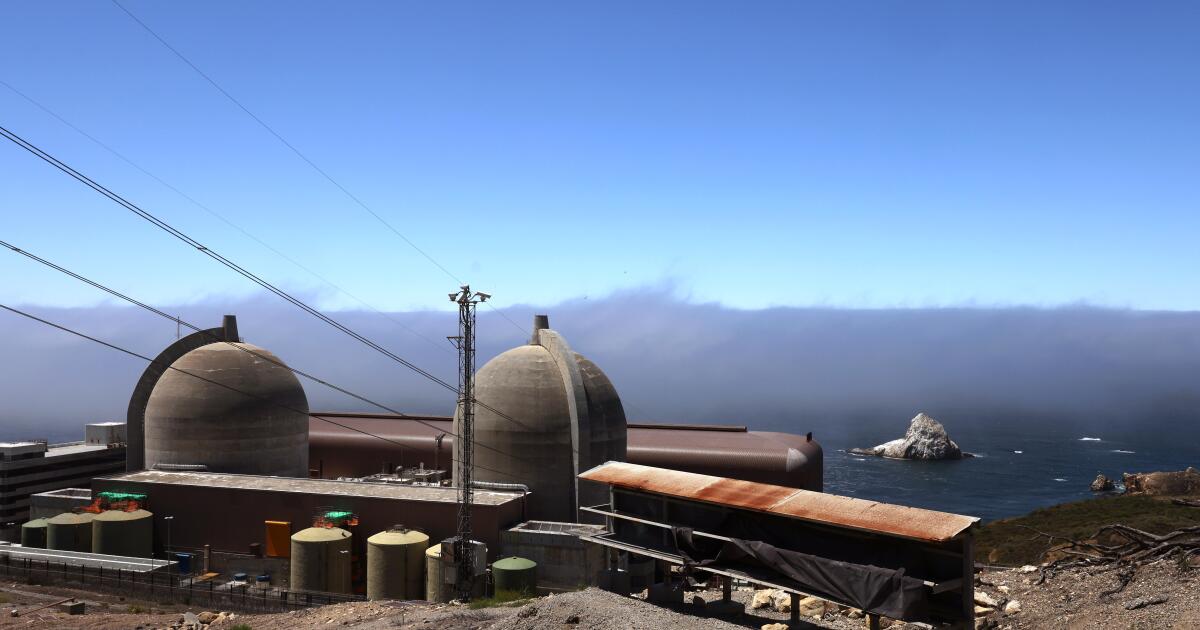
Central Coast Water authorities approved waste discharge permits for Diablo Canyon nuclear plant Thursday, making it nearly certain it will remain running through 2030, and potentially through 2045.
The Pacific Gas & Electric-owned plant was originally supposed to shut down in 2025, but lawmakers extended that deadline by five years in 2022, fearing power shortages if a plant that provides about 9 percent the state’s electricity were to shut off.
In December, Diablo Canyon received a key permit from the California Coastal Commission through an agreement that involved PG&E giving up about 12,000 acres of nearby land for conservation in exchange for the loss of marine life caused by the plant’s operations.
Today’s 6-0 vote by the Central Coast Regional Water Board approved PG&E’s plans to limit discharges of pollutants into the water and continue to run its “once-through cooling system.” The cooling technology flushes ocean water through the plant to absorb heat and discharges it, killing what the Coastal Commission estimated to be two billion fish each year.
The board also granted the plant a certification under the Clean Water Act, the last state regulatory hurdle the facility needed to clear before the federal Nuclear Regulatory Commission (NRC) is allowed to renew its permit through 2045.
The new regional water board permit made several changes since the last one was issued in 1990. One was a first-time limit on the chemical tributyltin-10, a toxic, internationally-banned compound added to paint to prevent organisms from growing on ship hulls.
Additional changes stemmed from a 2025 Supreme Court ruling that said if pollutant permits like this one impose specific water quality requirements, they must also specify how to meet them.
The plant’s biggest water quality impact is the heated water it discharges into the ocean, and that part of the permit remains unchanged. Radioactive waste from the plant is regulated not by the state but by the NRC.
California state law only allows the plant to remain open to 2030, but some lawmakers and regulators have already expressed interest in another extension given growing electricity demand and the plant’s role in providing carbon-free power to the grid.
Some board members raised concerns about granting a certification that would allow the NRC to reauthorize the plant’s permits through 2045.
“There’s every reason to think the California entities responsible for making the decision about continuing operation, namely the California [Independent System Operator] and the Energy Commission, all of them are sort of leaning toward continuing to operate this facility,” said boardmember Dominic Roques. “I’d like us to be consistent with state law at least, and imply that we are consistent with ending operation at five years.”
Other board members noted that regulators could revisit the permits in five years or sooner if state and federal laws changes, and the board ultimately approved the permit.
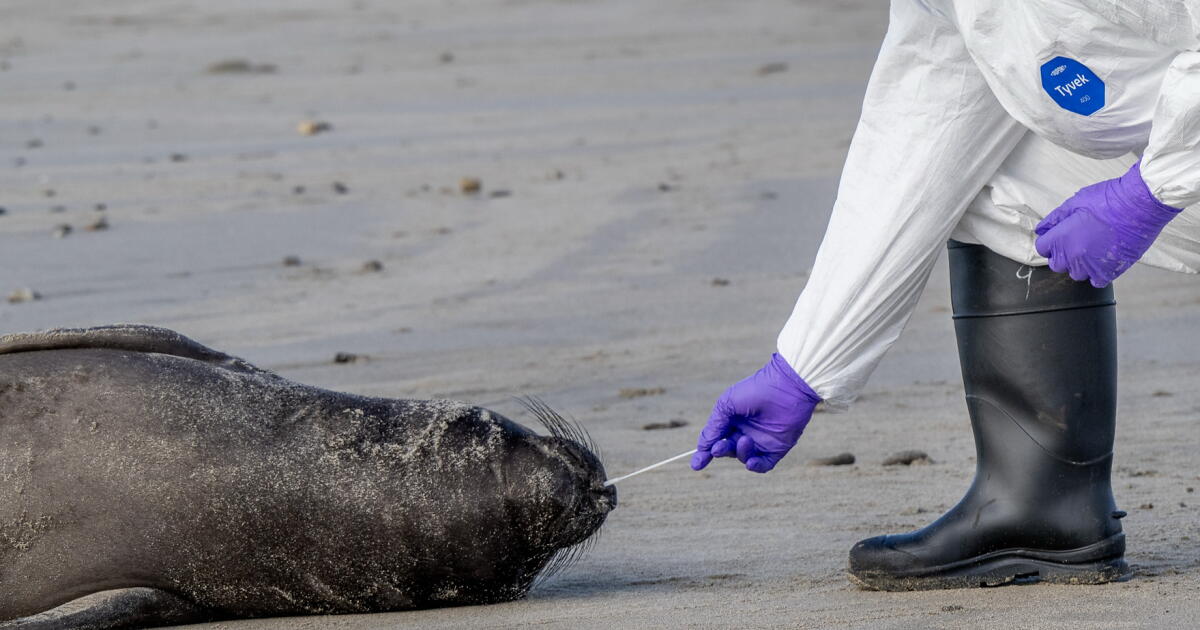
The H5N1 bird flu virus that devastated South American elephant seal populations has been confirmed in seals at California’s Año Nuevo State Park, researchers from UC Davis and UC Santa Cruz announced Wednesday.
The virus has ravaged wild, commercial and domestic animals across the globe and was found last week in seven weaned pups. The confirmation came from the U.S. Department of Agriculture’s National Veterinary Services Laboratory in Ames, Iowa.
“This is exceptionally rapid detection of an outbreak in free-ranging marine mammals,” said Professor Christine Johnson, director of the Institute for Pandemic Insights at UC Davis’ Weill School of Veterinary Medicine. “We have most likely identified the very first cases here because of coordinated teams that have been on high alert with active surveillance for this disease for some time.”
Since last week, when researchers began noticing neurological and respoiratory signs of the disease in some animals, 30 seals have died, said Roxanne Beltran, a professor of ecology and evolutionary biology at UC Santa Cruz. Twenty-nine were weaned pups and the other was an adult male. The team has so far confirmed the virus in only seven of the dead pups.
Infected animals often have tremors convulsions, seizures and muscle weakness, Johnson said.
Beltran said teams from UC Santa Cruz, UC Davis and California State Parks monitor the animals 260 days of the year, “including every day from December 15 to March 1” when the animals typically come ashore to breed, give birth and nurse.
The concerning behavior and deaths were first noticed Feb. 19.
“This is one of the most well-studied elephant seal colonies on the planet,” she said. “We know the seals so well that it’s very obvious to us when something is abnormal. And so my team was out that morning and we observed abnormal behaviors in seals and increased mortality that we had not seen the day before in those exact same locations. So we were very confident that we caught the beginning of this outbreak.”
In late 2022, the virus decimated southern elephant seal populations in South America and several sub-Antarctic Islands. At some colonies in Argentina, 97% of pups died, while on South Georgia Island, researchers reported a 47% decline in breeding females between 2022 and 2024. Researchers believe tens of thousands of animals died.
More than 30,000 sea lions in Peru and Chile died between 2022 and 2024. In Argentina, roughly 1,300 sea lions and fur seals perished.
At the time, researchers were not sure why northern Pacific populations were not infected, but suspected previous or milder strains of the virus conferred some immunity.
The virus is better known in the U.S. for sweeping through the nation’s dairy herds, where it infected dozens of dairy workers, millions of cows and thousands of wild, feral and domestic mammals. It’s also been found in wild birds and killed millions of commercial chickens, geese and ducks.
Two Americans have died from the virus since 2024, and 71 have been infected. The vast majority were dairy or commercial poultry workers. One death was that of a Louisiana man who had underlying conditions and was believed to have been exposed via backyard poultry or wild birds.
Scientists at UC Santa Cruz and UC Davis increased their surveillance of the elephant seals in Año Nuevo in recent years. The catastrophic effect of the disease prompted worry that it would spread to California elephant seals, said Beltran, whose lab leads UC Santa Cruz’s northern elephant seal research program at Año Nuevo.
Johnson, the UC Davis researcher, said the team has been working with stranding networks across the Pacific region for several years — sampling the tissue of birds, elephant seals and other marine mammals. They have not seen the virus in other California marine mammals. Two previous outbreaks of bird flu in U.S. marine mammals occurred in Maine in 2022 and Washington in 2023, affecting gray and harbor seals.
The virus in the animals has not yet been fully sequenced, so it’s unclear how the animals were exposed.
“We think the transmission is actually from dead and dying sea birds” living among the sea lions, Johnson said. “But we’ll certainly be investigating if there’s any mammal-to-mammal transmission.”
Genetic sequencing from southern elephant seal populations in Argentina suggested that version of the virus had acquired mutations that allowed it to pass between mammals.
The H5N1 virus was first detected in geese in China in 1996. Since then it has spread across the globe, reaching North America in 2021. The only continent where it has not been detected is Oceania.
Año Nuevo State Park, just north of Santa Cruz, is home to a colony of some 5,000 elephant seals during the winter breeding season. About 1,350 seals were on the beach when the outbreak began. Other large California colonies are located at Piedras Blancas and Point Reyes National Sea Shore. Most of those animals — roughly 900 — are weaned pups.
It’s “important to keep this in context. So far, avian influenza has affected only a small proportion of the weaned at this time, and there are still thousands of apparently healthy animals in the population,” Beltran said in a press conference.
Public access to the park has been closed and guided elephant seal tours canceled.
Health and wildlife officials urge beachgoers to keep a safe distance from wildlife and keep dogs leashed because the virus is contagious.
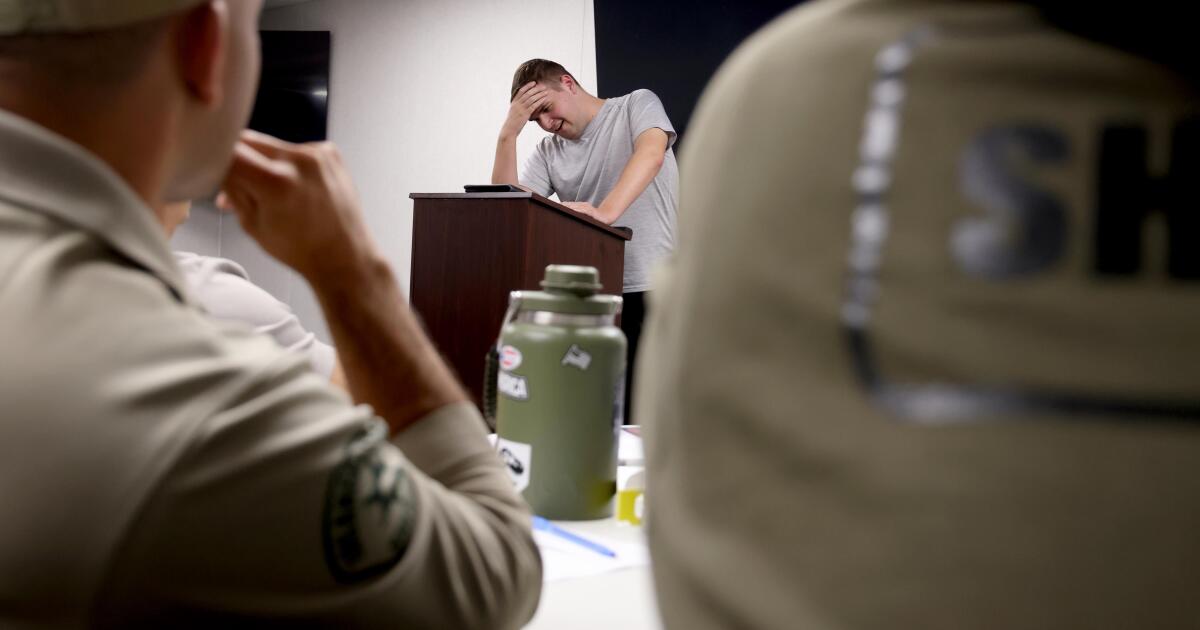
Kate Movius moved among a roomful of Los Angeles County sheriff’s deputies, passing out a pop trivia quiz and paper prism glasses.
She told them to put on the vision-distorting glasses, and to write with their nondominant hand. As they filled out the tests, Movius moved about the City of Industry classroom pounding abruptly on tables. Then came the cowbell. An aide flashed the overhead lights on and off at random. The goal was to help the deputies understand the feeling of sensory overwhelm, which many autistic people experience when incoming stimulation exceeds their capacity to process.
“So what can you do to assist somebody, or de-escalate somebody, or get information from someone who suffers from a sensory disorder?” Movius asked the rattled crowd afterward. “We can minimize sensory input. … That might be the difference between them being able to stay calm and them taking off.”
Movius, founder of the consultancy Autism Interaction Solutions, is one of a growing number of people around the U.S. working to teach law enforcement agencies to recognize autistic behaviors and ensure that encounters between neurodevelopmentally disabled people and law enforcement end safely.
She and City of Industry Mayor Cory Moss later passed out bags filled with tools donated by the city to aid interactions: a pair of noise-damping headphones to decrease auditory input, a whiteboard, a set of communication cards with words and images to point to, fidget toys to calm and distract.
“The thing about autistic behavior when it comes to law enforcement is a lot of it may look suspicious, and a lot of it may feel very disrespectful,” said Movius, who is also the parent of an autistic 25-year-old man. Responding officers, she said, “are not coming in thinking, ‘Could this be a developmentally disabled person?’ I would love for them to have that in the back of their minds.”
A sheriff’s deputy reads a pamphlet on autism during the training program.
(Genaro Molina / Los Angeles Times)
Autism spectrum disorder is a developmental condition that manifests differently in nearly every person who has it. Symptoms cluster around difficulties in communication, social interaction and sensory processing.
An autistic person stopped by police might hold the officer’s gaze intensely or not look at them at all. They may repeat a phrase from a movie, repeat the officer’s question or temporarily lose their ability to speak. They might flee.
All are common involuntary responses for an autistic person in a stressful situation, which a sudden encounter with law enforcement almost invariably is. To someone unfamiliar with the condition, all could be mistaken for intoxication, defiance or guilt.
Autism rates in the U.S. have increased nearly fivefold since the Centers for Disease Control began tracking diagnoses in 2000, a rise experts attribute to broadening diagnostic criteria and better efforts to identify children who have the condition.
The CDC now estimates that 1 in 31 U.S. 8-year-olds is autistic. In California, the rate is closer to 1 in 22 children.
As diverse as the autistic population is, people across the spectrum are more likely to be stopped by law enforcement than neurotypical peers.
About 15% of all people in the U.S. ages 18 to 24 have been stopped by police at some point in their lives, according to federal data. While the government doesn’t track encounters for disabled people specifically, a separate study found that 20% of autistic people ages 21 to 25 have been stopped, often after a report or officer observation of a person behaving unusually.
Some of these encounters have ended in tragedy.
In 2021, Los Angeles County sheriff’s deputies shot and permanently paralyzed a deaf autistic man after family members called 911 for help getting him to a hospital.
Isaias Cervantes, 25, had become distressed about a shopping trip and started pushing his mother, his family’s attorney said at the time. He resisted as two deputies attempted to handcuff him and one of the deputies shot him, according to a county report.
In 2024, Ryan Gainer’s family called 911 for support when the 15-year-old became agitated. Responding San Bernardino County sheriff‘s deputies shot and killed him outside his Apple Valley home.
Last year, police in Pocatello, Idaho, shot Victor Perez, 17, through a chain-link fence after the nonspeaking teenager did not heed their shouted commands. He died from his injuries in April.

Sheriff’s deputies take a trivia quiz using their non-writing hands, while wearing vision-distorting glasses, as Kate Movius, standing left, and Industry Mayor Cory Moss, right, ring cowbells. The idea was to help them understand the sensory overwhelm some autistic people experience.
(Genaro Molina / Los Angeles Times)
As early as 2001, the FBI published a bulletin on police officers’ need to adjust their approach when interacting with autistic people.
“Officers should not interpret an autistic individual’s failure to respond to orders or questions as a lack of cooperation or as a reason for increased force,” the bulletin stated. “They also need to recognize that individuals with autism often confess to crimes that they did not commit or may respond to the last choice in a sequence presented in a question.”
But a review of multiple studies last year by Chapman University researchers found that while up to 60% of officers have been on a call involving an autistic person, only 5% to 40% had received any training on autism.
In response, universities, nonprofits and private consultants across the U.S. have developed curricula for law enforcement on how to recognize autistic behaviors and adapt accordingly.
The primary goal, Movius told deputies at November’s training session, is to slow interactions down to the greatest extent possible. Many autistic people require additional time to process auditory input and verbal responses, particularly in unfamiliar circumstances.
If at all possible, Movius said, wait 20 seconds for a response after asking a question. It may feel unnaturally long, she acknowledged. But every additional question or instruction fired in that time — what’s your name? Did you hear me? Look at me. What’s your name? — just decreases the likelihood that a person struggling to process will be able to respond at all.
Moss’ son, Brayden, then 17, was one of several teenagers and young adults with autism who spoke or wrote statements to be read to the deputies. The diversity of their speech patterns and physical mannerisms showed the breadth of the spectrum. Some were fluently verbal, while others communicated through signs and notes.
“This population is so diverse. It is so complicated. But if there’s anything that we can show [deputies] in here that will make them stop and think, ‘Hey, what if this is autism?’ … it is saving lives,” Moss said.

Mayor Cory Moss, left, and Kate Movius hug at the end of the training program last November. Movius started Autism Interaction Solutions after her son was born with profound autism.
(Genaro Molina / Los Angeles Times)
Some disability advocates cautioned that it takes more than isolated training sessions to ensure encounters end safely.
Judy Mark, co-founder and president of the nonprofit Disability Voices United, says she trained thousands of officers on safe autism interactions but stopped after Cervantes’ shooting. She now urges families concerned about an autistic child’s safety to call an ambulance rather than law enforcement.
“I have significant concern about these training sessions,” Mark said. “People get comfort from it, and the Sheriff’s Department can check the box.”
While not a panacea, supporters argue that a brief course is better than no preparation at all. Some years ago, Movius received a letter from a man whose profoundly autistic son slipped away as the family loaded their car at the beach. He opened the unlocked door of a police vehicle, climbed into the back and began to flail in distress.
Though surprised, the officer seated at the wheel de-escalated the situation and helped the young man find his family, the father wrote to Movius. He had just been to her training.

Michigan rolls past Illinois to win Big Ten title outright, boosting No. 1 seed hopes

Eight takeaways from Friday’s high school playoffs action, including four 1,000-point scorers – The Boston Globe

Utah Mammoth take down Minnesota 5-2 to end the Wild’s winning streak at 6

Couple sentenced for selling faulty fire extinguishers to Mississippi daycares, businesses – SuperTalk Mississippi
Missouri Lottery Mega Millions, Pick 3 winning numbers for Feb. 27, 2026

Florida High School Football Rankings: Top 25 teams – Oct. 21

Cleary's 21 help Le Moyne down Central Connecticut State 69-64 in OT

How old is Bo Nix? What to know about Oregon quarterback ahead of 2024 NFL Draft

99th annual Pony Swim held in Virginia

Indiana Members Credit Union announced as new anchor tenant at Bottleworks District

ICE blasts Washington mayor over directive restricting immigration enforcement

Did the EU bypass Hungary’s veto on Ukraine’s €90 billion loan?

How the federal government is painting immigrants as criminals on social media

Where Iran’s ballistic missiles can reach — and how close they are to the US

Has India’s influence in Afghanistan grown under the Taliban?
-

 World2 days ago
Exclusive: DeepSeek withholds latest AI model from US chipmakers including Nvidia, sources say
-

 Massachusetts3 days ago
Mother and daughter injured in Taunton house explosion
-

 Montana1 week ago
2026 MHSA Montana Wrestling State Championship Brackets And Results – FloWrestling
-

 Louisiana5 days ago
Wildfire near Gum Swamp Road in Livingston Parish now under control; more than 200 acres burned
-

 Denver, CO2 days ago
10 acres charred, 5 injured in Thornton grass fire, evacuation orders lifted
-

 Technology7 days ago
YouTube TV billing scam emails are hitting inboxes
-

 Technology7 days ago
Stellantis is in a crisis of its own making
-

 Politics7 days ago
OpenAI didn’t contact police despite employees flagging mass shooter’s concerning chatbot interactions: REPORT