Science
A 150-million-year journey from the Jurassic to Exposition Park


150 million years ago, Laurasia
The massive neck dips, casting a curving shadow on the mossy ground. The dinosaur’s jaws close around its prize. The creature lifts its head, nearly dainty in scale, and contentedly gnaws a mouthful of ferns.
It’s the late Jurassic Period in the super continent of Laurasia, some 85 million years into the reign of the dinosaurs. The animal belongs to a herd of hefty herbivores who spend their days lumbering through an open landscape of conifers and gingkos, horsetails and monkey puzzle trees.

Paleontologists and volunteers gather at the dinosaur dig site near Bluff, Utah.
(Courtesy of Natural History Museum of Los Angeles County)
It’s 10 tons at least, far longer than it is tall, its seemingly endless neck and tail held parallel to the ground in surprisingly delicate balance.
Stubby ankylosaurs graze in the distance; carnivorous allosaurs stalk for prey. Tiny mammals scamper out of the path of its thunderous footsteps.
One day the dinosaur will have a name: Gnatalie. One day it will crisscross continents that don’t yet exist, coming to rest in the Natural History Museum of Los Angeles County.
But all that is a long way off. On this day in prehistory, Los Angeles still lies beneath a shallow sea.
This far back in time, some details are too fuzzy to make out. We don’t know the dinosaur’s sex. We don’t know how it dies: illness or injury, predators or old age. But we know it lives three or four decades, and eventually the day comes when the dinosaur falls and does not rise again for many, many years.

A hungry ecosystem devours its flesh and muscle. Rains come and the dinosaur’s bones wash into a river, where they lodge in the sandy bottom. Flowing water covers them in thin blankets of silt.
This is just the beginning.
80 million to 50 million years ago, Laramidia
Above ground, things live and die and disappear. But the dinosaur, encased in layers of sediment, is exempt from this endless cycle of growth and decay.
Millennia tick past. Those layers of soil compress into rock studded with the remains of forgotten creatures. More time goes by, and as the organic material in the bones wears away, water seeps into its place from the surrounding rock.
The water carries minerals, and with enough time — tens of thousands of years, or millions — mineral deposits fill up the bone-shaped cavities in the rock, creating perfect replicas of teeth that once chewed ferns and tibia that held up a giant.
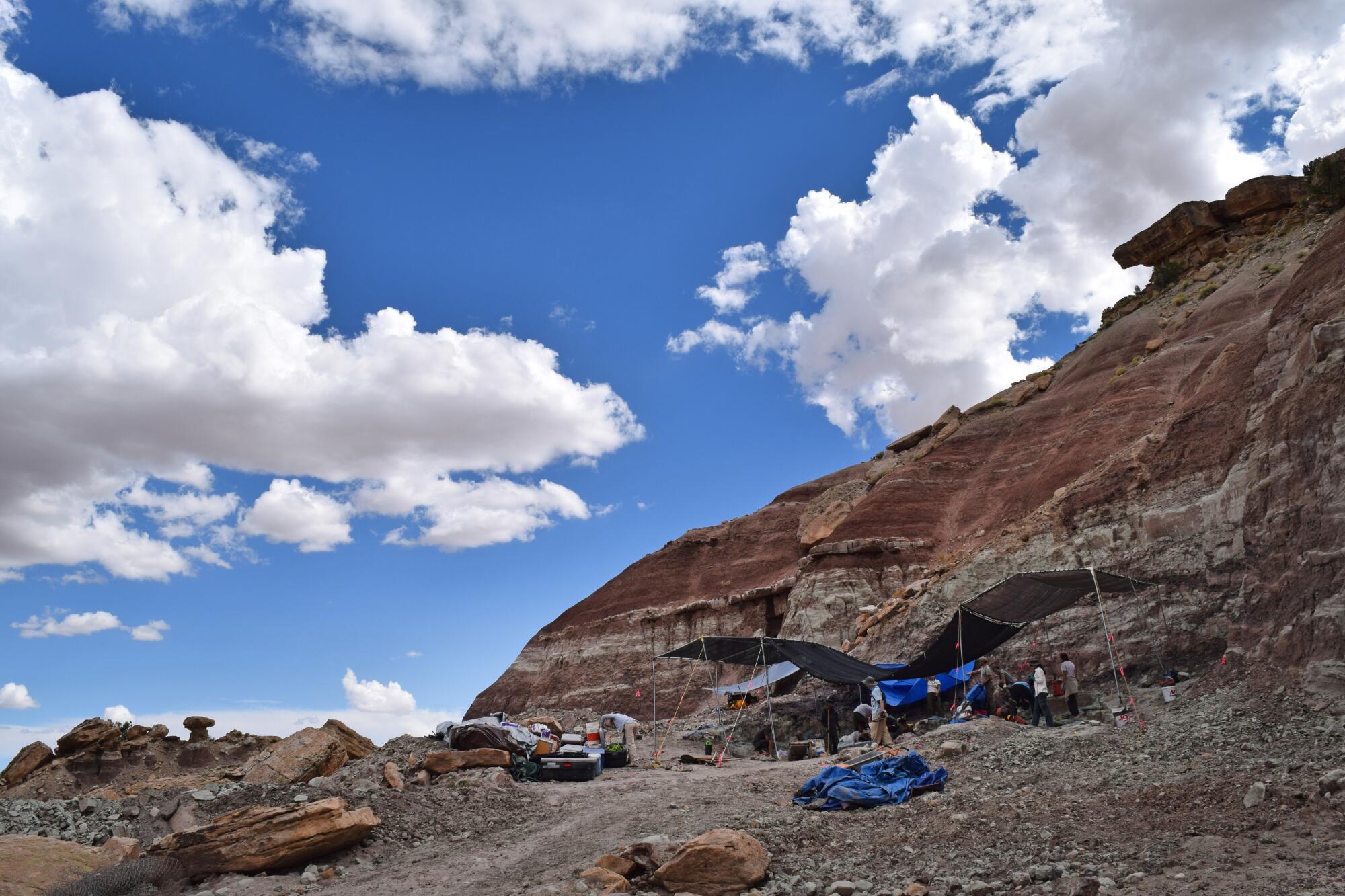
Hundreds of scientists and volunteers spent more than 10 years excavating the fossils after their discovery in 2007.
(Courtesy of Natural History Museum of Los Angeles County)
Volcanoes set off a cascade of chemical changes in the environment that make their way to the subterranean rock. The area becomes rich in celadonite, a soft greenish mineral. Over time, the bones concealed in the ground turn the same emerald hue.
Somewhere in there an asteroid strikes, the planet burns, and the dinosaurs’ era comes to an end. Gnatalie’s fossils, already ancient, lie untroubled in Earth’s crust.
6 million years ago, North America
Continents shift and oceans spread. Unseen forces drive a massive plateau of rock upward, carving spectacular features that one day will have names: Grand Canyon, Arches, Monument Valley. Gnatalie rises with it.
2007, Utah
Time passes. Things happen. Ice ages, cave paintings, nation-states, Bach.
The earth the dinosaurs once trod is now a massive expanse of solid rock. The place where Gnatalie’s remains lie has a name: the Colorado Plateau.
The closest town has a name too — Bluff, Utah. Even that small outpost is miles from the desert where a dozen paleontologists are hiking, looking for signs of long-ago life.
In the rock they spy something that is not rock, something surprisingly green. They mark the place and agree to come back.
2008-2019, Utah
Led by Luis Chiappe, director of the Natural History Museum’s Dinosaur Institute, the paleontologists return with generators and tents and jackhammers and dental picks. Amid hordes of gnats they excavate that first fossil, which turns out to be a damaged leg bone.

Scientists Jonatan Kaluza, Fernando, Alyssa Bell and Pedro Mocho work to excavate fossils at the Gnatalie quarry.
(Courtesy of Natural History Museum of Los Angeles County)
Beneath it is another one. And another. The Earth spills secrets like it’s been waiting for someone to ask.
Under the rock is a field of fossils, the commingled remnants of camarasaurs, sauropods, crocodiles, ankylosaurs, ornithopods — everything that washed into that long-gone river 150 million years ago.
The team returns every summer, year after year. Strewn throughout the bone bed are massive relics of something no one can quite identify, a mysterious dinosaur more numerous and better preserved than any other animal.
They nickname the unknown species “Gnatalie,” after the pests that plague them as they work.
The green fossils are each wrapped in a plaster jacket and carefully loaded into a truck for the 700-mile drive to the museum at Exposition Park.
2008-2022, Los Angeles
At the Natural History Museum of Los Angeles County, in rooms the public aren’t allowed to wander, preparators carefully clean, weigh and catalog each fossil. At benches they brush and gently scrape dust from fossilized bone, with the gentle dexterity of dentists cleaning Jurassic-era teeth.
Gnatalie, at this point, is a puzzle waiting to be assembled. But nature doesn’t make this game easy.
The staff has to sort through hundreds of fossils. They know they have found some kind of sauropod — a long-necked, long-tailed quadruped. The strange green dinosaur has the neck of a barosaur, a diplodocus-like spine. A review of the quarry’s haul reveals a long length of vertebrae from a single animal that connects the two and solves the riddle: Gnatalie, Chiappe confirms, is indeed a previously undiscovered species.
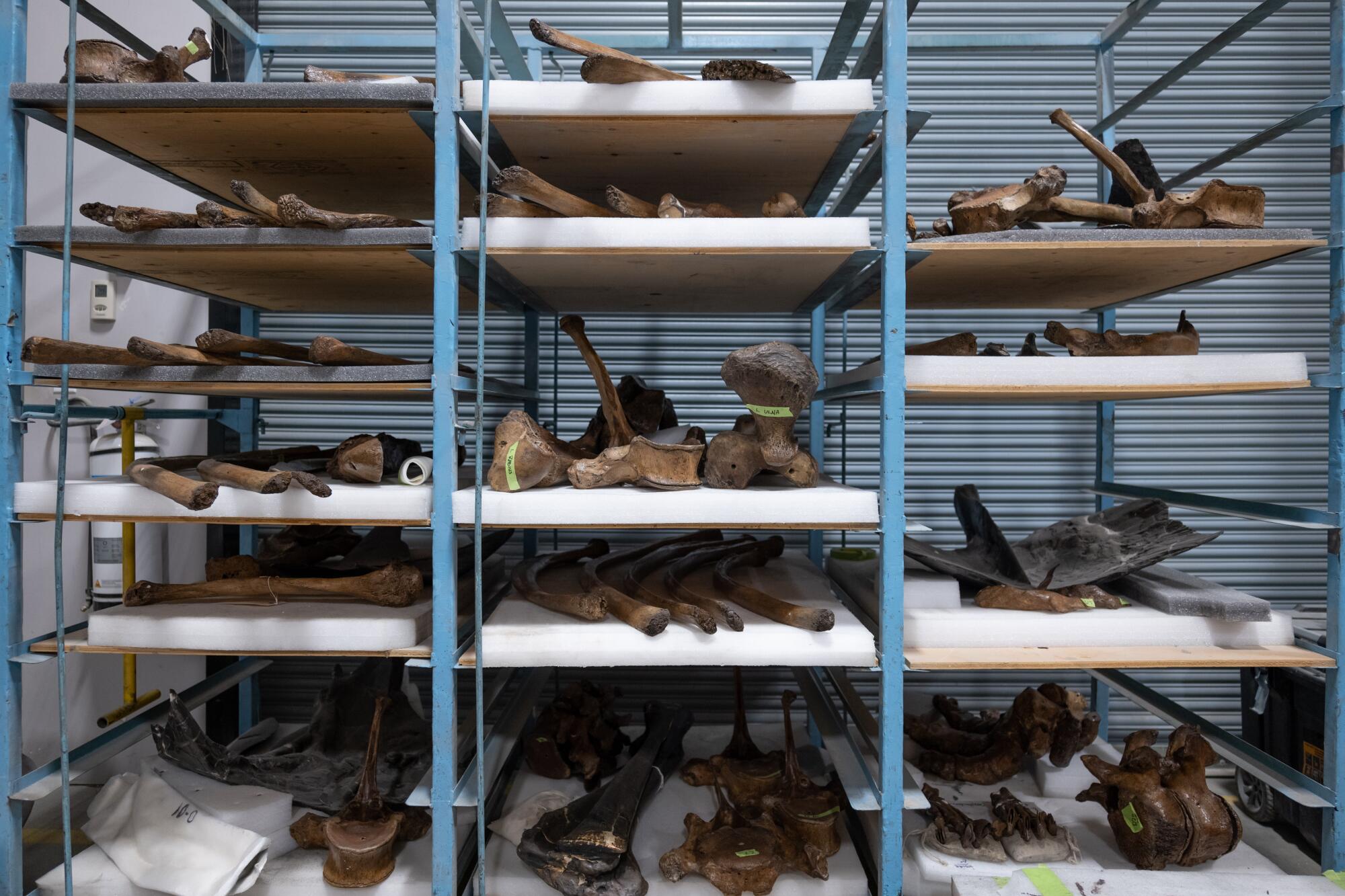
Various dinosaur fossils lie in temporary storage at Research Casting International in Trenton, Canada.
(Ian Willms / For The Times)
Dinosaurs are hardly ever found in their entirety, and this one is no exception. From a half-dozen fossil skeletons, paleontologists assemble a representative of the Gnatalie species, their best educated assumption of what the animal looked like. On a computer screen, the dinosaur’s internal architecture is put back together for the first time in millennia.
There are plans for this animal. The museum is opening a new welcome center, and space needs something big and bold. The answer is right there in the prep lab — the world’s only green dinosaur skeleton.
Two hundred bones are packed in crates, each in its own custom foam cradle. They are loaded onto trucks with specialized suspension, and a fleet carrying priceless cargo begins the 2,600-mile journey north.
2022-2024: Trenton, Canada
Research Casting International’s unassuming warehouse sits on the bank of a quiet bay about 100 miles east of Toronto. Outside, beavers gnaw at the vegetation around the chilly waters. Inside is a steampunk fossil carnival.
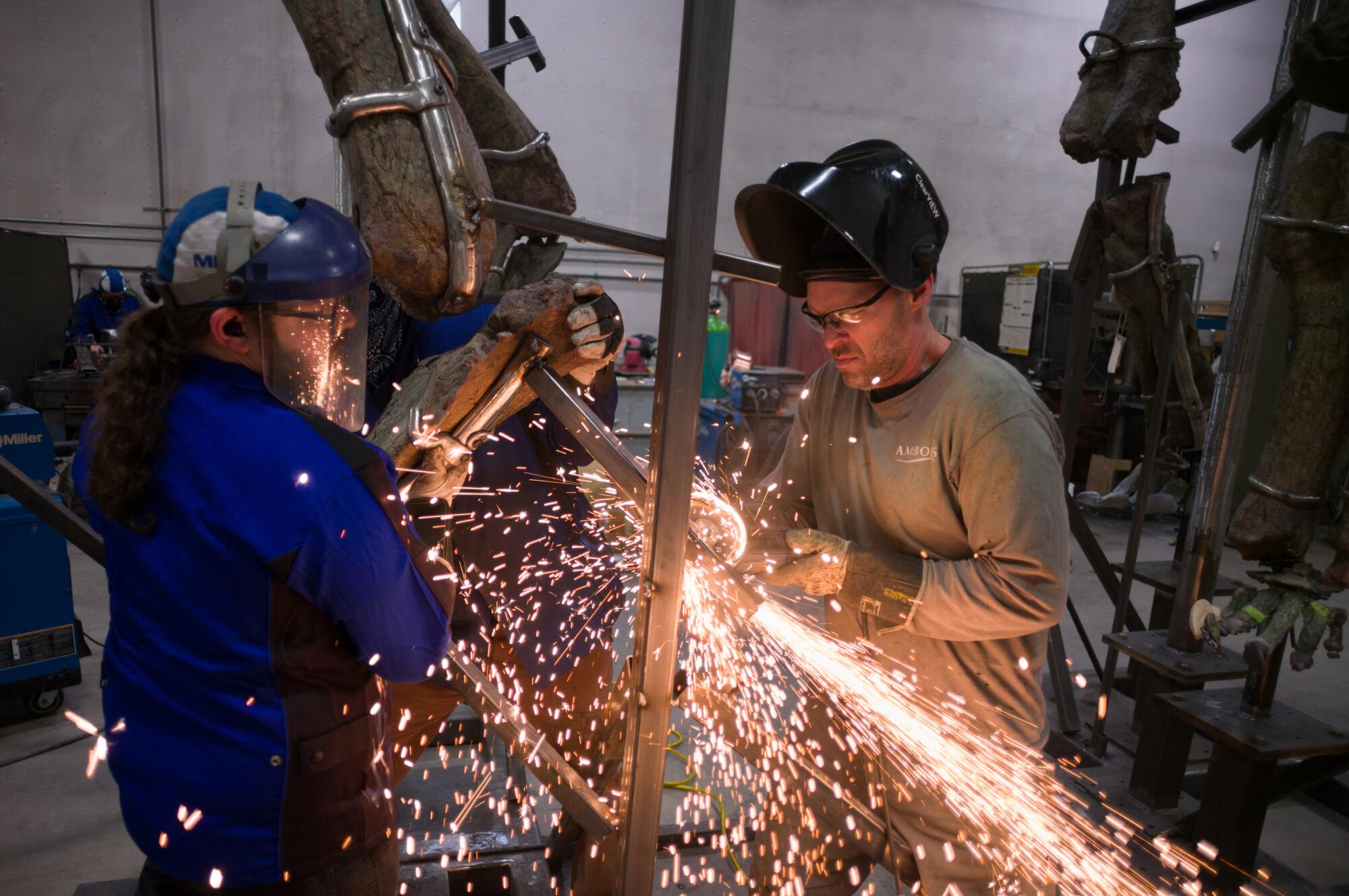
Fossil mounting technicians Nevin Dallman and Kevin Krudwig perform final adjustments on Gnatalie in RCI’s workshop.
(Ian Willms / For The Times)
In one corner the lanky, headless skeleton of a Quetzalcoatl appears ready to take flight. Welding sparks fly nearby as a worker puts finishing touches on the joints in a replica T-rex toe.
The rearing barosaurus in the rotunda of New York’s American Museum of Natural History, the T-rex and triceratops locked in battle in the Natural History Museum’s main hall in L.A. — all of them first took form here in founder Peter May’s workshop.
And in the back of the cavernous warehouse, in a secure hangar, Gnatalie stands for the first time in 150 million years.
It’s 75 feet from nose to end, longer than the letters in the Hollywood sign are tall. A quirk in the fossilized sacrum, a bone in the lower back, means that the animal’s neck curves slightly to the left, giving the impression of a dinosaur turning its head curiously toward an unexpected sight.
1

2
3

4

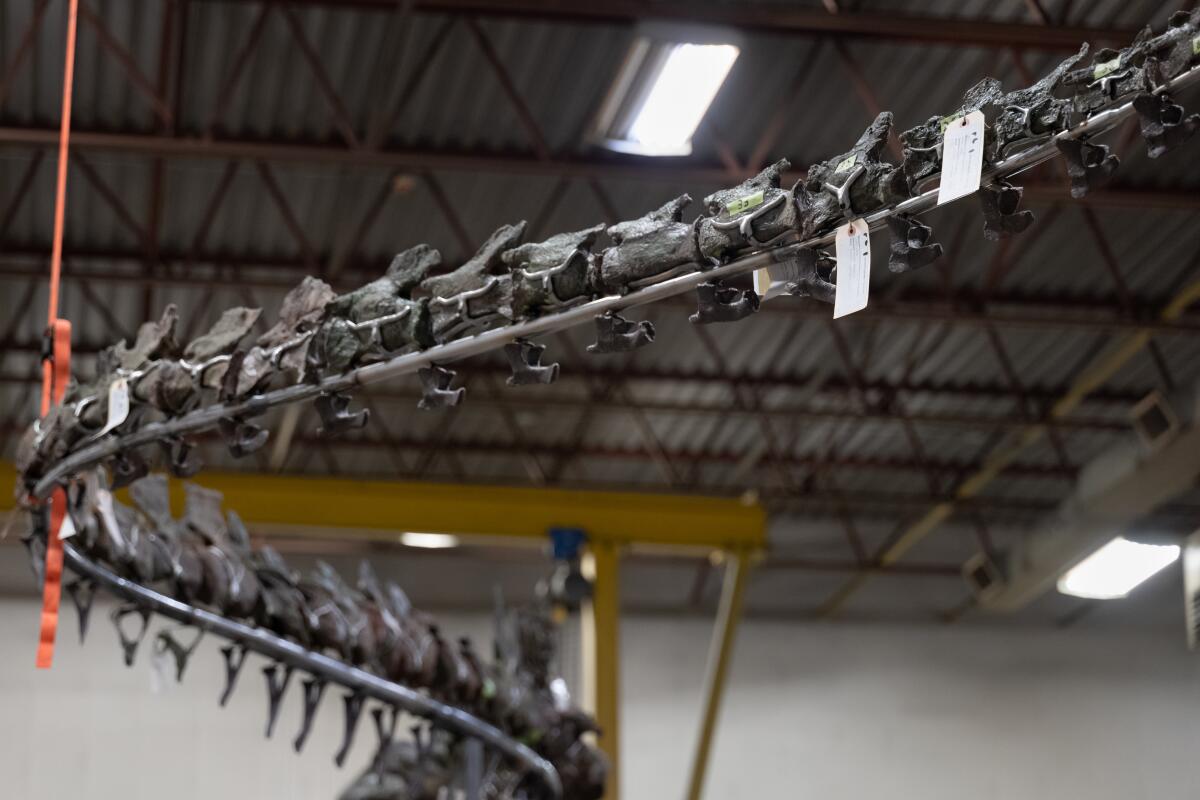
1. Custom metal reinforcements are fitted to dinosaur fossils. 2. The tail vertebrae of Gnatalie. 3. Mike Pyette prepares a temporary styrofoam skull for Gnatalie. 4. Paleontologist Luis Chiappe inspects “Natalie” at Research Casting International on March 4, 2023, in Trenton, Ontario, Canada. (Photos by Ian Willms/For The Times)
Hand-forged armatures connect some 350 bones to an underlying steel skeleton. Two-thirds are real fossils. The remainder are 3D-printed replicas of pieces nature didn’t preserve well, each hand-painted and textured to match the real bone.
As RCI employees walk through remaining work to be done on the mount, museum staff visiting from Los Angeles mark the location of the future hall’s entryway with painter’s tape on the warehouse floor.
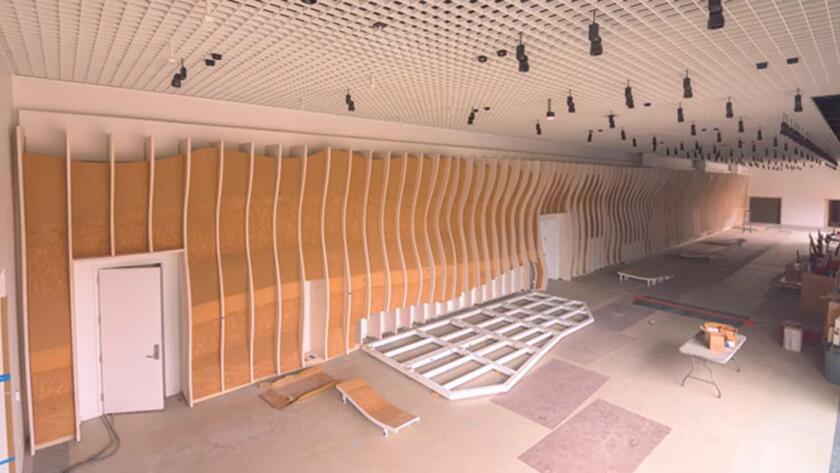
Timelapse video of installation of the 75 feet long dinosaur on display at the Natural History Museum. (Natural History Museum)
“We want that jaw-dropping moment that compels you to want to learn more about the specimen,” says Chris Weisbart, associate vice president for exhibits.
The dinosaur will stand on a specially constructed platform that provides a better view to the public and keeps the neck and tail beyond reach of over-eager visitors tempted to jump up and touch it.
Nature makes most of the decisions about how a dinosaur mount will look, but there is a little room for interpretation within the realm of the scientifically plausible. At the moment, Chiappe, May and paleontologist Pedro Mocho are locked in an intense discussion about the precise positioning of an ulna. Chiappe carries a laptop around the front leg so that Mocho, watching via Zoom from his office in Lisbon, Portugal, can examine the bone.
“It’s a weird angle,” Mocho says finally. The leg needs adjusting.
“We have quite a lot of work to do,” Chiappe says, looking somewhat abashed.
“We have quite a lot of time,” May says with a smile.
2024: Los Angeles
On Sunday the Natural History Museum of Los Angeles County will open the long-awaited $75-million NHM Commons expansion.
Earlier in the year the museum asked the public to name their new dinosaur — not the species, which will get its scientific moniker when the long process of publishing the discovery is complete, but the mounted skeleton that people will come to visit, the green dinosaur that belongs to L.A. alone.
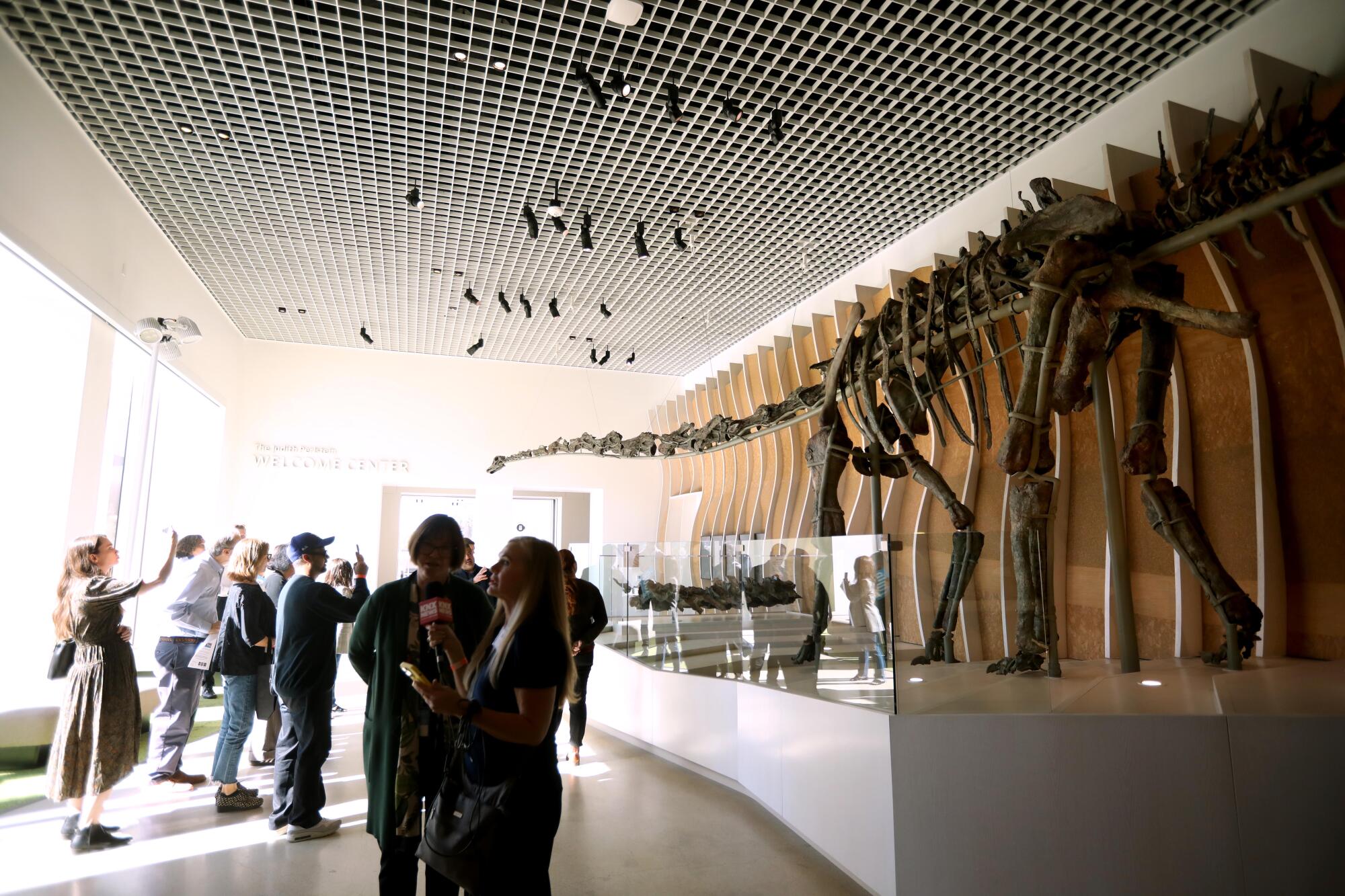
Visitors and media view Gnatalie in the new Welcome Center at the NHM Commons on Nov. 13.
(Genaro Molina / Los Angeles Times)
They threw out some options. Sage, for the native plant and earthy green color? Olive, a symbol of peace? Dinosaur enthusiasts voted to keep the name that stuck as soon as it came out of the Earth: Gnatalie.
Gnatalie will spend the rest of its fossilized existence welcoming visitors, its head arcing gently toward the windows, bony face turned toward the future Lucas Museum.
The height of the hall’s doors means that the shorter a visitor is, the better their perspective. Children coming to see the green dinosaur will gasp before their parents do. Small mammals will scamper at Gnatalie’s feet again.


new video loaded: NASA Announces Artemis III Crew
transcript
transcript
NASA Announces Artemis III Crew
NASA announced the crew of Artemis III mission, which will fly to low-Earth orbit to test rendezvous and docking maneuvers with one or two lunar landers.
-
“I am excited to welcome you as the next crew in the Artemis journey to successfully return to the moon — this time to stay.” “I’m honored by the role that I’ve been given. I’m also very humbled by the task in front of us. But first and foremost, I’m grateful.” “So with that, the Artemis II crew, comrade, hands you the baton. You got the controls.” “As you know, we had a significant anomaly at our Launch Complex 36A on May 28. We’ve redoubled our efforts and are moving forward.”
By Alisa Shodiyev Kaff
June 9, 2026
Science
Santa Monica Mountains’ last steelhead trout survived the Palisades fire — and even had babies

Scientists feared the Santa Monica Mountains’ last remaining steelhead trout were dead, smothered by debris flows unleashed by the Palisades fire.
But the endangered fish surprised them: A team of biologists recently spotted 30 of the rare trout — and 21 babies — in Topanga Creek.
“There was a lot of happy dancing in the creek,” said Rosi Dagit, principal conservation biologist for the Resource Conservation District of the Santa Monica Mountains, which works with public and private landowners to conserve natural resources.
That’s because the steelhead here are endangered, at both the state and federal levels. Once, they swam in most streams of the Santa Monicas, but their numbers plummeted amid overfishing and coastal development. Increasingly frequent wildfire has further stressed their habitat. Topanga Creek, a biodiversity hot spot, is home to their last known population in the mountains that stretch from the Hollywood Hills to Point Mugu in Ventura County.
The trout that were spotted, including this one, are part of a distinct Southern California population that’s listed as endangered at the state and federal levels.
(RCDSMM Stream Team)
The California Department of Fish and Wildlife spearheaded a complex mission to rescue trout threatened by the Palisades fire that sparked in January 2025.
Time was of the essence. The fire hadn’t yet been fully contained. But rain was on the way, which would sweep massive amounts of sediment from the denuded hillsides into the water. Fish are often killed this way.
Crews stunned the fish with electricity, scooped them up in buckets, trucked them to a hatchery and ultimately moved them to Arroyo Hondo Creek in Santa Barbara County.
Within days, Topanga Creek was choked with mud. Some assumed the fish left behind were goners.
But in March, the conservation district’s team found four. The following month, when water conditions were clearer, they saw more.
“These fish continue to amaze me,” said Kyle Evans, environmental program manager for the state Department of Fish and Wildlife, who had seen the damage to the creek. “I had seen populations get wiped out in similar situations. So when I heard, I was thrilled.”
Evans surmises the fish that survived were in an area of the creek where less charred material and sediment were swept in.
“These fish likely hunkered down, were hiding under some rocks or places to try to get away from the main concentration of flow,” he said. “And luckily they weren’t buried.”
The ones that were spotted were fairly small, around 6 to 14 inches. Rainbow trout and steelhead trout are the same species, but with different lifestyles. If the fish remain in freshwater, they’ll be considered rainbows. However, they can migrate to the ocean and become steelhead, where they typically grow larger before returning to their natal waters to spawn.
Topanga Creek hasn’t fully recovered from the damage it sustained, but scientists say it’s looking better. Surveys last year were “so depressing,” Dagit said, with very few animals, and stretches that were essentially transformed into flat roads from all the sediment buildup. Some of the riparian canopy burned right down to the creek.
Then came 32 inches of rain over the last nine months, scouring out and moving sediment, creating deeper pools. Dagit said they recently found newt egg masses for the first time in years, as well as a few adult newts and many frogs. Plants that provide cover are starting to recover.
She provided photos comparing certain pools last year and this year, some dramatically transformed. In September 2025, the Shrine Pool could have been an overgrown hiking trail. This April, it was filled with shallow water.

The Shrine Pool in September 2025, left, and the same location in April 2026, right, with RCDSMM’s Isaac Yelchin donning a wetsuit.
(RCDSMM Stream Team)
Topanga Creek is home to another endangered fish, the small but hardy northern tidewater goby, often described as cute. Not long before the trout operation, Dagit led a rescue of hundreds of these fish too. Many were repatriated to the lagoon at the mouth of the creek in a moving ceremony last June.
There’s still the matter of what to do with the trout that were moved to Santa Barbara County last year. Evans would like to bring them home to the Santa Monicas at some point, but isn’t sure if it will happen. On one hand, they could bolster the small, genetically isolated surviving population. On the other, they might inadvertently bring in a disease or bacteria. There is some time to decide. Evans estimates the creek still needs to recover for two to three more years.
For now, the fish are functioning fine in their adopted creek. Experts worried the trauma wrought by the move would disrupt their spawning process, but they had babies that spring. This year, they spawned again.

The Pacifica Municipal Pier was shut down and taped off Thursday after city workers noticed cracks running through the landmark structure and concrete chunks falling into the ocean.
It’s just one of many coastal California structures that have recently crumbled under pressure from a rising and relentless ocean.
Officials from the small, beach city south of San Francisco said the pier was closed due to “cracking, separation, and displacement of the concrete walkway and structural elements.”
It will stay closed while structural engineers asses its safety.
Photos taken by city employees show a wide crack that runs from top to bottom and across the structure as well. Other photos show a large horizontal crack under the foundation of a small restaurant on the pier, the Chit Chat Cafe.
The cafe was also shut down.
This is not the first time the 53-year-old pier has shown signs of stress. In 2021, part of it was shut down after handrails along the edge collapsed. And in 2023, after a series of storms pummeled the Central California coast, damaging parts of the pier, the structure was partially closed for more than year.
Those same storms caused extensive damage in Aptos and Capitola, 70 miles south, where piers and waterfront infrastructure were swept away or damaged.
In 2024, a 150- to 180- foot section of the Santa Cruz wharf was ripped off by powerful waves.
At least 10 of the state’s dozens of coastal public piers were closed for part or all of 2024 due to structural damage sustained in winter storms since 2022. At least five others have longer-term upgrades planned to address structural issues.
“These things are costly to maintain,” said Zach Plopper, senior environmental director at Surfrider. “They are a part of our California coastal culture in many ways, but we’re going to need to reckon with, one, the state that they’re in, and two, the continuous and worsening threats they’re going to experience,”
He said most of the piers were constructed in the early 1900s, and they weren’t built to withstand decades of rough seas, storms and rising sea level.
“With this incoming El Niño, which is forecasted to be significant, and this marine heat wave we’re in the midst of, we’re kind of in uncharted waters as far as what this winter could bring in terms of storms and swells to the California coast, and we’re likely going to see a lot more damage,” he said. “Not just piers, but roads and other coastal infrastructure up and down the state.”
There was no storm in Pacifica earlier this week, so no single event could be blamed for the destruction.
However, a 2025 report from an outside engineering firm, GHD, found that several sections of the pier were in “poor” or “serious” condition, and they recommended closure before anticipated storms or events that could “subject the piles to high winds, swells and large waves.”
The firm found several areas of the pier where concrete was missing and rebar was exposed and corroding.
“The pier has continued to experience high winds and large waves in a harsh marine environment,” the engineers wrote in the report, noting that continuous exposure to seawater or marine spray was “detrimental” to the structure.
A 2023 city report estimated it would cost $19 million to repair.
That same year, a state law was enacted to require local governments along the California coast to plan for sea level rise in the coming decades.
Sea level has risen some 8 inches, on average, along the coast in the past 150 years, Plopper said, and researchers anticipate another foot in the next 25 years.
“We’re going to see profound shifts on our coastline, none that we have ever experienced before, and building static structures on the coast just doesn’t work all that well,” he said. “We’re going to have to make some really hard decisions.”
-

 Los Angeles, Ca1 hour ago
Los Angeles High School locked down as police search for armed juvenile
-

 Detroit, MI2 hours ago
‘Diarra From Detroit’ sets date for second season on Paramount+
-

 San Francisco, CA2 hours ago
San Francisco police release video of shootout that critically wounded officer
-

 Dallas, TX2 hours ago
3 Dallas educators among FIFA World Cup volunteers
-

 Miami, FL2 hours ago
Miami Gardens man arrested after fleeing Florida Keys deputies at 125 mph, sheriff says
-

 Boston, MA2 hours ago
Boston gives update on plans for 3 a.m. last call at bars, outdoor drinking areas during World Cup
-

 Denver, CO2 hours ago
One Invitation Can Change a Life: Called By Name Campaign Inspires Future Priests For a Second Year in Denver
-

 Seattle, WA2 hours ago
Survey: What’s the toughest game to start the Seahawks’ season?

