Politics
Trump's past GOP rivals line up behind him at convention, say he'll make U.S. 'safe again'

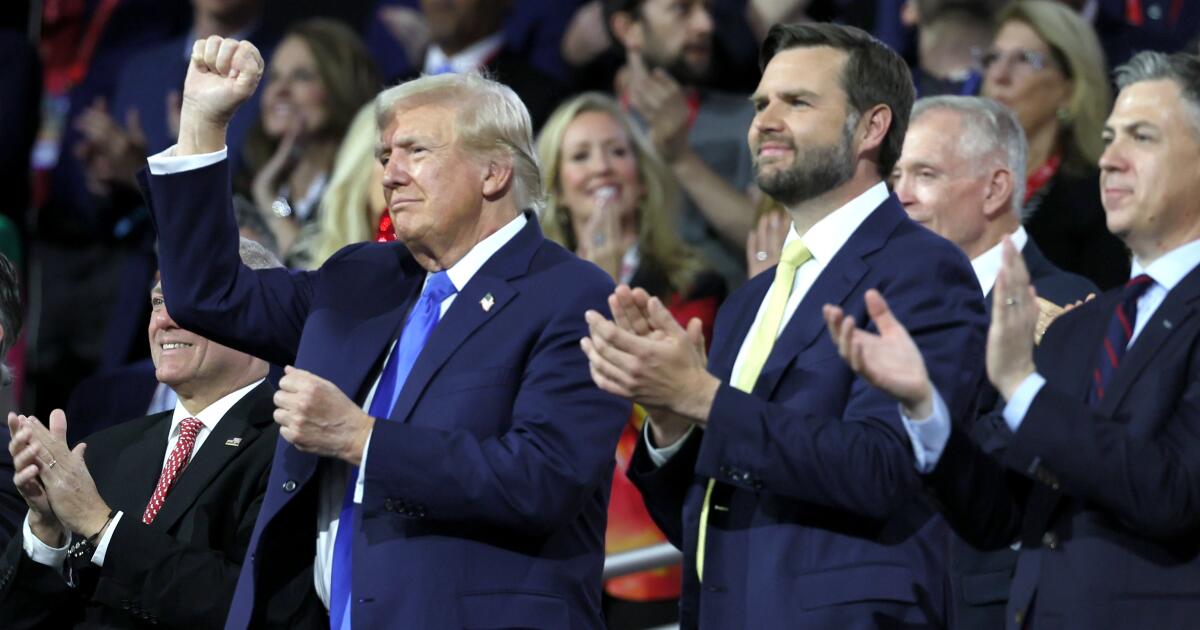
Former President Trump’s top rivals in the Republican Party lined up behind the 2024 nominee on Tuesday, promising he would “make America safe again” from violent criminals and dangerous undocumented immigrants who they suggested are invading the nation via an “open” southern border.
After questioning his abilities and integrity during the primaries, they gave full-throated backing to a man they once loudly reviled, saying that unifying behind their former foe was crucial for the nation’s future. Trump, who entered the convention hall to thunderous applause, looked on approvingly as his former opponents urged voters to return him to the White House.
“For more than a year, I said a vote for Joe Biden is a vote for President Kamala Harris,” said Trump’s former ambassador to the United Nations, Nikki Haley. “After seeing the debate, everyone knows it’s true. If we have four more years of Biden or a single day of Harris, our country will be badly worse off. For the sake of our nation, we have to go with Donald Trump.”
But Haley said her message was aimed at voters who may have qualms about the former president.
Former Ambassador Nikki Haley speaks during the Republican National Convention on Tuesday.
(Robert Gauthier / Los Angeles Times)
“We should acknowledge there are some Americans who don’t agree with Donald Trump 100% of the time. I happen to know some,” said Haley, whom Trump nicknamed “Birdbrain” during their 2024 primary contest. “My message to them is simple. You don’t have to agree with Trump 100% of the time to vote for him. Take it from me, I haven’t always agreed with President Trump, but we agree more often than we disagree.”
Trump and his running mate, Ohio Sen. J.D. Vance, entered the Milwaukee arena shortly before speeches by Haley, Florida Gov. Ron DeSantis, whom he bested in a testy 2024 GOP primary, and Texas Sen. Ted Cruz, one of his opponents in the 2016 election.
“Let’s send Joe Biden back to his basement and let’s send Donald Trump back to the White House,” said DeSantis, whom Trump nicknamed “Ron DeSanctimonious.” “Our border was safer under the Trump administration and our country was respected when Donald Trump was our commander in chief. Joe Biden has failed this nation.”
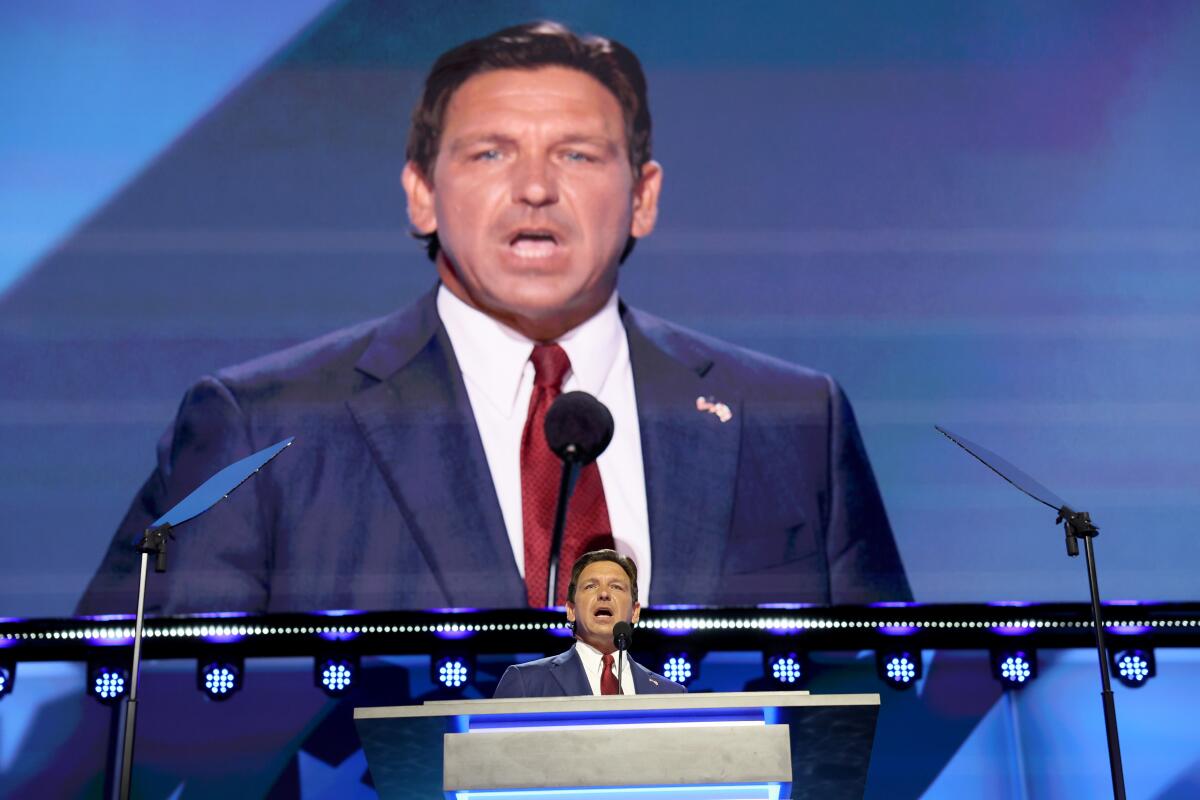
Florida Gov. Ron DeSantis speaks during the Republican National Convention on Tuesday.
(Robert Gauthier / Los Angeles Times)
Haley and DeSantis apparently learned a lesson from Cruz — aka “Lyin’ Ted” — whose failure to endorse Trump after losing to him in the 2016 GOP primary earned him boos at that year’s convention and some enmity from Trump loyalists. He has since fallen back in line with the man who suggested his father was potentially involved in the assassination of President John F. Kennedy.
The praise of Trump was interspersed with speeches about crime and immigration, and some of the most moving and powerful moments of the night came from families of crime victims.
On Tuesday, Cruz listed the names of Americans allegedly killed by people who are in the country illegally, including Kathryn Steinle, a 32-year-old woman who was shot in 2015 while strolling with her father on the Embarcadero in San Francisco.
“As a result of Joe Biden’s presidency, your family is less safe. Your children are less safe. The country is less safe. But here’s the good news: We can fix it. And when Donald Trump is president, we will fix it,” Cruz said. “We know this because he’s done it before.”
Tuesday night’s convention theme was “Make America Safe Again.”
Speaker after speaker, from politicians to law enforcement officials to people labeled “everyday Americans,” blamed crime in the U.S. in part on an “invasion” of criminals crossing into the country from the southern border with Mexico — though studies for years have shown immigrants are less likely to commit crimes here than natural-born U.S. citizens.
Kari Lake, a prominent 2020 election denier who lost a 2022 bid to become Arizona governor and is now running for the U.S. Senate, blamed “disastrous” Democratic policies for the surge in fentanyl and other opioid deaths in the country and along the southern border — which she said Trump would end.
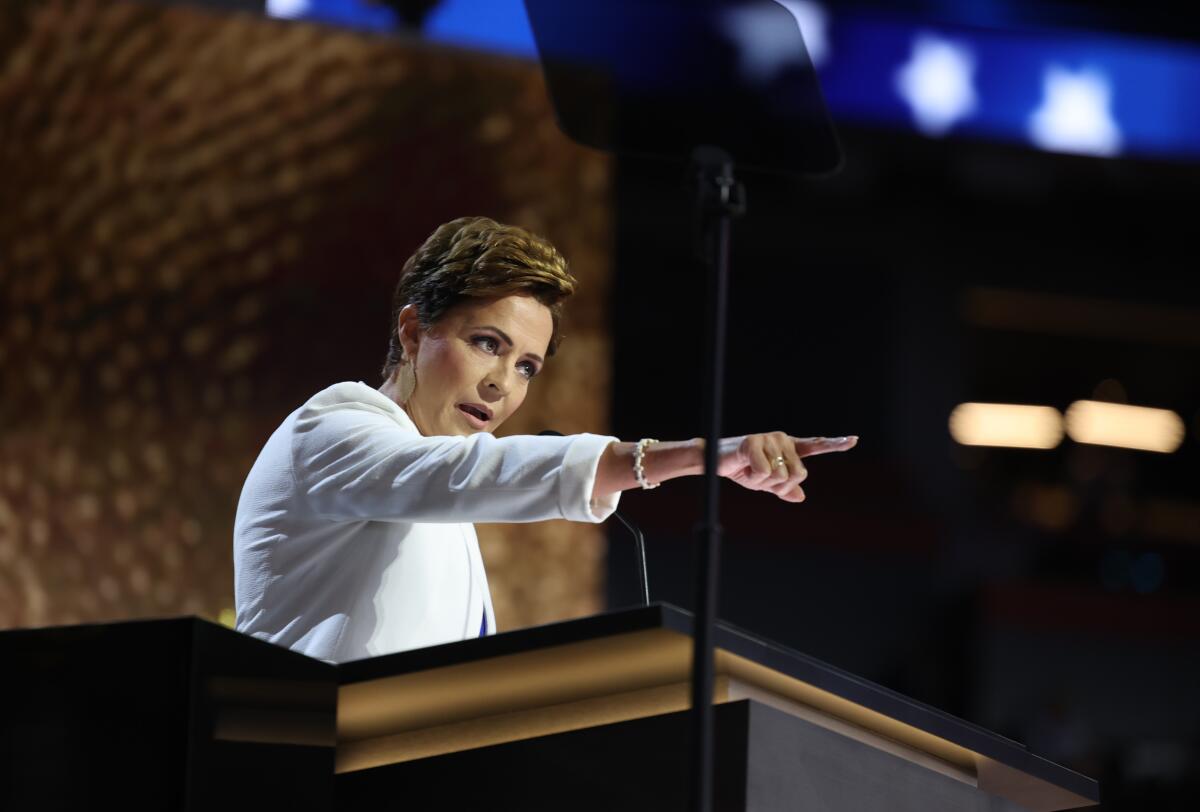
Kari Lake speaks at the Republican National Convention on Tuesday.
(Jason Armond / Los Angeles Times)
Lake said President Biden and Democrats “have handed over control of my state, Arizona’s border, to the drug cartels,” and that “because of them, criminals and deadly drugs are pouring in and our children are dying.”
Anne Fundner, a mother from California, said her 15-year-old son, Weston, died from fentanyl in 2022 — which she blamed on the “open border” policies of Biden, Vice President Kamala Harris and Gov. Gavin Newsom.
“This was not an overdose, it was a poisoning. His whole future, everything we ever wanted for him, was ripped away in an instant — and Joe Biden does nothing,” Fundner said.
She said Trump must be elected to help end fentanyl’s scourge on American families like hers. “This fight is not for me. My son is gone,” she said. “This fight is for your children.”
Crime and homelessness are perennial campaign talking points among Republicans, often couched as the result of liberal policies in states such as California.
Republicans claim the title of the “law and order” party, which has been a particularly useful point of political redirection for Trump as he has faced multiple criminal investigations and been convicted of dozens of felonies in recent years.
Democrats dismiss the Republican criticisms as inaccurate or overblown. Cities like Los Angeles and San Francisco do struggle with crime and homelessness issues, Democrats say, but not to the extent Republicans suggest — and cities in red states struggle with similar issues.
Democrats also blasted Republicans for platforming individuals at the RNC who were involved in the Jan. 6, 2021, insurrection and siege on the U.S. Capitol.
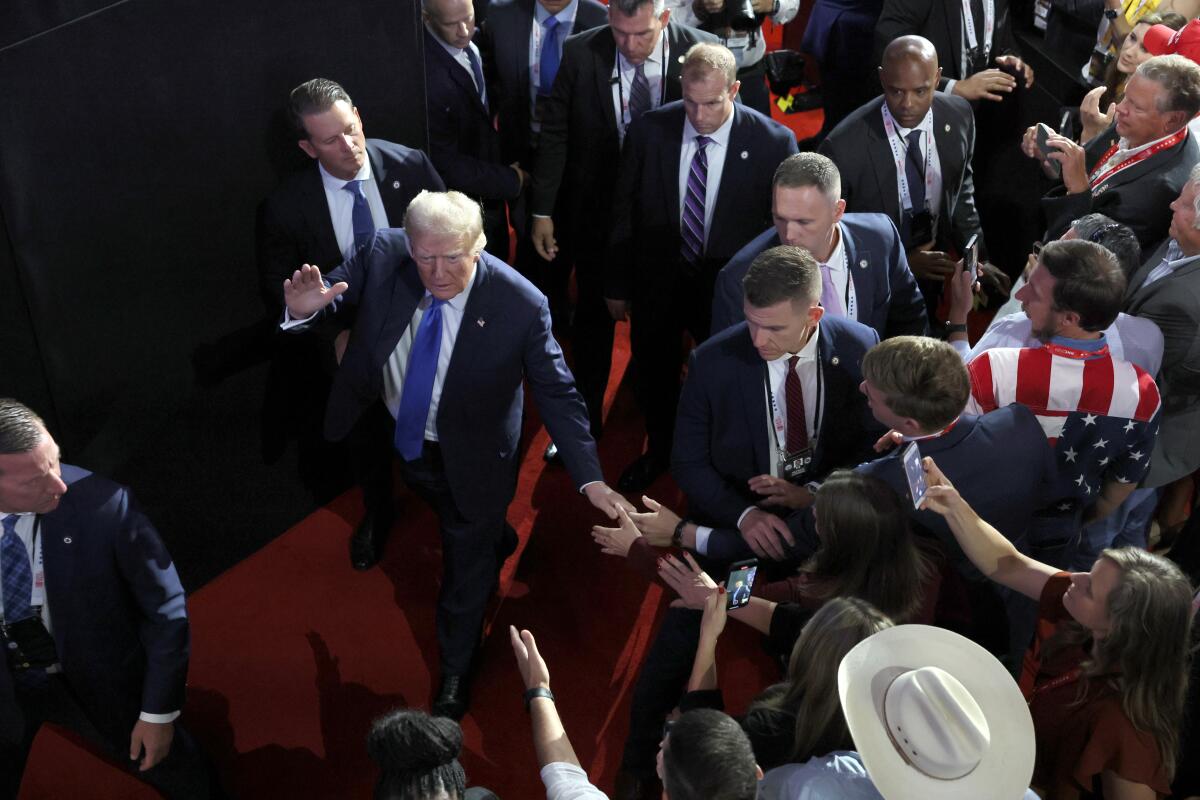
Presidential candidate Donald Trump leaves the Republican National Convention on Tuesday.
(Robert Gauthier / Los Angeles Times)
Officer Michael Fanone, a Capitol Police officer who was injured in that attack, condemned the presence of insurrectionists at the convention.
“What happened on January 6th almost cost me my life and brought our democracy to the brink,” Fanone said in a statement. “This is a moment to come together and oppose those who call for violence in politics, but the RNC’s decision to give a platform to the same people who rioted against our democracy on January 6th does the opposite.”
Crime data vary across the country and within individual states.
However, the clearest trend in crime data in recent years nationwide, experts said, is that violent crime is down. Republicans often dismiss such data by saying they are fabricated or the result of lower reporting rates.



new video loaded: Senate Republicans Block Limits to Trump’s War Powers
transcript
transcript
Senate Republicans Block Limits to Trump’s War Powers
Senate Republicans voted against a Democratic bill that would have required President Trump to obtain congressional authorization to continue waging war against Iran.
-
“The yeas are 47. The nays are 53. The motion to discharge is not approved.” “President Trump decided to attack Iran. That decision was profound, deliberate and correct. The president understands the weight of war.” “Why is Donald Trump hellbent on making history repeat itself? Why is he plunging America headfirst into a war that Americans do not want, and which he cannot even explain? The American people deserve a say, and that is what our resolution is about.”
By Shawn Paik
March 5, 2026
Politics
DHS defends McLaughlin against allegations husband’s company profited millions from ad contracts: ‘Baseless’

NEWYou can now listen to Fox News articles!
EXCLUSIVE: Newly obtained financial statements shed light on claims that former Department of Homeland Security (DHS) Assistant Secretary Tricia McLaughlin’s husband’s company made millions from a DHS advertising campaign.
DHS Secretary Kristi Noem faced intense questioning during a Senate Judiciary Committee hearing Tuesday, and Sen. John Kennedy, R-La., specifically called out the agency for contracting a public relations firm headed by McLaughlin’s husband, Benjamin Yoho.
“I have personally reviewed the allegations against Ms. McLaughlin, and I find them to be baseless,” DHS General Counsel James Percival told Fox News Digital. “Nothing illegal or unethical occurred with respect to these contracts. Ms. McLaughlin was not involved in selecting any subcontractors.
“She is, however, a superstar in the public affairs world, so I am not surprised that she married a successful businessman whose services were attractive to these outside firms.”
Newly obtained financial statements address allegations that former Department of Homeland Security Assistant Secretary Tricia McLaughlin’s husband’s firm improperly profited from a multimillion-dollar DHS ad campaign. Lawmakers pressed Secretary Kristi Noem over the contracts during a heated Senate hearing. (Jack Gruber/USA Today)
Kennedy alleged that Yoho’s firm, The Strategy Group, “got most of the money” out of what the Louisiana Republican senator says was $220 million in “television advertisements that feature [Noem] prominently.”
“I’m sorry,” Kennedy said. “Safe America Media was a company formed 11 days before you picked them. And that the Strategy Group got most of the money. And the head of that is married to your former spokesperson.”
“It’s just hard for me to believe knowing the president as I do, that you said, ‘Mr. President, here’s some ads I’ve cut, and I’m going to spend $220 million running them,’ that he would have agreed to that,” Kennedy explained. “I don’t think Russ Vought at OMB [Office of Management and Budget] would have agreed to that.”
‘YOU SHOULD BE ASHAMED!’: PROTESTER DRAGGED FROM KRISTI NOEM’S SENATE HEARING
Senate scrutiny intensified over a DHS advertising campaign after Sen. John Kennedy, R-La., questioned whether a firm linked to McLaughlin’s husband benefited unfairly. DHS officials and the company deny any wrongdoing or multimillion-dollar profits. (Andrew Harrer/Bloomberg via Getty Images)
The Strategy Group is a conservative advertising agency for which Yoho serves as CEO.
Figures obtained by Fox News Digital show a slightly lesser total advertising expenditure of approximately $185 million, with a total of roughly $146.5 million going to a campaign called “Save America.”
However, of the total that went to “Save America,” roughly $348,000 went to production costs, while the remaining $142 million went to “media buys.”
Sources at DHS say that media buys are the cost of actually buying the ads themselves, whether purchased from social media or for a TV ad.
Kennedy also alleged that the bidding process for the contracts never took place and that Safe America Media’s recent founding was a cause for concern and collusion between McLaughlin and her husband’s business.
WATCH THE MOST VIRAL MOMENTS AS KRISTI NOEM’S HEARING GOES OFF THE RAILS
Debate over DHS’ “Save America” ad campaign intensified as senators challenged its costs and contractor ties, even as agency officials touted the initiative as a historic success in promoting self-deportation. (Graeme Sloan/Getty Images)
“Yes they did,” Noem responded during the hearing. “They went out to a competitive bid, and career officials at the department chose who would do those advertising commercials.”
The Strategy Group posted to X Tuesday that it never had a contract with the department. While it did receive several hundred thousand dollars for production costs associated with the advertising campaigns, The Strategy Group never made millions.
“The Strategy Group has never had a contract with DHS,” the post said. “We had a subcontract with Safe America [Media] for limited production services. Safe America paid us $226,137.17 total for 5 film shoots, 45 produced video advertisements and 6 produced radio advertisements.
DHS SPOKESWOMAN TRICIA MCLAUGHLIN TO LEAVE TRUMP ADMIN, SOURCE CONFIRMS
Critics raised concerns about potential conflicts of interest in a high-dollar DHS advertising effort, but department representatives say McLaughlin recused herself and that subcontracting decisions were made independently. (AP Photo/Jose Luis Magana, File)
“If you’re going to try to question our integrity, bring actual evidence — we did,” the post concluded.
Because these ads were purchased using public funds, all contract totals are publicly available.
Lauren Bis, who took up the role of assistant secretary once McLaughlin left office, told Fox News Digital Tuesday that scrutiny from Republicans and Democrats over the advertising spending was unjustified because the campaigns resulted in “the most successful ad campaign in U.S. history.”
“Sanctuary politicians are attacking this ad campaign because it has been successful in CLOSING our borders and getting more than 2.2 million illegal aliens to LEAVE the U.S.,” Bis said.
“The DHS domestic and international ad campaign was the most successful ad campaign in U.S. history. The results speak for themselves: 2.2 million illegal aliens self-deported, and we now have the most secure border in American history.”
KRISTI NOEM TO FACE SENATE GRILLING OVER MINNEAPOLIS SHOOTINGS AS DHS SHUTDOWN HITS WEEK 3
The Trump administration reaffirmed that all illegal immigrants are eligible for deportations as they focus on arresting violent criminals first. (Raquel Natalicchio/Houston Chronicle via Getty Images)
Bis also compared the cost of arresting and deporting an illegal migrant to that of the minimal cost of an illegal migrant self-deporting. The department says the advertising campaign played a key role in marketing self-deportation.
A spokesperson at DHS also told Fox News Digital that contractors decide who they hire, fulfilling the terms of a contract, not the department itself.
“By law, DHS cannot and does not determine, control or weigh in on who contractors hire or use to fulfill the terms of the contract,” a DHS spokesperson told Fox. “Those decisions are made by the contractor alone. We have only become aware of these companies because of this inquiry and did not hire those companies.”
The spokesperson also noted that McLaughlin “recused herself” from interactions with subcontractors to avoid “any perceived appearance of impropriety.”
“Upon hearing who the subcontractors were for production of the ad, Ms. McLaughlin recused herself from any interaction or engagement with any subcontractors to avoid any perceived appearance of impropriety,” the spokesperson continued. “DHS Office of Public Affairs is the program officer. Ms. McLaughlin oversees the DHS Office of Public Affairs, which is simply the vehicle for this contract.”
Department of Homeland Security Secretary Kristi Noem takes her seat as she arrives to testify during a Senate Judiciary Committee hearing Tuesday on Capitol Hill in Washington, D.C. (Jim Watson/AFP via Getty Images)
McLaughlin told Fox News Digital the criticism of her and her family by senators at the hearing is a matter of public manipulation.
CLICK HERE TO DOWNLOAD THE FOX NEWS APP
“This is yet another example of politicians intentionally trying to dupe and manipulate the public to try to manufacture division and anger,” McLaughlin told Fox News Digital. “The ad spend and contracts are a matter of public record, and the process was done by the book.
“These politicians would rather smear private citizens and American small businesses than do any basic research.”
Fox News Digital’s Alexandra Koch contributed to this report.
Related Article


WASHINGTON — Senate Republicans blocked a war powers resolution Wednesday designed to withdraw U.S. forces from hostilities in Iran, as the Trump administration accelerates its military campaign in a conflict that has killed hundreds, including at least six American service members.
The motion failed in a vote of 47-53.
In addition to pulling out military resources from the Middle East, the measure — introduced by Sens. Chuck Schumer (D-N.Y.), Adam Schiff (D-Calif.) and Tim Kaine (D-Va.) — would have required Congress’ explicit approval before future engagement with Iran, a power granted to the legislative branch in the Constitution.
The House, where Republicans also hold an advantage, is scheduled to weigh in on a similar measure Thursday. Even if both Democratic-led measures were to succeed, President Trump was widely expected to veto the legislation.
“We are doing very well on the war front, to put it mildly,” President Trump said at a White House event on Wednesday afternoon. The president, who has come under scrutiny for offering shifting explanations on the war’s endgame, said that if he was asked to scale the American military operation from one to 10, he would rate it a 15.
Democrats dispute that Trump possesses the authority to wage the ongoing operation in Iran without explicit congressional approval.
Acknowledging the measure was unlikely to succeed, they framed the vote as a strategy to force lawmakers to put their support for or opposition to the war on record.
“Today every senator — every single one — will pick a side,” Schumer said. “Do you stand with the American people who are exhausted with forever wars in the Middle East, or stand with Donald Trump and Pete Hegseth as they bumble us headfirst into another war?”
Senate Majority Leader John Thune (R-S.D.) and most of his Republican colleagues have maintained that the president carried out a “pre-emptive” and “defensive” strike in Iran, giving him full authority to continue unilateral military operations.
Republicans saw the vote as the “last roadblock” stopping Trump from carrying out his mission against the Islamic Republic.
“I think the president has the authority that he needs to conduct the activities and operations that are currently underway there. There are a lot of controversy and questions around the war powers act, but I think the president is acting in the best interest of the nation and our national security interests,” Thune said at a news conference.
Senators largely held to party loyalties, with the exception of Kentucky Republican Rand Paul, who broke ranks to support the measure, and Pennsylvania Democrat John Fetterman, who opposed it.
The vote comes as Defense Secretary Pete Hegseth said Wednesday that the war against Iran is “accelerating,” with American and Israeli forces expanding air operations into Iranian territory. He pointed to evidence released by U.S. Central Command of a submarine strike on an Iranian warship, and also lauded other strikes throughout the region as civilian casualties in Iran surpassed 1,000 on the fourth day of the conflict, according to rights groups.
“We’re going to continue to do well,” Trump said Wednesday. “We have the greatest military in the world by far and that was a tremendous threat to us for many years. Forty-seven years they’ve been killing our people and killing people all over the world, and we have great support.”
Republicans blocked a similar war powers vote in January after the president ordered U.S. special forces to capture and extradite Venezuelan President Nicolás Maduro in Caracas on drug trafficking charges.
GOP leaders argued that the outcome of that mission equated to a quick success in the Middle East, despite an uncertain timeline from the Department of Defense.
In the House, lawmakers will vote on a separate war powers effort Thursday. That bill is led by Rep. Ro Khanna (D-Calif.) and Rep. Thomas Massie (R-Ky.), the two lawmakers who authored the Epstein Files Transparency Act.
“Instead of sending billions overseas, we need to invest in jobs, healthcare, and education here,” Khanna said on X.
In addition to that proposal, moderate Democrats in the House have introduced a separate resolution that would give the administration a 30-day window to justify continued hostilities in the Middle East before requiring a formal declaration of war or authorization from Congress.
RI Lottery Powerball, Numbers Midday winning numbers for March 4, 2026

South Carolina Lottery Powerball, Pick 3 results for March 4, 2026
SD Lottery Powerball, Lotto America winning numbers for March 4, 2026

Tennessee Football 2028 In-State CB Target Jermaine Cobbins Talks Recruitment

More severe weather possible in North Texas on Friday

Florida High School Football Rankings: Top 25 teams – Oct. 21

Cleary's 21 help Le Moyne down Central Connecticut State 69-64 in OT

How old is Bo Nix? What to know about Oregon quarterback ahead of 2024 NFL Draft

99th annual Pony Swim held in Virginia

Indiana Members Credit Union announced as new anchor tenant at Bottleworks District

DHS defends McLaughlin against allegations husband’s company profited millions from ad contracts: ‘Baseless’

Sánchez defies Trump in political gamble as Madrid say no to war

Satellite images show Iran school strike hit more buildings than earlier reported

US submarine sinks Iranian warship by torpedo in a first since World War II

Which oil and gas facilities in the Gulf have been attacked?
-

 World1 week ago
Exclusive: DeepSeek withholds latest AI model from US chipmakers including Nvidia, sources say
-

 Massachusetts1 week ago
Mother and daughter injured in Taunton house explosion
-

 Wisconsin3 days ago
Setting sail on iceboats across a frozen lake in Wisconsin
-

 Maryland4 days ago
AM showers Sunday in Maryland
-

 Denver, CO1 week ago
10 acres charred, 5 injured in Thornton grass fire, evacuation orders lifted
-

 Florida4 days ago
Florida man rescued after being stuck in shoulder-deep mud for days
-

 Oregon6 days ago
2026 OSAA Oregon Wrestling State Championship Results And Brackets – FloWrestling
-

 Massachusetts2 days ago
Massachusetts man awaits word from family in Iran after attacks