Politics
Trump wants mass deportations. Can Biden sell a more nuanced approach during the debate?

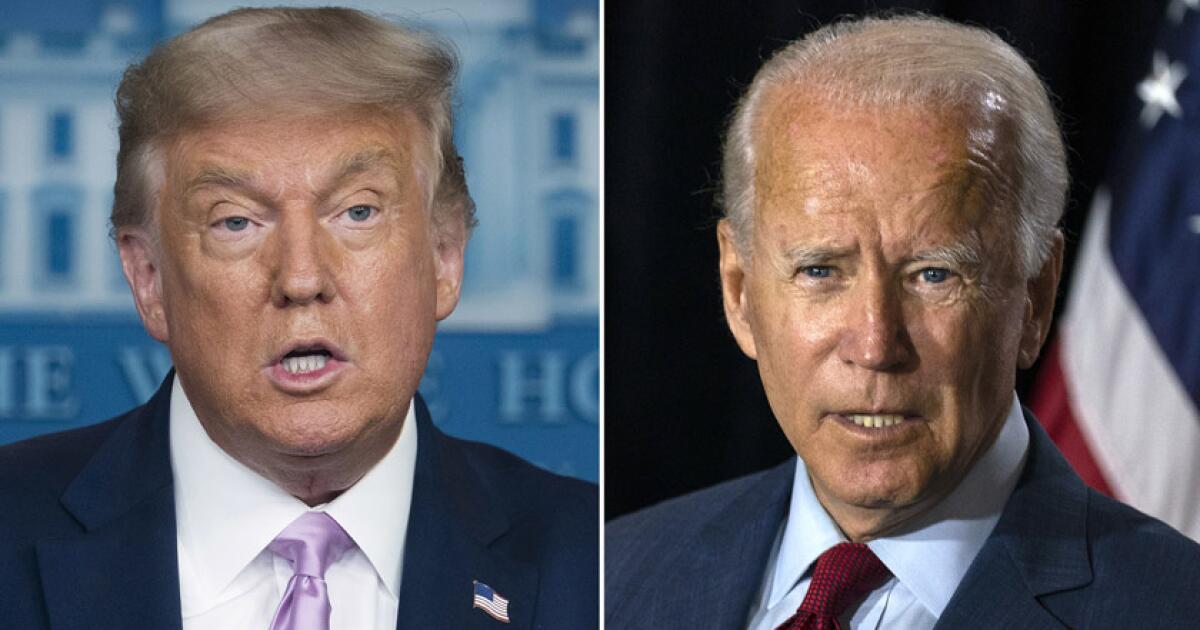
When President Biden and former President Trump take the stage in Atlanta on Thursday, immigration and the humanitarian crisis at the southern border will almost certainly be a flashpoint.
Many polls show that voters believe Trump is best positioned to address the issue, and he has continuously slammed Biden on it. He has blamed his successor’s policies for the crisis, and filled his social media feeds with missives about crimes allegedly committed by immigrants, referring to them as “Biden Migrant Killings.” He has vowed to deport millions of immigrants who are in the country without legal authorization.
Trump has referred to migrants as “animals” and even suggested they should be turned into mixed martial arts combatants.
“I said, ‘Dana, I have an idea for you to make a lot of money. You’re going to go and start a new migrant fight league, only migrants,’” Trump said before an evangelical Christian conference in Washington, D.C., last weekend, referring to Dana White, head of the Ultimate Fighting Championship.
Such comments have scored Trump points with his base and beyond.
Biden faces a trickier challenge, allies and advisors say, and needs to hone in on a nuanced message Thursday night that emphasizes the balance between the need for border security and humanity for immigrants who already have entered this country.
“I don’t think it’s an either-or and I don’t think the American public thinks it’s an either-or,” Sen. Alex Padilla (D-Calif.) told The Times this week. “We can and should do both.”
He said Thursday night’s debate will exemplify how “Joe Biden speaks to American people. Donald Trump speaks to his base.”
Matt A. Barreto, a Biden campaign pollster, said an April poll he oversaw found that two-thirds of respondents in key battleground states want “a balanced approach to the immigration system and report high levels of support for policies addressing both border security and paths to citizenship.”
“This is what the president is pushing for and the polling data suggests that’s what the American public wants,” Barreto told The Times. “They want to see a well managed orderly border and they also have tremendous empathy for long-term undocumented immigrants and they want to see them brought out of the shadows.”
Biden has made two moves recently that reflect this balancing act, imposing limits on asylum seekers and clearing a path to citizenship for undocumented spouses of American citizens.
For the third month in a row, respondents to an April Gallup poll cited immigration as the most important problem facing the United States. A recent Washington Post-Schar School of Policy and Government poll of swing state voters found that just 42% of respondents said immigrants who are in the country illegally should be deported. Nearly 60% said they should be offered the chance to apply for legal status.
Still, Trump’s handling of immigration is preferred to Biden’s, 52% to 26%, according to the same poll.
During the debate, Trump is likely to bring up serious crimes allegedly committed by undocumented immigrants.
In one instance, two men from Venezuela who entered the U.S. illegally earlier this year were charged in connection with the death of a 12-year-old girl in Houston. “We have a new Biden Migrant Killing — It’s only going to get worse, and it’s all Crooked Joe Biden’s fault,” Trump said on Truth Social.
But immigrants are less likely to commit crimes than people born in the U.S., studies show. The Times reported earlier this year that Trump was fundraising with Thomas Homan, a former acting director of U.S. Immigration and Customs Enforcement who helped implement the widely derided family separation policy.
In response, Trump spokesperson Karoline Leavitt said, “Biden’s reversal of President Trump’s immigration policies has created an unprecedented and illegal immigration, humanitarian and national security crisis on our southern border.”
Leavitt said that if Trump returns to the Oval Office, “he will restore all of his prior policies, implement brand new crackdowns that will send shock waves to all the world’s criminal smugglers, and marshal every federal and state power necessary to institute the largest deportation operation in American history.”
In recent weeks Trump has appeared to modulate, saying on a podcast that immigrants who graduate from American colleges should get a green card. The comments prompted fierce pushback from his allies.
His spokesperson then clarified that not all graduates would be getting green cards, saying it “would only apply to the most thoroughly vetted college graduates who would never undercut American wages or workers.”
Earlier this year, House Republicans heeded Trump’s demands and killed a bipartisan border security bill after months of negotiations in the Senate. The negotiations also exposed divisions among Democrats and reflected the two notes Biden will need to hit Thursday: How to speak to voters who think the southern border is too porous while also emphasizing the contributions of immigrants already in the country.
Pedro Rios of the American Friends Service Committee talks with asylum seekers at the border near San Diego in June.
(Robert Gauthier / Los Angeles Times)
“Every American should know that Trump proudly killed the strongest bipartisan border bill in a generation — siding with fentanyl traffickers over the Border Patrol and our security,” said campaign spokesperson Kevin Munoz, hinting at an avenue of attack Biden might utilize Thursday.
Padilla opposed the winter compromise because it didn’t include reforms to aid farmworkers and undocumented immigrants already in the country. Biden at the time said he would have signed the deal but it never made it to his desk primarily because of Trump’s opposition.
Even though he didn’t like the deal, Padilla said Biden has done a good job through executive orders and public pronouncements aimed at both securing the southern border and helping people already here. Padilla pointed to a recent executive order that would protect immigrant spouses of U.S. citizens who have lived consecutively in the country for at least a decade. The move allows as many as 500,000 of those immigrants to quickly access a pathway to U.S. citizenship.
Unlike Padilla, Rep. Greg Stanton (D-Ariz.) supported the Senate compromise deal. The former Phoenix mayor viewed it as a good start that immediately spoke to the frustrations of his constituents and would’ve “reestablished operational control” of the border. Stanton has frequently traveled to border stations and ports of entry — often with Republicans — and said that what he has witnessed is unsustainable.
Earlier this month, the Biden administration raised the legal standard for asylum claims and restricted access to asylum for those crossing the border illegally when arrests average higher than 2,500 a day, as has been common.
The change is hampered without additional funding, which the border bill would have provided, administration officials point out. Mexico has agreed to accept migrants from certain other countries, such as Venezuela and Cuba, allowing some to be quickly removed from the U.S. But officials can’t rely on the consistent cooperation of other countries, such as China, to take their citizens back.
Still, after record high arrests at the end of last year, Border Patrol said preliminary data since Biden’s announcement showed arrests had fallen by 25%.
May figures show arrests fell to the third-lowest of any month throughout his presidency.
Customs and Border Protection reported that agents recovered 895 remains of migrants in fiscal year 2022, three times as many as were discovered in 2018. Advocates say the number is a vast undercount.
Stanton said the debate is a moment where Biden can point to these accomplishments and lay out how Republican intransigency has torpedoed any efforts to get more durable fixes. Stanton was at the signing ceremony for Biden’s executive order where he highlighted the work of a formerly undocumented nurse who helped COVID-19 patients during the pandemic. The nurse had benefited from Deferred Action for Childhood Arrivals.
“Biden understands the fundamentals of saying you need strong border security and appropriate immigration, smart immigration reform,” Stanton said. “Those have always gone together.”
Times staff writer Andrea Castillo contributed to this report.

Politics
Omar’s disclosures erased millions, leaving her with potential negative net worth. She won’t explain why.

NEWYou can now listen to Fox News articles!
Rep. Ilhan Omar, D-Minn., refused to address her revised financial disclosures that could imply she has a negative net worth after the progressive lawmaker dramatically reducing the reported value of assets tied to her husband’s business ventures.
“Can you tell us if your husband still has the consulting business and the wine business?” Fox News Digital asked Omar.
The congresswoman stayed silent as she was repeatedly questioned, after previously telling Fox News Digital that the original filing — showing Omar’s reported assets reducing by as much as $29.9 million — was inaccurate and “incomplete” information.
ILHAN OMAR’S OFFICE SAYS SHE’S ‘NOT A MILLIONAIRE’ AFTER $30M FILING REVISED DOWN TO UNDER $100K: REPORT
US Representative Ilhan Omar, Democrat of Minnesota, speaks during a press conference with family members of Palestinian-American journalist Shireen Abu Akleh as members of Congress call for US investigations into Israel’s actions and reintroduce the Justice for Shireen Act, outside the US Capitol in Washington, DC, May 18, 2023. The Al Jazeera journalist, who was a dual US citizen, was killed on May 11, 2022. The Israeli army later admitted one of its soldiers likely shot the reporter. (Photo by SAUL LOEB / AFP) (Photo by SAUL LOEB/AFP via Getty Images)
The controversy surrounding Omar’s finances began when a 2024 financial report estimated that Omar and her husband possessed between $6 million and $30 million in assets, all while the Minnesota fraud scandal within the Somali community was beginning to come to fruition.
A more recent 2025 financial disclosure report shows Omar’s revised value of shared assets between her and husband to sit at a maximum of $125,000 — a multi-million-dollar drop from the year prior. The lower estimate of their assets, $20,000, compared to the low and high debt estimates, $30,000 and $100,000, would imply the Minnesota Democrat could have a negative net worth.
Both her and her husband have separate debts, each ranging somewhere between $15,000 and $50,000 — from her own student loans and her husband’s credit card debt, according to the disclosures.
WATCH: OMAR SILENT WHEN CONFRONTED ON ALLEGED TIES TO MASSIVE MINNESOTA FRAUD SCANDAL
RICHFIELD, MN – AUGUST 08: Rep. Ilhan Omar (D-MN) (C) campaigns with her husband Tim Mynett (R) at the Richfield Farmers Market on August 8, 2020 in Richfield, Minnesota. Omar is hoping to retain her seat as the representative for Minnesota’s 5th Congressional District in next week’s primary election. (Photo by Stephen Maturen/Getty Images)
The biggest change in the documents involved Omar’s husband, Tim Mynett. His reported ownership interests in both his winery and venture capital advisory firm, which were previously valued in the millions of dollars, are listed with no value now.
In Omar’s 2024 financial disclosure records, Mynett’s share in his winery was valued between $1 million and $5 million, and his share at the venture capital advisory firm was valued between $5 million and $25 million. Now, his equity interests are both listed at $0.
Omar’s office previously told Fox News Digital that Mynett has partners in both businesses and said the earlier disclosure mistakenly reflected the businesses’ total equity rather than his ownership interest. The office also said the original filing listed assets without accounting for liabilities.
VANCE REFERS TIM WALZ, MINNESOTA ATTORNEY GENERAL TO DOJ FOR CRIMINAL INVESTIGATION OVER STATE’S ALLEGED FRAUD
House Oversight Committee Chairman James Comer, R-Ky., has publicly voiced his interest in the Ethics Committee opening an investigation into Omar’s personal finances after the 2025 financial reports came out showing the possibility of a $29 million drop in her net worth.
Vice President JD Vance also has previously said the U.S. Department of Justice will be opening a probe into her alleged fraud as part of the administration’s anti-fraud taskforce that he spearheads, though no formal investigations have been shared with the public at this time.
Omar has been reluctant to answer Fox News Digital’s questions about her financial fallout and potential probes to be opened against her.
The Minnesota lawmaker similarly dodged answering any of Fox News Digital’s questions just last month about the revised disclosures.
CLICK HERE TO DOWNLOAD THE FOX NEWS APP
“There’s also the possibility that it might rain on this sunny day,” Omar replied without responding directly to the content of the question.
Fox News Digital’s Robert Schmad contributed to this report.

As a student years ago, I dove deep into the history of the Red-hunting McCarthy era and became familiar with the actor who emerged second only to Wisconsin Sen. Joe McCarthy as the villain of that insidious time: his shameless, conniving young lawyer, Roy Cohn. Never would I have imagined that a future president would count Cohn as a mentor and role model.
Then came Donald Trump.
Now, in Cohn-inflected McCarthyesque style, President Trump is channeling his tutor yet again, baselessly labeling his political enemies — all Democrats — as communists as he looks ahead to the fall’s midterm elections. Once more Trump shows that his catchphrase “Make America great again” means regressing, this time to Trump’s formative 1950s and the McCarthy era that sadly helped define it.
In recent speeches, including on the Fourth of July, Trump’s utterances of “communist” or “communism” reached double digits each time. (As that implies, the president didn’t set aside his divisive rhetoric even for the nation’s 250th birthday.)
“Our warriors did not fight communism on battlefields across the world only to have that menace rear its ugly head right back here in America,” Trump said late on the Fourth on the National Mall.
Trump couples his commie-baiting with a dash of his trademark xenophobia. “There is now a resurgence of the communist menace in our land, including by newcomers to our country who embrace ideas totally opposed to our way of life and our great success,” he said at Mount Rushmore a day earlier. (He’s got it backward, of course: Immigrants come here for the American way of life and promise of success.)
Here’s the irony: Trump’s actions in his second term make him look more like the commie. He’s projecting again.
Now that Trump is exploiting a few victories lately by left-wing democratic socialists in Democratic primaries to paint the entire party as communists, it’s time to review the record — his record.
A hallmark of communism is government ownership of companies and control of the economy, at the expense of private property and free markets. In just over a year, Trump has used billions of taxpayers’ dollars to buy shares for the government in a growing list of private companies — U.S. Steel, Intel, Westinghouse and more — citing national security. The companies don’t always welcome their new stakeholder; at a minimum, they rightly fear it for the demands the government could make about prices and production.
“It’s what Putin did,” the estranged Republicans at the Lincoln Project posted online Monday. “Trump is the closest we’ve ever come to communism.”
“What began as a populist revolt against so-called elites has become a program of state ownership, price fixing and top-down industrial control,” free-market economist Veronique de Rugy wrote in The Times last October of Trump’s actions. “The power to ‘partner’ with business is the power to control it.”
Comrade Trump’s first big government grab, and a model for those to come, was in June last year, when he wrested a permanent “golden share” in U.S. Steel in return for approving its sale to Japan’s Nippon Steel. The company’s charter was revised to give the U.S. president extraordinary veto power over nearly a dozen corporate activities, including closing or relocating plants, supply-chain decisions, even pricing.
“We have a golden share, which I control,” Trump told reporters at the time, in words I never thought I’d hear from a president of the party once associated with free markets.
Just last week, Trump boasted to CNBC how he’d extracted a 10% stake in beleaguered chip giant Intel last August, after first demanding that its chief executive resign. “Intel came in. They had a problem. I said, ‘I can solve your problem, but I want 10% of the company.’ … Somebody said that’s not very American. I said, ‘No, I think it is very American, actually.’ And I’ve done that with other deals.”
And so he has.
The Pentagon is now the largest stockholder in struggling MP Materials, a large rare-earth mine in California, and guarantees a 10-year price floor for its output that stunned competitors. The administration has since taken shares in other rare-earth companies. The Commerce Department took an option for an 8% stake in Westinghouse, to spur construction of nuclear reactors, and has the right to 20% if the government decides the company should go public. The government takes a 15% cut of Nvidia’s and Advanced Micro Devices’ AI chip sales to China.
As much as anything he does, Trump’s direct intervention in private enterprise invites the question “What if Biden/Harris/Obama did that?” The answer, of course: Trump and Republicans would cry “Communist!”
Trump’s actions are the sort Americans generally have only seen during economic emergencies or major wars, and then rarely. I covered the frenzied and ultimately successful response to the near-collapse of the global financial system and the U.S. auto, insurance and housing industries. Behind the scenes in the Obama White House (and George W. Bush’s at the outset) was constant, angst-filled debate about any actions smacking of government takeovers and a determination that interventions be temporary, unlike Trump’s schemes. (For all the still-lingering unpopularity of the banking bailout, the Treasury — the taxpayers — got all the money back and then some, and exited the business.)
Trump’s economic big-footing isn’t the only way in which he resembles the commies Americans know best, and whom he so admires: Vladimir Putin, Xi Jinping, Kim Jung Un. There are also the images of himself everywhere, monuments planned, drearily long and self-adulating speeches and interference in the nation’s cultural, educational and legal spheres and — worst of all — in elections.
At Rushmore, Trump closed with a demand that Congress pass his so-called SAVE America Act to restrict voting. “We do that and we’re not going to lose an election for 100 years,” he said, speaking of course about Republicans.
One-party rule through central government election finagling? Now that’s a communist.
Bluesky: @jackiecalmes
Threads: @jkcalmes
X: @jackiekcalmes

NEWYou can now listen to Fox News articles!
Maine state Rep. Valli Geiger, a Rockland Democrat, former nurse and former mayor, is drawing sudden national attention after saying now-former Democratic Senate nominee Graham Platner encouraged her to consider taking his place on the ballot in the Maine Senate race.
While Geiger has not been named the replacement nominee, her name entered the Maine Senate scramble after she told local outlet WMTW that Platner called her Monday night, praised her as a “fighter” and asked whether he could put her name forward. Platner’s campaign told the outlet he had not made an endorsement decision but confirmed he encouraged Geiger to consider running if he stepped aside.
After Geiger said Platner called her about potentially putting her name forward, Geiger posted Tuesday she would not “throw Graham under the bus,” while also saying she would not “slander or accuse” Jenny Racicot, the woman who accused Platner of rape, “of anything more than telling the truth as she experienced it.”
By Wednesday, local outlets were reporting that Geiger said Platner had encouraged her to consider running if he withdrew. Platner, who suspended his campaign Wednesday night, has denied the claim.
WHAT HAPPENS NEXT IF PLATNER DROPS OUT? HERE’S WHO COULD REPLACE HIM ON THE BALLOT AND HOW IT COULD WORK
Graham Platner Maine State Rep. Valli Geiger (Maine State Legislature/Getty Images)
“For the movement to continue, it can’t be me. For that reason, we are suspending campaign operations,” Platner said in a video posted to social media.
Geiger is a third-term Democratic state representative from Rockland, according to her legislative biography, representing a coastal House district in Maine that includes Rockland, Criehaven Township, Matinicus Isle Plantation, the Muscle Ridge Islands, North Haven and part of Owls Head. Her biography says she serves on the Labor Committee and the Energy, Utilities and Technology Committee.
Before entering the state legislature, Geiger served six years on the Rockland City Council, including one year as mayor and four years on the Rockland Comprehensive Planning Commission, three of them as chair.
Her biography says she holds a master’s degree in sustainable design and built her own passive-solar, net-zero-energy house. It also describes her as a former nurse at Pen Bay Medical Center who later worked as a health policy analyst and health administrator, including as director of the Healthreach Hospice program and clinical director for Federally Qualified Health Centers around Maine.
The Maine State Capitol May 18, 2026, in Augusta, Maine. (Joe Raedle/Getty Images)
PLATNER CAMPAIGN PUTTING ‘THUMB ON SCALE’ TO INFLUENCE POSSIBLE REPLACEMENT, MAINE DEM ALLEGES
Geiger’s connection to Platner predates the latest replacement speculation. Local reporting has described her as a close Platner supporter, and WMTW reported she previously stood with him and credited him with helping secure funding for rape kit tracking in Maine.
In her Facebook post responding to Racicot’s allegation, Geiger wrote that Racicot’s story “seems credible” but added that “none of us knows the truth nor will we ever.” She also described Platner as “a man becoming a better man” and said she had hoped he would lead the political movement his campaign had built and will not “throw Graham under the bus.”
In the post, Geiger also praised Platner’s “passion for economic populism” and said she had granted him “an enormous amount of grace” for his behavior during what she described as his “dark years” after multiple deployments.
Dr. Nirav D. Shah, director of the Maine Center for Disease Control and Prevention, speaks during a news conference about COVID-19 at Maine Emergency Management Agency in Augusta. (Derek Davis/Portland Press Herald via Getty Images)
CLICK HERE TO DOWNLOAD THE FOX NEWS APP
The Maine state representative is not the only Democrat whose name has surfaced as Maine Democrats prepare for the possibility that Platner exits the race against Republican Sen. Susan Collins.
Several Democrats have expressed interest or are considering bids, including former gubernatorial candidate Troy Jackson, Secretary of State Shenna Bellows and former Maine CDC Director Nirav Shah.
Under Maine law, the Maine Democratic Party can replace him on the general election ballot by selecting a new nominee through its party process, with the replacement required to be chosen by July 27.
Fox News Digital’s Andrew Mark Miller and Paul Steinhauser contributed to this report.
-
Culture36 minutes ago
Which Version of the ‘Odyssey’ Should You Read?
-
 Lifestyle39 minutes ago
Terry Tempest Williams on why women with big ideas get labeled ‘crazy’ : Wild Card with Rachel Martin
-

 Technology51 minutes ago
Google’s Nest Thermostat has hit its best price of the year
-

 World54 minutes ago
Argentinian flight instructor jumps to death from plane, 22-year-old student forced to land alone
-

 Politics59 minutes ago
Omar’s disclosures erased millions, leaving her with potential negative net worth. She won’t explain why.
-

 Health1 hour ago
Dr Oz links obesity to chronic disease surge, says GLP-1s can ‘jumpstart’ better health
-

 Sports1 hour ago
Pirates star pitcher makes unfortunate history after being taken out in middle of perfect game bid
-

 Technology1 hour ago
Medical identity theft follows you into the doctor’s office

