Politics
Taking cue from Supreme Court, Breed to launch aggressive homeless sweeps in San Francisco

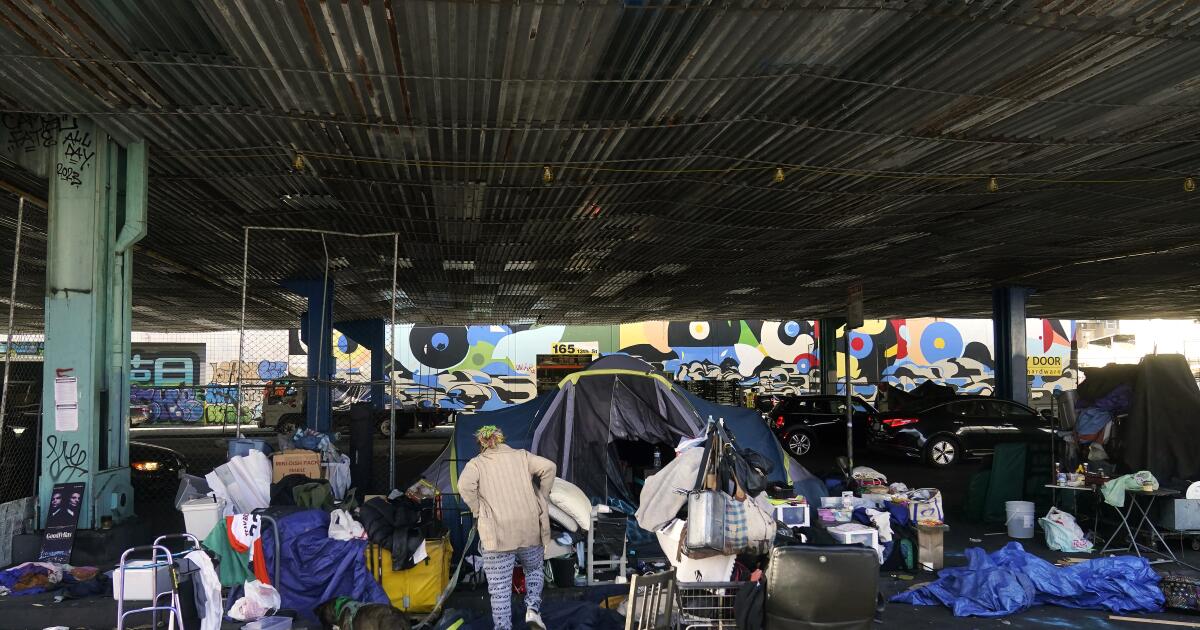
James Reem has lived in a tent on the corner of Fell and Baker streets for more than a year. An artist by trade, he said he was evicted from his apartment after troubles with his landlord and for a time lived out of a van. After the van got towed, someone gave him a tent and he turned to the streets.
His tent sits outside the city’s only DMV office, across the street from the Panhandle, a lush strip of greenery that opens into Golden Gate Park in a family-friendly neighborhood adorned by rows of manicured Victorians.
It’s a comfortable spot, said Reem, 59, with a sidewalk wide enough to accommodate his tent and still leave room for pedestrians. Some days, Reem is one of a dozen or more tent-dwellers on the concrete stretch.
“There are a few of us that stick together,” Reem said.
“They’re not concerned about the homeless,” James Reem said of San Francisco’s plans for encampment sweeps. “They’re concerned about getting rid of us.”
(Hannah Wiley / Los Angeles Times)
His adopted neighborhood is among dozens of sites likely to be targeted as the city launches what Mayor London Breed has said will be an assertive campaign to force people off the streets in response to a June ruling by the U.S. Supreme Court.
An estimated 8,300 people are living homeless in San Francisco. And despite a years-long effort to move people into temporary shelter or permanent housing, unsanctioned encampments remain a widespread and visible problem, often accompanied by garbage, theft and open drug use.
For years, Breed and other city officials said their hands were tied by decisions issued by the U.S. Court of Appeals for the Ninth Circuit, which covers many Western states, that deemed it cruel and unusual punishment to penalize someone for sleeping on the streets if no legal shelter was available.
The U.S. Supreme Court reversed that decision in a pivotal June 28 ruling, saying that cities in California and the West may enforce laws restricting homeless encampments on sidewalks and other public property.
On Thursday, citing the ruling, Democratic Gov. Gavin Newsom issued an executive order requiring state agencies to remove encampments in their jurisdictions. While the directive doesn’t require cities to follow suit, Newsom urged them to do so, characterizing the proliferation of encampments as a health and safety hazard that requires immediate action.
Breed, a fellow Democrat, has also embraced the ruling. She said last week that, armed with the high court’s decision, she will spearhead a “very aggressive” effort to clear homeless encampments beginning in August. She said the effort could include criminal penalties for refusing to disperse.
Breed was not available for an interview Friday, and her office has yet to provide details of what the sweeps will entail or where people living in tents are expected to relocate. Her spokesperson, Jeff Cretan, said some of those details would come into clearer focus next week.
During a July 18 mayoral debate hosted by the local firefighters union, Breed acknowledged her decision to orchestrate sweeps was “not a popular” one but said it was a necessary step.
“We have had to move from a compassionate city to a city of accountability,” she said. “And I have been leading the efforts to ensure we are addressing this issue differently than we have before.”
She said the city has worked over the last several years to add shelter beds and disperse outreach workers to offer services and support. But even when outreach workers offer shelter, according to the mayor’s office, those offers are rejected nearly 70% of the time.

San Francisco has experimented with sanctioned tent cities in an effort to address the needs of its homeless population.
(Carolyn Cole / Los Angeles Times)
Breed’s crackdown is likely to offer headlines out of San Francisco that counter the narratives promoted by conservative pundits as Vice President Kamala Harris ramps up her presidential campaign. Her Republican opponents have long tried to paint Harris, who rose to political power in 2004 as San Francisco’s elected district attorney, as a California liberal whose policies have helped contribute to the surging homelessness and retail crime plaguing her home state.
But the Supreme Court’s ruling is proving divisive for California’s local Democratic leaders. More left-leaning Democrats, including Los Angeles Mayor Karen Bass, say the decision will allow cities to criminalize homelessness without doing anything to address the root causes, including addiction and a dearth of affordable housing. It’s a sentiment echoed by homeless advocates.
“This order won’t reduce homelessness or deter encampments, but it will leave vulnerable people even farther away from home and health than they are today,” Sharon Rapport, state policy director for the Corporation for Supportive Housing, said in an emailed statement.
Whether San Francisco has enough shelter beds to accommodate the potential wave of people pushed off the streets is unclear. Since Breed took office, the city has expanded shelter beds from about 2,500 to nearly 4,000, her office said, and has expanded permanent supportive housing to about 14,000 slots.
The DMV encampment where Reem lives is one of several that city officials have cleared time and again, only to see it return days later. So far this year, the encampment has been cleared more than a dozen times, according to the mayor’s office.
Reem says he feels safer outside than he does in an emergency shelter, where he worries about his belongings getting stolen. He said he would accept help from city workers. But he also said he thinks Breed’s plan is less about helping people like him than it is about clearing out tents that make the public uncomfortable.
“They’re not concerned about the homeless,” he said. “They’re concerned about getting rid of us.”



new video loaded: Walz Drops Re-Election Bid as Minnesota Fraud Scandal Grows
transcript
transcript
Walz Drops Re-Election Bid as Minnesota Fraud Scandal Grows
Governor Tim Walz of Minnesota abandoned his re-election bid to focus on handling a scandal over fraud in social service programs that grew under his administration.
-
“I’ve decided to step out of this race, and I’ll let others worry about the election while I focus on the work that’s in front of me for the next year.” “All right, so this is Quality Learing Center — meant to say Quality ‘Learning’ Center.” “Right now we have around 56 kids enrolled. If the children are not here, we mark absence.”
By Shawn Paik
January 6, 2026
Politics
Pelosi heir-apparent calls Trump’s Venezuela move a ‘lawless coup,’ urges impeachment, slams Netanyahu

NEWYou can now listen to Fox News articles!
A San Francisco Democrat demanded the impeachment of President Donald Trump, accusing him of carrying out a “coup” against Venezuelan strongman Nicolás Maduro.
California state Sen. Scott Wiener, seen as the likely congressional successor to Rep. Nancy Pelosi, also took a swipe at Israeli Prime Minister Benjamin Netanyahu.
Wiener has frequently drawn national attention for his progressive positions, including his legislation signed by Gov. Gavin Newsom designating California as a “refuge” for transgender children and remarks at a San Francisco Pride Month event referring to California children as “our kids.”
In a lengthy public statement following the Trump administration’s arrest and extradition of Maduro to New York, Wiener said the move shows the president only cares about “enriching his public donors” and “cares nothing for the human or economic cost of conquering another country.”
KAMALA HARRIS BLASTS TRUMP ADMINISTRATION’S CAPTURE OF VENEZUELA’S MADURO AS ‘UNLAWFUL AND UNWISE’
California State Sen. Scott Wiener, D-San Francisco, speaks at a rally. (John Sciulli/Getty Images)
“This lawless coup is an invitation for China to invade Taiwan, for Russia to escalate its conquest in Ukraine, and for Netanyahu to expand the destruction of Gaza and annex the West Bank,” said Wiener, who originally hails from South Jersey.
He suggested that the Maduro operation was meant to distract from purportedly slumping poll numbers, the release of Jeffrey Epstein-related documents, and to essentially seize another country’s oil reserves.
“Trump is a total failure,” Wiener said. “By engaging in this reckless act, Trump is also making the entire world less safe … Trump is making clear yet again that, under this regime, there are no rules, there are no laws, there are no norms – there is only whatever Trump thinks is best for himself and his cronies at a given moment in time.”
GREENE HITS TRUMP OVER VENEZUELA STRIKES, ARGUES ACTION ‘DOESN’T SERVE THE AMERICAN PEOPLE’
In response, the White House said the administration’s actions against Maduro were “lawfully executed” and included a federal arrest warrant.”
“While Democrats take twisted stands in support of indicted drug smugglers, President Trump will always stand with victims and families who can finally receive closure thanks to this historic action,” White House spokeswoman Anna Kelly said.
Supporters of the operation have pushed back on claims of “regime change” – an accusation Wiener also made – pointing to actions by Maduro-aligned courts that barred top opposition leader María Corina Machado from running, even as publicly reported results indicated her proxy, Edmundo González Urrutia, won the vote.
“Trump’s illegal invasion of Venezuela isn’t about drugs, and it isn’t about helping the people of Venezuela or restoring Venezuelan democracy,” Wiener added. “Yes, Maduro is awful, but that’s not what the invasion is about. It’s all about oil and Trump’s collapsing support at home.”
EX-ESPN STAR KEITH OLBERMANN CALLS FOR IMPEACHMENT OF TRUMP OVER VENEZUELA STRIKES THAT CAPTURED MADURO
Around the country, a handful of other Democrats referenced impeachment or impeachable offenses, but did not go as far as Wiener in demanding such proceedings.
Rep. April McClain-Delaney, D-Md., who represents otherwise conservative “Mountain Maryland” in the state’s panhandle, said Monday that Democrats should “imminently consider impeachment proceedings,” according to TIME.
McClain-Delaney said Trump acted without constitutionally-prescribed congressional authorization and wrongly voiced “intention to ‘run’ the country.”
SCHUMER BLASTED TRUMP FOR FAILING TO OUST MADURO — NOW WARNS ARREST COULD LEAD TO ‘ENDLESS WAR’
One frequent Trump foil, Rep. Maxine Waters, D-Calif., cited in a statement that she has called for Trump’s impeachment in the past; blaming Republicans for letting the president “escape accountability.”
“Today, many Democrats have understandably questioned whether impeachment is possible again under the current political reality. I am reconsidering that view,” Waters said.
CLICK HERE TO DOWNLOAD THE FOX NEWS APP
“What we are witnessing is an unprecedented escalation of an unlawful invasion, the detention of foreign leaders, and a president openly asserting power far beyond what the Constitution allows,” she said, while appearing to agree with Trump that Maduro was involved in drug trafficking and “collaborat[ion] with… terrorists.”
Wiener’s upcoming primary is considered the deciding election in the D+36 district, while a handful of other lesser-known candidates have reportedly either filed FEC paperwork or declared their candidacy, including San Francisco Councilwoman Connie Chan.

California Rep. Doug LaMalfa (R-Richvale) has died, GOP leadership and President Trump confirmed Tuesday morning.
“Jacquie and I are devastated about the sudden loss of our friend, Congressman Doug LaMalfa. Doug was a loving father and husband, and staunch advocate for his constituents and rural America,” said Rep. Tom Emmer (R-Minn.), the House majority whip, in a post on X. “Our prayers are with Doug’s wife, Jill, and their children.”
LaMalfa, 65, was a fourth-generation rice farmer from Oroville and staunch Trump supporter who had represented his Northern California district for the past 12 years. His seat was one of several that was in jeopardy under the state’s redrawn districts approved by voters with Proposition 50.
Emergency personnel responded to a 911 call from LaMalfa’s residence at 6:50 p.m. Monday, according to the Butte County Sheriff’s Office. The congressman was taken to the Enloe Medical Center in Chico, where he died while undergoing emergency surgery, authorities said.
An autopsy to determine the cause of death is planned, according to the sheriff’s office.
LaMalfa’s district — which stretches from the northern outskirts of Sacramento, through Redding at the northern end of the Central Valley and Alturas in the state’s northeast corner — is largely rural, and constituents have long said they felt underrepresented in liberal California.
LaMalfa put much of his focus on boosting federal water supplies to farmers, and seeking to reduce environmental restrictions on logging and extraction of other natural resources.
One LaMalfa’s final acts in the U.S. House was to successfully push for the reauthorization of the Secure Rural Schools Act, a long-standing financial aid program for schools surrounded by untaxed federal forest land, whose budgets could not depend upon property taxes, as most public schools do. Despite broad bipartisan support, Congress let it lapse in 2023.
In an interview with The Times as he was walking onto the House floor in mid-December, LaMalfa said he was frustrated with Congress’s inability to pass even a popular bill like that reauthorization.
The Secure Rural Schools Act, he said, was a victim of a Congress in which “it’s still an eternal fight over anything fiscal.” It is “annoying,” LaMalfa said, “how hard it is to get basic things done around here.”
In a statement posted on X, California Democratic Sen. Adam Schiff said he considered LaMalfa “a friend and partner” and that the congressman was “deeply committed to his community and constituents, working to make life better for those he represented.”
“Doug’s life was one of great service and he will be deeply missed,” Schiff wrote.
Democratic Gov. Gavin Newsom in a statement called LaMalfa a “devoted public servant who deeply loved his country, his state, and the communities he represented.”
“While we often approached issues from different perspectives, he fought every day for the people of California with conviction and care,” Newsom said.
Flags at the California State Capitol in Sacramento will be flown at half-staff in honor of the congressman, according to the governor.
Before his death, LaMalfa was facing a difficult reelection bid to hold his seat. After voters approved Proposition 50 in November — aimed at giving California Democrats more seats in Congress — LaMalfa was drawn into a new district that heavily favored his likely opponent, State Sen. Mike McGuire, a Democrat who represents the state’s northwest coast.
LaMalfa’s death puts the Republican majority in Congress in further jeopardy, with a margin of just two votes to secure passage of any bill along party lines after the resignation of Georgia Rep. Marjorie Taylor Greene on Monday evening.
Adding to the party’s troubles, Rep. Jim Baird, a Republican from Indiana, was hospitalized on Tuesday for a car crash described by the White House as serious. While Baird is said to be stable, the Republican House speaker, Mike Johnson from Louisiana, will not be able to rely on his attendance. And he has one additional caucus member – Thomas Massie of Kentucky – who has made a habit of voting against the president, bringing their margin for error down effectively to zero.
President Trump, addressing a gathering of GOP House members at the Kennedy Center, addressed the news at the start of his remarks, expressing “tremendous sorrow at the loss of a great member” and stating his speech would be made in LaMalfa’s honor.
“He was the leader of the Western caucus – a fierce champion on California water issues. He was great on water. ‘Release the water!’ he’d scream out. And a true defender of American children.”
“You know, he voted with me 100% of the time,” Trump added.
A native of Oroville, LaMalfa attended Butte College and then earned an ag-business degree from Cal Poly San Luis Obispo. He served in the California Assembly from 2002 to 2008 and the California State Senate from 2010 to 2012. Staunchly conservative, he was an early supporter of Proposition 209, which ended affirmative action in California, and he also pushed for passage of the Protection of Marriage Act, Proposition 22, which banned same-sex marriage in California.
While representing California’s 1st District, LaMalfa focused largely on issues affecting rural California and other western states. In 2025, Congressman he was elected as Chairman of the Congressional Western Caucus, which focuses on legislation affected rural areas.

Suspects sought in Denver shooting that killed teen, wounded 3 others

Joy Hollingsworth Takes Helm in Seattle Council Shakeup » The Urbanist

San Diego sues federal government over razor wire fence near U.S.-Mexico border

Pregnant Milwaukee mom of 3-year-old dead after arson fire, police say

Overstreet announces 2026 Atlanta City Council committee leadership

Florida High School Football Rankings: Top 25 teams – Oct. 21

Cleary's 21 help Le Moyne down Central Connecticut State 69-64 in OT

How old is Bo Nix? What to know about Oregon quarterback ahead of 2024 NFL Draft

99th annual Pony Swim held in Virginia

Video: ‘It Didn’t Have to Happen This Way:’ U.Va. Faculty Call for Review of Police Response to Protests

Video: Nvidia Shows Off New A.I. Chip at CES

Pelosi heir-apparent calls Trump’s Venezuela move a ‘lawless coup,’ urges impeachment, slams Netanyahu

EU Commission examines childlike sexual images created by Musk’s AI

Lawmakers split over Maduro’s seizure. And, CDC cuts childhood vaccine schedule

Federal officials to halt more than $10B in funding to 5 states over non-citizen benefit concerns: report
-

 World1 week ago
Hamas builds new terror regime in Gaza, recruiting teens amid problematic election
-
 News1 week ago
For those who help the poor, 2025 goes down as a year of chaos
-
 Business1 week ago
Instacart ends AI pricing test that charged shoppers different prices for the same items
-

 World1 week ago
Podcast: The 2025 EU-US relationship explained simply
-
 Business1 week ago
Apple, Google and others tell some foreign employees to avoid traveling out of the country
-

 Technology1 week ago
ChatGPT’s GPT-5.2 is here, and it feels rushed
-

 Health1 week ago
Did holiday stress wreak havoc on your gut? Doctors say 6 simple tips can help
-

 Politics1 week ago
‘Unlucky’ Honduran woman arrested after allegedly running red light and crashing into ICE vehicle