Politics
Supreme Court Sides With Migrant Trump Administration Wrongly Deported


The Supreme Court on Thursday instructed the government to take steps to return a Salvadoran migrant it had wrongly deported to a notorious prison in El Salvador.
In an unsigned order, the court stopped short of ordering the return of the migrant, Kilmar Armando Abrego Garcia, indicating that courts may not have the power to require the executive branch to do so.
But the court endorsed part of a trial judge’s order that had required the government to “facilitate and effectuate the return” of Mr. Abrego Garcia.
“The order properly requires the government to ‘facilitate’ Abrego Garcia’s release from custody in El Salvador and to ensure that his case is handled as it would have been had he not been improperly sent to El Salvador,” the Supreme Court’s ruling said. “The intended scope of the term ‘effectuate’ in the district court’s order is, however, unclear, and may exceed the district court’s authority.”
The case will now return to the trial court, and it is not clear whether and when Mr. Abrego Garcia will be returned to the United States.
“The district court should clarify its directive, with due regard for the deference owed to the executive branch in the conduct of foreign affairs,” the Supreme Court’s ruling said. “For its part, the government should be prepared to share what it can concerning the steps it has taken and the prospect of further steps.”
The ruling appeared to be unanimous. But Justice Sonia Sotomayor, joined by Justices Elena Kagan and Ketanji Brown Jackson, issued a statement that was harshly critical of the government’s conduct and said she would have upheld every part of the trial judge’s order.
“To this day,” Justice Sotomayor wrote, “the government has cited no basis in law for Abrego Garcia’s warrantless arrest, his removal to El Salvador or his confinement in a Salvadoran prison. Nor could it.”
Justice Sotomayor urged the trial judge, Paula Xinis of the Federal District Court in Maryland, to “continue to ensure that the government lives up to its obligations to follow the law.”
A Justice Department spokesman responded to the order by focusing on its reference to the executive branch.
“As the Supreme Court correctly recognized, it is the exclusive prerogative of the president to conduct foreign affairs,” the spokesman said. “By directly noting the deference owed to the executive branch, this ruling once again illustrates that activist judges do not have the jurisdiction to seize control of the president’s authority to conduct foreign policy.”
Andrew J. Rossman, one of Mr. Abrego Garcia’s lawyers, expressed satisfaction with the Supreme Court’s action.
“The rule of law won today,” he said. “Time to bring him home.”
Mr. Abrego Garcia’s wife described the effect the case has had on their family and said she would keep pursuing his return to the United States.
“This continues to be an emotional roller coaster for my children, Kilmar’s mother, his brother and siblings,” Jennifer Stefania Vasquez Sura, his wife, said on Thursday, adding that “I will continue fighting until my husband is home.”
Judge Xinis had said the Trump administration committed a “grievous error” that “shocks the conscience” by sending Mr. Abrego Garcia to El Salvador despite a 2019 ruling from an immigration judge. The immigration judge granted him a special status known as “withholding from removal,” finding that he might face violence or torture if sent to El Salvador.
The administration contends that Mr. Abrego Garcia, 29, is a member of a violent transnational street gang, MS-13, which officials recently designated as a terrorist organization.
Judge Xinis, who was appointed by President Barack Obama, said those claims were based on “a singular unsubstantiated allegation.”
“The ‘evidence’ against Abrego Garcia consisted of nothing more than his Chicago Bulls hat and hoodie,” she wrote, “and a vague, uncorroborated allegation from a confidential informant claiming he belonged to MS-13’s ‘Western’ clique in New York — a place he has never lived.”
In the administration’s emergency application seeking to block Judge Xinis’s order, D. John Sauer, the U.S. solicitor general, said she had exceeded her authority by engaging in “district-court diplomacy,” because it would require working with the government of El Salvador to secure Mr. Abrego Garcia’s release.
“If this precedent stands,” he wrote, “other district courts could order the United States to successfully negotiate the return of other removed aliens anywhere in the world by close of business,” he wrote. “Under that logic, district courts would effectively have extraterritorial jurisdiction over the United States’ diplomatic relations with the whole world.”
In a response to the court, Mr. Abrego Garcia’s lawyers said their client “sits in a foreign prison solely at the behest of the United States, as the product of a Kafka-esque mistake.”
They added: “The district court’s order instructing the government to facilitate Abrego Garcia’s return is routine. It does not implicate foreign policy or even domestic immigration policy in any case.”
Mr. Sauer said it did not matter that an immigration judge had previously prohibited Mr. Abrego Garcia’s deportation to El Salvador.
“While the United States concedes that removal to El Salvador was an administrative error,” Mr. Sauer wrote, “that does not license district courts to seize control over foreign relations, treat the executive branch as a subordinate diplomat and demand that the United States let a member of a foreign terrorist organization into America tonight.”
Mr. Abrego Garcia’s lawyers said there was no evidence that he posed a risk.
“Abrego Garcia has lived freely in the United States for years, yet has never been charged for a crime,” they wrote. “The government’s contention that he has suddenly morphed into a dangerous threat to the republic is not credible.”
Mr. Sauer said Judge Xinis’s order was one in a series of rulings from courts exceeding their constitutional authority.
“It is the latest in a litany of injunctions or temporary restraining orders from the same handful of district courts that demand immediate or near-immediate compliance, on absurdly short deadlines,” he wrote.
In her statement on Thursday, Justice Sotomayor wrote that it would be shameful “to leave Abrego Garcia, a husband and father without a criminal record, in a Salvadoran prison for no reason recognized by the law.”
She added that the government’s position “implies that it could deport and incarcerate any person, including U. S. citizens, without legal consequence, so long as it does so before a court can intervene.”
“That view,” the justice wrote, “refutes itself.”
Alan Feuer, Aishvarya Kavi and Glenn Thrush contributed reporting.






NEWYou can now listen to Fox News articles!
A startup putting high-tech collars on cows could soon be worth more than $2 billion, as investors bet the technology could help farmers cut costs and cope with labor shortages.
Halter, a New Zealand-based company, is in talks to raise new funding in a deal expected to be led by billionaire Peter Thiel’s Founders Fund, according to a Bloomberg report. The round is attracting heavy investor interest and is close to being filled, though final details are still being negotiated.
THE SINGLE CRUSHING PROBLEM AMERICAN CATTLE RANCHERS WISH TRUMP WOULD FIX INSTEAD
A ranch hand rounds up cattle by horseback and drive them into the pens at the Adams Ranch Inc. in St. Lucie County, Florida on July 9, 2013. (Ty Wright/Bloomberg/Getty Images)
Farmers are increasingly looking for ways to lower expenses and boost efficiency — changes that could eventually affect food prices for consumers.
Beef prices are already soaring, and economists warn Americans shouldn’t expect relief anytime soon as the U.S. cattle herd has shrunk to its smallest size in 75 years.
The decline has been driven by years of drought, rising costs and an aging ranching workforce. Experts say rebuilding herds will take years, meaning beef prices are likely to remain elevated.
According to U.S. Department of Agriculture data, the average price of beef in grocery stores climbed from about $8.60 per pound in February 2025 to $10.12 per pound a year later — a roughly 18% increase.
THE COST OF THIS GROCERY STAPLE IS NEARING RECORD HIGHS — AND AMERICANS CAN’T GET ENOUGH
Against that backdrop, Halter is pitching technology aimed at helping farmers do more with less.
The company’s solar-powered, artificial intelligence-driven collars let ranchers herd cattle without fences, using GPS, sound and vibration signals controlled through a smartphone app. The system also tracks livestock health and movement in real time, giving farmers a way to manage herds remotely.
The goal is straightforward — fewer workers, lower costs and more efficient land use.
THE SURPRISING REASON WHY AMERICANS COULD FACE HIGH BEEF PRICES FOR YEARS
Cattle are shown in pens at the Cattlemen’s Columbus Livestock Auction in Columbus Wednesday, Oct. 8, 2025. (Melissa Phillip/Houston Chronicle/Getty Images)
Halter is part of a broader push toward “precision agriculture,” where technology is used to modernize farming. But that sector has struggled in recent years, with a wave of startups collapsing and investors pulling back amid high costs and slow adoption.
The company has also expanded into the U.S., opening an office in Colorado and targeting American ranchers as a key growth market.
CLICK HERE TO DOWNLOAD THE FOX NEWS APP
If the latest round closes as expected, it would signal renewed confidence that AI can succeed in farming — an industry where many tech bets have fallen short.
Halter did not immediately respond to Fox News Digital’s request for comment.

HAVANA — Reggaeton boomed in a neighborhood bar in Old Havana on a recent night, when, suddenly, the music stopped and everything went dark.
The customers groaned. Another blackout.
A U.S. blockade on oil shipments to Cuba has plunged the island into its worst energy crisis in modern history. The country’s already cratering economy now teeters on the verge of collapse, with vehicles idled by a lack of gas, hospitals forced to cancel surgeries and millions living without a steady supply of electricity and water.
It is the result of a calculated pressure campaign by President Trump, whose administration is negotiating with Cuba’s leaders over the future of the communist-ruled Caribbean island.
People fed up with rolling blackouts have staged sporadic protests in recent days, banging pots and shouting slogans against the government, rare demonstrations in a country known for repressing dissent.
Some power outages hit isolated areas, but in recent weeks Cuba has experienced three island-wide blackouts. The most recent one struck Saturday night and continued into Sunday.
Two men sell food from a cart in front of the Kempinski hotel Friday night in Havana.
As Havana and Washington hash out a possible deal — which is likely to include some form of economic opening, and perhaps limited changes to Cuba’s leadership — many people here say they feel like pawns in a geopolitical game beyond their control.
Some, like those at the bar, who kept drinking in the dark after the power vanished, say they have little choice but to adjust to a life where flushing a toilet, cooking a pot of rice or riding a bus to work is now considered a luxury.
“The U.S. is trying to punish the Cuban government,” said one customer, named Rolando. “But it’s the people who are suffering.”
Cuba’s struggles long predate the oil embargo. For years, Cubans have complained of food shortages, crumbling public services and political repression. Demographers say Cuba is undergoing one of the world’s fastest population declines — a 25% drop in just four years — as birth rates fall and emigration soars.
Cuban President Miguel Díaz-Canel blames “genocidal” economic, financial and trade restrictions imposed by the United States in the decades since Fidel Castro’s army toppled the U.S.-backed dictator Fulgencio Batista in 1959.
1

2

1. Young people play dominoes in the streets of Old Havana. 2. A woman reacts to her granddaughter at a bar in Old Havana. (Natalia Favre/For The Times)
But many Cubans blame their own leaders for mismanaging the economy — and straying from the ideals of Castro’s revolution. They were raised to believe in an implicit social contract, which maintained that while Cubans might not have luxuries or be allowed all civil liberties, they would always have free education and healthcare, a place to sleep and enough to eat.
“The pact has failed,” said Juan Carlos Albizu-Campos Espiñeira, an economist at the Christian Center for Reflection and Dialogue in Havana.
He faults the government for soaring inflation and a misguided investment strategy that pumped money into the tourism industry while neglecting fundamental sectors like industry and healthcare.
“This is the worst moment in Cuba’s history,” he said. “But things were really bad before this.”
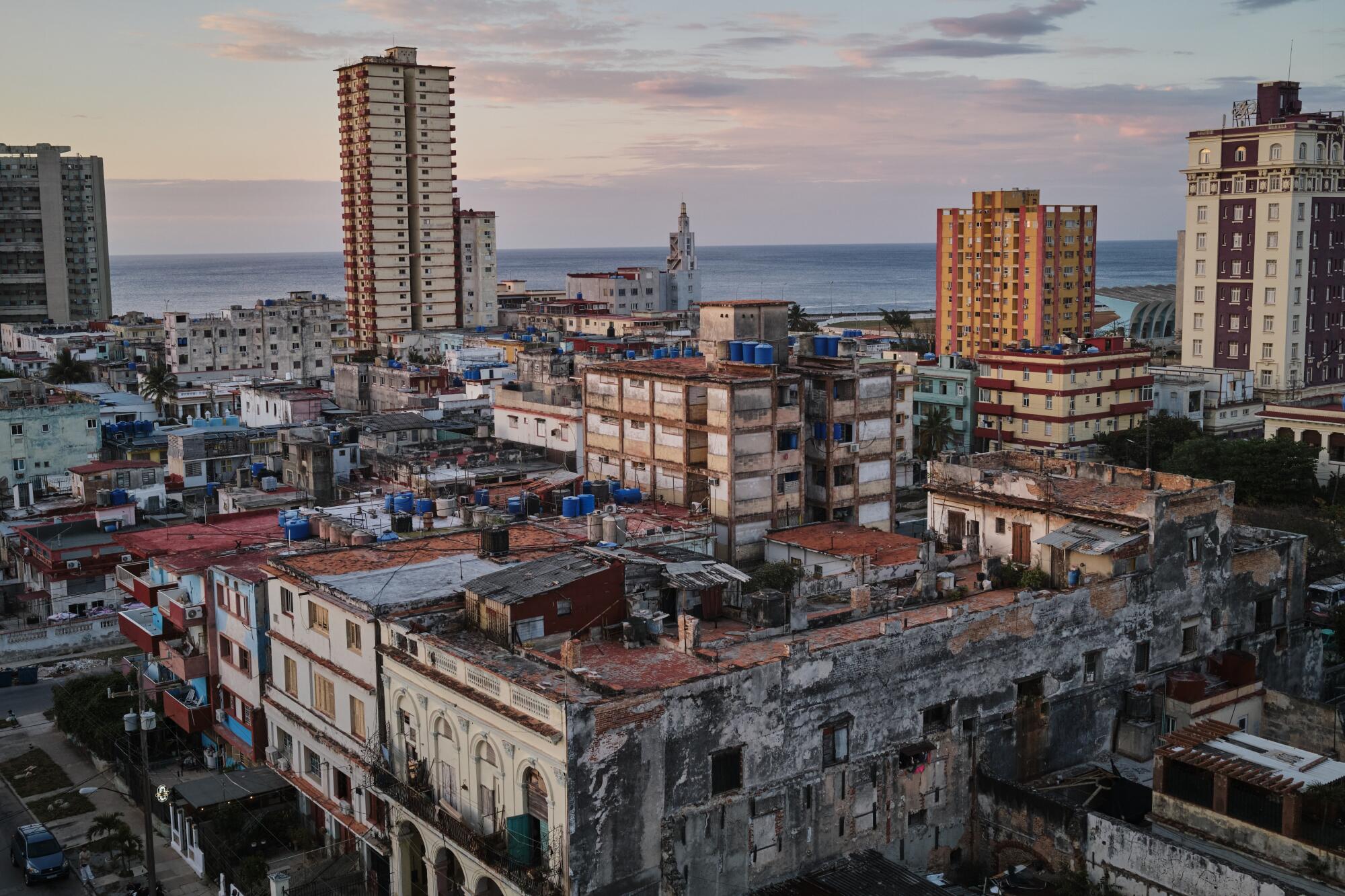
The Vedado neighborhood in Havana.
Life has long been challenging for Pablo Barrueto, 63, who works mornings at a construction site and now spends afternoons filling plastic jugs from a tap on the street and hauling them up narrow stairwells to neighbors who have been without water for weeks.
His two jobs barely enough cover food for him and his partner, Maribel Estrada, 55, who earns $5 monthly as a security guard at a state-run museum.
The pair, who live in a cramped studio apartment in a crumbling colonial-era building, can’t afford butter or mayonnaise, so breakfast is a piece of plain bread. Barrueto said he often goes to bed hungry. It has been years since he has tasted pork or beef.
“I work so hard,” said Barrueto, who on a recent afternoon was cooking beans in a pair of tattered jeans. “But I don’t see the fruits of my labor.”
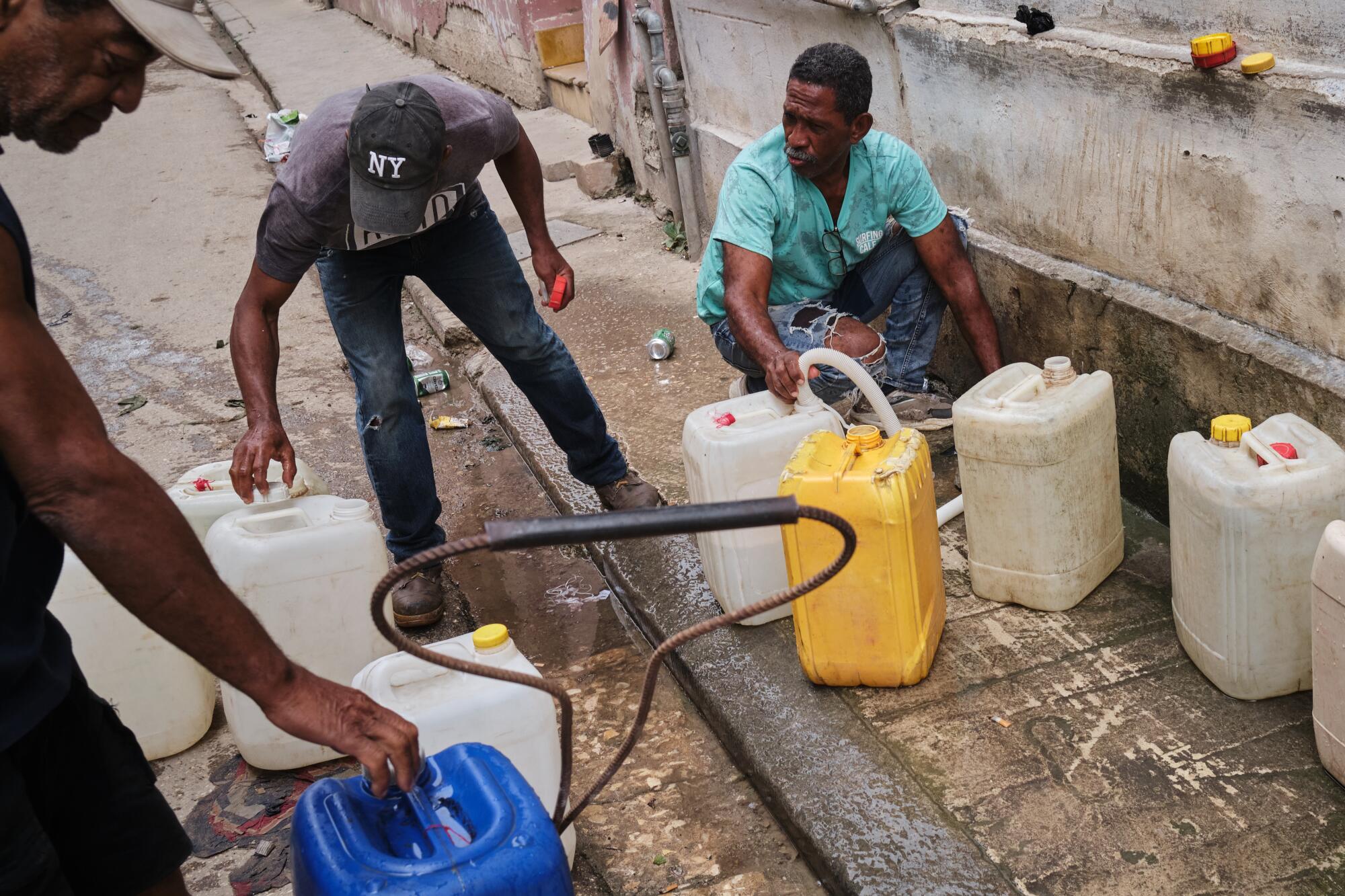
Pablo Barrueto, center, fills water containers from a public tap after more than 17 days without running water.
Estrada has developed ulcers on her legs, but the doctor who prescribed her antibiotics said she wouldn’t be able to find them on the empty shelves of state-run pharmacies. On the black market, the medication was being sold for more than what Estrada makes in a month.
“If I lived in another country, my legs wouldn’t look like this,” she said, rolling up her pants to show the chronic sores on her calves.
Estrada said she was reaching a point where she would accept anything that would improve her life, even U.S. intervention.
“If things don’t get better, they should just hand over the country to Trump,” she said.
The U.S. has long played a major role in Cuban history, from its involvement in the island’s war of independence from Spain to the heavy hand of American companies in Cuba’s sugar industry. Washington repeatedly backed unpopular leaders who protected U.S. interests, including Batista, whose corrupt and repressive regime sparked support for the Cuban Revolution.
For decades, the island was celebrated by U.S. critics worldwide as a scrappy symbol of anti-imperialism and a utopic experiment in socialism. But in recent years, amid a government crackdown on dissent, some of that support has faded.
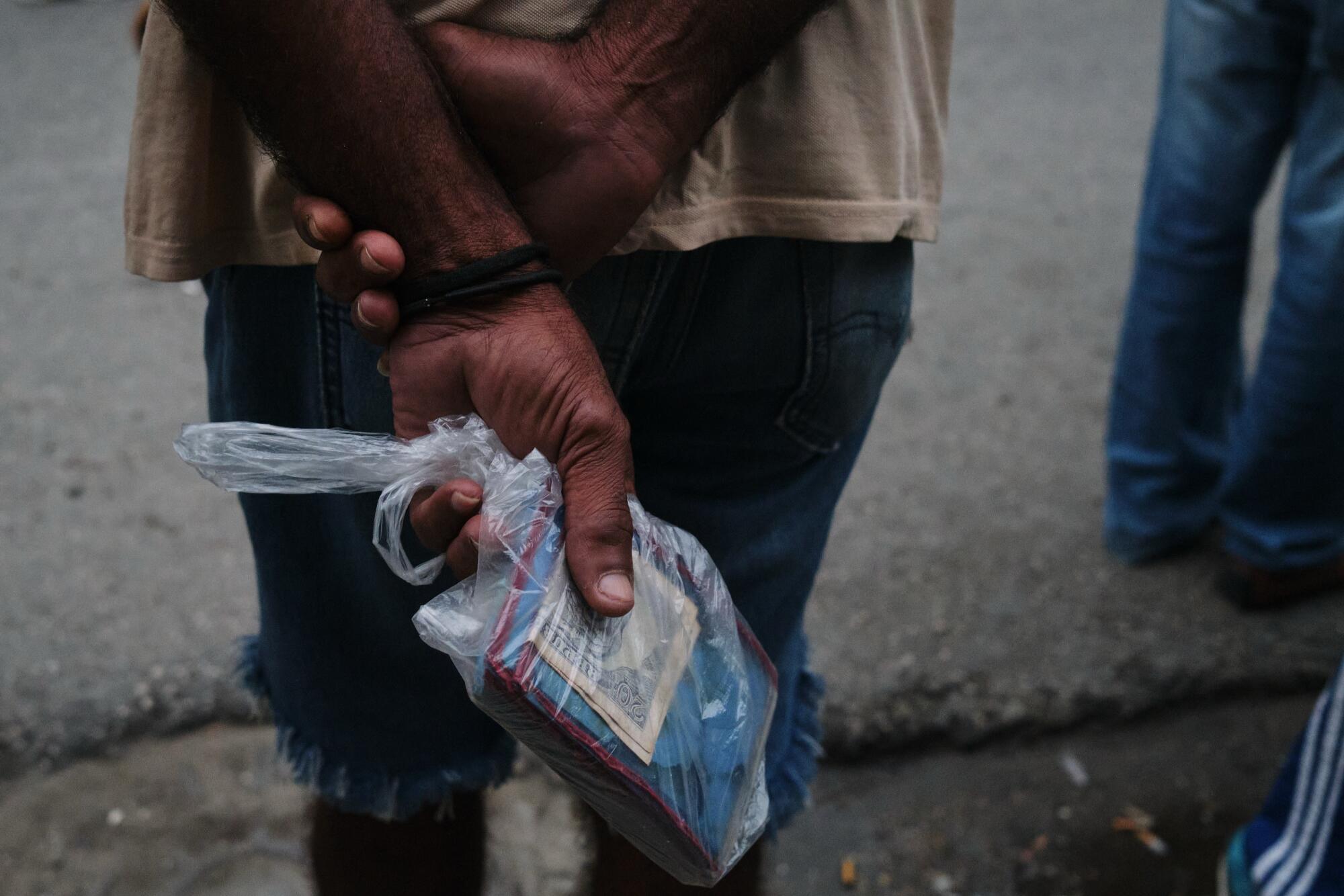
A man holds his ration book and cash while waiting to collect his daily bread in Havana.
The Trump administration’s bellicose new push to dominate Latin America with tariffs and military intervention has scared allies who in the past might have come to Cuba’s rescue.
Mexico, Brazil and Colombia, all led by leftists, have declined to provide emergency fuel shipments in recent months out of fear of angering Trump.
The current crisis was set in motion on Jan. 3, when the U.S. launched a surprise attack on Venezuela, killing 32 Cuban security guards stationed there — in addition to scores of Venezuelan troops and civilians — and capturing President Nicolás Maduro.
As the U.S. seized control of Venezuela’s oil industry, the impacts immediately rocked Cuba, which had long relied on subsidized oil shipments from Maduro’s regime.
Cuba’s leaders say the country has not received a single fuel shipment in three months, debilitating an economy that depends on oil to generate the electricity.
There is little relief in sight.
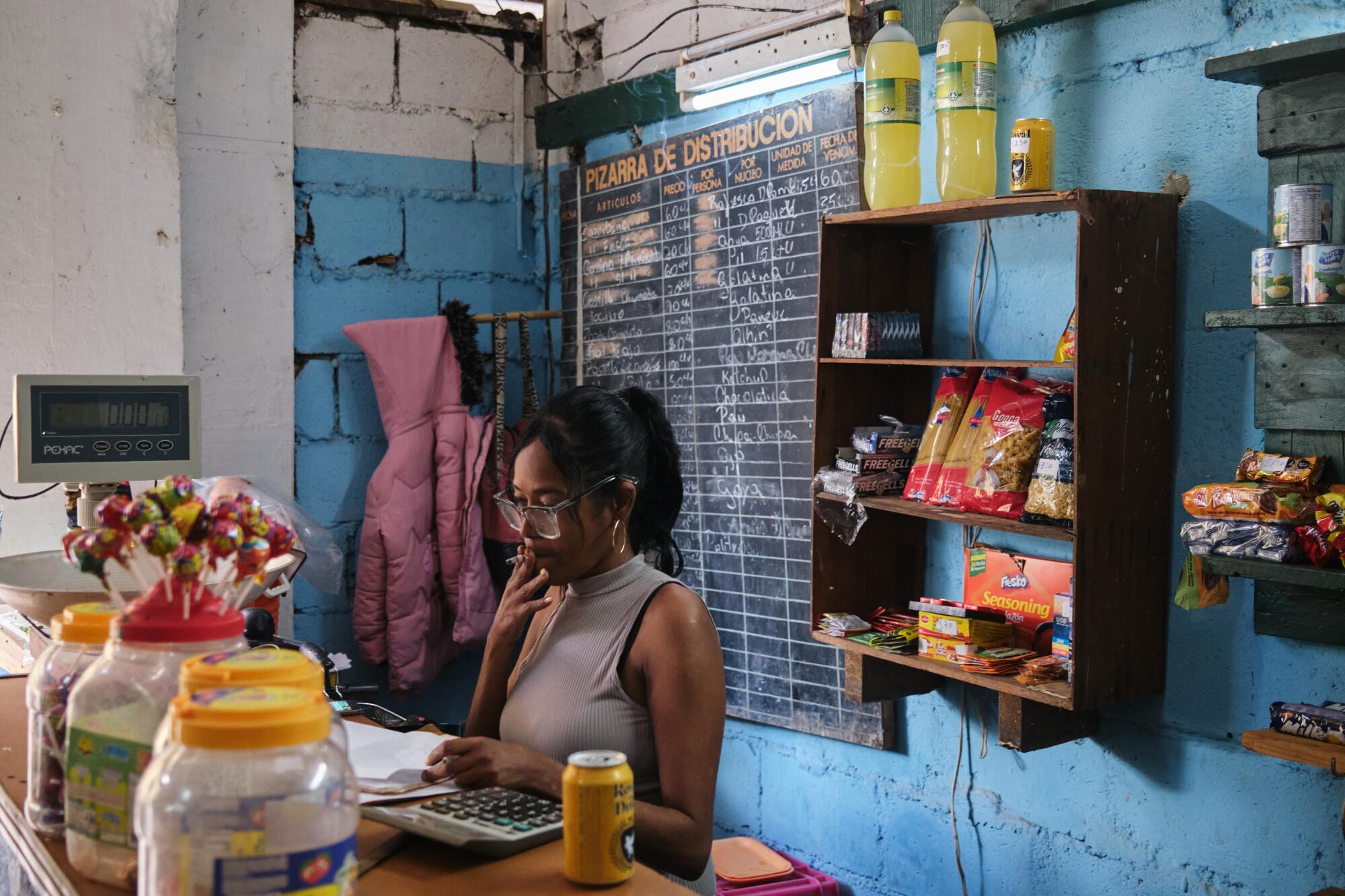
An employee of a MIPYME sells vegetables and other goods to a customer Friday in Havana.
A state-owned Russian oil tanker loaded with 750,000 barrels of crude is currently crossing the Atlantic. It’s unclear whether the U.S. will try to stop the ship from reaching Cuba, where the oil, once refined, could provide Havana with energy for several weeks.
At the same time, the “Nuestra América” humanitarian convoy is in the process of delivering more than 20 tons of critical supplies to Cuba, some of which will arrive by boat in the coming days.
David Adler, a general coordinator of Progressive International, a global leftist group that helped organize the flotilla, said he hoped the delivery of medicine, food, baby formula and solar panels would highlight the severity of Trump’s restrictions on Cuba.
“We’re beginning to come to grips with the fact that there will be mothers and children and elderly and sick people who will die simply as a result of this senseless and cruel and criminal policy,” Adler said. “Why are we inflicting such cruel punishment on a country that does not represent any threat to the United States?”
In Cuba, where many fear the prospect of no electricity come summer, with its muggy heat and swarms of disease-carrying mosquitoes, people are getting creative. With virtually no public transport and few drivers able to find — or afford — gas that costs more than $5 a gallon, many people have resumed riding bicycles. Others have fashioned electric-powered scooters into slow-moving taxis.

Young people talk in the street in central Havana.
One man in the small town of Aguacate made headlines after he modified his 1980 Fiat Polski to run on charcoal, the same fuel many people here are now cooking with.
Camila Hernández, who works at Havana’s airport, had hoped to celebrate her 21st birthday at home with friends, eating and dancing. “It would have been wonderful,” she said.
But it had been weeks without regular electricity in the home she shares with her parents and boyfriend. His family’s home had power — but lacked water.
To avoid yet another night sitting in the darkness, she marked her birthday by strolling to the Paseo del Prado, an iconic boulevard not far from the waterfront cooled by a light sea breeze.
Her boyfriend’s mother, Yusmary Salas, 47, said poor living conditions were testing her patience. “I can’t even go to the bathroom without planning how I will flush the toilet,” she said. She said she is hungry for change, but has no idea what shape it will take.
Trump insists he “can do whatever I want” in Cuba, and recently said he expects to have the “honor” of “taking Cuba in some form.”
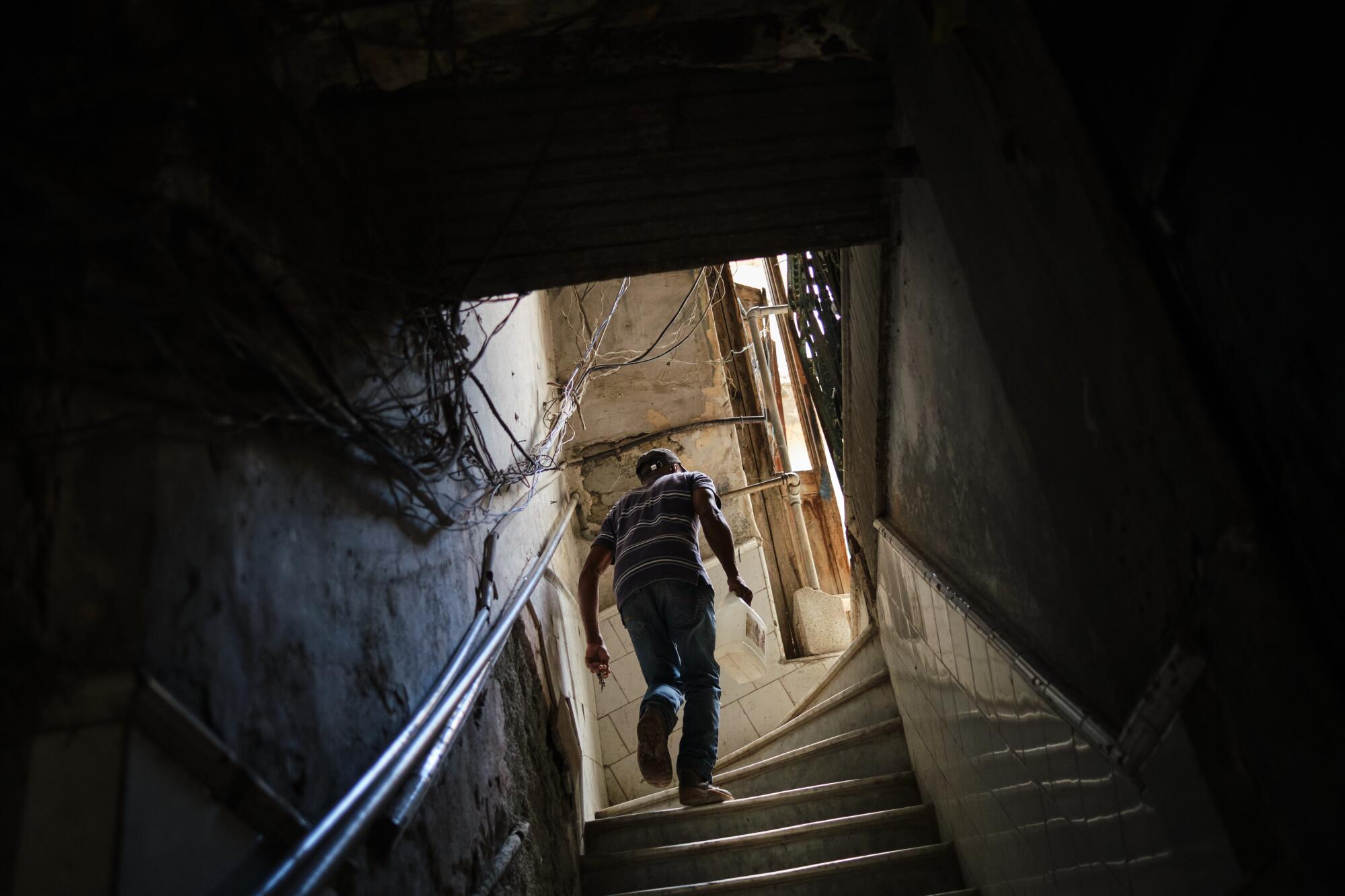
Pablo Barrueto carries a water container up to his home in Old Havana.
Such talk rattles many here who grew up in a country where government buildings still bear the revolutionary motto: “Homeland or death, we will prevail.”
Salas said she hopes that whatever comes next is peaceful, and that Cubans, long a proud people, have their dignity restored. And their power restored, too.
At the darkened bar in Old Havana, workers scrambled to light candles and serve beer that, without refrigeration, would soon go warm. Someone with a battery-powered speaker hit “play” on a song, the 2004 Daddy Yankee hit “Gasolina.”
“Dáme más gasolina!” they sang together. “Give me more gasoline!”

NEWYou can now listen to Fox News articles!
Senate Minority Leader Chuck Schumer, D-N.Y., condemned President Donald Trump’s plan to deploy U.S. Immigration and Customs Enforcement (ICE) agents to U.S. airports on Sunday.
Schumer made the comments while speaking on the Senate floor Sunday, saying Trump’s decision is “impulsive” and could make the situation at airports worse.
“Today, Donald Trump and [Tom] Homan are saying they will deploy ICE agents to airports starting on Monday. This is really disturbing. ICE agents who are untrained and have caused problems everywhere they’ve gone lurking at our airports. That’s asking for trouble, and it will certainly make the chaos at the airports even worse,” Schumer said.
“No one has any faith in ICE agents. They haven’t received training. They don’t know what it is to be a TSA person and do what you need to do,” he continued. “And the real problem here is they have no plan for using these ICE agents. Trump says, send them there. They send them there. And Homan says they’re still drawing up plans with less than a day’s notice. What is this? We know what it is. It’s another impulsive action by Donald Trump.”
SCHUMER GAMBIT FAILS AS DHS SHUTDOWN HITS 36 DAYS AND AIRPORT LINES GROW
President Donald Trump and Senate Minority Leader Chuck Schumer are clashing over funding plans for the DHS. (Anna Moneymaker/Getty Images; Kevin Dietsch/Getty Images)
“Some idea pops into his head and he announces it. And then the people working for him, a few of whom do have some degree of talent and ability. Not many underlings. They have to rush to try and implement what they know is an idiotic plan,” he said.
The ICE deployment is Trump’s latest move in the battle with Democrats over funding for the Department of Homeland Security.
Schumer also used his time on the Senate floor Sunday to criticize Trump’s actions in Iran.
“Donald Trump said, ‘you know, I may have a plan or I may not for a war,’” Schumer said. “There’s people’s lives are at stake. Billions are being spent on an almost daily basis. And he says, you know, ‘I may have a plan or I may not.’ These are the words of the commander in chief in the middle of a war involving one of the most dangerous regimes on Earth. ‘I have a plan, or I may not.’”
“That’s unhinged and dangerous. Lives are on the line. The president says he may not even have a plan. Tens of billions are being wasted. No plan. Troops being killed and injured, no plan. Civilians being killed and injured. No plan. Gasoline costs $3.94 a gallon on average. And Trump, ‘I have no plan’,” Schumer said.
Meanwhile, Schumer and his allies have refused to approve DHS funding without reforms to immigration enforcement.
TSA agents across the country have gone more than a month without a paycheck, with no clear end in sight.
Travelers wait in line at a TSA checkpoint at William P. Hobby Airport in Houston, Texas, on March 9, 2026. (Mark Felix/Bloomberg via Getty Images)
Trump first threatened to deploy ICE to airports on Saturday, demanding that Democrats “immediately sign an agreement” to fund DHS.
DHS SHUTDOWN TRIGGERS TSA ‘EMERGENCY MEASURES’ AS LAWMAKER WARNS AIRPORTS COULD FEEL ECONOMIC PAIN
Airports across the country have reported huge numbers of employees calling out sick or not showing up for work. More than 400 TSA employees have quit their jobs.
TSA Agents scan luggage at Ronald Reagan Washington National Airport in Arlington, Virginia. (Valerie Plesch/Getty Images)
“On Monday, ICE will be going to airports to help our wonderful TSA Agents who have stayed on the job despite the fact that the Radical Left Democrats, who are only focused on protecting hard-line criminals who have entered our Country illegally, are endangering the USA by holding back the money that was long ago agreed to with signed and sealed contracts, and all,” Trump wrote Sunday on Truth Social.
CLICK HERE TO DOWNLOAD THE FOX NEWS APP
Trump also predicted blowback from Democrats, saying they would complain “no matter how great a job ICE does.”

Big ballot mistakes: Mass. rent control, tax cut proposals would backfire – The Boston Globe

NCAA women’s tournament takeaways, Day 3: Minnesota drains buzzer-beater as LSU, Texas dominate again

Jackson hotel, restaurant taxes could increase with Mississippi Senate bill

What to Stream: Charlie Puth, Daniel Day-Lewis, Robyn, James Marsden and a ‘Hannah Montana’ special

NCAA Tournament Big Ten report— Nebraska makes first Sweet 16

Florida High School Football Rankings: Top 25 teams – Oct. 21

How old is Bo Nix? What to know about Oregon quarterback ahead of 2024 NFL Draft

Cleary's 21 help Le Moyne down Central Connecticut State 69-64 in OT

99th annual Pony Swim held in Virginia

Indiana Members Credit Union announced as new anchor tenant at Bottleworks District

Video: Plane Collides With Vehicle at LaGuardia Airport

As cattle herds shrink and beef prices rise, investors back AI cow collars

French elections: Paris stays left as far right makes mixed gains

ICE officers set to deploy to airports as delays mount, border czar Homan confirms

Video: ICE Agents Will Be Deployed to U.S. Airports, White House Confirms
-

 Detroit, MI4 days ago
Drummer Brian Pastoria, longtime Detroit music advocate, dies at 68
-

 Oklahoma1 week ago
Family rallies around Oklahoma father after head-on crash
-

 Georgia7 days ago
How ICE plans for a detention warehouse pushed a Georgia town to fight back | CNN Politics
-
 Science1 week ago
Federal EPA moves to roll back recent limits on ethylene oxide, a carcinogen
-

 Alaska1 week ago
Police looking for man considered ‘armed and dangerous’
-

 Movie Reviews4 days ago
‘Youth’ Twitter review: Ken Karunaas impresses audiences; Suraj Venjaramoodu adds charm; music wins praise | – The Times of India
-

 World1 week ago
Thousands march worldwide in solidarity with Palestine, Iran on al-Quds Day
-

 World1 week ago
Jamal Rayyan, the first face of Al Jazeera, dies at 73