Politics
Supreme Court appears wary of blocking Trump from Colorado ballot

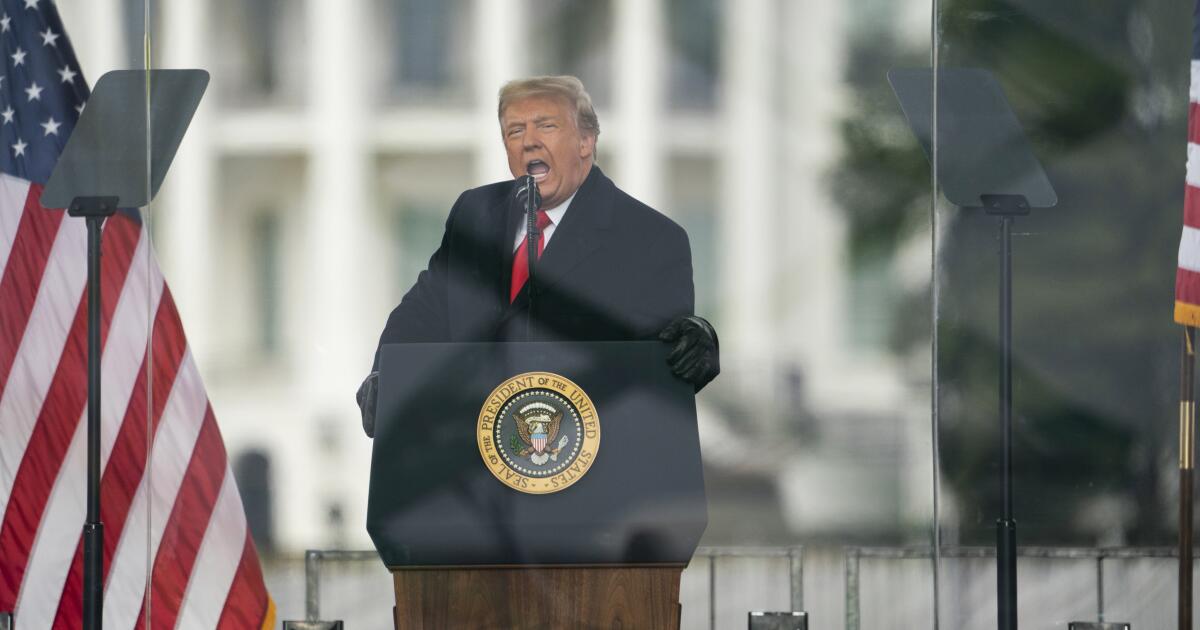
The Supreme Court justices gave a favorable hearing to former President Trump on Thursday, suggesting they will clear the way for him to seek election this year despite the mob attack on the Capitol that followed his loss in 2020.
The justices, both conservative and liberal, said they were skeptical of giving individual states the constitutional authority to disqualify candidates for a national office like the presidency.
“Why should a single state make this determination for the rest of the nation?” Justice Elena Kagan said. “It sounds awfully national.”
“It just doesn’t seem like a state call,” Justice Amy Coney Barrett added.
In December, the Colorado Supreme Court became the first and so far only state or federal court to rule that Trump must be removed from the primary ballot because he is not qualified to hold office again.
By a 4-3 vote, the state judges said Trump had violated Section 3 of the 14th Amendment, which says no person may “hold any office, civil or military” after having taken an oath to support the Constitution and later “engaged in insurrection” against the United States.
“We are here because, for the first time since the War of 1812, our nation’s Capitol came under violent assault. For the first time in history, the attack was incited by a sitting president of the United States to disrupt the peaceful transfer of presidential power,” said Denver attorney Jason Murray, who represented the Colorado voters who sued to disqualify Trump.
But he quickly ran into steadily skeptical questions from the justices. They spent little time on whether Trump’s actions leading up to Jan. 6 amounted to engaging in an insurrection.
Instead, they took turns disputing the notion that state judges in Colorado or elsewhere may decide whether a presidential candidate is qualified.
Chief Justice John G. Roberts Jr. said the 14th Amendment was adopted by the Reconstruction Congress to limit the authority of the states. “Wouldn’t that be the last place that you’d look for authorization for the states, including the Confederate states, to enforce the presidential election process?” he asked.
He predicted that if the high court were to endorse the Colorado ruling, other states “in very quick order” would make their own decisions on who can run for president, and some of them may seek to disqualify Democrats.
Justice Brett M. Kavanaugh repeatedly cited an 1869 decision holding that Congress had to pass a law to enforce the 14th Amendment’s disqualification rule. It was not up to each state, he said.
He also noted that while federal law makes it a crime to “incite an insurrection,” Trump had not been charged under that law.
The tenor of Thursday’s argument suggests a solid majority of the court, and perhaps all nine justices, will rule for Trump and reverse the Colorado court’s decision.
Only Justice Sonia Sotomayor sounded as though she may vote against Trump.
The court with Roberts taking the lead is likely to turn out an opinion in a few weeks. March is the prime time for primary elections in much of the nation.
By next week, however, the justices will have before them another Trump appeal that could decide whether he goes on trial this spring for the Jan. 6 attack.
Last week, the U.S. Court of Appeals for the District of Columbia Circuit rejected Trump’s claim that former presidents are immune from being prosecuted for their actions while in office. The appellate judges said they would keep the criminal case on hold until the Supreme Court decides whether to hear Trump’s appeal of that ruling.
If the justices quickly reject Trump’s appeal, his trial may be scheduled to begin in April or May. But if the justices decide to hear the appeal, the trial is likely to be postponed until late summer or fall.
Leading up to Thursday’s argument, some legal experts portrayed the disqualification issue as a test of the conservative court’s devotion to originalism.
Legal scholars and historians told the justices in friend-of-the-court briefs that the words and history of the 14th Amendment call for disqualifying Trump. They said the members of the Reconstruction Congress were determined to prevent insurrectionists from gaining power and subverting American democracy.
But the six conservatives are also GOP appointees, and Trump’s lawyers said it would be anti-democratic to remove the Republican presidential front-runner from the ballot.
And that argument appeared to resonate with most of the justices, including its three Democratic appointees.
The former president is “the presumptive Republican nominee and the leading candidate for president of the United States,” Trump’s lawyers said in their closing brief filed on Monday. “The American people — not courts or election officials — should choose the next president of the United States. Yet at a time when the United States is threatening sanctions against the socialist dictatorship in Venezuela for excluding the leading opposition candidate for president from the ballot … [the Colorado lawsuit] asks this court to impose that same anti-democratic measure at home.”
Much of Thursday’s argument was devoted to procedural and technical objections to the Colorado ruling.
In his legal argument for Trump, Texas attorney Jonathan Mitchell said the president is not “an officer of the United States” and is therefore not covered by Section 3 of the 14th Amendment. He said that officers are appointed, not elected, and that the 14th Amendment does not mention the president or vice president.
Many historians and legal scholars call this claim absurd.
It would mean the Reconstruction Congress sought to block former Confederates from holding “any office” across the nation except the presidency.
But by the argument’s end, it appeared the justices will decide the case without ruling on whether the former president was covered by the 14th Amendment or whether he led an insurrection before leaving office.


WASHINGTON — Initial efforts in the Senate failed Thursday to block the $1.8-billion fund that the Trump administration has sought to establish to pay people who claim the government wronged them, though further attempts were likely to come Thursday afternoon.
Republicans narrowly voted down a Democratic amendment to ban the payout fund and then Democrats killed a Republican amendment, which would have prohibited the use of federal money for the fund but would have sent $1.7 billion to the Justice Department’s fraud division.
It was the second effort in Congress to rebuke President Trump in two days, following the House vote Wednesday to rein in Trump’s war powers in Iran.
The dueling amendments were proposed by Senate Minority Leader Chuck Schumer (D-N.Y.) and Sen. Thom Tillis (R-N.C.). They were attached to the reconciliation bill that would fund Immigration and Customs Enforcement and the Border Patrol, a high priority for Republicans.
The votes came as the Senate began a “vote-a-rama,” during which lawmakers were expected to propose a stream of amendments to the immigration bill on various topics.
The Trump administration’s plan for the payment fund — widely seen as a way for Trump to compensate his political allies, including those who participated in the Jan. 6, 2021, attack on the Capitol — set off particular ire from some GOP lawmakers.
The plan has fueled growing unrest within parts of Trump’s party over his governance, compounded by the president’s endorsement of primary challengers to Sens. John Cornyn (R-Texas) and Bill Cassidy (R-La.), as well as Rep. Thomas Massie (R-Ky.), which angered some Republican senators.
Cassidy, who lost his primary and has since voiced strong opposition to Trump’s $1.8-billion fund, became a key player in the Thursday votes, voting down Schumer’s amendment but supporting Tillis’.
On Wednesday, Cassidy joined with Sen. Cory Booker (D-N.J.) to argue in a court filing that the $1.8-billion fund circumvents Congress’ authority and violates the Constitution’s spending and appropriations clauses.
“It is an unconstitutional attempt to spend the People’s money without Congressional approval,” Cassidy and Booker wrote in an amicus brief filed in the federal court case challenging the fund.
The fund was created by the Justice Department to settle a lawsuit brought by Trump against the Internal Revenue Service over the leak of his tax returns. Trump and his sons agreed to drop their personal lawsuit against the government in exchange for the creation of the $1.776-billion fund. Critics immediately questioned the plan, and it drew a rare backlash from Republicans.
In late May, GOP senators derailed plans to vote on the immigration bill over their displeasure with the payout fund and with Trump’s desire to use taxpayer funds for his planned White House ballroom. Senate Republicans removed the ballroom funding from the immigration package Wednesday, another setback for Trump.
The Trump administration sought to back away from its plans for the fund this week, following bipartisan outcry and a federal court ruling that temporarily blocked any payouts from the fund. Acting Atty. Gen. Todd Blanche said Tuesday the administration would end its plans to move ahead with the concept.
But Trump on Wednesday told reporters he didn’t know whether the fund was dead, calling it “a beautiful thing.”
After Schumer proposed the first amendment to ban the fund Thursday morning, the Senate came to a standstill as three key Republican senators deliberated. Schumer framed his effort to ban the fund Thursday as a way to force a referendum on Trump’s plan.
The amendment “offers Republicans a choice: Do you support Donald Trump’s $2 billion taxpayer-funded slush fund, or do you want to protect the American people and their paychecks?” Schumer said on the Senate floor before the vote.
Sen. Bernie Moreno (R-Ohio) urged Republicans to reject the amendment, saying Democrats were planning to “play so many games” on Thursday during the marathon session.
“We are going to fund immigration enforcement and border patrol, and I urge my Republican colleagues to stay united on that singular mission,” Moreno said.
The amendment failed after Cassidy voted against it. Republican Sens. Susan Collins of Maine, Jon Husted of Ohio and Dan Sullivan of Alaska voted in favor.
Schumer’s amendment was uniformly supported by Democrats, including California Sens. Adam Schiff and Alex Padilla.
Tillis, who also voted against Schumer’s amendment, immediately proposed his amendment. Sen. Jeff Merkley (D-Oregon) urged Democrats to oppose it, saying that the proposal would create “a new slush fund” by giving the money to the Justice Department.
“We heard over the last 48 hours that the acting attorney general said that this fund’s not moving forward. All this amendment does is codify what I believe the policy of the DOJ is,” Tillis said on the floor before voting began on his amendment. “This [fund] is unpopular, this administration has said they’re not moving forward with it; this is an opportunity for us to put it to bed.”
Responded Merkley: “Taking one slush fund and eliminating it and then creating a new slush fund still under control of the attorney general is not the way to go. The way to go is to get rid of these slush funds altogether.”
Trump has faced a recent string of failures, including the House vote Wednesday, a court ruling to remove his name from the Kennedy Center and a record-low approval rating among Americans as concern rises about economic issues, gas prices and Trump’s war with Iran.
On Wednesday, Trump lashed out against the four Republicans who backed the House war powers resolution, calling it “an unpatriotic thing” to do and calling the vote “meaningless.”
“They’re GRANDSTANDERS! They should be ashamed of themselves. MAGA!!! President DJT,” Trump wrote.
Times staff writer Ana Ceballos, in Washington, contributed to this report.

NEWYou can now listen to Fox News articles!
Maine Democratic Senate candidate Graham Platner has emerged as one of the party’s fastest-rising political figures, drawing national attention for his populist message and outsider image.
But as his profile has grown, so has scrutiny of his past conduct, with controversies ranging from sexually explicit messages and offensive social media posts to a Nazi-linked tattoo and campaign staff upheaval.
PLATNER CONTROVERSIES FUEL SPECULATION ABOUT LITTLE-KNOWN MAINE BALLOT REPLACEMENT PROVISION
In continued clean-up of those scandals, Platner came to Washington, D.C. on Tuesday to huddle with party figures at the Democratic Senatorial Campaign Committee headquarters just one week before his primary election.
The Marine veteran and oyster farmer has defended himself against the criticism and retained the support of prominent Democrats, including Senate Minority Leader Chuck Schumer, D-N.Y., and Sens. Bernie Sanders, I-Vt., and Elizabeth Warren, D-Mass. Still, some have questioned whether the allegations could complicate Democrats’ efforts to unseat Sen. Susan Collins, R-Maine, in one of the nation’s most closely watched Senate races.
Here’s a look at the major controversies that have engulfed Platner’s campaign.
Explicit text messages and sexting allegations
Senate candidate Graham Platner is under fire, but it was his wife Amy Gertner coming out with a controversial five-minute social media post by the campaign to denounce the ‘attacks’ while she did not deny the allegations of infidelity in a new marriage. (Joe Raedle/Getty Images)
The most recent controversy surrounding Platner stems from reports that he exchanged sexually explicit messages with multiple women during his marriage, an issue that campaign aides were reportedly aware of as his Senate bid was taking shape.
The Wall Street Journal reported that Platner’s wife, Amy Gertner, informed a campaign aide about the text exchanges shortly after he launched his Senate bid as staffers were assessing potential political liabilities.
According to the report, Gertner discovered the messages months after the couple married in 2024 and disclosed their existence before her husband held a campaign rally alongside progressive Sen. Sanders. The campaign told Politico that the aide viewed the matter as a private issue between the couple and did not raise concerns about it publicly.
SENATE CANDIDATE GRAHAM PLATNER SENT EXPLICIT TEXTS TO MULTIPLE WOMEN WHILE MARRIED, WIFE SAYS: REPORT
Platner’s campaign later confirmed the existence of the text exchanges to Politico.
He also told Fox News Digital in a statement: “Amy and I went through something hard — because of me. We did the work, and I’m grateful for her every hour of every day.”
“I’ve learned throughout this campaign is that people don’t care about gossip or headlines, they care that you’re fighting for their hospitals, their paycheck, their kids… Our opponents want politics to be empty of content and empty of actual change — and beating that is exactly what our movement is about,” he added.
In a statement to the Journal, Gertner criticized the disclosure of the information, saying she had shared “deeply personal details” about her marriage with someone she considered a friend, only to see those details become public.
She revealed that the two attended couple’s counseling, worked through the issues in their marriage and have since emerged as a stronger couple.
“I know who Graham is. I know the man I married and the husband he has been to me on the best and the worst days of my life,” Gertner said. “That hasn’t changed, and it won’t.”
Nazi-linked tattoo
Graham Platner, a Democratic candidate for U.S. Senate in Maine, points to a covered tattoo that was previously recognized as a Nazi symbol during an interview in Portland, Maine, on Oct. 22, 2025. (WGME via AP)
Platner’s campaign also faced intense scrutiny after it was revealed he once had a skull-and-crossbones tattoo on his chest closely resembling the “Totenkopf” symbol used by Hitler’s SS paramilitary forces.
The Maine Democrat said he got the tattoo during a “night of drinking” while on leave in Croatia in 2007 as a Marine and claimed he was entirely unaware of its meaning at the time.
In an Instagram video posted in May, Platner elaborated on the tattoo’s origins. He explained that he merely selected the design from a flash tattoo wall while “carousing” with fellow Marines in Split, Croatia.
“We thought it looked cool,” he downplayed.
Platner said he was later “appalled” to learn the image resembled a Nazi symbol, arguing that his life and career have been defined by opposition to fascism, racism and Nazism. He also noted that he was never questioned about the tattoo during his military service.
MAINE DEM SENATE HOPEFUL BACKED BY BERNIE SANDERS APOLOGIZES FOR NAZI-STYLE TATTOO, VOWS TO STAY IN RACE
Rather than undergo removal, Platner said he chose to cover the tattoo because tattoo removal services were not readily available near his rural Maine home.
“Going to a tattoo removal place is going to take a while,” he told The Associated Press. “I wanted this thing off my body.”
The symbol was ultimately covered with a tattoo featuring a Celtic knot and images of dogs, which Platner said were meant to honor his family pets.
Deleted Reddit posts reveal offensive comments
U.S. Senate candidate from Maine Graham Platner speaks during a campaign event on May 17, 2026, in Portland, Maine. (Joe Raedle/Getty Images)
The keystone scrutiny Platner has faced during his bid stemmed from thousands of now-deleted Reddit posts that resurfaced after he launched his Senate campaign.
In posts first reported by CNN and Politico, Platner referred to himself as a “communist” and “socialist” and endorsed the slogan “all cops are b—–ds.”
In other posts, he argued that those who “expect to fight fascism without a good semi-automatic rifle, they ought to do some reading of history” and said that “an armed working class is a requirement for economic justice.”
DELETED POSTS URGING VIOLENCE HAUNT DEMOCRATIC SENATE HOPEFUL IN MAINE RACE
The posts under his since-retired username “P-hustle” were deleted before Platner announced his Democratic Senate bid in August.
The candidate has since addressed the posts multiple times, telling CNN and Politico that he was “f—ing around on the internet” during a period when he felt “lost and very disillusioned with our government who sent me overseas to watch my friends die.”
“I made dumb jokes and picked fights,” Platner said. “But of course I’m not a socialist. I’m a small business owner, a Marine Corps veteran, and a retired s—poster.”
In the posts Platner made crude comments about masturbating in port-a-potties and claimed a U.S. service member who took enemy fire in Afghanistan “didn’t deserve to live.”
GRAHAM PLATNER VOWS TO ‘COME AFTER’ BEZOS AS SENATE HOPEFUL ESCALATES BILLIONAIRE TAX FIGHT
The controversies have done little to erode Platner’s standing within the Democratic Party as he has continued to attract national attention and grassroots support in the Democratic primary bid to challenge Sen. Collins for her seat.
Since former Democratic Maine Gov. Janet Mills halted her campaign in April, much of the party establishment has consolidated behind Platner, and national Democrats have continued to support his candidacy despite the flurry of scandals.
The steady stream of allegations and past controversies has also drawn attention to a little-known provision in Maine election law that allows political parties to replace a nominee under certain circumstances after a primary election.
CLICK HERE TO DOWNLOAD THE FOX NEWS APP
Under state law, a candidate who wins a primary and subsequently withdraws by 5 p.m. on July 13 can be replaced by a nominee selected by party officials. Any replacement candidate must then be chosen by 5 p.m. on July 27.
There is currently no indication that Platner plans to withdraw from the race, and the Democratic hopeful has repeatedly vowed to continue his campaign. Still, the provision has drawn renewed interest as questions persist about whether additional revelations could complicate his candidacy.
Platner’s campaign did not immediately respond to Fox News Digital’s request for comment.
Politics
Commentary: Bass clears first hurdle, but if Pratt holds off Raman, the mayoral race could be a holy war

L.A. Mayor Karen Bass made what sounded like a victory speech Tuesday night.
Councilmember Nithya Raman made what sounded almost like a concession speech.
And former reality TV star Spencer Pratt relayed a message from the heavens.
“Well, obviously God wanted five more months of me exposing all the failures of our mayor, so it’s gonna be a fun ride,” Pratt said. “I hope she’s ready.”
Assuming Pratt holds on to one of the two spots in the Nov. 3 general election as the final votes are tallied in the next few days, the smart money will be on Bass, for reasons I’ll get into in a moment.
But the supreme being and patron of all pontiffs has to be considered a wild card. This is the first time, to my knowledge, that an incumbent mayor in the City of Angels would be running against a challenger whose campaign manager is God Almighty.
So here we go. We could be in for one of the more remarkable electoral adventures in city history, with a complete novice and MAGA conservative going up against a liberal career politician in a deep-blue city and state full of people who are tired of hearing excuses from Democrats. (If Raman ends up ousting Pratt, my apologies for jumping to conclusions. But it’s not my fault. The devil made me do it.)
If you intend to follow closely, as of course you should, maybe you can help me count the number of times Pratt plays the faith card. I went to St. Peter Martyr School and attended the church by the same name, and I don’t recall ever hearing a nun or a priest drop God’s name as often as Pratt does.
In fact, I just watched a clip of Pratt talking to Fox News TV host and Donald Trump disciple Kayleigh McEnany, and over the course of 1 minute and 52 seconds, he mentioned God or Jesus 10 times.
“Thankfully, I married an angel who was very connected with Jesus and has brought me to the light,” Pratt said of his wife and former reality TV co-star Heidi Montag. “It’s been very empowering to just pray and just be on his path and just say, ‘God, if you want me to save these animals, save these humans and protect my city, just keep putting me in the place where I can do that.’”
Is he running for mayor or cardinal?
Look, I totally respect your average true believer. But I’m not entirely comfortable with a mayor who might be sitting around City Hall waiting for signs and smoke signals rather than knowing what to do on his own.
God has a lot on his plate. He might be busy multiplying fishes and loaves so people don’t go hungry thanks to the president’s tariffs and warmongering. Is he going to rush to answer a prayer for guidance about underfunded parks or broken sidewalks in Los Angeles?
How did we get here, you ask?
Well, Pratt is an AI creation, in a way. A composite of sorts. You combine the forces of social media, political rebellion, second-rate celebrity obsession and the Peter Principle, and here’s a little Trump puppet walking around L.A. like he’s the chosen one.
Add to that the very real essence of his appeal to some voters:
Los Angeles has problems. Big problems that don’t get fixed quickly enough or at all, and Pratt represents the angry voter who wants to know why City Hall can’t do better and where all the money went. He’s absolutely right when he says we shouldn’t have people living on the streets, using drugs on the streets and dying on the streets.
But if Pratt is in the general election rather than Raman, we’re in for a national media circus rather than a summit on solutions. Raman is well-versed on matters of relevance and could have pushed back against Bass in substantive, detailed ways. On the other hand, as Pratt has fairly argued, Raman headed City Council’s homelessness committee, so isn’t she partly to blame for the failures she tried to pin on Bass?
As for Pratt’s policy chops, he has not responded to my offers of a get-together. Absent that, and given his careful avoidance of local reporters who know their stuff, I read his platform on his campaign website and I can tell you that while he touches on many of the right issues — public safety, fiscal integrity, homelessness — attention to detail and depth of knowledge are not God-given strengths.
Maybe Pratt can actually deliver on his promise of a “treatment-led recovery model that addresses mental illness and addiction as the primary drivers of chronic homelessness.” But that would require an act of God (which I suppose is possible given their relationship), because those matters are primarily under the direction of the county, not the city.
This is the main problem here. Bass was beatable, and could have been pushed by a serious challenger to do better.
In the last election, Rick Caruso gave her a scare. That was partly because he had some depth on the issues, he was a successful businessman and philanthropist, he had served on the police commission and the water and power board, he had built relationships across the city and, along with his family, he had poured time and millions of dollars into underserved communities.
In this election, it looks as though Bass could get lucky and face off against a guy who lost his house in the Palisades fire, saw a few homeless encampments through his car window, and decided he wanted to be mayor. Some might have questioned his hubris, but only before learning that he was on a mission from God.
If you’re keeping count, that’s nine mentions of God so far in this column.
One more for the tie, with an eye toward five more months of campaign fodder.
Thank you, God.
steve.lopez@latimes.com
-

 Lifestyle59 seconds ago
OTB Takes Full Control of Viktor & Rolf
-
Politics8 minutes ago
Senate rejects an initial attempt to ban Trump’s $1.8-billion ‘anti-weaponization’ fund
-
 Science11 minutes ago
Emergency room visits during heat waves available to the public in ‘near-real time’ in L.A. County
-
 Sports16 minutes ago
How Myles Garrett’s arrival has the Rams — and even Cooper Kupp — talking Aaron Donald return
-

 World26 minutes ago
Russia kills 12 in Ukraine as Kyiv mourns 707 children killed since 2022
-

 News53 minutes ago
Trump’s name must come off the Kennedy Center by June 12
-

 Los Angeles, Ca2 hours ago
Overnight military training brings loud flash bangs, simulated gunfire to quiet Pasadena neighborhood
-

 Detroit, MI3 hours ago
Detroit Lions add UDFA rookie WR during OTAs

