Politics
Robert F. Kennedy Jr. says he has qualified for California's presidential ballot

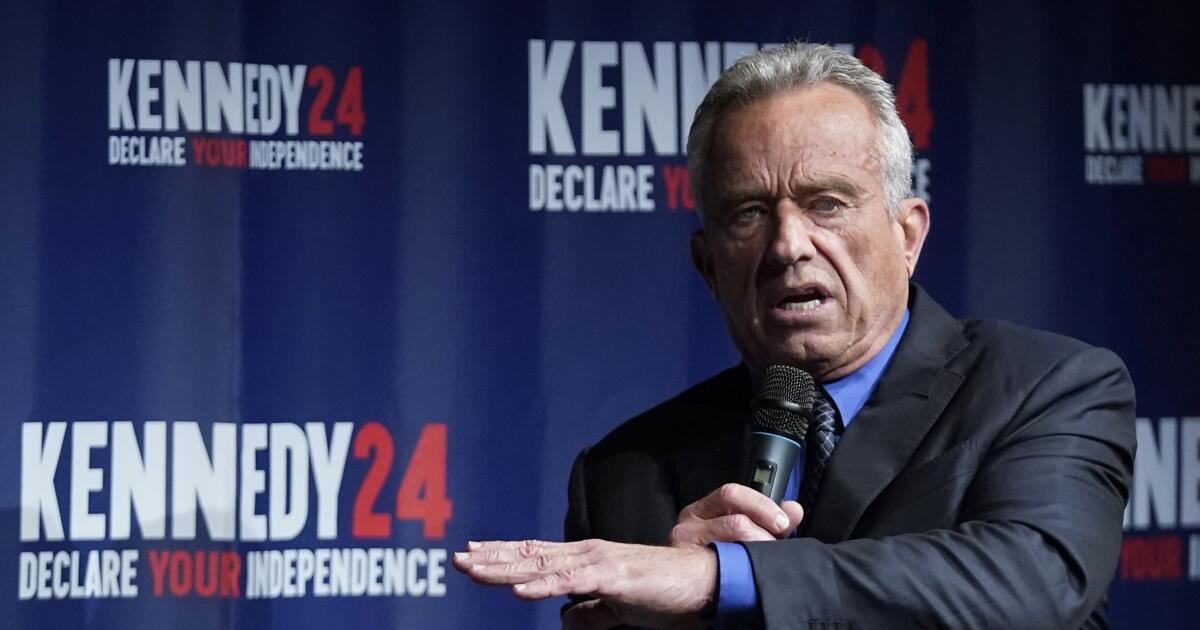
Robert F. Kennedy Jr. said Tuesday that he has qualified for California’s presidential election ballot, giving his third-party candidacy a long shot chance at collecting 54 electoral votes this fall.
If his spot on the ballot is certified by the California secretary of state, which could come in August, he would represent the American Independent Party. The secretary of state’s office confirmed to The Times that Kennedy’s candidacy had been submitted by the party.
The party has a controversial history dating back to 1968, when it nominated Alabama Gov. George Wallace as its candidate for president. He ran opposing desegregation and championing states’ rights. Kennedy’s father, Sen. Robert F. Kennedy (D-N.Y.), was assassinated in Los Angeles the night he won that year’s California presidential primary.
Kennedy says he has qualified for the ballot in California, Hawaii, Michigan and Utah. The political scion has been investing heavily and seeking alternate paths to the ballot since he opted out of running in the Democratic primary late last year. He recently selected California tech lawyer, entrepreneur and political newcomer Nicole Shanahan as his vice presidential running mate.
In a video statement released Tuesday, Kennedy said the AIP was “so impressed by this outpouring of democratic energy and vigor. … So they approached my campaign and offered us their spot on the California ballot. I see this story as a symbol of America’s homecoming .”
He added that he saw Wallace as a “bigot” who “was antithetical to everything my father believed in.”
In recent years, the American Independent Party has been a source of confusion for voters seeking to avoid registering as either a Republican or a Democrat. In California, voters may register as having no party preference, but The Times reported in 2016 that tens of thousands of voters had registered for AIP, many of them in error. Nearly three in four people did not realize they had joined the party, a survey of registered AIP voters conducted for The Times found.
The American Independent Party now exists only in California, but Wallace won 46 electoral votes nationally as its standard bearer in 1968, one of the most successful third-party runs in modern history.
The party now is not segregationist and in recent years officials told the Times that it “is a conservative, constitutionalist party.”
In the past its opposed abortion, and the 2024 March California primary voter guide said that AIP members “are all refugees from the Republican or Democrat parties. We believe the Constitution is the contract America has with itself. Its willful distortion led to the violation of our 10th Amendment guaranteed right to limited government — which inevitably requires oppressive taxation. Its faithful application will lift that burden.”
In a statement Tuesday, AIP state Chairman Victor Moroni said: “We all deserve to find inspiration at the ballot box. Our party is pleased to provide the opportunity for all 22 million voters in California to vote for Robert F. Kennedy Jr. for President. Voters crave a real leader who will unite America.”
The move could have an impact on the presidential race in California, but not enough to change the expected outcome.
A March poll from the UC Berkeley Institute of Government Studies and The Times found President Biden leading former President Trump by 18 percentage points statewide in a head-to-head matchup. That dropped to 12 points when independent and minor party candidates such as Kennedy were included.
In battleground states, Kennedy’s ability to qualify for the ballot could prove pivotal. In Michigan, like in California, Kennedy latched onto a smaller party — the Natural Law Party — that long held a ballot line. His success in these efforts appears to have led Trump to ratchet up his attacks on the Los Angeles resident. The former president said on social media over the weekend that Kennedy was “far more LIBERAL than anyone running as a Democrat.”
In Michigan, recent polls have shown the race essentially tied between Trump and Biden with Kennedy a distant third. Polls in other battleground states show a tight contest but Trump in most cases leading.
Kennedy’s campaign has been on the receiving end of vicious attacks from Democrats who view him as a spoiler with extreme views that could result in another term for Trump. They point to his skepticism of certain vaccines. In a 2021 podcast, Kennedy told parents to “resist” the U.S. Centers for Disease Control and Prevention’s guidelines on vaccinating their children.
Through the years he has repeatedly spread falsehoods about the effectiveness of vaccines, and more recently said the COVID-19 lockdowns were something a totalitarian state would do, likening them to Nazi Germany.



new video loaded: Trump Settled a Case With Himself. Was That Legal?

By Adam Liptak, Paul Abowd, Nikolay Nikolov, Rafaela Balster, Jon Miller and Whitney Shefte
May 21, 2026
Politics
Rep. Tom Kean Jr. says he expects to return to Congress ‘in the next couple of weeks’ after missing 100 votes

NEWYou can now listen to Fox News articles!
Rep. Tom Kean Jr., R-N.J., said Thursday that he expects to return to Congress “in the next couple of weeks” after missing 100 consecutive House votes during an extended absence tied to what his office has described only as a “personal health matter.”
“My doctors are confident that I’m on the road to a full recovery,” Kean, 57, told the New Jersey Globe in his first public comments since stepping away from Capitol Hill in March.
“I understand the need for public transparency, and I appreciate the support of my constituents,” he added. “I anticipate that in the next couple of weeks, I’ll return to voting and to the campaign trail.”
Kean last voted on March 5 and has missed every House roll call vote since then, according to GovTrack. His absence has drawn heightened attention because Republicans hold a slim majority in the House and because Kean represents one of the country’s most competitive congressional districts ahead of the 2026 midterm elections.
TOM KEAN JR’S PROLONGED ABSENCE PUTS PRESSURE ON HOUSE REPUBLICANS’ RAZOR-THIN MAJORITY
Rep. Tom Kean Jr., R-N.J., is running for a third House term in 2026 after fending off Democratic challengers in prior election cycles. (Getty Images)
His office has repeatedly declined to disclose details about the illness, saying only that the congressman is focused on recovery and expected to return “soon.” Fox News Digital reached out to a representative for Kean for additional comment.
Last week, Kean’s father, former New Jersey Gov. Tom Kean Sr., told NJ.com that his son was recovering from a “serious illness.”
“You can’t say definitely, but their best guess is now he’ll be out in two or three weeks,” Kean Sr. said, referring to doctors treating his son. “Any time you’ve been through a serious illness, you can’t be 100% the day you get back. You’re gonna be able to do things, but gradually ramping up.”
COMPLEX PARTIAL SEIZURE RULED AS CAUSE OF PAUSING EPISODE DURING HOUSE FLOOR SPEECH, DEM CONGRESSMAN SAYS
Tom Kean Jr., GOP candidate for New Jersey’s 7th Congressional District, speaks at his election night party in Basking Ridge, N.J., on Nov. 8, 2022. (Stefan Jeremiah/AP)
Kean Sr. also said doctors expect his son to make a full recovery but declined to discuss the diagnosis.
House Speaker Mike Johnson, R-La., told reporters this week that he had spoken with Kean recently but was unaware of details surrounding the congressman’s condition.
“We’re expecting him back here soon. He’s had a medical issue,” Johnson said Wednesday. “I don’t even know the details.”
JOHNSON WARNS HOUSE REPUBLICANS TO ‘STAY HEALTHY’ AS GOP MAJORITY SHRINKS TO THE EDGE
House Speaker Mike Johnson, R-La., speaks during a news conference on Capitol Hill while House Majority Whip Tom Emmer, R-Minn., listens. (Mariam Zuhaib/AP)
The absence has become a growing political issue in New Jersey as Democrats target Kean’s swing district. Kean is running unopposed in the Republican primary on June 2, while several Democrats are competing for their party’s nomination.
Earlier this month, a top Kean aide told The New York Times, “There’s no cameras where Tom is.”
Kean consultant Harrison Neely said this week the congressman remains committed to seeking reelection.
CLICK HERE TO DOWNLOAD THE FOX NEWS APP
“What I can tell you is that the congressman is dealing with a personal health matter. He is focused on his recovery,” Neely told the New York Post.
Fox News Digital’s Adam Pack contributed to this report.

WASHINGTON — A political influencer has filed a complaint against Tom Steyer’s campaign for governor, saying the committee failed to notify her of disclosure requirements, as required by law, when she was paid to meet with Steyer in March and later produced social media content from the meeting.
What’s more, she said the Steyer campaign falsely accused her of posting paid content in support of Steyer’s chief Democratic rival, Xavier Becerra, and failing to disclose it in a complaint filed by the billionaire’s campaign this week.
Maggie Reed, who regularly posts satirical takes on politics to roughly half a million followers on Instagram and TiKTok under the username mermaidmamamaggie, said she was actually paid by Steyer’s campaign and signed an agreement that barred her from disclosing the payment.
She posted, and later deleted, a video from her meeting with Steyer in March.
“In plain terms: the Committee paid for political content, structured it to look like an ordinary creator’s organic opinion, and used a non-disclosure agreement to keep the public from learning the truth,” says the complaint, filed Thursday with California’s Fair Political Practices Commission.
Steyer’s campaign disclosed in a campaign filing that it had paid the agency that represents Reed $5,000 for digital advertising, but didn’t indicate that the payment was connected to Reed’s meeting with Steyer or her production of content.
The Steyer campaign said that while it did pay to meet with Reed, it left the decision of whether to create content entirely up to her.
Since then, Reed has produced several videos expressing support for Becerra, the former California congressman and U.S. secretary of Health and Human Services, but she said that she was not paid to produce those videos and that they reflected her genuine support for Becerra’s campaign.
Becerra has been the top Democrat in recent polling in the race, maintaining a narrow edge over Steyer and a firm grip on one of the top two spots in the June 2 primary that would send him to the general election in November.
Reed’s complaint is the latest volley in a back and forth involving the use of paid influencers in the gubernatorial race.
Two influencers who support Becerra — but were not paid by his campaign — filed a complaint last week saying that a number of influencers had created paid content in support of Steyer but failed to disclose so in their posts.
Steyer’s campaign then filed a complaint earlier this week in which it leveled accusations against Reed and another influencer named Jay Gonzalez, who is now a paid staffer on the Becerra campaign. The complaint alleges that Gonzalez made several pro-Becerra posts after joining the campaign and belatedly amended them to include disclosure that they were sponsored.
The Becerra campaign has maintained that it does not otherwise pay influencers to produce content on its behalf.
Steyer’s complaint included screenshots of an email sent to Reed’s talent agency by a gubernatorial campaign gauging her interest in producing paid content.
While the screenshots produced in Steyer’s complaint did not disclose who had sent the inquiry, Reed said in her complaint that the request had come from a staffer for the gubernatorial campaign of former Los Angeles Mayor and California State Assembly Speaker Antonio Villaraigosa.
Disclosure of paid political content by social media creators is required in California thanks to a law passed in 2023.
Influencers themselves are required to disclose that a post they created was sponsored, but campaigns are required to notify them of the requirement.
Violation of the law doesn’t trigger civil, criminal or administrative penalties, but the Fair Political Practices Commission has the right to take violators to court and request that a judge force compliance with the law.
The agreement Reed signed with Steyer’s campaign, which was attached to her complaint, indicated that she needed to follow all applicable state, federal and local laws, but made no specific mention of her requirement to disclose that content she produced was sponsored.
The agreement did specify that Steyer’s campaign might need to disclose the payment.
-

 Wyoming6 minutes ago
Wyoming’s ties to super PAC suspected of helping GOP by spending big on long-shot Dems – WyoFile
-

 Crypto12 minutes ago
Polymarket Targets Japan Market Entry, Appoints Representative in Push for 2030 Approval
-

 Finance18 minutes ago
Special meeting set for swearing-in of Magnolia finance officer and town clerk
-

 Fitness24 minutes ago
I’m a strength coach – this exercise ‘looks easy’ but do it right, and you’ll have stronger obliques and better core stability
-

 Movie Reviews36 minutes ago
‘Ladies First’ Review: Sacha Baron Cohen and Rosamund Pike in a Netflix Comedy That’s High-Concept but Hopelessly Predictable
-
World48 minutes ago
A look at the Hajj pilgrimage and Eid al-Adha and their significance to Muslims around the world
-

 News54 minutes ago
Video: Thousands Attend Prayer Service for San Diego Mosque Attack Victims
-

 Politics60 minutes ago
Video: Trump Settled a Case With Himself. Was That Legal?

