Politics
Porter attacks Schiff for taking 'dirty money.' His response? 'I gave that money to you'

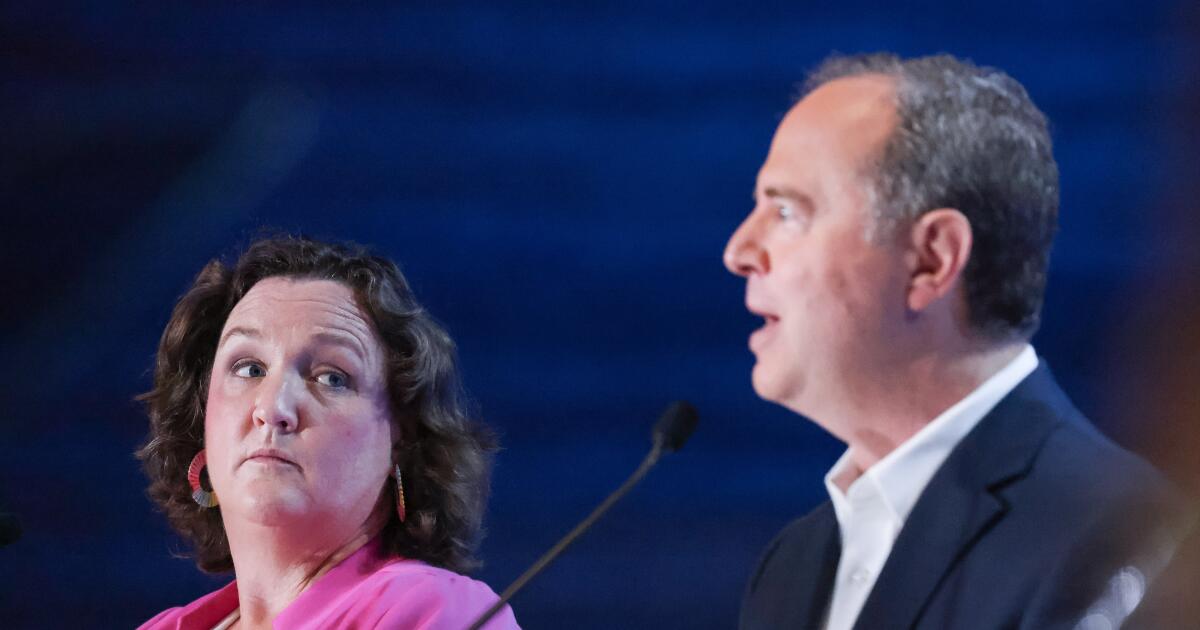
Irvine Rep. Katie Porter has repeatedly attacked her top Democratic rival in California’s 2024 Senate race, Burbank Rep. Adam B. Schiff, for accepting campaign contributions from oil, pharmaceutical, financial and other influential special interests trying to sway federal policy in Washington.
She prided herself on not taking donations from corporate political action committees, unlike Schiff, who along with Republican former baseball All-Star Steve Garvey is leading in the polls as Tuesday’s primary election fast approaches.
“Representative Schiff may have prosecuted big oil companies before he came to Congress, but when he got to Congress he cashed checks from companies like [British Petroleum] — from fossil fuel companies,” she said at a debate in January.
“I have delivered results on climate in my few years in Congress.”
Schiff, who took $2,000 total from the BP North American Employee PAC in 2004 and 2006, responded curtly during that debate. Schiff said he used some of the millions he raised through the years to help Porter in her congressional campaigns.
“I gave that money to you, Katie Porter, and the only response was thank you, thank you, thank you.”
The Times analyzed campaign finance reports from three election cycles when Porter and Schiff overlapped in Congress to see if the candidates’ claims were true. Both have been prodigious fundraisers for their own campaigns, raising tens of millions of dollars, while also starting political action committees that they used to support other candidates.
Here’s what we found:
Defense, tech and pharmaceutical companies donated money to Schiff
Schiff’s committees reported 377 contributions from corporate PACs, according to a Times analysis. The Schiff for Congress campaign committee received 357 contributions and Frontline USA, his leadership PAC, reported 20, totaling $636,625 and $75,000, respectively.
The more than 80 corporate PAC donors included defense, tech and telecommunications companies, which were the industries that gave the most to his committee.
The corporate PAC representing Comcast Corp. and NBCUniversal contributed more than $40,000. Schiff also received money from committees representing Wells Fargo and Amgen, among many others, during his House elections.
“I didn’t realize how much dirty money you’ve took until I was running against you,” Porter said at that same debate.
“You need to own your record.”
A majority of corporate PAC donations to Frontline USA came from groups representing defense companies, including Lockheed Martin, Raytheon and Northrop Grumman. Frontline also received donations from PACs representing Amazon, Universal Music Group and Centene Corp. — a large insurer.
Schiff donated over $50,000 to Porter
A Times analysis of Federal Election Commission records found that throughout her election and reelection campaigns for the House of Representatives, Porter received $54,675 in campaign contributions from Schiff’s two committees.
The majority of this money came from individual donors who used Frontline USA as a conduit to donate to Porter’s campaign; the PAC gave more than $33,000 in contributions to Porter’s races in 2018, 2020 and 2022.
In May 2020, Schiff texted Porter after a fundraiser about one donation, according to messages Schiff’s campaign shared with The Times.
“Hi Katie, sending $5,475 more from my friends Dick and Lois Gunther. Keep up the great work and see you soon,” Schiff wrote on May 14, 2020.
“Thank you so much Adam. Your (sic) are great! I’m doing handwritten thank yous that mention you to these folks,” she wrote back days later.
“(I do a lot of handwritten notes and like to acknowledge the source).”
Frontline USA reported two earmarked donations for Porter from the couple in May 2020 totaling the amount. The couple also sent $5,600 to Porter’s campaign three months earlier.
Schiff’s campaign estimates that the Senate candidate helped Porter raise close to $240,000 since she first ran in 2018. Much of this money, according to Schiff’s campaign, came from fundraising solicitations he sent on her behalf and fundraisers he hosted.
It’s hard to avoid corporate money in politics
Schiff’s corporate donations, which Porter hates, flow into a much larger pool of cash that’s made up of individual donations. The money is indistinguishable when it’s donated to Porter but reflects how money from corporate special interests can make its way into the accounts of someone who decries them.
Porter’s congressional contests were high-priced affairs, and the majority of the millions she raised came from individual contributors. She has refused to accept campaign donations from corporate PACs throughout her political career. When Schiff entered the Senate contest last year, he promised to not take money from these groups, too.
The majority of fundraising by Schiff’s committees similarly comes from individual contributions. For Frontline USA, contributions from non-political party committees — including corporate PACs, along with labor, trade and other groups — comprised 11% and 3% of its total receipts for the 2018 and 2020 election cycles, respectively.
“Part of my job was to help elect Democrats — help them get reelected,” Schiff said about his national fundraising work.
When asked about Schiff’s fundraising history, Porter didn’t see trying to help Democrats as a good justification for taking money from special interests actively trying to influence Congress.
After winning in 2018, Porter created her own leadership political committee called Truth to Power PAC, which has raised a little more than $1 million since its inception. Most of the money came from individual donors, and close to $630,000 was doled out to candidates across the country who were in competitive races, according to Porter senior advisor Nathan Click.
It didn’t take money from corporate political action committees.
“Katie didn’t have to reach her hand out to the likes of BP oil or defense contractors or corporate payday lenders in order to help her Democratic colleagues, but Adam did,” Click said.



Politics
Spanberger ripped after taking credit for billions in investments secured under GOP predecessor: ‘Pathetic’

NEWYou can now listen to Fox News articles!
Virginia’s Democratic Governor, Abigail Spanberger, took credit for billions in economic achievements secured under her GOP predecessor, earning her backlash from Republican leaders and their representatives running the state before she got there.
Spanberger touted signing legislation that authorized four separate investments from the aerospace, energy, and pharmaceutical industries earlier this week. The investments, according to a press release from Spanberger’s office, would welcome 3,250 new jobs and $7.1 billion in business investment to the state.
“From my very first day in office, I have been working to create a stable business environment so companies can hire, expand, and continue to invest in our Commonwealth,” Spanberger said in her press release. “I am signing these bills into law so we can continue to grow Virginia’s economy and create opportunities for Virginians.”
However, Spanberger’s signature was effectively just a formality, as the deals she touted were part of Youngkin’s broader push to spur economic development as governor of Virginia, which included a record of $156 billion in total CEO commitments during his term. As he was exiting office, the former GOP governor garnered more than the previous six gubernatorial administrations combined, according to a press release from Youngkin’s team.
BIDEN ALLY TELLS SPANBERGER TO EXIT ‘BUNKER’ AS EX-GOV RENEWS DEBATE PUSH
“She’s trying to take credit for somebody else’s work,” former Virginia Attorney General Jason Miyares told Fox News Digital. “In grade school we call that cheating.”
Virginia Gov. Abigail Spanberger delivers the Democratic response to U.S. President Donald Trump’s State of the Union address on February 24, 2026 in Williamsburg, Virginia. Spanberger is serving in her first year as governor and is the first woman to hold the position in the Commonwealth of Virginia. (Mike Kropf/Getty Images)
“The last three months have been nothing but horrible news for Virginians as Abigail Spanberger broke every single promise she made on the campaign trail and now has the lowest approval rating of any Virginia governor this century,” added Youngkin spokesperson Justin Discigil. “Governor Youngkin is happy that Virginians are being reminded of some good news, even if it means Gov. Spanberger taking credit for the economic deals he secured for the Commonwealth.”
Spanberger did not respond to Fox News Digital’s requests for comment on the matter.
WHO IS ABIGAIL SPANBERGER, AND WHY DID DEMOCRATS CHOOSE HER FOR TO THEIR STATE OF THE UNION RESPONSE?
The four bills she signed, which with her signature authorized the awards, were announced during Youngkin’s term as governor.
The first, HB 1531, allocates $537 million to aerospace company Avio USA and is expected to create over 1,500 jobs. The award, according to public reports at the time, was announced in December 2025. The next bill, HB 799, will allocate $457 million and is expected to create over 825 jobs. This award was announced by Youngkin in September 2025. HB 800, allocating over $2 billion to pharmacuetical manufacturer Eli Lilly and expected to create more than 450 jobs to manufacture the active ingredient in major cancer, autoimmune and other advanced drugs, was announced in September 2025 as well. Meanwhile, rounding out the handful of investments touted by Spanberger this week was HB 1076, which invested $4 billion into pharmaceutical company AstraZeneca and is expected to create around 500 jobs. That commitment was announced in October 2025.
Abigail Spanberger takes part in the key exchange with departing Virginia Gov. Glenn Youngkin before inaugural ceremonies at the Capitol in Richmond Va., on Saturday Jan. 17, 2026. (Steve Helber/AP)
“Attracting new businesses and jobs to Virginia is a core focus of my administration — and I’m proud of the hundreds of millions of dollars in investment we have already announced this year,” Spanberger continued in her press release this week announcing the Virginia investments. “I look forward to continuing to work with legislators, local communities, and business leaders as we make clear that Virginia is the top state in the nation to grow or start a business.”
In a background section of the press release, the announcement continues touting Spanberger’s commitment to growing Virginia’s economy.
FORMER VIRGINIA GOV GLENN YOUNGKIN HINTS AT POLITICAL FUTURE, SAYS HE’S ‘CHOMPING AT THE BIT’ AFTER EXIT
“My simple message for Abigail Spanberger is, to quote Elizabeth Warren, ‘You didn’t build that!’” Sean Kennedy, president of Virginians for Safe Communities, said. “Spanberger has to take credit for her Republican predecessor’s accomplishments bringing jobs to Virginia because her policies are actually raising taxes, killing jobs, and hiking energy costs. Spanberger has to play make believe that she is delivering on her affordability agenda to impress the 2028 Democratic Party kingmakers. I expect that Spanberger will nevertheless persist in her false claims.”
Critics of Spanberger have questioned the moderate campaign message she campaigned on, as well as her economic strategy, which has included ushering in new taxes in the state despite campaigning on a message of affordability.
“Abigail Spanberger’s first 100 days in office have been a disaster when it comes to economic development, argued Miyares, who lost to current Democratic Attorney General Jay Jones in November. Jones infamously called for the murder of his GOP rival, something that ultimately did not matter enough for voters as he and Spanberger came out victorious in November.
“Three pillars of a good business environment is a good tax environment, a good regulatory environment and an environment that – from a litigation perspective – is not anti-business. Spanberger has already indicated and done a rash of bills that will make Virginia less competitive. Virginia does not compete by itself, we compete with 49 other sates, and Spanberger seems hellbent to hurt us with her tax, regulatory and litigation.”
Miyares added that he was aware of multiple Virginia businesses that former Governor Youngkin had recruited and were thinking about expanding in Virginia, but will no longer do so as a result of Spanberger’s policies.
He also pointed out that Spanberger “does not believe in energy abundance” despite touting energy infrastructure investments this week. “I find it in some ways laughable and pathetic what she is attempting to do,” Miyares said.
Virginia Attorney General Jay Jones (left) defeated former Virginia Attorney General Jason Miyares in November. Jones won alongside Spanberger who beat out former Gov. Glenn Youngkin’s Lt. Gov. Winsome Sears. (Mike Kropf/Richmond Times-Dispatch via pool)
CLICK HERE TO DOWNLOAD THE FOX NEWS APP
“Abigail Spanberger inherited a $2.7 billion surplus and benefitted from hundreds of thousands of new jobs created under Republican leadership,” the Virginia GOP added in February, in response to headlines about rising Virginia unemployment numbers. “Her and her Democrat allies are squandering it all in a matter of weeks while breaking every promise they made on ‘affordability.’”

When the speaker of the Texas House recently outlined his priorities for the next legislative session, he mentioned tax relief, the development of data centers and a notion that sent many eyebrows skyward.
Dustin Burrows, a Republican from Lubbock, directed the chamber’s governmental oversight committee to study the legal and economic implications of Texas absorbing one or more counties in eastern New Mexico.
The “conversation,” Burrows told the Dallas Morning News, “is ultimately about culture, opportunity and the right to choose a path that reflects the shared values of the Permian and Delaware basins,” a vast desert expanse awash in oil and natural gas.
Apparently, Texas lawmakers have time and money to burn.
The notion of the swaggering state swallowing a chunk of its resistant neighbor is completely far-fetched. Just four states have been carved from the territory of others: Kentucky, Maine, Vermont and West Virginia. And it’s been quite a spell since the last time that happened. West Virginia split off from Confederate Virginia in 1863.
Realistically, there is no end of hurdles — legal, political, practical — that would have to be surmounted for a partial Texas-New Mexico merger to occur. Both states would need to agree — New Mexico is a hard no — and Congress would also have to approve.
But the impulse to bust up, break away and move on is as old as America itself and, at the same time, as fresh as the latest provocation to pass the lips of the nation’s frothing commander-in-chief.
“Calexit,” the idea of California breaking away from the U.S. and becoming its own nation, took root during President Trump’s turbulent first reign and gained renewed support as soon as he returned to power. Texas toyed with the idea of secession when Barack Obama was president.
“The driver,” said Syracuse University professor Ryan Griffiths, an author and expert on secession, “is politics and polarization.”
The notion being if you don’t like it, then leave.
Or, at least, make noise about doing so.
Eastern New Mexico — dry, desolate — looks and feels very much like an appendage of West Texas. Its residents have long been estranged from the rest of their state and, especially, the Democratic leadership in Santa Fe, the state capital. That is not to say, however, the slightest inch of New Mexico territory will be going anywhere anytime soon.
Earlier this year, two Republican state lawmakers introduced a measure to give voters a say on whether they wanted their counties to break away — or, as one of the legislators put it, “Get the hell out of New Mexico.” The constitutional amendment died without a hearing.
When Burrows renewed talk of a takeover, Javier Martinez, speaker of the New Mexico House, responded without equivocation. “Over my dead body,” he said.
But the notion has garnered Burrows plenty of attention in the Lone Star State, a place with no lack of self-regard. And it certainly hasn’t hurt his standing with Texas’ arch-conservative Republican base, which has sometimes viewed Burrows with suspicion.
“People in Texas have a lot of fun with the idea that Texas … is entitled to secede and that maybe it can restore lost lands in New Mexico, Kansas, Colorado and beyond,” said Cal Jillson, a longtime student of Texas politics at Southern Methodist University. “It [appeals to] the conservative base, but also to everyone who loves to chuckle.”
Serious or not, secession — or independence, as some prefer to call it — has long been the dream of dissenters, of the discontented and those who feel put upon or politically unrepresented. America, after all, was birthed by divorcing itself from Britain and King George III.
For the longest time, residents in the ruddy north of blue California have agitated for a breakaway state called Jefferson. In recent years unhappy conservatives in eastern Oregon have spoken of splitting from their Democratic state and becoming a part of Republican Idaho. (Lawmakers in Boise passed a measure in 2023 inviting Oregon to the negotiating table; Oregon has so far declined to show.)
Since 2020, voters in 33 rural Illinois counties have voted to separate from their state and its Democratic leadership, a move welcomed in a measure passed by the Republican-run Indiana Legislature and signed by the state’s GOP governor, Mike Braun. (Illinois Gov. JB Pritzker dismissed the 2025 legislation as “a stunt.”)
Which, indeed, it appeared to be.
But Richard Kreitner said there is a certain logic behind secession movements, as governments from Washington to the statehouse are seen as increasingly unresponsive and dysfunctional.
“As people become more disenfranchised … more disillusioned from the political process, you’re going to start looking outside of the political process, the political structure, the constitutional structure, for a possible solution,” said Kreitner, who hosts a history podcast, “Think Back,” and has also written a book on secession. “If you’re going to do that in a country founded with a secessionist manifesto, the Declaration of Independence, at some point people are going to start thinking about that.”
Legitimate grievance grounded in serious concern is certainly worthy of attention. But exploiting that discontent to draw notice or score cheap political points — as Burrows seems to be doing in Texas — is something altogether different.
The chance of New Mexico ceding a part of itself to Texas is precisely zero, meaning the legislative study is less about “culture” and “opportunity” than the speaker and fellow Republicans evidently looking to troll their blue-state neighbor.
There are better, more productive ways for lawmakers to spend their time.
And their taxpayers’ dime.

NEWYou can now listen to Fox News articles!
With the deadline to file taxes a week away, a record number of voters say their taxes are too high, according to the latest Fox News Poll. They are also bothered by the rich not paying their fair share and how the government uses their money. In addition, three-quarters feel government spending is wasteful — up almost 20 points since last year.
Last year, 57% said a great deal (44%) or almost all (13%) of government spending was inefficient; now that’s up 18 points, with 75% feeling that way (53% a great deal, 22% almost all).
FOX NEWS POLL: BROAD ANXIETY ABOUT AI DOESN’T EXTEND TO JOBS
The increase in those thinking spending is wasteful is seen among most demographics, with the biggest bumps among Democrats and independents. Three-quarters of Republicans think government spending is wasteful, down from more than 8 in 10 in March 2025.
Voters are also down on how the Trump administration has handled identifying and cutting wasteful government spending, with nearly two-thirds, 64%, calling their efforts only fair (20%) or poor (44%), up from 56% last March (13% only fair, 43% poor).
While there is broad bipartisan agreement that a significant share of government spending is wasteful and inefficient — with roughly three-quarters of Democrats, Republicans, and independents saying so — a sharp partisan divide emerges on the Trump administration’s handling of identifying and cutting that waste: nearly all Democrats (90%) and a large majority of independents (80%) say it is not doing a good job, while 7-in-10 Republicans (69%) give it a positive rating.
A record 70% of voters think the taxes they pay are too high — up 11 points from last March and surpassing the previous high of 64% in March 2024. It also marks the largest year-over-year increase since the question was first asked in 2004, when 51% felt taxes were too high. A majority of voters have consistently said their tax burden is too much.
FOX NEWS POLL: SOUR VOTERS SAY WASHINGTON IS OUT OF TOUCH
Compared to last year, groups showing the highest increase in concern over how much they are paying include voters with graduate degrees (+24 points since 2025), very liberal voters (+20), Democratic men (+19), moderates (+19), rural voters (+17), White voters without a college degree (+16), and women ages 45+ (+16).
What bothers people most about federal income taxes is the wealthy are not paying enough (38%), although that figure has dipped slightly from last year’s record high of 45%. Close behind is concern about how the government spends their tax dollars, up 3 points from a year ago to 29%.
Other irritations are the amount of taxes paid (14%), feeling too many people don’t pay enough (10%), and the complexity of the system (9%).
Democrats (57%) and independents (40%) are the most concerned about the rich not paying enough, while Republicans’ biggest issue is the amount the government uses (39%).
“The data show why Democrats persistently frame budget, spending, and tax policy questions as a matter of the rich paying their fair share,” says Republican Daron Shaw, who conducts the Fox News survey with Democrat Chris Anderson. “It’s one of the only ways the party is competitive on these issues given public skepticism about government performance.”
Disapproval of how President Trump is handling taxes has reached a record high of 64%, up 11 points from a year ago.
CLICK HERE FOR CROSSTABS AND TOPLINE
Dissatisfaction is up across the board, including among Democrats (+9 points disapproving since April 2025), independents (+14) and Republicans (+9).
One more thing…
AI use is on the rise, but not for tax prep.
Nearly 9 in 10 voters (87%) say they are not using AI to help with their taxes this year, while roughly 1 in 10 (13%) say they will or already have. Those most likely to say they will use AI are Republicans under age 45 (29%), voters under 30 (23%), Hispanic voters (21%), Black voters (20%), and employed voters (19%).
Conducted March 20-23, 2026, under the direction of Beacon Research (D) and Shaw & Company Research (R), this Fox News survey includes interviews with a sample of 1,001 registered voters randomly selected from a national voter file. Respondents spoke with live interviewers on landlines (104) and cellphones (641) or completed the survey online after receiving a text (256). Results based on the full sample have a margin of sampling error of ±3 percentage points. Sampling error for results among subgroups is higher. In addition to sampling error, question wording and order can influence results. Weights are generally applied to age, race, education and area variables to ensure the demographics are representative of the registered voter population. Sources for developing weight targets include the most recent American Community Survey, Fox News Voter Analysis and voter file data.

Google makes it easy to deepfake yourself

Iran threatens to end ceasefire over Hezbollah’s exclusion from truce deal

Spanberger ripped after taking credit for billions in investments secured under GOP predecessor: ‘Pathetic’

Simple dinner table habit linked to poor diet and higher health risks in adults over 60

Bryson DeChambeau adds 3D-printed club to bag for Masters

Florida High School Football Rankings: Top 25 teams – Oct. 21

How old is Bo Nix? What to know about Oregon quarterback ahead of 2024 NFL Draft

Cleary's 21 help Le Moyne down Central Connecticut State 69-64 in OT

99th annual Pony Swim held in Virginia

Indiana Members Credit Union announced as new anchor tenant at Bottleworks District
Spanberger ripped after taking credit for billions in investments secured under GOP predecessor: ‘Pathetic’

Newsletter: NATO holds amid fragile Iran ceasefire
Jim Whittaker, the first American to summit Mount Everest, dies at 97

Video: Military Families Bear the Burden of War, Again

Fox News Poll: Record number say taxes are too high; government spending seen as wasteful
-

 Atlanta, GA4 days ago
1 teenage girl killed, another injured in shooting at Piedmont Park, police say
-

 Culture1 week ago
Do You Know Where These Famous Authors Are Buried?
-

 Movie Reviews1 week ago
Vaazha 2 first half review: Hashir anchors a lively, chaos-filled teen tale
-

 Georgia2 days ago
Georgia House Special Runoff Election 2026 Live Results
-

 Pennsylvania2 days ago
Parents charged after toddler injured by wolf at Pennsylvania zoo
-

 Education1 week ago
Video: We Put Dyson’s $600 Vacuum to the Test
-
 Milwaukee, WI3 days ago
Potawatomi Casino Hotel evacuated after fire breaks out in rooftop HVAC system
-
 Entertainment1 week ago
Inside Ye’s first comeback show at SoFi Stadium