Politics
Podcasts, ‘The View’ and Howard Stern: How Harris and Trump are 'microtargeting' voters

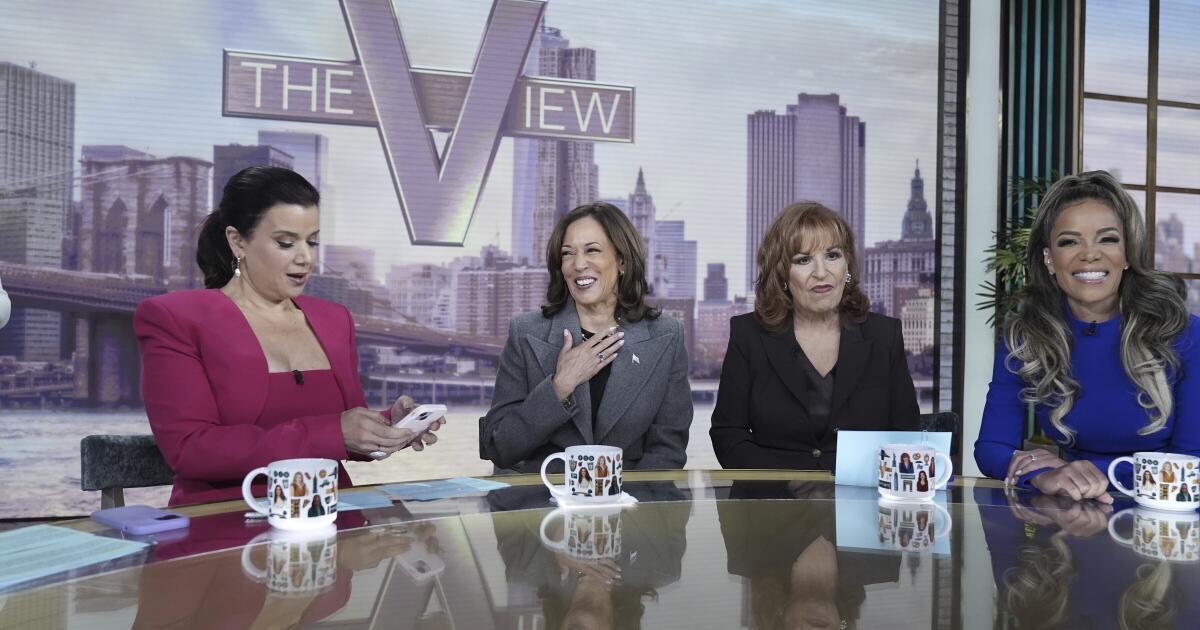
The viewers of “The View” talk show and the listeners of Howard Stern’s satellite radio program couldn’t be more different: older women who watch daytime television for the former versus young and middle-aged white men who have long constituted the fervent followers of the once-raunchy stylings of the latter.
Yet within the span of a couple of hours Tuesday, Democratic presidential nominee Kamala Harris traveled between their studios in Manhattan to sit down for lengthy interviews, an odd juxtaposition of a television show initially viewed as a ladies-who-lunch klatch and a radio host who became famous because of pornographic, misogynistic and at times racist diatribes that led to millions of dollars in indecency fines from the federal government.
Historically, serious political candidates would never have appeared on either; President Obama was mocked by fellow Democrats for being the first sitting president to sit for an interview on “The View.”
But both programs, which have millions of followers, have evolved: “The View” is one of the most popular stops for presidential candidates of both parties, and Stern has transformed into a therapy-touting, inquisitive interviewer. And both represent a bipartisan strategy as candidates of both parties including former President Trump court voters through the exponentially growing network of broadcast, radio, podcast and social media venues where voters who aren’t MSNBC or Fox News junkies get their news.
Bill Burton, a national spokesperson for Obama’s 2008 presidential campaign who worked on his communications team during his first term in the White House, said “the landscape has completely changed” since he started working in politics a quarter-century ago.
“Once the most obvious ways to communicate with voters was through political reporters,” he said. “That has shifted to getting a better understanding of who voters are, where they’re getting their information and communicating with them where they’re getting their information.”
The heightened focus on nontraditional media is the latest iteration of microtargeting, efforts by campaigns to reach specific blocs of voters. One of the most effective efforts occurred during President George W. Bush’s 2004 reelection campaign when strategists used consumer data, such as which magazines voters received or the cars they bought, to surgically target Republican voters in Democratic precincts in states such as Ohio.
“Campaigns are no longer a top-down approach to messaging. Oftentimes, it’s a very customized bottom-up approach,” said Kevin Madden, a GOP strategist who worked on Bush’s 2004 reelection bid as well as Mitt Romney’s 2008 and 2012 campaigns. “Before 2004, campaigns had 30-second ads targeted at the general population of people watching the news at 6:30 and across cable news. Now … you have this almost omnipresent approach communicating through all these channels based on what you know about their issues and what you know about peer sets.”
Recalling those efforts two decades ago, Madden said: “If you drive a truck and drink Budweiser, you’re one of our voters. If you drive a Grand Cherokee and drink Heineken, you may be a swing voters. Based on consumer habits, we know where to target you with some of our messaging, whether it’s peer-to-peer communication or through Field & Stream magazine.”
“Now, it’s morphed into a more comprehensive understanding of electorate,” said Madden, now a senior partner at a Washington-based global strategic communications group. “A couple cycles ago, it was sort of like painting by numbers. Now, it’s like pixilated digital images, and we just get more and more understanding of the electorate and mood shifts and what motivates them.”
Trump has also appeared on nontraditional forums, such as the podcasts of the Nelk Boys and professional wrestler Logan Paul, both popular with young men. On Tuesday, the former president said on Ben Shapiro’s controversial podcast that President Biden and Harris ought to be removed from office through the 25th Amendment, which addresses the transfer of presidential power in cases of disability, resignation or removal from office or death.
Harris has also spoken to eyebrow-raising hosts, such as Alex Cooper of “Call Her Daddy,” an explicit podcast that boasts millions of listeners and is reminiscent of the early days of Stern’s radio show because of its frank sexual banter.
On Tuesday, Harris’ questioners on “The View” were friendly. The two Republicans sitting around the coffee table on set were notable Trump critics: Florida strategist Ana Navarro and former Trump White House aide Alyssa Farah Griffin. Harris used the appearance to roll out a proposal to offer long-term-care assistance for seniors through Medicare as she addressed the needs of the “sandwich” generation, people who are taking care of aging parents and children.
“There are so many people in our country who are right in the middle, taking care of their kids, and they’re taking care of their aging parents. And it’s just, almost, impossible to do it all, especially if they work,” Harris said, recalling her experience caring for her mother after she was diagnosed with cancer. “We’re finding that so many are then having to leave their job, which means losing a source of income, not to mention the emotional stress. And so what I am proposing is that basically what we will do is allow Medicare to cover in-home healthcare.”
But Republicans quickly focused on an answer about what she would have done differently than Biden during their time leading the nation — a tricky line Harris had to walk as she is loyal to the current president while also arguing she is a change candidate.
“There is not a thing that comes to mind … and I’ve been part of most of the decisions that have had impact,” Harris said, later adding that she would include a Republican in her Cabinet.
Trump; his running mate, Ohio Sen. JD Vance; and other Republicans seized upon the remark.
“President Trump breaks the internet on X Spaces with Elon Musk, attends UFC fights and football games to roaring crowds, and opens up on personal topics like his family’s struggle with addiction on podcasts like Theo Von,” Anna Kelly, a spokesperson for the Republican National Committee, said in a statement. “In contrast, Kamala Harris doubles down on the past four years of failure, from the disastrous Afghanistan withdrawal to crushing inflation and record high prices for rent, groceries, and gas.
“The contrast is clear: while President Trump continues to build the largest, most diverse coalition in history, Kamala Harris wants four more years of the same weak, failed Biden-Harris agenda — and Americans will reject the tired politics of the past when they vote for President Trump in November,” Kelly said.
Shortly after her appearance on “The View,” Harris did an interview that lasted more than an hour with Stern, who initially was famous for having lascivious discussions on the airwaves, releasing “Butt Bongo Fiesta,” a $10-million-grossing home video featuring him spanking young women’s bare bottoms in time with music, and many other instances of offensive content, including using the N-word.
Vice President Kamala Harris with SiriusXM radio host Howard Stern on Tuesday.
(SiriusXM’s “The Howard Stern Show”)
He dabbled in politics, flirting with running for governor of New York before being required to release his income. He had a New Jersey highway rest stop named after him after endorsing successful GOP gubernatorial candidate Christine Todd Whitman.
As Stern has aged, he has evolved. Although he had a long-term relationship with Trump — they attended each other’s weddings — Stern said it disintegrated after he refused to introduce Trump at the 2016 Republican National Convention because he was backing Hillary Clinton.
His interview of Harris was fawning. Stern urged his supporters to vote for her or, if they supported Trump, to not vote all together. They both repeated familiar talking points about the perils they believe the former president poses to democracy and the world.
Although Harris hit many of the same notes as prior interviews, such as speaking about eating an entire bag of nacho cheese Doritos — “family size” — the night Trump won the 2016 presidential election, she also spoke about her love of Formula One racing and surprising her husband with tickets to see U2 at the Sphere in Las Vegas.
“Oh my God, have you been to the Sphere?” she asked Stern. “Everyone should go in with a clear head.”
Stern responded, “Basically, don’t be high?”
“Correct,” the vice president said. “It’s a lot. There’s a lot of visual stimulation.”



Politics
Mamdani’s response to Trump’s Iran strike sparks conservative backlash: ‘Rooting for the ayatollah’

NEWYou can now listen to Fox News articles!
New York City’s socialist Mayor Zohran Mamdani is facing blowback from conservatives on social media over his post condemning the U.S. attack on Iran that led to the killing of Iran’s supreme leader, Ayatollah Ali Khamenei.
On Saturday, as a joint strike on Iran by the United States and Israel was developing, Mamdani blasted the Trump administration’s decision in a post on X that has been viewed roughly 20 million times.
“Today’s military strikes on Iran — carried out by the United States and Israel — mark a catastrophic escalation in an illegal war of aggression,” Mamdani wrote.
“Bombing cities. Killing civilians. Opening a new theater of war. Americans do not want this. They do not want another war in pursuit of regime change.”
New York City Mayor Zohran Mamdani speaks to reporters during a news conference in New York Feb. 17, 2026. (AP Photo/Seth Wenig)
Mamdani said Americans prefer “relief from the affordability crisis” before speaking directly to Iranians in New York City.
“You are part of the fabric of this city — you are our neighbors, small business owners, students, artists, workers, and community leaders,” Mamdani said. “You will be safe here.”
The post was quickly slammed by conservatives on social media making the case that Mamdani’s response appeared sympathetic to Iran’s brutal regime and pointing to his lack of public reaction to the Iranian protesters killed in recent years.
“Comrade Mayor is rooting for the Ayatollah,” GOP Sen. Ted Cruz posted on X. “They can chant together.”
OBAMA OFFICIAL WHO BACKED IRAN DEAL SPARKS ONLINE OUTRAGE WITH REACTION TO TRUMP’S STRIKE: ‘SIT THIS ONE OUT’
“Do u say anything pro American ?” Fox News host Brian Kilmeade posted on X. “do u know any Iranians – ? they hate @fr_Khamenei they celebrate his death, you should be celebrating his death ! hes killed thousands of American’s and just killed 30k Iranians, did u even say a word about that? You are an embarrassment !! Please quit.”
Sen. Ted Cruz, R-Texas, questions Pam Bondi, President-elect Donald Trump’s nominee to be attorney general, during her Senate Judiciary Committee confirmation hearing in Hart building Jan. 15, 2025. (Tom Williams/CQ-Roll Call, Inc via Getty Images)
“I don’t feel safe in New York listening to someone like you, Mamdani, who sympathizes with the regime that killed more than 30,000 unarmed Iranians in less than 24 hours,” Iranian American journalist Masih Alinejad posted on X.
“We Iranians do not allow you to lecture us about war while you had nothing to say when the Islamic Republic shot schoolgirls and blinded more than 10,000 innocent people in the streets. You were busy celebrating the hijab while women of my beloved country Iran were jailed and raped by Islamic Security forces for removing it.
“And NOW you find your voice to defend the regime? No. I will not let you claim the moral high ground. The people of Iran want to be free. Where were you when they needed solidarity?”
CLICK HERE TO DOWNLOAD THE FOX NEWS APP
“How is it that you can’t differentiate between good and evil?” Billionaire hedge fund manager Bill Ackman posted on X. “Why is this so hard for you?”
“It takes a particular kind of audacity, or ignorance, for a city mayor to appoint himself the conscience of American foreign policy while his constituents step over garbage on their way to work,” GOP Rep. Nancy Mace posted on X. “History will not remember his bravery. It will not remember him at all.”
“Iranian New Yorkers are thrilled today and see right through you,” Republican New York City Councilwoman Vickie Paladino posted on X.
Bill Ackman, CEO of Pershing Square Capital Management LP, speaks during the WSJ D.Live global technology conference in Laguna Beach, Calif., Oct. 17, 2017. (Patrick Fallon/Bloomberg/Getty Images)
“When Kuwait, Saudi Arabia, Qatar, Turkey, UAE, Bahrain all support today’s operation eliminating world’s #1 sponsor of terror, but New York City’s Mayor @ZohranMamdani is shilling for Iran,” Republican New York City Councilwoman Inna Vernikov posted on X.
Fox News Digital reached out to Mamdani’s office for comment.
Shortly after Mamdani’s post, it was announced by President Trump and Israeli officials that the military operation resulted in Khamenei’s death.
Israeli leaders confirmed Khamenei’s compound and offices were reduced to rubble early Saturday after a targeted strike in downtown Tehran.
“Khamenei was the contemporary Middle East’s longest-serving autocrat. He did not get to be that way by being a gambler. Khamenei was an ideologue, but one who ruthlessly pursued the preservation and protection of his ideology, often taking two steps forward and one step back,” Behnam Ben Taleblu, senior director of FDD’s Iran program, told Fox News Digital.
Related Article

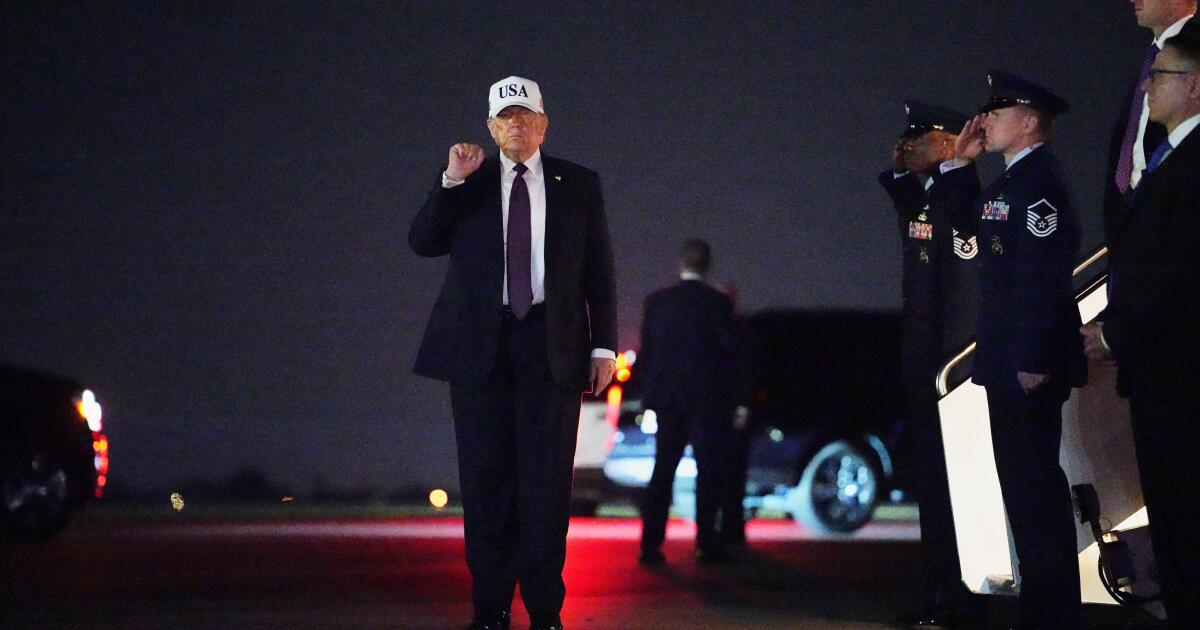
WASHINGTON — For a decade, President Trump promised to end what he calls forever wars, casting himself as a leader opposed to prolonged conflicts in the Middle East and who would rather pursue peace in the world.
Now, early in his second term, Trump is taking military action against Iran that could expand well beyond a limited effort to halt the country’s nuclear program.
In a video posted on Truth Social, the commander in chief said American forces also plan to “raze their missile industry to the ground” and “annihilate their navy.” He warned members of Iran’s military to surrender or “face certain death.” And urged the Iranian people to take the moment as an opportunity to rise up against their government.
“This regime will soon learn that no one should challenge the strength and might of the United States armed forces,” Trump said.
A few hours after relaying that message, Trump confirmed in a separate social media post that Ayatollah Ali Khamenei, the supreme leader of Iran, was among those killed by U.S. and Israeli strikes. Even with his death, Trump said that “the heavy and pinpoint bombing” would continue in Iran “as long as necessary to achieve our objective of PEACE THROUGHOUT THE MIDDLE EAST AND, INDEED, THE WORLD!”
Trump, who has been considering a strike on Iran for several weeks, acknowledged he reached the decision to attack Iran while aware of the human toll that could come with it.
“The lives of courageous American heroes may be lost, and we may have casualties. That often happens in war,” he said. “But we are doing this, not for now, we are doing this for the future, and it is a noble mission.”
Trump’s military campaign in Iran is a sharp turn in tone for a president who has long been critical of open-ended conflicts in the Middle East, and marks a shift from an America-first agenda message that helped him return to the White House.
“I’m not going to start a war. I’m going to stop wars,” Trump said in his November 2024 victory speech as he promised to focus national resources on domestic priorities rather than foreign conflicts.
As Trump advocated to bring home American forces from deployments around the world and to withdraw from key defense treaties, his position resonated with a war-weary electorate in the lead-up to the election.
Fewer than six in 10 Americans (56%) believed the United States should take an active role in world affairs ahead of the election — the second-lowest level recorded since the question was first asked in 1974, according to polling by the Council on Foreign Affairs.
Trump’s posture on war in the Middle East had been largely consistent before he ran for office.
In 2013, he criticized then-President Obama’s negotiations with Tehran, predicting in a post on Twitter that Obama would “attack Iran because of his inability to negotiate properly.” That same year, Trump warned that “our horrendous leadership could unknowingly lead us into World War III.”
And in a heated February 2016 debate, Trump attacked former Florida Gov. Jeb Bush, stating that his brother George W. Bush lied about Iraq’s nuclear capabilities to get the U.S. into the Iraq war. Trump called the Iraq war a “big, fat mistake” that “destabilized the Middle East.”
“They lied. They said there were weapons of mass destruction. There were none, and they knew there were none,” he said.
At the time of the Iraq war, however, Trump had said he supported it.
Trump’s confrontation with Iran bears little resemblance to his earlier rebukes.
Trump has yet to present evidence of an imminent threat to the United States from Iran’s nuclear program — a capability he claimed to have “obliterated” just eight months ago — and has instead framed the military campaign as one to ensure Tehran never develops nuclear weapons at all.
“It is a very simple message,” he said. “They will never have a nuclear weapon.”
Trump’s shift has already drawn the attention of congressional Democrats, many of whom are calling the president out for backing out on his promise to end foreign wars — and are demanding that he involve Congress in any further military actions.
“Regardless of what the President may think or say, he does not enjoy a blank check to launch large-scale military operations without a clear strategy, without any transparency or public debate, and not without Congressional approval,” Sen. Alex Padilla (D-Calif.) said.
Sen. Adam Schiff (D-Calif.) criticized Trump for “drawing the country into yet another foreign war that Americans don’t want and Congress has not authorized.”
The military involvement in Iran is not the first time that members of Congress have complained about the Trump administration’s willingness to sideline the legislative branch on decisions that could trigger broader conflicts this year.
In January, Trump ordered military forces to capture former Venezuelan President Nicolás Maduro and said the United States would run the sovereign nation until further notice. He threatened military action in Colombia, whose leftist President Gustavo Petro has been one of Trump’s most vocal critics.
Trump has alienated allied nations when he said he was willing to send American troops to seize Greenland, a semiautonomous territory of Denmark. And on Friday, he said U.S. is in talks with Havana and raised the possibility of a “friendly takeover of Cuba” without offering any details on what he meant.
His actions have coincided with his annoyance at not being awarded the Nobel Peace Prize. At one point, the president said he no longer felt an “obligation to think purely of Peace” because he didn’t get the recognition.
Trump’s shifting tone, and his use of violent war imagery in his pretaped remarks about Iran, have rattled even part of his base.
“I did not campaign for this. I did not donate money for this,” said former Rep. Marjorie Taylor Greene, a conservative who recently left Congress after a bitter fight with Trump. “This is not what we thought MAGA was supposed to be. Shame!”
Republican leaders, however, are largely standing behind the president.
Senate Majority Leader John Thune (R-S.D.) said Iran “posed a clear and unacceptable threat” to the United States and has refused “the diplomatic off-ramps.” House Speaker Mike Johnson (D-La.) said Trump took the action after exhausting “every effort to pursue peaceful and diplomatic solutions.”
Other top Republican lawmakers rallied behind Trump, too.
“The butcher’s bill has finally come due for the ayatollahs,” Sen. Tom Cotton, the chairman of the Senate Intelligence Committee, wrote in a post on X. “May God bless and protect our troops on this vital mission of vengeance, and justice, and safety.”
Politics
Iran fires missiles at US bases across Middle East after American strikes on nuclear, IRGC sites

NEWYou can now listen to Fox News articles!
Iran launched missile and drone strikes targeting U.S. military facilities in multiple Middle Eastern countries Friday, retaliating after coordinated U.S.–Israeli strikes on Iranian military and nuclear-linked sites.
Explosions were reported in or near areas hosting American forces in Bahrain, Qatar, the United Arab Emirates, Kuwait and Jordan, according to regional officials and state media accounts. Several of those governments said their air defense systems intercepted incoming projectiles.
It remains unclear whether any U.S. service members were killed or injured, and the extent of potential damage to American facilities has not yet been confirmed. U.S. officials have not publicly released casualty figures or formal damage assessments.
Iran’s Islamic Revolutionary Guard Corps (IRGC) described the operation as a direct response to what Tehran called “aggression” against Iranian territory earlier in the day. Iranian officials claimed they targeted U.S. military infrastructure and command facilities.
Explosions were reported in or near areas hosting American forces in Bahrain, pictured above. (Photo by Petty Officer 2nd Class Adelola Tinubu/U.S. Naval Forces Central Command/U.S. 5th Fleet )
The United States military earlier carried out strikes against what officials described as high-value Iranian targets, including IRGC facilities, naval assets and underground sites believed to be associated with Iran’s nuclear program. One U.S. official told Fox News that American forces had “suppressed” Iranian air defenses in the initial wave of strikes.
Tomahawk cruise missiles were used in the opening phase of the U.S. operation, according to a U.S. official. The campaign was described as a multi-geographic operation designed to overwhelm Iran’s defensive capabilities and could continue for multiple days. Officials also indicated the U.S. employed one-way attack drones in combat for the first time.
IF KHAMENEI FALLS, WHO TAKES IRAN? STRIKES WILL EXPOSE POWER VACUUM — AND THE IRGC’S GRIP
Smoke rises after reported Iranian missile attacks, following strikes by the United States and Israel against Iran, in Manama, Bahrain, Feb. 28, 2026. (Reuters)
Iran’s retaliatory barrage targeted countries that host American forces, including Bahrain — home to the U.S. Navy’s Fifth Fleet — as well as Qatar’s Al Udeid Air Base and the UAE’s Al Dhafra Air Base. Authorities in those nations reported intercepting many of the incoming missiles. At least one civilian was killed in the UAE by falling debris, according to local authorities.
Iranian officials characterized their response as proportionate and warned of additional action if strikes continue. A senior U.S. official described the Iranian retaliation as “ineffective,” though independent assessments of the overall impact are still developing.
Smoke rises over the city after the Israeli army launched a second wave of airstrikes on Iran in Tehran on Feb. 28, 2026. (Fatemeh Bahrami/Anadolu via Getty Images)
CLICK HERE TO DOWNLOAD THE FOX NEWS APP
Regional governments condemned the strikes on their territory as violations of sovereignty, raising the risk that additional countries could become directly involved if escalation continues.
The situation remains fluid, with military and diplomatic channels active across the region. Pentagon officials are expected to provide further updates as damage assessments and casualty reviews are completed.
Fox News’ Jennifer Griffin contributed to this report.
Related Article

Boy dies after being struck by vehicle in Hawaii Kai | Honolulu Star-Advertiser

Who is running for Illinois governor in 2026? What to know as primary Early Voting sites open

Indiana Pacers Must Manage Two-Way Contract Player Availability Down Stretch

Iowa Boys High School State Basketball Tournament Sets Two Classes

Why Matthew Driscoll continues to say Kansas State is ‘close’

Florida High School Football Rankings: Top 25 teams – Oct. 21

Cleary's 21 help Le Moyne down Central Connecticut State 69-64 in OT

How old is Bo Nix? What to know about Oregon quarterback ahead of 2024 NFL Draft

99th annual Pony Swim held in Virginia

Indiana Members Credit Union announced as new anchor tenant at Bottleworks District

Mamdani’s response to Trump’s Iran strike sparks conservative backlash: ‘Rooting for the ayatollah’

Activists hail ‘historic’ EU’s decision on accessible abortion

A long-buried recording and the Supreme Court of old (CT+) : Consider This from NPR

2 Survivors Describe the Terror and Tragedy of the Tahoe Avalanche

Iran fires missiles at US bases across Middle East after American strikes on nuclear, IRGC sites
-

 World3 days ago
Exclusive: DeepSeek withholds latest AI model from US chipmakers including Nvidia, sources say
-

 Massachusetts4 days ago
Mother and daughter injured in Taunton house explosion
-

 Montana1 week ago
2026 MHSA Montana Wrestling State Championship Brackets And Results – FloWrestling
-

 Louisiana6 days ago
Wildfire near Gum Swamp Road in Livingston Parish now under control; more than 200 acres burned
-

 Denver, CO3 days ago
10 acres charred, 5 injured in Thornton grass fire, evacuation orders lifted
-

 Technology1 week ago
YouTube TV billing scam emails are hitting inboxes
-

 Technology1 week ago
Stellantis is in a crisis of its own making
-

 Politics1 week ago
OpenAI didn’t contact police despite employees flagging mass shooter’s concerning chatbot interactions: REPORT