Politics
Patrick Soon-Shiong's controversial shakeup at the L.A. Times: 'Bias meter,' opinion upheaval and a call for growth


Patrick Soon-Shiong had become accustomed to making the news.
He was the doctor and medical technology innovator who built a fortune, the striving South African immigrant who bought a piece of the Lakers and the L.A. billionaire who brought the Los Angeles Times back under local control when he purchased it in 2018.
But none of that created the public tempest like the one that has surrounded Soon-Shiong’s recent actions: First when he blocked the Times editorial board, which he oversees, from endorsing Vice President Kamala Harris for president. Then he suggested the newspaper had become an “echo chamber” for the political left. And, this month, he announced The Times would create a digital “bias meter” to alert readers about the ideological tilt of the paper’s content.
An estimated 20,000 subscribers dropped The Times after the non-endorsement in the presidential race and its aftermath. Soon-Shiong’s pledges of a more “fair and balanced” approach triggered more dismay from many and charges of a capitulation to President-elect Donald Trump. But the new stance also brought praise from others for what they saw as a long-overdue recalibration of coverage in the West’s most prominent newspaper.
In his first extended interview about the furor, Soon-Shiong depicted himself as an unflinching protector of journalistic balance, one who is betting that a moderate, nonideological viewpoint is the best path forward. He also spoke at length about his hopes for the future of the paper.
The Times significantly increased its number of paying digital subscribers after Soon-Shiong purchased the paper. He added more than 150 people to a newsroom that had been slashed for two decades, making The Times a bright spot in an industry beset by massive downsizing as revenues cratered, following the flight of advertising to digital giants like Facebook and Google.
Soon-Shiong in the lobby of the old L.A. Times building downtown shortly after he bought the newspaper in 2018.
(Marcus Yam / Los Angeles Times)
For The Times and virtually every other paper in America, incremental increases in online subscriptions have not been enough to fill gaping budget holes. The Times has been losing tens of millions of dollars a year and went through two rounds of painful layoffs — erasing most of the staffing gains that followed the Soon-Shiong acquisition.
‘I’m extremely proud’
In last week’s interview with The Times, the medical doctor and former transplant surgeon expressed pride in much of the journalism in the newspaper. He vowed to protect the independence of the newsroom, even as he pledged to become more involved in the outlet’s editorial and opinion pages.
“I’m extremely proud of work we’ve done right,” he said, “and we’ve done a lot right,” he said, pointing to six Pulitzer Prizes the paper has won during his ownership, among other honors.
But he said it was essential to build a bigger audience, which he described as key to securing the 143-year-old newspaper’s future.
“I think that’s our goal,” Soon-Shiong said. “The only way you can survive is to not be an echo chamber of one side.”
He said he intends on introducing more moderate and conservative commentators on the newspaper’s opinion pages, where liberal writers have been dominant for years.
Soon-Shiong made it clear he also wants editors and reporters who produce news stories to be alert for ideological imbalance and fairness, though he said he has no intention of meddling in decisions made by The Times’ newsroom leaders about how to cover the news.
Soon-Shiong acknowledged he had paid less attention to The Times for much of the first 6½ years of his ownership as he focused on several other businesses, with particular attention to an immunotherapy treatment that won FDA approval this spring.
With the demands of his biomedical career slightly reduced, the entrepreneur said that he “emphatically” intends to become more involved in finding a sustainable path forward for The Times.
“Staying strong and resolute to transform the paper and drive a rebirth @LATimes,” he recently declared on X. “We laid out the path for the LA Times to report just the facts when we publish ‘news.’ “
Big investment, big losses
Many civic leaders and everyday readers hailed Soon-Shiong when he bought the newspaper in 2018, rescuing it from a cost-cutting owner and a possible sale to chains known for operating bare-bones news operations. Since that initial $500-million investment to buy The Times and the San Diego Union-Tribune, Soon-Shiong said he has set aside $250 million to renovate the El Segundo headquarters and to build a museum and auditorium, which are under construction.
But, like other media outlets, The Times saw already floundering ad revenue take another big hit with the onset of the COVID-19 pandemic. The owner said he provided his newspaper with operating capital of “another $40 [million], $50 million a year,” declining slightly last year, when he said he paid $30 million to fill the gap between revenue and expenditures.
With total outlays of about $1 billion, Soon-Shiong has made one of the largest investments in local journalism in America. He said he has not wavered in his commitment, but made clear that he expects more progress in building the audience, particularly online.
“Unless we build a paper that can engage and increase the readership, what are we doing?” he said.
The Times has about 650,000 paid readers, combining print, digital and other third-party platforms. About 275,000 of those are direct digital subscribers.
The owner sounded incredulous when he noted that the L.A. Times has fewer subscribers in California than the New York Times. “We need to ask ourselves, very honestly, why is that?” he said. He suggested that a reasonable starting point was to get 1% of California’s 40 million residents, or 400,000, to pay for direct digital subscriptions, which go for $60 a year.
When he bought The Times, Soon-Shiong suggested he had a “100-year plan” and wanted ownership of the news outlet to be part of his family’s legacy.
“And as long as I can see progress” in readership, “I’ll continue to fund it, yes,” he says now. “But something has to change if all this is [being] considered a philanthropic trust. It’s not. A sustainable business has to occur.”
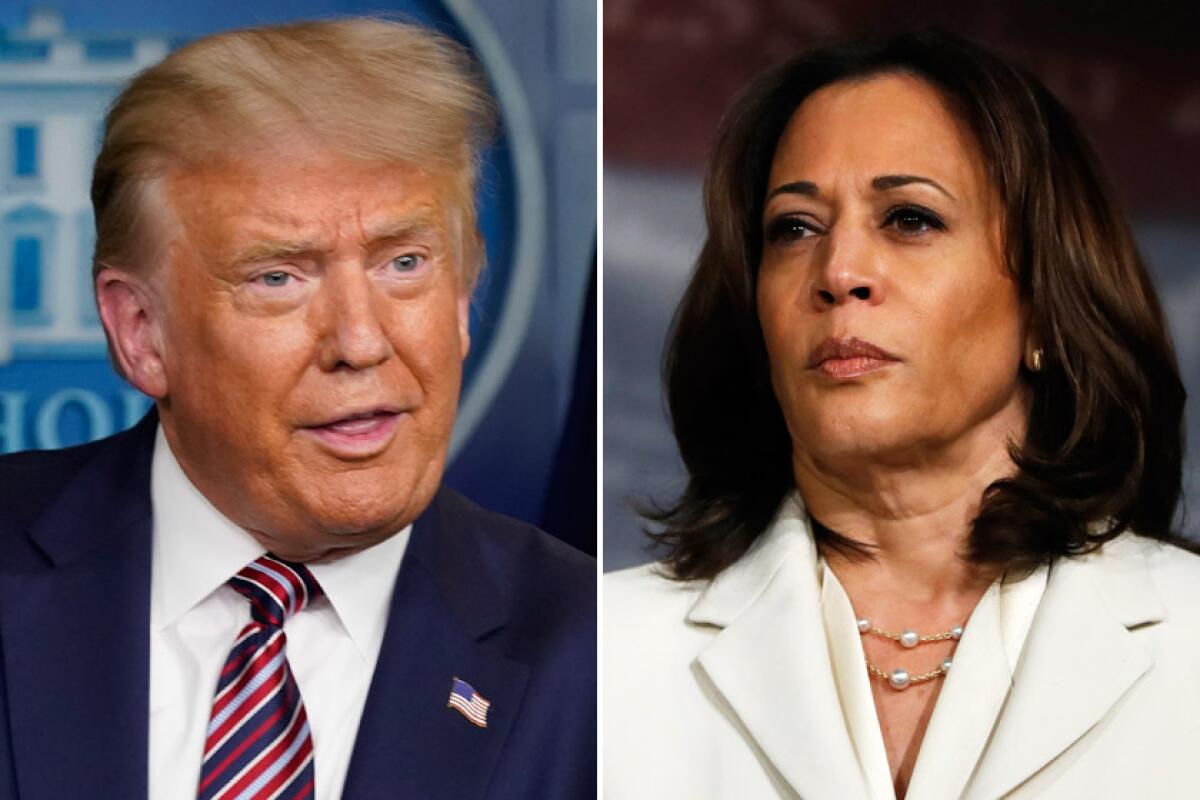
The Times owner nixed an editorial board plan to endorse Kamala Harris over Donald Trump in the presidential election. It was the first time since 2008 the paper did not endorse in a presidential race.
(Associated Press)
Non-endorsement roiled newspaper
He believes that presenting a greater diversity of views will be a key to success.
Throughout his ownership, most of the newspaper’s opinion columnists have been politically liberal. The unsigned editorials that represent the views of The Times, as an institution, have also leaned left, with sharp criticism of Trump routine.
As owner, Soon-Shiong has been a member of the internal board that produced those editorials, and it’s understood that he can exercise his privilege to make the final decision on what is published, a common role for American newspaper owners. In the past, he infrequently attended the board’s meetings and did little to influence the content of editorials, he acknowledged.
That changed dramatically in the final weeks of this year’s presidential race. As The Times prepared to endorse Harris, and run a series of other editorials on the downsides of a second Trump presidency, Soon-Shiong said he wanted to take a different course.
He asked the editorial page leaders to create a feature enumerating the records of Trump and Harris during their respective four years as president and vice president. Soon-Shiong said that such an approach would have given readers more information, without recommending either candidate. He described that as the fairest approach.
But editorials editor Mariel Garza and her staff noted that The Times had endorsed a presidential candidate in every election since 2008. After writing for several years that Trump was unfit and a danger to democracy — as a convicted felon who attempted to overturn his 2020 election defeat — the editorial writers said that a non-endorsement would amount to an abdication of their responsibility, and a tacit approval of the Republican.
News of the internal dispute became public in late October, and Garza (calling the non-endorsement “craven and hypocritical”) and two of her fellow board members resigned. Two others later joined the exodus from the board. Even after the editorial board departures, the dispute continued to simmer, with one regular opinion contributor departing and some union members sending a letter of protest.
While Soon-Shiong received praise on the right, he soon learned that thousands of Times readers were canceling their subscriptions in protest.
“I knew this would be disruptive, and it took courage to do that,” he said, adding that he believes that in the long run the move will win over readers in a nation that has become too polarized. He rejected claims that the late decision was “so that I could support President Trump, so I could appease him, because I was scared of him, which was the furthest from the truth.”
Those “who cancel [their] subscription should respect the fact that there may be two views on a certain point, and nobody has 100% the right view,” Soon-Shiong said. “And it’s really important for us [to] heal the nation. We’ve got to stop being so polarized.”
The owner took heart from a commentator, writing for The Times of India, who said the non-endorsement had been the right call.
“Democracy depends on maintaining the trust and participation of all citizens, and endorsements risk deepening existing divisions,” wrote the columnist. “When distrust already runs high, even well-intended endorsements can appear partisan, eroding the media’s role as a space for diverse perspectives.”

Soon-Shiong says he plans to revamp the Times editorial board, adding more moderate and conservative writers to provide ideological balance. He said he intends to lay out details of the new opinion operation in January.
(Kent Nishimura / Los Angeles Times)
Rethinking opinion pages
Soon-Shiong soon announced on social media and in interviews that he planned to revamp the Times editorial board, adding more moderate and conservative writers to provide ideological balance. He said he intends to lay out details of the new opinion operation in January. But some of the outlines of the proposal came out during the Times interview and in talks with Times management.
Soon-Shiong has described what would amount to two distinct editorial panels.
One would operate something like The Times’ traditional editorial board, though it would focus primarily on local and California issues and candidates. That board would be made up of full-time employees, who would write the unsigned opinion pieces and endorsements that have been a tradition for decades.
With the board currently reduced to just one full-time writer, The Times is seeking to hire an unknown number of others to rebuild the group. The owner has made clear he wants writers with a variety of ideological perspectives to be on the remade editorial board.
A second group of writers, now being assembled by Soon-Shiong, will focus on national and international affairs. Those opinion columnists are expected to be freelancers. Soon-Shiong has suggested that besides writing signed pieces for The Times, the columnists — representing an array of professions, industries and personal backgrounds — might be featured in videos produced by L.A. Times Studios or at conferences sponsored by the newspaper.
Late last month, the Times owner announced that veteran Republican political operative Scott Jennings — a regular CNN panelist and frequent Trump defender — will be a part of the new initiative. (Even before the announcement, Jennings was a regular contributor to The Times — writing nearly three dozen columns over the last five years.)
“His reasoned, fact-based approach perfectly aligns with our commitment to inclusivity,” Soon-Shiong wrote on X. Jennings called the Times owner’s emphasis on ideological diversity “groundbreaking.”
Soon-Shiong vows ‘more active role’
While details remain to be worked out, Soon-Shiong said he would “have a direct and more active role,” adding that he would leave certain topics to his opinion writers, while having more to say about “issues that are dear to my heart, [such as] cancer, climate change, energy issues and issues of national importance.”
His increased involvement became apparent again recently. The paper was on the verge of publishing an editorial saying that Trump’s Cabinet appointments should be subject to the full Senate confirmation process — rather than being seated via recess appointments. Soon-Shiong said that the editorial could be published only if the paper accompanied it with a companion piece with the opposing view, which would defend a president’s right to make some recess appointments. With the print deadline fast approaching, the editors didn’t have time to produce a companion piece, so they replaced it with commentary on another subject.
Soon-Shiong suggested in a Fox News interview last month that he also had concerns about opinion leaking into The Times’ news operation, which operates independently of the opinion staff.
“I knew that people don’t like change,” Soon-Shiong said in a podcast interview this month. “And I knew I had to actually address even the newsroom by saying, ‘Look, are you sure your news is news? Or is your news really [your] opinion of . . . news?’ ”
Many Times reporters and editors rejected the notion that they inject opinion into their news reporting, saying they long labored to be impartial arbiters. Some noted how Times reporting, with no ideological tilt, helped expose scandals at USC and the racist railings of L.A. political leaders (all Democrats) in a closed-door meeting.
“Journalists of the Los Angeles Times are committed to shining a light on injustice, exposing wrongdoing, and seeking the facts,” the union representing most Times journalists responded in a statement. “We speak truth to power, regardless of which party is in power.”
During the Times interview, Soon-Shiong made clear his skepticism about the “journalistic integrity” of some journalists who had spoken about his actions anonymously, while he has made his views on the record. He has also complained about how various outlets reported on him.
He recently has expressed particular gall about how some media depicted the departure in January of Times Executive Editor Kevin Merida, suggesting that coverage contributed to his skeptical view of journalists.
At the time of the exit, The Times reported that Soon-Shiong called his veteran editor’s departure “mutually agreed,” and the description was not challenged. Merida, a former managing editor at the Washington Post, told the newspaper that he made the decision to leave, “in consultation with Patrick.”
But in last week’s interview, Soon-Shiong expressed consternation that some accounts of the Merida departure left the impression he had resigned under protest about staff cuts and other disagreements with the owner. In fact, the owner said, he fired the top editor.
“My great disappointment . . . was for him to go around and provide misinformation…that he resigned under protest,” Soon-Shiong said.
Merida responded with an email statement. “I have said all I want to say about my decision to leave the L.A. Times 11 months ago. I’ve moved on,” it said. “But I continue to root for The Times and for all of the tremendous journalists who are still there.”
Though newspaper operations seem opaque to many readers, there is a tradition of the journalists who write for the editorial and opinion pages operating with almost complete independence from those who write news stories. The Times has followed that model for decades. While Soon-Shiong oversees the editorial board, the Times newsroom is led independently by the executive editor, Terry Tang, a former opinion and news editor for the New York Times who was raised in Southern California.
Soon-Shiong expressed confidence in Tang, who oversees both the news and opinion operations and was promoted to the top post early this year, succeeding Merida. He noted that she had helped increase staff productivity since taking over.
Both the owner and top editors at The Times noted that Soon-Shiong occasionally has suggested news stories, particularly in his biomedical field, but most often did not result in stories.
The owner also said in the interview that he had no intention of blocking stories to protect friends, family or political figures he has praised, including Robert F. Kennedy Jr., whom he recently lauded in social media posts.
Said Soon-Shiong: “If somebody has had a conflict of interest or done something bad, and it’s factually true, we should report it.”
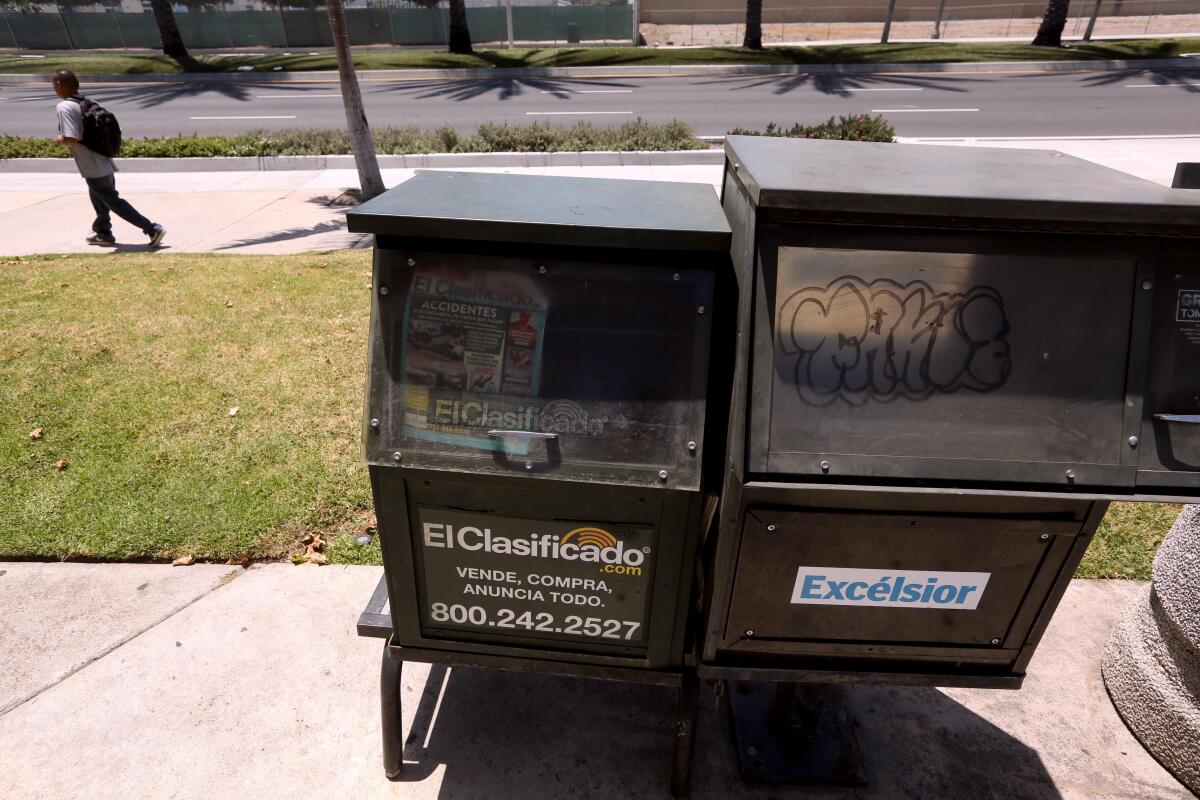
Digital news is a tough business, delivering a fraction of the income of print papers, which are in rapid decline.
(Genaro Molina / Los Angeles Times)
The struggle for future of local news
This is not the first time Soon-Shiong has spoken out publicly about major national and international affairs. He often shares his experience growing up as a man of Chinese heritage under South Africa’s racist apartheid regime.
In the racial reckoning in this country that followed the 2020 murder of George Floyd at the hands of police, he wrote that The Times for much of its history had “ignored large swaths of the city and its diverse population, or covered them in one-dimensional, sometimes racist ways,” and thereby “contributed to social and economic inequity.”
He is also not alone in wrestling with how to approach opinion journalism.
Amazon founder and Washington Post owner Jeff Bezos also killed his paper’s editorial endorsing Harris in the presidential election, and faced a similar backlash. The Post reportedly lost 250,000 subscribers. In a column explaining his actions, Bezos noted that trust in the media was in major decline and he felt one reason was that some readers considered news organizations biased.
A Pew Research Center survey last month found that 59% of adults in the U.S. had some, or a lot of, trust in the information presented by national news organizations. That was down from 76% who trusted national news sources eight years ago. Trust among Republicans over that time period dropped much more precipitously, from 70% to 40%, while roughly 80% of Democrats expressed trust in national news sources.
But it is far from clear that more ideological diversity on opinion pages alone will bring readers back or fill revenue holes. Digital news is a tough business, delivering a fraction of the income of print papers, which are in rapid decline. As Google and other sites dominate digital advertising, a recent effort in the California Legislature to force the tech companies to compensate news organizations stalled.
America’s two largest newspaper chains operate with dramatically reduced staffing. Even Bezos’ Post — resurgent in the billionaire’s early tenure — ordered staff buyouts as revenue declined.
The New York Times’ success has been a notable exception, with the venerable newspaper recently reporting it had nearly 10.5 million digital subscribers. It has fueled revenue gains with games, recipes and consumer recommendations. Its gains have come while most of its editorials and opinion columns continued to lean left.
Soon-Shiong believes a wider array of viewpoints can lure more readers back to the L.A. Times. He hopes to bring in other revenue with events, such as the Times’ popular Festival of Books and its food events. He also plans to create more shows with L.A. Times Studios. He spoke proudly about the paper’s Fast Break team, which produces breaking and developing news and draws an outsize share of reader page views.
Bill Grueskin, a former Wall Street Journal deputy managing editor who teaches at the Columbia University journalism school, said he did not think that changing the ideological leaning of editorials and columns would save newspapers, including the L.A. Times.
“The declines have much more to do with the advertising market cratering, the elimination of a lot of the reporting jobs, the huge number of competitors, most of them illegitimate sources of real news, many of them free, which, unfortunately, a lot of our fellow citizens feel are a perfectly adequate substitute,” Grueskin said.
Still, traditional views of the kind of media that will draw paid consumers and advertising is evolving. Just a few years ago, no one could have predicted that podcaster Joe Rogan would draw more than 40 million viewers for his extended interview with Trump shortly before the November election.
Explaining the ‘bias meter’
The furor over the newspaper’s non-endorsement was dying down this month when Soon-Shiong again became a trending topic on social media. This time, it was after the Times owner told Jennings during a podcast interview that he planed to unveil a “bias meter” to let readers know the ideological bent of his newspaper’s content.
He said in the interview with The Times that the meter would use an “augmented intelligence” patent (dubbed the “Reasoning Engine”) that he created in his biomedical endeavors. The meter will be displayed atop a piece of writing to tell readers where it ranks on a scale that will range from “far left” to “far right.”
Although he told Jennings the meter would appear on both news and opinion content, Soon-Shiong clarified last week that he intends it only to be an additional label on Times editorials and opinion columns, not news stories.
He said he intends to have the AI technology also parse 50 years of Times editorials and columns, to determine the ideological bent of every Times editorial and opinion piece published over five decades. He says he will publish the results of that analysis.
The feature also will allow readers to click on a button to obtain an AI-compiled story or stories, offering alternative viewpoints, Soon-Shiong said.
A variety of experts from mainstream journalism questioned the value and reliability of a machine-driven analysis. One Times reader captured some of the concern when he said via email: “I find it kind of insulting to the reader. I think I and most readers can judge the varying perspectives of the people who are writing opinion pieces.”
Lakers legend Kareem Abdul-Jabbar — who has occasionally written articles for The Times — also gave the “bias meter” a thumbs-down. “Another blow to journalism — and democracy,” Abdul-Jabbar wrote on his blog last week, “by another billionaire with a conservative agenda that serves his wealth.”
Soon-Shiong, who said he is a political independent, believes the device will help show readers The Times is offering a variety of opinions.
“It’s exhausting to turn on Fox and turn on CNN and turn on MSNBC,” he said. “We need to be that middle-of-the-road, trustworthy source. … I think that’s our goal. The only way you can survive is not be an echo chamber of one side.”

As the public battle over Times content has raged, the owner and his newsroom employees have been locked in a prolonged contract dispute.
(Kent Nishimura / Los Angeles Times)
Inside the newsroom
As the very public battle over Times content has raged, the owner and his newsroom employees have been locked in a prolonged contract dispute. Negotiations between management and the union representing most Times journalists have limped along for nearly three years, with the sides far apart on pay and other issues.
Soon-Shiong became particularly animated during the interview in declaring his determination to loosen seniority protections now written into the contract. He said the rules forced him to lay off staff members with less tenure at the company, many of them hired to help improve digital operations and growth.
“The contract is structured that, no matter how good this young person is, you have to fire him, and all you will do then is, we’ll take this down into an existential spiral of death,” Soon-Shiong said.
The council representing Times guild members disagreed, saying that seniority protection “promotes stability, expertise and talent retention,” adding: “Seniority gives our journalists a bulwark to speak truth to power. And seniority is a recognition that a superior product comes from time, deep community ties, and experience.”
The Times management and workers have also been locked in a fight over whether employees should return to the office or remain working at home, as most Times staffers have been doing since the start of the pandemic in early 2020. This practice has continued as many other workplaces have returned to the office at least part time.
The Times has ordered its journalists to return to the office two days a week, now that the health emergency is over, while the union has argued that the directive amounts to a change in working conditions that must be negotiated.
The owner said a collective working environment is crucial to fostering collegiality, collaboration and productivity. Many workers say they get more done working at home, while not wasting time and money commuting, a more daunting cost given that they have gone without an across-the-board cost-of-living increase for more than three years.
When he gave a tour of the El Segundo headquarters Monday to a couple of guests, Soon-Shiong reported finding a newsroom that was almost entirely empty.
“So this idea of making an investment is a two-way street, where you would think we are all in this together,” he said. “I’m working to make this a success. And I was extremely disappointed to see an empty building.”
Told that more journalists come into the office on Thursdays, the owner responded: “So should I just fund you for Thursdays? … There’s a sense of entitlement that cannot be tolerated.”
The guild replied in a statement that it had not denied that workers might return to the office more regularly, but only wanted to negotiate the point. “Stalling tactics in bargaining, years without a contract, and statements that inaccurately demean the entire newsroom all drain morale,” the statement said.
The owner said his remarks should not be construed as a blanket judgment of “the quality and strength of the newsroom.”
“The paper sets its culture,” Soon-Shiong said. “I’m trying to set our culture as a middle-of-the-road, trustworthy news source.
“I believe that public support for journalism is completely vital, so that we can have a free and independent press, which I believe is the foundation of a healthy democracy. Without it, I think we lose our ability to hold the powerful accountable. Without it, we lose our ability to make informed decisions.”

Politics
Trump-aligned House holdouts accused of holding ‘life-saving’ veterans bill ‘hostage’ over SAVE America Act

NEWYou can now listen to Fox News articles!
A sweeping veterans package supporters describe as the largest expansion of veterans’ health care and benefits in more than a decade is expected to return to the House floor when lawmakers come back from the July recess, but backers warn the legislation could once again become collateral damage in the Republican standoff over the SAVE America Act.
The Take Care of America’s Veterans Act rolls roughly 60 veterans bills into a package that would dramatically expand veterans’ health care and benefits. At its core, the legislation would cement veterans’ access to community care outside the VA while increasing benefits for combat-wounded veterans, caregivers and Gold Star families, expanding mental health services and enacting dozens of additional reforms.
House Veterans’ Affairs Committee Chairman Mike Bost, R-Ill., told Fox News Digital he intends to bring the Take Care of America’s Veterans Act back for a vote as soon as the House reconvenes next week.
WASHINGTON, D.C. – MARCH 17: Eugene Simpson, 29, from Dale City, Virginia goes through physical therapy at the Veterans Affairs Medical Center in Washington, D.C. with Michael Minor, a kinesiotherapist with the United States Department of Veterans Affairs on March 17, 2006 in Washington, D.C., USA. (Photo by Jeff Hutchens/Getty Images) (Jeff Hutchens/Getty Images)
HOUSE CONSERVATIVES DERAIL GOP AGENDA IN SAVE AMERICA ACT SHOWDOWN
The legislation was held up last month after a group of House Republicans joined Democrats to defeat a procedural vote, stopping the House from taking up the bill.
“I’m feeling good as long as my members stay with us on the rule,” Bost said. “Right now, there’s some politics being played, not about this bill, but just in general.”
The bill became entangled in a broader House Republican fight over the SAVE America Act, legislation championed by President Donald Trump that would require proof of U.S. citizenship to register to vote in federal elections.
On June 30, the House voted on H. Res. 1398, the procedural rule governing floor consideration of several bills, including the National Defense Authorization Act and the Take Care of America’s Veterans Act. The rule failed after 14 Republicans joined Democrats in opposition, preventing the House from taking up the veterans package and bringing floor business to a standstill. Rep. Anna Paulina Luna, R-Fla., claimed to have voted against the rules vote in protest against House leadership’s handling of the SAVE America Act. As a result, Speaker of the House Mike Johnson sent the members home early.
Bost accused the holdouts of effectively putting veterans legislation on hold.
The US Department of Veterans Affairs building is seen in Washington, DC, on July 22, 2019. (Photo by Alastair Pike / AFP) (Photo credit should read ALASTAIR PIKE/AFP via Getty Images) (Photo credit should read ALASTAIR PIKE/AFP via Getty Image)
‘IT’S A MESS’: GOP TURNS ON HOUSE CONSERVATIVES AS VOTER ID BLOCKADE STALLS TRUMP’S AGENDA
“They’re holding all bills hostage,” Bost said. “They’re not voting for any rule. Any bill that has to pass a rule before it comes to the floor—which this bill does because of its size—can’t move.”
Although Bost said he supports the SAVE America Act and has voted for it three times, he argued the Senate’s failure to act should not stop the House from advancing unrelated legislation.
“I agree with that bill,” Bost said. “But the Senate still has to do their work. We don’t stop our work because the Senate isn’t doing it.”
With 23 legislative days left in the Congressional session, Concerned Veterans for America Strategic Director John Byrnes, a supporter of the bill, said time is of the essence.
“There are lots and lots of things that have to get done,” Byrnes told Fox News Digital. “There’s also the National Defense Authorization Act, which is a must pass every year, so these things eat up time. There’s requirements to have debate on these, which eat up session time.”
Byrnes argued that every procedural delay pushes other legislation further down the calendar.
“This bill will save lives in 2027,” Byrnes said. “If we lose veterans because they could have had faster, better access to health care, we’re never going to get those veterans back.”
Rep. Mike Bost, R-Ill. ( )
TRUMP’S SAVE AMERICA ACT SHOWS SIGNS OF LIFE IN THE SENATE DESPITE REPUBLICAN REVOLT
But Rep. Chip Roy, R-Texas, who also voted no on the procedural vote, told Fox News Digital that he has concerns about how the bill is financed.
“I appreciate what the chairman’s trying to do in some respects, but there’s a few issues,” Roy said.
Among them, Roy pointed to provisions offsetting new spending through changes affecting other veterans.
“You’re taxing certain veterans to provide some sort of benefits and changes to other veterans,” Roy said. “There are concerns about some of the pay-fors.”
Veterans of Foreign Wars has also taken issue with Section 108 of the bill, warning that it would codify changes to future disability ratings for tinnitus and sleep apnea to help finance other veterans priorities.
But Bost said this is inaccurate.
“No veteran is going to have their benefits reduced,” Bost said. “If you’re receiving a benefit right now, that’s not going to be reduced at all.”
Roy, who previously served two years on the House Veterans’ Affairs Committee, said he supported a lot of what the bill was seeking to accomplish; but said other pieces of legislation are priorities, too.
CLICK HERE TO DOWNLOAD THE FOX NEWS APP
“There is a block of us for whom border security, the SAVE Act and demonstrating our leadership on major issues is critical,” Roy said. “Some of these other bills may or may not get hung up based on a desire of many in the conference to see movement on other things.”
Fox News Digital reached out to Luna’s office and the White House for comment.
WASHINGTON — Shortly before President Trump ended a ceasefire with Iran this week, Israeli officials presented his team with intelligence indicating Tehran was hatching new plots to kill him.
It was not the first such warning. U.S. law enforcement and intelligence agencies have tracked evidence for years of Iranian efforts to target the president, with signals only increasing since the start of the war.
Their desire to target Trump and his top aides began six years ago, just outside Baghdad International Airport, when the president ordered a drone strike that killed Iran’s most powerful general. The assassination of Qassem Suleimani brought the two countries to the brink of war.
Yet even as full-scale war was averted, top Iranian officials vowed revenge for the strike, authorizing attempts on the lives not just of the president, but of his secretary of State and national security advisor, among others, even after they had left office.
Now, calls for revenge have reached a sharper pitch in Tehran, after a joint U.S.-Israeli operation killed Iran’s supreme leader, Ayatollah Ali Khamenei, at the start of the war in February.
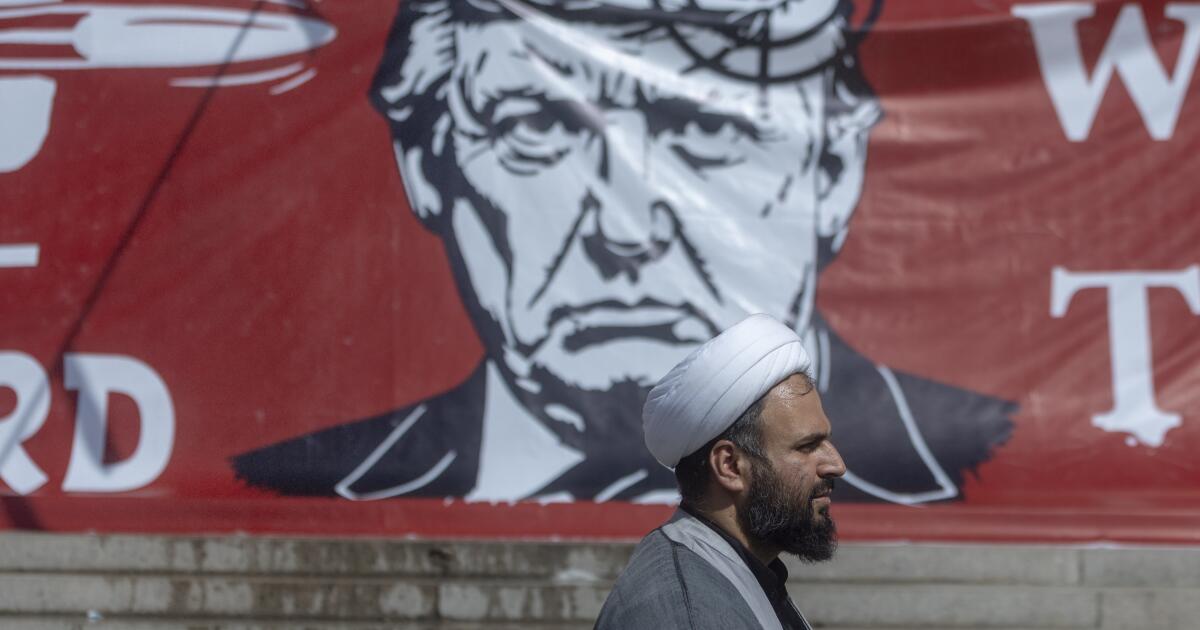
At Khamenei’s funeral ceremonies this week, red flags of vengeance flew throughout the capital as protesters explicitly called on their government to “kill Trump.” His son, Mojtaba, the new supreme leader, was absent from the commemorations, fearing assassination himself.
Mourners hold an anti-President Trump banner at the Imam Khomeini Grand Mosque during mass funeral prayers for Iran’s late Supreme Leader Ayatollah Ali Khamenei and his family in Tehran on Sunday.
(Morteza Nikoubazl / NurPhoto via Getty Images)
The prospect of foreign assassination plots targeting U.S. leaders puts the United States in dangerous new territory, where its embrace of political killings could ultimately place its own officials at unprecedented risk. And experts fear the existential threat of assassination has pushed peace further out of reach: When both sides believe their survival is at stake, the trust required for diplomacy becomes far harder to achieve.
Israeli news organizations have reported that Israel’s prime minister, Benjamin Netanyahu, cited Iranian attempts to kill Trump in recent years as part of his case to go to war in the first place.
A U.S. official told The Times that a range of serious threats exist against the president, including from Iran, but that Israel’s intelligence pointed to a more specific plot. The official did not provide further details. Israeli officials did not respond to requests for comment.
Iran’s president, Masoud Pezeshkian, has said in recent months that the government sees vengeance against U.S. officials as “its legitimate duty and right,” and “will fulfill this great responsibility and duty with all its might.”
“The Suleimani killing accelerated a lifting of restraints on foreign assassinations — and the taboo on targeting and killing foreign leaders, with U.S. military assets, has been more or less lifted,” said Matt Dallek, a political professor at George Washington University.
“If the United States sets the example of how to conduct international relations, and it is using assassination of foreign leaders as a political weapon, it’s only logical that other countries will be more inclined to also engage in assassinations,” Dallek added. “It does seem likely that Trump will have a bigger target on his back.”
Returning from a NATO summit in Turkey on Wednesday, Trump was forced to switch back to an old model of Air Force One — equipped with specialized defensive technologies — from a new plane given as a gift by Qatar, after the Secret Service warned of potential threats to the aircraft from Iran.
“They want to take out the U.S. leader — me,” Trump told reporters aboard the plane. “I’m on whatever list. I saw this morning I’m on every single one of their lists. And so far, I guess I’ve been a bit lucky, but maybe that doesn’t last very long.”
The threat has remained on his mind in the days since. In an interview with the New York Post, Trump told the reporter, “I hope you’ll miss me,” adding that he has “been on their list for a long time.” And in a subsequent social media post Friday night, he warned of a catastrophic response he instructed the administration to pursue in the event Tehran succeeds.
“1000 Missiles are Locked and Loaded and aimed at the Islamic Republic of Iran,” he wrote, “with thousands of more to immediately follow, should the Iranian Government act on its threat, pronounced in many corners of the Globe, to assassinate, or attempt to assassinate, the sitting President of the United States of America, in this case, ME!”
The United States had a decades-old prohibition against assassinating foreign leaders before Trump’s presidency, codified in an executive order signed by President Ford in 1976 over concerns of a CIA plot to kill Fidel Castro.
The policy was only strengthened further by subsequent administrations, fearing a new international standard for targeted killings could result in unintended consequences in the halls of Washington.
Other administrations have been accused of targeting foreign leaders before. Under the Obama administration, an international coalition targeting the Libyan regime of Moammar Kadafi during the country’s 2011 civil war struck his fleeing convoy, leading to his capture and killing by rebel fighters.
But experts say Trump’s explicit targeting of Suleimani and Khamenei — and his public celebration of their deaths — marks a new paradigm.
“Through words and actions, President Trump has done more to normalize political violence than any other U.S. president, certainly in modern times,” said Robert Pape, a professor at the University of Chicago and author of “Our Own Worst Enemies: America in the Age of Violent Populism.”
“On the international front alone, the president routinely brags about killing Iranian leaders and seizing the leader of Venezuela, among others,” he added, “to the point that assassination is becoming the new normal in international politics.”
Politics
Trump takes unusual step, lets bipartisan housing bill become law unsigned amid SAVE pressure campaign

NEWYou can now listen to Fox News articles!
A bipartisan housing bill became law Saturday at midnight after President Donald Trump declined to sign it, capping a weeks-long saga over whether the president would veto the measure amid frustrations with Congress over his stalled agenda.
Trump refused to sign the 21st Century ROAD to Housing Act — legislation aimed at expanding the nation’s housing stock and lowering costs — in an attempt to pressure Congress to pass the SAVE America Act, despite the housing bill clearing both chambers with overwhelming majorities.
“I will not sign the Housing Bill, which has been fully approved by Congress and sent to the White House, in PROTEST over the fact that the United States Senate is not capable of passing THE SAVE AMERICA ACT, which is polling at 97% with the Republican Party, and very high with the non-politician Dumocrats,” he declared on Truth Social Friday morning.
The Trump-backed election measure, which would require proof of citizenship to vote in federal elections and impose voter ID requirements, has struggled to overcome the Senate’s 60-vote threshold.
Meanwhile, the House has not passed a version of the bill that includes the president’s proposed crackdown on mail-in voting and banning men from women’s sports.
President Donald Trump speaks in the Oval Office of the White House, Wednesday, June 3, 2026, in Washington. (Alex Brandon/AP)
HOUSE CONSERVATIVES DERAIL GOP AGENDA IN SAVE AMERICA ACT SHOWDOWN
Under the U.S. Constitution, Trump had 10 days, not including Sundays, to sign or veto the housing measure after the House formally transmitted the legislation to the White House in late June. The president ultimately chose neither option, allowing the measure to become law without his signature.
Though Trump declined to veto the legislation, he sharply criticized elements of the bill and argued it should not have been a legislative priority in recent weeks.
“It’s so unimportant … compared to the SAVE America Act,” Trump told reporters in the Oval Office in late June. “I think the SAVE America Act is exactly what it says. It’s saving America from crooked elections.”
Trump went on to call the housing bill “a yawn,” adding, “compared to the SAVE America Act, just about everything is a big yawn.”
It would have taken a two-thirds majority in both chambers to override a veto — a margin the House and Senate exceeded when they passed the legislation. However, it remains unclear whether so many Republicans would have defied the president had he vetoed the bill.
Trump also appeared to criticize the bill over a provision restricting Wall Street investors from purchasing single-family homes — a policy he first proposed during his January State of the Union address and later urged Congress to pass. Trump previously argued the investor ban would give individual homebuyers a leg up against private equity firms in the housing market.
“I don’t want to hurt people that own houses, too,” Trump later told reporters, appearing to reference the provision. “These people, for the first time in their lives, they have valuable houses. They’ve become rich. I don’t want to hurt them either. What you want to do is what’s good for everyone, get the interest rates down.”
The law also aims to boost housing supply by streamlining federal environmental reviews, loosening rules around the construction of factory-built homes, and incentivizing local governments to modify their zoning laws to allow more housing, among roughly 60 provisions.
Trump’s souring on the legislation created headaches for Republicans, who touted the bill as an affordability win as voters grapple with high housing costs.
“It’s irresponsible to postpone signing the Housing bill due to the SAVE Act,” Sen. Bill Cassidy, R-La., a retiring lawmaker who lost re-election to a Trump-backed challenger, wrote on social media. “We need to start delivering relief to people for the high cost of housing ASAP!!”
Construction workers stand on the roof of homes under construction at a new housing development on June 24, 2026, in Valencia, Calif. (Justin Sullivan/Getty Images)
WARREN TELLS TRUMP TO ‘SIGN THE DAMN BILL’ AS BIPARTISAN HOUSING PACKAGE REMAINS STALLED IN WASHINGTON
Trump abruptly canceled a signing ceremony for the legislation at the U.S. Capitol in June with GOP leaders. The stage had already been set, with at least one senior Republican arriving unaware the president had called off the event shortly before it was scheduled to begin.
The president then declared he would not sign the legislation until Congress passed the SAVE America Act, despite Senate GOP leaders insisting the votes do not exist to advance the measure.
Trump has also expressed frustration with the Republican-controlled Senate for declining to weaken the legislative filibuster, which requires 60 votes to advance most legislation in the upper chamber.
“GET SMART REPUBLICANS, IF YOU DON’T, YOU WON’T BE IN OFFICE FOR LONG!” Trump wrote in a Truth Social post on Sunday.
Before Trump came out against the bill, White House Press Secretary Karoline Leavitt called it “one of the most significant pieces of housing affordability legislation in American history” and said it included an array of policies “long championed” by Trump.
House Speaker Mike Johnson, a Republican from Louisiana, speaks during a news conference at the U.S. Capitol in Washington, D.C., on Oct. 15, 2025. (Eric Lee/Bloomberg via Getty Images)
Meanwhile, Trump political operative James Blair touted the legislation for including the president’s Wall Street investor ban, which he referred to as a “signature commitment.”
House Speaker Mike Johnson, R-La., has argued that Republicans will still promote the landmark housing bill ahead of November.
CLICK HERE TO DOWNLOAD THE FOX NEWS APP
“We’ll still celebrate it, but he’s trying to make a point, and I think he’s making it very effectively,” the speaker recently told reporters, referring to Trump. “And the fact that you all ask me every three steps down the hallway illustrates that he has achieved the desired objective, and that is to make SAVE America the number one thing, because if we don’t get that right, everybody’s concerned about what happens next.”
-

 Detroit, MI3 minutes ago
Phillies end the Tigers’ winning streak at 6 with a 4-2 victory
-

 San Francisco, CA11 minutes ago
Giants select Barry Bonds’ nephew Peyton in third round
-

 Dallas, TX18 minutes ago
Mark Cuban takes legal action against the Dallas Mavericks ownership over proposed arena deal
-

 Miami, FL21 minutes ago
South Florida businesses report economic boom, as FIFA officials estimate a billion dollar economic impact
-

 Boston, MA26 minutes ago
Forecast: Looking ahead to toasty temps next week
-

 Denver, CO33 minutes ago
Denver weather: Warming trend continues this weekend and into next week
-

 Seattle, WA36 minutes ago
Tech Investor Vinod Khosla to Acquire the NFL’s Seattle Seahawks for $9.6 Billion
-

 San Diego, CA41 minutes ago
Endo injury overshadows 2-0 Angel City victory over San Diego – Equalizer Soccer

