Politics
Opinion: Want to convince a conspiracy theory believer they're wrong? Don't start with the truth

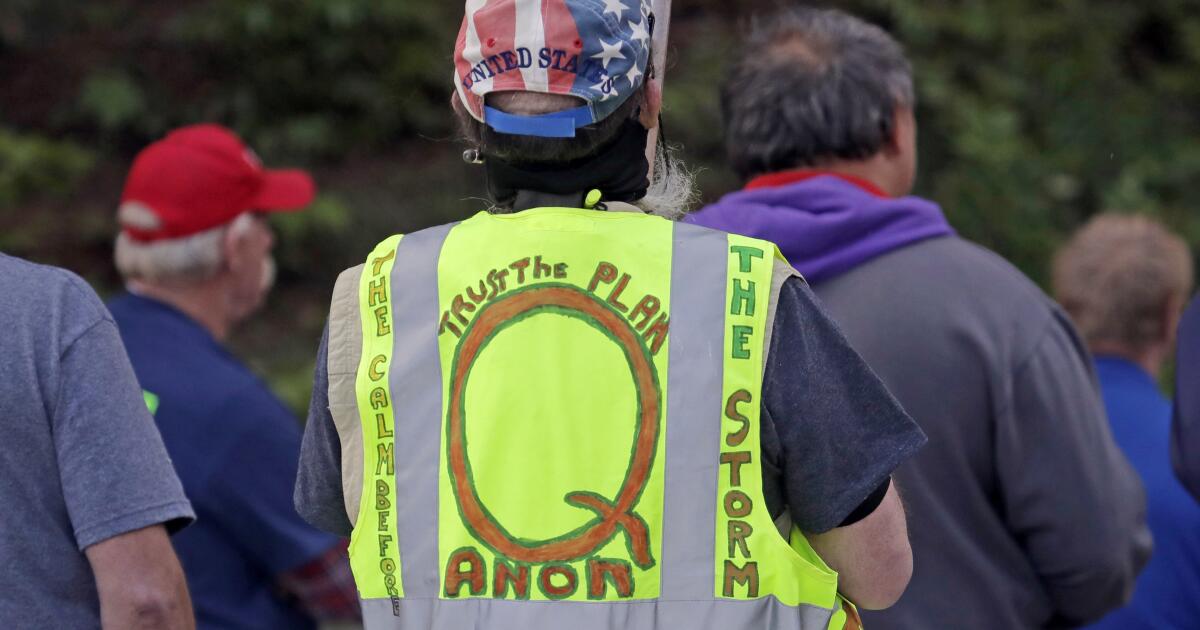
Not long ago, a millennial father of two in the Midwest whom I interviewed was convinced that many of our elected leaders like to feast on the flesh of children. He feared that the world was at the mercy of a depraved club of the richest and most powerful among us, one armed with space lasers and clones.
Most shocking to those who knew him weren’t the conspiracy theories themselves. It was that he had come to believe them. Nearing 40 years old, he was a college-educated, upstanding guy with friends, a family and an established career. How, they wondered, had this perfectly sane person gone crazy?
It’s a question more and more Americans are asking about their own loved ones. As disinformation permeates our culture, the road to QAnon-type territory is getting shorter. Healthy skepticism easily gives way to undue suspicion. The dizzying public reaction to Donald Trump’s near-assassination was a perfect illustration: Observers across the political spectrum raced to fill the information void with baseless assertions that have gained momentum despite mounting evidence to the contrary, revealing a nation increasingly at odds with reality.
The statistics are as stunning as the falsehoods. Millions of people now believe that the government, media and financial worlds are “controlled by Satan-worshiping pedophiles,” according to recent polling. These aren’t loosely held views. While reporting for my book “The Quiet Damage,” I talked to people all over the country who had tried until they were blue in the face to make the conspiracy theorists in their lives accept the truth.
But the truth is almost beside the point.
It seems entirely sensible to fight fiction with fact. In spite of passionately professed allegiances to “the truth,” however, ardent conspiracy theory adopters seldom have a desire to be accurately informed. Belief in the unbelievable, in many cases, stems from desperation to meet fundamental human needs, such as feeling valued and having a purpose. Over the last three years, while interviewing hundreds of disinformation-splintered families, it has become clear to me that facts alone can’t fix this. The solution begins with treating conspiracy theory obsession not as a sickness but as a symptom.
For the Midwestern father, the trouble began after an injury largely robbed him of his mobility — and, in turn, much of his life’s meaning. Once an active family man, he was suddenly stuck in a chair. His wife took up solo hobbies and completed the housework alone; his children played with friends instead of with their dad. If he couldn’t fulfill his role as a husband and father in the ways he always had, who was he?
In the QAnon quagmire, which he eventually stumbled into online, he was a patriot helping to bring “deep state” corruption to light. One of the good guys fighting the good fight. Someone who mattered again. During his gradual journey from QAnon-curious to feverishly embracing the most crackpot claims, his critical thinking skills didn’t mysteriously vanish — they were overpowered.
Human needs are just that: needs. Our innate need for things such as meaning and belonging is superseded only by what the body requires for subsistence, and not by any thirst for accuracy or truth. When these needs go unmet, we can become desperate to satisfy them by whatever means necessary. And the conditions that leave people deprived of what they need and susceptible to irrational conspiracy theories are common — and commonly overlooked.
In movements such as QAnon, the lonely find belonging, the aimless find direction and the angry find validation. Consider baby boomers, who share an alarming amount of fake news online. Many people believe that some mix of cognitive aging, poor digital literacy and too much Fox News is to blame. But this overlooks a bigger issue. Conspiracy-theory-entranced seniors have described to me how, before adopting a QAnon-like brand of what some called “activism,” they felt as if society no longer valued or had use for them. Facing what experts have identified as an “epidemic of loneliness,” they yearned for purpose, community and fulfillment.
By their nature, conspiracy theories provide all of the above. They give supporters an enemy to oppose and a cause to rally around. It’s not difficult to see how churning out Facebook posts (errantly) warning about killer COVID vaccines could have felt like a gratifying self-appointed job in retirement. Or how latching onto delusions that offer convenient answers and clear villains in times of debilitating uncertainty can restore feelings of agency and security.
There’s no singular mold of conspiracy theorists or set of circumstances that shapes them. In my research, I’ve encountered people of all generations, classes, races and political leanings. All had their own reasons for believing and their own needs to satisfy. A political psychology study published on factors that predispose people to conspiracy theories shows that those less capable of “bouncing back” from hardship are more susceptible, suggesting that espousing these views can be a crutch. At the deepest level, then, it doesn’t necessarily matter to believers whether Taylor Swift is truly a psy-op or chemtrails are poisoning the skies. What matters is how clinging to such convictions serves the believers’ underlying needs.
In the end, it wasn’t the truth that saved the Midwestern father, though he has come to see it clearly again. After badly damaging his life at rock bottom of the rabbit hole, he carved a long, sometimes bizarre and profoundly difficult path toward recovering his sense of purpose as a parent and partner. Only then did the ludicrous lies he’d been so consumed by lose their hold over him. He no longer needed them.
Success stories like this will remain rare if we don’t shift our approach to this crisis. We’re living in a moment where a slew of critical stressors, including an unprecedented election season and an artificial intelligence boom, are fueling a tsunami of disinformation and leaving many of us mentally and emotionally compromised. As more Americans turn to conspiracy theories to cope, we must remind ourselves that we can’t do away with delusions that meet people’s fundamental needs by simply debunking them. We need to focus on the cause, not the symptom — to look past the lunacy and probe the roots of our collective vulnerability — because none of us is as immune as we would like to think.
Jesselyn Cook is a reporter and journalism lecturer. Her new book is “The Quiet Damage: QAnon and the Destruction of the American Family.”



new video loaded: Protests Against ICE in Minneapolis Continue Into Friday Night
transcript
transcript
Protests Against ICE in Minneapolis Continue Into Friday Night
Hundreds of protesters marched through downtown Minneapolis on Friday night. They stopped at several hotels along the way to blast music, bang drums and play instruments to try to disrupt the sleep of immigration agents who might be staying there. Mayor Jacob Frey of Minneapolis said there were 29 arrests but that it was mostly a “peaceful protest.”
-
The vast majority of people have done this right. We are so deeply appreciative of them. But we have seen a few incidents last night. Those incidents are being reviewed, but we wanted to again give the overarching theme of what we’re seeing, which is peaceful protest. And we wanted to say when that doesn’t happen, of course, there are consequences. We are a safe city. We will not counter Donald Trump’s chaos with our own brand of chaos here. We in Minneapolis are going to do this right.
By McKinnon de Kuyper
January 10, 2026

NEWYou can now listen to Fox News articles!
President Donald Trump said Saturday that Venezuela has begun releasing political prisoners “in a BIG WAY,” crediting U.S. intervention for the move following last week’s American military operation in the country.
“Venezuela has started the process, in a BIG WAY, of releasing their political prisoners,” Trump wrote on Truth Social. “Thank you! I hope those prisoners will remember how lucky they got that the USA came along and did what had to be done.”
He added a warning directed at those being released: “I HOPE THEY NEVER FORGET! If they do, it will not be good for them.”
The president’s comments come one week after the United States launched Operation Absolute Resolve, a strike on Venezuela and capture of dictator Nicolás Maduro as well as his wife Cilia Flores, transporting them to the United States to face federal drug trafficking charges.
US WARNS AMERICANS TO LEAVE VENEZUELA IMMEDIATELY AS ARMED MILITIAS SET UP ROADBLOCKS
Government supporters in Venezuela rally in Caracas. (AP Photo)
Following the military operation, Trump said the U.S. intends to temporarily oversee Venezuela’s transition of power, asserting American involvement “until such time as a safe, proper and judicious transition” can take place and warning that U.S. forces stand ready to escalate if necessary.
At least 18 political prisoners were reported freed as of Saturday and there is no comprehensive public list of all expected releases, Reuters reported.
Maduro and Flores were transported to New York after their capture to face charges in U.S. federal court. The Pentagon has said that Operation Absolute Resolve involved more than 150 aircraft and months of planning.
TRUMP ADMIN SAYS MADURO CAPTURE REINFORCES ALIEN ENEMIES ACT REMOVALS
A demonstrator holding a Venezuelan flag sprays graffiti during a march in Mexico City on Santurday. (Alfredo Estrella / AFP via Getty Images)
Trump has said the U.S. intends to remain actively involved in Venezuela’s security, political transition and reconstruction of its oil infrastructure.
The White House did not immediately respond to Fox News Digital’s request for comment.
President Donald Trump said Saturday that Venezuela has begun releasing political prisoners. (Mark Schiefelbein/AP Photo)
CLICK HERE TO DOWNLOAD THE FOX NEWS APP
Fox News Digital’s Morgan Phillips and Greg Norman-Diamond contributed to this reporting.

Secretary of Defense Pete Hegseth, who is taking a tour of U.S. defense contractors, on Friday visited a Long Beach rocket maker, where he told workers they are key to President Trump’s vision of military supremacy.
Hegseth stopped by a manufacturing plant operated by Rocket Lab, an emerging company that builds satellites and provides small-satellite launch services for commercial and government customers.
Last month, the company was awarded an $805-million military contract, its largest to date, to build satellites for a network being developed for communications and detection of new threats, such as hypersonic missles.
“This company, you right here, are front and center, as part of ensuring that we build an arsenal of freedom that America needs,” Hegseth told several hundred cheering workers. “The future of the battlefield starts right here with dominance of space.”
Founded in 2006 in New Zealand, the company makes a small rocket called Electron — which lay on its side near Hegseth — and is developing a larger one called Neutron. It moved to the U.S. a decade ago and opened its Long Beach headquaters in 2020.
Rocket Lab is among a new wave of companies that have revitalized Southern California’s aerospace and defense industry, which shed hundreds of thousands of jobs in the 1990s after the end of the Cold War. Large defense contractors such as Northrop Grumman and Lockheed Martin moved their headquarters to the East Coast.
Many of the new companies were founded by former employees of SpaceX, which was started by Elon Musk in 2002 and was based in the South Bay before moving to Texas in 2024. However, it retains major operations in Hawthorne.
Hegseth kicked off his tour Monday with a visit to a Newport News, Va., shipyard. The tour is described as “a call to action to revitalize America’s manufacturing might and re-energize the nation’s workforce.”
Long Beach Mayor Rex Richardson, a Democrat who said he was not told of the event, said Hegseth’s visit shows how the city has flourished despite such setbacks as the closure of Boeing’s C-17 Globemaster III transport plant.
“Rocket Lab has really been a superstar in terms of our fast, growing and emerging space economy in Long Beach,” Richardson said. “This emergence of space is really the next stage of almost a century of innovation that’s really taking place here.”
Prior stops in the region included visits to Divergent, an advanced manufacturing company in aerospace and other industries, and Castelion, a hypersonic missile startup founded by former SpaceX employees. Both are based in Torrance.
The tour follows an overhaul of the Department of Defense’s procurement policy Hegseth announced in November. The policy seeks to speed up weapons development and acquisition by first finding capabilities in the commercial market before the government attempts to develop new systems.
Trump also issued an executive order Wednesday that aims to limit shareholder profits of defense contractors that do not meet production and budget goals by restricting stock buybacks and dividends.
Hegseth told the workers that the administration is trying to prod old-line defense contractors to be more innovative and spend more on development — touting Rocket Lab as the kind of company that will succeed, adding it had one of the “coolest factory floors” he had ever seen.
“I just want the best, and I want to ensure that the competition that exists is fair,” he said.
Hegseth’s visit comes as Trump has flexed the nation’s military muscles with the Jan. 3 abduction of Venezuelan President Nicolás Maduro, who is now facing drug trafficking charges to which he has pleaded not guilty.
Hegseth in his speech cited Maduro’s capture as an example of the country’s newfound “deterrence in action.” Though Trump’s allies supported the action, legal experts and other critics have argued that the operation violated international and U.S. law.
Trump this week said he wants to radically boost U.S. military spending to $1.5 trillion in 2027 from $900 billion this year so he can build the “Dream Military.”
Hegseth told the workers it would be a “historic investment” that would ensure the U.S. is never challenged militarily.
Trump also posted on social media this week that executive salaries of defense companies should be capped at $5 million unless they speed up development and production of advanced weapons — in a dig at existing prime contractors.
However, the text of his Wednesday order caps salaries at current levels and ties future executive incentive compensation to delivery and production metrics.
Anduril Industries in Costa Mesa is one of the leading new defense companies in Southern California. The privately held maker of autonomous weapons systems closed a $2.5-billion funding round last year.
Founder Palmer Luckey told Bloomberg News he supported Trump’s moves to limit executive compensation in the defense sector, saying, “I pay myself $100,000 a year.” However, Luckey has a stake in Anduril, last valued by investors at $30.5 billion.
Peter Beck, the founder and chief executive of Rocket Lab, took a base salary of $575,000 in 2024 but with bonus and stock awards his total compensation reached $20.1 million, according to a securities filing. He also has a stake in the company, which has a market capitalization of about $45 billion.
Beck introduced Hegseth saying he was seeking to “reinvigorate the national industrial base and create a leaner, more effective Department of War, one that goes faster and leans on commercial companies just like ours.”
Rocket Lab boasts that its Electron rocket, which first launched in 2017, is the world’s leading small rocket and the second most frequently launched U.S. rocket behind SpaceX.
It has carried payloads for NASA, the U.S. Space Force and the National Reconnaissance Office, aside from commercial customers.
The company employs 2,500 people across facilities in New Zealand, Canada and the U.S., including in Virginia, Colorado and Mississippi.
Rocket Lab shares closed at $84.84 on Friday, up 2%.

Why California is keeping this unusual solar plant running when both Trump and Biden wanted it closed

Bennett Zmolek’s first goal in four years sparks UND past Colorado College

Chock, Bates win record-setting seventh U.S. Figure Skating title ahead of Milan

See how much homes prices fell in Sussex County recently

Winner and Loser of the Week in Florida politics — Week of 1.4.26

Florida High School Football Rankings: Top 25 teams – Oct. 21

Cleary's 21 help Le Moyne down Central Connecticut State 69-64 in OT

How old is Bo Nix? What to know about Oregon quarterback ahead of 2024 NFL Draft

99th annual Pony Swim held in Virginia

Video: ‘It Didn’t Have to Happen This Way:’ U.Va. Faculty Call for Review of Police Response to Protests

Trump says Venezuela has begun releasing political prisoners ‘in a BIG WAY’

Somali minister says Israel plans to displace Palestinians to Somaliland

Slow-moving prisoner releases in Venezuela enter 3rd day after government announces goodwill effort

Video: Raising a Baby in Altadena’s Ashes

Trump signs order to protect Venezuela oil revenue held in US accounts
-

 Detroit, MI1 week ago
2 hospitalized after shooting on Lodge Freeway in Detroit
-

 Technology5 days ago
Power bank feature creep is out of control
-

 Dallas, TX2 days ago
Anti-ICE protest outside Dallas City Hall follows deadly shooting in Minneapolis
-

 Dallas, TX6 days ago
Defensive coordinator candidates who could improve Cowboys’ brutal secondary in 2026
-

 Delaware2 days ago
MERR responds to dead humpback whale washed up near Bethany Beach
-

 Iowa5 days ago
Pat McAfee praises Audi Crooks, plays hype song for Iowa State star
-

 Health7 days ago
Viral New Year reset routine is helping people adopt healthier habits
-

 Nebraska4 days ago
Oregon State LB transfer Dexter Foster commits to Nebraska