Politics
Opinion: The delusions that won the Iowa caucuses


Does anyone believe that Florida Gov. Ron DeSantis or former South Carolina Gov. Nikki Haley truly stands a chance of becoming the Republican Party’s 2024 presidential nominee? It’s a scenario that is increasingly hard to imagine.
That is because the Iowa caucuses went almost exactly as predicted: Former President Trump wiped the floor with his rivals, while the two of them battled for second place. DeSantis, despite pulling ahead in that battle, is staring down the end of his presidential ambitions.
As has become the case with today’s GOP, reality took a back seat to fantasy. Everyone declared themselves a winner.
Opinion Columnist
Robin Abcarian
“In spite of all that they threw at us, everyone against us,” said DeSantis, “we got our ticket punched out of Iowa.” (There’s a brick wall waiting for him in New Hampshire.)
“Tonight,” Haley told her supporters, “Iowa made this primary a two-person race.”
Did it, though?
Haley is expected to fare better next week in New Hampshire, where the conservative electorate is less rigidly ideological than in Iowa, and of course in South Carolina, where she is a native daughter. Even if Haley miraculously beats or comes close to Trump in New Hampshire, his iron grip on the party will be hard to shake. Every indictment, every court hearing seems to reinforce his perceived status as a persecuted victim of the Democratic Party in general and President Biden in particular.
While Haley and DeSantis at least acknowledged they were still competing for a presidential nomination, Trump, in his typically grandiose style, behaved as if he’d already won the general.
Monday in his victory speech, he called for national unity in the same way he called for Jan. 6 protesters to remain peaceful — that is to say, completely disingenuously.
“This is time now for everybody, our country, to come together, we want to come together,” he said as he launched into rambling, off-the-cuff remarks. “Whether it’s Republican or Democrat, or liberal or conservative, it would be so nice if we could come together and straighten out the world.”
But Trump’s gotta Trump. He simply could not sustain the unity theme: “I don’t want to be overly rough on the president,” he said, “but I have to say that he is the worst president that we’ve had in the history of our country. He is destroying our country.”
The Trump blowout in Iowa pretty much answered the question that Haley posed to her supporters late Monday evening: “Do you want more of the same? Or do you want a new generation of conservative leaders?”
Sorry, Governor, but it appears they want more of the same.
They want more of Trump’s lies about the 2020 election, more of his immigrant-bashing, more of his fantasies about how, on his watch, Russia wouldn’t have dared invade Ukraine and Hamas wouldn’t have dared invade Israel. They want more of his apocalyptic rhetoric about the border, about how “mental institutions and insane asylums” are “being emptied out into our country.” They want to hear more about Jan. 6 “hostages” and about how, on Biden’s watch, the United States is being invaded by terrorists, “some of them really bad.”
Trump’s hold on the imaginations, not to mention the moral compasses, of his supporters shows little sign of weakening. Entrance polls conducted for the major television networks found that nearly two-thirds of Iowa’s Republican caucus-goers do not believe that Biden won the 2020 election. About the same proportion said they would vote for Trump even if he were a convicted criminal.
On Tuesday, as Haley appeared in New Hampshire and DeSantis touched down briefly in South Carolina before heading north, Trump showed up in a New York federal courtroom.
There, he once again faced the writer E. Jean Carroll, who accused him of raping her in a Bergdorf Goodman dressing room years ago. She already won a civil case against him, and $5 million in damages for lies he told about her before he was president. This trial will determine how much he should pay for defaming her while he was president. (She is asking for $10 million.)
“The fact that Mr. Trump sexually abused — indeed, raped — Ms. Carroll has been conclusively established and is binding in this case,” said U.S. District Judge Lewis Kaplan.
The trial has an ouroboros quality about it. On Monday while Trump was in court, his Truth Social account blasted out claims that he’d never met Carroll. As long as Trump continues to deny raping Carroll, or even knowing her, she can theoretically just keep suing him for damages, ad infinitum.
Not that the base cares. As polls have shown, his legal woes are a big part of his political appeal. If Haley or DeSantis could just get themselves arrested for something, anything, they might stand a chance against him.



new video loaded: How the Supreme Court Made Itself More Secretive

By Jodi Kantor, Alexandra Ostasiewicz, June Kim and Lauren Pruitt
February 2, 2026
Politics
Portland mayor demands ICE leave city after federal agents use tear gas on protesters ‘Sickening decisions’

NEWYou can now listen to Fox News articles!
The mayor of Portland, Oregon, is calling on U.S. Immigration and Customs Enforcement (ICE) to leave his city after federal agents deployed tear gas at a crowd of demonstrators, including young children, outside an ICE facility over the weekend.
Mayor Keith Wilson characterized the protests on Saturday as peaceful, as federal agents reportedly used tear gas, pepper balls, flash-bang grenades and rubber bullets against the anti-ICE demonstrators.
Wilson urged ICE agents to resign and for the agency to leave Portland, denouncing their “use of violence” and the “trampling of the Constitution.”
“Today, federal forces deployed heavy waves of chemical munitions, impacting a peaceful daytime protest where the vast majority of those present violated no laws, made no threat, and posed no danger to federal forces,” he said in a statement on Saturday.
CHICAGO MAYOR BRANDON JOHNSON PUTS ICE ‘ON NOTICE’ WITH EXECUTIVE ORDER SEEKING PROSECUTION OF AGENTS
Mayor Keith Wilson characterized the protests in his city as peaceful, as he called for ICE to leave. (Ali Gradischer/Getty Images)
“To those who continue to work for ICE: Resign. To those who control this facility: Leave. Through your use of violence and the trampling of the Constitution, you have lost all legitimacy and replaced it with shame. To those who continue to make these sickening decisions, go home, look in a mirror, and ask yourselves why you have gassed children. Ask yourselves why you continue to work for an agency responsible for murders on American streets. No one is forcing you to lie to yourself, even as your bosses continue to lie to the American people,” the mayor continued.
The mayor added that this nation “will never accept a federal presence where agents wield deadly force against the very people they are sworn to serve.”
“I share the impatience with those who demand we use every legal tool at our disposal to push back against this inexcusable, unconscionable, and unacceptable violence against our community,” Wilson said. “I share the need to act. Actions that can withstand the scrutiny of the justice system take time – and we cannot afford to lose this fight.”
CBP/BORDER PATROL AGENTS PLACED ON ADMINISTRATIVE LEAVE AFTER DEADLY CONFRONTATION WITH ALEX PRETTI
Federal agents deployed tear gas at a crowd of demonstrators, including young children, outside an ICE facility in Portland. (Victor J. Blue/Bloomberg via Getty Images)
Portland officials are working to operationalize an ordinance, which went into effect last month, that imposes a fee on detention facilities that use chemical agents, the mayor said.
“As we prepare to put that law into action, we are also documenting today’s events and preserving evidence. The federal government must, and will, be held accountable,” he wrote.
“Portland will continue to stand firmly with our immigrant neighbors, who deserve safety, dignity, and the full protection of the communities they help build,” he continued. “We are also proud of the Portlanders who showed up today in peaceful solidarity, demonstrating the strength and clarity of those shared values in the face of federal overreach.”
This comes amid national unrest and bipartisan scrutiny of immigration enforcement tactics following two killings of U.S. citizens by federal immigration agents last month in Minneapolis.
The Trump administration has faced bipartisan scrutiny over its immigration enforcement tactics following two killings of U.S. citizens by federal immigration agents in Minneapolis. (Demetrius Freeman/The Washington Post via Getty Images)
CLICK HERE TO DOWNLOAD THE FOX NEWS APP
Renee Nicole Good was shot and killed by ICE agent Jonathan Ross on Jan. 7 in Minneapolis, and Alex Pretti was fatally shot on Jan. 24 by Border Patrol agent Jesus Ochoa and Customs and Border Protection officer Raymundo Gutierrez while he was recording immigration enforcement operations in the same city.
Pretti, an ICU nurse, appeared to be attempting to assist a woman agents had knocked down when he was sprayed with an irritant, pushed to the ground and beaten, according to video and witness accounts. An agent was later seen pulling Pretti’s lawfully owned firearm from his waistband before other agents fired several shots, killing him.
How do you find the missing?
If you do find them, how can you help?
Oakland civil rights attorney James Cook has been on the ground in Minnesota for months figuring out answers to these question as he goes.
A fast-talking Minneapolis native who still lives in the Twin Cities part time, Cook is one of a handful of attorneys who have dropped everything to aid (for free) those caught up in the federal crackdown — protesters, immigrants and detained citizens — too many of whom have found themselves facing deportation, arrest or even been disappeared, at least for a time.
Civil rights attorney James Cook in the rear view mirror as he makes phone calls in his car in Minneapolis.
(Caroline Yang/For The Times)
“They are leaders that are on the ground really helping people through this process,” Minnesota school board member Chauntyll Allen told me.
She’s one of the protesters arrested inside a local church, charged with conspiracy to deprive others of their constitutional rights by Pam Bondi’s politicized Department of Justice, which also Friday arrested journalist Don Lemon for the same incident. Cook is one of the lawyers now representing Allen.
“It shows us that the judicial arm, or some of the judicial arm of our democracy, is willing to step up and ensure that our democracy stands strong,” Allen said of Cook and others like him.
While it’s the images of clashes in the streets that captivate media and audiences, it’s lawyers like Cook who are fighting an existential battle in the background to preserve the rule of law in a place where it is increasing opaque, to put it gently.
The legal work behind detentions has largely been an overlooked battlefield that will likely rage on years after ICE departs the streets, leaving in its wake hundreds if not thousands of long-and-winding court cases.
Beyond the personal fates they will determine, the outcome of the civil litigation Cook and others are spearheading will likely force whatever transparency and accountability can be pulled from these chaotic and troubling times.
It’s time-consuming and complicated work vital not just to people, but history.
Or, as Cook puts it, “I’ll be 10 years older when all this s— resolves.”

Federal agents stand guard against a growing wall of protesters on Jan. 24 in Minneapolis, just hours after Alex Pretti was shot by federal agents.
(Caroline Yang/For The Times)
Cook told me this while on his way to the Bishop Henry Whipple Federal Building where some detainees are being held, maybe. It’s hard to find out. A few years ago, when immigration enforcement in Minnesota ramped up under the first Trump term, activists tried to get the name of the building changed, arguing Whipple, the first Protestant Episcopal bishop in the state, had been an advocate of the marginalized and wouldn’t want his name associated with what the feds were up to.
It didn’t work, but the movement’s slogan, “What would Whipple do?” still has resonance in this town, where two American citizens, Alex Pretti and Renee Good, have been fatally shot while protesting — incidents ugly enough that Bruce Springsteen wrote a song about them.
Cook is well aware that the guns carried by the federal agents are not for show, even without the Boss’ new ballad. Just a few days ago, one of the first times he drove his beat-up truck up to the gate, the federal guards at Whipple pointed their guns at him.
“I’m like, ‘Hey, I’m going to take my keys out of the ignition, drop them on the ground. So please don’t shoot,’” he said.
They lowered the guns, but Cook was scared, a feeling that doesn’t come easy.
Long before his law degree, when he was a punk-rock loving teen in the 1980s, fresh out of Southwest High, the public school not too far from Whipple, a former coach convinced him to give up college dreams and instead pursue a shot at making the first Muay Thai kickboxing team at the Olympics.
The martial art ended up not making it as an official Olympic sport, but the experience launched Cook into a professional boxing and kickboxing career that took him to competitions around the world, and taught him fear is not a reason to back down.
But, “Father Time is undefeated,” Cook said. “I got older and I started losing fights, and I was like, all right, time to get back to life.”
That eventually led him to obtaining a law degree in San Francisco, where after an intern stint as a public defender, he decided he wanted to be a trial attorney, fighting in court.

Civil rights attorney James Cook has been doing pro bono immigration work since the crackdown began in Minneapolis.
(Caroline Yang/For The Times)
He started cold-calling John Burris, another Bay Area lawyer who is an icon of civil rights and police misconduct cases. Burris, who has been called the “Godfather of Police Litigation,” was involved in the “Oakland Riders” case in 2000, when officers were discovered to have planted evidence. He also represented Rodney King, the family of Oscar Grant, and the family of Joseph Mann among many others.
But Burris, a boxing fan, didn’t respond to Cook’s calls until the young lawyer offered him free tickets to one of his fights, which he was still doing on the side.
“And then immediately I got a call back,” Cook said.
Burris said Cook’s history as a fighter intrigued him, but “I did say to James, you can’t be a fighter and lawyer. You can’t get punched in your head all the time.”
Cook did not take this advice.
Still, Burris said, “It was his persistence that I admired, because the type of work we’re involved in, you need people who are dedicated, who have some real commitment to the work, and he showed that kind of consistency and dedication.”
Cook’s been working with Burris more than 20 years now, but until recently, the labyrinth of the immigration system wasn’t his area of expertise. It’s been a crash course for him, he said, on the often arcane laws that govern who gets to stay in America and who doesn’t.
It’s also been a crash course on what a civil rights emergency looks like. Along with his work looking for locked-up immigrants, Cook spends a lot of time on the streets at protests, helping people understand their rights — and limitations — and seeing first hand what is happening.
“If you ever wondered what you would have done in Germany, now is the time,” he said. “Now is the time to do something. People are being interned.”
In the hours after Pretti was shot, Cook was at the location of the shooting, in the middle of the tear gas, offering legal help to anyone who needed it and bearing witness to conduct that will almost certainly face scrutiny one day, even if government leaders condone it now.

Law enforcement officers launch tear gas canisters as they work to push the crowd back and expand their perimeter in Minneapolis on Jan. 24.
(Caroline Yang/For The Times)
“The way the officers chase people down, protesters who were really just protesting lawfully and were beaten and pepper sprayed and gassed — all those are civil rights violations,” Burris said. “And so the law is the guardrails. So there has to be lawyers who are prepared to protect those guardrails and to stand as centurions, as I refer to us.”
Cook has tried to calm protesters, he told me, and prevent clashes. But people are mad, and resolute. His greatest fear is summer — when warm weather could bring even larger crowds if enforcement is still ongoing. He’s worried that the actions of the federal agents will spill over into anger at local cops enforcing local laws, leading to even more chaos.
“I’ve always supported cops as long as they do their job correctly,” Cook said.
For now, he’s taking it one day at a time, one case at a time, one name at a time.
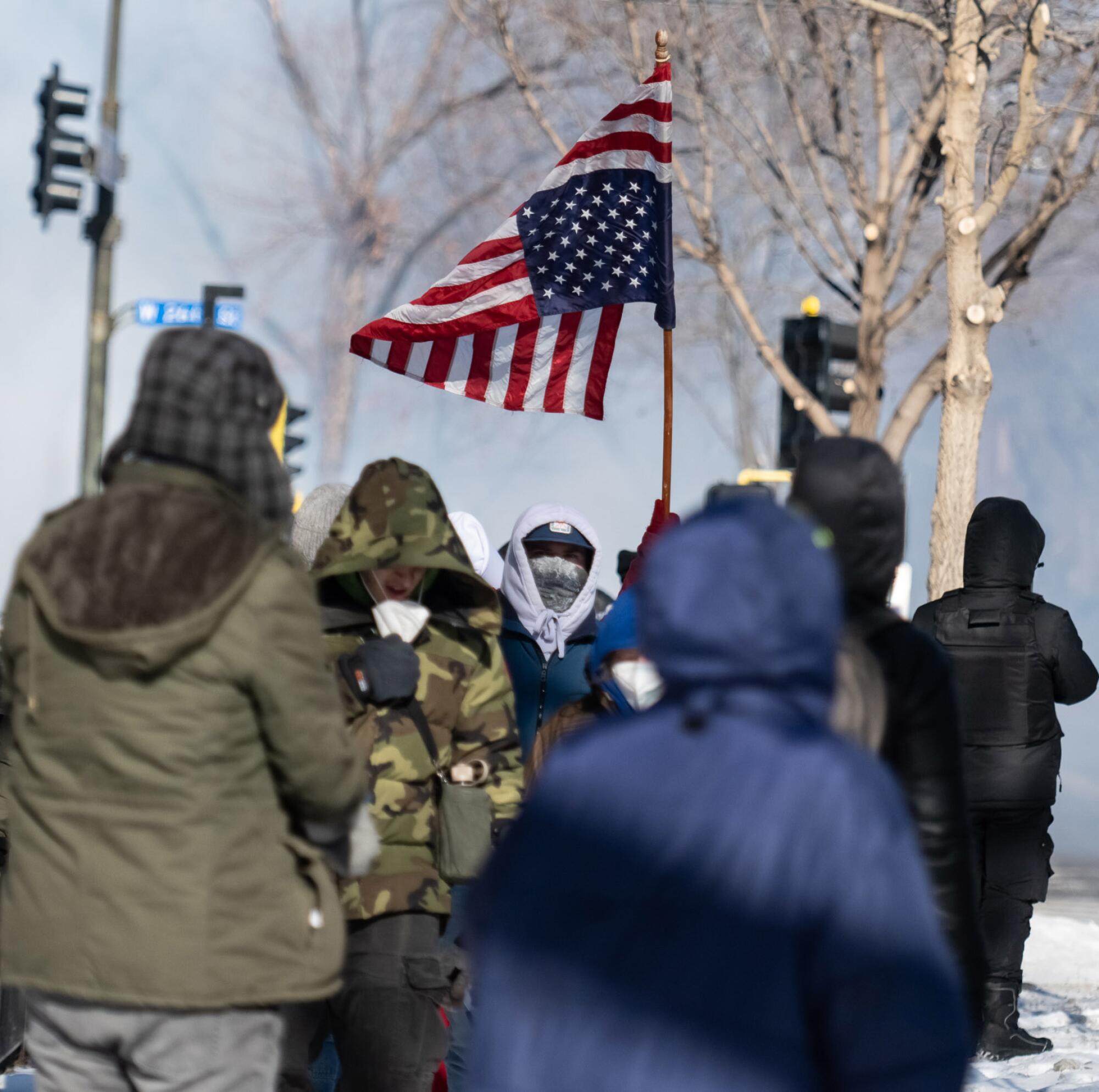
Protesters raise an inverted American flag as law enforcement officers launch tear gas canisters in Minneapolis after Alex Pretti was killed by federal agents.
(Caroline Yang/For The Times)
Tuesday, Cook passed through the armed checkpoint at Whipple carrying a list of about seven people, folks who have been picked up by federal agents for one reason or another, or reasons unknown, and now cannot be located. They are not in the public online system that is meant to track detainees, and family and friends have not heard from them.
If he’s lucky, Cook will get information on one or two, that they are indeed inside, or maybe at a detention center in Texas, where many have been sent. But there will be more whose location remains unknown. He’ll make calls, fill out forms and come back tomorrow. And the tomorrow after that.
“This is what we do,” he said. “I’m always in it for the long run. I mean, you know, shoot, yeah, that’s kind of the way it works.”

Seattle metro area leads nation in affordable housing – MyNorthwest.com

The death of the affordable restaurant meal in San Diego County

Milwaukee shooting Monday; 1 wounded near 35th and Highland

Columbus Crew acquire Jamal Thiaré from Atlanta United | MLSSoccer.com

Column: Minneapolis killings expose government lies, brutality

Florida High School Football Rankings: Top 25 teams – Oct. 21

Cleary's 21 help Le Moyne down Central Connecticut State 69-64 in OT

How old is Bo Nix? What to know about Oregon quarterback ahead of 2024 NFL Draft

99th annual Pony Swim held in Virginia

Indiana Members Credit Union announced as new anchor tenant at Bottleworks District

Video: How Trump’s Tariffs Affected the Economy After One Year

Portland mayor demands ICE leave city after federal agents use tear gas on protesters ‘Sickening decisions’

Cuba denies security threat accusations as US raises pressure

Kennedy Center will close for 2 years for renovations in July, Trump says, after performers backlash

Government shutdowns may be fewer, but they’re increasingly disruptive
-

 Massachusetts2 days ago
TV star fisherman, crew all presumed dead after boat sinks off Massachusetts coast
-

 Indiana14 hours ago
13-year-old rider dies following incident at northwest Indiana BMX park
-

 Tennessee2 days ago
UPDATE: Ohio woman charged in shooting death of West TN deputy
-

 Pennsylvania1 week ago
Rare ‘avalanche’ blocks Pennsylvania road during major snowstorm
-

 Movie Reviews6 days ago
Vikram Prabhu’s Sirai Telugu Dubbed OTT Movie Review and Rating
-
 Science1 week ago
LAUSD says Pali High is safe for students to return to after fire. Some parents and experts have concerns
-
 Politics1 week ago
Trump’s playbook falters in crisis response to Minneapolis shooting
-
Austin, TX3 days ago
TEA is on board with almost all of Austin ISD’s turnaround plans

