Politics
Newsom leaves the Vatican with pope's praise for refusing to impose the death penalty

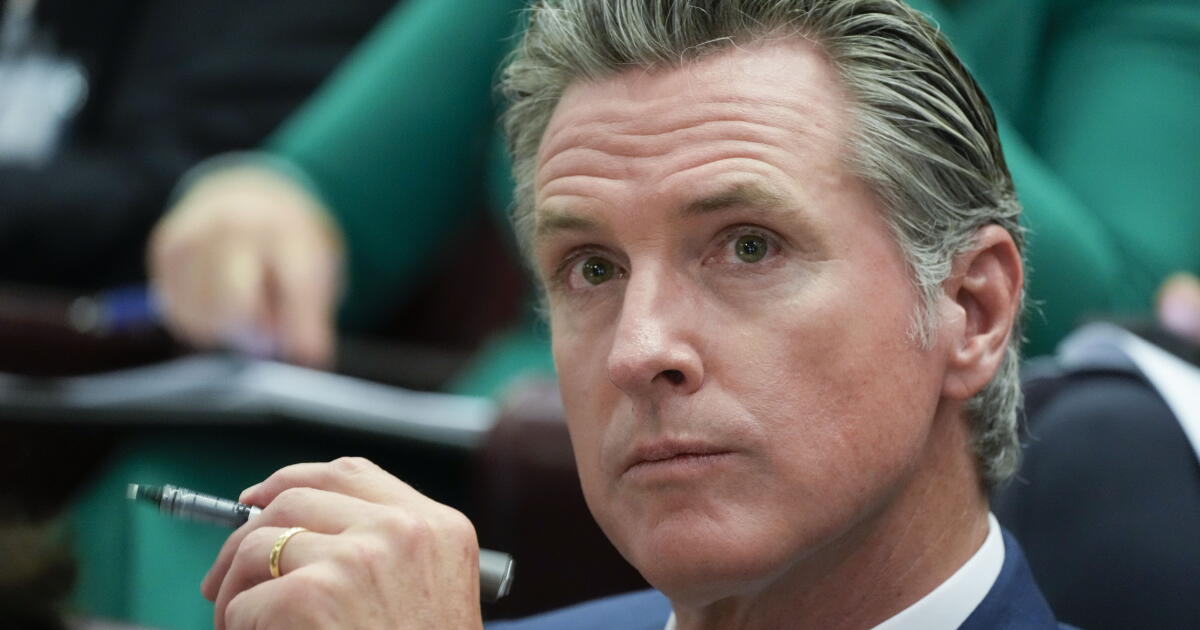
In an opulent hall in the Apostolic Palace framed in marble and adorned with Renaissance murals, Gov. Gavin Newsom waited in a line of governors, mayors and scientists for an opportunity to greet Pope Francis.
The queue wasn’t the ideal setup envisioned by the governor’s advisors. Newsom traveled more than 6,000 miles from California to the Vatican to give a speech before — and hopefully talk with — the pope about climate change.
Pope Francis, however, had other topics on his mind besides the warming planet.
“I was struck by how he immediately brought up the issue of the death penalty and how proud he was of the work we’re doing in California,” Newsom said afterward. “I was struck by that because I wasn’t anticipating that, especially in the context of this convening.”
The talk was brief and informal. But the politically astute head of the Roman Catholic Church still took advantage of the moment to support one of Newsom’s most controversial actions as governor.
Through executive order two months after his inauguration, Newsom issued a temporary moratorium on the death penalty and ordered the dismantling of the state’s execution chambers at San Quentin State Prison. Families of murder victims criticized the decision, and legal scholars called it an abuse of power.
Newsom’s refusal to impose the death penalty could hurt him politically if he runs for president.
As a Catholic, however, the governor’s decree is in line with the church and the pope’s teachings.
In an interview with The Times after he left the Vatican, Newsom said he has yet to propose a statewide ballot measure to abolish the death penalty because he doesn’t have confidence that it would pass. California voters rejected measures to ban executions in 2012 and 2016.
Newsom said recent polls conducted by his political advisors show soft support for a ban.
“We constantly put it in our surveys that I do,” Newsom said in an interview with The Times. “It’s in the margin. But I’m thinking a lot about this beyond that because we’re reimagining death row. I’m thinking about when I’m leaving; I mean, I’ve been pretty honest about that. I’m trying to figure out what more can I do in this space.”
There were more than 730 inmates on death row when Newsom took office. Death row at San Quentin was the largest of any prison in the Western Hemisphere. Under his plan to reform the prison to emphasize rehabilitation, Newsom said California is just weeks from emptying death row entirely.
The governor said he was outspoken about his opposition to capital punishment when he campaigned in 2018. He endorsed the 2012 and 2016 ballot measures to abolish the death penalty.
“I campaigned very openly as lieutenant governor, as governor. I went out of my way to say, ‘If you elect me, this is what I’m going to do,’” Newsom said. “And also I have the legal authority. So I wasn’t challenging that.”
Currently, 21 of the 50 states impose the death penalty. The remaining 29 either have no death penalty or paused executions due to executive action — including California, according to the Death Penalty Information Center.
Newsom’s moratorium might not play well with voters in some swing states in a potential presidential campaign, adding to perceptions that leftist California and the Democratic governor are soft on crime and misaligned with the rest of the nation. The governor has repeatedly dismissed speculation that he’s eyeing the White House, and he has actively campaigned for President Biden’s reelection.
Kevin Eckery, a political consultant who has worked with the Catholic Church in California, said the death penalty isn’t going to be a deciding factor in an election.
“Nationally, the death penalty has been carried out so infrequently for the last 50 years that I don’t see people voting based on your position on [the] death penalty,” Eckery said. “They are going to vote on pocketbook issues. They are going to vote on other things, but not that issue.”
The Catholic Church has long said the death penalty could be justified only in rare situations. Francis updated church doctrine in 2018 to say “the death penalty is inadmissible because it is an attack on the inviolability and dignity of the person.”
Newsom lunched in an arched courtyard covered in jasmine at the American Academy in Rome after he, in a speech at the Vatican, accused former President Trump of “open corruption” by soliciting campaign donations from oil executives.
Sitting in a weathered wood chair under the shade of a tree, the governor explained how his Catholic background and the inequities in the criminal justice system influenced his refusal to sign off on executions as governor.
His paternal grandparents were devout Catholics, and his late father, William Newsom, who served as a state appellate court justice, went to church every day growing up, he said.
Later in life, Newsom’s father considered himself “a Catholic of the distance,” the governor said, and “kind of pushed away” because of the politics of the church.
Newsom said Jesuit teachings at Santa Clara University, where he attended college, spoke a language he appreciated “of faith and works.” His own religious beliefs, he said, have always been exercised “around a civic frame.”
“The Bible teaches many parts, one body,” Newsom said, mentioning a quote he often references. “One part suffers, we all suffer, and this notion of communitarianism.
“You can’t get out of Santa Clara University without the requisite studies and sort of a religious baseline: God and common thought type frames,” he said.
As a Catholic and San Francisco native, Newsom said his beliefs follow “the Spirit of St. Francis” and the idea of being good to others, but not necessarily a strict religious doctrine.
The governor said he attended the private Catholic school École Notre Dame des Victoires in San Francisco for a short time during early elementary school. He said his family often attended Glide Memorial, a nondenominational church in San Francisco. The governor said he attended church on Easter with his family.
Newsom mentioned religion at other points during his trip, telling reporters outside the hall where he spoke at the Vatican about the importance of the bridge between science and the pope’s moral authority on climate change.
“As we know from church, it’s faith and works,” Newsom said. “So, as we pray, we move our feet. It’s that action with our passion.”
Daniel Philpott, a professor of political science at the University of Notre Dame, said it’s smart for politicians in either party to talk about faith.
“We’ve learned over the last 30 years that presidential candidates in general benefit when they can be shown to be religious, or practicing their religious faith,” Philpott said.
Newsom said he didn’t want to overplay the influence of religion on his position on the death penalty, which his father also opposed.
His father and grandfather were involved in the case of Pete Pianezzi, a friend who was wrongfully convicted of first-degree murder in the shooting and killing a gambler and busboy in Los Angeles in 1937.
Pianezzi escaped the death penalty by a single vote and served 13 years in prison. He was later exonerated.
Even if it were possible to limit inequity and wrongful convictions in the criminal justice system, Newsom said he would still be against the death penalty.
Receiving the pope’s support made Newsom reflect on the way he agonized over the decision before he issued the moratorium a few years ago, he said. The governor met with families of victims and sought guidance from others prior to his announcement.
“It just never made sense to me, the basic paradigm, that we were going to kill people to communicate to the general public that killing is wrong,” he said. “I could never understand that. I could never sanction that.”

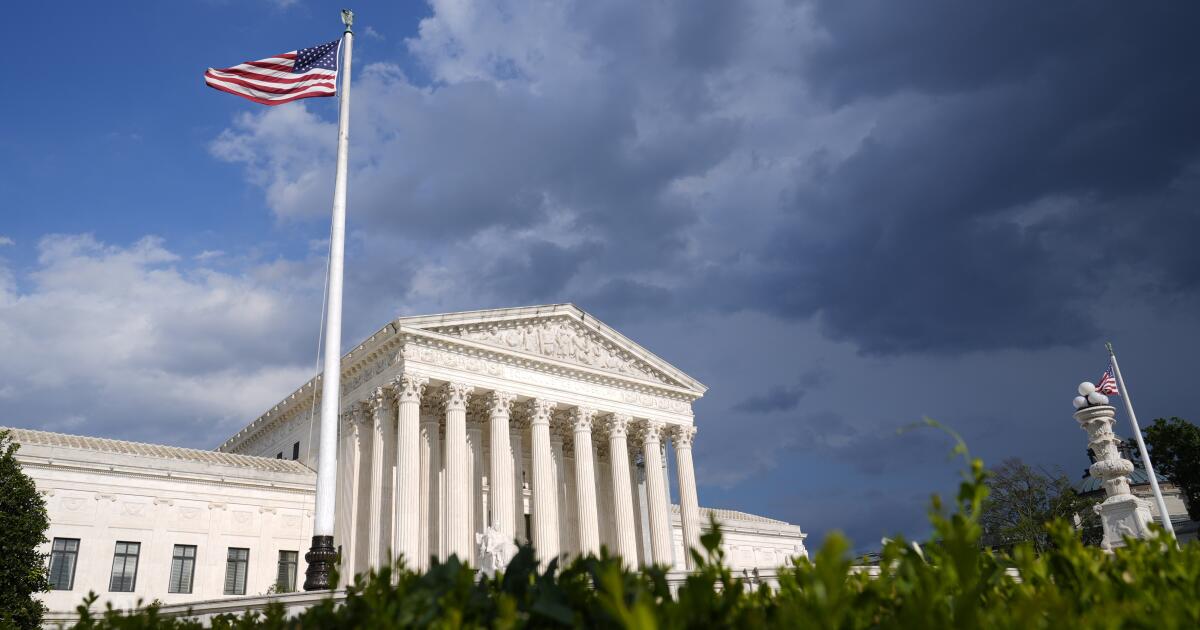
WASHINGTON — The Supreme Court cast doubt Monday on whether police may obtain cellphone data to find crime suspects.
In a 6-3 decision, the justices said this location information showing where a cellphone user has traveled is personal and private and subject to the protection of the 4th Amendment’s ban on unreasonable searches.
Justice Elena Kagan said these “records serve as a personal journal of a user’s movements.”
She said the information “resembles other private materials — think of emails, documents, photographs, or calendars—that even if stored on Google’s servers, a user reasonably views as his own…and reasonably expects to be shielded from the inquisitive eyes of the government.”
Because an “individual has a legitimate expectation of privacy in his cellphone location data,” she said police investigators need a valid search warrant from a magistrate.
The court stopped short of deciding the proper basis for a search warrant in such cases. Instead, the justices sent the case back to judges in Virginia.
But the outcome casts doubt on “geofence warrants.”
In recent years, police have gone to Google and cellphone companies seeking tracking data on cellphones that were at a crime scene. Sometimes, they have had a warrant from a magistrate.
Civil libertarians say the use of this tracking data raises the specter of mass surveillance on innocent people.
Police and government lawyers say no one has a reasonable right to privacy when they are walking on a sidewalk or driving down the street.
The case before the court arose from the armed robbery conviction of a Virginia man who stole $195,000 from a credit union in a small town near Richmond.
By the time police arrived, the robber had fled. But surveillance cameras showed he was carrying a gun and a cellphone.
Lacking other leads, detective Joshua Hilton asked a judge to issue a special type of warrant seeking information from Google.
Referred to as a “geofence warrant,” it seeks data from phones in a particular area at a particular time.
The detective sought data on phones that were within 150 yards of the credit union within one hour of the late afternoon robbery.
After examining and paring down the data, the detective asked for the phone records of Okello Chatrie. Then, with a search warrant of his home, investigators found two robbery-style demand notes, a semi-automatic pistol and about $100,000 in cash.
A judge refused to suppress the evidence from an allegedly unconstitutional search, and Chatrie entered a conditional guilty plea.
The full 4th Circuit Court of Appeals split evenly on the legality of the geofence warrant, and the Supreme Court agreed to decide the issue in Chatrie vs. U.S.
Usually investigators obtain warrants to search the home or vehicle of a known crime suspect.
The new and disputed geofence warrants seek to find a suspect by examining data on the cellphones that were at the scene of a crime.
The FBI used this cellphone data in 2021 to identify suspects who broke through police barricades on Jan. 6, 2021, and pushed their way into the Capitol to disrupt the official counting of electoral votes.
Chief Justice John G. Roberts Jr. and Justices Sonia Sotomayor, Neil M. Gorsuch, Brett M. Kavanaugh and Ketanji Brown Jackson agreed on the outcome in Chatrie vs. U.S.
In a 21-page dissent, Justice Samuel A. Alito Jr. said the court had “carefully set the stage for its planned performance: striking a pose as a great champion of privacy in the digital age. I cannot support this irresponsible escapade.”
Justice Clarence Thomas agreed.
Justice Amy Coney Barrett agreed in a one-paragraph dissent. “Chatrie had no reasonable expectation of privacy in data about his public movements that he voluntarily disclosed to Google,” she said.
The Supreme Court ruled 6-3 that President Trump could fire independent regulators for any reason. But the justices carved out an exception for the Federal Reserve, preventing the immediate removal of Lisa D. Cook, a Federal Reserve governor.
Politics
Emotion and feelings: How Democratic Socialists’ congressional insurgency could come back to bite them

NEWYou can now listen to Fox News articles!
Democratic Socialists of America are on the charge, running hot off their wins in the New York Democratic primaries last week. Their victories in multiple Congressional seats – felling both Reps. Adriano Espaillat, D-N.Y., and Dan Goldman, D-N.Y. – signals that the party is ready to move on from the same old, same old.
Espaillat chaired the Congressional Hispanic Caucus. Goldman was a key House staffer during the first impeachment of President Donald Trump.
“Even Dan Goldman’s not good enough for them,” said House Judiciary Committee Chairman Jim Jordan, R-Ohio, on Fox. “That is how radical it’s become.”
Some moderate Democrats are trying to distance themselves from the left.
MAMDANI-BACKED SOCIALISTS LOOK TO TAKE NEW YORK PLAYBOOK NATIONWIDE AFTER PRIMARY VICTORIES
The left flank of the Democratic Party has surged to the top of the nation’s most hotly-contested primaries. (Michael M. Santiago/Getty Images)
“That’s not the same brand of politics that we have. We’re not those type of Democrats,” said Rep. Tom Suozzi, D-N.Y., who represents a battleground district.
“There’s a new group of Democratic Socialists who are socialists who are not commonsense Democrats. Who are not interested in getting things done. They’re interested in throwing bombs. Not actually solving problems,” said Rep. Josh Gottheimer, D-N.J.
LURCHING LEFT: MAMDANI-BACKED CANDIDATES OUST ESTABLISHMENT DEMOCRATS
Some Democrats are worried how far left candidates command more attention than those in the middle. Rep. Kristen McDonald Rivet, D-Mich., worries that the outsized attention garnered by the left sends the wrong impression to voters.
“What they don’t want is divisiveness. They don’t want screaming and yelling,” said McDonald Rivet.
Mainstream Democrats feel trapped in the middle as the left – specifically the New York City left – wields an outsized media and political megaphone.
“Those candidates would not have won in Virginia where I live,” said Rep. Suhas Subramanyam, D-Va.
Rep. Tom Suozzi, D-N.Y., is among the moderate Democrats trying to distance themselves from the party’s insurgent wing. (Nathan Posner/Anadolu via Getty Images)
Republicans believe they are primed to nationalize the midterms. Republicans can do that by highlighting the extreme views of Democratic Socialists who captured primary victories in New York City. The GOP wants to portray their opponents as veering left.
“These are board-certified communists, right?” asked Sen. Roger Marshall, R-Kan. “They want no police. They want no private property.”
President Trump capitalized on the Democratic outcomes in his home city.
“The Democrat party is in big trouble because this isn’t stopping with New York,” he forecast.
VICTORIES BY MAMDANI-BACKED CONGRESSIONAL CANDIDATES SPOTLIGHTS GROWING RIFT IN DEMOCRATIC PARTY
This shakeup has progressive leaders demanding transformation at the top.
“You’re going to see, I think, people voting for new leadership and to change their representation,” said Rep. Alexandria Ocasio-Cortez, D-N.Y.
The Democratic Party tapped Sen. Elissa Slotkin, D-Mich., to deliver their official response to President Trump’s 2025 State of the Union speech. Slotkin is a moderate who won in a battleground race in 2024 – even as the President prevailed in the Wolverine State. But during an appearance on SiriusXM, Slotkin insists on a Democratic Party management switch.
“If people can’t understand that the game has fundamentally changed and they can’t adapt, then they need to let others,” said Slotkin. “The old models do not work for people.”
House Minority Leader Hakeem Jeffries, D-N.Y., is perceived by Republicans as vulnerable after his preferred candidates failed in their congressional primaries. (Roberto Schmidt/Getty Images)
Republicans believe House Minority Leader Hakeem Jeffries, D-N.Y., is vulnerable after the DSA elected their candidates over his preferred picks in New York City.
“I think Hakeem Jeffries’ friends and neighbors gave him a big middle finger,” said House Oversight Chairman James Comer, R-Ky. “If you lose three elections in your hometown, that’s a pretty big slap in the face.”
He added that Democrats “are going further and further to the left to the point where they are full-blown, card-carrying socialists.”
And then there is the anti-Israel, anti-Jewish, and in some cases, antisemitic take by some of these candidates. Rep. Greg Landsman, D-Ohio, is a moderate Democrat from a swing district. He’s Jewish and one of the most pro-Israel Democrats in the House.
“There are some on the left who use Israel the way that some on the right use immigrants or trans kids as a way to divide. And I think it’s terrible. It’s also just not what voters want us talking about,” said Landsman.
HOUSE DEMOCRAT LASHES OUT WHEN GRILLED ON WHETHER SOCIALIST VICTORIES WOULD THREATEN DEM UNITY
Yours truly tangled with Rep. John Larson, D-Conn. – who once chaired the House Democratic Caucus. I pressed him about what the party would do about some candidates “who are too far to the left.”
“What does that mean? That’s your statement. Did the people of New York vote?” queried Larson.
I assured him that they did.
“Is that democracy?” asked Larson.
“But if some of them are antisemitic,” I countered.
“Is that a democracy?” continued Larson.
“Will you stand by people if they have antisemitic views?” I followed up.
Larson finally addressed my inquiry. His answer crystallized the schism the Democratic Party now faces.
“I’m against antisemitism, if that’s your question,” Larson declared.
Rep. John Larson, D-Conn., got into a heated exchange with Fox News’ Chad Pergram over the views of some likely members of his party’s next freshman class. (Bill Clark/CQ-Roll Call, Inc via Getty Images)
The fact that Democrats are now facing this debate robs them of valuable time on economic issues.
Landsman argued that voters would prefer candidates to stick to groceries and the price of gas.
Gottheimer echoed Landsman on kitchen table subjects.
“We should be focused on ways to actually solve problems like that. Not coming in here and using tea party tactics and trying to divide up the country and pray to socialist ideals,” said Gottheimer.
So what is the party to do?
DEMOCRACY ’26: STAY UP TO DATE WITH THE FOX NEWS ELECTION HUB
“They’re our nominees. We’re going to support them. We’re going to welcome them. They’re going to be part of our caucus and we’re going to unite behind Leader Jeffries,” said Rep. Robert Garcia, D-Calif., the top Democrat on the Oversight panel.
But that doesn’t address the fissures. It doesn’t address how voters may perceive the party. And it doesn’t establish if these new Democratic nominees will work on behalf of the party to raise money and advocate for Democrats across the board. Or, will they become professional bomb throwers – ala what the right has endured for a while.
“It’s going to be a lot harder to get things done when you get more and more extreme candidates who are here because they’re interested in political celebrity. They are interested in fighting. They’re interested in making points,” asserted Rep. Dusty Johnson, R-S.D.
Republicans have had an abysmal week themselves – President Donald Trump and Sen. Bill Cassidy, R-La., for instance, got into a shouting match over Iran. (Chip Somodevilla/Getty Images; Tyler Kaufman/Getty Images)
Republicans suffered through an absolutely abysmal week. House GOP leaders had to yank multiple bills off the floor and send lawmakers home early because of internal disputes. President Trump and Sen. Bill Cassidy, R-La., got into a shouting match about Iran. And the president even threatened to veto a bipartisan housing bill. President Trump then refused to sign the bill at the Capitol, despite his aides touting the bill and House Republicans tricking out Statuary Hall for a signing ceremony.
The President characterized the housing bill as “a yawn.”
But the Democrats’ internal fractures may have superseded any internecine fighting among Republicans.
“While it’s not been a great week for Republicans, I think it’s been a much worse week for Democrats because of these primary elections,” observed Rep. Mario Diaz-Balart, R-Fla.
CLICK HERE TO DOWNLOAD THE FOX NEWS APP
Democrats will certainly run on economic issues and capitalize on statements by the President about basic issues like housing. But will a genuine policy debate outweigh fears about progressives nationwide?
Emotion and feelings rule in politics. And it could be a problem for Democrats if Republicans appropriate what happened in New York and Xerox it onto battleground districts across the country.
-
 Business7 minutes ago
Comcast is spinning off NBCUniversal media and entertainment assets
-
 Entertainment12 minutes ago
Alannah Keyser is latest fired ‘Love Island USA’ contestant to apologize for using a racist slur
-

 Lifestyle19 minutes ago
Chanel’s Bruno Pavlovsky on Reengineering an Iconic Brand
-
Politics22 minutes ago
Supreme Court limits police use of cellphone data to find crime suspects
-
 Sports34 minutes ago
Teoscar Hernández returns, and Dodgers unleash 17-hit barrage in win over Athletics
-

 World42 minutes ago
DR Congo says 1,307 Ebola cases confirmed, including 377 deaths
-
 News1 hour ago
Michigan governor threatens to pull troops from D.C. if used for Trump task force
-

 New York2 hours ago
Metropolitan Diary Challenge Day 2: How to Write Your N.Y. Story

