Politics
Newsom celebrates political victory on gas price spike bill, but concerns remain about policy

At a campaign rally in the Coachella Valley, former President Trump on Saturday called out California’s cost of living and nation-leading gas prices as an example of Vice President Kamala Harris and other “radical Democrats” destroying the state.
“Today California has the highest inflation, the highest taxes, the highest gas prices, the highest cost of living, the most regulations,” he said. “We’re not going to let Kamala Harris do to America what she did to California.”
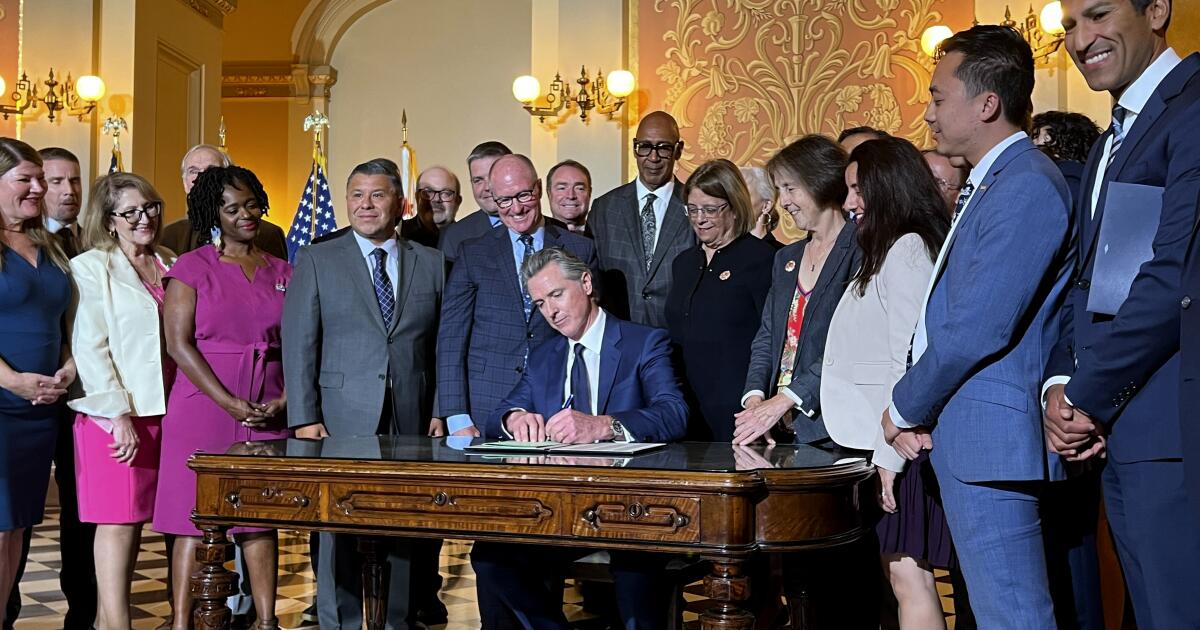
Two days later at the state Capitol, Gov. Gavin Newsom celebrated the passage of a new state law that could lower gasoline price spikes by giving regulators the authority to require that California oil refiners store more inventory.
Newsom and Democratic lawmakers cast the bill as a solution to high gas prices. With less than three weeks until the Nov. 5 election, affordability has become a major political issue and a potential vulnerability for Harris’ presidential campaign.
“It’s about time we stood up,” Newsom said after he signed the bill on Monday. “This is the fourth largest market in the world. This is a big damn deal.”
The newly passed law gives Newsom a win in his political battle with the oil industry, but whether Harris or other Democratic candidates will benefit from the governor’s victory remains unclear.
Newsom’s law will not immediately lower the cost of gasoline in California. While experts say it could ultimately offer reductions of future price spikes, regulators will have to complete a thorough review process to enact the new controls.
Governors in Arizona and Nevada wrote letters warning that the legislation could drive up costs for their constituents, potentially bolstering concerns in pivotal swing states about California’s policies.
Newsom called lawmakers back to Sacramento for a special session to pass the policy. At the same time, however, his administration is expected to adopt stricter limits on carbon fuels that could drive up per-gallon costs by almost half a dollar or more just days after the election.
The governor declined to answer a question at a news conference about whether he thought the new law would affect Democrats in the election, arguing that the effort wasn’t about politics. In a video posted to social media minutes before he signed the bill into law on Monday, Newsom accused the industry of being in “cahoots” with Trump by intentionally pushing prices higher to scare voters during election season.
Opponents have cast his push to address gas prices as an example of “political theatrics.”
“This is politics, not policy,” said Catherine Reheis-Boyd, chief executive of the Western States Petroleum Assn. “This is a show. This is anything but good policy.”
Newsom and the petroleum trade group have been locked in a political battle over gas prices since the summer of 2022. The governor ran ads in Florida calling out Gov. Ron DeSantis’ conservative policies, which prompted a response from the petroleum group blaming Newsom for California’s highest-in-the-nation gas prices.
Since then the governor has repeatedly accused the industry of intentionally gouging consumers.
His administration has pointed out that prices spike when refineries experience unplanned maintenance problems with their equipment, which limits the amount of gasoline available in the state and drives up prices. Requiring the refineries to increase fuel reserves, his administration says, will help prevent those shortages.
Reheis-Boyd has argued that requiring refineries to store more gasoline will increase costs for the companies and drive up prices at the pump. The industry contends that California’s nation-leading gasoline costs are a supply and demand problem in a state that has adopted environmental policies to limit oil drilling and production.
The cheapest way to lower gas prices is to allow oil companies to increase crude oil production in California and rely less on supply from overseas, Reheis-Boyd said.
The state should be working closely with California’s small number of refineries to ensure the state has enough gasoline, instead of adopting new regulations that restrict profits and pushing the companies out of business, she said.
“We have a governor who isn’t interested in the conversation,” Reheis-Boyd said. “He’s the only governor I’ve never met with, because he won’t meet.”
This year marks the second time in two years that Newsom has pushed lawmakers to adopt new oil regulations, an issue that divides Democrats as they navigate desires to fight climate change and lower gas prices.
In 2023, lawmakers balked at passing Newsom’s proposal to penalize oil companies that earn excessive profits. Instead lawmakers adopted new oversight of the industry and gave regulators the ability to cap profits through a rule-making process that has yet to result in any new restrictions.
Democrats in the Legislature were reluctant to pass Newsom’s new oil bill again this year.
Two weeks before the regular session concluded at the end of August, Newsom announced a proposal to require that petroleum refiners maintain a stable inventory in order to prevent fuel shortages and price spikes when refinery equipment is taken offline for maintenance.
Assembly Speaker Robert Rivas (D-Hollister) refused to take up the bill for a floor vote at the end of session, arguing that his caucus did not want to rush legislation through without properly vetting the policy. He agreed to work on the proposal in a special session.
Senate President Pro Tem Mike McGuire (D-Healdsburg) took the opposite approach. His caucus was ready to pass the bill at the end of session, he said, and he initially refused to participate in a special session before giving in to the governor’s demands.
During the special session, the Assembly held a series of hearings before passing the bill earlier this month. The Senate quickly signed off on the proposal the following week.
While some liberal Democrats quietly fumed as the governor forced them to vote on another one of his political proposals, many felt the policy could ultimately reduce price spikes that hurt consumers.
“The data is clear: Price spikes happen when refineries fail to plan for supply during scheduled maintenance,” said Assemblymember Gregg Hart (D-Santa Barbara). “This bill will hold oil companies accountable for resupply plans when refineries’ shutdowns occur, ultimately saving Californians billions at the pump.”
Several Democratic legislators competing for swing-district seats in November did not vote, or opposed the bill.
State Sen. Dave Min (D-Irvine), who declined to vote on the proposal, said he supported the goal to address the problem of high gas prices in the state but did not agree with the approach. Min is locked in a tight race for Congress against Republican Scott Baugh in Orange County.
Min said opponents to Newsom’s proposal “raised serious concerns” about whether it would be effective in lowering gas prices or even be counterproductive.
“These concerns deserve a fair and full vetting, which is difficult to do in a special session conducted just weeks before many of the current legislators will be leaving office,” Min said in a statement.
Republicans said Democrats would reduce gas taxes if they were serious about the problem of affordability.
“So, who’s making the money?” asked state Sen. Brian Dahle (R-Bieber). “Who’s gouging Californians for every gallon of gas? It’s the government. $1.42 for every single gallon of gas goes to taxes, whether it’s state, local or federal.”
Opposition to the proposal from labor unions representing workers in the industry added to the pressures on Democrats.
Tom Baca, the international vice president for western states of the International Brotherhood of Boilermakers, said giving regulators control over maintenance schedules, instead of relying on the insight of the workers with deep knowledge of the equipment, could put his members in dangerous conditions if work is delayed.
David Sikorski, business manager for the International Union of Operating Engineers Local 12, called the special session “unnecessary.”
His union represents 21,000 workers in California, Arizona and Nevada. He said Newsom’s policy could prove to be a liability to Harris in the neighboring swing states of Arizona and Nevada.
“We’ve made some real momentum, hit the ground running in Arizona, and we put a lot of resources into getting friendly politicians, and Kamala Harris, elected in that state,” he said. “This is just one more hurdle that we have to overcome with our membership and working people in general.”



NEWYou can now listen to Fox News articles!
Fresh satellite images give a rare aerial view of the damage across Iran after U.S.-Israeli strikes and what Tehran’s retaliation left behind across the region.
Planet Labs satellite imagery captured burning ships and damaged facilities at the Konarak base in southern Iran, as well as significant destruction at Iran’s naval headquarters in Bandar Abbas on the Persian Gulf, reflecting the scale of the strikes on military infrastructure.
Satellite imagery from Planet Labs shows damage at Konarak naval base in southern Iran, left, and Iran’s Bandar Abbas naval headquarters in the Persian Gulf, right. (Planet Labs PBC)
Imagery from Vantor shows damage to facilities and vessels located in Iran’s Bushehr port in the Persian Gulf.
In addition to naval assets, satellite photos show a bunker at Bushehr air base hit by a strike, leaving a large crater and destroying several nearby small buildings.
More strikes targeted the Choqa Balk drone facility in western Iran.
Radar systems at the Zahedan air base in eastern Iran — near the country’s borders with Pakistan and Afghanistan — were also struck.
The two facilities are about 800 to 900 miles apart, underscoring the broad reach of the coordinated strikes.
Satellite imagery also reveals damage to aircraft on the tarmac at Shiraz air base, including scorch marks and debris around several parking areas.
Side-by-side photos showing damage to aircraft at Shiraz air base in Shiraz, Iran on March 6, 2026. (Vantor/Maxar/Getty Images)
Satellite imagery from Planet Labs shows thick smoke plumes rising above Tehran, signaling explosions and fires inside the Iranian capital.
The smoke underscores how the conflict has moved beyond isolated military sites and into the heart of Iran’s political center.
THE UNLIKELY TOOL TRUMP IS EYEING TO TACKLE RISING OIL PRICES AMID THE IRAN CONFLICT
A satellite image from Planet Labs shows a plume of smoke above Tehran, Iran, on March 1, 2026. (Planet Labs PBC)
Iran has since responded with missile and drone strikes of its own, expanding the conflict across the region.
Satellite images reveal damage to the port city of Sharjah in the United Arab Emirates. Sharjah is the third most populous after Dubai and Abu Dhabi.
CLICK HERE TO DOWNLOAD THE FOX NEWS APP
The Jebel Ali Port, the region’s largest maritime hub, was also targeted, underscoring how the retaliation extended beyond military sites to key infrastructure.
The new satellite imagery comes on the heels of U.S.-Israeli strikes that killed Iran’s supreme leader, Ayatollah Ali Khamenei, and several top members of the regime, triggering a succession crisis.
President Donald Trump warned on Sunday that Iran’s new leader is “not going to last long” without U.S. approval as Operation Epic Fury marches into a third week.
Related Article


WASHINGTON — The U.S. and Israeli war against Iran entered its ninth day Sunday with no clear path toward de-escalation, as the U.S. announced a seventh American service member had been killed and Iranian state TV reported the selection of Supreme Leader Ayatollah Ali Khamenei’s son as his successor.
Meanwhile, the price of oil surpassed $100 a barrel for the first time in 3½ years.
President Trump said deploying American ground troops to the Middle East remains under consideration and Iran’s foreign minister rejected calls for a ceasefire.
Trump said last week that Mojtaba Khamenei would be an “unacceptable” choice to replace his father, the 86-year-old leader who was killed on the first day of U.S. and Israeli attacks. The clerical body in charge of choosing Iran’s next supreme leader selected him anyway, state TV reported Sunday.
The younger Khamenei, a 56-year-old Shiite cleric, has never held government office, but has long been a quiet force within his father’s inner circle. As supreme leader, he will play a central role in deciding Iran’s war strategy moving forward, with the powerful paramilitary Islamic Revolutionary Guard Corps answering to him.
The White House did not immediately respond to a request for comment on his selection.
Speaking to reporters on Air Force One on Saturday, Trump declined to rule out the possibility of sending U.S. forces inside Iran, saying it could “possibly happen” as the conflict intensifies.
“There would have to be a very good reason,” Trump said. “I would say if we ever did that they would be so decimated that they wouldn’t be able to fight at the ground level.”
His remarks came ahead of another relentless day of bombings in Iran, and as desalination plants critical to civilian water supplies in the arid region came under attack on both sides of the conflict.
The United States military on Sunday announced that an American service member died Saturday night of injuries sustained March 1 in Saudi Arabia during Iran’s “initial attacks” on U.S. allies and facilities across the region, in response to U.S. and Israeli strikes. The service member was not immediately identified, pending notification of family.
In addition to the seven U.S. service members killed in the war, a National Guard soldier died Friday of a “health-related incident” in Kuwait, where he had been deployed, the military said. The cause of death was under review.
Other deaths were also reported in the region. Israel reported two of its soldiers were killed in fighting in southern Lebanon — its first military deaths of the war — while Saudi Arabia reported two people were killed and 12 wounded by a military projectile that fell in a residential area of Al Kharj.
The death toll in Iran has been difficult to nail down, but Iran’s ambassador to the United Nations on Friday put the number at more than 1,300.
Iran has said it is prepared to continue fighting the war despite sustaining heavy losses and would be ready to fight American ground troops if they set foot in the country.
“We have very brave soldiers who are waiting for any enemy who enters into our soil to fight with them, and to kill them and destroy them,” Iran’s foreign minister, Abbas Araghchi, said in an interview with NBC’s “Meet the Press” on Sunday.
Araghchi added that Iran is not considering a ceasefire at this time. He said the United States and Israel would first need to explain “why they started this aggression and then guarantee there would be a permanent end of the war.”
“Unless we get to that, I think we need to continue fighting for the sake of our people and our security,” he said.
Araghchi also pushed back on Trump’s demand last week that the president be involved in determining Iran’s future leadership as a condition to ending the conflict.
“We allow nobody to interfere in our domestic affairs. This is up to the Iranian people to elect their new leader,” Araghchi said. “It’s only the business of the Iranian people, and nobody else’s business.”
In addition to mounting deaths and widespread destruction, the economic toll of the war has also continued to rise, particularly in energy markets — with oil prices jumping above $100 a barrel on Sunday.
“If the war continues like this, there will be neither a way to sell oil nor have the ability to produce it,” Iran’s parliament Speaker Mohammad Bagher Ghalibaf said in a social media post Sunday. He added that the war would affect not just the U.S., but also the rest of the world “due to [Israeli Prime Minister Benjamin] Netanyahu’s delusions.”
Israeli strikes Sunday hit an oil storage facility in Tehran, marking what appears to be the first time a civil industrial facility has been targeted in the war. Black smoke billowed over the Iranian capital, with officials there warning of the hazardous health effects for residents.
“By targeting fuel depots, the aggressors are releasing hazardous materials and toxic substances into the air, poisoning civilians, devastating the environment, and endangering lives on a massive scale,” Iran’s Foreign Ministry spokesperson Esmaeil Baqaei said on X.
U.S. Energy Secretary Chris Wright said Sunday that there’s a “fear premium in the marketplace” and sought to assure Americans that the soaring oil prices are a short-term problem.
“We never know exactly the time frame of this,” Wright said in an interview with CNN’s “State of the Union.” “But in the worst case, this is a weeks, this is not a months, thing.”
White House Press Secretary Karoline Leavitt echoed the same message in an interview with Fox News’ “Sunday Morning Futures,” calling the rising gas prices a “short-term disruption.”
“Ultimately taking out the rogue Iranian regime is going to be a good thing for the oil industry,” Leavitt said. “Those prices are going to come back down just like they have over the course of the past year, because of President Trump’s American energy dominance agenda.”
The strike on the oil storage facility came as Netanyahu promised “many surprises” for the next phase of the conflict.
Israel also claimed Sunday to have destroyed the Tehran headquarters of the Revolutionary Guard air force, which it said operated Iran’s “ballistic missile command, unmanned aerial vehicle (UAV) array, and other air force units.” It also said it had killed five top commanders in the Revolutionary Guard who were “hiding in a civilian hotel” in central Beirut, Lebanon.
Crucial civilian infrastructure also came under attack, on both sides of the conflict.
Bahrain denounced what it said was an Iranian attack on one of its desalination plants — facilities that supply water to millions of people in the parched deserts of the Persian Gulf. Araghchi said a U.S. airstrike had damaged an Iranian desalination plan on Qeshm Island first.
“Attacking Iran’s infrastructure is a dangerous move with grave consequences. The U.S. set this precedent, not Iran,” Araghchi wrote on X.
The United States has also come under scrutiny after evidence suggested that an American strike was probably responsible for an explosion at an Iranian elementary school that killed more than 165 people, most of them children.
Trump administration officials have said that the matter is under investigation and that no determination has been made as to who was responsible for the strike. But on Saturday, Trump said Iran was to blame for the explosion.
“It was done by Iran,” he told reporters. “They’re very inaccurate, as you know, with their munitions. They have no accuracy whatsoever. It was done by Iran.”
Asked Sunday whether Iran had any evidence that the strike was conducted by the Americans, Araghchi said that it had to have been either the U.S. or Israeli military and that Trump’s suggestion that Iran was responsible for the attack was “funny.”
“It is our school, these are our students and our girls, and they are attacked by an American fighter, a jet fighter, and they have been killed. Why [is] Iran responsible?” Araghchi said.
Other world leaders and nations have called for a halt to fighting and added their own estimates to its toll.
Lebanon said more than half a million people have been displaced by the fighting between Israel and Hezbollah.
French President Emmanuel Macron said he had spoken with Iranian President Masoud Pezeshkian on Sunday, and urged him to stop strikes in the region. Macron is the first Western leader to speak with Pezeshkian since the war began, the Associated Press reported.
Pope Leo XIV wrote on X on Sunday that reports out of Iran and the wider Middle East “continue to cause deep dismay and raise the fear that the conflict will expand, and that other countries in the region, including dear Lebanon, may once again sink into instability.”
He asked the world to pray “for the roar of bombs to cease, weapons to fall silent, and space to open for dialogue, in which people’s voices may be heard.”

NEWYou can now listen to Fox News articles!
President Donald Trump is vowing to reject signing any new bills into law until the SAVE America Act is passed by the Senate, a tall order with just 53 Republicans seated and the 60-vote filibuster threshold a high hurdle.
“Great Job by hard working Scott Pressler on Fox & Friends talking about using the Filibuster, or Talking Filibuster, in order to pass THE SAVE AMERICA ACT, an 88% issue with ALL VOTERS,” Trump wrote Sunday morning on Truth Social. “It must be done immediately.”
“It supersedes everything else,” Trump added. “MUST GO TO THE FRONT OF THE LINE.”
The vow to halt all new law signings is a new one coming from the White House and notable because of the Senate hesitation to follow the urgings of Sen. Mike Lee, R-Utah, to force the Senate to bring the bill forward through the talking filibuster.
Sen. Mike Lee, R-Utah, talks with a guest during an “Only Citizens Vote Bus Tour” rally in Upper Senate Park to urge Congress to pass the Safeguard American Voter Eligibility (SAVE) Act on Wednesday, Sept. 10, 2025. (Tom Williams/CQ-Roll Call, Inc via Getty Images)
“I, as President, will not sign other Bills until this is passed,” Trump’s post continued, “AND NOT THE WATERED DOWN VERSION – GO FOR THE GOLD: MUST SHOW VOTER I.D. & PROOF OF CITIZENSHIP: NO MAIL-IN BALLOTS EXCEPT FOR MILITARY – ILLNESS, DISABILITY, TRAVEL: NO MEN IN WOMEN’S SPORTS: NO TRANSGENDER MUTILIZATION FOR CHILDREN! DO NOT FAIL!!!”
While Senate Majority Leader John Thune, R-S.D., has publicly acknowledged a willingness to bring a vote on the SAVE America Act before the upper chamber, there is hesitation within the Republican Party about forcing the talking filibuster under the current Senate rules.
The talking filibuster would force Democrats to speak on the Senate floor to argue against a voter identification position widely supported by Americans, as Trump noted, but it would also force Republicans to sit in attendance with a quorum. That has been rebuked by longtime Senate GOP veterans as something that would “waste time.”
FETTERMAN EXPECTS DHS SHUTDOWN AMID PARTISAN FUNDING FEUD, BREAKS WITH DEMOCRATS ON VOTER ID
Senate Majority Leader John Thune, R-S.D., has promised to bring the SAVE America Act to the Senate floor, but there remains some GOP hesitation on forcing the talking filibuster. (Kevin Dietsch/Getty Images)
Former Senate GOP Leader Mitch McConnell, R-Ky., has been publicly opposed to forcing a talking filibuster because of the time constraints it would force on the Senate GOP, and he remains one of the few Senate Republicans not signing on to support the SAVE America Act.
Another development that clouds the SAVE America Act filibuster is the recent appointment of Sen. Markwayne Mullin, R-Okla., to serve as the next Department of Homeland Security secretary, perhaps resigning from the Senate by the end of March.
Fox News Digital reached out to Mullin’s office for comment. McConnell’s office declined to comment on Trump’s Truth Social vow to block all new law signings amid the standoff on the DHS funding that has the government in a partial shutdown and the Senate sitting on the House-passed SAVE America Act.
GOP REACHES KEY 50-VOTE THRESHOLD FOR TRUMP-BACKED VOTER ID BILL AS SENATE FIGHT LOOMS
“We’re going to have a vote on this, but in terms of what the president is willing to sign, Maria, we need to get the Department of Homeland Security funded,” Senate Majority Whip John Barrasso, R-Wy., told Maria Bartiromo on “Sunday Morning Futures.”
“The Democrats have blocked that right now. And the greatest threat to the American people today is terrorism. So I want to make sure that the Democrats work with us to pass and fund the Department of Homeland Security, because I’m worried about the lone wolf, the sleeper cells and the cyber terrorism that’s coming our way because of what Iran is telling people around the world to do to continue this reign of terror,” Barrasso said.
Getting to 60 votes in the Senate is unlikely with just Sen. John Fetterman, D-Pa., as the lone potential Democrat vote to side with the Senate GOP on the SAVE America Act.
HOUSE REPUBLICANS PUSH JOHNSON TO GO TO WAR WITH SENATE OVER SAVE ACT
Senate GOP WHIP John Barrasso, R-Wy., and current Senate Majority Leader John Thune, R-S.D., have expressed more support for forcing Democrats to filibuster the SAVE America Act than former GOP leader Sen. Mitch McConnell, R-Ky. (Getty Images)
“The Democrats are against so many of the things that I think help this country,” Barrasso added to Bartiromo. “They’d rather stand with illegal immigrant criminals than with the safety and security of the American people. I want to get the Save act to the floor. I want to have a vote.”
“That’s the next step on this need to get the Department of Homeland Security open and funded,” he continued. “The Democrats are bowing to the liberal left: The people that want to eliminate ICE, the people that want open borders again, and the people that really aren’t looking out for the best interest of the American people.
“As the president said in the State of the Union, it is the first duty of the American government to protect American citizens, not illegal aliens. But that’s what not one single Democrat stood up for that when every Republican stood and cheered loudly.”
Barrasso, the Senate GOP member whipping up support, considers the SAVE America Act “common sense.”
CLICK HERE TO DOWNLOAD THE FOX NEWS APP
“You want to make sure that only citizens can vote,” he concluded to Bartiromo. “You want to make sure that when people show up, they have a photo ID to prove they are who they say they are. You need a you need a photo ID to buy a beer, to board a plane, all of those things. And it’s 90% popular with the American people. The only people against this are the Democrats because they want to make it easier to cheat.”
Related Article
TN Lottery Cash 3 Evening, Cash 4 Evening winning numbers for March 8, 2026

Grand Prix Arlington set to bring top speeds to North Texas’ entertainment district

Utah drivers rethink budgets as gas prices jump

Spring-like days ahead, but the risk for additional river ice jams and flooding will continue.

Brothers of Epstein accuser Virginia Giuffre visit New Mexico ranch, demand unredacted documents

Florida High School Football Rankings: Top 25 teams – Oct. 21

How old is Bo Nix? What to know about Oregon quarterback ahead of 2024 NFL Draft

Cleary's 21 help Le Moyne down Central Connecticut State 69-64 in OT

99th annual Pony Swim held in Virginia

Indiana Members Credit Union announced as new anchor tenant at Bottleworks District

Video: Airports Struggle to Staff T.S.A. During Partial Government Shutdown

Before-and-after satellite imagery offers a rare look at damage inside Iran
Hungary's opposition leader Péter Magyar calls on Russia to refrain from election interference

Video appears to show U.S. cruise missile striking Iranian school compound

Trump vows block on signing new laws until SAVE America Act passes Senate
-

 Wisconsin1 week ago
Setting sail on iceboats across a frozen lake in Wisconsin
-

 Massachusetts6 days ago
Massachusetts man awaits word from family in Iran after attacks
-

 Maryland1 week ago
AM showers Sunday in Maryland
-

 Florida1 week ago
Florida man rescued after being stuck in shoulder-deep mud for days
-

 Pennsylvania4 days ago
Pa. man found guilty of raping teen girl who he took to Mexico
-

 Oregon1 week ago
2026 OSAA Oregon Wrestling State Championship Results And Brackets – FloWrestling
-

 News1 week ago
2 Survivors Describe the Terror and Tragedy of the Tahoe Avalanche
-

 Sports4 days ago
Keith Olbermann under fire for calling Lou Holtz a ‘scumbag’ after legendary coach’s death