Lifestyle
Bucks County, Pa., Is Now a Celebrity Hot Spot


It’s hard to pinpoint when things began to change around here but you might start with the arrival of Yolanda Hadid in 2017.
Ms. Hadid, a onetime regular on “The Real Housewives of Beverly Hills,” bought a farm just outside New Hope, Pa., to be closer to her daughters, the models Gigi and Bella Hadid, who were then living in New York City.
The 32-acre property, with its stone farmhouse, horse barn and formal garden, became a family retreat, and the Hadids’ social media feeds filled with pastoral images: Gigi in a two-piece bathing suit, posing with a bowl of newly picked vegetables beside a patch of basil; Yolanda in black boots, bluejeans and a puffer vest, showing off a heap of fresh-cut lavender.
“We ride horses, we have a vegetable garden,” Yolanda told The Toronto Star in 2018, describing her life in the countryside with her famous daughters, who between them have 140 million followers on Instagram.
The presence of the Hadids attracted other famous people to Bucks County, a woodsy area known for its rolling hills and 12 covered bridges. In 2018, Zayn Malik, the British pop singer who was in a relationship with Gigi, bought a farm there. “It is quiet,” he said in an interview with British Vogue. “There are no human beings.” People magazine shared the news that Gigi gave birth to the couple’s daughter at home in Bucks County in 2020.
Tranquil Bucks County was back in the media spotlight the next year, when TMZ and Billboard reported on an altercation involving Mr. Malik, Gigi and Yolanda that took place at one of their country homes. Facing four charges of harassment, Mr. Malik pleaded no contest and was sentenced to 360 days of probation; he and Gigi broke up after the incident.
In 2023, the actor-writer-director Bradley Cooper, widely reported to have succeeded Mr. Malik as Gigi’s love interest, paid $6.5 million for a 33-acre gentleman’s farm close to Yolanda’s property. Then came local sightings of Leonardo DiCaprio and Justin and Hailey Bieber. Just across the Delaware River from New Hope, in Lambertville, N.J., Julianne Moore and Sydney Sweeney were filming a movie.
Suddenly, New Hope and the quaint neighboring towns were becoming a celebrity enclave. While a census might reveal fewer famous people per acre than in the Hamptons, Malibu, or Aspen, the area’s glamour quotient was on the rise.
Located between Philadelphia and Manhattan, New Hope has long been a haven for wealthy part-time residents. The surrounding countryside has been compared to that of the Cotswolds in England, and the artists and artisans living in the area add a touch of bohemia to the rusticity. But in past decades the weekenders tended to be lawyers and executives from Philadelphia, not supermodels, Hollywood actors and pop stars.
Michael Arenella, a musician and the founder of the annual Jazz Age Lawn Party on Governors Island, bought a weekend house in Bucks County in 2014, when he was living in Brooklyn. He started living there full-time two years later in the belief that he had chosen a place well off the cool map.
“Beacon is like Brooklyn 2.0,” Mr. Arenella, 46, said, referring to the Hudson Valley town that has been nicknamed “Bro No,” an abbreviation of Brooklyn North, because of the many former Brooklynites residing there. “I wanted to get away from New Yorkers. Bucks County is not quite as pretentious.”
Lately, though, Mr. Arenella has been seeing plenty of New York license plates in and around New Hope. Beyond sightings of Gigi Hadid or Jakob Dylan, another famous transplant, there are other signs of change in the area.
Humble inns have been refurbished to attract a new clientele, and several luxury hotels have sprung up, including River House at Odette’s, where the average nightly rate for a Saturday in November was $560 and the private rooftop club charges members $1,250 a year.
Philadelphia magazine cited the hotel and its in-house restaurant as the most glaring example of “the new New Hope.” Opened in 2020 by a group of investors that includes Ed Breen, the executive chairman of DuPont, it was built on the former site of Chez Odette’s, a restaurant and cabaret presided over by an eccentric French actress and poet, Odette Myrtil.
Along with Bucks County Playhouse, which opened in 1939 and drew such stars as Grace Kelly and Robert Redford, Odette’s came to symbolize New Hope’s bohemian culture. It closed in 2007, after three consecutive floods struck the town, and the stone building that housed it was painstakingly relocated to another lot, where it now sits empty.
Just up the Delaware, in Stockton, N.J., population 494, the historic Stockton Inn recently reopened after a two-year renovation. Its owners hired a James Beard Award winner to manage the property and its two restaurants. They also opened Stockton Market, a gourmet café that sells Frankies 457 olive oil and matcha tea made on site. Nearby, another high-end dining establishment, the Northridge Restaurant, opened last month after a three-year transformation of a weathered barn on the property of the Woolverton Inn.
Real estate values have soared in the area as the ultrarich supersize musty, low-ceilinged 19th-century abodes. “The old Bucks County farmhouse is now being blown out and expanded into true estates,” said Michael J. Strickland, a real estate agent with Kurfiss Sotheby’s International Realty who moved from Manhattan to Bucks County full-time in 2000.
Part of the appeal, he added, is that “property values are still accessible here, versus the Hamptons.”
‘Everyone Is From Brooklyn’
Mira Nakashima has seen the changes up close. She moved to New Hope as a child, in 1943. Her father, George Nakashima, was a woodworker and designer whose sculptural tables and chairs were displayed at the Museum of Modern Art and today fetch thousands of dollars at auction.
Mira took over George Nakashima Woodworkers after his death in 1990 and still runs the complex of workshops he built on a tree-lined property above the town. Sitting at a walnut table made by her father, Mira, 82, recalled the old New Hope as low-key and artsy.
“A lot of landscape painters came because the landscape was so beautiful,” she said. “There was fishing on the river. And there were canals running both sides of the river. And it was quiet and peaceful.”
For years, Nakashima Woodworkers held an open house on Saturdays. Recently, Mira said, the grounds became so overcrowded that she now offers guided tours by appointment only.
“Everyone is from Brooklyn. I can smell Brooklyn on them when they arrive here,” added Soomi Hahn Amagasu, Mira’s daughter-in-law and the studio’s sales manager. “So many young people are coming here.”
They won’t find Williamsburg-on-the-Delaware, however. New Hope’s commercial drag still has a hippie vibe distinct from the increasingly refined retail atmosphere of that Brooklyn neighborhood, with its Hermès and Chanel stores.
Mainstays include Witch Shop Gypsy Heaven, MagiKava teahouse and Love Saves the Day, a vintage bric-a-brac emporium formerly located in New York’s East Village. Another store sells tie-dye rock T-shirts. Those places, along with the homey bars and reasonably priced restaurants, bring in the suburban teens, twentysomethings and other day-trippers who clog the streets on weekends.
The lack of luxury stores of the kind you might find in East Hampton is by design, said Larry Keller, New Hope’s mayor for the last 27 years and an antique dealer in town. The town is also not so hot on national chains: After Starbucks and Dunkin’ moved in, the council revised zoning laws to favor local businesses.
“You don’t have the square-footage,” Mr. Keller said, referring to the tiny storefronts. “Where is Ralph Lauren going to have a store and sell enough gear to make sense? These are boutiques.”
One of New Hope’s shops made the grade for Gigi Hadid: Ditto Vintage, on Brick Street. Last winter Ms. Hadid stopped in and bought a Nahui Ollin handbag, a leather jacket and a necklace.
There are some upscale shops in nearby Lambertville: Albucker Gallery sells contemporary art and an assortment of found objects; Ten Church offers vintage clothing; and Rago Arts and Auction Center sells works by Nakashima and other design goods. Lambertville is also on the foodie map: Canal House Station, which serves American fare in a converted 1870s train station, earned a Michelin star.
Back on the Pennsylvania side of the iron bridge, there are signs that New Hope is in the early stages of a makeover. The building that houses Farley’s Bookshop, which opened in 1967, was recently renovated into a bright, modern space. A few doors down, a scruffy indoor mini mall was turned into a Ferry Market, a food hall. A high-end eyeglass store, Kitto Optical, opened on the same block.
“The French fries the restaurants serve are now truffle fries,” joked Katsutoshi Amagasu, 21, a Nakashima family member who grew up in New Hope.
Some of the town’s structures date to the colonial era, like the circa.-1727 Logan Inn. But on the residential north end, beyond the protected historic district, a Victorian house overlooking the river was bulldozed and replaced with a modernist compound befitting Bel Air. On an adjacent empty lot, a builder promises four luxury condominiums, each with a terrace, elevator and private dock. The asking price for one unit is $3.5 million.
Lorraine Eastman, a real estate agent at Berkshire Hathaway, said the riverfront has been built up to the point that portions of the Delaware are no longer visible to passers-by. Ms. Eastman lived in New Hope back in the ’80s, before moving to Los Angeles and eventually returning seven years ago.
“I bartended with Big Sue, who was 6-foot-1, wore size 13 motorcycle boots and smoked a cigar and sang jazz,” she recalled of her time working at John and Peter’s, a bar and rock club on South Main Street that’s still in business. “I lived in a loft on Ferry Street, which is now the Nurture Spa. New Hope was very artsy, gritty, very bohemian. It still has a little bit of all those qualities, but it is changing.”
Eat, Pray, Spend
Like many picturesque small towns, New Hope seems to have been discovered during the pandemic by urbanites who gobbled up property and drove up real estate prices.
“People are always looking for a place to go that’s a hidden little storybook town,” said Ms. Eastman, who recently listed a renovated 1769 farmhouse with a pool and “party” barn on 37 acres for $4.5 million.
Celebrity residents aren’t exactly new, either: Paul Simon had a weekend house in Bucks County in the early ’70s; more recently, the “Eat, Pray, Love” author Elizabeth Gilbert lived in Frenchtown, N.J., 16 miles north.
But the presence of the Hadids and Mr. Cooper, who grew up in suburban Philadelphia, has lent glamour to the area and whetted the appetites of developers and entrepreneurs.
A few miles from Yolanda Hadid’s estate, in the hamlet of Carversville, Pa., another hospitality project is nearly complete.
Milan Lint and his husband, Mitch Berlin, each of whom have had finance careers in New York, are renovating the Carversville Inn, a circa.-1813 stone building that the couple bought in 2020.
Standing amid the construction one morning last month, Mr. Lint, who has owned a weekend home with Mr. Berlin in Bucks County for 20 years, described the plans for the space, which is slated to open soon.
The new Carversville Inn will be a European-style boutique hotel with six rooms priced around $500 a night, Mr. Lint said. Its 65-seat restaurant will have “a French brasserie menu, in the Pastis or Balthazar style,” Mr. Lint added, name-checking a pair of Manhattan stalwarts.
Asked why he and Mr. Berlin had chosen Bucks County as the place for their venture, rather than, say, the Hudson Valley, Mr. Lint shared a memory of a boring, rainy summer spent in the area.
“The Hudson Valley is very pocket, and weather-dependent,” he said. “Here, the towns dot up and down the river. You can have a full weekend four seasons a year.”



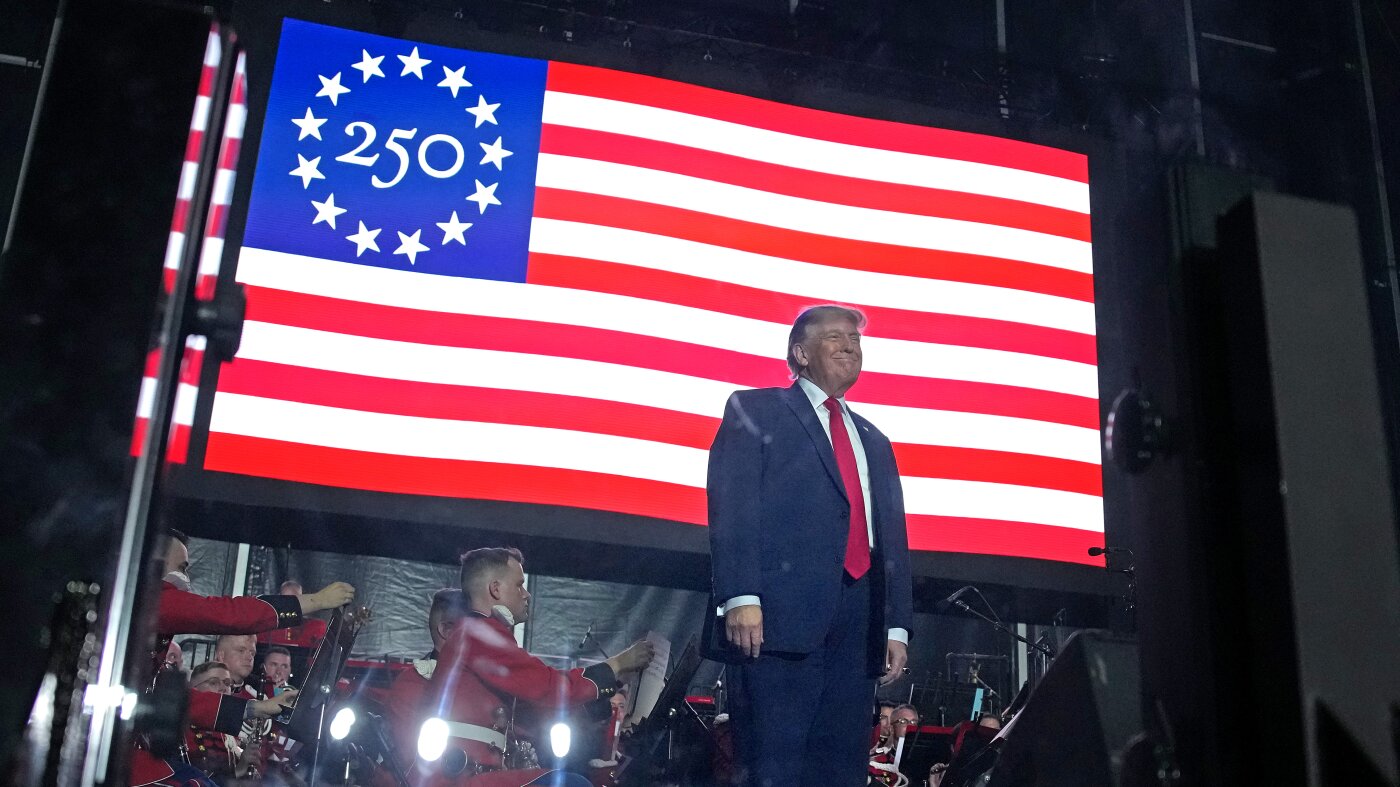
President Trump speaks at a rally kicking off the Great American State Fair last week, part of the anniversary celebrations organized by White House-backed group Freedom 250.
Andrew Harnik/Getty Images
hide caption
toggle caption
Andrew Harnik/Getty Images
As America’s birthday celebrations kick into high gear, so too do criticisms of the preeminent national group organizing them, Freedom 250.
Democrats on the House Natural Resources Committee published a 55-page report Thursday accusing the group of aiding President Trump in turning America’s milestone into a “hotbed of corruption and self-enrichment” through tactics that potentially amount to criminal fraud.
It’s titled “From Vanity to Insanity: How the White House Cheated the American People out of their 250th Birthday.”

Rep. Jared Huffman of California, the ranking Democrat on the committee, told NPR that the report was months in the making. It is based on interviews with unnamed whistleblowers, sworn Congressional testimony, internal Freedom 250 documents and other written responses.
“We put it all together to really tell the story … of how Donald Trump hijacked what should have been a unifying national celebration and repurposed it for his own interests,” Huffman said in a Zoom interview. “This was a team of operatives using the Freedom 250 shell company, but it was also Donald Trump himself telling them what to do.”
The White House referred a request for comment to Freedom 250, though Freedom 250 told NPR that it does not speak for the White House.
Freedom 250 is the public-private partnership behind some of the summer’s most high-profile anniversary events, including a UFC fight outside the White House in June, a controversial state fair on the National Mall, a July Fourth fireworks show opening with a Trump rally, and the “Patriot Games,” a high school athletic competition scheduled for August.
It was created via executive order last year, and describes itself as “the national, non-partisan organization leading the celebration of our Nation’s 250th birthday.” But it’s not the only one: Congress had created a nonpartisan commission called America250 for this same purpose in 2016.
Democratic critics and watchdog groups say Trump decided to forge ahead with his own group after unsuccessful attempts to pack America 250 with his allies. Freedom 250 was incorporated as an LLC in October 2025 under the National Park Foundation, the nonprofit arm of the National Park Service, whose board now includes a number of Trump loyalists, including Chris LaCivita, senior adviser on his 2024 campaign.

Visitors can buy Freedom 250 merchandise at the state fair on the National Mall.
Al Drago/Getty Images
hide caption
toggle caption
Al Drago/Getty Images
Thursday’s report describes Freedom 250 as “a shadow organization capable of infiltrating the celebrations and injecting America’s 250th with Trump’s extreme, partisan agenda.”
Several of its events, like the “Great American State Fair” and a prayer gathering on the National Mall, have been criticized for their sanitized presentation of history and overtly Christian bent. The report accuses the group of funding its programming through opaque and questionable avenues, including soliciting foreign funds, misleading donors and selling access to the president.
“Once you siphon off the funds and supplant the real bipartisan commission with this new entity and you declare it the main platform for our nation’s celebration, and you award all these shady contracts to your friends, you can do anything you want,” Huffman said. “And what these folks chose to do was to push a very divisive, very extreme and explicitly sectarian religious agenda into all these materials in our name, using our taxpayer dollars.”
Some of the accusations, if true, could be found to violate federal law. For example, the report alleges that the deception of donors who thought they were supporting America250 — but were actually given banking information for Freedom 250 — could constitute wire fraud.

Freedom 250 spokesperson Danielle Alvarez denied the report’s claims as “categorically false,” calling it a “partisan smear.”
“Congressional members should be ashamed they are spending countless hours fabricating a report instead of joining Americans in creating an absolutely beautiful celebration,” Alvarez wrote in a statement shared with NPR.
The report has not been adopted by the Natural Resources Committee, so does not reflect its official view. Republicans on the committee have so far refused to conduct any oversight on the issue, despite Democrats raising concerns at previous hearings. Republican ranking member Rep. Bruce Westerman did not respond to NPR’s request for comment.
Huffman said his team had tried for nearly a year to get information from Freedom 250, but faced “resistance and obstruction every step of the way.”
“I would hope that Freedom 250, if they claim that … there’s nothing to see here, open up your books,” he said. “Give us the documents that we’ve asked for, and the information we’ve asked for.”
Huffman said his investigation will continue well past July Fourth, especially if Democrats reclaim the House in this fall’s midterm elections. In that case, he didn’t rule out the possibility of subpoenas or criminal referrals if applicable.
Regardless, he believes more information and witnesses will come to light — and says a full accounting is critical to prevent such a playbook from being used again.
“We may not be able to undo the damage they’ve done to us and the national celebration,” Huffman said. “But we can do something very patriotic by reminding everyone that our government belongs to all of us, not to Donald Trump.”
What the report alleges
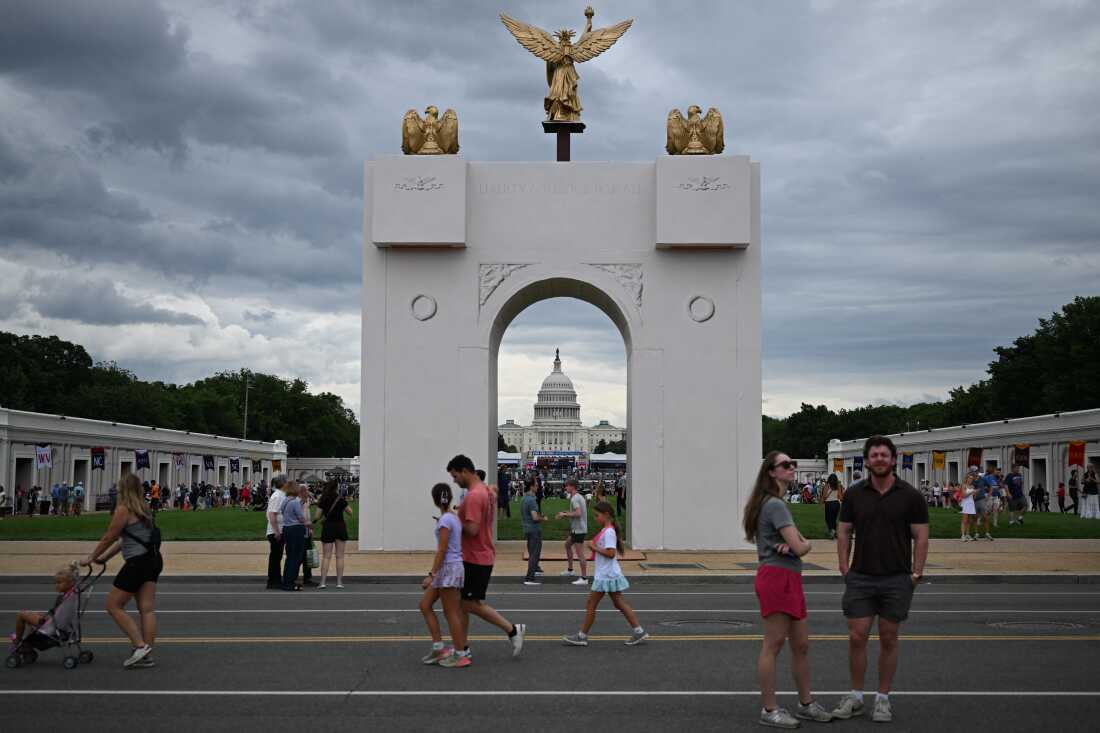
Trump also wants to commemorate the anniversary by building a 250-foot arch, a replica of which stands at the state fair.
Alex Wroblewski/AFP via Getty Images
hide caption
toggle caption
Alex Wroblewski/AFP via Getty Images
The report accuses Trump of long wanting to place himself at the center of the anniversary agenda. It points to events held on his birthdays — last year’s Army 250th parade and this year’s White House UFC fight — and longer-term projects like his plans to build a 250-foot-tall triumphal arch.
It alleges that when America250 resisted that vision, the Trump administration turned the National Park Foundation from a “beloved nonprofit into a presidential shell” by standing up Freedom 250 under its auspices.

It is not clear where that directive came from: Secretary of the Interior Doug Burgum, who serves as ex officio director of the foundation’s board, testified before Congress in May that he was “not aware of the final decision maker on Freedom 250.” That same month, he told CNN the organization is “run out of the White House.”
In any case, Freedom 250 emerged with more visibility and more federal funding than America250.
Alvarez, of Freedom 250, says it “stepped in to rescue our nation’s 250th birthday from years of wasted time, wasted money, and failed planning.” But the report argues it supplanted America250 “through a series of diversions and misrepresentations that drained the chartered Commission of the resources it needed to function.”
The report says Congress allocated $150 million in federal funds last year to the Interior Department for events celebrating the 250th anniversary, with the “understanding” that $100 million of that would go to America250. The group has only received $25 million, it says, citing unnamed sources.
A statement from Freedom 250 says no funds were specifically earmarked for one entity over the other, so “claims that federal funds were ‘diverted’ from America250 to Freedom250 are baseless.”
When asked for comment, America250 Chair Rosie Rios — who served as U.S. treasurer under President Obama — did not address the report. She said the organization “will continue to focus on the values-based programming approved by our bipartisan Commission” and is “supportive” of organizations planning events for the 250th.

The America250 logo is seen on a White House Christmas tree skirt in December. That group is less visible than Freedom 250, but is planning many community-based anniversary events and a concert in Los Angeles.
Anna Moneymaker/Getty Images
hide caption
toggle caption
Anna Moneymaker/Getty Images
The report alleges that Freedom 250 was advertised as an addition to America250 rather than as its replacement, creating confusion. For example, many of the performers who withdrew from a scheduled concert last month said they had falsely believed the event was nonpartisan (it was later rebranded as a Trump rally).
The report alleges that Freedom 250 capitalized on donors’ confusion in a way that potentially amounts to fraud.

“Donors who intended to support America250 were misled and apparently provided with Freedom 250’s banking information, meaning contributions solicited in the name of the nation’s nonpartisan birthday foundation were routed instead to the President’s substitute entity,” it reads.
Freedom 250 said in a statement that “every major sponsor received documentation identifying Freedom 250 as the recipient’s organization before funds were transferred, and donors were free to decline.”
Alan Zibel, a researcher with the progressive consumer advocacy nonprofit Public Citizen, called those allegations “very troubling.” He applauded House Democrats for looking into them, even though they don’t have subpoena power at the moment.
“They’ve given House Democrats, should they take the majority next year, months and months of investigative work to do,” he said. “And there are some pretty rich target opportunities.”
Many questions remain
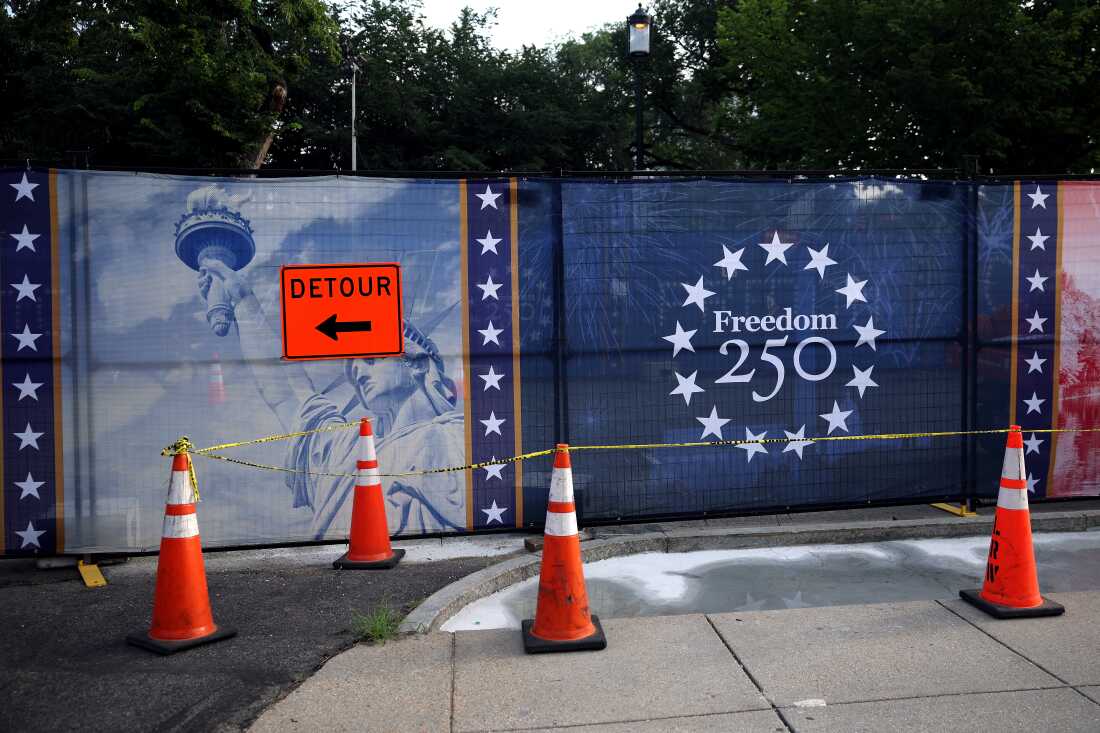
The Freedom 250 logo is visible on fencing around the National Mall on Thursday.
Kevin Dietsch/Getty Images
hide caption
toggle caption
Kevin Dietsch/Getty Images
The bigger-picture problem, critics say, is the lack of transparency throughout the entire process.
“All of these things have been so thoroughly conducted outside of public view,” said Toni Aguilar Rosenthal, a program director at the nonprofit Revolving Door Project. “But I think the House Dems’ report is an excellent extension of those sort of remaining questions that continue to plague just the entire situation and Freedom 250 organizationally.”
Aguilar Rosenthal co-authored a separate report on Freedom 250’s contracts and tactics, along with Zibel from Public Citizen.
Based on their analysis, Aguilar Rosenthal said of the more than $120 million in public funds funneled toward the anniversary celebrations, over $100 million has been “funneled” directly to projects, events and entities with ties to the Trump administration.
Some of those public contracts raise particular alarm among watchdogs. Federal contracts have directed tens of millions of dollars to a company called Event Strategies, Inc., which helped organize Trump’s infamous rally outside the U.S. Capitol on Jan. 6, 2021.

“They had a chance to do this in a bipartisan way or a way that wouldn’t enrich cronies, but they pretty clearly didn’t do that,” said Zibel. “I think that this is a follow-the-money situation that needs to be explored.”
Zibel says many companies — including major defense contractors and tech firms — that have donated to the 250th celebrations also rely on the government for contracts, funding and regulatory oversight. The report mentions that Freedom 250 circulated sponsorship packages culminating in a photo op with Trump, effectively selling access to the president.
Both reports raised questions about potential foreign influence. Alvarez, of Freedom 250, says it does not accept foreign donations.
But Keith Krach, a former Trump administration official who is the CEO of Freedom 250, appeared to solicit just that while speaking at the World Economic Forum in Davos, Switzerland, earlier this year, offering “toolkits for countries, states, companies, all of that.”
“What could be funner than marketing America, or really marketing freedom,” Krach said.
There is little visibility into the origins and destinations of donations in general, Aguilar Rosenthal says. Best case, they are still being used for some of America250’s original goals, she says. Worst case, she says, “public dollars and funds that have been earmarked for semiquincentennial celebrations are being used as a slush fund” for the administration and its political allies.
The report says the National Park Foundation’s donor structure “conceals the identities of those who give and the benefits they may be promised in return.” And at a congressional hearing in February, the foundation’s president and CEO, Jeff Reinbold, promised anonymity for any Freedom 250 donors who requested it (but said donations would otherwise be disclosed in the regular reporting process).
Huffman conceded that any anniversary celebration of this scale would merit scrutiny over spending and contracts. But he said if this had been organized by the bipartisan commission that Congress authorized — with representation from both parties to ask questions and do oversight — it would have been more transparent.
“There would have been public reporting,” he said, “because a publicly-created commission from Congress can’t hide behind the cloak of secrecy of an LLC.”


Swift has attended fashion’s biggest night, the Met Gala, a handful of times over the years. Perhaps no appearance was more memorable than 2016’s event where it was not her dress, but her hair that made an impact. Swift’s bleached platinum bob at the star-studded fund-raiser that year was part of a short-lived era known as “Bleachella” to some fans.
Some fans believe the 2016 event, which both Swift and her ex-boyfriend, the actor Joe Alwyn attended, is where the couple might have first encountered one another. A moment Swifties think the songstress referenced in “Dress,” singing “flashback when you met me, your buzz cut and my hair bleached,” a line that describes how both stars looked that night.
For her first time as host on “Saturday Night Live,” a then 19-year-old Swift arrived having already written the song she would sing as the opening monologue. Seth Meyers, the show’s head writer at the time, later recalled bringing Swift into Lorne Michaels’s office, where she performed a “perfect” musical monologue and noted it was better than what the show’s writers had concocted for her to deliver. Swift has served as host and musical guest on the sketch-comedy show over the years. She’s also made repeated cameo appearances, including appearing alongside Kerry Washington and Betty White in a “Californians” sketch in 2015 for the show’s 40th anniversary.
In 2023, Swift and Travis Kelce both made cameo appearances on the show. The same day, they were also spotted by tabloids holding hands in New York City, one of the earliest public glimpses of them as a couple.
The iconic arena in Midtown Manhattan will serve as the venue for a private, two-day event around the wedding of Swift and Kelce on July 2 and 3. The first event will reportedly be a smaller gathering of 100 people for a rehearsal dinner at the Infosys Theater, a venue inside the Garden, while as many as 1,000 guests are expected to arrive at the venue the next day for a larger celebration, with possible stage appearances. Swift has some history with the Garden, performing there several times over the years, as well as sitting courtside and cheering the Knicks to a win during a game earlier this summer.
Whenever the singer is spotted coming and going from the Greenwich Village recording studio — which was founded by Jimi Hendrix and has hosted icons like the Rolling Stones and Chuck Berry over the years — fans are immediately abuzz with whispers about new music. Swift has worked there with Jack Antonoff, her longtime collaborator, on albums including “Lover” and “Folklore,” as well as re-releases of her older albums.
Swift has been spotted plenty of times at this Italian hot spot in the West Village neighborhood of Manhattan, most recently in May, celebrating Lena Dunham’s 40th birthday. If you can’t get a table, try your hand at making their famed — and delicious — salad dressing.
For a period between 2016 and 2017, Swift rented a four-story townhouse in Manhattan’s West Village. The pad appears to have inspired her 2019 track “Cornelia Street” from the album “Lover.” It’s a road she’ll never walk again, at least according to her lyrics.
Fans still regularly visit the house, even though it has been nearly a decade since Swift inhabited the home, which has an indoor swimming pool. In 2023, some Swifties made pilgrimages to the location after news broke on her split with the actor Joe Alwyn, whose relationship fans believe to be the inspiration for many of the tracks on “Lover.”
Swift’s residence in the TriBeCa neighborhood of Manhattan has grown over the years. She initially bought two penthouses from the “The Lord of the Rings” director Peter Jackson in 2014. A fan who once visited the apartment recalled Swift’s father saying that when his daughter first viewed the place, the actor Ian McKellen, who had been living there, was sitting in the kitchen. She has since purchased several adjacent properties.
Fans have seen glimpses of the home on social media over the years and, more recently, watched Swift use a fire extinguisher to put out a small candle blaze in the kitchen in a video posted by Swift’s recent musical collaborator Gracie Abrams.
Good luck getting a table here if you are not Swift or Kelce. The upscale American restaurant in SoHo is known for comforting dishes like a French dip sandwich and an ice cream sundae, as well as its savory sour-cream-and-onion martini from the cocktail menu. Swift has visited several times — including outings with Gigi Hadid and Sabrina Carpenter.
In “Delicate,” Swift sings of an unnamed “dive bar on the East Side.” Swifties believe this dark speakeasy on East Seventh Street is that bar. Fans also believe the song was written about Swift’s ex-boyfriend, the actor Joe Alwyn. The pair broke up in 2023; later that year she met Kelce.
This exclusive, members-only club in Lower Manhattan is frequented by plenty of celebrities, including Swift. The club bans photography and videos, as well as members of the media, and patrons are barred from identifying others in the room on social media or to the press.
Still, even with the privacy rules, there have been plenty of posts and photos documenting Swift coming and going from Zero Bond. There was a visit in 2023 with the actor Miles Teller and his wife, Keleigh, as well as a recent celebratory evening with the Haim sisters in June after the group watched the Knicks win at Madison Square Garden in matching shirts. There have also been multiple visits with Kelce over the years.
Swift spent part of her 34th birthday celebration at this rustic American restaurant on the Lower East Side of Manhattan. Wearing a black minidress bedazzled with a moon and stars — a nice nod to the visual themes of her “Midnights” era — she partied the night away at Freemans’ upstairs cocktail bar with guests including Jack Antonoff, Blake Lively, Zoë Kravitz, the Haim sisters, Sabrina Carpenter and her childhood best friend, Abigail Anderson Berard, who was immortalized in Swift’s song “Fifteen.” The pop star was also seen dining here with Gracie Abrams earlier that same year.
People line up for hours — yes, hours — to secure a spot at this restaurant in the Carroll Gardens neighborhood of Brooklyn. The brick-oven pizza spot, which is B.Y.O.B. and cash only, is a favorite of pizza connoisseurs — though not those at The New York Times — and celebrities alike. (Its owner has said he does not accept reservations.) Beyoncé, Jay-Z, the Beckhams and, of course, Swift have all been seen dining here, though unclear if they had to sweat it out in the line like us mere mortals. Swift, who once sent her dad to hand out pizzas, though likely not from Lucali, to fans camping out in New York to watch her perform on “Good Morning America,” has shared meals here with famous friends including Blake Lively and Selena Gomez, as well as a date night with Kelce.
The Brooklyn neighborhood where, if Swiftie lyrical interpretations are to be trusted, Swift left a now-infamous scarf at the home of one Maggie Gyllenhaal around 2010. Swift was dating Gyllenhaal’s brother, Jake, at the time and their relationship is believed to have inspired Swift’s “All Too Well,” a 2012 heart-wrencher of a song beloved by many fans, which Rolling Stone once ranked as her best song. “You keep my old scarf from that very first week,” Swift sings. In 2017, Maggie Gyllenhaal told Andy Cohen on “Watch What Happens Live” that she was “in the dark about the scarf.”
Swift later released an updated, 10-minute version of the track in 2021. A red scarf featured prominently as a thematic motif in “All Too Well: The Short Film,” which Swift also released that same year.
-
Lifestyle5 minutes ago
House Democrats accuse Trump of ‘hijacking’ America’s 250th birthday for his own gain
-

 Technology17 minutes ago
Tesla driver faces manslaughter charges over Texas crash that killed a woman inside her home
-

 World20 minutes ago
Six Kurdish fighters killed in IRGC ambush as clashes spread across western Iran
-

 Politics25 minutes ago
Sanctuary county refused 615 ICE transfer requests, turned over just 11 illegal immigrants, records show
-

 Health32 minutes ago
Mystery parasite leaves Americans battling ‘explosive’ illness as CDC investigates
-

 Sports35 minutes ago
2026 World Cup Round Of 16 Odds: Who’s Favored To Advance?
-

 Technology45 minutes ago
Fox News AI Newsletter: American manufacturer says AI is creating jobs, not replacing them
-
Business50 minutes ago
First recorded Tesla Semi crash kills two people in Nevada


