Politics
Newsom calls the Democratic brand 'toxic' as he defends his podcast

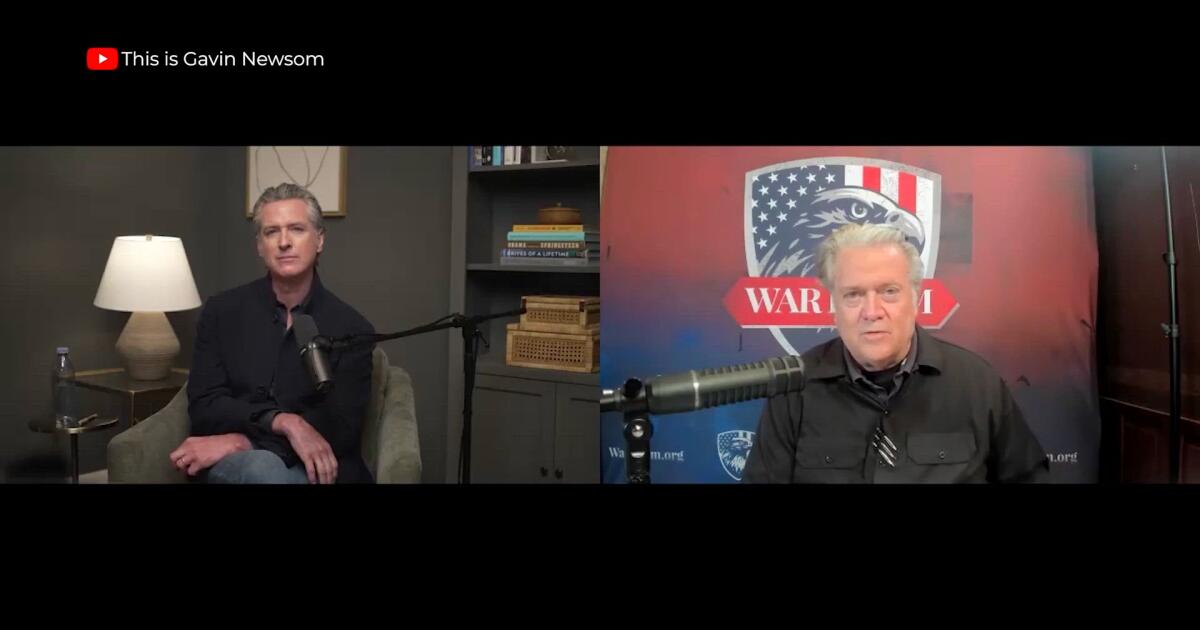
SACRAMENTO — Since his podcast debuted in March, Gov. Gavin Newsom of California has flummoxed Democrats who fear that the politician they considered a liberal prizefighter is turning MAGA-friendly.
The rap against “This Is Gavin Newsom,” in which the governor spoke out against trans athletes competing in women’s sports and disavowed the gender-inclusive term “Latinx,” is that he doesn’t sound like the Newsom they know at all.
“What in God’s name is going on with Gavin Newsom?” asked CNN anchor Erin Burnett, quoting a headline criticizing the podcast, during a recent segment ripping the governor’s apparent shift.
“The country is trying to figure out how he went from progressive hero and governor of the most liberal state in the country to interviewing and spending time with MAGA favorites like Steve Bannon and Charlie Kirk.”
The Democratic governor was also surprised, but by the response.
“I did what I said I was going to do. I mean, when I launched this, I said I was going to have, not debates with people I disagree with, I said we’re gonna have people on we disagree and agree with to have civil conversations to try to understand each other at this time of such polarization,” Newsom said in an interview with The Times on Friday. “And I said I was going to specifically meet with members of the MAGA movement. And then we did it and people were shocked.”
A common takeaway from the podcast is that Newsom is attempting to shape-shift into a moderate as he gears up to run for president in the aftermath of the Democratic Party’s disastrous 2024 election.
Newsom disputed that “exhausting” assumption, which he said others have attributed to actions for more than two decades. The governor offered his own blistering critique of his party to explain why he’s sitting down with controversial GOP figures now.
“Because our party’s getting our ass kicked,” Newsom said. “Because the Democratic Party brand is toxic. Because people don’t think we make any damn sense. They think we make noise. They don’t think we support them. You fill in the generic them. They don’t think we have their values. They think we’re elite. We talk down to people. We talk past people. They think we just think we’re smarter than other people, that we’re so judgmental and full of ourselves.”
The governor paused to say he loves his party, but “we’ve lost our way” and he wants people to know he hears it.
“I think you do that by having people you disagree with [on the podcast] without being disagreeable.”
It’s not the first time the governor has disagreed with his fellow Democrats.
As speculation mounted about whether then-President Biden was fit to run for president last summer, Newsom called the chatter from his own party “unhelpful” and “unnecessary” as he encouraged Democrats to back the president. A year earlier, he scolded the Democratic Party for its passive response to Republicans and for its lack of an offensive political playbook.
Newsom created headlines across the country in the premiere episode of his podcast when he told Kirk, a conservative activist and Trump loyalist, that allowing transgender athletes to compete in women’s sports is “deeply unfair.” Newsom’s comments represented a clear break from progressives.
The backlash from the left was swift. Newsom was accused of deserting his core LGBTQ+ constituency and flip-flopping after old social media posts surfaced with him expressing support for the California law signed by former Gov. Jerry Brown that gave trans students more rights in public schools, including the ability to compete in sports and use bathrooms based on their gender preference.
Newsom’s position aligned with 66% of American adults, who in a Pew Research survey in February said trans athletes should be required to compete on teams that match their sex assigned at birth.
The governor also was criticized for suggesting, in his podcast with Kirk, that no one in his office used the term “Latinx,” a gender neutral term, to describe Latinos, despite direct quotes of the governor that prove otherwise. A Pew poll from 2024 found that only 4% of Latinos describe themselves as “Latinx.”
Eric Jaye, the chief consultant for Newsom’s 2003 mayoral campaign, said the governor is an astute politician, though he disagreed with his decision to speak out against transgender athletes.
“San Francisco has produced many extraordinary politicians — Nancy Pelosi, Dianne Feinstein, Willie Brown, Kamala Harris — but in terms of the ability to adapt to changing political times and climes, Gavin Newsom’s head and shoulders above all of them,” Jaye said. “He’s deeply, deeply attuned to which way the political wind is blowing and he has so far shown an extraordinary ability to navigate changing political weather.”
“Now the challenge is, the question will be, at what point does that stop seeming like someone adapted to changing times and start seeming inauthentic, if not outright fake?”
On Friday, Newsom said he understood why people might view his podcast as a departure from his liberal image, shaped largely by his groundbreaking support for gay marriage as mayor of San Francisco and as an advocate for universal healthcare.
But the governor said his politics has never fit into an “ideological prism.”
Anyone who knows him, he said, remembers when he was the “small business supervisor” in San Francisco, raging against the board for raising fees on business owners and championing “Care Not Cash,” a policy to take welfare checks from homeless people and use the savings to pay for treatment options.
“I’m open to argument,” Newsom said. “I’m interested in evidence. I have very strong values. I’m a progressive but I’m a pragmatic one, and that’s something that anyone who has followed me knows, and people that don’t, they’re learning a little bit about that now.”
Still, Newsom always has been the main architect of his public image.
A wine entrepreneur allied with the business community, he ran as a moderate to win the mayor’s office in 2003 against a Green Party candidate. “Care Not Cash” was widely panned by progressives but helped seal his victory.
When Newsom set his sights on the biggest political prize in California in the 2018 governor’s race, he ran as a progressive advocate for single-payer healthcare and pledged to build more affordable housing.
Yet even as he effused his liberal platform, Newsom couldn’t shake criticism from his opponents that his positions were a mirage.
Former Los Angeles Mayor Antonio Villaraigosa, a moderate Democrat, accused Newsom of selling “snake oil” with his support for single-payer healthcare in order to win over the nurses union and progressives.
Newsom delivered some of his campaign pledges in his first term as governor. He successfully advocated for universal preschool and state-sponsored healthcare coverage to all income-eligible Californians regardless of immigration status. He also paused death row executions.
The governor, who has a close relationship with the tech industry and counts Google founder Sergey Brin and Salesforce Chief Executive Marc Benioff as his friends, has shown more of his moderate side in his second term.
He drew criticism from truck drivers for rejecting their push to require more regulation of autonomous big rigs. He vetoed a marquee bill last year that would have required artificial intelligence developers to put safeguards on the technology. Newsom rebuffed Hollywood unions when he rejected a bill that would have allowed workers to receive unemployment benefits when on strike.
He made a show this year of saying he would veto a bill for a second time that sought to restrict the state prison system’s ability to coordinate with federal immigration authorities attempting to deport felons. He’s also rejected proposals to allow immigrants who are in the country illegally to participate in a subsidized home loan program and to allow undocumented students to work at public universities.
Lorena Gonzalez, president of the California Federation of Labor Unions, said she wasn’t shocked to see Newsom appear more moderate on the podcast.
“He has always been more or less a tech bro from Northern California with the same kind of politics as we thought,” Gonzalez said.
Perhaps, she said, “He’s done playing liberal and now he’s just going to be himself.”
Steve Kawa, Newsom’s chief of staff as mayor, scoffed at the idea that Newsom has changed. He said the governor has always been interested in speaking to people on all sides of a policy idea. Politicians, like regular people, aren’t one-dimensional.
“Maybe he’s moderate on this issue,” Kawa said. “Maybe he’s progressive on this issue. I don’t think he looks at it in terms of under what column is this solution to make life better for the public and I can only be in this column.”
To criticism that he appears too comfortable talking to Bannon, a Trump campaign architect, and Kirk one day and Democrats such as Minnesota Gov. Tim Walz and commentator Ezra Klein the next, Newsom said he meets with people he disagrees with all the time. He mentioned his 90-minute sit-down with Trump in the Oval Office.
“That’s called life,” Newsom said. “I don’t decide who my friends are on the basis of their politics. I’d never met Charlie Kirk. I’d never met Bannon, but I know people that think like them and they’re good parents and they’re good people, and I vehemently disagree with their politics and they’re Trumpers.”
The amicability he displayed in the podcast toward Republican figures whom Democrats perceive as villains doesn’t come as a surprise to people who have closely followed his career.
“He sounds evenhanded about the views of people that you would think he would find an anathema to his being. That’s because of how he is on a path of existence beyond politics and I think that’s reflected in the podcast,” said David McCuan, a professor of political science at Sonoma State University.
“He’s always lived a charmed life in terms of politics, but there’s also been more to him.”


new video loaded: Jan. 6 Rioter Hired by Pentagon
transcript
transcript
Jan. 6 Rioter Hired by Pentagon
Elias Irizarry, who pleaded guilty to climbing through a broken window at the Capitol on Jan. 6, 2021, now works for an office responsible for uncovering and defending against terrorism plots at the Pentagon.
-
“Full pardon or commutation?” “Full pardon.”
By Alisa Shodiyev Kaff
June 4, 2026

NEWYou can now listen to Fox News articles!
Democrats splintered over a resolution seeking to block the U.S. from assisting Israel’s war against Hezbollah, an Iranian-backed terrorist group, on Thursday.
The measure, offered by progressive Rep. Rashida Tlaib, D-Mich., would require President Donald Trump to withdraw U.S. forces from Lebanon. For months, Israel and Hezbollah, a U.S.-designated terrorist group and Iranian proxy, have been at war in southern Lebanon, but the United States has not joined the conflict.
A bipartisan coalition of lawmakers, including House Minority Leader Hakeem Jeffries, D-N.Y., rejected the measure. Critics argued the resolution could aid Hezbollah and potentially hamstring U.S. military operations in the country.
Tlaib’s resolution failed 92-324, with more than half of House Democrats joining nearly all Republicans to vote it down.
The Lebanon war powers resolution divided Democrats, with House Minority Leader Hakeem Jeffries, D-N.Y., joining Republicans in rejecting the measure. (Aaron Schwartz/Bloomberg)
REP RASHIDA TLAIB MOVES TO BLOCK US OPERATIONS IN LEBANON BUT IGNORES HEZBOLLAH
Rep. Thomas Massie, R-Ky., an Israel critic, was the lone Republican to support Tlaib’s measure. Meanwhile, Reps. Derek Tran, D-Calif., and Betty McCollum, D-Minn., voted present.
House Democratic leaders said shortly before the vote they would oppose Tlaib’s resolution and work with the progressive lawmaker on a narrower measure exempting some U.S. military operations in the country. Their statement also denounced Hezbollah as a “violent terrorist organization” and a “sworn enemy of the United States.”
Tlaib, who has accused Israel of committing “ethnic cleansing” in Lebanon, did not mention Hezbollah in her resolution. She and other proponents of the measure also avoided discussing the Iranian proxy force during heated floor debate over the measure.
Republicans highlighted the omission and accused the legislation’s supporters of serving as “proxies for Hezbollah.”
“Apparently they don’t want to see Israel killing Hezbollah, even though it’s Hezbollah that is killing Israeli children, Israeli adults, Israeli elders,” House Foreign Affairs Committee Chairman Brian Mast, R-Fla., said Wednesday, referring to his Democratic colleagues.
Tlaib asserted that her resolution would only affect U.S. forces actively engaged in hostilities. Republicans, however, disputed that claim and suggested it would hurt U.S. efforts to counter Hezbollah.
“It doesn’t say anything about [whether] you can keep the Marines that are in the embassy,” Mast said, referring to the U.S. embassy in Beirut. “That’s a pretty big oversight. It doesn’t say anything about whether we can keep United States armed forces that are training missions with the LAF [Lebanese Armed Forces]. Again, pretty big oversight.”
Rep. Rashida Tlaib, a Democrat from Michigan, attempted to bar U.S. forces from joining Israel’s war in Lebanon. (Tierney L. Cross/Bloomberg)
RASHIDA TLAIB HIT WITH HOUSE CENSURE THREAT, ACCUSED OF ‘CELEBRATING TERRORISM’ IN PRO-PALESTINIAN SPEECH
The debate turned personal when Rep. Max Miller, R-Ohio, a member of the House Foreign Affairs Committee, linked Tlaib to Hezbollah.
“Hezbollah is a terrorist organization … and its members are butchers that you like to hang out with to a certain extent,” the Ohio lawmaker said, referring to Tlaib.
A shouting match between the two then broke out, with Tlaib demanding that Miller’s remarks be stricken from the record.
The presiding chair ultimately complied with her request, but Miller doubled down on his remarks.
CLICK HERE TO DOWNLOAD THE FOX NEWS APP
“Yes, I said it. I own it, and I stand by it,” Mast said on behalf of Miller on the floor.
Tlaib’s failed war powers resolution comes as Iran has sought to tie Israel’s invasion of Lebanon to its ceasefire negotiations with the United States.
Hezbollah, which has long helped Iran project power in the region, rejected a ceasefire agreement between Israel and Lebanon’s government Thursday.

WASHINGTON — Initial efforts in the Senate failed Thursday to block the $1.8-billion fund that the Trump administration has sought to establish to pay people who claim the government wronged them, though further attempts were likely to come Thursday afternoon.
Republicans narrowly voted down a Democratic amendment to ban the payout fund and then Democrats killed a Republican amendment, which would have prohibited the use of federal money for the fund but would have sent $1.7 billion to the Justice Department’s fraud division.
It was the second effort in Congress to rebuke President Trump in two days, following the House vote Wednesday to rein in Trump’s war powers in Iran.
The dueling amendments were proposed by Senate Minority Leader Chuck Schumer (D-N.Y.) and Sen. Thom Tillis (R-N.C.). They were attached to the reconciliation bill that would fund Immigration and Customs Enforcement and the Border Patrol, a high priority for Republicans.
The votes came as the Senate began a “vote-a-rama,” during which lawmakers were expected to propose a stream of amendments to the immigration bill on various topics.
The Trump administration’s plan for the payment fund — widely seen as a way for Trump to compensate his political allies, including those who participated in the Jan. 6, 2021, attack on the Capitol — set off particular ire from some GOP lawmakers.
The plan has fueled growing unrest within parts of Trump’s party over his governance, compounded by the president’s endorsement of primary challengers to Sens. John Cornyn (R-Texas) and Bill Cassidy (R-La.), as well as Rep. Thomas Massie (R-Ky.), which angered some Republican senators.
Cassidy, who lost his primary and has since voiced strong opposition to Trump’s $1.8-billion fund, became a key player in the Thursday votes, voting down Schumer’s amendment but supporting Tillis’.
On Wednesday, Cassidy joined with Sen. Cory Booker (D-N.J.) to argue in a court filing that the $1.8-billion fund circumvents Congress’ authority and violates the Constitution’s spending and appropriations clauses.
“It is an unconstitutional attempt to spend the People’s money without Congressional approval,” Cassidy and Booker wrote in an amicus brief filed in the federal court case challenging the fund.
The fund was created by the Justice Department to settle a lawsuit brought by Trump against the Internal Revenue Service over the leak of his tax returns. Trump and his sons agreed to drop their personal lawsuit against the government in exchange for the creation of the $1.776-billion fund. Critics immediately questioned the plan, and it drew a rare backlash from Republicans.
In late May, GOP senators derailed plans to vote on the immigration bill over their displeasure with the payout fund and with Trump’s desire to use taxpayer funds for his planned White House ballroom. Senate Republicans removed the ballroom funding from the immigration package Wednesday, another setback for Trump.
The Trump administration sought to back away from its plans for the fund this week, following bipartisan outcry and a federal court ruling that temporarily blocked any payouts from the fund. Acting Atty. Gen. Todd Blanche said Tuesday the administration would end its plans to move ahead with the concept.
But Trump on Wednesday told reporters he didn’t know whether the fund was dead, calling it “a beautiful thing.”
After Schumer proposed the first amendment to ban the fund Thursday morning, the Senate came to a standstill as three key Republican senators deliberated. Schumer framed his effort to ban the fund Thursday as a way to force a referendum on Trump’s plan.
The amendment “offers Republicans a choice: Do you support Donald Trump’s $2 billion taxpayer-funded slush fund, or do you want to protect the American people and their paychecks?” Schumer said on the Senate floor before the vote.
Sen. Bernie Moreno (R-Ohio) urged Republicans to reject the amendment, saying Democrats were planning to “play so many games” on Thursday during the marathon session.
“We are going to fund immigration enforcement and border patrol, and I urge my Republican colleagues to stay united on that singular mission,” Moreno said.
The amendment failed after Cassidy voted against it. Republican Sens. Susan Collins of Maine, Jon Husted of Ohio and Dan Sullivan of Alaska voted in favor.
Schumer’s amendment was uniformly supported by Democrats, including California Sens. Adam Schiff and Alex Padilla.
Tillis, who also voted against Schumer’s amendment, immediately proposed his amendment. Sen. Jeff Merkley (D-Oregon) urged Democrats to oppose it, saying that the proposal would create “a new slush fund” by giving the money to the Justice Department.
“We heard over the last 48 hours that the acting attorney general said that this fund’s not moving forward. All this amendment does is codify what I believe the policy of the DOJ is,” Tillis said on the floor before voting began on his amendment. “This [fund] is unpopular, this administration has said they’re not moving forward with it; this is an opportunity for us to put it to bed.”
Responded Merkley: “Taking one slush fund and eliminating it and then creating a new slush fund still under control of the attorney general is not the way to go. The way to go is to get rid of these slush funds altogether.”
Trump has faced a recent string of failures, including the House vote Wednesday, a court ruling to remove his name from the Kennedy Center and a record-low approval rating among Americans as concern rises about economic issues, gas prices and Trump’s war with Iran.
On Wednesday, Trump lashed out against the four Republicans who backed the House war powers resolution, calling it “an unpatriotic thing” to do and calling the vote “meaningless.”
“They’re GRANDSTANDERS! They should be ashamed of themselves. MAGA!!! President DJT,” Trump wrote.
Times staff writer Ana Ceballos, in Washington, contributed to this report.
-

 Indianapolis, IN8 seconds ago
‘Thrill is gone’: Jason Whitlock says Caitlin Clark fever is over in Indianapolis
-

 Pittsburg, PA3 minutes ago
Pittsburgh promises its largest firework show yet for America’s 250th
-

 Augusta, GA8 minutes ago
Gaines endorses Kendrick in Augusta mayoral runoff
-

 Washington, D.C15 minutes ago
Juvenile injured after gunfire reported in DC’s Michigan Park neighborhood
-

 Cleveland, OH18 minutes ago
Cleveland readies for pre-World Cup soccer match
-

 Austin, TX23 minutes ago
Texas lawmakers discuss rural hospitals
-

 Alabama30 minutes ago
Alabama has one of college football’s toughest schedule stretches in 2026
-

 Alaska33 minutes ago
Former Alaska corrections officer sentenced to 150 years in prison for killing wife and teen daughter

