Politics
More NOAA Employees May Be Let Go, Making 20% of Staff Cut


The National Oceanic and Atmospheric Administration, the nation’s premier agency for weather and climate science, has been told by the Trump administration to prepare to lose another 1,000 workers, raising concerns that NOAA’s lifesaving forecasts might be hindered as hurricane and disaster season approaches.
The new dismissals would come in addition to the roughly 1,300 NOAA staff members who have already resigned or been laid off in recent weeks. The moves have alarmed scientists, meteorologists and others at the agency, which includes the National Weather Service. Some activities, including the launching of weather balloons, have already been suspended because of staffing shortages.
Together, the reductions would represent nearly 20 percent of NOAA’s approximately 13,000-member work force.
Managers within NOAA have been told to draw up proposals for layoffs and reorganizations to trim the agency’s staff by at least 1,000 people, according to eight people who requested anonymity because they weren’t authorized to discuss the plans publicly. The effort is part of the “reductions in force” that President Trump required as part of an executive order last month, as he and the billionaire Elon Musk make rapid, large-scale cuts to the federal bureaucracy.
NOAA managers have been asked to complete their proposals by Tuesday, one of the people said. The proposals are likely to involve eliminating some of the agency’s functions, though managers have received little guidance about which programs to prioritize for cutting.
Representatives for NOAA didn’t immediately respond to a request for comment on Saturday.
The recent employee departures have already affected NOAA’s operations in many realms: predicting hurricanes and tornadoes, overseeing fisheries and endangered species, monitoring the changes that humans are bringing about to Earth’s climate and ecosystems.
NOAA, a $6.8 billion agency within the Commerce Department, has been singled out for cuts by some of Mr. Trump’s allies. Project 2025, the policy blueprint published by the Heritage Foundation that is echoed in many of the Trump administration’s actions, calls NOAA “one of the main drivers of the climate change alarm industry.” The document calls for the agency to be dismantled and some of its functions eliminated or privatized.
Organizations including the American Geophysical Union, which represents earth and space researchers, have called on Congress to oppose the administration’s actions.
“Undermining NOAA’s operations could risk the safety of millions of Americans and destabilize countless industries, from farming and fisheries to energy and finance, threatening job losses and economic downturn,” the organizations wrote in a letter. They pointed out that, as the planet warms, extreme weather is becoming more frequent and more damaging, making NOAA’s work more critical.
The idea that private companies could replace NOAA in forecasting the weather is a “gross misunderstanding,” said Keith Seitter, a distinguished visiting lecturer in meteorology and climate science at College of the Holy Cross in Worcester, Mass.
“The app on your phone or what you’re watching on TV, those are private-sector companies, but those private-sector companies depend critically on NOAA for all the information that they’re using to create those forecasts,” Dr. Seitter said. “It’s a coordinated effort.”
Employees who are still working at NOAA describe feelings of deep anxiety. Their colleagues have been let go unannounced, meaning they have no idea who might simply not show up for work. With their government-issued credit cards frozen, they can’t buy supplies for research projects or travel to retrieve instruments that have been installed at sea. They are scrambling to back up their scientific data, fearful that programs might be shuttered or leases on buildings canceled.
At least three NOAA facilities were on a list of federal properties that the Trump administration flagged last week for possible sale. The list was later taken down, replaced by a web page that said a new inventory was “coming soon.”
The firings of scientists at NOAA and other agencies, plus potential cuts to federal funding for research at universities and hospitals, have fed worries that the administration is undermining the foundations of America’s modern scientific leadership.
On Friday, crowds gathered at “Stand Up for Science” rallies in cities around the nation including Austin, Birmingham, Ala., Boston, Chicago, Denver, Nashville and Washington.
“This is the most challenging moment I can recall for science,” Michael Mann, a climate researcher at the University of Pennsylvania, told the rally in Washington, where the crowd peaked at 5,000 people, according to the organizers. “Science is under siege,” Dr. Mann said.
The National Weather Service has faced budget cuts, hiring freezes and calls for privatization before, Dr. Seitter said. “But nothing where you’ve just arbitrarily whacked whole chunks out of the work force, or potentially taken away whole chunks of budget that support mission-critical things,” he said.



When President Trump sought to overturn his loss in the 2020 election and remain in power, resistance from within his own government helped to stop him.
Top Justice Department officials rejected his specious claims that the vote had been marred by widespread fraud. Senior officials at the Department of Homeland Security refused to go along with his outlandish efforts to seize voting machines. Cybersecurity experts praised the count as secure, and the intelligence community sidestepped his requests to declare that foreign nations had interfered in the results.
But Mr. Trump’s second term looks very different. The president has filled his administration with people who are sympathetic to his baseless claims that the presidential race more than five years ago was stolen.
These officials have been put into positions across the federal government, at the White House and in agencies where they could play a role in undermining the midterm elections and the 2028 presidential cycle.
At the same time, Mr. Trump has maintained allies in Congress and in state governments who could wield significant power over the process of counting votes and the seating of members of the House.
Abigail Jackson, a White House spokeswoman, sidestepped questions about Mr. Trump’s personnel decisions and instead asserted that he was “committed to ensuring that Americans have full confidence in the administration of elections.” She pointed to the president’s efforts to have Congress pass legislation that would require proof of citizenship to register to vote and photo identification to vote, prohibit mail-in ballots and bar the practice of ballot harvesting — having one person turn in mail ballots for several others.
“The vast majority of Americans support President Trump’s common-sense election integrity agenda,” Ms. Jackson said.
Officials from the Department of Homeland Security and the Office of the Director of National Intelligence said that the agencies were focused on keeping elections safe and secure, and were working to carry out the president’s policies on elections. The Justice Department did not respond to a request for comment.
With Mr. Trump consistently seeking to sow doubts about the integrity of elections, the number of election deniers he has installed across the administration means he would face fewer checks on any efforts to undermine an outcome he did not like, and could more easily amplify baseless claims of fraud.
Here is a look at some of the key players.
The White House has no formal or legal role to play in administering elections, but Mr. Trump recently created a presidentially appointed position to oversee election integrity and security.
That job has largely been involved in investigating the 2020 election.
What happened in 2020
Mr. Trump has always been the government’s most avid promoter of false claims that the 2020 election was rigged against him. And in 2020, he routinely used the force of the Oval Office — albeit unsuccessfully — to strong-arm state officials and federal appointees to act on his claims.
Kurt Olsen
Director of election security and integrity
Mr. Olsen was central to opening a recent F.B.I. investigation that led to the search of a Fulton County, Ga., election office in January.
Prior support for claims of election fraud
Mr. Olsen was a pro-Trump lawyer who in late 2020 contacted senior Justice Department officials on Mr. Trump’s behalf, pushing them to file a motion to nullify the election with the Supreme Court.
After 2020, he worked with Mike Lindell, the chief executive of MyPillow and a longtime election denier, to bring many unsuccessful lawsuits challenging the results of other elections and the use of voting machines, based on debunked conspiracy theories. While representing Kari Lake, a former candidate for governor in Arizona, he was hit with sanctions for making false and misleading claims.
Ms. Lake, who tried to reverse her defeat in the 2022 race, has served as the effective head of the U.S. Agency for Global Media. A judge ruled Ms. Lake’s appointment invalid, but the administration says she still works for the organization.
Clay Parikh
Special government employee with a background in cybersecurity
Mr. Parikh is working closely with Mr. Olsen to re-examine claims of fraud in the 2020 election, and was cited as a supposed expert in the F.B.I. affidavit supporting the search of Fulton County’s elections office.
Prior support for claims of election fraud
Mr. Parikh took part in Ms. Lake’s failed efforts to reverse her defeat in the 2022 Arizona governor’s race, and has served as a witness in other cases brought by Mr. Olsen challenging the use of voting machines.
Office of the Director of National Intelligence
In his first term, Mr. Trump issued an executive order that gave the Office of the Director of National Intelligence the ability to make determinations about foreign interference in elections. Such declarations could allow the president to declare national emergencies surrounding elections.
What happened in 2020
Several advisers to Mr. Trump tried to push the intelligence community to determine that foreign entities had meddled in the election, in an effort to justify a move to seize voting machines. The consensus opinion among intelligence agencies was ultimately that countries like China and Russia had not interfered in a significant way.
John Ratcliffe, then the director of national intelligence, disagreed about China’s supposed role, but did not issue his dissent until Jan. 7, 2021, a day after the election had been certified.
Tulsi Gabbard
Director of national intelligence
Ms. Gabbard is helping oversee the Trump administration’s effort to investigate supposed voting irregularities in Georgia, and was present at the F.B.I. search of the Fulton County elections office. Her office also recently seized voting machines in Puerto Rico, to examine them for vulnerability to hacking by foreign entities.
Prior support for claims of election fraud
Unlike others Mr. Trump has installed in government, Ms. Gabbard did not have a history of supporting Mr. Trump’s claims of election fraud. She started to back such claims publicly as the director of national intelligence.
The Justice Department has the power to open investigations into allegations of fraud in elections, a move that could, if nothing else, undermine faith in the results of the upcoming midterms.
What happened in 2020
After the 2020 election, Mr. Trump pressured the department to investigate his baseless claims that the voting had been marred by fraud. He wanted to use those inquiries to persuade state legislatures to refuse to certify his defeat.
Attorney General William P. Barr rejected Mr. Trump’s claims that the count had been compromised, and refused suggestions from the president’s advisers to seize voting machines. Mr. Barr was replaced by Jeffrey Rosen, the deputy attorney general, in late December of that year. He similarly resisted Mr. Trump’s efforts.
Pam Bondi
Attorney general
Last spring, the Justice Department began seeking detailed voter roll data from states, to compile a national voting database. Under Ms. Bondi, it has sued at least 29 states and territories in an attempt to force them to turn over data.
Prior support for claims of election fraud
As a private lawyer, Ms. Bondi helped the Trump campaign seek to overturn the results of the 2020 election in Pennsylvania. She appeared at a news conference with the Trump ally Rudolph W. Giuliani, and falsely claimed that Mr. Trump had won Pennsylvania, even though not all of the ballots had been counted.
Ms. Bondi later served as the litigation chairwoman for the Trump-allied America First Policy Institute, which brought a series of lawsuits seeking to hinder ballot box access or disenfranchise groups of voters.
Kash Patel
F.B.I. director
Mr. Patel is overseeing a criminal investigation into supposed irregularities in the 2020 presidential election that has so far led to the seizure of voting records at the Fulton County election center in Georgia, and the subpoenaing of records in Maricopa County, Ariz.
Prior support for claims of election fraud
During his Senate confirmation hearing last year, Mr. Patel sidestepped questions about whether Mr. Trump had lost the 2020 election, responding only that Joseph R. Biden Jr. had been certified and sworn in as president.
Last summer, Mr. Patel promoted an unsubstantiated theory on his social media account that thousands of fake driver’s licenses seized by customs officials in 2020 were part of a Chinese plot to throw the election that year to Mr. Biden.
Harmeet K. Dhillon
Assistant attorney general for civil rights
Ms. Dhillon has led the Justice Department effort to obtain complete, unredacted voter roll lists from every state in the country, including suing more than half the states in an attempt to force them to turn over the data.
Prior support for claims of election fraud
Ms. Dhillon advocated efforts to overturn Mr. Trump’s loss in the 2020 election, and encouraged people to donate to his legal defense fund. Shortly after the election, she appeared on Fox Business urging Mr. Trump’s appointees on the Supreme Court to “step in and do something” to help him win the race.
She also served as a campaign lawyer for Ms. Lake and assisted her efforts to overturn her 2022 Arizona governor’s race loss.
Eric Neff
Acting Chief, voting section
Mr. Neff leads the voting section at the Justice Department, which is supposed to enforce the civil provisions of the federal laws that protect the right to vote.
Prior support for claims of election fraud
As a Los Angeles County prosecutor, Mr. Neff was placed on administrative leave in 2022 after basing a prosecution of the chief executive of the election management company Konnech on tips from a right-wing group, True the Vote, which has promoted conspiracy theories centered on election fraud.
Mr. Neff also served at one point as a lawyer for Patrick Byrne, the former Overstock chief executive, who advised the Trump administration to seize voting machines during the 2020 election.
Christopher Gardner
Trial attorney, voting section
Mr. Gardner is taking part in a Justice Department effort to secure voting records from Georgia officials.
Prior support for claims of election fraud
As a private lawyer, Mr. Gardner helped file a lawsuit seeking to prevent officials in Georgia from certifying the state’s 2020 election results. He also worked with other Trump-allied lawyers, including Kenneth Chesebro, John Eastman and Cleta Mitchell, to provide legal advice to a fake slate of electors in Georgia. Those electors claimed that Mr. Trump won the state even though Mr. Biden actually prevailed.
Megan Frederick
Trial attorney
Ms. Frederick participated in a Justice Department effort demanding voter rolls from officials in the District of Columbia.
Prior support for claims of election fraud
Ms. Frederick served as a lawyer representing the Trump campaign during the Dane County, Wis., recount in 2020, and took part in efforts to challenge more than 200,000 ballots in the state.
She also worked as a leader of the Only Citizens Vote Coalition, which is part of the election-denying Election Integrity Network, an umbrella organization run by Ms. Mitchell, a stalwart pro-Trump lawyer who tried to overturn his election loss.
Joseph Voiland
Trial attorney, civil rights division
Mr. Voiland is active in the Justice Department’s efforts to gain access to Wisconsin’s voter registration list.
Prior support for claims of election fraud
Mr. Voiland, a former Wisconsin county judge, served as a lawyer for Mr. Trump’s 2020 campaign, and sought to have thousands of ballots in the state thrown out.
Sigal Chattah
First assistant U.S. attorney in Nevada
Last July, Ms. Chattah pushed the F.B.I. to investigate claims that illegal immigrants in her state had cast ballots in the 2020 election, according to Reuters. After a federal judge ruled that she had been unlawfully appointed as interim U.S. attorney, the Justice Department put her in the role of first assistant and gave her a second title as special attorney.
Prior support for claims of election fraud
Ms. Chattah joined the Republican National Committee in 2023 to advocate taking a more hard-line stance on elections, and to oust its chairwoman, Ronna McDaniel, who was seen by Trump loyalists as not doing enough to help Mr. Trump overturn the election results in 2020.
Ms. Chattah was a defense lawyer for one of the people who served as a so-called fake elector in Nevada in 2020. She also sued unsuccessfully to stop a bill that made it illegal in Nevada to harass election officials.
Jeanine Pirro
U.S. attorney in Washington
Ms. Pirro oversees a key federal prosecutor’s office that handles many matters related to the administration of the government.
Prior support for claims of election fraud
After Mr. Trump’s loss in the 2020 election, Ms. Pirro, then a Fox News host, used her show to amplify false allegations that voting machines made by Dominion Voting Systems had been used to rig the tally. Fox ultimately paid nearly $780 million to settle claims by Dominion that the network had defamed it through its coverage.
Department of Homeland Security
The Department of Homeland Security oversees multiple departments that have critical roles in election security, such as the Cybersecurity and Infrastructure Security Agency.
It has also been leading a review of election records, looking for proof of noncitizen voting. (It has not found much.)
What happened in 2020
In the immediate aftermath of the election, the Cybersecurity and Infrastructure Security Agency issued a statement saying that the election was “the most secure in American history.” It contradicted claims of interference and noted that there was “no evidence that any voting system deleted or lost votes, changed votes, or was in any way compromised.”
The statement drew the ire of Mr. Trump, who fired the agency’s director, Chris Krebs, days later.
Markwayne Mullin
Secretary of Homeland Security
The Senate confirmed Mr. Mullin on March 23. During his confirmation hearing, he suggested that he supported the federal investigations into the 2020 election.
Prior support for claims of election fraud
After the 2020 election, Mr. Mullin was one of the more prolific voices in Congress calling for further investigations into vote tallies. He signed a letter to Mr. Trump asking him to direct the attorney general to appoint a special counsel to investigate the 2020 election.
Heather Honey
Deputy assistant secretary for election integrity
Ms. Honey has asserted that the Trump administration could declare a “national emergency” to justify dictating new election rules to state and local governments.
Prior support for claims of election fraud
Ms. Honey repeatedly made claims of voting irregularities in Pennsylvania during the 2020 election, and was centrally involved in the recount of Arizona’s vote tally. She also served as a witness for Ms. Lake’s failed 2022 election challenge in Arizona in a case in which Mr. Olsen worked as a lawyer. She was a leader in Ms. Mitchell’s Election Integrity Network.
Marci McCarthy
Director of public affairs at the Cybersecurity and Infrastructure Security Agency
The agency works to help secure election systems and assets like voting machines.
Prior support for claims of election fraud
Ms. McCarthy also worked closely with Ms. Mitchell’s Election Integrity Network and helped place far-right activists on the local election board in DeKalb County, Ga. She was instrumental in forcing out a member of the Georgia State Election Board who voted against a rule to end mail voting.
Gregg Phillips
Associate administrator of FEMA’s office of response and recovery
While the Federal Emergency Management Agency plays no formal role in assisting elections, its Homeland Security Grant Program has been used for cybersecurity and other election protections in the past, including in 2020, according to the Brennan Center for Justice.
Prior support for claims of election fraud
After the 2016 election, Mr. Phillips claimed without evidence that millions of illegal immigrants had cast votes — an assertion later amplified by Mr. Trump. Leading up to the 2020 election, he worked with the right-wing group True the Vote to attack mail voting as fraudulent.
He also served as the executive producer on the movie “2000 Mules,” a documentary by the conservative commentator Dinesh D’Souza that falsely claimed that a network of “mules” had illegally gathered large numbers of ballots to swing the 2020 election away from Mr. Trump.
David Harvilicz
Assistant secretary for cyber, infrastructure, risk and resilience policy
Mr. Harvilicz oversees policies for maintaining the security of the country’s election infrastructure, including voting machines.
Prior support for claims of election fraud
Mr. Harvilicz has done business with James Penrose, a former intelligence officer who took part in several efforts to seize voting machines after the 2020 election in an attempt to undermine Mr. Trump’s defeat in the race, according to ProPublica. He has also called for doing away with voting machines, and has questioned victories of Democratic candidates.
Politics
Stefanik grills University of Michigan leader on lack of audit after string of Chinese national arrests

NEWYou can now listen to Fox News articles!
Rep. Elise Stefanik, R-N.Y., continued her relentless cross examinations of college administrators Thursday – this time pressing Michigan’s interim president Domenico Grasso on Chinese student spies at the university.
Stefanik wanted to know why Chinese nationals in Michigan were accused of spying on America and his university is not auditing potential national security vulnerabilities in research there.
“Last year, facing congressional pressure, Michigan ended its partnership with Shanghai Jiao Tong University after five Chinese students were caught spying at night and taking illegal photos of U.S. military drills and equipment on the remote Michigan installation Camp Grayling,” Stefanik said. “These students lied and misled U.S. law enforcement about their motives and later conspired on the CCP-controlled messaging app WeChat to clear their phones and cameras of photos and evidence.”
“Has the university conducted a full audit to determine what intellectual property or federally funded research was compromised?” the congresswoman asked.
CHINESE UNIVERSITY OF MICHIGAN STUDENTS CHARGED AFTER ALLEGEDLY SPYING ON MILITARY BASE
Rep. Elise Stefanik questioned interim University of Michigan president Domenico Grasso during a hearing Thursday, March 26, 2026, on Capitol Hill in Washington, D.C. (C-SPAN)
Without an audit, Grasso responded, “we are unaware of any research that was compromised by these individual students,” noting the alleged spying occurred “miles and miles away from campus.”
But Stefanik was nonplussed by the answer.
“I understand Camp Grayling is off campus, but was there an audit conducted?”
TRUMP DOUBLES DOWN ON PLAN FOR 600,000 CHINESE STUDENT VISAS DESPITE MAGA BACKLASH
Rep. Elise Stefanik, R-N.Y., has made headlines with her questioning U.S. academic leaders, during House Education and the Workforce Committee hearings. (Haiyun Jiang/Bloomberg)
Grasso admitted Michigan did not.
“Well, they were not researchers,” he said, doubting “they did something nefarious.” “They were undergraduate students. So, we did not do an audit.”
And, adding, “they did not have any access to any of our research.”
FOREIGN-BACKED INFLUENCE IN SCHOOLS TO BE EXPOSED UNDER GOP ‘TRACE ACT’ GIVING PARENTS ACCESS TO CURRICULUM
But Stefanik noted they were found to be spying.
“Well, they did do something nefarious off campus,” she said. “I think it would be important for the university to ensure that there is a full audit conducted to make sure that no research, that they didn’t take any nefarious acts there.”
CLICK HERE TO DOWNLOAD THE FOX NEWS APP
Grasso admitted he does “not know what all of our researchers are involved in,” but doubted the Department of War would clear them for access to U.S. secrets on campus.
“Congresswoman, we have improved, and we’re continuing to improve our background checks for all of our researchers and students that come into the country, but we also have to partner more closely with our federal intelligence community to make sure that these students are vetted before they’re allowed to get visas to enter our country as well,” he concluded.
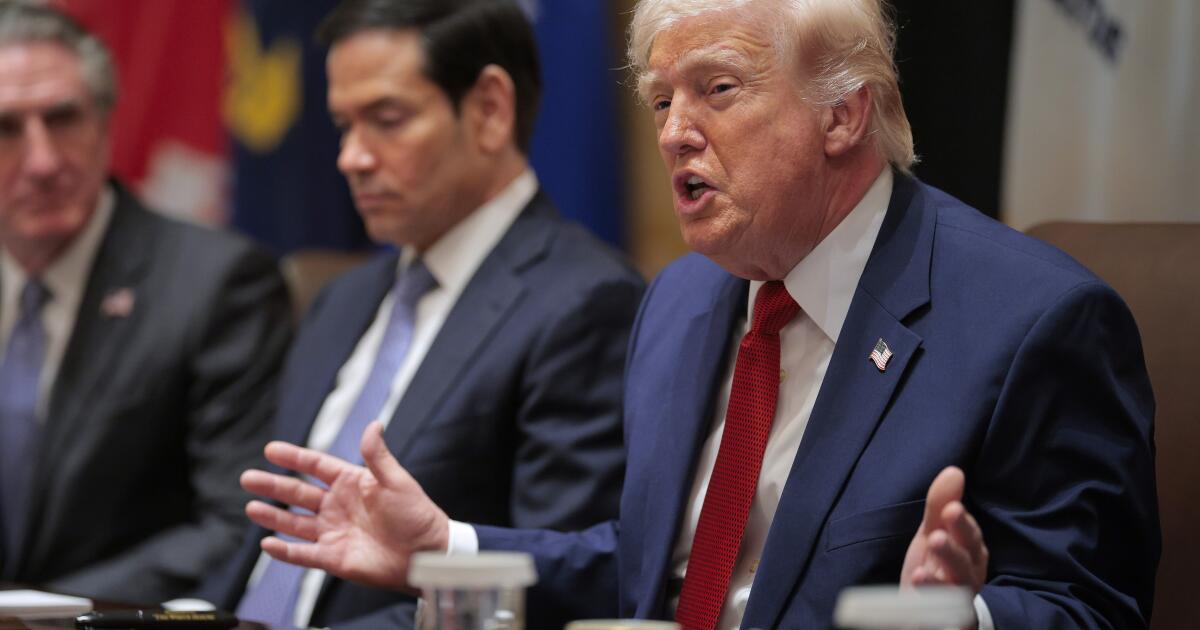
President Trump on Thursday continued projecting confidence in the U.S. war effort in Iran, suggesting online and during a high-level Cabinet meeting that Iran has been “obliterated,” that its leaders were “begging” for a deal, and that the U.S. is “roaming free” over Iran and “NEEDS NOTHING” from its European allies.
His description of the war as all but finished — he actually said “we’ve won” — stood in contrast to the facts on the ground, where Iran continued to launch attacks and threaten oil tanker traffic in the vital Strait of Hormuz, and the U.S. continued sending troops and warships to what is already the largest U.S. military buildup in the Middle East in decades.
Trump’s framing of the conflict also contrasted with that of Iranian officials, who have remained publicly defiant, downplayed negotiations and outwardly rejected several of Trump’s conditions for ending the war — as Trump himself acknowledged, accusing them of saying one thing in private and another in public.
“They better get serious soon, before it is too late,” the president wrote on social media, “because once that happens, there is NO TURNING BACK, and it won’t be pretty.”
“They are begging to make a deal, not me,” Trump reiterated later Thursday, while hosting his first Cabinet meeting since the war began. “Anybody that sees what is happening understands why they are begging to make a deal.”
Trump asserted that Iran’s military capabilities have been destroyed, and that the American mission is “ahead of schedule.” He said American forces were operating without opposition over Iran, and “there’s not a damn thing they can do about it” because they’ve been “beat to s—.”
Trump’s outward confidence, a defining feature of the war campaign that has been consistently echoed by Secretary of Defense Pete Hegseth and other administration loyalists, continued despite growing concerns this week in Congress — and not only from Democrats.
Several Republicans emerged from a classified war briefing Wednesday clearly frustrated with the administration for not providing a clearer picture of the path out of the now monthlong war, or clear answers on whether it planned to deploy ground troops.
“We want to know more about what’s going on,” said Rep. Mike Rogers (R-Ala.), chairman of the House Armed Services Committee. “We’re just not getting enough answers.”
“I can see why he might have said that,” said Sen. Roger Wicker (R-Miss.), chairman of the Senate Armed Services Committee.
Democrats have hammered the president — contrasting the war and its massive budget with rising fuel costs for average Americans and lamenting the deaths of U.S. service members.
“Thirteen American lives lost and tens of billions of taxpayer dollars spent in just three weeks since Donald Trump plunged us into war without congressional authorization. There is still no plan, no clear justification, and no end in sight,” Sen. Alex Padilla (D-Calif.) said. “Americans called for lower prices, not endless wars.”
For weeks, Trump, Hegseth and other war leaders such as Gen. Dan Caine, the chairman of the Joint Chiefs of Staff, have focused on U.S. wins in the conflict — tallying up Iran’s sunken ships and grounded planes, assassinated leaders and undermined missile capabilities.
In recent days, Trump has suggested that, because of those wins, Iran is buckling. He has said the U.S. is pushing a 15-point plan that will forever block Iran from developing a nuclear weapon or threatening the U.S. or its allies. And he and others in his administration have accused the media of ignoring battlefield wins to harp on losses instead.
Israel, America’s major partner in the conflict, has projected similar confidence while showing no signs of slowing its attacks on Iran. On Thursday it announced it had killed several senior Iranian naval commanders, including Commodore Alireza Tangsiri, the head of the Islamic Revolutionary Guard Corps’ navy.
Israel’s Defense Minister Israel Katz said the deaths should send a “clear message” that Israel will continue to hunt down top Iranian military officials. Iran did not immediately acknowledge Tangsiri’s death.
The head of U.S. Central Command, Adm. Brad Cooper, praised Tangsiri’s killing, said U.S. strikes would continue, and called on Iranian fighters to “immediately abandon their post and return home to avoid further risk of unnecessary injury or death.”
Meanwhile, death, destruction and environmental and economic damage from the war spread far beyond Iran, where officials recently increased their estimated death toll to nearly 2,000.
Israel was fighting off a barrage of incoming missiles Thursday, with booms heard in Tel Aviv and Jerusalem and an impact reported in the central town of Kafr Qassem. Israel was also continuing its offensive against Hezbollah in Lebanon, where the death toll had risen to 1,116, Lebanon’s Health Ministry said Thursday.
Iraqi Defense Ministry spokesman Maj. Gen. Tahsin al Khafaj on Thursday said 23 people had been wounded in a Wednesday strike on a military clinic in western Iraq’s Anbar province.
Israeli soldiers grieve during the funeral of Staff Sgt. Ori Greenberg, 21, at the Mount Herzl military cemetery in Jerusalem on Thursday.
(Odd Andersen / AFP via Getty Images)
Thousands of additional U.S. troops are on their way to the region, while many of the tens of thousands already stationed there have been displaced into hotels and other temporary housing — diminishing their war-fighting capabilities — by ongoing Iranian attacks that have left the 13 regional military bases they normally live on “all but uninhabitable,” the New York Times reported.
Iran announced Thursday that it had launched drone and missile attacks on a U.S. military base in Kuwait and a separate air base used by American forces in Saudi Arabia.
Jasem Mohamed al-Budaiwi, the secretary-general of the Gulf Cooperation Council, accused Iran of charging fees for ships to safely transit the Strait of Hormuz, continuing the economic toll on global oil supplies. Environmental experts warned of massive pollution from burning oil and gas fields.
France’s Defense Ministry said Thursday that nearly three dozen countries had joined military talks about how to reopen the strait “once the intensity of hostilities has sufficiently decreased.”
Russia, emboldened by the Iran war, which has drawn resources away from Ukraine and led the U.S. to ease sanctions on Russian oil, has launched a renewed spring offensive against Ukraine.
The distance between U.S. and Iranian messaging about the war and their negotiations to end it — which foreign officials have said are occurring through intermediaries — has contributed to the tensions and the reluctance of allies to get involved, with some citing similar frustrations as Republicans in Congress this week.
Many allies have largely stayed out of the conflict despite Trump vacillating between demanding their help and insisting it isn’t necessary.
In one of his posts to social media Thursday morning, Trump blasted allies in the North Atlantic Treaty Organization, or NATO, for having “DONE ABSOLUTELY NOTHING TO HELP” in the conflict, and said the U.S. would “never forget.”
Asked during his Cabinet meeting about his desire to end the war soon, Trump said he was “the opposite of desperate” — “I don’t care,” he said — and that there “are other targets that we want to hit before we leave.”
Trump said that when the “right deal” is made with Iran, the Strait of Hormuz will reopen — while insisting that Iran no longer has any “mine droppers” that would threaten merchant vessels passing through the key oil route.
Steve Witkoff, one of Trump’s top advisors leading the negotiations in the Middle East, said the Iranians were looking for an “offramp,” that Pakistan is serving as a mediator between Washington and Tehran, and that the 15-point plan Trump had mentioned “forms the framework for a peace deal.”
“These are sensitive, diplomatic discussions and you have directed us to maintain confidentiality on the specific terms and not negotiate through the news media, as others do,” Witkoff said. “We will see where things lead and if we can convince Iran that this is the inflection point, with no good alternatives for them other than more death and destruction.”
Trump has declined to say whom Washington is negotiating with in Iran, but described them as “very smart,” “not fools,” and “very lousy fighters, but great negotiators.”
He also said he knows they are “the right people” for the U.S. to be dealing with because they had given him a “present” — and proved they are in control — by allowing “eight big boats of oil” travel through the strait this week.
Asked if he intended to send U.S. troops into Iran to take its enriched uranium, he called it a “ridiculous question” that he wouldn’t answer.
Treasury Secretary Scott Bessent said he is confident that more merchant vessels will soon be able to safely pass through the Strait of Hormuz, and energy prices will drop when the war ends.
“Many people, especially the Democrats, underestimate the will of the American people for short-term volatility for 50 years of safety that we are going to have on the other side of this,” Bessent said.
Hegseth repeatedly slammed the media for framing the war effort as floundering or unfocused, saying Iran’s “air defenses are gone,” its leaders hiding in “underground bunkers,” and its fighters losing morale.
He said Iranian officials in private are admitting “very heavy losses,” and that the U.S. and the world are benefiting from having Trump, whom he called the “ultimate deal maker,” working toward a peace deal.
In the meantime, he said, the U.S. military will “continue negotiating with bombs.”

Metro Detroit weather forecast, March 26, 2026 — 11 p.m. Update

Man convicted in the deadly 2021 assault of a Thai grandfather in San Francisco avoids prison

Dallas Mayor Eric Johnson is confident about cost estimates to repair, rehab City Hall and insists the process has been transparent

Miami Gardens community rallies to help retired teacher rebuild after a fire tore through his home

Boston police searching for gunman after ‘juvenile’ shot in Allston – Boston News, Weather, Sports | WHDH 7News

Florida High School Football Rankings: Top 25 teams – Oct. 21

How old is Bo Nix? What to know about Oregon quarterback ahead of 2024 NFL Draft

Cleary's 21 help Le Moyne down Central Connecticut State 69-64 in OT

99th annual Pony Swim held in Virginia

Indiana Members Credit Union announced as new anchor tenant at Bottleworks District

Video: Savannah Guthrie Says She Believes Her Mother Was Taken for Ransom

Stefanik grills University of Michigan leader on lack of audit after string of Chinese national arrests

Photos: More than one million displaced by Israel’s evacuations in Lebanon

DHS shutdown live updates as Senate holds test vote on funding bill

Video: Jury Rules Against Meta and YouTube for Addictive Features
-

 Detroit, MI1 week ago
Drummer Brian Pastoria, longtime Detroit music advocate, dies at 68
-

 Science1 week ago
How a Melting Glacier in Antarctica Could Affect Tens of Millions Around the Globe
-

 Movie Reviews1 week ago
‘Youth’ Twitter review: Ken Karunaas impresses audiences; Suraj Venjaramoodu adds charm; music wins praise | – The Times of India
-
 Science1 week ago
I had to man up and get a mammogram
-

 Sports5 days ago
IOC addresses execution of 19-year-old Iranian wrestler Saleh Mohammadi
-

 New Mexico4 days ago
Clovis shooting leaves one dead, four injured
-

 Texas7 days ago
How to buy Houston vs. Texas A&M 2026 March Madness tickets
-

 Tennessee3 days ago
Tennessee Police Investigating Alleged Assault Involving ‘Reacher’ Star Alan Ritchson