Politics
Israel's religious right has a clear plan for Gaza: 'We are occupying, deporting and settling'

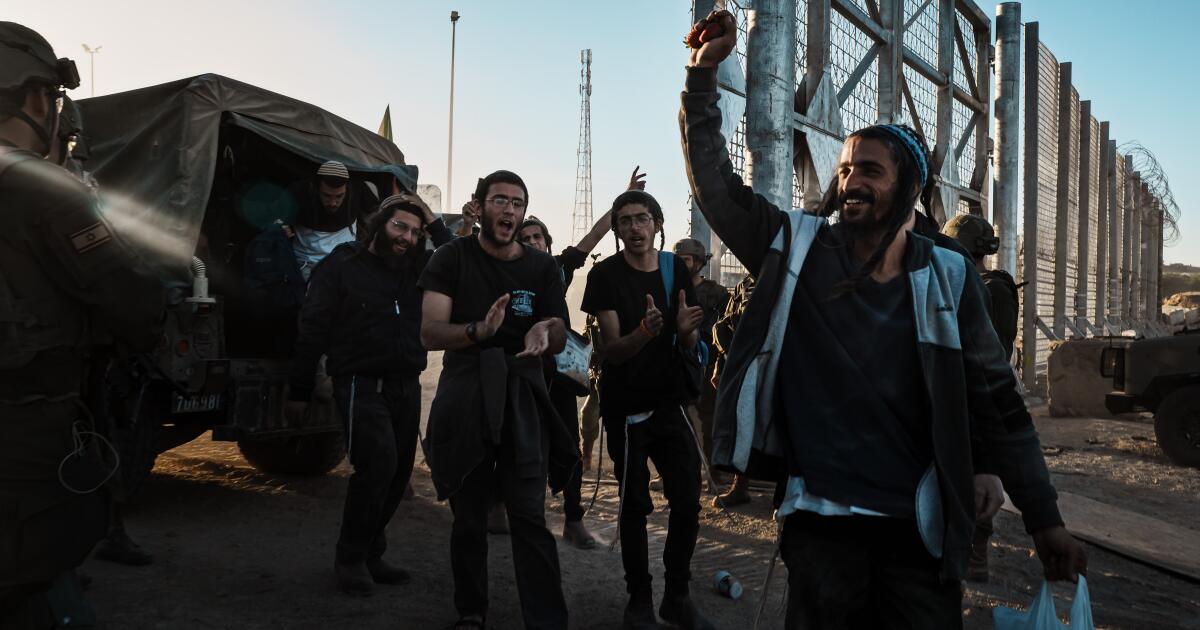
Carrying planks of plywood, a group of Israeli settlers pushed past soldiers guarding the barrier surrounding the Gaza Strip and quickly got to work. Within minutes, the young men had erected two small buildings — outposts, they said, of a future Jewish settlement in the war-torn Palestinian enclave.
Their movement had hungered for this moment for years, but now, after Oct. 7, they felt it was just a matter of time before Jews would be living in Gaza again. “It is ours,” said David Remer, 18. “[God] said it is ours.”
1
2
3
1. Protesters march to a border checkpoint in Kerem Shalom, Israel, hoping to block aid shipments into war-torn Gaza. 2. Israeli troops stand by at Erez Crossing as activists try to enter the military buffer zone into Gaza. 3. Israeli troops remove a protester from a sit-in intended to block shipments of aid into the Gaza Strip.
Religious Zionists, who believe the Jewish people have divine authority to rule from the Jordan River to the Mediterranean Sea, make up only around 14% of Israel’s population. But in recent years they have greatly expanded their influence in the military, the government and society at large, and their often extremist ideology is helping shape Israel’s war against Hamas.
Although they are not politically homogeneous, most religious Zionists embrace far-right views. They loudly oppose a cease-fire deal to bring home Israeli hostages, and have repeatedly blocked humanitarian assistance from entering Gaza by standing in front of aid trucks.
They see the deadly Oct. 7 Hamas-led attack on Israel as proof of their longtime assertion that peace cannot be made with the Palestinians, and view Gaza as a territory that they have a religious obligation to conquer. Increasingly, they have called for the expulsion of the 2.3 million Palestinians living there.
Jewish settler activists hastily erect outposts inside the Israeli military’s buffer zone for the Gaza Strip at the Erez crossing.
First, they dream of reestablishing Gush Katif, a bloc of Jewish settlements that existed in Gaza until Israel withdrew from the enclave in 2005.
It’s a goal embraced by some of the top leaders in Israel’s far-right government, many of whom appeared at a recent Jerusalem rally pushing for Gaza’s resettlement. While videos played showing Israel’s brutal military assault on the enclave and organizers shared brochures promising new houses with views of the Mediterranean Sea, National Security Minister Itamar Ben-Gvir sang religious songs alongside participants and told them: “Now is the time to return home.”
On the battlefield, some religious soldiers have recorded themselves dancing with Torah scrolls and waving the orange flags of Gush Katif. Other combatants travel with mezuzahs, small boxes containing biblical Scriptures meant to be hung outside Jewish residences, to affix to Palestinian homes.
Reuven Gal, former chief psychologist for the military and a researcher at the Israel Institute of Technology, says that for many soldiers, the Gaza conflict that has killed more than 30,000 Palestinians is “not just a military operation.”
“For them,” he said, “it’s a holy war.”
Top, Settler Avraham Sheinman, overlooking Nablus in the West Bank from Mt. Gerizim, points out passages in his Torah that he says show Jews have a religious obligation to conquer Palestinian territories. Bottom, Yishai Sheinman, left, and father Avraham Sheinman uncover the Torah in a synagogue in Yitzhar, West Bank. Yishai, 27, belongs to a violent extremist group devoted to expanding Israeli control of the region.
Yair Margolis, an army reservist who was called up from his yeshiva studies last year to fight in Gaza, said during a recent break from battle that the war had a clear spiritual dimension.
“Going back to that land is returning home,” he said. “This is where we are from, and this is what we are fighting for.”
It’s a vision starkly at odds with Israel’s mainstream, even as the country’s political center has shifted discernibly to the right in recent years. A January poll by Israel’s Channel 12 broadcaster found that 51% of Israelis oppose building Jewish settlements in Gaza, compared with 38% who support doing so.
1
2
1. Israel’s national security chief and leader of the far-right Jewish Power Party, Itamar Ben-Gvir, center, called at a recent convention for rebuilding Jewish settlements in Gaza and expanding those in the occupied West Bank. 2. The crowd celebrates at the Jerusalem convention, organized by far-right activists seeking expansion onto more Palestinian land.
Prime Minister Benjamin Netanyahu, a right-wing populist, has called settling Gaza “unrealistic.” But in 2022, as his ongoing corruption trials left him isolated, Netanyahu made a deal with several religious Zionist parties to form a coalition government, and his political future is now closely tied to theirs.
Beyond a pledge to maintain indefinite military control over Gaza and eventually turn over administrative duties to Palestinians, Netanyahu’s postwar strategy remains murky, leaving a vacuum, political analysts say, that the religious right is eager to fill.
Israeli forces arrive at the Erez border crossing next to the northern Gaza Strip.
In a recent video from Gaza circulated on social media, an Israeli soldier dressed in camouflage stands smiling with a machine gun in front of a bombed-out building. He directly addresses Netanyahu, who is widely known by his nickname “Bibi.”
“We are occupying, deporting and settling,” the soldier says. “Do you hear that, Bibi?”
::
During the war in 1967, Israel captured a wide swath of Palestinian land that included the West Bank, East Jerusalem and the Gaza Strip.
Almost immediately, Jewish settlers began establishing communities in each of them, displacing Palestinians who lived there.
Tuvia Levy, far right, and Marom Harel, center, look over Palestinian towns from a security outpost in Yitzhar, West Bank. Both men live in West Bank settlements and were called up for reserve duty after Oct. 7.
While the settler movement isn’t composed just of religious people, and over the years it has received backing from both right- and left-wing Israeli governments, it is ideologically driven by practitioners of Orthodox Judaism who believe God gave what they call the Land of Israel exclusively to the Jews.
Unlike the ultra-Orthodox, some of whom oppose the Zionist project and decline to serve in the military, religious Zionists embrace the teachings of rabbis who say believers have a spiritual imperative to expand Israel’s borders.
By 2005, around 8,000 mostly religious Zionists were living in Gaza, often in neighborhoods that resembled Southern California subdivisions, with their orderly rows of red-tile-roofed homes. The settlements were heavily guarded by the military, and residents frequently clashed with their Palestinian neighbors.
Amid growing concerns about high casualties among the troops tasked with protecting the settlements, Prime Minister Ariel Sharon ordered a complete Israeli withdrawal from the enclave. Sharon, who was a supporter of settlers in the West Bank, now instructed soldiers to forcibly remove them from Gaza.
The “disengagement” from Gaza, with its scenes of screaming settlers being pulled from their homes and synagogues, was transformative for religious Zionists. Many vowed to gain more influence in the traditionally secular institutions they felt had betrayed them.
“For them it was a traumatic event,” said Yagil Levy, a professor of political sociology at the Open University of Israel. “They want to erase this trauma by any means.”
Palestinians take in the rubble left by an Israeli airstrike on residential buildings and a mosque in Rafah, Gaza Strip.
(Fatima Shbair / Associated Press)
That meant building a political movement that has sought “to push the government as far right as it can go” and “completely demolish any talk of a Palestinian state,” said political scientist Dahlia Scheindlin. Over time, she said, ideas that once seemed extreme — like expanding settlements in the West Bank — became normalized.
Helping their cause were the country’s changing demographics: Religious Zionists, like the ultra-Orthodox, were having children at a much higher rate than their secular peers.
At the same time, they were making new inroads in the army.
The military academy that has become the West Point for the religious right is built atop a wind-swept hill in the West Bank settlement of Eli. Here, young men wearing yarmulkes spend their days studying both the Torah and military strategy.
For many years, religious Zionist families were hesitant for their sons to fulfill Israel’s mandatory three-year army service, worried that exposure to secular peers would erode their faith. This school, Bnei David, promised to minimize that risk, offering teenage boys a chance to fortify their religious beliefs before entering the military. Its website boasts of starting a “quiet revolution in the Israel Defense Forces.”
Students are taught that God “wants a people of Israel, and there is no state of Israel if there isn’t a strong army,” said Rabbi Eli Sadan, the school’s founder. They’re also taught by instructors who oppose the presence of women in the military and who have described gay people as “sick and perverted.”
Speaking from behind a large desk strewn with rabbinical texts, Sadan said he supports a scorched-earth military strategy in Gaza, “so Israel’s enemies will see the ruins and think: ‘I don’t want to mess with the Jews.’”
He is against the rebuilding of Palestinian society in Gaza, where at least half of all buildings have been damaged or destroyed during Israel’s fierce bombing campaign. “We must eliminate the possibility of Gazans returning,” he said, arguing that displaced civilians should be forced to live in tents for many years until they decide “to emigrate willingly.”
Top, Rabbi Eli Sadan, the founder of the Bnei David military academy, said he supports a scorched-earth strategy in Gaza. Bottom, Students attend a class in a room at Bnei David that honors alumni who died serving in the Israeli military. The school has lost 18 former students in the Gaza war.
Sadan said his school, which recently hosted events with both Netanyahu and Israel’s defense minister, has produced 3,000 soldiers, more than 50% of whom have risen to the rank of officer or higher. Since the conflict broke out, 18 alumni have died in Gaza.
The rise of religious military academies like this one has dramatically changed the makeup of the army, said Levy, the sociologist. Religious Zionists made up about 3% of officer school graduates in 1990, Levy’s research shows; in 2018, they accounted for over a third.
Levy, who has written about what he calls the “theocratization of the Israeli military,” said the trend has caused conflicts, with some religious soldiers refusing to serve alongside women.
A student does push-ups at the religious and military academy for religious Zionists.
A pressing question, he said, is whether religious soldiers would comply with orders to forcibly remove Jewish residents from a settlement — a scenario that could play out under the creation of a Palestinian state.
Sadan said he teaches his students to always heed commands from military superiors. But during the 2005 disengagement from Gaza, other rabbis called on soldiers to refuse orders, and some did.
“What we see is growing resistance in the ranks,” Levy said. “They’re trying to challenge the formal codes of the military.”
::
Those hoping to establish Jewish settlements in Gaza say they will model their strategy on the West Bank, where today 500,000 settlers live among 3 million Palestinians.
Since Oct. 7, tensions here have been simmering as the line between settlers and soldiers has become increasingly blurred.
Reservist Yosef Shalom Sheinman, 30, was called up after Oct. 7 to help protect Jewish settlements in the West Bank, where he lives.
After the Hamas attack in southern Israel killed around 1,200 people, hundreds of thousands of Israeli reservists were called up for duty. Many reservists in the West Bank were instructed to don uniforms and guard their own communities.
Among them were Yosef Shalom Sheinman, 30, who is from Har Bracha, a mountain settlement overlooking the Palestinian city of Nablus.
Sheinman’s parents helped found Har Bracha in 1987 amid protests from Jewish leftists and the Palestinians who once grazed sheep here. His younger brother, 27-year-old Yishai, belongs to a famously violent extremist group known as the Hilltop Youth, which is devoted to expanding Israeli control of the region. “These are kids who would eat Arabs for breakfast,” their father says proudly.
For decades, Israeli soldiers have been deployed throughout the West Bank to protect existing settlements, which most of the world considers illegal under international law. But the soldiers are also often instructed to stop the building of illegal settlement outposts. In the past, they sometimes clashed with Yishai Sheinman, tearing down new outposts he and his friends had erected.
Like many religious Zionists, Yishai Sheinman, his wife, Rashid, and their children live in a settlement on Palestinian territory despite the disapproval of Washington and international law.
Now many of the soldiers in the region are his friends — or, in the case of his older brother, his family.
The reservists are not curtailing settlement expansion, the older brother said. Instead, they’re focused on patrolling nearby Palestinian villages — and making sure they aren’t growing. His unit recently cut a new road through a stretch of hillside between a Palestinian hamlet and Har Bracha, in effect claiming the area for the settlement.
“This is our land,” he said. “And God is with us.”
On a recent afternoon, Sheinman stood with his father, Avraham, taking in views sweeping from the peaks of Jordan to the skyscrapers of Tel Aviv. Avraham Sheinman clutched a well-worn Torah, which he consulted frequently to highlight passages that he says show Jews have a religious obligation to be here. “We have a commandment to conquer it,” he said.
He spoke of a war with Palestinians, but also of “an inner war” within Israel.
“Who are we? What direction are we going?” he asked. “Are we going in the direction of our destiny as a chosen people in the Land of Israel — as a Jewish state according to Jewish law? Or are we a secular leftist copy of Europe or America?”
Israeli troops try to to stop one of many far-right activists from entering the Erez Crossing military buffer zone into Gaza.
Many on the other side of the political divide view that question with the same urgency.
In an interview with Sky News this month, writer and historian Yuval Noah Harari said the biggest threat to Israel is not Hamas, Hezbollah or Iran, but Jewish extremism: “There is really a battle for the soul of the Israeli nation between patriotism on the one side and ideals of Jewish supremacy on the other.”
It is too early to say exactly how the Hamas attack and the Gaza war will shape that debate. But early indications suggest they have awakened new support for the right.
Protests near the Egyptian border to halt aid delivery into Gaza were first organized by religious Zionists, but now draw secular participants. And while much of the international community holds out hope that the West Bank, East Jerusalem and Gaza will one day be recognized as a Palestinian country, faith among Israelis in a two-state solution has dimmed.
A Tel Aviv University poll found that support for peace negotiations among Israeli Jews had fallen from 48% just before the Hamas attacks to 25% a few weeks after.
Supporters of Jewish settlements talk with Israeli troops in an effort to enter war-ravaged Gaza.
Leaders of the religious right, meanwhile, are using the war as an opportunity to push through extreme policies.
Ben-Gvir, the national security chief, leads the Jewish Power party and has helped arm thousands of Israeli civilians by relaxing restrictions on gun ownership. Finance Minister Bezalel Smotrich, head of the Religious Zionist Party, recently announced plans to expand settlements in the West Bank by more than 3,000 homes. Both Smotrich and Ben-Gvir, who has been convicted of inciting racism and supporting terrorism, live in the West Bank.
Life for Palestinians there has gotten markedly worse since Oct. 7, with more than 600 settler attacks against Palestinians recorded since the war broke out, according to the United Nations, and more than 1,200 Palestinians displaced from their homes.
Palestinian activist Issa Amro lives in the historic center of Hebron, the largest city in the West Bank, in the midst of a heavily guarded Jewish settlement.
On the day of the Hamas attack, he was returning from work when several neighbors surprised him in an olive grove and began assaulting him. Some, he said, wore army uniforms probably left over from their military service.
Palestinian Issa Amro says he has lived in fear since he was assaulted by settlers, then detained and beaten at a military base. He’s surrounded in Hebron, West Bank, by a heavily guarded settlement.
Amro was then taken to a military base, where he says he was detained for 10 hours and beaten.
He said he lives in fear. Every day he passes former Palestinian businesses shuttered by settlers, as well as a sign that says: “We’re occupying Gaza now.”
“Every meter I walk, I think I may be shot,” he said.
Amro said he doesn’t blame the settlers so much as the political leaders who have allowed the settlements to flourish. He pointed to Netanyahu, who allied with Ben-Gvir and Smotrich, and to Donald Trump, who as president abandoned Washington’s long-held position that West Bank settlements violate international law. “Netanyahu made them mainstream,” Amro said. “The Trump administration made them mainstream.”
An Israeli soldier orders Palestinian children in the West Bank city of Hebron to go back inside, barring them from playing on the street.
President Biden has since reversed the U.S. stance on West Bank settlements — and recently imposed sanctions on four Israeli settlers for carrying out violence against Palestinians. And Secretary of State Antony J. Blinken says Washington opposes the reoccupation of the Gaza Strip by Israel and any reduction of the Palestinian territory’s size.
Joel Carmel, a former Israeli soldier who is now a peace activist, said the future of Jewish settlements in Gaza may depend on who wins the U.S. election in November.
“Probably the only thing holding back the resettlement of Gaza is the Biden administration,” he said. “And who knows how long that’s going to last.”
Many Palestinians in the West Bank think it’s only matter of time before Israeli settlers move permanently into Gaza.
Areej Al Jaabari, who lives in Hebron, West Bank, points toward the settlement where Israel’s national security minister lives.
Areej Al Jaabari, a mother in Hebron, has watched as settlements have crept ever closer to her family home. Ben-Gvir lives in a sprawling suburban community she can see from her living room window.
“They’re gradually accomplishing their goals,” she said of the settlers. “Eventually they will control everything in Gaza too.”
Linthicum reported from Jerusalem and from Yitzhar, Har Bracha and Hebron in the West Bank. Times staff photojournalist Marcus Yam contributed to this report from Erez Crossing, Israel.


WASHINGTON — California’s two Democratic senators on Thursday criticized the Trump administration after it requested $87.6 billion from Congress to address some of the nation’s most “urgent needs” but omitted funding for victims of last year’s Los Angeles wildfires.
“Donald Trump’s desire to punish Los Angeles and the state of California for not voting for him, means once again that thousands of Angelinos are left watching this administration fight for anything but them, their businesses, and their communities,” Sens. Alex Padilla and Adam Schiff said in a joint statement.
“These fires did not discriminate based on party or political preference. Neither should this administration,” they added.
The omission is the latest strain in a yearlong standoff between California leaders and the Trump administration over federal disaster aid, and it comes after Los Angeles Mayor Karen Bass and Los Angeles County Supervisor Kathryn Barger met with President Trump at the Oval Office in April to request the funding.
At the meeting, Trump signaled his commitment to working with local officials to help with disaster recovery efforts. The officials asked for $16 billion that would be split between the city and county. The money would consist primarily of disbursements from the Federal Emergency Management Agency flagged for communities hit by the fires, part of a $33.9-billion wildfire relief funding request made by Gov. Gavin Newsom.
Two months later, those talks have yet to yield results sought by local leaders.
The budget request, submitted by the Office of Management and Budget on Wednesday, mostly seeks funding for the Pentagon to address costs related to the Iran war. It also includes $11.1 billion in economic assistance for American farmers, $1.4 billion to address the Ebola virus outbreak in Central Africa, $500 million to support “ongoing efforts to complete restorations and construction projects” across the nation’s capital and $1 billion to boost the pensions of workers at General Motors that were cut as a result of the automaker’s bankruptcy.
“I urge the Congress to take action on these important and urgent requests as soon as possible,” White House budget director Russell Vought wrote in a letter addressed to House Speaker Mike Johnson (R-La.).
Vought said the administration was open to discussing “additional relief for other urgent matters.” The White House did not immediately respond when asked why the budget request did not mention the Eaton and Palisades disaster relief funds.
State leaders, including Newsom, have repeatedly accused the Trump administration of stonewalling billions in wildfire aid. The governor visited Washington in December to meet with lawmakers, including three who serve on the Senate and House appropriations committees, to push for the funding.
The governor also attempted to meet with FEMA about the matter, but said his request was denied. Newsom, a political foe of Trump’s, would not say whether he had attempted to meet with Trump to talk about the recovery efforts.
Politics
Trump administration pledges $150M in aid, deploys Navy warships after deadly Venezuela earthquakes

Secretary Rubio details US aid to Venezuela after earthquakes
Secretary Rubio, in Manama, Bahrain, outlines the comprehensive U.S. government response to the devastating back-to-back earthquakes in Venezuela. He confirms immediate deployment of search and rescue teams, medical resources and humanitarian assistance, emphasizing the urgency to save lives. Rubio reiterates President Donald Trump’s commitment to supporting Venezuela and collaborating with international partners on recovery efforts and long-term stability.
NEWYou can now listen to Fox News articles!
Following a catastrophic set of earthquakes that left at least 235 people dead in Venezuela, the Trump administration has activated a government-wide humanitarian response, pledging $150 million in aid and deploying U.S. Navy warships to assist in life-saving rescue operations.
The rapid mobilization Thursday comes after back-to-back magnitude 7.2 and 7.5 earthquakes rocked northern Venezuela roughly 120 miles west of Caracas Wednesday night.
The rare earthquake “doublet” injured more than 940 people and turned the state of La Guaira into a disaster zone, while forcing the closure of the damaged Simón Bolívar International Airport, according to Venezuela’s Health Ministry.
US RESCUE TEAMS TO DESCEND ON HARD-HIT CARIBBEAN AFTER CATASTROPHIC HURRICANE MELISSA’S IMPACT
Rescuers search for victims in a collapsed building following an earthquake in Caracas on June 24, 2026. (Manaure Quintero / AFP via Getty Images)
The U.S. Department of State announced on Thursday it is mobilizing $150 million in aid, which includes $50 million in new bilateral awards for relief partners on the ground — such as Samaritan’s Purse, Catholic Relief Services and World Vision — along with a $100 million contribution to a United Nations humanitarian pooled fund.
To spearhead efforts on the ground, the State Department has deployed a regional Disaster Assistance Response Team alongside two highly specialized urban search-and-rescue teams from fire departments in Fairfax County, Virginia, and Los Angeles County, California.
U.S. WARSHIPS TO PATROL INTERNATIONAL WATERS AROUND VENEZUELA AS TRUMP VOWS TO STOP CARTELS
Members of the County of Los Angeles Fire Department’s international urban search and rescue team (USA-2) prepare to leave for Venezuela, in Pacoima, Calif., Thursday. (Blake Fagan/AFP via Getty Images)
U.S. Southern Command (SOUTHCOM) said it is surging assigned U.S. military forces to the region, directing the USS Fort Lauderdale and the USS Billings to Venezuela to back the State Department-led operations.
The USS Fort Lauderdale will serve as a “floating command center” with a flight deck to support heavy-lift helicopters and a well deck to launch landing craft, according to SOUTHCOM.
Meanwhile, the agile USS Billings will provide critical support close to the shorelines to accelerate the disaster response missions.
U.S. SOUTHCOM said it has directed USS Fort Lauderdale (LPD 28) and USS Billings (LCS 15) to Venezuela to support State Department-led U.S. government relief operations in Venezuela. (@Southcom/X)
SOUTHCOM said it is also sending rotary-wing aircraft, which will provide critical life-saving airlift support, transporting U.S. government response personnel, search and rescue teams and partners during relief operations.
Amid the crisis, the State Department emphasized that the safety of U.S. citizens remains the administration’s highest priority.
“The Trump Administration has no higher priority than the safety and security of Americans. The Department of State is working tirelessly to provide consular assistance to U.S. citizens and their families in the affected areas,” officials wrote in a statement. “The United States remains steadfast in its commitment to helping Venezuela recover from this devastating disaster and will continue to explore additional ways to provide meaningful assistance during this critical time.”
CLICK HERE TO DOWNLOAD THE FOX NEWS APP
U.S. citizens in Venezuela are urged to enroll in the Smart Traveler Enrollment Program (STEP) and can contact the State Department 24/7 at 202-501-4444 for emergency assistance.
Family members in the U.S. seeking information on loved ones can call toll-free at 888-407-4747.
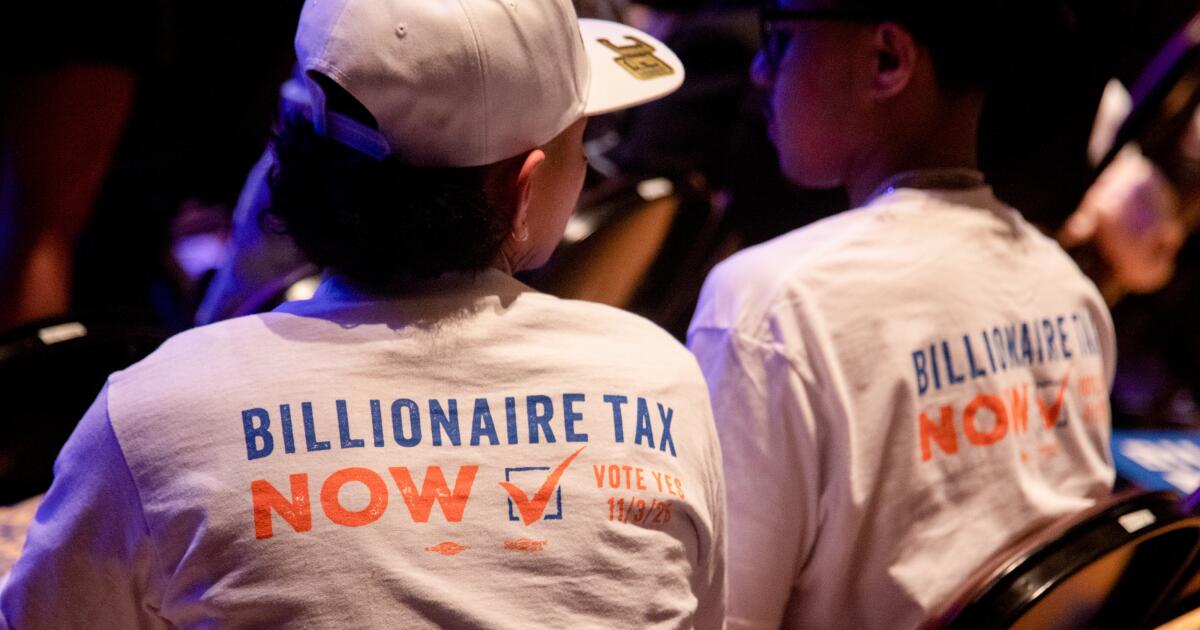
Proponents of a tax on California billionaires vowed on Thursday to move forward with their November ballot measure despite mounting opposition from many of the state’s most powerful political forces.
A labor union spent $31 million gathering signatures to qualify the measure for the ballot in an effort to offset federal healthcare funding cuts that will affect millions of California’s most vulnerable residents. A representative for the campaign supporting the ballot measure pushed back at opposition to the effort as self-entitled wealthy Californians and entrenched Sacramento interests.
“While a few morally bankrupt billionaires and their buddies in Sacramento want to see California’s hospitals close, and tax breaks for billionaires protected — I assure you, the vast majority of voters do not,” said Debru Carthan, a spokesperson for the Billionaire Tax Now Coalition, which is funded by the Service Employees International Union-United Healthcare Workers West, the sponsor of the proposal.
California Secretary of State Shirley Weber is expected to officially certify the measure to appear on the Nov. 3 ballot on Thursday evening.
Carthan said their effort has support in public opinion polls, and from lawmakers, unions, community organizations and volunteers across the state, “something the billionaires and their buddies will never have.” And she criticized Gov. Gavin Newsom for opposing the measure, saying that he is in “lock-step” with President Trump and billionaires.
“Gov. Newsom has no plan,” Carthan said during a Thursday evening news conference. “He has no plan to stop emergency rooms from closing. He has no plan for your healthcare costs. He has no plan to make sure that your family doesn’t have to drive further and wait longer to get medical care. Gov. Newsom has no plan to fix one of Trump’s deadliest domestic policy blunders.”
Rep. Ro Khanna (D-Fremont) also attacked the governor, though not by name.
“If you’re opposed to this tax, you’re on the side of trickle-down economics,” Khanna said. “You’re protecting the very, very rich, as opposed to standing up for the working class.”
Both Khanna and Newsom are considering running for president in 2028.
The Newsom administration did not respond to a request for comment Thursday evening.
A coalition of healthcare, education, public safety, housing, business and labor leaders opposed to the proposal warned that it would make the state’s notoriously unstable budget even more unpredictable.
“The dangerous wealth tax directly threatens vital funding for education and schools, healthcare and clinics, public safety, and infrastructure projects by making California’s revenue even more volatile,” the leaders of the California Medical Assn., the California Primary Care Assn. and the California School Boards Assn. said in a statement. “That’s why so many leaders – both Democrats and Republicans – are joining us and saying NO. We look forward to ensuring voters have the facts, know the stakes, and resoundingly reject this reckless experiment in November.”
Supporters of the one-time proposed 5% tax on the assets of the state’s wealthiest residents pitched the effort as a stop-gap measure to offset devastating federal healthcare funding cuts passed by the GOP-led Congress and signed by President Trump nearly one year ago. The federal legislation is expected to result in $100 billion in cuts that would affect California’s most vulnerable residents.
The proposed tax, which would be retroactive to billionaires who lived in the state as of Jan. 1, drew predictable opposition from the wealthy, notably Silicon Valley tech leaders.
But it notably divided liberals. While Sen. Bernie Sanders (I-Vt.) and Khanna supported the proposal, Newsom was among the Democrats who opposed it because of fears about the potential impact on the state’s volatile budget.
Despite being the fourth largest economy in the world — the home of Hollywood and Silicon Valley — California’s budget is extremely dependent on the state’s most prosperous residents.
Newsom and others who generally support increasing taxes on the wealthiest Americans also argued that the proposed billionaire tax in California was poorly crafted and that any such levies ought to be enacted nationally, because varying state policies would be ineffective.
Opponents also argued that the political priority in the 2026 midterm election should be squarely focused on efforts to make sure Democrats regain control of Congress to serve as a counter balance during the final two years of Trump’s presidency.
“It’s disappointing. This is a critical election where we need to concentrate on flipping the house and undoing the damage that was done” by Trump’s legislation that led to the healthcare funding cuts, said Jodi Hicks, chief executive and president of Planned Parenthood Affiliates of California. The wealth tax “is short term and doesn’t address what is the long-term problem. And I’m not even sure the policy is a viable solution. It’s so critical to be sending the right message — holding Congress accountable and how we need to find long-term solutions to make sure Californians have access to healthcare.”
Dave Regan, the president of SEIU-United Healthcare Workers West, lashed out at the leadership of Planned Parenthood as “out of touch” with their workers and their patients.
Rob Lapsley, co-chair of Californians Against Tax Increases and president of the California Business Roundtable, argued that the proposed wealth tax would ultimately affect every Californian.
“Strip away the spin, and this measure forces every California taxpayer, not just billionaires, to file a sworn declaration of their net worth with the Franchise Tax Board under penalty of perjury,” Lapsley said in a statement. “And it hands the Legislature the power to extend the wealth tax to all Californians and every kind of property, including home equity, retirement savings without ever returning to the voters – effectively gutting” voter-approved caps on property tax increases.
Supporters of the tax submitted nearly 1.6 million signatures in April to qualify the proposal for the ballot, roughly double the number required. However, support for the effort has grown increasingly shaky. Newsom’s team created a broad coalition of opponents, including healthcare and education activists, that undercut the foundational argument for the tax.
The union that crafted the proposal responded last week by proposing a legislative alternative that would create a 2% tax on billionaire’s assets. It was flatly refused by the Newsom administration. No deal was reached by the Thursday evening deadline for the union to withdraw the proposal from the November ballot.
Two efforts that were crafted to sink the proposed billionaire tax — dubbed poison pills — also qualified for the Nov. 3 ballot, according to the California Secretary of State’s office. One would bar new state taxes on personal property, while the other prohibits any new taxes being exempted from existing state spending rules and to be regularly audited. If the billionaire tax proposal is approved by voters but either of the other proposals receives more votes, the tax measure would be voided.
“We will not allow California’s most vulnerable patients to be used as political pawns,” said Francisco Silva, president and CEO of the California Primary Care Assn. “Our broad coalition will mount an aggressive campaign to educate voters, defeat this reckless initiative, and protect care for millions of patients.”
The proposed billionaire tax would apply to more than 200 Californians, some of whom proactively left the state or moved their companies out of California because of the proposal.
The prospect of the wealthy fleeing the state is among the reasons that prominent Democrats such as Newsom opposed it, given California’s budget being so reliant on the state’s most prosperous residents.
Sergey Brin, a co-founder of Google, is among the billionaires who have reportedly moved out of California because of the tax proposal. He donated at least $82 million to an organization that is funding efforts to invalidate the proposed billionaire tax.
Ballot measure proponents had a Thursday evening deadline to withdraw their proposals.
Other policy proposals that will appear on the Nov. 3 ballot include:
- Requiring government-issued voter identification to cast ballots in elections.
- Reforming the California Environmental Quality Act, once a third-rail in Democratic politics that has become increasingly scrutinized in the rebuilding in the aftermath of the Palisades and Eaton wildfires.
- Creating a $11.3-billion affordable housing bond.
Two notable proposals were pulled off the ballot after negotiations between the California Hospital Assn. and labor unions:
- An effort to limit healthcare executives’ compensation.
- A union proposal by the same union backing the billionaire tax that would have required many healthcare clinics to spend 90% of their revenue to serve low-income and underserved residents.
-
 Entertainment4 minutes ago
‘The Bear’ at closing time: Ayo Edebiri and Jeremy Allen White reflect on five seasons
-
 Lifestyle11 minutes ago
L.A. Affairs: After decades of near-misses, I finally told him: ‘I’m not leaving here without you’
-
Politics14 minutes ago
Trump budget request omits funds for L.A. fire relief, prompting criticism from senators
-
 Science19 minutes ago
EPA touts crackdown on smuggled pesticides in L.A. visit
-
 Sports26 minutes ago
Commentary: Did Padres curse themselves by messing with that anti-Dodgers FTD burger?
-

 World34 minutes ago
Copernicus lead warns extreme heat measures needed or deaths to ensue
-

 News59 minutes ago
“It’s blood money”: Family of exonerated man in Texas yogurt shop murders speaks out after settlement
-

 Los Angeles, Ca2 hours ago
Woman ambushed, violently attacked by robber in downtown Long Beach

