Politics
Fox News Politics: Trump Ungagged…Kinda


Welcome to Fox News’ Politics newsletter with the latest political news from Washington D.C. and updates from the 2024 campaign trail.
FACE OFF: Don’t miss the Fox News Simulcast of the CNN Presidential Debate on Thursday at 9 p.m. ET. Stay in the know for more updates here.
What’s happening…
-Calls for Biden to fire official for past anti-Israel tweets
-Trump urges drug test for Biden
-Whistleblower who exposed NPR bias finds new job
What can he say?
Judge Juan Merchan has partially lifted the gag order he imposed against former President Trump – weeks after the jury found him guilty on all counts.
Trump and his legal team have been fighting the gag order since it was imposed upon him at the start of the trial, but had ramped up their efforts when it concluded last month. The former president and presumptive Republican nominee’s legal team had argued the gag order should be lifted before the June 27 presidential debate.
Merchan’s gag order barred Trump from making or directing others to make public statements about witnesses with regard to their potential participation or about counsel in the case – other than Manhattan District Attorney Alvin Bragg – or about court staff, DA staff or family members of staff.
Merchan on Tuesday partially lifted the gag order because the trial has concluded.
Trump is now able to speak about protected witnesses and jurors.
Trump is still blocked from commenting about individual prosecutors, court staff and their family members. That portion of the gag order will remain in effect until Trump’s sentencing on July 11.
Judge Juan Merchan imposed over Donald Trump (AP)
White House
‘JUST HORRIFYING’: Watchdog group calls for Biden to fire WH official for past anti-Israel tweets …Read more
Capitol Hill
‘OBSCENE’: House GOP lawmaker rips State Dept ahead of vote on U.S. dollars going to Taliban …Read more
U.S. Representative Jamaal Bowman (D-NY) speaks to the crowd while he campaigns in the Bronx borough of New York City, U.S., June 22, 2024. REUTERS/Joy Malone (REUTERS/Joy Malone)
Tales from the Campaign Trail
‘THEATER OF CONFLICT’: Democrat challenger slams Bowman tirade, says profanity-laced rally jeopardizes party ‘unity’ …Read more
JUST SAY ‘NO’: Trump urges drug test for Biden, says he’ll do same screening …Read more
EPIC CLASH: How to watch the CNN Presidential Debate Simulcast on the Fox News Channel …Read more
‘SUGARCOATING’ CONTROVERSY: California city keeps charged ballot language for non-citizen voting measure …Read more
CALL TO THE BULLPEN: Obama again serving as Joe’s closer ahead of 2024 Trump rematch …Read more
Trials and Tribulations
DAY 3: US v Trump: The afternoon public hearing ended with no decision from Judge Cannon Read more
Across America
NO ABORTIONS FOR MINORS: Tennessee sued over law banning adults from helping minors get abortions without parental consent …Read more
MOVING ON: Whistleblower finds new gig after exposing alleged liberal bias at NPR …Read more
NEW YORK PAYS PRICE FOR NAIVETY: Cuomo scorches Dems for migrant crisis: ‘We’re finding out, 200,000 people later, you needed a plan’ …Read more
GETTING AWAY WITH MURDER: This blue city that ‘Defund Police’ supporters call home has over 1,000 unsolved homicides …Read more
KENYAN EXPEDITIONARY FORCE: Kenyan police depart for Haiti to tackle rampant gang violence …Read more
ALL MUST SERVE: Israel’s Supreme Court rules ultra-Orthodox men must serve in military in unanimous decision …Read more
HUGE POPULATION: Houston area, an immigration hot spot, reeling from murder of Jocelyn Nungaray …Read more
Subscribe now to get Fox News Politics newsletter in your inbox.
Get the latest updates from the 2024 campaign trail, exclusive interviews and more on FoxNews.com.






Politics
Commentary: With midterm vote starting, here’s where things stand in national redistricting fight
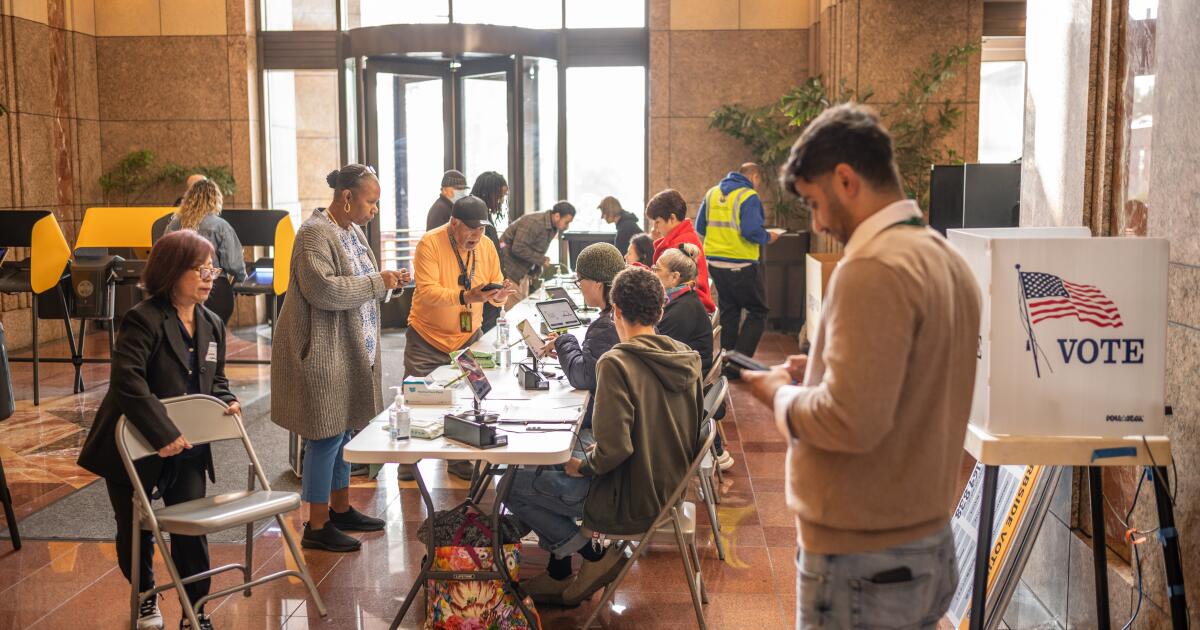
Donald Trump has never been one to play by the rules.
Whether it’s stiffing contractors as a real estate developer, defying court orders he doesn’t like as president or leveraging the Oval Office to vastly inflate his family’s fortune, Trump’s guiding principle can be distilled to a simple, unswerving calculation: What’s in it for me?
Trump is no student of history. He’s famously allergic to books. But he knows enough to know that midterm elections like the one in November have, with few exceptions, been ugly for the party holding the presidency.
With control of the House — and Trump’s virtually unchecked authority — dangling by a gossamer thread, he reckoned correctly that Republicans were all but certain to lose power this fall unless something unusual happened.
So he effectively broke the rules.
Normally, the redrawing of the country’s congressional districts takes place once every 10 years, following the census and accounting for population changes over the previous decade. Instead, Trump prevailed upon the Republican governor of Texas, Greg Abbott, to throw out the state’s political map and refashion congressional lines to wipe out Democrats and boost GOP chances of winning as many as five additional House seats.
The intention was to create a bit of breathing room, as Democrats need a gain of just three seats to seize control of the House.
In relatively short order, California’s Democratic governor, Gavin Newsom, responded with his own partisan gerrymander. He rallied voters to pass a tit-for-tat ballot measure, Proposition 50, which revised the state’s political map to wipe out Republicans and boost Democratic prospects of winning as many as five additional seats.
Then came the deluge.
In more than a dozen states, lawmakers looked at ways to tinker with their congressional maps to lift their candidates, stick it to the other party and gain House seats in November.
Some of those efforts continue, including in Virginia where, as in California, voters are being asked to amend the state Constitution to let majority Democrats redraw political lines ahead of the midterm. A special election is set for April 21.
But as the first ballots of 2026 are cast on Tuesday — in Arkansas, North Carolina and Texas — the broad contours of the House map have become clearer, along with the result of all those partisan machinations. The likely upshot is a nationwide partisan shift of fewer than a handful of seats.
The independent, nonpartisan Cook Political Report, which has a sterling decades-long record of election forecasting, said the most probable outcome is a wash. “At the end of the day,” said Erin Covey, who analyzes House races for the Cook Report, “this doesn’t really benefit either party in a real way.”
Well.
That was a lot of wasted time and energy.
Let’s take a quick spin through the map and the math, knowing that, of course, there are no election guarantees.
In Texas, for instance, new House districts were drawn assuming Latinos would back Republican candidates by the same large percentage they supported Trump in 2024. But that’s become much less certain, given the backlash against his draconian immigration enforcement policies; numerous polls show a significant falloff in Latino support for the president, which could hurt GOP candidates up and down the ballot.
But suppose Texas Republicans gain five seats as hoped for and California Democrats pick up the five seats they’ve hand-crafted. The result would be no net change.
Elsewhere, under the best case for each party, a gain of four Democratic House seats in Virginia would be offset by a gain of four Republican House seats in Florida.
That leaves a smattering of partisan gains here and there. A combined pickup of four or so Republican seats in Ohio, North Carolina and Missouri could be mostly offset by Democratic gains of a seat apiece in New York, Maryland and Utah.
(The latter is not a result of legislative high jinks, but rather a judge throwing out the gerrymandered map passed by Utah Republicans, who ignored a voter-approved ballot measure intended to prevent such heavy-handed partisanship. A newly created district, contained entirely within Democratic-leaning Salt Lake County, seems certain to go Democrats’ way in November.)
In short, it’s easy to characterize the political exertions of Trump, Abbott, Newsom and others as so much sound and fury producing, at bottom, little to nothing.
But that’s not necessarily so.
The campaign surrounding Proposition 50 delivered a huge political boost to Newsom, shoring up his standing with Democrats, significantly raising his profile across the country and, not least for his 2028 presidential hopes, helping the governor build a significant nationwide fundraising base.
In crimson-colored Indiana, Republicans refused to buckle under tremendous pressure from Trump, Vice President JD Vance and other party leaders, rejecting an effort to redraw the state’s congressional map and give the GOP a hold on all nine House seats. That showed even Trump’s Svengali-like hold on his party has its limits.
But the biggest impact is also the most corrosive.
By redrawing political lines to predetermine the outcome of House races, politicians rendered many of their voters irrelevant and obsolete. Millions of Democrats in Texas, Republicans in California and partisans in other states have been effectively disenfranchised, their voices rendered mute. Their ballots spindled and nullified.
In short, the politicians — starting with Trump — extended a big middle finger to a large portion of the American electorate.
Is it any wonder, then, so many voters hold politicians and our political system in contempt?
Politics
Mamdani’s response to Trump’s Iran strike sparks conservative backlash: ‘Rooting for the ayatollah’

NEWYou can now listen to Fox News articles!
New York City’s socialist Mayor Zohran Mamdani is facing blowback from conservatives on social media over his post condemning the U.S. attack on Iran that led to the killing of Iran’s supreme leader, Ayatollah Ali Khamenei.
On Saturday, as a joint strike on Iran by the United States and Israel was developing, Mamdani blasted the Trump administration’s decision in a post on X that has been viewed roughly 20 million times.
“Today’s military strikes on Iran — carried out by the United States and Israel — mark a catastrophic escalation in an illegal war of aggression,” Mamdani wrote.
“Bombing cities. Killing civilians. Opening a new theater of war. Americans do not want this. They do not want another war in pursuit of regime change.”
New York City Mayor Zohran Mamdani speaks to reporters during a news conference in New York Feb. 17, 2026. (AP Photo/Seth Wenig)
Mamdani said Americans prefer “relief from the affordability crisis” before speaking directly to Iranians in New York City.
“You are part of the fabric of this city — you are our neighbors, small business owners, students, artists, workers, and community leaders,” Mamdani said. “You will be safe here.”
The post was quickly slammed by conservatives on social media making the case that Mamdani’s response appeared sympathetic to Iran’s brutal regime and pointing to his lack of public reaction to the Iranian protesters killed in recent years.
“Comrade Mayor is rooting for the Ayatollah,” GOP Sen. Ted Cruz posted on X. “They can chant together.”
OBAMA OFFICIAL WHO BACKED IRAN DEAL SPARKS ONLINE OUTRAGE WITH REACTION TO TRUMP’S STRIKE: ‘SIT THIS ONE OUT’
“Do u say anything pro American ?” Fox News host Brian Kilmeade posted on X. “do u know any Iranians – ? they hate @fr_Khamenei they celebrate his death, you should be celebrating his death ! hes killed thousands of American’s and just killed 30k Iranians, did u even say a word about that? You are an embarrassment !! Please quit.”
Sen. Ted Cruz, R-Texas, questions Pam Bondi, President-elect Donald Trump’s nominee to be attorney general, during her Senate Judiciary Committee confirmation hearing in Hart building Jan. 15, 2025. (Tom Williams/CQ-Roll Call, Inc via Getty Images)
“I don’t feel safe in New York listening to someone like you, Mamdani, who sympathizes with the regime that killed more than 30,000 unarmed Iranians in less than 24 hours,” Iranian American journalist Masih Alinejad posted on X.
“We Iranians do not allow you to lecture us about war while you had nothing to say when the Islamic Republic shot schoolgirls and blinded more than 10,000 innocent people in the streets. You were busy celebrating the hijab while women of my beloved country Iran were jailed and raped by Islamic Security forces for removing it.
“And NOW you find your voice to defend the regime? No. I will not let you claim the moral high ground. The people of Iran want to be free. Where were you when they needed solidarity?”
CLICK HERE TO DOWNLOAD THE FOX NEWS APP
“How is it that you can’t differentiate between good and evil?” Billionaire hedge fund manager Bill Ackman posted on X. “Why is this so hard for you?”
“It takes a particular kind of audacity, or ignorance, for a city mayor to appoint himself the conscience of American foreign policy while his constituents step over garbage on their way to work,” GOP Rep. Nancy Mace posted on X. “History will not remember his bravery. It will not remember him at all.”
“Iranian New Yorkers are thrilled today and see right through you,” Republican New York City Councilwoman Vickie Paladino posted on X.
Bill Ackman, CEO of Pershing Square Capital Management LP, speaks during the WSJ D.Live global technology conference in Laguna Beach, Calif., Oct. 17, 2017. (Patrick Fallon/Bloomberg/Getty Images)
“When Kuwait, Saudi Arabia, Qatar, Turkey, UAE, Bahrain all support today’s operation eliminating world’s #1 sponsor of terror, but New York City’s Mayor @ZohranMamdani is shilling for Iran,” Republican New York City Councilwoman Inna Vernikov posted on X.
Fox News Digital reached out to Mamdani’s office for comment.
Shortly after Mamdani’s post, it was announced by President Trump and Israeli officials that the military operation resulted in Khamenei’s death.
Israeli leaders confirmed Khamenei’s compound and offices were reduced to rubble early Saturday after a targeted strike in downtown Tehran.
“Khamenei was the contemporary Middle East’s longest-serving autocrat. He did not get to be that way by being a gambler. Khamenei was an ideologue, but one who ruthlessly pursued the preservation and protection of his ideology, often taking two steps forward and one step back,” Behnam Ben Taleblu, senior director of FDD’s Iran program, told Fox News Digital.
Related Article

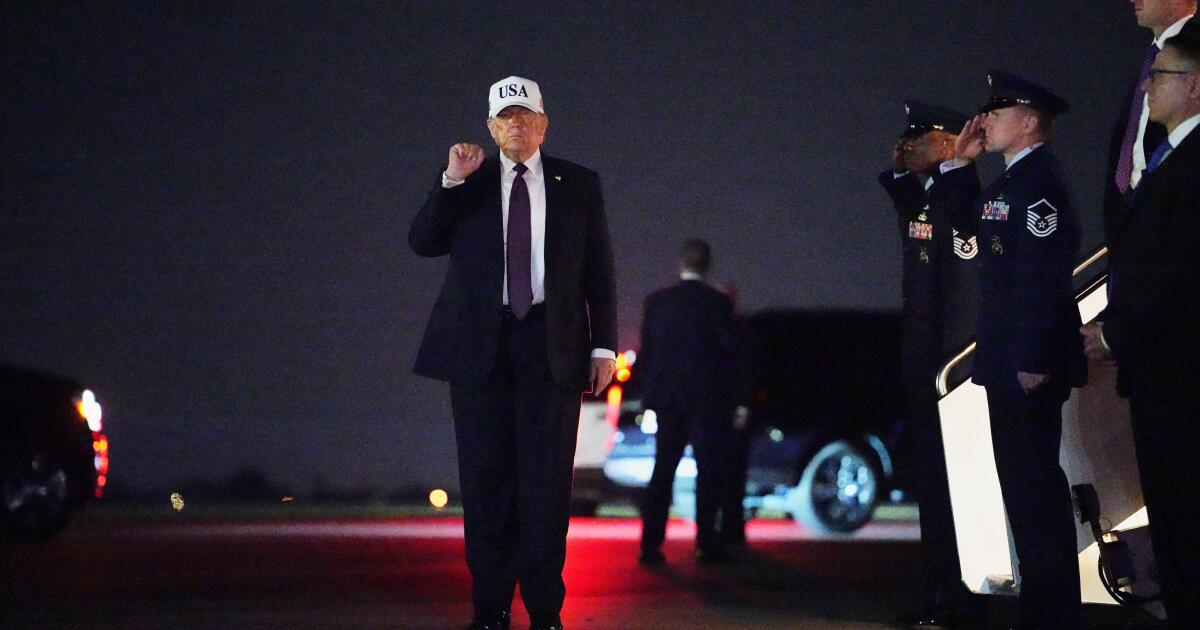
WASHINGTON — For a decade, President Trump promised to end what he calls forever wars, casting himself as a leader opposed to prolonged conflicts in the Middle East and who would rather pursue peace in the world.
Now, early in his second term, Trump is taking military action against Iran that could expand well beyond a limited effort to halt the country’s nuclear program.
In a video posted on Truth Social, the commander in chief said American forces also plan to “raze their missile industry to the ground” and “annihilate their navy.” He warned members of Iran’s military to surrender or “face certain death.” And urged the Iranian people to take the moment as an opportunity to rise up against their government.
“This regime will soon learn that no one should challenge the strength and might of the United States armed forces,” Trump said.
A few hours after relaying that message, Trump confirmed in a separate social media post that Ayatollah Ali Khamenei, the supreme leader of Iran, was among those killed by U.S. and Israeli strikes. Even with his death, Trump said that “the heavy and pinpoint bombing” would continue in Iran “as long as necessary to achieve our objective of PEACE THROUGHOUT THE MIDDLE EAST AND, INDEED, THE WORLD!”
Trump, who has been considering a strike on Iran for several weeks, acknowledged he reached the decision to attack Iran while aware of the human toll that could come with it.
“The lives of courageous American heroes may be lost, and we may have casualties. That often happens in war,” he said. “But we are doing this, not for now, we are doing this for the future, and it is a noble mission.”
Trump’s military campaign in Iran is a sharp turn in tone for a president who has long been critical of open-ended conflicts in the Middle East, and marks a shift from an America-first agenda message that helped him return to the White House.
“I’m not going to start a war. I’m going to stop wars,” Trump said in his November 2024 victory speech as he promised to focus national resources on domestic priorities rather than foreign conflicts.
As Trump advocated to bring home American forces from deployments around the world and to withdraw from key defense treaties, his position resonated with a war-weary electorate in the lead-up to the election.
Fewer than six in 10 Americans (56%) believed the United States should take an active role in world affairs ahead of the election — the second-lowest level recorded since the question was first asked in 1974, according to polling by the Council on Foreign Affairs.
Trump’s posture on war in the Middle East had been largely consistent before he ran for office.
In 2013, he criticized then-President Obama’s negotiations with Tehran, predicting in a post on Twitter that Obama would “attack Iran because of his inability to negotiate properly.” That same year, Trump warned that “our horrendous leadership could unknowingly lead us into World War III.”
And in a heated February 2016 debate, Trump attacked former Florida Gov. Jeb Bush, stating that his brother George W. Bush lied about Iraq’s nuclear capabilities to get the U.S. into the Iraq war. Trump called the Iraq war a “big, fat mistake” that “destabilized the Middle East.”
“They lied. They said there were weapons of mass destruction. There were none, and they knew there were none,” he said.
At the time of the Iraq war, however, Trump had said he supported it.
Trump’s confrontation with Iran bears little resemblance to his earlier rebukes.
Trump has yet to present evidence of an imminent threat to the United States from Iran’s nuclear program — a capability he claimed to have “obliterated” just eight months ago — and has instead framed the military campaign as one to ensure Tehran never develops nuclear weapons at all.
“It is a very simple message,” he said. “They will never have a nuclear weapon.”
Trump’s shift has already drawn the attention of congressional Democrats, many of whom are calling the president out for backing out on his promise to end foreign wars — and are demanding that he involve Congress in any further military actions.
“Regardless of what the President may think or say, he does not enjoy a blank check to launch large-scale military operations without a clear strategy, without any transparency or public debate, and not without Congressional approval,” Sen. Alex Padilla (D-Calif.) said.
Sen. Adam Schiff (D-Calif.) criticized Trump for “drawing the country into yet another foreign war that Americans don’t want and Congress has not authorized.”
The military involvement in Iran is not the first time that members of Congress have complained about the Trump administration’s willingness to sideline the legislative branch on decisions that could trigger broader conflicts this year.
In January, Trump ordered military forces to capture former Venezuelan President Nicolás Maduro and said the United States would run the sovereign nation until further notice. He threatened military action in Colombia, whose leftist President Gustavo Petro has been one of Trump’s most vocal critics.
Trump has alienated allied nations when he said he was willing to send American troops to seize Greenland, a semiautonomous territory of Denmark. And on Friday, he said U.S. is in talks with Havana and raised the possibility of a “friendly takeover of Cuba” without offering any details on what he meant.
His actions have coincided with his annoyance at not being awarded the Nobel Peace Prize. At one point, the president said he no longer felt an “obligation to think purely of Peace” because he didn’t get the recognition.
Trump’s shifting tone, and his use of violent war imagery in his pretaped remarks about Iran, have rattled even part of his base.
“I did not campaign for this. I did not donate money for this,” said former Rep. Marjorie Taylor Greene, a conservative who recently left Congress after a bitter fight with Trump. “This is not what we thought MAGA was supposed to be. Shame!”
Republican leaders, however, are largely standing behind the president.
Senate Majority Leader John Thune (R-S.D.) said Iran “posed a clear and unacceptable threat” to the United States and has refused “the diplomatic off-ramps.” House Speaker Mike Johnson (D-La.) said Trump took the action after exhausting “every effort to pursue peaceful and diplomatic solutions.”
Other top Republican lawmakers rallied behind Trump, too.
“The butcher’s bill has finally come due for the ayatollahs,” Sen. Tom Cotton, the chairman of the Senate Intelligence Committee, wrote in a post on X. “May God bless and protect our troops on this vital mission of vengeance, and justice, and safety.”
Commentary: With midterm vote starting, here’s where things stand in national redistricting fight

Prep talk: Football student-athletes to be honored at annual banquets

At least nine killed after Iranian strike on Israel’s Beit Shemesh

Mass shooting at Austin, Texas bar leaves at least 3 dead, 14 wounded, authorities say

Newsom’s ‘disgraceful’ call for Dems to be ‘culturally normal’ is ‘dangerous,’ far-left podcaster says

Florida High School Football Rankings: Top 25 teams – Oct. 21

Cleary's 21 help Le Moyne down Central Connecticut State 69-64 in OT

How old is Bo Nix? What to know about Oregon quarterback ahead of 2024 NFL Draft

99th annual Pony Swim held in Virginia

Indiana Members Credit Union announced as new anchor tenant at Bottleworks District
At least nine killed after Iranian strike on Israel’s Beit Shemesh
Mass shooting at Austin, Texas bar leaves at least 3 dead, 14 wounded, authorities say

Mamdani’s response to Trump’s Iran strike sparks conservative backlash: ‘Rooting for the ayatollah’

Activists hail ‘historic’ EU’s decision on accessible abortion

A long-buried recording and the Supreme Court of old (CT+) : Consider This from NPR
-

 World3 days ago
Exclusive: DeepSeek withholds latest AI model from US chipmakers including Nvidia, sources say
-

 Massachusetts4 days ago
Mother and daughter injured in Taunton house explosion
-

 Montana1 week ago
2026 MHSA Montana Wrestling State Championship Brackets And Results – FloWrestling
-

 Denver, CO4 days ago
10 acres charred, 5 injured in Thornton grass fire, evacuation orders lifted
-

 Louisiana6 days ago
Wildfire near Gum Swamp Road in Livingston Parish now under control; more than 200 acres burned
-

 Technology1 week ago
YouTube TV billing scam emails are hitting inboxes
-

 Technology1 week ago
Stellantis is in a crisis of its own making
-

 Politics1 week ago
OpenAI didn’t contact police despite employees flagging mass shooter’s concerning chatbot interactions: REPORT