Politics
Commentary: Half a century on the beat, and thank you very much


The Bard of Los Angeles was waiting for an elevator when I arrived at the office one day in 2002. Columnist Al Martinez and I greeted each other, and with a mixture of pride and disbelief, he shared a milestone.
“This is it,” he said. “Fifty years in the business.”
Martinez was in his early 70s and said he had no intention of slowing down. You’d have needed a tranquilizer gun to keep him from chasing after the next story, and the next, and he was still telling stories until his death in 2015.
Steve Lopez
Steve Lopez is a California native who has been a Los Angeles Times columnist since 2001. He has won more than a dozen national journalism awards and is a four-time Pulitzer finalist.
I was a full generation behind him, and had trouble imagining myself at his age, still on the beat.
But time did what it does.
It vanished.
Now I’m in my early 70s, and I’m stealing Martinez’s line.
This is it. Fifty years in the business.
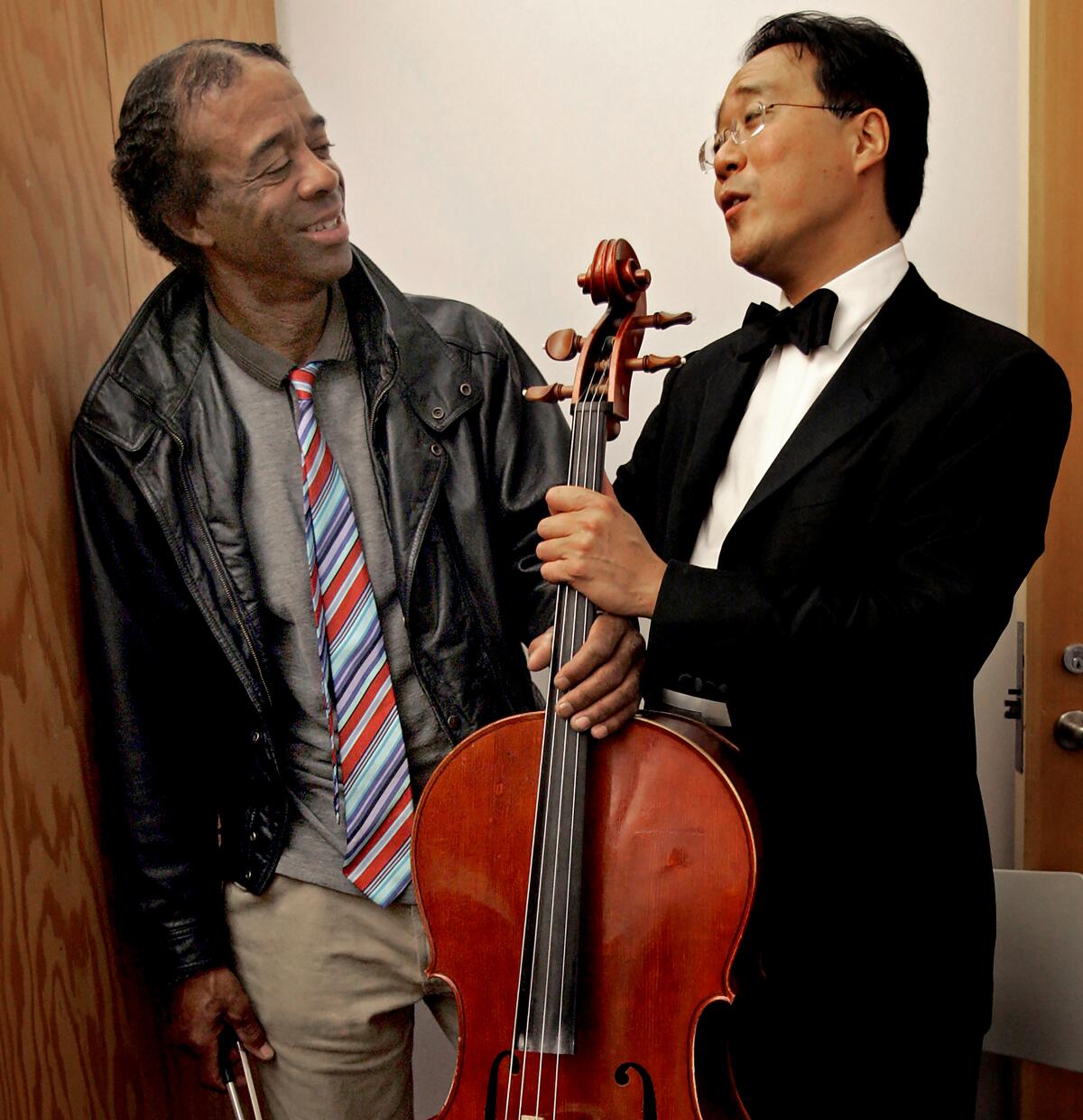
Nathaniel Ayers and Yo Yo Ma at Walt Disney Concert Hall in 2006.
(Francine Orr/Francine Orr)

Nathaniel Ayers plays the violin along 4th St. in downtown Los Angeles in April 2008.
(Rick Loomis / Los Angeles Times)
Newspapers have soared and sputtered in that time, rising to hero status half a century ago for taking down a crooked president, only to be called the enemy of the people by the current occupant of the White House.
In Al Martinez’s heyday, an errant toss of the Sunday L.A. Times could have maimed a standard poodle. But a tsunami of disruption, starting with the rise of the internet in the 1990s, swamped the news and advertising industries, driving thousands of newspapers and magazines under or put them on life support, critically damaging one of the pillars of democracy.
This is an excellent moment in history to be a crook, a liar, a gasbag or a double-dealing political hack, because there are far fewer reporters rooting around like drug-sniffing airport dogs.
But don’t worry, I’m not going to mark this anniversary by rambling on and on about the death spiral, other than to remind you to renew your subscription immediately.
I’m here to tell you how lucky I’ve been for half a century, why I wouldn’t change a thing if someone loaded me into a time machine, and why, even though I’m buckled into a seat on the Hindenburg, I still want to order a few more cocktails before we crash-land.
To be honest, I did have a moment of doubt about my career choice after leaving San Jose State University on a Tuesday night in May of 1975 and starting work the next morning at the Woodland Daily Democrat. Woodward and Bernstein had just changed the world with their muckraking, and what was I doing with my brand-new degree in journalism? I was covering Little League baseball in Davis, an exercise in recycling adjectives to describe home runs that were clobbered, ripped, slugged, rocketed, smoked and launched.

Boyle meets with Jose Trujano in October 2022.
(Genaro Molina / Los Angeles Times)
But I had a foot in the door, as they say, and shamelessly stalked editors at other newspapers, begging for work. I’d discovered an essential truth about a job in which you’re supposed to go fishing for stories, knock on doors, rattle cages, call out the posers, meet up with life’s winners and losers, and then sit down at a keyboard, take a deep breath, and do your best to turn a blank page into a postcard one day, an indictment the next:
It never really feels like a job.
For 50 years, I’ve been enrolled in a continuing education course, learning a little more each week about this and that, with no end to the variety of topics or the cavalcade of characters and crackpots, dreamers and dropouts.
My L.A. professors have included barbers (Lawrence Tolliver), patron saints of second chances (Father Gregory Boyle), social workers (Mollie Lowery and Anthony Ruffin), and a homeless musician who taught me more about humility, hope, and the shame of L.A.’s unsolved catastrophe of homelessness than anyone else (thank you Mr. Ayers, a thousand times, thank you).
I’ll admit that when I arrived in Los Angeles in 2001, I was a bit worried about whether, as a transplant, I’d make a fool of myself in print, or have trouble finding enough good stories in a place where I knew only a handful of people and little of the political landscape.
But a press credential is like a passport, and it gets you onto front porches and into living rooms where people have stories to tell, some that lift you up and others that break your heart. And I was helped along by the daily flow of breaking news, which doesn’t trickle — it gushes. As if from a fire hose.
I hadn’t been here long before the local franchise of the Catholic Church firmly established itself as one of the more egregious offenders in a sprawling sexual abuse scandal. And then an action hero decided to run for governor, and I went to Beverly Hills to see if Arnold Schwarzenegger’s barber could give me the same hairdo and Woody Woodpecker dye job (I had hair at the time, but looked pretty ridiculous for a few weeks).
As I began to find my way, Los Angeles became my home, and it was a different place from the one I had imagined from afar.
This city of millions is millions of different things, organically immune to being entirely understood or neatly described. You have to keep exploring, as if each story is the first page of a mystery. The real love affair with L.A. begins when you recognize the existence of a place, unique in the world, that lies beyond all the lazy cliches and pompous proclamations.

(Los Angeles Times)
In covering L.A., I’m guided by something a Philadelphia Inquirer editor named Ashley Halsey told me by phone at the end of the first Gulf War, when I was reporting from a Kurdish refugee camp in the mountains between Iraq and Turkey. I watched families bury loved ones in a muddy cemetery and was at a loss to convey the enormity of the moment, set against the panorama of geopolitics.
Halsey told me he didn’t want a panorama. He wanted a snapshot. Count the graves, describe the terrain, talk to survivors. Put readers in the cemetery.
Good advice.
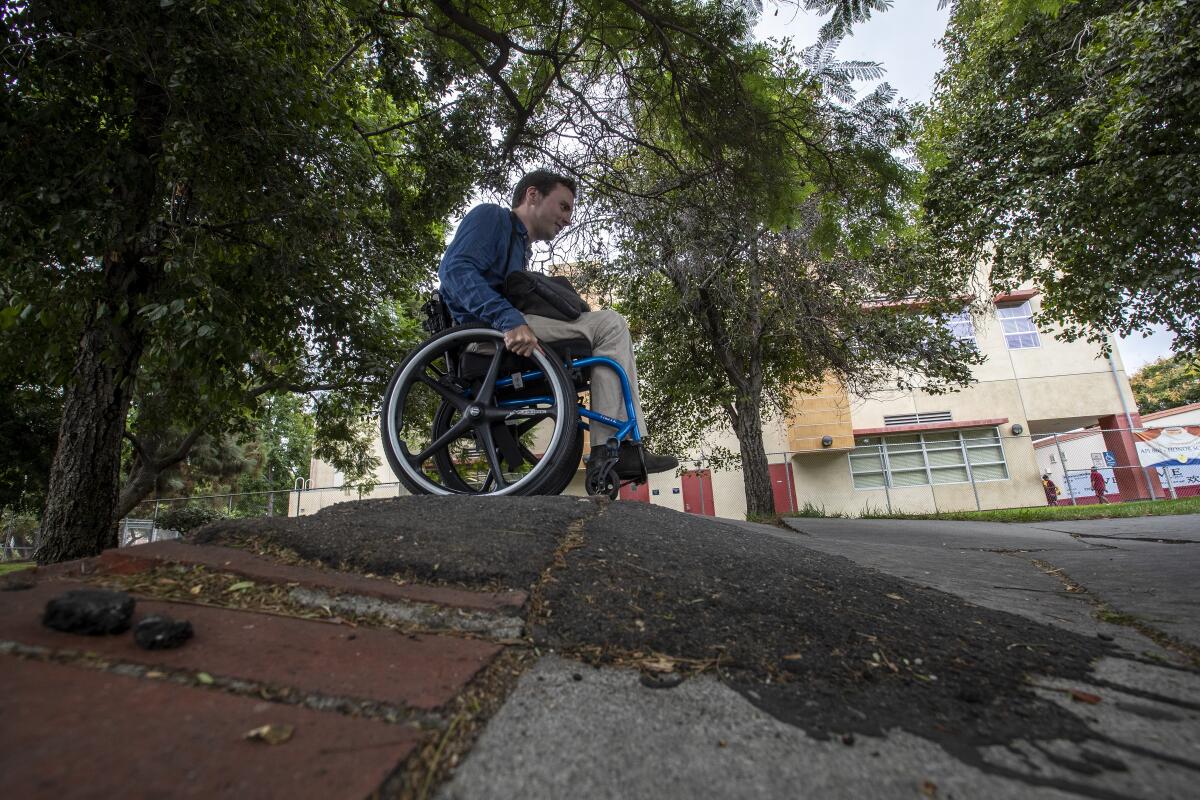
It works well, by the way, when you’re writing about ruptured sidewalks in Los Angeles. And this reminds me that I want to thank every mayor and council member, going back many years, who have contributed to the current embarrassment of spectacular disrepair, in which the waiting time for the city to come by and fix a sidewalk is 10 years (spoiler alert, I’m working on another chapter of the story as you read this).
I owe a garden of roses to my wife, for years of support, guidance and religiously reading the newspaper, despite having to put up with my story-juggling distractions and constant carping about the trajectory of the news business.
And to the hundreds of reporters, photographers and editors I’ve learned from and been inspired by — at the Woodland Daily Democrat, the Pittsburg Post-Dispatch, Concord Transcript, Oakland Tribune, San Jose Mercury News, Philadelphia Inquirer, Time Magazine, and the L.A. Times, where, countless times, my columns were informed by the ace reporting of my colleagues.
We are, tragically, fewer in number, but the mission has never been more vital.
And one last thank you:
The best part of the last 50 years has been my relationship with readers.
Not every one of you, to be honest. There’s a lot of anger out there, from people who disagree, think I’m a moron, or wonder why I haven’t followed up on their ideas.
(Brian van der Brug/Los Angeles Times)
But I’ve tried to make the column a running conversation, and I thank you for the feedback — positive and negative — as well as all the story ideas. Thousands of exchanges over the last 24 years, by email, by phone and in person, have helped me better understand Los Angeles and all the frustrations and joys of living here. I get backed up and am not as responsive as I should be, but I do not take this relationship for granted. In fact, I consider it a privilege.
So yes, 50 years and counting, and in the spirit of Al Martinez, on to the next, and the next.
Send me a story tip or two, will you?
Steve.lopez@latimes.com

Construction workers unfurled a large printed tarp to cover scaffolding installed at the White House’s front entrance. Doug Burgum, the interior secretary, said President Trump had ordered the repairs after noticing damage to columns.
Politics
WATCH: Trump’s Energy chief reveals what escalating Iran tensions could mean for gas prices

NEWYou can now listen to Fox News articles!
Energy Secretary Chris Wright is telling Americans not to be concerned about the possibility of another surge of sharp increases in gasoline prices as tensions with Iran have started to escalate once again.
Asked whether Americans should worry about higher prices at the pump and how the Trump administration is preparing to keep the economy stable if the conflict continues to worsen, Wright told Fox News Digital: “It has not been any good behavior from Iran that’s allowed oil to flow. It’s been the United States military.”
“That’s not changing,” he assured, speaking from the Great American State Fair on the National Mall this week.
US CLAWS BACK KEY CONCESSION TO IRAN AFTER FRESH ATTACKS ON COMMERCIAL SHIPS IN STRAIT OF HORMUZ
(Mario Tama/Getty Images) (Mario Tama/Getty Images)
With Iran striking three commercial vessels transiting the Strait of Hormuz on Monday and Tuesday, Wright doubled down in urging citizens to not credit Iran for the U.S. military’s work to ensure oil shipments continue flowing through the strait.
“Look, the U.S. Military has been the key asset here,” he said. “They have assured the flow of oil and gas through the Strait of Hormuz throughout. Not at the beginning of this conflict, but through the last six weeks.”
Wright said the administration is closely monitoring global oil supplies as the tentative ceasefire with Iran seemingly came to come to a halt, with President Donald Trump telling Secretary-General Mark Rutte the call for peace with Iran is “over” at the NATO Summit in Turkey on Wednesday.
But, he pointed to the continued shipping through the Strait as evidence that markets should remain stable.
TRUMP SAYS IRAN CEASEFIRE IS ‘OVER’ AFTER IRANIAN ATTACKS TRIGGER MASSIVE US RESPONSE
President Donald Trump speaks at the White House on Tuesday, April 22. (AP/Alex Brandon)
“We’re of course constantly watching the supply of oil, the supply of refined products and what’s going on there,” Wright said. “And I think still all positive trends.”
Beyond geopolitical concerns, Wright also praised the new chain of discounted gas stations across Pennsylvania and New Jersey, Freedom Fuel, which promises customers prices below the national average.
The Trump administration, though not involved with the network, has heavily endorsed the new chain and its 25 locations.
“We love it,” Wright said when asked about Freedom Fuel. “I mean, look, any mechanism we can to lower energy costs for Americans of all kinds, we’re all in on.”
“With Freedom Fuels, they’re just lowering it down to their wholesale price of gasoline,” Wright said. “So they’re not making any money selling gasoline, but they’ve got convenience stores. That’s how most gas stations make money.”
NEWSOM UNDER FIRE AS CALIFORNIA GAS TAX HIKE SENDS PUMP PRICES EVEN HIGHER
Gasoline costs are a known concern for many Americans, and amid surging prices there has been a considerable increase in those opting to purchase electric vehicles to save money long-term at the pump — with Tesla dominating the market for these types of models.
Wright argued one of the benefits to living in America is having the option to choose what type of vehicle you drive.
CLICK HERE TO DOWNLOAD THE FOX NEWS APP
“We just want people to buy what they would prefer,” he told Fox News Digital when asked his thoughts on increasing calls for support of the electrification of cars. “Consumer choice — you wanna buy an electric car, you wanna buy a gas powered car, diesel powered car, buy a big truck. That’s the choice.”
“That’s why you live in America. You get the choice of all those.”

In 2023, California regulators levied more than $100,000 in fines against the private operator of a federal immigration facility, kicking off a three-year battle over whether detainees who do work at the facilities should be considered employees.
The question went beyond semantics: If considered employees, the detainees would be subject to state worker protection laws.
A legal settlement announced this week now affirms that private immigrant detention facilities are subject to California’s workplace safety and health requirements.
“Every worker deserves a safe and healthy workplace and should be able to report workplace hazards without fear of retaliation,” said Denisse Gómez, spokesperson for the California Division of Occupational Safety and Health or Cal/OSHA.
“Individuals who perform work in these facilities are entitled to workplace safety protections, and this settlement reinforces Cal/OSHA’s commitment to enforcing those protections and safeguarding vulnerable workers,” she added.
Under the settlement between California and the GEO Group, a Florida-based private prison company, the company recently withdrew its legal challenges and agreed to pay more than $100,000 in the fines.
The GEO Group did not respond to requests for comment.
Back in 2023, Cal/OSHA issued $104,510 in fines against the GEO Group. The agency had found six violations of state code by the company after detainees complained about a lack of protective equipment and proper training while cleaning the facility for $1 per day.
Detainees alleged they routinely wiped black mold off shower walls at the facility, saw black dust spew from air vents and used cleaning solutions that lacked instructions during the COVID-19 pandemic.
The biggest fine levied against the GEO Group was for failure to establish and maintain “effective written procedures to reduce employee risk of exposure to aerosol transmissible disease.”
Advocates viewed Cal/OSHA’S recognition of the detainees as workers as a victory that could pave the way for future labor rights fights at other detention centers in the state.
But the GEO Group appealed, arguing that detainees participating in ICE’s voluntary work program make their own schedules and aren’t employees, so hazard exposure couldn’t be “as a result of assigned duties,” as California law states. Plus, the company argued, there wasn’t enough evidence that detainees were exposed to any hazard.
Early last year, the state’s Occupational Safety and Health Appeals Board rejected the GEO Group’s argument and found that detainees should be considered “affected employees.”
The GEO Group sued, but three days before a California Superior Court hearing in May, the company and Cal/OSHA reached the settlement.
Along with paying the fines, the GEO Group agreed to draft plans for avoiding aerosol transmissions at 12 secure and reentry facilities in California, including five detention centers that hold immigrants.
“GEO ensures detainees are afforded the necessary tools, equipment, and personal protective equipment … to safely and effectively perform any necessary tasks,” the settlement states.
Gómez said the settlement also leaves intact the appeals board’s ruling that civil immigration detainees who participate in work programs can participate in proceedings anonymously, “acknowledging the potential for retaliation when individuals raise workplace safety concerns.”
But the question of whether detainees are employees and deserve certain protections isn’t entirely resolved — at least not for the federal government.
Last month, U.S. Immigration and Customs Enforcement released new standards for detention facilities across the country. The revised guidelines “emphasize that detainee volunteers participating in the voluntary work program are not considered facility and/or government employees” and thus not entitled to labor regulations.
Attorney Mariel Villarreal said the timing of the new detention standards made her question whether the GEO Group had asked ICE to specify in its standards that detainees are not workers in response to its battle with Cal/OSHA.
“To me, it’s a reaction to this very settlement,” she said. Villarreal works for the California Collaborative for Immigrant Justice, which filed the original complaint on behalf of detainees who said they worked in unsafe conditions.
Villarreal pointed to a Washington Post report that GEO Group executives privately asked ICE to specify that detainees are not employees of the facilities where they work. Two top Trump administration officials, border czar Tom Homan and acting ICE director David Venturella, previously worked for the GEO Group.
New versions of ICE detention standards take effect as contracts are established or modified, so this year’s rules won’t immediately apply to every facility.
An ICE spokesperson did not comment about the settlement. The spokesperson, who did not provide their name in an emailed statement Wednesday, said the agency has begun transitioning detention facilities to meet the 2026 standards, “building on its longstanding commitment to safe, secure, and professional detention operations.”
“ICE has consistently implemented many of these best practices independently, reinforcing its role as the leader in detention operations,” the spokesperson added.
The GEO Group and other immigrant detention center operators have faced other legal battles over workers’ rights, including lawsuits in Washington, Colorado and California over the $1-per-day payment.
Villarreal said she’s confident that the Cal/OSHA settlement would continue to hold even if California facilities incorporated the new standards. But she said she believes the statements are an attempt by the GEO Group to “sidestep responsibility” and avoid the possibility of being fined under similar circumstances in other states.
“These statements in the new standards are a way for them to try and preserve profits as much as possible,” she said. “GEO and ICE are so intertwined at this point that they have the same motives.”
-

 Austin, TX2 minutes ago
Texas Has One Trait Almost Every National Champion Shares
-

 Alabama9 minutes ago
Final 2026 MLB mock draft projections for Alabama’s Justin Lebron
-
 Alaska12 minutes ago
Watch My Buddy Matt Not Get Eaten by Bears in Alaska
-

 Arizona17 minutes ago
Roller derby still has a home in Arizona despite myriad obstacles
-

 Arkansas24 minutes ago
Freshman OL Tucker Young never wavered through Arkansas football coaching changes | Whole Hog Sports
-

 California27 minutes ago
Northern California high school graduation shooting suspect arrested in Texas
-

 Colorado32 minutes ago
Colorado to weigh daily hunting limits, ban on fur sales for wildlife hunted for fur
-

 Connecticut39 minutes ago
Woman arrested, accused of murdering man in Farmington in March

