Politics
Column: What I learned from watching Fox News after the New Orleans terrorist attack

I usually kick off every Jan. 1 with the Rose Parade broadcast on Channel 5, then college football in the afternoon and evening. It’s one of the few days I honestly, truly try to relax and do something that’s next to impossible for me: not work.
Sadly, that’s not how I began my 2025.
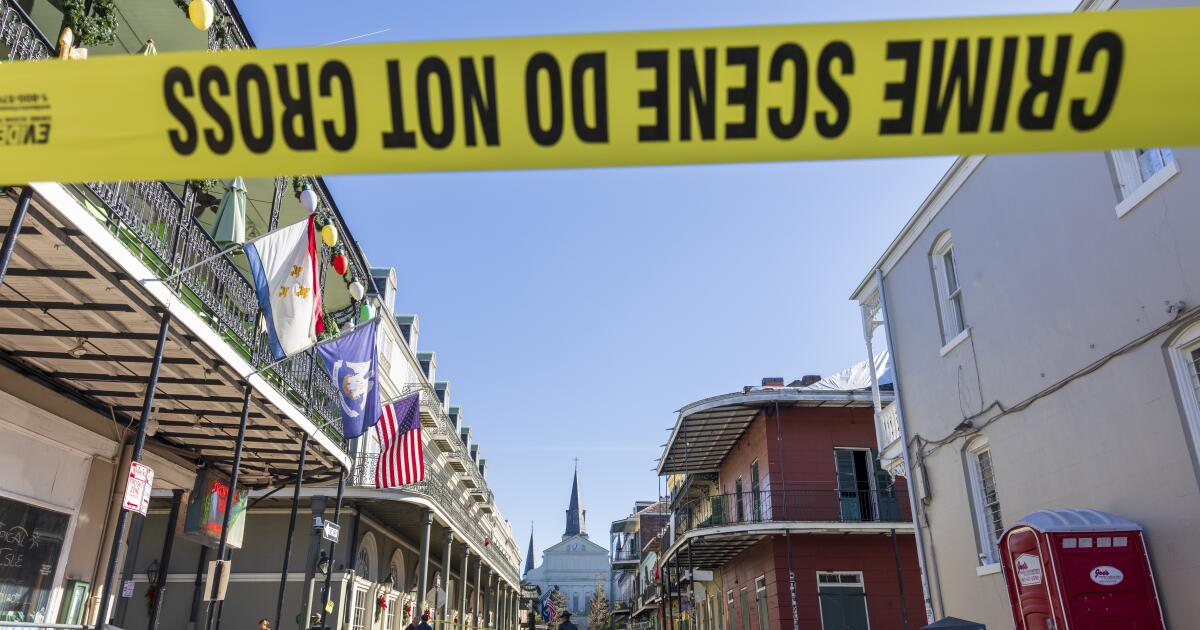
I woke up to the news that an ISIS sympathizer had driven a truck onto Bourbon Street in New Orleans earlier that morning, killing 14 people and injuring dozens more. Shortly after, a family member texted that they were safe after a Tesla Cybertruck blew up in front of the Trump International Hotel in Las Vegas.
Whenever national tragedies like these happen, I immediately switch my television to CNN. The cable channel’s team of on-the-ground correspondents is without peer, and its anchors and commentators leave the opining and speculation to a minimum as they stick to the facts with a tone that tries to be authoritative. That’s what I watched for hours on Wednesday, instead of flower-festooned floats and read-option offenses, as I tried to make sense of the horrible start to the new year.
Maybe I was groggy from the previous night’s festivities. Maybe I was too full on breakfast tamales. But at some point, I decided to ditch CNN and tune into a channel I rarely watch:
Fox News.
I don’t live in a liberal bubble. I listen to Ben Shapiro’s and Rep. Dan Crenshaw’s podcasts when I can, receive dozens of conservative newsletters ranging from libertarian to white nationalist and subscribe to orthodox Catholic newspapers like the Wanderer and New Oxford Review. Right-leaning friends love to debate me, because they know I’m not a knee-jerk ideologue. I have tracked the rise of Trump-loving Latinos in this columna for years, and have long warned liberals they ignore and ridicule Republicans at their own peril.
A well-informed American listens to all views and makes up their mind while always following the newspaper adage that if your mom tells you she loves you, go check it out. That’s why Fox News has always been a bridge too far for me.
A parade of demagogic hosts through the years — Lou Dobbs, Sean Hannity, Laura Ingraham, Tucker Carlson and Bill O’Reilly being among the most notorious — has corroded public discourse like rust eating through a sink. When it comes to breaking news on serious matters, I don’t care for rants and slants — that’s why I rarely watch MSNBC, either. Besides, my viewing habits have always been resolutely local — Channel 5 in the morning, KCAL-TV Channel 9’s nightly three-hour news block, then the 11 p.m. half-hour newscast on KNBC-TV Channel 4.
I’m always willing to give things I oppose a chance. I don’t regret my decision to turn on Fox News on New Year’s Day, because it was a sobering, necessary reminder of the fetid information ecosystem that put Donald Trump in the White House, created a majority in both chambers of Congress and paints critics like me as the enemy.
Former White House Press Secretary Kayleigh McEnany appears on “Hannity” at Fox News’ studio in Manhattan in 2023.
(Roy Rochlin / Getty Images)
I watched Fox News for four straight hours, with anchors Kayleigh McEnany (a former White House secretary under Donald Trump), Tammy Bruce and Trace Gallagher following each other. Their broadcasts led with segments from the scenes of the deadly attacks that told viewers what was known at the time and included footage of press conferences by the law enforcement agencies investigating the crimes. Those short bits at least offered the pretense of objectivity — the “fair and balanced” mantra Fox News has long insisted is its modus operandi.
But once the anchors brought in Fox News contributors, their shows reflected the unhinged worldview that now holds power in this country.
Guest after guest blamed the attacks on the FBI for supposedly preferring diversity initiatives and investigating the Jan. 6 Capitol insurrection and conservatives over stopping terrorist attacks. Buzzwords flew around like confetti that had nothing to do with the crimes at hand: Antifa. Open borders. Police haters. The far left.
McEnany, Bruce and Gallagher didn’t imply that the perpetrator had recently entered the country, as Trump and their own network initially did. But they kept referring to the attacker as a “U.S. citizen,” as if they couldn’t believe that a man with a name like Shamsud-Din Jabbar could possibly be an American. The same term was not used on Fox News to describe the Las Vegas Cybertruck exploder, Matthew Livelsberger, according to a review of transcripts.
Ex-Green Beret Jim Hanson called President Biden a “dementia-addled, barely animated carcass.” California Republican Party chair Jessica Milan Patterson demanded that all of Trump’s nominees “be confirmed immediately” so the incoming president could more easily accomplish his agenda. Counterterrorism commentator Aaron Cohen mentioned a pro-Palestinian rally in Times Square that day and tied it to the New Orleans attack, claiming, “You don’t shut this stuff down. This is what happens.”
The Fox News I remembered was in full force: Frothing. Paranoid. Vengeful. Seeking not to inform viewers but to inflame.
But the most wacko commentary came from former San Bernardino County sheriff’s Deputy Meagan McCarthy. Earlier in the day, Fox News published — and then walked back — a report that the truck Jabbar used to kill so many had crossed into the U.S. from Mexico a few days earlier. Following that erroneous piece, an avalanche of politicians demanded that the southern border be shut down, and Trump claimed on social media that “the criminals coming in are far worse than the criminals we have in our country.”
Gallagher aired an interview with New Orleans-area Republican Rep. Steve Scalise in which Scalise referenced Fox News’ original border crossing claim.
“We don’t know why,” Gallagher told McCarthy. “We don’t know what the link is. We’re not pointing fingers. We’re just saying that it’s interesting that we are at this point.”
“Where there’s smoke, there’s fire,” she replied. “And two things can be true at the same time. You can have an individual who was infiltrated while he was an American citizen, and you can have a problem at the southern border that maybe influenced this attack.”
That’s why McCarthy suggested that the FBI allow the American public “to be a part of the investigation” — something I doubt she would have advocated for back when she was a sheriff’s deputy.
“I understand as a law enforcement officer, you’re privy to certain things you want to keep close to the chest,” she said. “But I think we have seen the destruction at our southern border for four years. We know that there’s some correlation.”
Later, Gallagher mentioned a police officer who had remarked earlier that day that not going after shoplifters made it “tougher to go after the big fish, the bigger criminals.”
McCarthy agreed.
“Back when I was a cop, you would do those traffic stops to get those moving violations because it would lead to a bigger crime,” she said before adding, “We need to start getting back to defending people and not being afraid of offending people, and that starts with having some hard conversations and saying some hard truths.”
From ripping off a Walgreens to a terrorist attack in New Orleans? Fox News used to have another slogan: We report, you decide. Given that its ratings are the highest in a decade and that it was the highest-rated cable network for the ninth consecutive year, too many Americans have decided that Fox News’ whine-world is reality and have voted into office fellow true believers.
Buckle up your seat belts, everyone else: It’s going to be a hell of a next four years.

Politics
Trump takes unusual step, lets bipartisan housing bill become law unsigned amid SAVE pressure campaign

NEWYou can now listen to Fox News articles!
A bipartisan housing bill became law Saturday at midnight after President Donald Trump declined to sign it, capping a weeks-long saga over whether the president would veto the measure amid frustrations with Congress over his stalled agenda.
Trump refused to sign the 21st Century ROAD to Housing Act — legislation aimed at expanding the nation’s housing stock and lowering costs — in an attempt to pressure Congress to pass the SAVE America Act, despite the housing bill clearing both chambers with overwhelming majorities.
“I will not sign the Housing Bill, which has been fully approved by Congress and sent to the White House, in PROTEST over the fact that the United States Senate is not capable of passing THE SAVE AMERICA ACT, which is polling at 97% with the Republican Party, and very high with the non-politician Dumocrats,” he declared on Truth Social Friday morning.
The Trump-backed election measure, which would require proof of citizenship to vote in federal elections and impose voter ID requirements, has struggled to overcome the Senate’s 60-vote threshold.
Meanwhile, the House has not passed a version of the bill that includes the president’s proposed crackdown on mail-in voting and banning men from women’s sports.
President Donald Trump speaks in the Oval Office of the White House, Wednesday, June 3, 2026, in Washington. (Alex Brandon/AP)
HOUSE CONSERVATIVES DERAIL GOP AGENDA IN SAVE AMERICA ACT SHOWDOWN
Under the U.S. Constitution, Trump had 10 days, not including Sundays, to sign or veto the housing measure after the House formally transmitted the legislation to the White House in late June. The president ultimately chose neither option, allowing the measure to become law without his signature.
Though Trump declined to veto the legislation, he sharply criticized elements of the bill and argued it should not have been a legislative priority in recent weeks.
“It’s so unimportant … compared to the SAVE America Act,” Trump told reporters in the Oval Office in late June. “I think the SAVE America Act is exactly what it says. It’s saving America from crooked elections.”
Trump went on to call the housing bill “a yawn,” adding, “compared to the SAVE America Act, just about everything is a big yawn.”
It would have taken a two-thirds majority in both chambers to override a veto — a margin the House and Senate exceeded when they passed the legislation. However, it remains unclear whether so many Republicans would have defied the president had he vetoed the bill.
Trump also appeared to criticize the bill over a provision restricting Wall Street investors from purchasing single-family homes — a policy he first proposed during his January State of the Union address and later urged Congress to pass. Trump previously argued the investor ban would give individual homebuyers a leg up against private equity firms in the housing market.
“I don’t want to hurt people that own houses, too,” Trump later told reporters, appearing to reference the provision. “These people, for the first time in their lives, they have valuable houses. They’ve become rich. I don’t want to hurt them either. What you want to do is what’s good for everyone, get the interest rates down.”
The law also aims to boost housing supply by streamlining federal environmental reviews, loosening rules around the construction of factory-built homes, and incentivizing local governments to modify their zoning laws to allow more housing, among roughly 60 provisions.
Trump’s souring on the legislation created headaches for Republicans, who touted the bill as an affordability win as voters grapple with high housing costs.
“It’s irresponsible to postpone signing the Housing bill due to the SAVE Act,” Sen. Bill Cassidy, R-La., a retiring lawmaker who lost re-election to a Trump-backed challenger, wrote on social media. “We need to start delivering relief to people for the high cost of housing ASAP!!”
Construction workers stand on the roof of homes under construction at a new housing development on June 24, 2026, in Valencia, Calif. (Justin Sullivan/Getty Images)
WARREN TELLS TRUMP TO ‘SIGN THE DAMN BILL’ AS BIPARTISAN HOUSING PACKAGE REMAINS STALLED IN WASHINGTON
Trump abruptly canceled a signing ceremony for the legislation at the U.S. Capitol in June with GOP leaders. The stage had already been set, with at least one senior Republican arriving unaware the president had called off the event shortly before it was scheduled to begin.
The president then declared he would not sign the legislation until Congress passed the SAVE America Act, despite Senate GOP leaders insisting the votes do not exist to advance the measure.
Trump has also expressed frustration with the Republican-controlled Senate for declining to weaken the legislative filibuster, which requires 60 votes to advance most legislation in the upper chamber.
“GET SMART REPUBLICANS, IF YOU DON’T, YOU WON’T BE IN OFFICE FOR LONG!” Trump wrote in a Truth Social post on Sunday.
Before Trump came out against the bill, White House Press Secretary Karoline Leavitt called it “one of the most significant pieces of housing affordability legislation in American history” and said it included an array of policies “long championed” by Trump.
House Speaker Mike Johnson, a Republican from Louisiana, speaks during a news conference at the U.S. Capitol in Washington, D.C., on Oct. 15, 2025. (Eric Lee/Bloomberg via Getty Images)
Meanwhile, Trump political operative James Blair touted the legislation for including the president’s Wall Street investor ban, which he referred to as a “signature commitment.”
House Speaker Mike Johnson, R-La., has argued that Republicans will still promote the landmark housing bill ahead of November.
CLICK HERE TO DOWNLOAD THE FOX NEWS APP
“We’ll still celebrate it, but he’s trying to make a point, and I think he’s making it very effectively,” the speaker recently told reporters, referring to Trump. “And the fact that you all ask me every three steps down the hallway illustrates that he has achieved the desired objective, and that is to make SAVE America the number one thing, because if we don’t get that right, everybody’s concerned about what happens next.”

The Trump administration has signed off on a company’s plan to convert an oil and gas pipeline to pump groundwater from the Mojave Desert to thirsty California cities for the first time, a lucrative venture that critics say threatens natural springs and wildlife.
The federal Bureau of Land Management released documents Thursday saying that Cadiz Inc.’s plan to repurpose 162 miles of the pipeline to transport water “will not significantly affect” the environment.
“We’re excited to achieve this pivotal milestone. After many years of planning and environmental review, the project has now reached the construction stage,” said Susan Kennedy, chair and chief executive of Cadiz.
Environmental advocates and leaders of Native tribes, who have been fighting the project, criticized the decision.
“This groundwater mining proposal would drain the desert and rob the Mojave of its rare springs and wildlife habitat,” said Chance Wilcox, California desert associate director of the National Parks Conservation Assn. “It’s indefensible that the Trump administration would once again try to revive the pointless Cadiz project, by defying decades of scientific warnings and refusing to conduct an environmental review of the groundwater mining.”
The application for the federal authorization was filed by the Fenner Gap Mutual Water Co. The documents say the company plans to build seven pump stations, three of them located on federal land managed by the agency.
The 30-inch steel pipeline runs underground from Cadiz’s desert property, near the town of Amboy, northward to the town of Mojave.
The BLM said in its authorization that repurposing the pipeline for water “would comply with all applicable statutes and regulations.” The agency said it has “reasonably determined that the impacts of groundwater withdrawal associated with Cadiz’s groundwater extraction project are outside the scope of analysis.”
Cadiz’s attempts to export water from its property 200 miles east of Los Angeles have drawn controversy for decades.
In 2019, Gov. Gavin Newsom signed legislation that requires the project to undergo scientific study and gain approval from the State Lands Commission before it can take water from the Mojave and sell it to California cities.
Activists opposing the company’s plans include civil rights leader Dolores Huerta.
“Cadiz spells destruction for water, sacred lands, and the desert economy,” Huerta said in a statement. “It is exactly this type of greed and injustice that I have dedicated my life to oppose.”
Leaders of nearby tribes have also objected to Cadiz’s plans to pump from the desert aquifer near the Mojave Trails National Monument and Mojave National Preserve.
“It is the living heart of the desert,” said Daniel Leivas, chairman of the Chemehuevi Indian Tribe. “To drain it would be to drain the life out of the entire desert. No profit is worth such desecration.”
Chairman Timothy Williams of the Fort Mojave Indian Tribe said the company’s plan “to pump and sell 25 times more groundwater each year than the aquifer can replenish would desecrate our traditional territories.”
“Pumping more groundwater than is sustainably replenished is not only negligent, but dangerous to the American Desert Southwest,” he said in the joint statement with other opponents of the project.
For years, while pursuing its plan to sell water far away, the company has been using wells on its property to irrigate nearly 2,000 acres of farmland growing lemons, grapes and other crops. It has drilled more wells in anticipation of being able to export water once the government approved its pipeline.
The company intends to pipe water to communities in San Bernardino County and says it’s “expected to provide one of the lowest-cost sources of new water in the drought-plagued Southwest.” It says the federal permit “marks a key milestone as we finalize project financing with prospective investors.”
Cadiz bought the 220-mile pipeline from El Paso Natural Gas in 2020. Once construction is completed, the company says the pipeline will be able to transport up to 25,000 acre-feet of water per year — about 5% of what Los Angeles uses each year.
The Los Angeles-based corporation is also seeking to build a new pipeline along a railroad right-of-way to transport water to the south.
Environmental groups have repeatedly filed lawsuits challenging the project.
Ileene Anderson, a senior scientist at the Center for Biological Diversity, called the Trump administration’s decision “a green light for environmental destruction.”
She said six of the proposed pumping stations slated to be built are in the habitat of desert tortoises, a species in decline.
“We’ve successfully fended off this project before and we’ll continue to fight to stop this zombie from coming back,” Anderson said.
In 2021, the Biden administration reversed a Trump administration decision that had cleared the way for Cadiz to pipe water across public land. In 2022, a federal judge scrapped the pipeline permit that the Trump administration had issued.
But during President Trump’s second term, the company has again made headway on its plans. In February, Cadiz announced that the federal Environmental Protection Agency had invited it to submit an application for a $194-million low-interest loan for the northern pipeline project.
The company said in May that it reached an agreement with the federal Bureau of Reclamation to provide funding for a review of its potential role in “augmenting water supplies” along the shrinking Colorado River.
The company has also been lobbying the Trump administration. The group Public Citizen said in a recent report that Cadiz, through its nonprofit Fenner Gap Mutual Water Co., enlisted former Interior Secretary David Bernhardt’s new lobbying firm, the Bernhardt Group, and has spent at least $330,000 on lobbying in 2025 and 2026.
Records show lobbyist Luke Johnson has repeatedly accompanied Kennedy at meetings with Interior Department officials.
“The extensive influence of David Bernhardt’s boutique lobbying firm on the agency he formerly led highlights how insider firms staffed with former Trump officials have grown in recent years,” said Alan Zibel, a research director with Public Citizen. He said Bernhardt and his lobbyists “have learned how to master influence-peddling in the anything-goes era of Trump 2.0.”
Earlier this month, an Arizona water agency announced it signed an initial “memorandum of understanding” agreement to buy up to 10,000 acre-feet of water per year from Cadiz’s Mojave Groundwater Bank. The Central Arizona Irrigation and Drainage District provides water to farmlands in Pinal County, where growers are dealing with water cutbacks.
The company said that for this to happen, it would need to build pipelines and reach deals to exchange water across state lines.
Members of California’s congressional delegation have raised concerns. In a recent letter to Interior Secretary Doug Burgum, California Sens. Adam Schiff and Alex Padilla called for a thorough environmental review, saying that federal agencies and peer-reviewed scientific analyses have “warned of the significant and irreversible impacts that Cadiz’s project could have on federal lands and surrounding communities.”
Rep. Raul Ruiz (D-Indio) said in a letter to Burgum that he is concerned about the company’s long-standing effort to extract and export groundwater.
“The area I represent cannot afford to absorb the long-term costs of a commercially driven groundwater export scheme,” Ruiz said.
President Trump has promoted a chain of newly rebranded gas stations across the Philadelphia area with lower gas prices. The New York Times has not been able to get detailed information about who is behind the stations. The Trump administration says it did not fund or subsidize the company.
-

 World8 minutes ago
Moldova president nominates pro-European businessman Tofan for PM
-

 News36 minutes ago
US congressman says he was detained by armed Israeli settlers in occupied West Bank
-

 Los Angeles, Ca2 hours ago
New details emerge in fatal stabbing of boy in El Monte
-

 Detroit, MI2 hours ago
1 dead, 1 injured after two-vehicle crash at Collingwood and Belleterre in Detroit
-

 San Francisco, CA2 hours ago
4 arrested, 3 cited after brawl following Giants vs. Rockies game at Oracle Park
-

 Dallas, TX3 hours ago
Mark Cuban takes legal action against Dallas Mavericks ownership over potential new arena deal
-

 Miami, FL3 hours ago
South Florida Dirt: A timeline of the Vacchi vs. Stern legal battle
-

 Boston, MA3 hours ago
Tall Ships begin historic Boston parade of sails

