Politics
Column: L.A. County's Hall of Administration should stand, Janice Hahn says. And not because of her dad

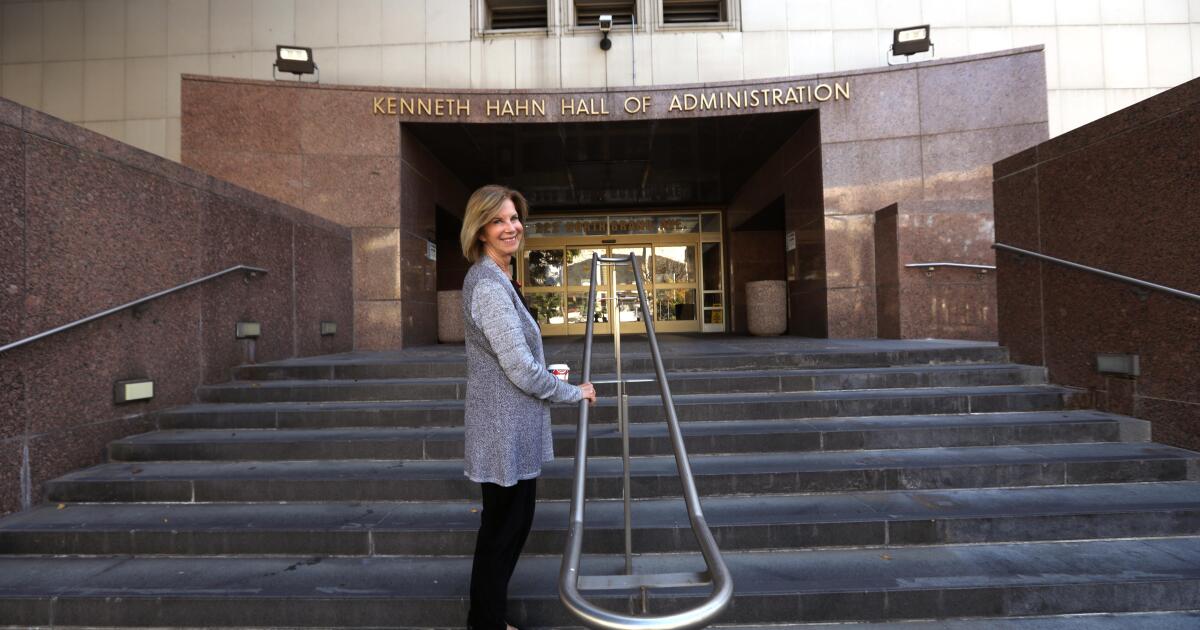
I drove around downtown Los Angeles on a recent Friday morning looking for one of the Civic Center’s ugly ducklings.
The Kenneth Hahn Hall of Administration … um, which building was it again?
It had been years since my only other visit, so unmemorable that I had forgotten how the ten-story structure looked. Google Maps gave me an address, but I was lost in a sea of architectural grandeur when I finally parked in a small lot near Temple and Grand. To my left was the majestic Cathedral of Our Lady of the Angels. Behind me were the Music Center’s elegant triplets of the arts: the Dorothy Chandler Pavilion, Mark Taper Forum and Ahmanson Theatre.
In front of me was a building with cream-colored tiles that connected to a taller building that looked the same, except with windows.
Oh, yeah. That’s the Hall of Administration.
Seat of the county of Los Angeles since it opened in 1960, it looks like a Lego block with slits. No wonder it’s never gotten as much love from Angelenos as its flashier neighbors, especially L.A. City Hall, which looms to the south like the haughty older civic cousin it is.
That’s why there hasn’t been any uproar since the county Board of Supervisors voted in November to buy the 52-story Gas Co. Tower for $200 million — a bargain worthy of the late, great 99 Cents Only chain, since its appraised value is $632 million — with plans to relocate county workers there, from the Hall of Administration and elsewhere, as early as this summer.
Nearly a third of the purchase price came from funds originally set aside to seismically retrofit the Hall of Administration and update its electrical system, effectively sentencing the place to the literal and historical scrap heap. The county’s preliminary plan calls for razing it, except for the portion where the supervisors hold their public meetings.
The sole “no” vote came from Janice Hahn, daughter of the Hall of Administration’s legendary namesake, the longest-serving supervisor in L.A. County history. She was waiting for me in the parking lot to give me a tour of the unloved building and argue for its virtue — and survival.
“This is Nate’s Lot,” she told me, explaining that it was named after a parking attendant who told her father he didn’t like working in the Hall of Administration’s underground garage. So the supervisor created the lot just for him.
“There’s history like that all around in a building like this,” said Hahn, Starbucks chai latte in hand, as we walked through the doors. Three staffers accompanied us, including Mark Baucum, who is both her son and her chief of staff.
“It has a warm feel, not like …” Her face scrunched as if she had stepped on a snail, and she waited a beat before referencing the county’s recent purchase. “That soulless skyscraper.”
Gloria Molina Grand Park is nestled alongside the Kenneth Hahn Hall of Administration, left, in Los Angeles. City Hall towers in the background.
(Genaro Molina / Los Angeles Times)
The halls gleamed with vintage charm. Marble walls and terrazzo floors. Frosted windows on doors with the old-school gold sans serif font long used by county departments. Phone booths that still work. Wood-paneled elevators that Janice and her brother, former L.A. mayor and current Superior Court Judge Jim Hahn, rode as kids like they were at an amusement park.
We walked through the spacious main lobby, where people waited in line to pay their property taxes, and out of the building toward Hill Street.
“That soulless skyscraper doesn’t have a lobby like this,” Hahn said. Across the street was the Hall of Records, built in 1962. To our left were the Stanley Mosk Courthouse, opened in 1959, and Gloria Molina Grand Park.
“They’re not on the chopping block,” she said, referring to the buildings. “People once thought City Hall was too expensive to retrofit. Were it not for civic-minded people, it would’ve been torn down. What a tragedy that would’ve been.”
As we rounded the Hall of Administration’s western side to look at large, gold-colored statues of Moses and Thomas Jefferson, the wear-and-tear of the 75-year-old building quickly became evident. Chunks missing from window ledges. Chipped granite base. Cracks on the walls here and there.
“Yes, it needs work,” Hahn acknowledged, as Baucum helped a woman who couldn’t tell the difference between the Hall of Administration and the Stanley Mosk Courthouse. “We had some of that money, but it was used to buy … that soulless skyscraper. And we have a budget of $50 billion. We can do this.”
Hahn estimated the cost to be $700 million. A spokesperson for L.A. County Chief Executive Officer Fesia Davenport said the seismic retrofit is expected to cost about $700 million, with renovations and other needed repairs bringing the estimated total to $1.8 billion.
But should it be done? I wondered as we went back inside the Hall of Administration. What possible role could an empty building play, when the other four supervisors want to get the hell out of there, and all of the money set aside to take care of it has already been spent?
One person I figured might have some pity for the Hall of Administration was Supervisor Kathryn Barger. She’s worked there since 1989 — first as an aide, then as chief of staff to then-Supervisor Mike Antonovich, and for the last eight years in her current role.
“From an aesthetic point of view, not much there,” said Barger, who voted to buy the Gas Co. Tower, in a phone interview. “You go to City Hall, you’re like, ‘Wow.’”
She gets Hahn’s point that it’s a historic structure, but Barger is more focused on the price tag for renovation, which she put at $1.2 billion. “I cannot discount Janice, but we have to do right by the taxpayers,” she said.
Barger mentioned that the supervisors are going to need much more office space after voters in November approved an eventual expansion of the board from five members to nine. She also brought up the late Gloria Molina, who served alongside Kenneth Hahn and whom Barger got to know well while working for Antonovich.
“Her vision and dream was to create more open space, and it was always shot down,” Barger said. She suggested that the Board of Supervisors could knock down the Hall of Administration, which spans the length of two city blocks, and expand Gloria Molina Grand Park.
“This issue is emotional for [Hahn],” Barger said, “but you have to separate the emotional from the reality.”
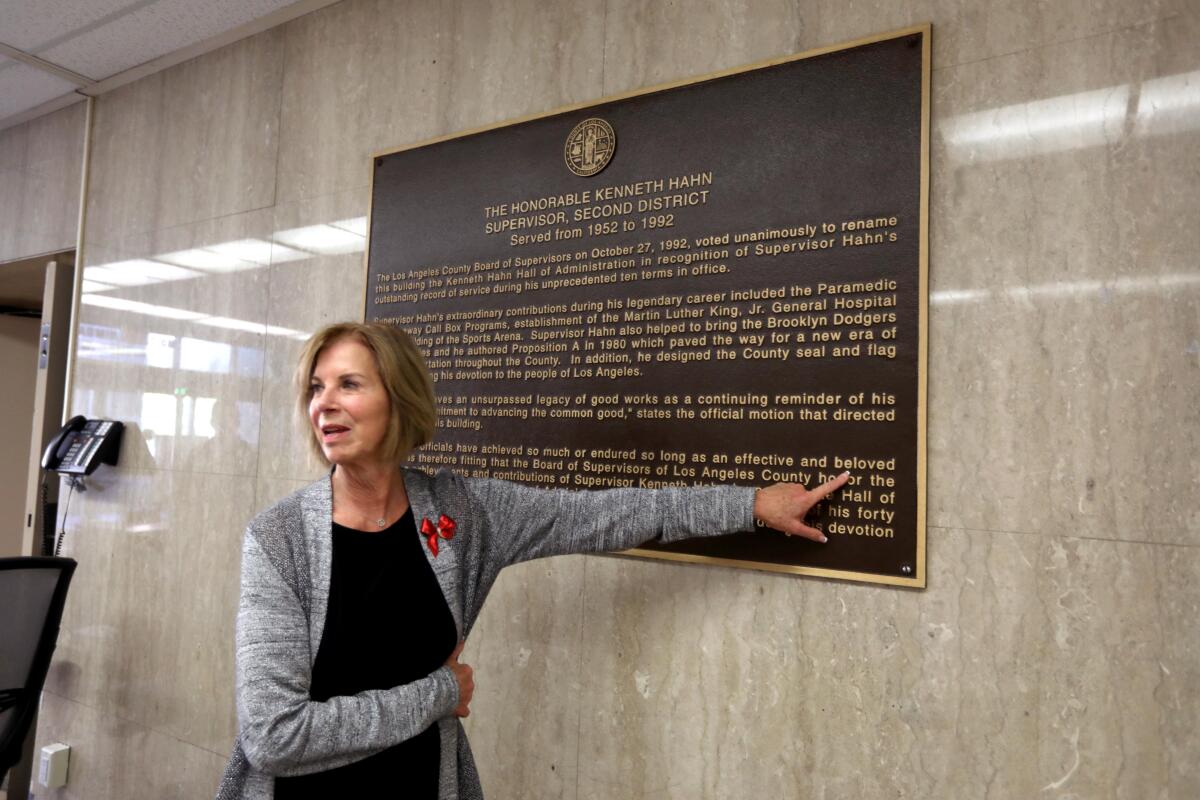
Supervisor Janice Hahn points out the word “beloved,” referring to her late father, on a plaque at the Kenneth Hahn Hall of Administration in Los Angeles.
(Genaro Molina / Los Angeles Times)
Hahn brought up that charge herself, then disputed it.
“Every story written implies it’s because of my father,” Hahn told me as we stood in front of a plaque near the lobby praising Kenneth Hahn’s “unsurpassed legacy of good works” in 40 years as a county supervisor. He died in 1997.
“It’s not,” she continued. “People have said, ‘We’ll put his name on the skyscraper.’ Oh, hell no. He would’ve questioned the rationale of using certain budget stats to prove” the necessity of leaving the Hall of Administration, she said. “He would find holes in their argument and find $700 million to save this hall.”
The tour went on for about an hour, with Hahn greeting every single person she passed. We visited the Board of Supervisors’ meeting room, which will remain standing (“That’ll make a disjointed county government”), and finally went up to her office. A painting hangs near the entrance, depicting her on a couch with a portrait of her dad hovering above.
“This is my life,” Hahn cracked. “My dad always looking over my shoulder.”
We briefly sat down, then went outside to a terrace ringing the length of the Hall of Administration. The floor was peeling, but the view before us of the Civic Center and downtown was stunning.
I understood, and even appreciated, Hahn’s argument that moving the county offices from here, where other parts of L.A. government reside, would create “a gaping hole in the idea of civic togetherness,” as her son put it. But the fiscal reasoning against it was strong, I said, before asking if her crusade stood any chance of succeeding.
“I think so,” she said. “I think we’ll get the momentum. And Dad always loved a good fight.”
Her son pointed out a sliver of a skyscraper poking out behind another skyscraper. That was the Gas Co. Tower.
“Ugh,” the supervisor said, shaking her head. “Soulless.”
After we said our goodbyes, I walked the four blocks to Hahn’s Moby Dick, which was built in 1991. She wasn’t wrong. The exterior is a bunch of charmless windows going up and up. The lobby, with its collection of elevators, scowling security guards and small glass turnstiles, is cold and anodyne. No amount of bureaucratic lipstick can pretty up this political pig.
Maybe Hahn was right, I thought as I headed back to Nate’s Lot. Then I ran into Miguel Santana, president of the California Community Foundation and a longtime Molina confidante.
I know few people who care about L.A. history and responsible leadership as much as he does. What does he think about the county abandoning the Hall of Administration?
“Great!” he said, barely breaking his stride. “I’m all for it. Gloria always wanted to knock it down and turn it into more park.”
Good luck with your fight, Supervisor Hahn: You’re going to need it.

Politics
Rubio sanctions Cuban groups with ties to US nonprofit network funded by communist donor Neville Roy Singham

NEWYou can now listen to Fox News articles!
Secretary of State Marco Rubio put U.S. organizations on notice: they can no longer do business with a key Cuban organization that has spent over six decades – since the launch of Fidel Castro’s communist revolution in 1959 – cultivating relationships with U.S. activists and groups, many of them now funded by communist American tycoon Neville Roy Singham.
The sanctions target the Cuban Institute of Friendship with the Peoples, known by its Spanish acronym ICAP, an organization founded by Castro in 1960 to spread Marxist ideology and support for Cuba. Long ago, U.S. officials and intelligence assessments concluded ICAP is a key component of Cuba’s intelligence apparatus.
“For decades, Cuba has been the world capital for radical left-wing terrorism,” Rubio said. “The regime in Havana has recruited, trained and backed violent Marxist and third-worldist movements across our hemisphere and beyond.”
REVOLUTIONARY TOURISM: INSIDE THE $600M MARRIAGE OF DARK MONEY AND FAR-LEFT AGITPROP
Marco Rubio moves to put sanctions on a group that Fidel Castro established in 1960 to spread Cuba’s communist influence in the world. (Sven Creutzmann/Mambo Photography/Getty Images; Nathan Posner/Anadolu via Getty Images)
Earlier this year, ICAP worked with U.S. nonprofits, including the People’s Forum, Progressive International and CodePink, to organize a March “convoy” that included controversial Marxist streamer Hasan Piker landing in Cuba to support Cuba’s communist party.
The trip has since attracted federal scrutiny, with CodePink co-founder Medea Benjamin confirming she received questions from federal officials about the trip, investigating whether she violated sanctions.
Late last month, Fox News Digital published a three-part series, reporting that federal investigators are examining Cuba’s alleged malign foreign influence operation in the U.S., investigating a network of 145 groups with collective revenues of about $1 billion, promoting Cuba’s agenda and communist ideology.
“Today, we are targeting the network that enables and funds Cuba’s subversive and radical operations,” Rubio said.
The groups working closely with ICAP include the People’s Forum, CodePink, BreakThrough News and Tricontinental, funded by Singham, a Marxist tech tycoon living in Shanghai. As reported, Singham has pumped $285 million into nonprofits since 2017 that have built very close relationships with ICAP and the communist government of Cuba.
Singham is married to CodePink co-founder Jodie Evans.
INSIDE CUBA’S FOREIGN INFLUENCE CAMPAIGN: FROM THE VENCEREMOS BRIGADE OF THE 1960S TO SATURDAY IN A UNION HALL
ICAP is today led by Fernando González Llort, one of five former Cuban intelligence officers, known as the “Cuban Five,” convicted in the U.S. years ago on espionage-related charges and released after spending time in jail.
Critics say ICAP acts as a gateway for revolutionaries from around the world to get embedded in the propaganda, organizing tactics and strategic goals of the Communist Party of Cuba. ICAP has denied wrongdoing and says it’s a civil society organization.
ICAP was one of five entities that Rubio designated as off-limits under sanctions authorities established by President Donald Trump’s Cuba executive order. The sanctions also target Cuba’s Ministry of the Revolutionary Armed Forces (MINFAR), the Committees for the Defense of the Revolution (CDR), Minera La Victoria S.A. and the state-run tourism company Amistur Cuba S.A., which has arranged trips to Cuba with U.S. nonprofits in the Singham network.
Experts said the move signals that the Trump administration is focused not only on the Cuban government but also on U.S. institutions that U.S. officials believe help project Cuban influence internationally.
A declassified CIA report from the Cold War era, “Cuba: Castro’s Propaganda Apparatus and Foreign Policy,” described Cuba’s international propaganda and influence activities as a central component of Castro’s foreign policy strategy. The report named ICAP among organizations that act as important instruments for cultivating sympathetic political movements abroad and extending Cuban influence beyond the island.
DOJ, TREASURY INVESTIGATE NONPROFITS AND LEADERS ALLEGEDLY COORDINATING WITH CUBA IN INFLUENCE CAMPAIGN
One of the most notable examples was the Venceremos Brigade, a Cuba solidarity program established in 1969 that brought generations of American activists to the island through exchanges organized with Cuban authorities and institutions including ICAP.
The program became one of the most visible pipelines connecting American activists to the Cuban revolutionary government.
Today, the Venceremos Brigade operates as a fiscally-sponsored project of the People’s Forum.
Lawmakers and federal authorities are examining whether organizations funded by Singham have acted on behalf of foreign interests without properly registering and have helped amplify messaging favorable to the Chinese Communist Party and the Communist Party of Cuba.
Cuba’s President Miguel Diaz-Canel (C) listens to Progressive International’s general coordinator, David Adler, during an event at the Cuban Institute for Friendship with the Peoples (ICAP) in Havana, on March 21, 2026. (Ernesto Mastrascusa/AFP via Getty Images)
HOW A RHODES SCHOLAR WITH TIES TO CUBA’S PRESIDENT ORGANIZED THE CONVOY THAT BROUGHT HASAN PIKER TO HAVANA
During the recent convoy in March, Progressive International co-founder David Adler appeared alongside Cuban President Miguel Díaz-Canel and ICAP President González at an official event hosted by ICAP.
Years ago, Los Angeles Mayor Karen Bass participated in Venceremos Brigade trips, a connection that her mayoral candidate Spencer Pratt resurfaced during her campaign. Bass has denied any wrongdoing.
Supporters of such exchanges describe them as educational and humanitarian programs intended to foster international understanding. Critics argue they function as political influence operations designed to build support for the Cuban regime and its ideological objectives.
The Cuban government condemned Rubio’s sanctions shortly after the announcement.
President Miguel Díaz-Canel accused the United States of escalating economic pressure against Cuba and attempting to intensify tensions between the two countries.
Hasan Piker, a Democratic Socialists of America member, and CodePink co-founder Jodie Evans meet in Havana, Cuba, as part of a “United Front” supporting the communist regime. (CodePink via Storyful)
“The Treasury Department has added new names of Cuban leaders, organizations and companies to an illegitimate sanctions list,” Díaz-Canel wrote on social media. “They are aimed at reinforcing the blockade measures and the scenario of conflict between Cuba and the United States.”
Rubio’s warning extended beyond the sanctioned entities.
The action signals that the administration is increasingly focused on the networks, partnerships and influence channels that U.S. officials believe have helped advance Cuban interests abroad long after the Cold War officially ended.
“Anyone providing services to these sanctioned actors is at risk of sanctions themselves,” he said. “Foreign banks and other companies that provide services to these entities should freeze those activities.”
CLICK HERE TO DOWNLOAD THE FOX NEWS APP
Fox News Digital’s Reagan Schroeder contributed to this report.
Politics
Commentary: No, Mr. Hilton, our elections are not ‘a joke.’ It’s time for you to stand up to Trump

Well, that didn’t take long.
A day after California’s primary election, President Trump took to social media with baseless claims of election fraud — predictable, but also dangerous.
“Look what’s happening in California, the Dumocrats, right before our very eyes, are stealing the Vote,” Trump wrote in one post.
“There’s BIG cheating by the Dumocrats in California,” he wrote in another, apparently enamored of his latest juvenile slur.
Never mind that his candidate, Steve Hilton, is in the lead — for now anyway.
California has once again become the main dish on Trump’s buffet of bull-hockey as he continues to undermine democracy and consolidate authoritarian power, using this disingenuous and patently untrue narrative that American elections are rigged by shadowy Democratic forces working in collusion with illegal immigrants.
That last part is called the Great Replacement Theory, the idea that “elites” are replacing white people — and white voters — with Black and brown immigrants in a bid to destroy white culture. It’s at the heart of Trump’s voter fraud allegations.
The twist this time is that Hilton, the man who wants to represent all Californians, seems to be jumping on the election fraud conspiracy train with the president. I get it, there’s the MAGA base to feed, and it’s a base that feasts on outrage and fakery. Serving up resentment glazed with lies and propaganda has been the MAGA playbook for years under Trump, a strategy that no one can deny has been heartbreakingly effective.
But Hilton is a smart man and must certainly know that voter fraud is rare, to the point of being inconsequential to election outcomes. Hilton by his own admission understands voting patterns, and that in this cycle, Republicans have voted early and often by mail, despite Trump’s claims that all vote-by-mail should be suspect. So Hilton understands that early votes have skewed his way, and that later vote tallies will likely favor Democrats.
And Hilton is definitely intelligent enough to expect that in a state where Democrats outnumber Republicans nearly three to one, he will not keep the top spot in this primary, and a slim chance remains that he will not make it into the top two. That’s just simple math.
So if Hilton truly seeks to represent this state as its top elected executive, now is the time to renounce election fraud myths and stand up to Trump’s lies. If Hilton can’t say that he believes our recent election was free and fair, then he has no business being our governor.
Unfortunately, that doesn’t seem to be the path he’s taking, even as it seems increasingly likely that he will advance to the general election.
This week, speaking with far-right podcaster and former Turning Point USA creative director Benny Johnson (who was allegedly duped into working for a Russian influence operation), Hilton said that while “so far we’re not seeing any signs” of cheating, “we’re going to be all over it. We’re not going to let them do that.”
Hilton was responding to a question from Johnson on whether Hilton will sue over “cheating.”
On a post-election appearance with Laura Ingraham, the conservative Fox News host who has repeatedly promoted the Great Replacement Theory, Hilton delved into more conspiracy.
“Just to really underline the point that you made about the corruption,” he told Ingraham an anecdote about supposed fraud in a previous election cycle when a “whistleblower” at the post office told him that they were instructed that a handwritten postmark was acceptable when sorting ballots to deliver to the county registrar.
“It’s just unbelievable, and of course, that’s why so many people don’t believe the results, but it just undermines confidence,” he told Ingraham, certainly knowing that the post office forwarding a ballot on to a county registrar in no way means it will be certified or counted. Would we really want the USPS deciding which ballots to deliver? Disingenuous on Hilton’s part at best.
“The whole thing is a joke,” Hilton went on to say of California elections, which of course, is absurd.
Thursday, when I asked Hilton’s team to speak with him about his views on voter fraud, they sent back a response that focused on the slowness of the California vote count; voter rolls Hilton has described as “wildly inaccurate,” which is a wildly inaccurate claim; and two instances of actual fraud with voter registration — not examples of votes that were counted.
To be sure, all those items are important. Any malfeasance should be punished, and the system should always strive to improve.
But how hard is it to simply be against fraud, while accurately acknowledging that it is rare and our current system provides accurate results?
I am against voter registration fraud. I am against vote fraud. I am absolutely pro-democracy, including policies such as mail-in voting that increase participation.
I do not believe that there is widespread fraud in the California primary, or in American elections in general, because the evidence does not support that conspiracy. I do not believe that Democrats are running a decades-long, nationwide conspiracy to replace white voters with votes from Black and brown undocumented immigrants, because that is both false and racist.
Pretty basic stuff, and statements in line with the values and common sense of the majority of Californians Hilton says he will represent.
If Hilton can’t come out and clearly say that Trump is wrong — about fraud and about the Great Replacement Theory — can he really be trusted to represent the values of the Golden State?

new video loaded: Jan. 6 Rioter Hired by Pentagon
transcript
transcript
Jan. 6 Rioter Hired by Pentagon
Elias Irizarry, who pleaded guilty to climbing through a broken window at the Capitol on Jan. 6, 2021, now works for an office responsible for uncovering and defending against terrorism plots at the Pentagon.
-
“Full pardon or commutation?” “Full pardon.”
By Alisa Shodiyev Kaff
June 4, 2026
-

 Los Angeles, Ca36 minutes ago
NB 405 Freeway closed near LAX after pursuit ends in gunfire
-

 Detroit, MI58 minutes ago
Judge blocks steam line project on Lafayette Park property
-

 San Francisco, CA1 hour ago
First Thursdays kicks off Pride Month in San Francisco
-

 Dallas, TX1 hour ago
Dallas Cowboys Defense is ‘Annoying’ CeeDee Lamb and That’s a Good Thing
-
 Miami, FL1 hour ago
Tampa Bay Rays vs Miami Marlins Live Stream: How to Watch MLB
-

 Boston, MA1 hour ago
Orioles news: O’s win series in Boston
-

 Denver, CO1 hour ago
Denver Broncos roster review: OLB Dasan McCullough
-

 Seattle, WA2 hours ago
Your Seattle-area weekend events guide: Pride, pinball, and car shows! – MyNorthwest.com

