Politics
Column: Barbara Boxer gives Biden two weeks to fix his ailing campaign

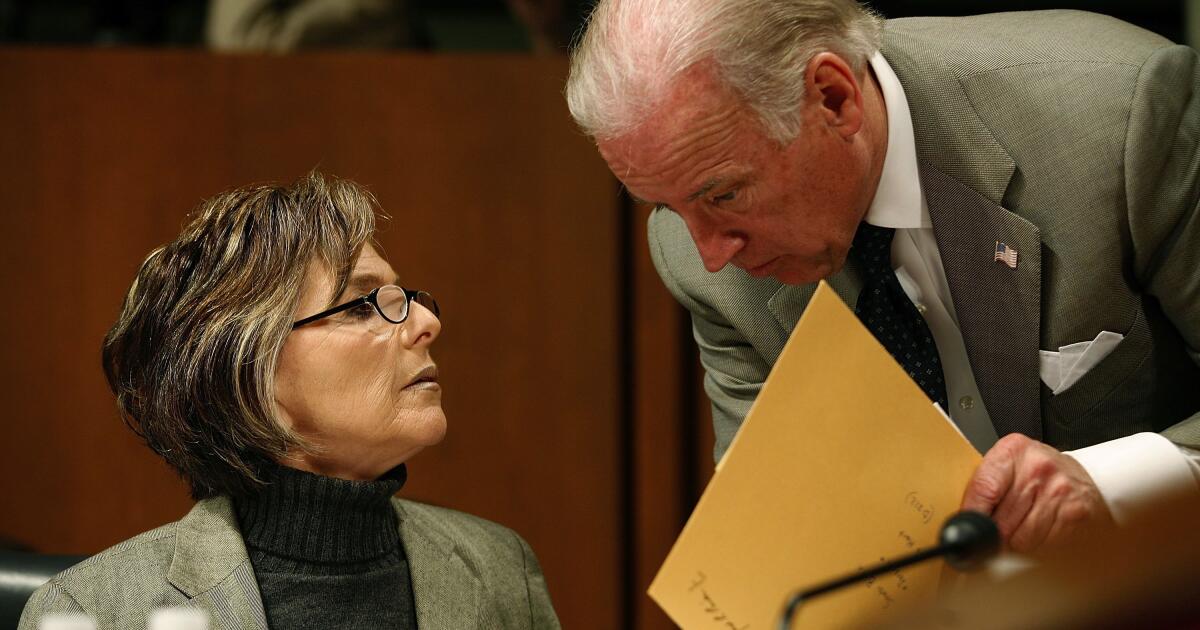
When Barbara Boxer arrived in the U.S. Senate, her image as a fiery liberal from Marin County — land of crystals, hot tubs and aging hippies — preceded her.
It was not a good thing.
“The word was that I was this very militant feminist and the guys were frightened to death,” Boxer recalled.
The colleague who smoothed her path — “She’s good people,” he assured the Old Bulls — was Joe Biden, who by 1993 was already starting his third decade on Capitol Hill.
The two grew close, personally and politically.
“We really bonded on protecting dolphins and protecting women,” Boxer said of their legislative work (regulating purse seine nets, cracking down on domestic violence), which had begun in the 1980s when she was in the House.
Boxer endorsed Biden when he ran for president in 1988 and again in 2020, notably passing over the Democrat who replaced her in the Senate, Kamala Harris.
Given all that, Boxer was slack-jawed as she and family members watched Biden mumble and bumble his way through his disastrous debate performance last week. “This wasn’t the Joe we knew,” she said. “Something was off.”
Instantly, what had been a persistent, low-grade nervousness among Democrats turned into a full-fledged party freak-out. A small but growing chorus has called for the 81-year-old incumbent to withdraw from the presidential race, before it’s too late and he drags his party down with him. (Many more express that sentiment in private.)
Boxer isn’t there. Not yet, anyway.
Two weeks, she said. Give Biden two weeks to demonstrate that his zombified appearance in Atlanta was an anomaly.
“The man has done it, time and time again,” Boxer said this week in a conversation from her home in Palm Springs. “Every time he’s been counted out, he’s come back. Can he do it one more time? I don’t know the answer. But out of respect and admiration for what he’s done, let’s give him the time to do it.
“And if he can’t, he can’t,” Boxer said, “and there will be someone else.”
That’s not exactly a stand-firm-until-the-last-dog-dies endorsement.
But it’s not casting a gravely wounded Biden to the wolves, either.
When the late Sen. Dianne Feinstein was going through her widely chronicled mental and physical decline, there were widespread calls for her to quit and make way for someone younger, more vigorous and more acute. Boxer, who made history with Feinstein when the two were elected to the Senate in tandem, offered a gentle nudge. There is life — and a good one — to be had after leaving the Senate, she advised her former colleague in a 2021 interview.
But Boxer never overtly pushed Feinstein, the way many others did. Her fellow Democrat died in September at age 90, hours after casting her final vote on the Senate floor.
The situation with Biden is different, Boxer said.
“We don’t know what happened with Joe,” she said, still puzzled nearly a week later.
She speculated. Perhaps his lifelong stutter kicked in under the studio lights? Maybe Biden suffered from a terrible head cold, or from cold medication he’d taken?
“I think the president owes the country an explanation,” Boxer said. And more crucially, she went on, he needs to show voters that he can not only take on Donald Trump, but that he can also defeat him in November.
“He needs to be out without a script. Without a teleprompter and just face the press, face the public,” she said. “That’s critical.”
Biden has made a few public appearances, including a comparatively feisty showing at a North Carolina rally the day after the debate. He spoke to reporters following the Supreme Court’s carte blanche decision granting presidents near-total immunity, and again while discussing the country’s sizzling weather at an emergency operations center in Washington.
But Biden worked off a teleprompter and refused to take reporters’ questions.
The president’s first without-a-net appearance is a scheduled interview Friday with ABC’s George Stephanopoulos. The stakes are exceedingly high. Another tottering performance could lead to a dam burst of calls from Democrats for Biden to step aside.
Meantime, polls taken after Thursday night’s debate show Biden losing ground to Trump and voters expressing heightened concern about the president’s mental and cognitive health.
Like many people, Boxer speaks of a Trump restoration in apocalyptic terms.
“This race is like no other,” she said. “We have to stop a man who says he’s going to be ‘a dictator on Day One.’ Who wants to imprison his opponents. … It gets worse and worse, day by day.”
She extolled Biden’s performance over the last 3½ years: his record on job creation, addressing climate change, fighting to lower the cost of prescription drugs. But that’s all in the past, and none of it seems to matter very much to voters who, in the here and now, worry and wonder very much about Biden’s capabilities going forward.
Democrats are nervous, Boxer said. “I’m nervous. I’m very nervous.”
But she’s still willing to give Biden a shot at one more political comeback. Two weeks, she said. “Because in August we have the convention, and if there is going to be an open convention, there needs to be time for people to decide who they’re supporting.”
That’s a long way from “Biden or bust.” It shows even the best of friends and greatest of admirers have limits to their hope and patience with a president whose mental and physical capacities seem to be touch-and-go.
But there’s no room for sentimentality with so much at stake.

Construction workers unfurled a large printed tarp to cover scaffolding installed at the White House’s front entrance. Doug Burgum, the interior secretary, said President Trump had ordered the repairs after noticing damage to columns.
Politics
WATCH: Trump’s Energy chief reveals what escalating Iran tensions could mean for gas prices

NEWYou can now listen to Fox News articles!
Energy Secretary Chris Wright is telling Americans not to be concerned about the possibility of another surge of sharp increases in gasoline prices as tensions with Iran have started to escalate once again.
Asked whether Americans should worry about higher prices at the pump and how the Trump administration is preparing to keep the economy stable if the conflict continues to worsen, Wright told Fox News Digital: “It has not been any good behavior from Iran that’s allowed oil to flow. It’s been the United States military.”
“That’s not changing,” he assured, speaking from the Great American State Fair on the National Mall this week.
US CLAWS BACK KEY CONCESSION TO IRAN AFTER FRESH ATTACKS ON COMMERCIAL SHIPS IN STRAIT OF HORMUZ
(Mario Tama/Getty Images) (Mario Tama/Getty Images)
With Iran striking three commercial vessels transiting the Strait of Hormuz on Monday and Tuesday, Wright doubled down in urging citizens to not credit Iran for the U.S. military’s work to ensure oil shipments continue flowing through the strait.
“Look, the U.S. Military has been the key asset here,” he said. “They have assured the flow of oil and gas through the Strait of Hormuz throughout. Not at the beginning of this conflict, but through the last six weeks.”
Wright said the administration is closely monitoring global oil supplies as the tentative ceasefire with Iran seemingly came to come to a halt, with President Donald Trump telling Secretary-General Mark Rutte the call for peace with Iran is “over” at the NATO Summit in Turkey on Wednesday.
But, he pointed to the continued shipping through the Strait as evidence that markets should remain stable.
TRUMP SAYS IRAN CEASEFIRE IS ‘OVER’ AFTER IRANIAN ATTACKS TRIGGER MASSIVE US RESPONSE
President Donald Trump speaks at the White House on Tuesday, April 22. (AP/Alex Brandon)
“We’re of course constantly watching the supply of oil, the supply of refined products and what’s going on there,” Wright said. “And I think still all positive trends.”
Beyond geopolitical concerns, Wright also praised the new chain of discounted gas stations across Pennsylvania and New Jersey, Freedom Fuel, which promises customers prices below the national average.
The Trump administration, though not involved with the network, has heavily endorsed the new chain and its 25 locations.
“We love it,” Wright said when asked about Freedom Fuel. “I mean, look, any mechanism we can to lower energy costs for Americans of all kinds, we’re all in on.”
“With Freedom Fuels, they’re just lowering it down to their wholesale price of gasoline,” Wright said. “So they’re not making any money selling gasoline, but they’ve got convenience stores. That’s how most gas stations make money.”
NEWSOM UNDER FIRE AS CALIFORNIA GAS TAX HIKE SENDS PUMP PRICES EVEN HIGHER
Gasoline costs are a known concern for many Americans, and amid surging prices there has been a considerable increase in those opting to purchase electric vehicles to save money long-term at the pump — with Tesla dominating the market for these types of models.
Wright argued one of the benefits to living in America is having the option to choose what type of vehicle you drive.
CLICK HERE TO DOWNLOAD THE FOX NEWS APP
“We just want people to buy what they would prefer,” he told Fox News Digital when asked his thoughts on increasing calls for support of the electrification of cars. “Consumer choice — you wanna buy an electric car, you wanna buy a gas powered car, diesel powered car, buy a big truck. That’s the choice.”
“That’s why you live in America. You get the choice of all those.”

In 2023, California regulators levied more than $100,000 in fines against the private operator of a federal immigration facility, kicking off a three-year battle over whether detainees who do work at the facilities should be considered employees.
The question went beyond semantics: If considered employees, the detainees would be subject to state worker protection laws.
A legal settlement announced this week now affirms that private immigrant detention facilities are subject to California’s workplace safety and health requirements.
“Every worker deserves a safe and healthy workplace and should be able to report workplace hazards without fear of retaliation,” said Denisse Gómez, spokesperson for the California Division of Occupational Safety and Health or Cal/OSHA.
“Individuals who perform work in these facilities are entitled to workplace safety protections, and this settlement reinforces Cal/OSHA’s commitment to enforcing those protections and safeguarding vulnerable workers,” she added.
Under the settlement between California and the GEO Group, a Florida-based private prison company, the company recently withdrew its legal challenges and agreed to pay more than $100,000 in the fines.
The GEO Group did not respond to requests for comment.
Back in 2023, Cal/OSHA issued $104,510 in fines against the GEO Group. The agency had found six violations of state code by the company after detainees complained about a lack of protective equipment and proper training while cleaning the facility for $1 per day.
Detainees alleged they routinely wiped black mold off shower walls at the facility, saw black dust spew from air vents and used cleaning solutions that lacked instructions during the COVID-19 pandemic.
The biggest fine levied against the GEO Group was for failure to establish and maintain “effective written procedures to reduce employee risk of exposure to aerosol transmissible disease.”
Advocates viewed Cal/OSHA’S recognition of the detainees as workers as a victory that could pave the way for future labor rights fights at other detention centers in the state.
But the GEO Group appealed, arguing that detainees participating in ICE’s voluntary work program make their own schedules and aren’t employees, so hazard exposure couldn’t be “as a result of assigned duties,” as California law states. Plus, the company argued, there wasn’t enough evidence that detainees were exposed to any hazard.
Early last year, the state’s Occupational Safety and Health Appeals Board rejected the GEO Group’s argument and found that detainees should be considered “affected employees.”
The GEO Group sued, but three days before a California Superior Court hearing in May, the company and Cal/OSHA reached the settlement.
Along with paying the fines, the GEO Group agreed to draft plans for avoiding aerosol transmissions at 12 secure and reentry facilities in California, including five detention centers that hold immigrants.
“GEO ensures detainees are afforded the necessary tools, equipment, and personal protective equipment … to safely and effectively perform any necessary tasks,” the settlement states.
Gómez said the settlement also leaves intact the appeals board’s ruling that civil immigration detainees who participate in work programs can participate in proceedings anonymously, “acknowledging the potential for retaliation when individuals raise workplace safety concerns.”
But the question of whether detainees are employees and deserve certain protections isn’t entirely resolved — at least not for the federal government.
Last month, U.S. Immigration and Customs Enforcement released new standards for detention facilities across the country. The revised guidelines “emphasize that detainee volunteers participating in the voluntary work program are not considered facility and/or government employees” and thus not entitled to labor regulations.
Attorney Mariel Villarreal said the timing of the new detention standards made her question whether the GEO Group had asked ICE to specify in its standards that detainees are not workers in response to its battle with Cal/OSHA.
“To me, it’s a reaction to this very settlement,” she said. Villarreal works for the California Collaborative for Immigrant Justice, which filed the original complaint on behalf of detainees who said they worked in unsafe conditions.
Villarreal pointed to a Washington Post report that GEO Group executives privately asked ICE to specify that detainees are not employees of the facilities where they work. Two top Trump administration officials, border czar Tom Homan and acting ICE director David Venturella, previously worked for the GEO Group.
New versions of ICE detention standards take effect as contracts are established or modified, so this year’s rules won’t immediately apply to every facility.
An ICE spokesperson did not comment about the settlement. The spokesperson, who did not provide their name in an emailed statement Wednesday, said the agency has begun transitioning detention facilities to meet the 2026 standards, “building on its longstanding commitment to safe, secure, and professional detention operations.”
“ICE has consistently implemented many of these best practices independently, reinforcing its role as the leader in detention operations,” the spokesperson added.
The GEO Group and other immigrant detention center operators have faced other legal battles over workers’ rights, including lawsuits in Washington, Colorado and California over the $1-per-day payment.
Villarreal said she’s confident that the Cal/OSHA settlement would continue to hold even if California facilities incorporated the new standards. But she said she believes the statements are an attempt by the GEO Group to “sidestep responsibility” and avoid the possibility of being fined under similar circumstances in other states.
“These statements in the new standards are a way for them to try and preserve profits as much as possible,” she said. “GEO and ICE are so intertwined at this point that they have the same motives.”
-

 North Dakota3 minutes ago
Schulz to transition from ND Parks and Recreation to ND Department of Corrections and Rehabilitation
-

 Ohio6 minutes ago
Marion lecture to focus on expanding youth learning programs
-
 Oklahoma11 minutes ago
‘THE SPIRIT OF OKLAHOMA!’ Cherokee artist restores landmark to honor father’s legacy
-

 Oregon18 minutes ago
Oregon ‘mega-mansion’ sits unfinished 30 years later
-

 Pennsylvania21 minutes ago
Here’s how to see Big Boy, the world’s largest steam locomotive, in western Pennsylvania
-

 Rhode Island26 minutes ago
Our Favorite Write-Ins From the 2026 Best of Rhode Island Readers’ Poll – Rhode Island Monthly
-

 South-Carolina33 minutes ago
South Carolina National Guard lifts suspensions for pilots in July Fourth flyover
-

 South Dakota36 minutes ago
South Dakota T. rex could bring $30 million or more at auction

