Politics
Challenges to Pelosi part of broader movement to replace the Democratic Party’s old guard


SAN FRANCISCO — State Sen. Scott Wiener couldn’t wait any longer. The once-in-a-generation political opening he’d eyed for years had arrived, he decided — whether the grand dame of San Francisco politics agreed or not.
On Wednesday, Wiener, 55, a prolific and ambitious lawmaker, formally announced his candidacy for the San Francisco congressional seat held for nearly four decades by Rep. Nancy Pelosi, 85, who remains one of the party’s most powerful leaders and has yet to reveal her own intentions for the 2026 race.
“The world is changing, the Democratic Party is changing, and it’s time,” Wiener said in an interview with The Times. “I know San Francisco, I have worked tirelessly to represent this community — delivering housing, health care, clean energy, LGBTQ and immigrant rights — and I have a fortitude and backbone to be able to deliver for San Francisco in Congress.”
State Sen. Scott Wiener (D-San Francisco) announced Wednesdat that he will run for the congressional seat currently held by former Speaker Nancy Pelosi.
(Josh Edelson/For The Times)
Wiener’s announcement — which leaked in part last week — caught some political observers off guard, given Wiener had for years seemed resigned to run for Pelosi’s seat only once she stepped aside. But it stunned few, given how squarely it fit within the broader political moment facing the Democratic Party.
In recent years, a long-simmering reckoning over generational power has exploded into the political forefront as members of the party’s old guard have increasingly been accused of holding on too long, and to their party’s detriment.
Long-serving liberal Supreme Court Justice Ruth Bader Ginsburg ruffled many Democratic feathers by declining to step down during Barack Obama’s presidency despite being in her 80s. She subsequently died while still on the court at the age of 87 in 2020, handing President Trump his third appointment to the high court.
Californians watched as the late Sen. Dianne Feinstein, another D.C. power player from San Francisco, teetered into frailty, muddled through her final chapter in Washington and then died in office at 90 in 2023. The entire nation watched as President Biden, another octogenarian, gave a disastrous debate performance that sparked unrelenting questions about his age and cognitive abilities and cleared the way for Trump’s return to power last year.

Visitors walk past a bust of U.S. Sen. Dianne Feinstein at San Francisco City Hall. The former mayor of San Francisco served in the Senate until she died in 2023 at age 90.
(Stephen Lam/San Francisco Chronicle via Getty Images)
As a result, age has become an unavoidable tension point for Democrats heading into next year’s midterm elections.
It has also been an issue for Republicans, including Sen. Mitch McConnell (R-Ky.), 83, the former Senate majority leader who has faced health issues in recent years and is retiring in 2026 after more than 40 years in the Senate. Other older Republicans are facing primary challenges for being perceived as too traditional or insufficiently loyal to Trump or the MAGA movement — including Sen. John Cornyn (R-Tex.), 73 and in office since 2002, and Sen. Bill Cassidy (R-La.), 68 and in the Senate since 2015.
For decades, many conservatives have called for congressional term limits in opposition to “career politicians” who cling to power for too long. Florida Gov. Ron DeSantis, a Republican, and David Trone, a Maryland Democrat, renewed those calls on Wednesday, announcing in an op-ed published in the New York Times that they would co-chair a national campaign to push for term limits.
However, perhaps because they are in power, the calls for a generational shake-up in 2026 have not been nearly as loud on the Republican side.
Democratic Party activists have sounded the alarm about a quickening slide into gerontocracy on the political left, blamed it for their party’s inability to mount an energetic and effective response to Trump and his MAGA movement, and called for younger candidates to take the reins — while congressional leaders in their 70s and 80s have increasingly begun weighing their options in the face of primary challenges.
“It’s fair to say the political appetite for octogenarians is not high,” said Eric Jaye, a veteran Democratic strategist in San Francisco.
“The choice in front of people is not just age,” said Saikat Chakrabarti, a 39-year-old tech millionaire and Democratic political operative who is also running for Pelosi’s seat. “We need a whole different approach and different candidates.”
“There’s like this unspoken rule that you don’t do what we’re doing in this moment. You sit out and wait your turn,” said Sacramento City Councilmember Mai Vang, 40, who has launched a primary challenge to Rep. Doris Matsui (D-Sacramento), who is 81 and has been in Congress since 2005. “But I’m not going to wait on the sidelines, because there is an urgency of now.”
A national trend
The generational shift promises to reshape Congress by replacing Democrats across the country, including some who are leaving without a fight.
Sen. Jeanne Shaheen, 78 and a senator representing New Hampshire since 2009, said in March that it was “time” to step aside.
In Illinois, Sen. Richard Durbin, 80 and a senator since 1997, and Rep. Jan Schakowsky, 81 and in the House since 1999, both announced in May that they would not run again. Durbin said it was time “to pass the torch,” while Schakowsky praised younger “voices” in the party as “so sharp.”
Rep. Jerry Nadler of New York, 78 and in the House since 1992, announced his retirement last month, saying that “watching the Biden thing really said something about the necessity for generational change in the party.”

New York City mayoral candidate Zohran Mamdani speaks at a news conference.
(Michael Nagle/Bloomberg via Getty Images)
Other older Democrats, meanwhile, have shown no intention of stepping aside, or are seeking out new roles in power.
Maine Gov. Janet Mills, 77, recently announced she is running to challenge Republican Sen. Susan Collins, who is 72 and has been in the Senate since 1997. Mills has tried to soften concerns about her age by promising to serve just one term if elected.
Sen. Ed Markey of Massachusetts, 79 and in the Senate since 2013, has stiffly rebuffed a primary challenge from Rep. Seth Moulton, 46, accusing Moulton of springing a challenge on him amid a shutdown and while he is busy resisting Trump’s agenda.
In Connecticut, Rep. John Larson, 77, who has been in office since 1999 and suffered a complex partial seizure on the House floor in February, has mocked his primary challengers’ message of generational change, telling Axios, “Generational change is fine, but you’ve got to earn it.”

David Hogg, a survivor of the 2018 mass shooting at Marjory Stoneman Douglas High School in Parkland, Fla., speaks at the 2022 March for Our Lives.
(Leigh Vogel / Getty Images for March For Our Lives)
David Hogg, a 25-year-old liberal activist who was thrust into politics by the 2018 mass shooting at his Parkland, Fla., high school, is among the party’s younger leaders pushing for new blood. He recently declined to seek reelection as the co-vice chair of the Democratic National Committee to bring primary challenges to older Democratic incumbents with his group Leaders We Deserve.
When he announced that decision in June, Hogg called the idea that Democratic leaders can stay in power until they die even if they don’t do a good job an “existential threat to the future of this party and nation.” His group fundraises and disperses money to young candidates it backs.
When asked by The Times about Pelosi and her primary challengers, however, Hogg was circumspect, calling Pelosi “one of the most effective and consequential leaders in the history of the Democratic Party.”
A shift in California
Pelosi is not the only older California incumbent facing a primary challenge. In addition to Matsui, the list also includes Rep. Brad Sherman (D-Porter Ranch), who is 70 and has been in office since 1997, and Rep. Mike Thompson (D-St. Helena), who is 74 and has been in office since 1999.
But Pelosi’s challenges have attracted more attention, perhaps in part because her departure from Congress would be the clearest sign yet that the generational shift sought by younger party activists is fully underway.
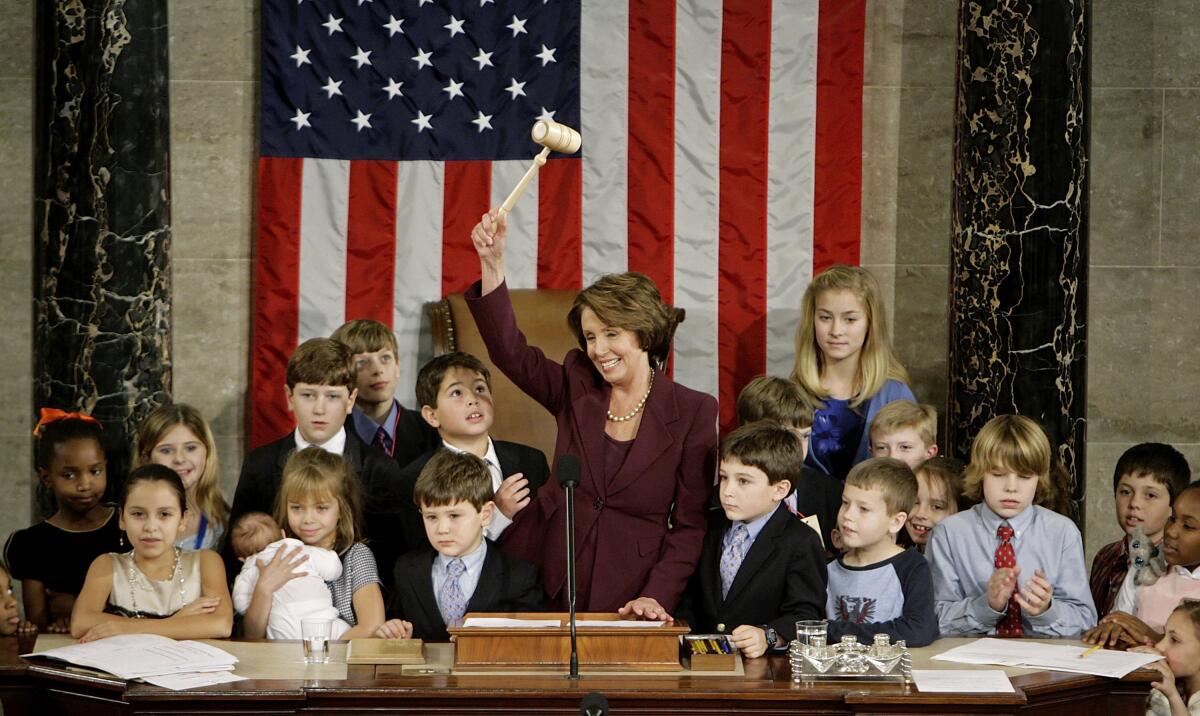
Nancy Pelosi is sworn in as House speaker in 2007, surrounded by her grandchildren and children of other members of Congress.
(Chip Somodevilla / Getty Images)
A trailblazer as the first female speaker of the House, Pelosi presided over two Trump impeachments. While no longer in leadership, she remains incredibly influential as an arm-twister and strategist.
She played a central role in sidelining Biden after his debate meltdown, and for the last couple months has been raising big money — a special skill of hers — in support of California’s Proposition 50. The measure seeks voter approval to redraw California’s congressional districts to better favor Democrats in response to Trump’s pressure campaign on Texas and other red states to redraw their lines in favor of Republicans.
Pelosi has used Prop. 50 in recent days to deflect questions about her primary challengers and her plans for 2026, with her spokesman Ian Krager saying she “is fully focused” on the Prop 50 fight and will be through Nov. 4.
Chakrabarti, who helped Rep. Alexandria Ocasio-Cortez (D-N.Y.) unseat a longtime Democratic incumbent in 2019, said he sees even more “appetite for change” among the party’s base today — as evidenced by “mainstream Democrats who have voted for Nancy Pelosi their whole life” showing up to his events.
And it makes sense, he said.
For decades, Americans have watched the cost of essentials skyrocket while their wages have remained relatively flat, Chakrabarti said, and that has made them desperate to support messages of “bold, sweeping economic change” — whether from Obama or Trump — even as long-serving, mainstream Democrats backed by corporate money have worked to maintain the status quo.
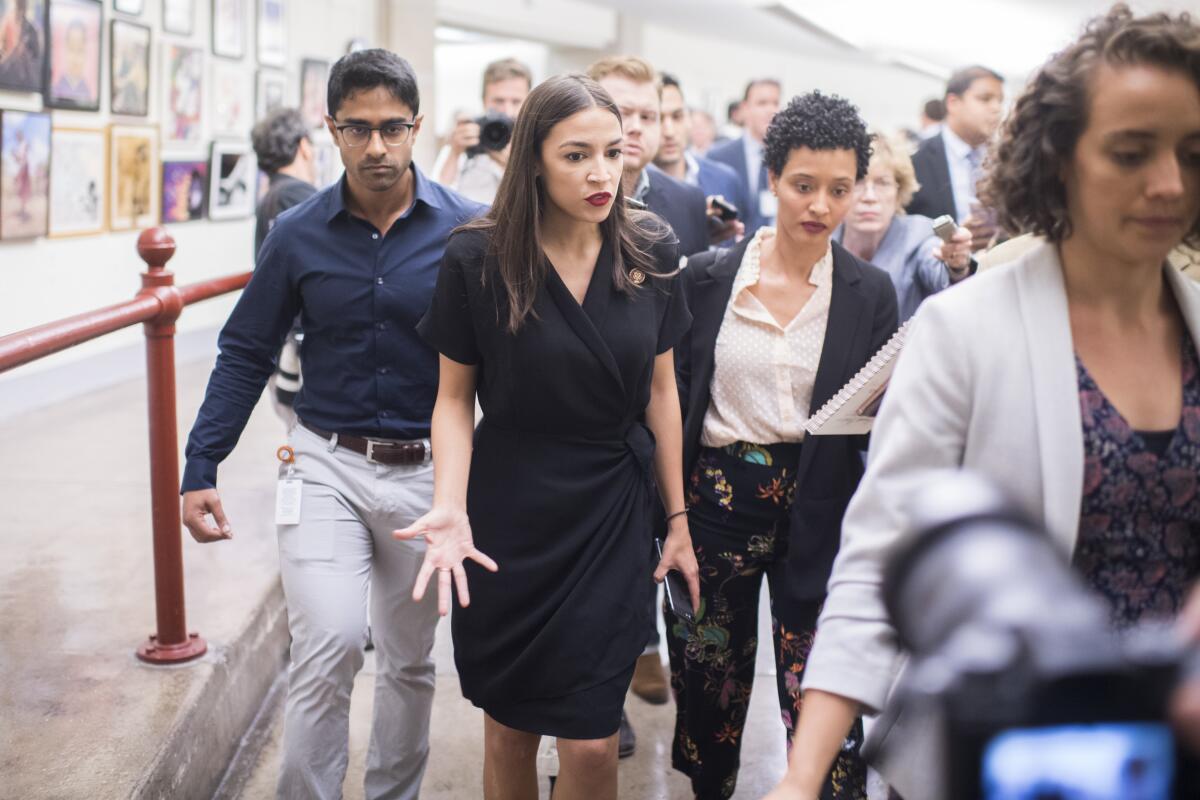
Rep. Alexandria Ocasio-Cortez leaves a news conference at the Capitol in 2019. At left is Saikat Chakrabarti, who was her chief of staff and is now a candidate for the congressional seat held by Rep. Nancy Pelosi.
(Tom Williams/CQ-Roll Call, Inc via Getty Imag)
He said it is time for Democrats to once again push bold, big ideas, which he plans to do — including Medicare for all, universal child care, free college tuition, millions of new units of affordable housing, a new economy built around climate action, and higher taxes on billionaires and mega-millionaires like him.
Wiener, who also backs Prop. 50 and would be the first out gay person to represent San Francisco in Congress, said he cannot speak to Pelosi’s thinking — or to Politico reporting Wednesday that Pelosi is considering her options and has been seen “publicly elevating” San Francisco Supervisor Connie Chan in the race — but is confident in his readiness for the role.
Wiener agreed with Chakrabarti that big ideas are needed from Democrats to win back voters and make progress. He also said that his track record in the state Legislature shows that he has “been willing to take on very, very big fights to make significant progressive change.”
“No one has ever accused me of thinking small,” he said — citing his success in passing bills to create more affordable housing, reform health insurance and drug pricing, tackle net neutrality, challenge telecommunications and cable companies and protect LGBTQ+ and other minority communities and immigrants.
“In addition to having the desire to make big progressive change, in addition to talking about big progressive change, you have to be able to put together the coalitions to deliver on that change, because words are not enough,” Wiener said. “I’ve shown over and over again that I know how to do it, and that I can deliver.”
Political analysts said a message of big ideas will clearly resonate with some voters. But they also said that Pelosi, if she stays in the race, will be hard to beat. She will also face more serious questions than ever about her age and “her ability to function at the extraordinarily high level” she has worked at in years past, Jaye said, and will “have to answer those questions.”
If Pelosi decides not to run, Chakrabarti has the benefit of self-funding and of the current party enthusiasm for fresh faces, they said, and anyone — Chan or otherwise — would benefit from a Pelosi endorsement. But Wiener already has a strong base in the district, a track record for getting legislation passed and, as several observers pointed out, a seemingly endless battery.
“Scott Wiener is an animal. The notion of work-life balance is not a concept he has ever had. He is just like a robotic working machine,” said Aaron Peskin, who served 18 years on the San Francisco Board of Supervisors, some alongside Wiener.
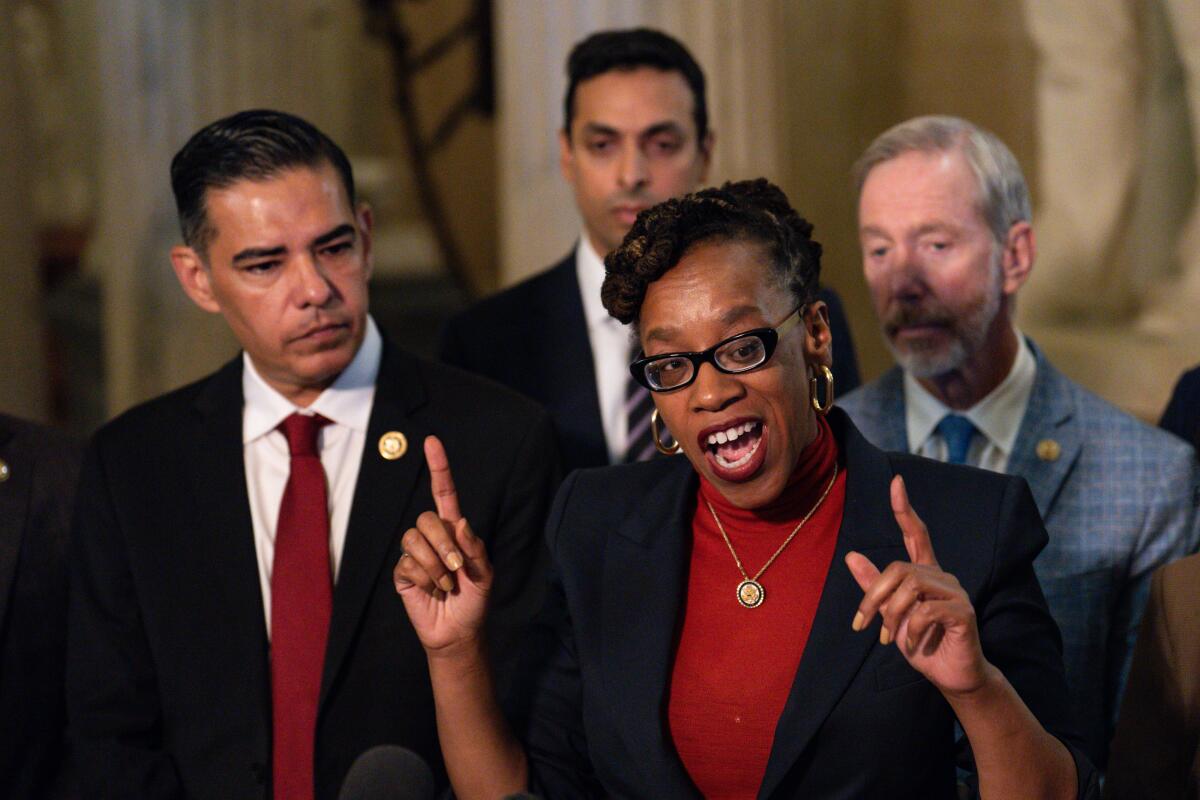
Rep. Lateefah Simon (D-Oakland) speaks to reporters at the Capitol in September.
(Kayla Bartkowski/Bloomberg via Getty Images)
Amanda Litman, the president of Run for Something, which supports young progressive candidates, said there is pent-up demand for a new generation of leaders, and “older Democrats, especially those in Congress, need to ask themselves, ‘Am I the best person to lead this party forward right now?’”
Rep. Lateefah Simon (D-Oakland), 48, won her seat in 2024 after longtime Rep. Barbara Lee, 79, who had been in the seat since 1998, decided to run for Oakland mayor. Simon said that to her, “it’s not necessarily about birthdays” but who can do the job — “who can govern, who can mentor and who can hold this administration accountable.”
As a longtime community activist who worked with youth, Simon said she is “extremely excited” by all the energy of young Democratic office seekers. But as a freshman in Congress who has leaned on Lee, Pelosi and other mentors to help her learn the ropes, she said it’s also clear Democrats need to “have some generals who are really, really tried and tested.”
“What is not helpful to me in this moment,” Simon said, “is for the Democrats to be a circular firing squad.”



Politics
Texas Republicans launch ‘Sharia Free America Caucus’ aimed at defending ‘Western civilization’

NEWYou can now listen to Fox News articles!
FIRST ON FOX: A pair of conservative lawmakers are launching a new group in the House of Representatives to “protect Western civilization in the United States,” according to one of its founders.
Reps. Keith Self, R-Texas, and Chip Roy, R-Texas, are starting the “Sharia Free America Caucus,” Fox News Digital learned first.
“Anytime you go to a fight, you bring as many friends with you as you can. I’m a military guy,” Self told Fox News Digital. “So what we need to do is build this caucus now so that we can start educating the American people to the dangers of Sharia in the United States.”
TRUMP MOVES AGAINST MUSLIM BROTHERHOOD AS ISLAMIST GROUP SPREADS IN WEST
Reps. Chip Roy and Keith Self are creating a new group called the “Sharia Free America Caucus.” (Tom Brenner/Getty Images; Andrew Harnik/Getty Images)
Self said it was “fundamentally incompatible with the U.S. Constitution.”
The caucus also has support in the Senate from Sen. Tommy Tuberville, R-Ala., who Self said he hoped could help push some of its legislative goals forward through both chambers.
Among the bills they’re hoping to push is a ban on foreign nationals who “adhere to Sharia” from entering the U.S., and a measure that would designate the Muslim Brotherhood as a terrorist organization.
FORMER UK PM DEFENDS TRUMP FOR HIGHLIGHTING ‘SHARIA LAW’ IN BRITAIN DURING UN SPEECH
Sen. Tommy Tuberville arrives for a Senate Republican Caucus luncheon at the U.S. Capitol in Washington, April 2, 2025 (Nathan Posner/Anadolu via Getty Images)
“America is facing a threat that directly attacks our Constitution and our Western values: the spread of Sharia law,” Roy said in a statement. “From Texas to every state in this constitutional republic, instances of Sharia adherents masquerading as ‘refugees’ — and in many cases, sleeper cells connected to terrorist organizations — are threatening the American way of life.”
Sharia broadly refers to a code of ethics and conduct used by devout Muslims. Sharia law more specifically often refers to the criminal code used in non-secular Islamic countries, like Iran.
In its most extreme cases, such as when ISIS-controlled parts of the Middle East, charges like blasphemy could carry the death penalty.
U.S. Capitol building is seen in Washington, Dec. 2, 2024. (Celal Gunes/Anadolu via Getty Images)
But guarantees of religious freedom in the Constitution mean that Sharia law can not be carried out on any governmental level in the U.S.
CLICK HERE TO DOWNLOAD THE FOX NEWS APP
The Republicans’ caucus appears largely symbolic in nature, but it’s evidence of the continued culture war raging in the country.
Self also pointed to countries like the U.K. and France, where growing unrest between Muslim refugees and the current populace has dominated headlines in recent years.
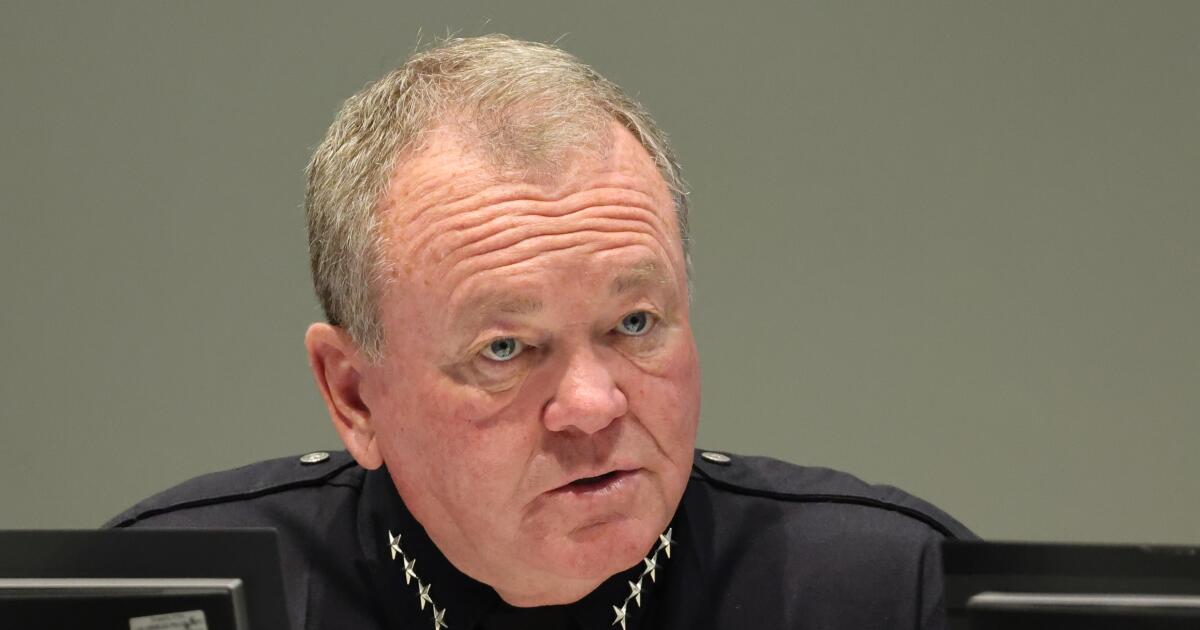
When an LAPD captain stood up during a meeting this fall and asked Chief Jim McDonnell to explain the role of his most trusted deputy, Dominic Choi, other top brass in attendance waited with anticipation for the reply.
Multiple department sources, who requested anonymity to discuss the private meeting and speak candidly about their boss, said McDonnell’s answer drew confused looks.
Some officials had began to wonder how closely the 66-year-old McDonnell, who stepped into the job in November 2024 after recent work in consulting and academia, was involved in day-to-day operations. Choi is often attached to his hip, and McDonnell has privately advised other senior staff to go through the assistant chief for key matters, leaving some uncertainty about how shots are called, the sources said.
At the senior staff meeting, McDonnell joked about not wanting to talk about Choi — who was not present in the room — behind his back, and told the captain that Choi was simply his “eyes and ears,” without offering more clarity, according to the sources.
The awkward exchange reflected the uncertainty that some LAPD officials feel about McDonnell’s leadership style.
Over the last year, The Times spoke with numerous sources, from high-ranking commanders to beat cops on the street, along with recently retired LAPD officials and longtime department observers, to gather insights on McDonnell’s first 12 months as the city’s top cop.
By some measures, McDonnell has been a success. Violent crime citywide has continued to decline. Despite the LAPD’s hiring struggles, officials say that applications by new recruits have been increasing. And support for the chief remains strong in some political circles, where backers lauded his ability to navigate so many challenges, most not of his own making — from the city’s financial crisis and civil unrest to the devastating wildfires that hit just two months after he was sworn in.
At the same time, shootings by police officers have increased to their highest levels in nearly a decade and the LAPD’s tactics at protests this summer drew both public outrage and lawsuits. Some longtime observers worry the department is sliding back into a defiant culture of past eras.
“You’ve got a department that’s going to bankrupt the city but doesn’t want to answer for what it is going to be doing,” said Connie Rice, a civil rights attorney.
In an interview with The Times, McDonnell said he is proud of how his department has performed. He said his bigger plans for the LAPD are slowly coming together.
McDonnell rose through the LAPD’s ranks early in his career, and acknowledged much has changed in the 14 years that he was away from the department. That’s why he has leaned “heavily” on the expertise of Choi, who served as interim chief before he took over, he said.
“He’s been a tremendous partner for me coming back,” McDonnell said.
Dominic Choi, who served as interim LAPD chief before Jim McDonnell was hired, speaks at a 2024 news conference with federal law enforcement officials.
(Al Seib / For The Times)
McDonnell added that he has relied just as much on his other command staff, encouraging them to think and act for themselves “to get the job done.”
Retired LAPD commander Lillian Carranza is among those saying the new chief has failed to shake things up after Michel Moore stepped down abruptly in January 2024.
Instead, she said, McDonnell has lacked the decisiveness required to make real changes in the face of resistance from the police union and others.
“It appears that the chief thought he was coming back to the LAPD from 15 years ago,” she said of McDonnell. “It’s been a disappointment because of the individuals that he’s promoted — it just seems like Michel Moore 2.0 again.”
There are notable contrasts in style and strategy between McDonnell and his predecessor.
Moore, who did not respond to a call seeking comment, often used his pulpit to try to get out ahead of potential crises. McDonnell has kept a lower profile. He has largely halted the regular press briefings that Moore once used to answer questions about critical incidents and occasionally opine on national issues.
Unlike Moore, who developed a reputation as a demanding manager who insisted on approving even minor decisions, McDonnell has seemingly embraced delegation. Still, his perceived deference to Choi, who also served as a top advisor to Moore, has led to questions about just how much has really changed. Choi has represented the department at nearly a fourth of all Police Commission meetings this year, a task usually performed by the chief.
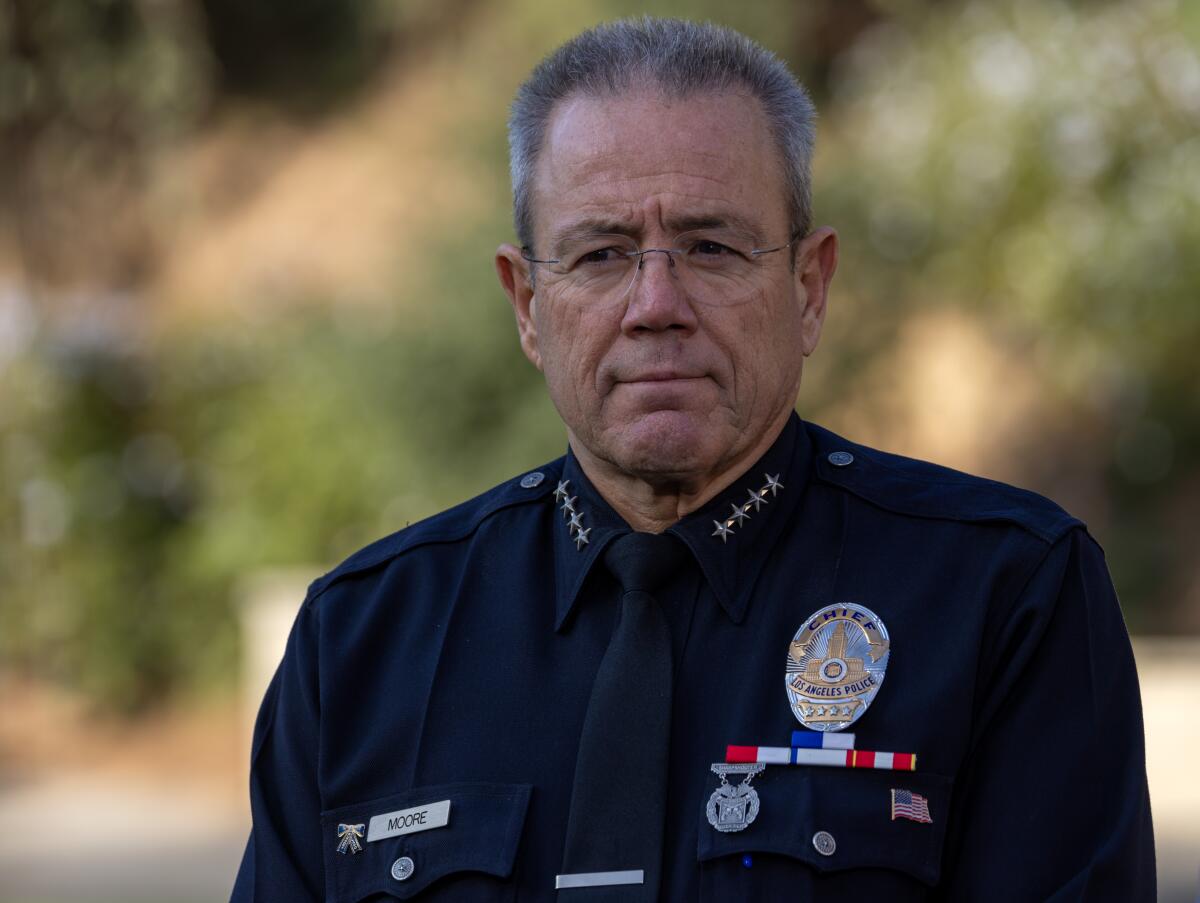
Former LAPD Chief Michel Moore attends an event at the Police Academy on Dec. 7, 2023.
(Irfan Khan / Los Angeles Times)
It’s telling of their closeness, LAPD insiders said, that Choi occupies the only other suite on the 10th floor of LAPD headquarters with direct access, via a balcony, to McDonnell’s own office.
Choi did not respond to a request for comment.
Mayor Karen Bass chose McDonnell as chief after a lengthy nationwide search, picking him over candidates who would have been the first Black woman or first Latino to lead the department. He offered experience, having also served as police chief in Long Beach and as L.A. County sheriff.
McDonnell has mostly avoided the type of headline-grabbing scandals that plagued the department under Moore. Meanwhile, homicides citywide were on pace to reach a 60-year low — a fact that the mayor has repeatedly touted as her reelection campaign kicks into gear.
In a brief statement, the mayor commended McDonnell and said she looked forward to working with him to make the city safer “while addressing concerns about police interaction with the public and press.”

Jim McDonnell shakes hands with Mayor Karen Bass after being introduced as LAPD chief during a news conference at City Hall on Oct. 4, 2024.
(Ringo Chiu / For The Times)
McDonnell has taken steps to streamline the LAPD’s operations, including folding the department’s four homicide bureaus into the Robbery-Homicide Division and updating the department’s patrol plan to account for the department being down fewer officers.
John Lee, who chairs the City Council’s public safety committee, said the chief is the kind of experienced and steady leader the city needs as it gets ready to host the World Cup and Olympics. McDonnell, he said, deserves credit for guiding the LAPD through “unprecedented situations,” while largely delivering on promises to reduce crime and lift officer morale.
But among the rank and file, there is continued frustration with the department’s disciplinary system. The process, which critics outside the LAPD say rarely holds officers accountable, is seen internally as having a double standard that leads to harsh punishments for regular cops and slaps on the wrist for higher-ranking officials. Efforts at reform have repeatedly stalled in recent years.
McDonnell told The Times that officers have for years felt that the system was stacked against them. One of his priorities is “making the disciplinary system more fair in the eyes of those involved in it,” he said, and speeding up internal affairs investigations that can drag on for a year or more without “jeopardizing accountability or transparency.”
He said he’d like to give supervisors greater authority to quickly weed out complaints that “are demonstrably false on their face” based on body camera footage and other evidence.”
But the lack of progress on the issue has started to rankle the Los Angeles Police Protective League, the union for officers below the rank of lieutenant. The League urged McDonnell to take action in a statement to The Times.
“The way we see it, the Chief is either going to leverage his mandate and implement change, much to the chagrin of some in his command staff that staunchly support the status quo, or he will circle the wagons around the current system and continue to run out the clock,” the statement read. ”There’s no need to keep booking conference rooms to meet and talk about ‘fixing discipline,’ it’s time to fish or cut bait.”
Perhaps more than anything, the ongoing federal immigration crackdown has shaped McDonnell’s first year as chief.
Although McDonnell is limited in what he can do in the face of raids by Immigration and Customs Enforcement and other federal agencies, some of the chief’s detractors say he is missing a moment to improve relations between police and citizens of a majority-Latino city.
The son of Irish immigrants from Boston, McDonnell drew criticism during President Trump’s first term when, as L.A. County sheriff, he allowed ICE agents access to the nation’s largest jail. As LAPD chief, McDonnell has often voiced his support for long-standing policies that restrict cooperation on civil immigration enforcement and limit what officers can ask members of the public about their status in the country.
“I get hate mail from two extremes: those that are saying we’re not doing enough to work with ICE and those that are saying we’re working with ICE too much,” McDonnell said.

U.S. Border Patrol Cmdr. Gregory Bovino marches with federal agents to the Edward R. Roybal Federal Building on Aug. 14.
(Carlin Stiehl / Los Angeles Times)
Deputy Chief Alan Hamilton, who runs the department’s detective bureau, said McDonnell has to tread lightly politically and can’t follow the suggestion of some people that “we should use our law enforcement agencies to fight back against the feds.”
“He can’t come out and say, ‘We oppose ICE, get out of our city,’ like some of these other clowns are doing,” Hamilton said. “I mean, what, are you just trying to bring the wrath?”
But the LAPD’s response to the protests against Trump’s agenda has repeatedly led to bad optics. Officers have stepped in to keep the peace when angry crowds form at the scene of ICE arrests, which some said created the appearance of defending the federal actions.
During large demonstrations — which have occasionally turned unruly, with bricks and Molotov cocktails hurled by some in the crowds — LAPD officers on foot or horseback have not held back in swinging batons, firing less-lethal munitions and even launching tear gas, a measure that hadn’t been deployed on the streets of L.A. in decades.
Press rights organizations and a growing list of people who say they were injured by police have filed lawsuits, potentially adding to the tens of millions in the legal bills the department already faces for protest-related litigation from years that predated McDonnell.
Attorney Susan Seager, who is suing the department over its recent protest tactics, said that McDonnell has seemed unwilling to second-guess officers, even when confronted with clear video evidence of them violating court-imposed restrictions.
“I’ve never seen LAPD so unhinged at a protest shooting people,” she said.

An LAPD officer pushes back an anti-ICE protester during a rally on “No Kings Day” in downtown Los Angeles on June 14.
(Carlin Stiehl / Los Angeles Times)
McDonnell said that each use of force would be investigated thoroughly, and if necessary discipline would be imposed, but denied that his department’s response had been excessive.
What goes unmentioned by the LAPD’s detractors, he said, is how volatile and “kinetic,” protests have been, requiring officers to use all means available to them to avoid being overwhelmed by hostile crowds.
Reporters and others on the front lines should know the risks of being there, he said.
“If the journalists are in that environment, they sometimes get hit with less-lethal projectiles — as do our police officers who are in that same environment,” he said.

new video loaded: Fani Willis Defends Failed Election Interference Case in Heated Hearing
transcript
transcript
Fani Willis Defends Failed Election Interference Case in Heated Hearing
The Atlanta-area district attorney called President Trump and his allies “criminals” while being questioned by a Georgia Senate committee on Wednesday.
-
“Are you ready to tell them what they want to hear?” “Is it true that part of your transition team was involved in the pr ocess of interviewing people before you entered office to lead the investigation into the 2020 presidential election?” “If you recall the facts, I was already district attorney when this all came to light. I interviewed everybody at the D.A.’s office. And I interviewed other people to come and work at the district attorney’s office. And as I told you, I did that on my free time before I became D.A., but I had no way of knowing that these criminals were going to commit a crime. You all want to intimidate people from doing the right thing, and you think that you’re going to intimidate me. But you see, I’m not Marjorie Taylor Greene. I ain’t going to quit in a month because somebody threatens me.” “Mr. Peter Skandalakis, as head of PAC, continued the investigation after you were disqualified. He concluded the investigation did not further warrant further action.” “Mr. Skandalakis has never read our entire file when he just dismissed this case. There is no way that he read the entire file. You want something to investigate as a legislature? Investigate how many times they’ve called me the N-word. Why don’t you investigate that? Why don’t you investigate them writing on my house? Why don’t you investigate the fact that my house has been SWATted? If you want something to do with your time that makes sense. And you can use all this in your campaign ad — you attacked Fani Willis. What have you done, sir? Nothing.” “Based on the indictment, that the goal was — the ultimate goal was to overthrow the 2020 election.” “That was the ultimate goal. And we’ve had people that are supposed to be leaders that instead of being leaders, are just cowering down. This country needs leaders, not cowards.”

By Meg Felling
December 17, 2025

Kumail Nanjiani opens up on his regrets, critical failures and embracing fear : Wild Card with Rachel Martin

The latest iPad Air is $400 for the first time and arrives by Christmas

Vatican confirms resignation of Cardinal Timothy Dolan, announces new archbishop of New York

Texas Republicans launch ‘Sharia Free America Caucus’ aimed at defending ‘Western civilization’

Simple lifestyle changes could slash heart attack risk for millions, scientists report

Florida High School Football Rankings: Top 25 teams – Oct. 21

Cleary's 21 help Le Moyne down Central Connecticut State 69-64 in OT

How old is Bo Nix? What to know about Oregon quarterback ahead of 2024 NFL Draft

99th annual Pony Swim held in Virginia

Video: ‘It Didn’t Have to Happen This Way:’ U.Va. Faculty Call for Review of Police Response to Protests
Texas Republicans launch ‘Sharia Free America Caucus’ aimed at defending ‘Western civilization’

UK police arrest four people for pro-Palestine ‘Intifada’ calls

BBC Verify Live: Fact-checking Trump’s unusual new White House presidential plaques

Border Patrol chief, progressive mayor caught on camera in tense street showdown: ‘Excellent day in Evanston’

European Parliament asks for EU funds to finance abortions abroad
-

 Iowa3 days ago
Addy Brown motivated to step up in Audi Crooks’ absence vs. UNI
-

 Washington1 week ago
LIVE UPDATES: Mudslide, road closures across Western Washington
-

 Iowa5 days ago
How much snow did Iowa get? See Iowa’s latest snowfall totals
-

 Maine2 days ago
Elementary-aged student killed in school bus crash in southern Maine
-

 Maryland3 days ago
Frigid temperatures to start the week in Maryland
-

 Technology1 week ago
The Game Awards are losing their luster
-

 South Dakota4 days ago
Nature: Snow in South Dakota
-

 Nebraska1 week ago
Nebraska lands commitment from DL Jayden Travers adding to early Top 5 recruiting class