Politics
Attacks on ICE up 1,000%? Trump administration claim not backed up by court records

The federal prosecutor faced the jury, brandishing the item he said had been “used as a sword” to assault a federal officer during a July protest in downtown Los Angeles.
The object that Assistant U.S. Atty. Patrick Kibbe said was wielded as a weapon: An umbrella that an investigator needed a special scale to weigh because it was less than one pound.
For months, Trump administration officials have cited violence against federal law enforcement officers carrying out the president’s deportation campaign as justification for aggressive tactics, including threats to deploy the National Guard and U.S. Marines. The Department of Homeland Security has touted a staggering figure, claiming a 1,000% increase in assaults against Immigration and Customs Enforcement agents.
But a Times analysis of court records related to assaults on federal law enforcement in Los Angeles, San Diego, Portland, Ore., Chicago and Washington, D.C., shows the majority of the alleged attacks resulted in no injury to an agent. In roughly 42% of the cases The Times reviewed, federal law enforcement officers were either shoved, spat on or flailed at, or had water bottles thrown at them, according to court affidavits.
During the umbrella assault trial in October, prosecutors provided no evidence of any injuries. In L.A. and across the country, defendants accused of assaulting federal officers have won acquittals or had charges dropped. More than a third of the cases The Times analyzed ended in dismissals or acquittals, in some instances because the defendants were deported. No cases have ended in a conviction at trial.
Tricia McLaughlin, a spokesperson for the Department of Homeland Security, responded to questions from The Times about the assault numbers with a statement that said “our officers are facing terrorist attacks, being shot at, having cars being used as weapons against them, bomb threats, assaults, doxxing.”
McLaughlin highlighted a case in which she said an ICE officer needed 13 stitches and suffered burns after he was beaten with a metal coffee cup by an undocumented immigrant in Houston last month. In another that she flagged, an alleged gang member in Nebraska brutally beat an ICE agent in June, leaving them hospitalized with serious head injuries.
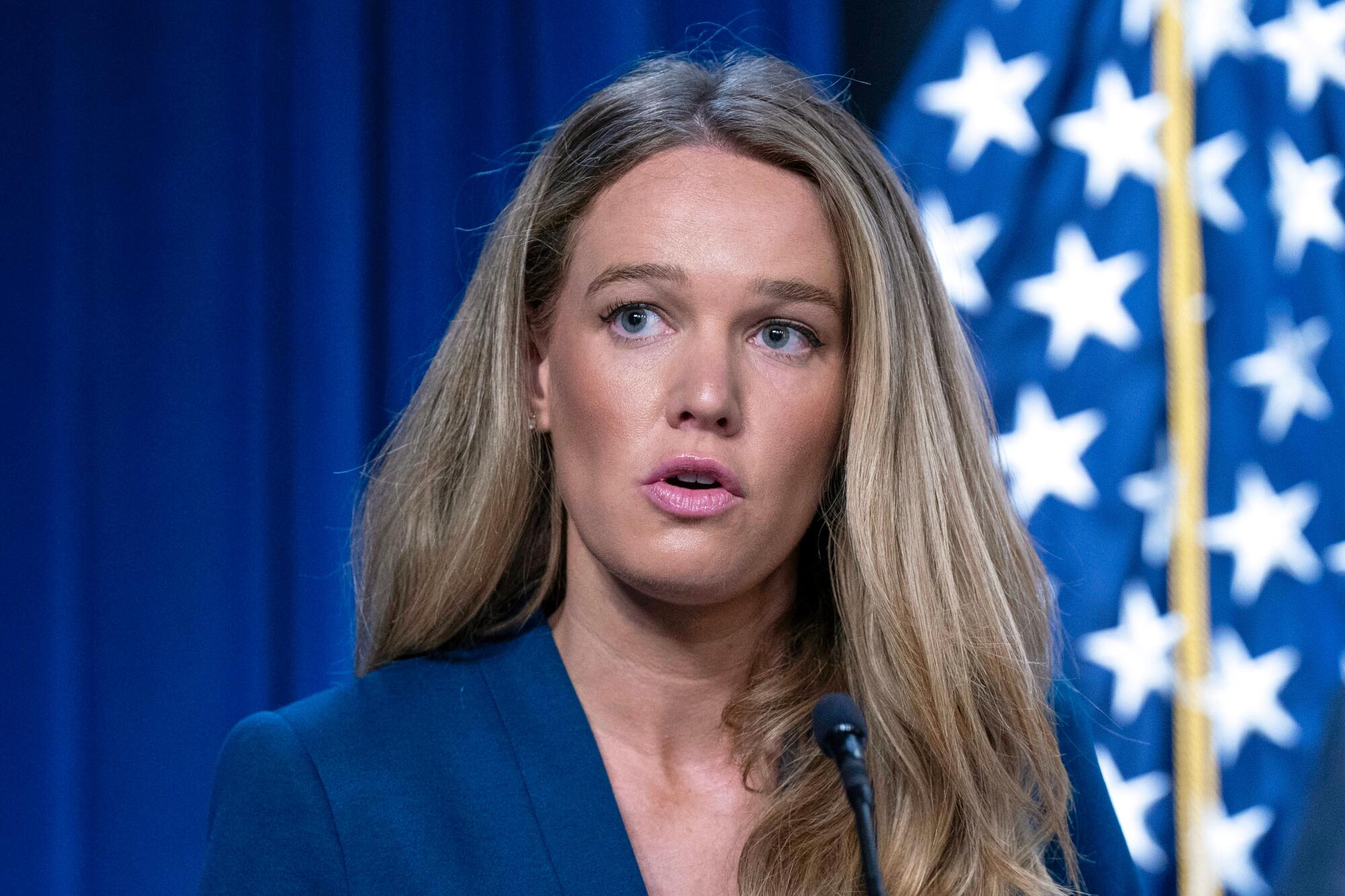
Tricia McLaughlin, a DHS spokesperson, responded to questions from The Times with a statement that said “our officers are facing terrorist attacks, being shot at, having cars being used as weapons against them, bomb threats, assaults, doxxing.”
(Jose Luis Magana / Associated Press)
President Trump invoked the 1,000% increase figure in a memo directing federal law enforcement groups to investigate “domestic terrorism,” and federal officials have cited the number repeatedly to justify aggressive tactics against protesters and the need for agents to wear masks to avoid being identified.
Homeland Security officials ignored multiple requests to release a complete list of alleged assaults. In late November, the agency announced a 1,153% increase in assaults on ICE agents from Jan. 21 to Nov. 21, with 238 reported assaults this year compared to 19 in the same time frame in 2024.
The five jurisdictions The Times analyzed were the federal districts where the Trump administration has conducted large-scale law enforcement and immigration operations or threatened to deploy the military because of the supposed danger faced by federal agents. In those areas, 163 cases of assault of a federal officer had been filed between Jan. 21 and Nov. 21. That’s up from 129 in the same areas and time frame in 2024, an increase of 26%. An NPR analysis came up with a similar figure earlier this year.
The 2024 data is also inflated by the filing of assault charges by prosecutors in Washington against rioters who attacked the U.S. Capitol on Jan. 6, 2021. Trump has pardoned all of those defendants.
The Times analysis captured assaults against all types of federal officers. ICE or Border Patrol agents were described as victims in about 60% of those cases.
David Bier, director of immigration studies at the Cato Institute, a libertarian think tank, said the government is relying on the shocking percentages, without proper context, to advance a narrative.
“They are justifying why they need to use extreme force against the people they’re arresting and the public as they interact with individuals on the street,” he said. “I think that’s the primary purpose, to say: ‘We’re under attack. We’re being assaulted daily and therefore we need to be able to use extreme force including military support.’”

In just over half of the cases scrutinized by The Times, court records show the officer who was allegedly assaulted suffered no physical injury. In roughly 30% of the cases, officers sustained minor injuries such as bruising following a punch, kick or bite.
Twenty-six incidents resulted in a serious injury or required an agent to seek medical attention. A Portland ICE agent was smashed in the head with a rock, federal agents suffered dislocated or fractured fingers in Los Angeles and some agents said they were attacked with their own batons or stun guns while trying to detain people.
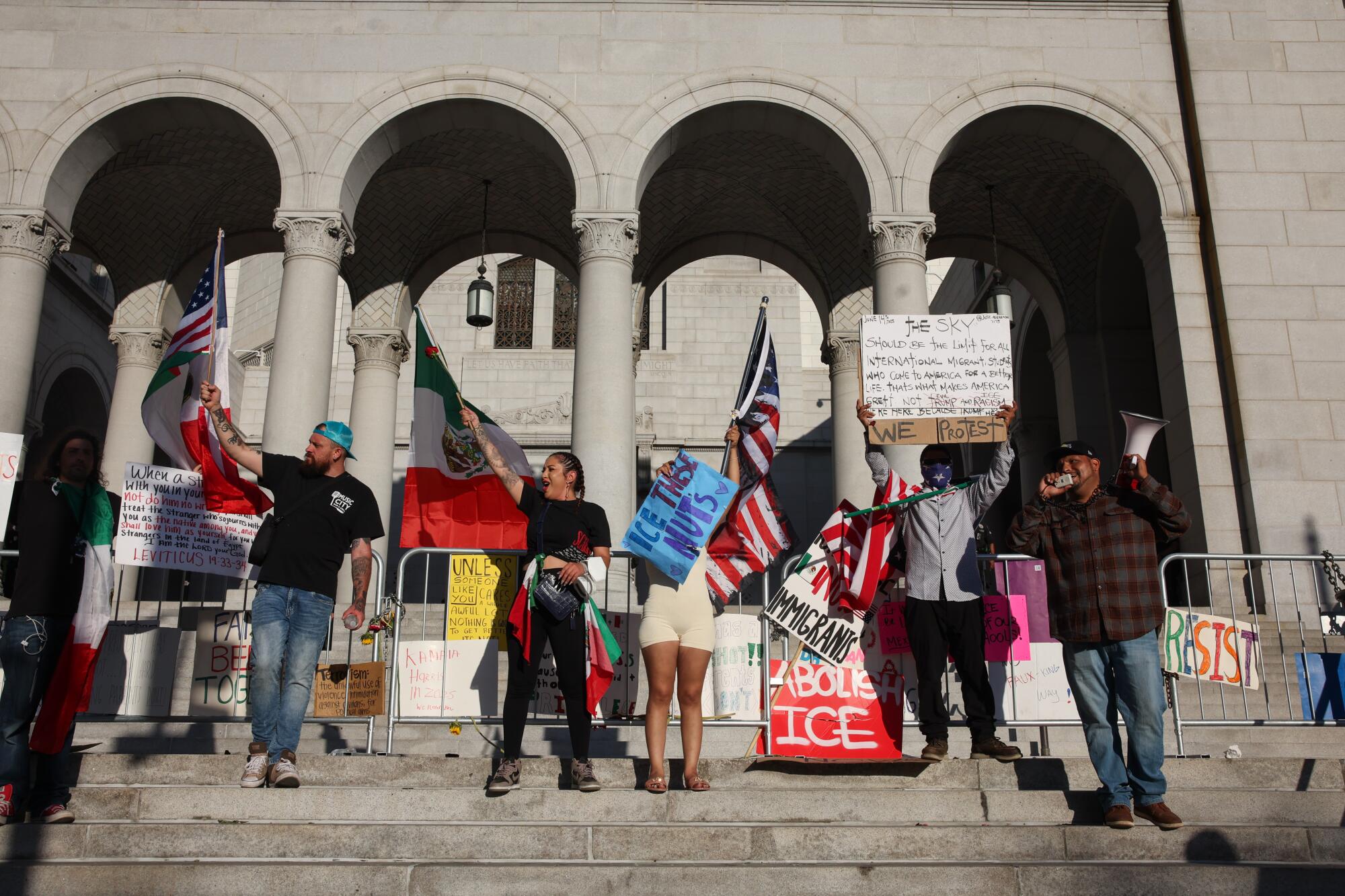
Protesters at an anti-ICE demonstration at Los Angeles City Hall on June 15.
(Jason Armond / Los Angeles Times)
The Times’ analysis does not capture serious incidents in other jurisdictions, or attacks where no charges were filed. Assailants have opened fire twice this year on ICE facilities in Texas, though the people struck by bullets were immigrant detainees and a local police officer.

The only documented incident in which a federal law enforcement officer was shot during an immigration enforcement action this year happened in Los Angeles in October — when a bullet from an ICE agent’s gun ricocheted into a deputy marshal’s hand during a vehicle stop.
One National Guard member was killed and another was seriously wounded in a shooting in Washington last week. Both were part of Trump’s anti-crime deployment. Officials have said the gunman is from Afghanistan and was admitted to the U.S. in 2021 as part of a Biden administration program to help people fleeing the Taliban, and his asylum application was approved under Trump.
An undocumented immigrant from Mexico was also arrested after allegedly shooting at Border Patrol agents in Chicago on Nov. 8, according to the Department of Homeland Security. A local Fox News affiliate identified the suspect as Hector Gomez, but a criminal complaint makes no mention of shooting at agents. DHS did not respond to inquiries from the Fox affiliate.
Sen. Alex Padilla (D-Calif.) is among those questioning the administration’s claims. During a Nov. 19 subcommittee hearing titled “ICE Under Fire: The Radical Left’s Crusade Against Immigration Enforcement,” Padilla asked why there were no government witnesses “providing facts and data behind the numbers that the Department of Homeland Security so often cites to claim an increase in assaults on its officers and agents.”
“Today’s hearing is not a serious attempt to protect law enforcement,” Padilla said. “It’s designed to fuel the propaganda machine and encourage even more brutal immigration enforcement operations.”
The purported weapons used in some of the cases have only fueled skepticism: A District of Columbia man was charged for throwing a Subway sandwich. In Portland, a woman was charged with assault via tambourine. In L.A., federal agents have claimed assaults involving a hat, a work bag, a flag — and the umbrella.
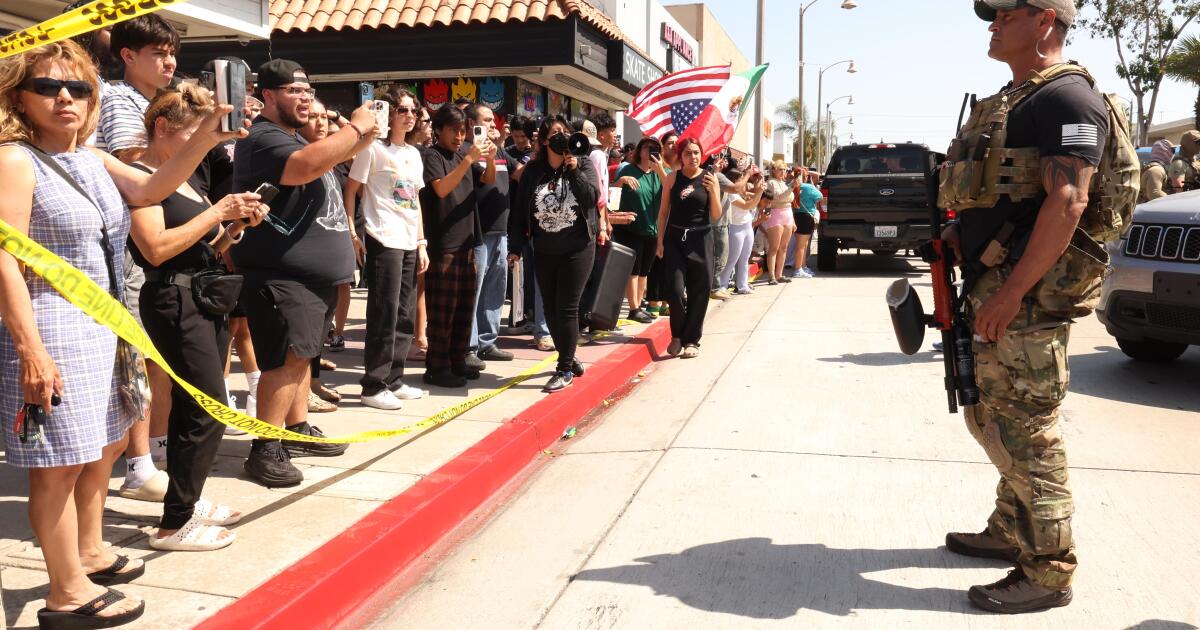
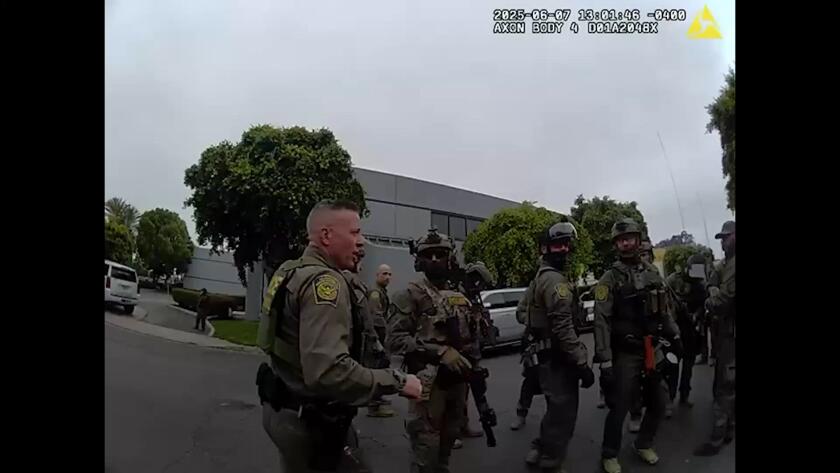
On June 7 — in the early days of the Trump administration’s immigration crackdown in California — Border Patrol commander Gregory Bovino stood in Paramount, sounding like he was preparing his officers for battle.
Bovino, addressing agents decked out in tactical gear as protesters gathered nearby, told the agents to “arrest as many people that touch you as you want to, those are the general orders all the way to the top.”
“Everybody f— gets it if they touch you,” Bovino said. “This is our f— city.”
The National Guard was deployed the next day, with Trump publicly claiming Los Angeles was under siege.
The clip of Bovino was played during the trial of Brayan Ramos-Brito, who was accused of pushing a Border Patrol agent that day in Paramount. Video evidence shows an agent shove Ramos-Brito, but does not clearly capture him shoving the agent back.
Bovino testified that merely touching an agent “could be assault depending on the situation. Spitting on someone could be assault.”
After about an hour of deliberations — and despite Bovino testifying that he witnessed Ramos-Brito push an agent — the jury came back with a not guilty verdict.
In Los Angeles, court records show federal prosecutors have charged 71 people with assault on a federal officer this year, with 21 of those cases ending in dismissals or acquittals. Only nine such cases were filed in 2024.

Bill Essayli, who is functioning as L.A.’s top federal prosecutor, said he would not “read too much” into dismissal figures.
(Damian Dovarganes / Associated Press)
During an October news conference, Bill Essayli, who is functioning as L.A.’s top federal prosecutor, said he would not “read too much” into the dismissal figures.
“When we charge a complaint we’re on the clock, so if the agents need more time to collect evidence sometimes we will dismiss a case without prejudice which allows us to bring it back at our choosing,” he said.
A former ICE official, who asked not to be named out of fear of retaliation, said that in prior years the U.S. attorney’s office “didn’t prosecute hardly anybody” for assault — unless the interaction turned violent.
“We’d get guys who would spit on us and all kinds of other stuff and it was like, ‘Hey, it’s part of the job,’” the official said.
Law enforcement experts noted that an increase in assaults is to be expected, since interactions by immigration agents with the public have increased dramatically in Trump’s second term.
John Sandweg, who headed ICE under President Obama, said he believes new tactics are helping drive the increase. Under previous administrations, ICE focused on targeted operations.
“When you shift those tactics and have agents out there in broad daylight, in Home Depot parking lots, when you have these cities on edge … it’s just going to increase the number of incidents where some sort of an assault happens,” he said.
In a number of cases examined by The Times, defendants were arrested and charged with assault after Border Patrol or ICE agents initiated physical contact.
Andrea Velez, a 4-foot 11-inch U.S. citizen, was accused of standing in the path of an ICE officer in downtown L.A. with her arms extended, striking his head and chest when they collided in June. Her defense attorney previously said masked men ran at Velez and one shoved her to the ground. Velez, fearing she was being abducted, held up her work bag to shield herself.
Velez’s lawyer requested body-worn camera video and witness statements cited in the complaint. Soon after, prosecutors dropped the case.
In Chicago, four assault cases were filed against protesters who ignored a dispersal order outside an immigration detention facility and flailed in response to being shoved or struck by Border Patrol agents. One of the defendants was a 70-year-old military veteran. All charges have been dropped, records show.

Courtesy of attorney Kacey McBroom
In another L.A. case, a man was accused of assault for smacking an agent with a hat. Video footage from the scene in August showed the man, Jonathon Redondo-Rosales, swung after he was struck by a government vehicle, as officers were moving to tackle him to the ground.
In October, Marimar Martinez was shot five times by a Border Patrol agent who alleged she was following him in a car and interfering with a Chicago operation. Martinez allegedly collided with a CBP vehicle, causing minor damage, according to photos included in a criminal complaint.
But in a sudden turnabout a month later, prosecutors moved to dismiss the indictment against Martinez. A spokesperson for the U.S. attorney’s office in Illinois said in a statement that prosecutors are “constantly evaluating new facts and information relating to cases and investigations.”
Martinez’s attorney, Damon Cheronis, thanked prosecutors for doing the right thing after reviewing what he called Border Patrol’s hyperbolic claims against Martinez.
“The criminal complaint made a lot of allegations that our client rammed them. There were all these reports that our client had an assault weapon or was a domestic terrorist,” he said. “None of that was true.”
Homeland Security officials have also claimed a 1,300% increase in vehicle attacks against ICE agents; the 28 alleged attacks this year since Jan. 20 marked a jump from two in 2024.

Protesters rally in front of City Hall in downtown L.A. for immigrant rights, to stop mass deportations and decrying what they see as threats to democracy.
(Genaro Molina / Los Angeles Times)
Of the 26 alleged vehicle attacks captured by The Times analysis, five resulted in serious injuries. A member of a Homeland Security task force was hospitalized with a “possible sternum fracture” after being hit by a car in November in National City, just outside of San Diego, according to DHS.
A handful of other L.A. cases resulted in officers seeking medical evaluation. One ICE agent needed medical attention after they were hit with a skateboard while trying to make an arrest in downtown L.A. in September, records show.
The month before, Oscar Magana Reyes, who was allegedly trying to flee an immigration arrest in San Bernardino, stole an ICE agent’s Taser and briefly incapacitated them with a shock to the groin. Reyes was indicted in October and is awaiting trial.
Although more incidents are being reported, available data still shows local law enforcement officers are far more likely to be attacked in the line of duty than immigration agents. L.A. County sheriff’s deputies faced roughly 600 assaults from January to October of this year, more than double the number of alleged on-duty assaults ICE agents suffered nationwide from Jan. 21 to Nov. 21, according to sheriff’s department records.
Charis Kubrin, a professor of law, criminology and sociology at UC Irvine, said the administration’s trumpeting of a more than 1,000% increase is misleading when the jump is coming from a baseline of almost zero assaults against agents.
“This is what we call in sociology a moral panic,” she said. “A moral panic is created when statistics and other things are used to kind of create or socially construct a problem that is bigger than it is.”

Alexandria Augustine sits for a portrait at her home in West Hollywood. Augustine recently won her court case after being arrested while protesting ICE outside of the Metropolitan Detention Center for allegedly assaulting a federal officer.
(Juliana Yamada / Los Angeles Times)
The trial of Alexandria Augustine, the 25-year-old woman accused of assaulting a federal officer with her umbrella, played out over the course of several days in October.
Augustine told The Times she was offered different plea deals in the course of a few months, but decided to take her chances before a jury.
“The entire purpose of a lot of this is to keep people off the streets and hold them up in the courts,” she said. “They don’t expect us to fight back because they have way more resources and power than we do.”
During the trial, Kibbe, the prosecutor, held up the metal skeleton of the umbrella and told jurors that Augustine had hit a Federal Protective Service inspector with it in the arm and chest.
Deputy federal public defender Aden Kahssai said Augustine opened the umbrella to protect fellow protesters. It was the federal officer, she said, who grabbed the umbrella, yanking the fabric off.
“What happened here was not an assault,” Kahssai told jurors.
When Inspector Alexandro Gutierrez took the stand, he testified that he had grabbed the umbrella because it obstructed his view. He testified that Augustine then told him “if you f—ing want it, here,” and then threw it at him in an overhand motion.
“These things could potentially cause serious harm,” he told jurors. He testified that he wasn’t wearing a face shield and the metal ribs of the umbrella could have poked him in the eye.
Among those who turned out for Augustine’s trial was Margaret Ortiz, an Army combat veteran who had been charged with assault after the fabric of a black flag she was holding hit a federal officer in the chin, nose and eyes. The case against her was later dismissed.
“I kind of wanted it to go to trial,” Ortiz said outside the courtroom. “It was going to be stupid, just like this.”
During closing arguments, Supervising Deputy Federal Public Defender Rebecca Abel said Augustine had thrown the umbrella up and it dropped down and connected with Gutierrez. The umbrella, she said, “couldn’t hurt a fly, let alone a 260-pound man” in a Kevlar vest.
“It barely touched him. He was not injured,” Abel said. “This case began with a protest … it should never have ended here, in a federal courtroom.”
Within hours, the jury came back with its verdict: Not guilty.
Times researcher Cary Schneider and Data and Graphics reporter Gabrielle LaMarr LeMee contributed to this report.


NEWYou can now listen to Fox News articles!
Maine state Rep. Valli Geiger, a Rockland Democrat, former nurse and former mayor, is drawing sudden national attention after saying now-former Democratic Senate nominee Graham Platner encouraged her to consider taking his place on the ballot in the Maine Senate race.
While Geiger has not been named the replacement nominee, her name entered the Maine Senate scramble after she told local outlet WMTW that Platner called her Monday night, praised her as a “fighter” and asked whether he could put her name forward. Platner’s campaign told the outlet he had not made an endorsement decision but confirmed he encouraged Geiger to consider running if he stepped aside.
After Geiger said Platner called her about potentially putting her name forward, Geiger posted Tuesday she would not “throw Graham under the bus,” while also saying she would not “slander or accuse” Jenny Racicot, the woman who accused Platner of rape, “of anything more than telling the truth as she experienced it.”
By Wednesday, local outlets were reporting that Geiger said Platner had encouraged her to consider running if he withdrew. Platner, who suspended his campaign Wednesday night, has denied the claim.
WHAT HAPPENS NEXT IF PLATNER DROPS OUT? HERE’S WHO COULD REPLACE HIM ON THE BALLOT AND HOW IT COULD WORK
Graham Platner Maine State Rep. Valli Geiger (Maine State Legislature/Getty Images)
“For the movement to continue, it can’t be me. For that reason, we are suspending campaign operations,” Platner said in a video posted to social media.
Geiger is a third-term Democratic state representative from Rockland, according to her legislative biography, representing a coastal House district in Maine that includes Rockland, Criehaven Township, Matinicus Isle Plantation, the Muscle Ridge Islands, North Haven and part of Owls Head. Her biography says she serves on the Labor Committee and the Energy, Utilities and Technology Committee.
Before entering the state legislature, Geiger served six years on the Rockland City Council, including one year as mayor and four years on the Rockland Comprehensive Planning Commission, three of them as chair.
Her biography says she holds a master’s degree in sustainable design and built her own passive-solar, net-zero-energy house. It also describes her as a former nurse at Pen Bay Medical Center who later worked as a health policy analyst and health administrator, including as director of the Healthreach Hospice program and clinical director for Federally Qualified Health Centers around Maine.
The Maine State Capitol May 18, 2026, in Augusta, Maine. (Joe Raedle/Getty Images)
PLATNER CAMPAIGN PUTTING ‘THUMB ON SCALE’ TO INFLUENCE POSSIBLE REPLACEMENT, MAINE DEM ALLEGES
Geiger’s connection to Platner predates the latest replacement speculation. Local reporting has described her as a close Platner supporter, and WMTW reported she previously stood with him and credited him with helping secure funding for rape kit tracking in Maine.
In her Facebook post responding to Racicot’s allegation, Geiger wrote that Racicot’s story “seems credible” but added that “none of us knows the truth nor will we ever.” She also described Platner as “a man becoming a better man” and said she had hoped he would lead the political movement his campaign had built and will not “throw Graham under the bus.”
In the post, Geiger also praised Platner’s “passion for economic populism” and said she had granted him “an enormous amount of grace” for his behavior during what she described as his “dark years” after multiple deployments.
Dr. Nirav D. Shah, director of the Maine Center for Disease Control and Prevention, speaks during a news conference about COVID-19 at Maine Emergency Management Agency in Augusta. (Derek Davis/Portland Press Herald via Getty Images)
CLICK HERE TO DOWNLOAD THE FOX NEWS APP
The Maine state representative is not the only Democrat whose name has surfaced as Maine Democrats prepare for the possibility that Platner exits the race against Republican Sen. Susan Collins.
Several Democrats have expressed interest or are considering bids, including former gubernatorial candidate Troy Jackson, Secretary of State Shenna Bellows and former Maine CDC Director Nirav Shah.
Under Maine law, the Maine Democratic Party can replace him on the general election ballot by selecting a new nominee through its party process, with the replacement required to be chosen by July 27.
Fox News Digital’s Andrew Mark Miller and Paul Steinhauser contributed to this report.
Politics
Nexstar launches its first digital subscription service with The Hill Insider, aimed at political junkies

Nexstar Media Group’s The Hill, the political web site that started as a free newspaper read in most congressional offices in Washington, is launching a new direct-to-consumer streaming service that will be behind a paywall.
Starting Wednesday, Nexstar will offer The Hill Insider, which will carry daily streaming video programs and newsletters. Subscribers will also be able to interact with The Hill’s journalists and analysts, who will take questions live.
The service, available for $5.99 a month or $59.99 a year, is the first digital subscription product for the Irving, TX-based Nexstar, the largest owner of television stations in the U.S. Premium memberships are available for $9.99 a month, or $99.99 a year, which will be ad-free and offer access to live events presented by The Hill.
The endeavor is the first subscription streaming service offered by Nexstar. The Hill already produces a free ad-supported streaming channel distributed on such platforms as Roku.
The free version of The Hill is the most viewed political web site in the U.S. with 1.24 billion page views in 2025, a year-to-year increase of 7%, according to Comscore. The Hill is known for offering brisk, up-to-date reports out of each branch of government in Washington, and is often linked to on other websites.
Nexstar, which also owns the cable network NewsNation, acquired The Hill in 2021 from New York-based entrepreneur James Finkelstein for $130 million. NewsNation adapted The Hill brand name for its Washington-based programs, including a Sunday roundtable show with Chris Stirewalt, politics editor for The Hill and NewsNation.
NewsNation politics editor Chris Stirewalt on the set of “The Hill Sunday.”
(NewsNation)
Stirewalt and the Washington journalists and commentators seen on NewsNation programs will be featured on The Hill Insider. The service will also use the resources of Decision Desk HQ, the political media firm that was the first to call President Trump’s victory on election night in 2024. Decision Desk will be involved in a streaming show called “Data Nerds.”
The Hill Insider will be aimed at the political junkie who wants to go deeper on polling data and hear longer, in-depth discussion on issues. Bill Sammons, senior vice president of editorial content for Nexstar, said the company’s research shows there is a national appetite for such content, as only 5% of The Hill’s current audience is based in Washington.
The Hill has long touted itself as non-partisan and Stirewalt hopes users will gravitate to the subscription version to become better informed about legislative and political issues and not reaffirm their existing opinions.
“My imagined audience is of people in America who are not addicted to politics but are addicted to good citizenship and the idea of fulfilling their civic virtue,” Stirewalt said in a recent interview. “And they would like to do it in a way that doesn’t insult their intelligence.”
While the free version of The Hill has been growing, the new subscription product enters a crowded field of digital programs and platforms aimed at the consumers of political news.
The launch comes as journalists from legacy media such as former CNN anchor Jim Acosta, former ABC News correspondent Terry Moran, and Chuck Todd, the longtime moderator of NBC’s “Meet the Press,” have launched their own daily podcasts and newsletters as second acts in their careers.
MS NOW, the progressive-leaning cable news channel, is entering the direct to consumer market later this year making the channel available outside of pay-TV packages for the first time. Like The Hill Insider, the MS NOW streaming product is expected to offer users additional benefits, such as access to live events and content not seen on the cable network.
Original topical programming that does not have a shelf life is challenging to sustain on a streaming service. When Fox News Media launched its streaming service Fox Nation in 2018, it carried a line-up of live, politically-oriented shows aimed at its conservative-leaning audience. The service eventually pivoted to documentary, movies and lifestyle programming and became the home of the annual Fox News fan event, The Fox Nation Patriot Awards.

NEWYou can now listen to Fox News articles!
Political heavyweight Dana White, whose endorsement of President Donald Trump was instrumental in his 2024 victory, is now hinting that he may jump back into presidential politics in 2028 because he has “become really close” with Secretary of State Marco Rubio.
This comes as White’s UFC announced a rare “sports diplomacy” partnership with the State Department this week. White and Rubio signed a memorandum of understanding establishing the partnership last month, according to a UFC statement. The league said that as part of the agreement, UFC athletes and coaches will serve as “sports ambassadors” for young athletes around the world through the State Department’s Sports Envoy Program.
White was explicitly asked by OutKick’s Tomi Lahren, whether there are any leaders he is looking at for 2028, to which he responded, “It’s funny, As I was, leading up to the White House fight, doing all this media, you know, a lot of the left media was saying to me, ‘So, you’re out of politics after this, right?’ And I can’t remember who it was that I said it to but … I said, ‘I’ve become really close to Rubio.’ We’ve become really close.”
“People are asking me if I’m going to get out of politics when the president leaves and I just said, ‘I’ve become very close to Rubio.’ He and I have become friends,” he emphasized.
RUBIO ANNOUNCES FRAMEWORK DEAL BETWEEN ISRAEL AND LEBANON AS EXPERTS WARN IRAN WILL FIGHT TO SABOTAGE IT
UFC President and CEO Dana White and US Secretary of State Marco Rubio shake hands as htey participate in a Memorandum of Understanding signing ceremony at the State Department in Washington, DC, on June 11, 2026. (Brendan SMIALOWSKI / AFP via Getty Images)
White said that Rubio “is a great guy, I like him,” adding, “He’s smart, I like the way he handles himself.”
He also said, “I’ve met his sons, and I like his kids and, you know, so, never say never.”
Pressed on whether Rubio is his official pick to succeed Trump as president, White clarified, “I’m not saying I’m picking.” He noted that he also likes Vice President JD Vance, who, alongside Rubio, is a rumored 2028 presidential frontrunner.
“JD is a great guy too,” said White, adding, “It’s a tricky situation, and I don’t know enough about politics to even comment on that, but, yeah, I don’t know, but it’s not a bad thing to have two strong candidates.”
Rubio and Vance are the two Republicans most discussed as possible successors to Trump. While Rubio ran for president in 2016, he has expressed support for Vance, calling him a “close friend” and saying the vice president “would be a great nominee if he decides he wants to do that.”
VIRAL MARCO RUBIO CLIP ON HIS VISION FOR AMERICA SPARKS MORE 2028 SPECULATION
Vice President JD Vance speaks during a visit to ALTA Refrigeration Inc., Aug. 21, 2025, in Peachtree City, Georgia. (Brynn Anderson/The Associated Press)
Though White stopped short of issuing a full-throated endorsement of Rubio, his partnership with the State Department through UFC underscores the high regard he appears to have for the secretary.
This is the first time the UFC has entered into such a partnership with the State Department. The NFL, which entered into a similar agreement in January, is the only other major sports organization to have signed such a formal agreement with the department.
SIGN UP TO GET THE POLITICS NEWSLETTER
UFC Chief Operating Officer Lawrence Epstein said the league is “thrilled” about the partnership. He said it would allow the State Department and UFC to “work together to build bridges through community engagement.”
“We’re excited to join this program, led by Secretary Rubio, as UFC is a truly global organization with athletes representing 75 countries. We can’t wait to get started later this year,” said Epstein.
VANCE TAKES LEAD SELLING TRUMP’S IRAN GAMBLE AS RUBIO, HEGSETH AND RATCLIFFE CEDE SPOTLIGHT ON FRAGILE DEAL
President Donald Trump speaks with Secretary of State Marco Rubio and UFC CEO and President Dana White during UFC 327 at Kaseya Center on April 11, 2026 in Miami, Florida. (Julia Demaree Nikhinson – Pool / Getty Images)
CLICK HERE TO DOWNLOAD THE FOX NEWS APP
In turn, Rubio spoke very highly of the UFC, saying it “has become a global phenomenon by embracing values that resonate far beyond the Octagon: excellence, discipline, opportunity, and meritocracy.”
The secretary said the State Department is “proud” to launch the sports diplomacy partnership with UFC and to “continue growing the sport of MMA.”
-

 Crypto1 minute ago
Binance maintains commitment to EU, seeking more licences in Asia
-

 Finance6 minutes ago
How Banreservas mobilised diaspora capital
-

 Fitness13 minutes ago
I’d Fallen Into an Exercise Rut—Until Trail Running Reminded Me How Joyful Movement Could Be
-

 Movie Reviews21 minutes ago
Movie review: Supergirl is a blast
-

 World26 minutes ago
Trump Says He Thinks He Will Remove Syria From US Terrorism Sponsor List
-
 Lifestyle1 hour ago
Appeals court denies Trump’s request to halt removal of his name from the Kennedy Center
-

 Technology1 hour ago
Meta is reportedly working on smart glasses that would be recording all the time
-

 World1 hour ago
Trump says ‘Iran lies and cheats’ as IRGC emerges as dominant force in negotiations with US

