Politics
50 years after the fall of Saigon, Vietnam tweaks the story of its victory


HO CHI MINH CITY — Military officers stoop to inspect slim green cannons along the Saigon River. Construction equipment whines as workers erect towering bleachers in a downtown park. Fighter jets and helicopters roar above the city in practice drills.
For weeks, Vietnam has been preparing this city for the anniversary of a defining moment in the nation’s history: On April 30, 1975, North Vietnamese forces stormed the Presidential Palace in Saigon, the governing seat of the Republic of Vietnam, just days after U.S. troops had withdrawn. The victory of the communist regime over the U.S. allied armies in the south in effect ended a costly, three-decade conflict and unified the country.
Fifty years later, Vietnam is celebrating April 30 like never before. But amid the fanfare of parades, fireworks and airshows, a long-standing debate over what to call the holiday continues, a subtle acknowledgment of the lingering scars of a contentious war.
Victorious North Vietnamese troops take up positions outside Independence Palace in Saigon on April 30, 1975.
(Yves Billy / Associated Press)
The official designation is “The Liberation of the South and National Reunification Day,” but it’s known by many other names. Vietnamese who are aligned with the ruling communist party here often refer to it as Liberation Day or Victory Day, while those who resettled in the U.S. still use terms such as Black April or National Day of Resentment. Many Vietnamese in Hanoi and Ho Chi Minh City — as Saigon is known today — say they simply refer to it as April 30.
In the run-up to the 50th anniversary under General Secretary To Lam, who assumed party leadership in August, academics say that state media and government have embraced the shorthand “Reunification Day.”
“It has been a divisive issue for Vietnamese within Vietnam, and also between the government of Vietnam and the diaspora,” said Tuong Vu, a professor of political science at the University of Oregon and founding director of its U.S.-Vietnam Research Center. “But this year, they have talked a bit more about national reconciliation and unification.”
Throughout history, different names have often been given to the same wars and holidays, depending on who is framing the conflict. Here the Vietnam War is referred to as the American War, or the Resistance War Against America.

The Hien Luong Bridge, located within the Demilitarized Zone in Quang Tri province, is a symbol of the Vietnam War.
(Magdalena Chodownik / Getty Images)
The American Civil War was sometimes referred in the South as the War Between the States, and, later, the War of Northern Aggression. The 1973 Arab-Israeli War is also known as the Yom Kippur War and the October War, among other names.
Academics suggest that, for Vietnam, using the more neutral name of Reunification Day could help bridge a gap with the generations of Vietnamese who grew up abroad.
“It does show an effort to reach out to the other side, and that’s what many people have been advising the government,” Vu said. “If you want to take advantage of the strength of the diaspora, then you have to tone down your rhetoric.”
In February, secretary of the Ho Chi Minh City Party Committee Nguyen Van Nen said the holiday should be considered a day of peace.
“It must be affirmed that it was a war of national defense, not about winning or losing. On the day peace came, there were mixed emotions — some felt joy; others sorrow. But after 50 years, personal sorrow needs to merge with the joy of the nation,” he said, according to Vietnamese media.
Vietnam’s determination to navigate a changing geopolitical landscape — with a flexible approach known as “bamboo diplomacy” — has also influenced the language its leaders use to describe the past.
For example, Vu said official statements now have fewer references to a “puppet government” in what was formerly South Vietnam, a term used to delegitimize its former adversary and denounce America’s involvement in the war. He added this shift was probably made in the hope of improving cooperation with the U.S. and to strengthen Vietnam’s territorial claims to several islands in the South China Sea.
The country has benefited from maintaining strong bilateral ties to both China and the U.S., its two largest trading partners, even as the rivalry between the two superpowers has intensified.
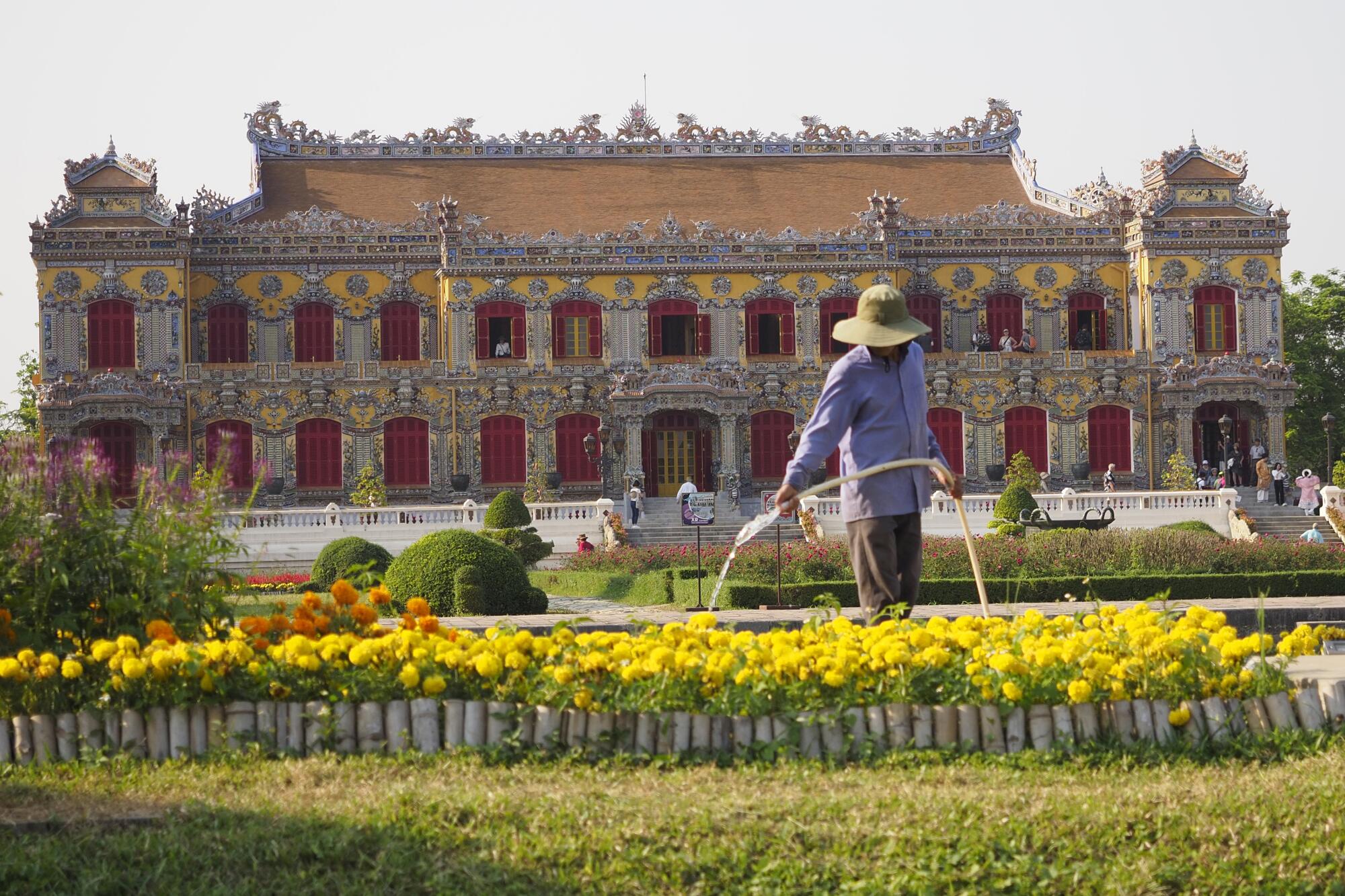
A gardener waters flowers outside the newly rebuilt Kien Trung Palace within the Imperial City of Hue.
(David Rising / Associated Press)
“They just kind of worked to build relationships with everybody and become a bigger player because of their economic development,” said Scot Marciel, a former ambassador based in Vietnam when it resumed diplomatic relations with the U.S. in 1995. “The business community has tended to view Vietnam as really a rising star in the region. It’s been a very steady, very pragmatic approach.”
The Trump administration may be taking action that could dim that star. Earlier this month, President Trump proposed a 46% tariff on U.S. imports from Vietnam, which could stall the country’s manufacturing and economic growth. Various news outlets have reported that Trump has also told senior diplomats in Vietnam not to attend the April 30 festivities.
Vietnam also invited military personnel from China, Cambodia and Laos to participate in its holiday parade.
“Vietnam prioritizes its relationship with regional and ideological allies as much as this strategic partnership with the U.S.,” said An Nguyen, a historian and lecturer at the University of Maine. “Maintaining that balance, I think, is becoming much harder in today’s context.
Hai Nguyen Hong, a senior lecturer of politics and international relations at Vin University in Hanoi, said he’s noticed the use of terms such as Liberation Day and Anti-American War has decreased over the past three-plus years. That shift, he said, can go a long way in changing perceptions in Vietnam and promoting national harmony.
“The day itself is a historical day. You can’t change it,” Hong said. “What you can change, and what you can see and observe change, is the mood and the attitude of the Vietnamese people.”
Vietnamese media and online discourse are tightly controlled, and there are no national surveys that include uncensored opinions about the government. But ahead of the high-profile commemoration on Wednesday, reactions to the celebration on the streets of Ho Chi Minh City ranged from enthusiasm to ambivalence.

Tran Thi Loan Anh, 27, and Phan Minh Quan, 26, in Ho Chi Minh City, said they will camp out in the early morning of the parade on Wednesday to get a good view of the 50th anniversary celebration.
(Stephanie Yang / Los Angeles Times)
Tran Thi Loan Anh, a 27-year-old tax advisor, said that she and her friends plan to camp out downtown at 3 a.m. the day of the parade, in order to secure a front-row view.
“I’ve been impressed by how the government has organized events that foster patriotism and national pride,” she said. “I’m especially struck by how music is used — traditional songs about the nation performed in such powerful, stirring ways.”
Pham Phu Quy, a driver and deliveryman, was a teenager in Saigon in 1975, with a father who worked for the South Vietnamese government, and a mother who worked for the northern army. Today, the 69-year-old said, Vietnam provides a freedom that differs from his childhood experiences. During the war, soldiers and checkpoints kept him from traveling. Now he rides his motorbike all around the country, taking selfies and photos along the way.
“I don’t know what the future holds, but this is a good enough life for me. Of course, debates between the two sides still continue to this day,” he said. “I just feel that if the country hadn’t been reunified — if the war had continued — everything would still be incredibly difficult.”
Pham Thao Anh, 75, is used to spending the national holiday in the capital of Hanoi where she grew up. But this year, she plans to fly to Ho Chi Minh City to celebrate.
“I remember that some of the soldiers that drove the tank into the Independence Palace that day were from my hometown,” the retired hospital worker said. “So this day has very special meaning to me.”

Le Anh Dung, 23, right, grew up hearing stories about the war from his grandfather and says he watches the April 30 celebration on television every year. His grandfather, Nguyen Van Them, 73, will travel to Ho Chi Minh City with other retired military officials to attend the 50th anniversary commemoration this year.
(Stephanie Yang / Los Angeles Times)
Nguyen Thuy Vy, a 32-year-old translator, said her generation generally has less attachment to the April 30 anniversary than other holidays such as Valentine’s Day, Christmas or Lunar New Year. “Young people I think nowadays are busy with work, and they don’t care about this traditional holiday,” she said.
But Le Anh Dung, a 23-year-old graphic designer in Hanoi, grew up hearing stories about the war from his grandfather, a former military officer who was working in North Vietnam’s artillery unit the day Saigon fell. Reading about the wars in Ukraine and Gaza have made him more appreciative of peace at home, he said, adding, “I feel so lucky that I don’t have to endure the smell of gunpowder or crawl into a bunker once in a while, like previous generations did.”
His grandfather, Nguyen Van Them, 73, said watching the celebrations on television helped his grandchildren understand what previous generations sacrificed for them. He believes that tweaking the holiday’s name makes it more meaningful.
“‘Liberation of the South’ is not quite right, because it only mentions one half. But the other half also looks forward to the country’s liberation, unity, harmony and oneness,” Nguyen said.



Construction workers unfurled a large printed tarp to cover scaffolding installed at the White House’s front entrance. Doug Burgum, the interior secretary, said President Trump had ordered the repairs after noticing damage to columns.
Politics
WATCH: Trump’s Energy chief reveals what escalating Iran tensions could mean for gas prices

NEWYou can now listen to Fox News articles!
Energy Secretary Chris Wright is telling Americans not to be concerned about the possibility of another surge of sharp increases in gasoline prices as tensions with Iran have started to escalate once again.
Asked whether Americans should worry about higher prices at the pump and how the Trump administration is preparing to keep the economy stable if the conflict continues to worsen, Wright told Fox News Digital: “It has not been any good behavior from Iran that’s allowed oil to flow. It’s been the United States military.”
“That’s not changing,” he assured, speaking from the Great American State Fair on the National Mall this week.
US CLAWS BACK KEY CONCESSION TO IRAN AFTER FRESH ATTACKS ON COMMERCIAL SHIPS IN STRAIT OF HORMUZ
(Mario Tama/Getty Images) (Mario Tama/Getty Images)
With Iran striking three commercial vessels transiting the Strait of Hormuz on Monday and Tuesday, Wright doubled down in urging citizens to not credit Iran for the U.S. military’s work to ensure oil shipments continue flowing through the strait.
“Look, the U.S. Military has been the key asset here,” he said. “They have assured the flow of oil and gas through the Strait of Hormuz throughout. Not at the beginning of this conflict, but through the last six weeks.”
Wright said the administration is closely monitoring global oil supplies as the tentative ceasefire with Iran seemingly came to come to a halt, with President Donald Trump telling Secretary-General Mark Rutte the call for peace with Iran is “over” at the NATO Summit in Turkey on Wednesday.
But, he pointed to the continued shipping through the Strait as evidence that markets should remain stable.
TRUMP SAYS IRAN CEASEFIRE IS ‘OVER’ AFTER IRANIAN ATTACKS TRIGGER MASSIVE US RESPONSE
President Donald Trump speaks at the White House on Tuesday, April 22. (AP/Alex Brandon)
“We’re of course constantly watching the supply of oil, the supply of refined products and what’s going on there,” Wright said. “And I think still all positive trends.”
Beyond geopolitical concerns, Wright also praised the new chain of discounted gas stations across Pennsylvania and New Jersey, Freedom Fuel, which promises customers prices below the national average.
The Trump administration, though not involved with the network, has heavily endorsed the new chain and its 25 locations.
“We love it,” Wright said when asked about Freedom Fuel. “I mean, look, any mechanism we can to lower energy costs for Americans of all kinds, we’re all in on.”
“With Freedom Fuels, they’re just lowering it down to their wholesale price of gasoline,” Wright said. “So they’re not making any money selling gasoline, but they’ve got convenience stores. That’s how most gas stations make money.”
NEWSOM UNDER FIRE AS CALIFORNIA GAS TAX HIKE SENDS PUMP PRICES EVEN HIGHER
Gasoline costs are a known concern for many Americans, and amid surging prices there has been a considerable increase in those opting to purchase electric vehicles to save money long-term at the pump — with Tesla dominating the market for these types of models.
Wright argued one of the benefits to living in America is having the option to choose what type of vehicle you drive.
CLICK HERE TO DOWNLOAD THE FOX NEWS APP
“We just want people to buy what they would prefer,” he told Fox News Digital when asked his thoughts on increasing calls for support of the electrification of cars. “Consumer choice — you wanna buy an electric car, you wanna buy a gas powered car, diesel powered car, buy a big truck. That’s the choice.”
“That’s why you live in America. You get the choice of all those.”

In 2023, California regulators levied more than $100,000 in fines against the private operator of a federal immigration facility, kicking off a three-year battle over whether detainees who do work at the facilities should be considered employees.
The question went beyond semantics: If considered employees, the detainees would be subject to state worker protection laws.
A legal settlement announced this week now affirms that private immigrant detention facilities are subject to California’s workplace safety and health requirements.
“Every worker deserves a safe and healthy workplace and should be able to report workplace hazards without fear of retaliation,” said Denisse Gómez, spokesperson for the California Division of Occupational Safety and Health or Cal/OSHA.
“Individuals who perform work in these facilities are entitled to workplace safety protections, and this settlement reinforces Cal/OSHA’s commitment to enforcing those protections and safeguarding vulnerable workers,” she added.
Under the settlement between California and the GEO Group, a Florida-based private prison company, the company recently withdrew its legal challenges and agreed to pay more than $100,000 in the fines.
The GEO Group did not respond to requests for comment.
Back in 2023, Cal/OSHA issued $104,510 in fines against the GEO Group. The agency had found six violations of state code by the company after detainees complained about a lack of protective equipment and proper training while cleaning the facility for $1 per day.
Detainees alleged they routinely wiped black mold off shower walls at the facility, saw black dust spew from air vents and used cleaning solutions that lacked instructions during the COVID-19 pandemic.
The biggest fine levied against the GEO Group was for failure to establish and maintain “effective written procedures to reduce employee risk of exposure to aerosol transmissible disease.”
Advocates viewed Cal/OSHA’S recognition of the detainees as workers as a victory that could pave the way for future labor rights fights at other detention centers in the state.
But the GEO Group appealed, arguing that detainees participating in ICE’s voluntary work program make their own schedules and aren’t employees, so hazard exposure couldn’t be “as a result of assigned duties,” as California law states. Plus, the company argued, there wasn’t enough evidence that detainees were exposed to any hazard.
Early last year, the state’s Occupational Safety and Health Appeals Board rejected the GEO Group’s argument and found that detainees should be considered “affected employees.”
The GEO Group sued, but three days before a California Superior Court hearing in May, the company and Cal/OSHA reached the settlement.
Along with paying the fines, the GEO Group agreed to draft plans for avoiding aerosol transmissions at 12 secure and reentry facilities in California, including five detention centers that hold immigrants.
“GEO ensures detainees are afforded the necessary tools, equipment, and personal protective equipment … to safely and effectively perform any necessary tasks,” the settlement states.
Gómez said the settlement also leaves intact the appeals board’s ruling that civil immigration detainees who participate in work programs can participate in proceedings anonymously, “acknowledging the potential for retaliation when individuals raise workplace safety concerns.”
But the question of whether detainees are employees and deserve certain protections isn’t entirely resolved — at least not for the federal government.
Last month, U.S. Immigration and Customs Enforcement released new standards for detention facilities across the country. The revised guidelines “emphasize that detainee volunteers participating in the voluntary work program are not considered facility and/or government employees” and thus not entitled to labor regulations.
Attorney Mariel Villarreal said the timing of the new detention standards made her question whether the GEO Group had asked ICE to specify in its standards that detainees are not workers in response to its battle with Cal/OSHA.
“To me, it’s a reaction to this very settlement,” she said. Villarreal works for the California Collaborative for Immigrant Justice, which filed the original complaint on behalf of detainees who said they worked in unsafe conditions.
Villarreal pointed to a Washington Post report that GEO Group executives privately asked ICE to specify that detainees are not employees of the facilities where they work. Two top Trump administration officials, border czar Tom Homan and acting ICE director David Venturella, previously worked for the GEO Group.
New versions of ICE detention standards take effect as contracts are established or modified, so this year’s rules won’t immediately apply to every facility.
An ICE spokesperson did not comment about the settlement. The spokesperson, who did not provide their name in an emailed statement Wednesday, said the agency has begun transitioning detention facilities to meet the 2026 standards, “building on its longstanding commitment to safe, secure, and professional detention operations.”
“ICE has consistently implemented many of these best practices independently, reinforcing its role as the leader in detention operations,” the spokesperson added.
The GEO Group and other immigrant detention center operators have faced other legal battles over workers’ rights, including lawsuits in Washington, Colorado and California over the $1-per-day payment.
Villarreal said she’s confident that the Cal/OSHA settlement would continue to hold even if California facilities incorporated the new standards. But she said she believes the statements are an attempt by the GEO Group to “sidestep responsibility” and avoid the possibility of being fined under similar circumstances in other states.
“These statements in the new standards are a way for them to try and preserve profits as much as possible,” she said. “GEO and ICE are so intertwined at this point that they have the same motives.”
-

 Utah3 minutes ago
Tyler Robinson preliminary hearing expected to wrap up Friday – KSLNewsRadio
-
Washington8 minutes ago
Bengals 2026 Opponent Preview: Washington Commanders
-

 Vermont8 minutes ago
Beau Welling’s Stowe Country Club Revamp Signals New Vermont Golf Era
-

 Virginia15 minutes ago
Rabid cat, bat, raccoons and skunks reported in these 4 Virginia counties
-

 Wisconsin23 minutes ago
Shipwreck Coast sanctuary council to meet July 16 in Sheboygan
-

 West Virginia30 minutes ago
Helicopter crashes in Pocahontas County
-

 Wyoming33 minutes ago
Wyoming officials say Meta’s 715,000-square-foot data center is responsible for contaminating its water system with a rare bacterium | Fortune
-

 Crypto38 minutes ago
What Are KOLs Discussing About the Cryptocurrency Market Today?

