Vermont
They got priced out of NYC, so they bought a $160,000 house in Vermont — but country life doesn't mean they're 'suddenly wealthy'

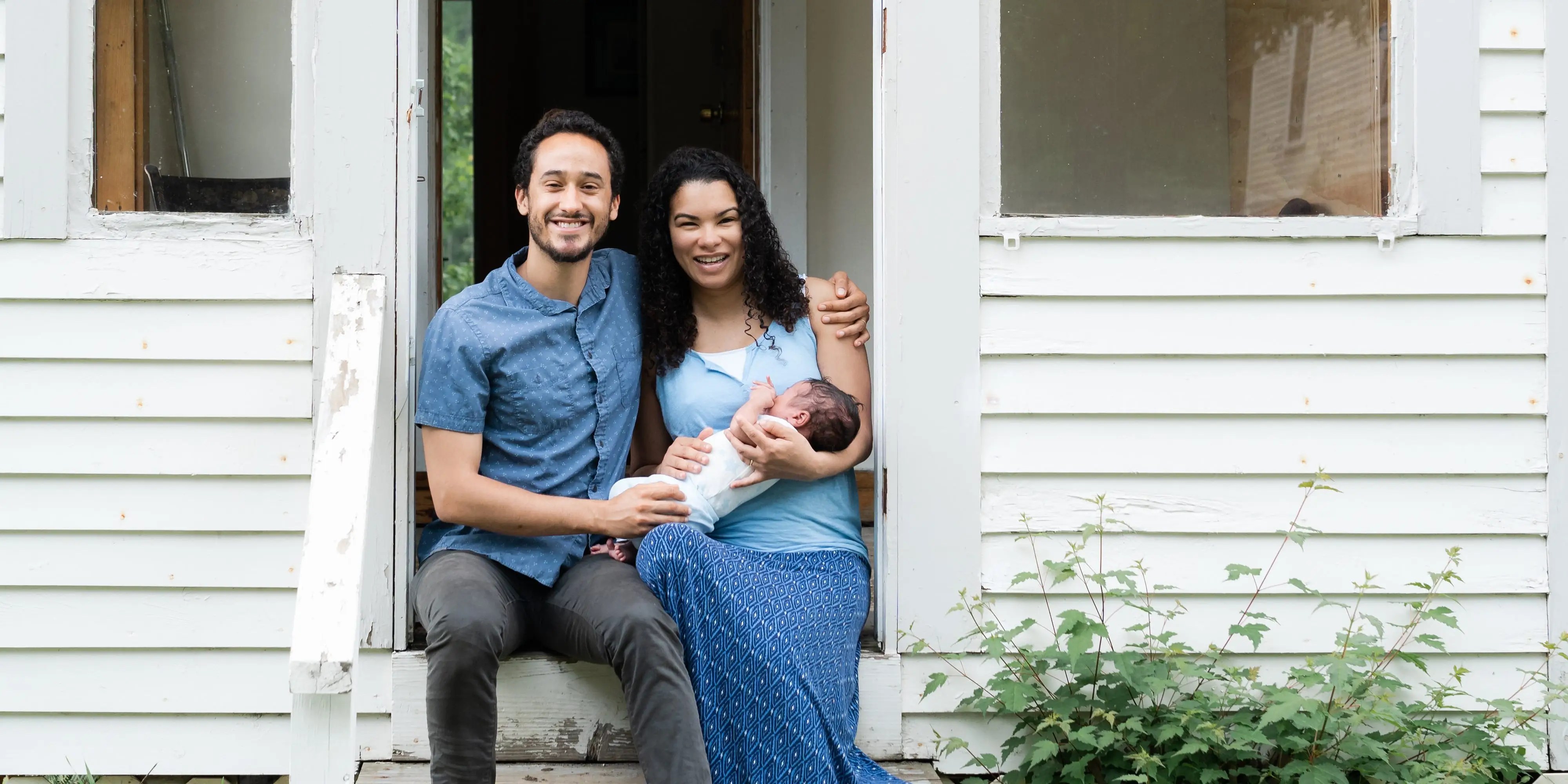
They were looking for an affordable place they could call their own: A house where they could put down more permanent roots, that ideally came with one or more acres of land where they could garden and start homesteading projects.
Two Of Us Photography. Photo provided by Full Joy Farm.
It was around the same time as the pandemic, so the couple decided to take advantage of their remote working arrangements to explore different towns.
“Because our work was remote — we were both working in schools at the time, which shut down — we were able to move around a bit on this sort of spring break trip,” Taylor, 34, told Business Insider.
During their road trip, the couple stumbled onto the Upper Valley area in Vermont and fell in love with the location.
Full Joy Farm.
With that, they decided to take the leap and moved out of NYC into a 350-square-foot studio apartment in Hartford, Vermont, near Dartmouth College, which they found online.
“It was probably slated for one person related to the college. But those lists of apartments, that’s public access, so it doesn’t have to be a Dartmouth student who lives there,” Tatum, 30, told BI.
Full Joy Farm.
It was a temporary arrangement — and a way to have an official address in Vermont — while they continued looking for proper housing in the area.
A fixer-upper within their budget
When they chanced upon the listing for a one-bedroom, one-bathroom fixer-upper in the small town of Pomfret, it was love at first sight.
“I thought it would be perfect for us,” Taylor, who is an artist, said. “At the time, it wasn’t a house, so I didn’t see it set up in a residential way. It was not lived in for at least, I want to say, about a decade or more.”
Full Joy Farm.
The 650-square-foot cottage was being used as an office for a local business, but Taylor saw its potential despite that.
“I saw the beauty of the natural lighting, there was a lot of sunlight. There are a lot of neat details with the wood and the cabinets which I thought were really cute. And then, mostly, the outdoor space was what we wanted,” she said.
Full Joy Farm.
The charming house came with 2.6 acres of land. It was initially listed for $225,000, but the price had been steadily decreasing.
“Not very popular on the market as far as a one-bedroom house, but we wanted a small house and it was perfect for when the price was reduced,” Taylor said.
The couple bought the property for $160,000 in March 2021. It took them about three to four months to close on the house, and moving in felt good.
Full Joy Farm.
“We packed up and moved a dozen or more times during the summer of 2020, so to be able to do that for the last time and unpack the boxes — knowing that we had no intentions to repack them — was a great relief,” Tatum, who works in parks and recreation, said.
Turning the house into a home
Although Tatum did some of the renovation work himself, the couple also hired a carpenter to assist them with some projects.
The first thing the couple did was fix up the sliding door that leads to their porch. The door was broken, and the wood underneath was rotting.
Full Joy Farm.
“With winter fast approaching, we absolutely had to take care of that in the first months of us getting here,” Tatum said. At that point, the couple was also expecting their first child, and that served as another form of motivation to improve things around the house.
While they’re still on the grid, the couple also invested in solar panels for their home.
“I think it’s a good investment since we’ll save a lot of money over time. And I think it’s an indication that we intend to be here for the long run,” Tatum said.
In an effort to be more sustainable, most of the items in the home are either gifted, thrifted, or free.
Full Joy Farm.
“I encourage people always to use what’s there, whether it’s salvage or free materials, instead of going out and trying to buy a bunch of stuff to set your home and garden up,” Taylor said.
The couple’s home is located on the main road of their town, which consists of about 1,000 people spread out across miles of mostly farmland. They’re 20 minutes from the nearest hospital and about an hour and a half from the city of Burlington.
While they have neighbors right across the street, the population density in the town is low.
“So our neighbors are right across the street from us. For context, they have about 75 acres, and their neighbors have 500. And we live on about two and a half acres here,” Tatum said.
Full Joy Farm.
What the couple loves about their home is the amount of privacy it affords them, without being too secluded.
“Maybe they could hear through the walls in our Brooklyn apartment, but if we needed help and we were to yell loudly here, our neighbors would hear us,” Tatum added.
The couple also manages a small campsite on their land where people can come and enjoy the outdoors. There’s a firepit where guests can start a campfire, and a composting toilet is available. Rates start from $24 a night for a maximum of four guests.
While the campsite is open all year round, Taylor says most people come between April and November.
Full Joy Farm.
City versus small-town living
Life in Vermont is quite different from in NYC.
For instance, they drive now, whereas they didn’t before.
“In New York City, I did not drive. I walked to work, I biked to work. If I wanted to visit a friend 90 minutes away, that meant I was on a train and we traveled 10 miles. And here, I drive 10 miles to work every day,” Tatum said.
The way they interact with their community is also very different.
“In New York City, we’re not waving at everyone we pass by because if you did that, you’d go insane. It’s too many people, and not everyone is your friend there,” Tatum said. “But here in Vermont, everyone waves at you, and you learn to wave back. It’s very friendly and very welcoming.”
Full Joy Farm.
While it was tough to make friends in Vermont at first — since it was the pandemic — it became easier to get to know new people, especially after they had their son.
“We met other parents and families through playgroups and things like that, and got to know our neighbors more,” Taylor said.
The slower pace of life in Vermont has been refreshing compared to the hustle and bustle of the city, Taylor, who was originally from Pennsylvania, added.
“I lived in New York City for about four years, and it’s something that I knew I wouldn’t be able to sustain long-term in terms of the sensory overwhelm and the pace of life,” she said.
Full Joy Farm.
That said, with a two-year-old toddler in tow, the young parents are “still exhausted,” Tatum, who is originally from NYC, said.
“The pace here is slower, but that doesn’t mean that we’re not running around, trying to get him from play date to day care and back to work. I just can’t imagine how we’d pull it off in New York,” he added.
Getting used to life in the country
The Barnes family isn’t alone in their journey.
More and more Americans are being priced out of the city. A single person in NYC would have to make about $140,000 to live comfortably, and this amount jumps to $318,000 for a family of four consisting of two adults and two children.
It comes as no surprise that many lower-earning New Yorkers and even young families are choosing to move to the suburbs or leave the country entirely in order to enjoy a lower cost of living. A December 2023 report from the Fiscal Policy Institute found that 65,242 residents who earned between $32,000 and $65,000 left NYC in 2022, compared to 50,160 of those who earned over $172,000.
However, the couple says that things aren’t as straightforward as it seems.
“Compared to New York City, the mortgage is half that of what we paid for rent,” Tatum said. “And while that may look good on paper, the reality is that being homeowners means that those savings go to the repairs and the projects that allow us to push up our comfort in the space and our enjoyment of the house.”
At the end of the day, everything balances out, he said.
“We’re not suddenly wealthy because we are living in the country,” he added.
Full Joy Farm.
The couple has some advice for those who want to move out of the city and into the country: Learn to let your guard down.
Tatum said that living in cities can teach people to be alert and wary of others, but that’s not how things necessarily work in the countryside.
“In small, rural towns, people often have good intentions — and you need to only reach out and ask for help to receive it,” he added. “Your greatest threat is not your fellow man, but the raccoons that are going to find their way into your attic or kill your chickens or the bears that are going to get too curious around your bird feeder. It’s a different set of threats, and it’ll take a little bit of time for your brain to make the switch.”
Have you recently built or renovated your dream home? If you’ve got a story to share, get in touch with me at agoh@businessinsider.com.



NEWBURY, Vt. (WCAX) – A new face joins the race for Vermont governor.
Aly Richards, the former CEO of Lets Grow Kids, will hold her campaign announcement on Monday morning.
Richards has spent the last decade advocating for affordable child care in Vermont, including pushing for the state’s landmark child care law.
Richards’ campaign announcement will take place in her hometown of Newbury at 11 a.m.
Copyright 2026 WCAX. All rights reserved.

MONTPELIER, Vt. (WCAX) – About 160 households will no longer receive hotel rooms following the end of cold weather rules for the state’s General Assistance program this week.
Anti-homeless advocates said last year the federal government authorized Vermont to use state Medicaid funds for a program that could supplement rent for people at risk of homelessness.
State leaders this week said that is not an option as Vermont is still building the program.
Vermont Human Services Secretary Jenney Samuelson said at a press conference this week the waiver gives the authority, not the funding or infrastructure to build the program.
“The state would need to put up significant investments including enrolling housing providers, landlords, developing and building IT systems,” Samuelson said. “These steps require significant time and resources.”
The state legislature and Governor Scott’s administration have been trying to wind down the use of hotels and instead ramp up shelters to get people back on their feet.
Copyright 2026 WCAX. All rights reserved.

Amanda Rancourt was facing a predicament.
She had started raising chickens in response to rising egg prices. But last May, a clutch of baby chicks she was raising in her backyard had grown up. Unexpectedly, one of the supposedly all-female chickens had a surprise for Rancourt.
The chicken turned out to be a rooster.
Rancourt knew what that meant. She could keep the chickens. But she lives in Barre City.
The rooster would have to go.
“It’s unfortunate. I literally live on the Barre City, Barre Town line,” she said. “It just kind of stinks we weren’t able to keep him, legally.”
Over the past few years, complaints across Vermont municipalities regarding roosters and their chatter have spurred many towns to ban them within their borders. Ordinances banning roosters have been in place in Burlington, South Burlington, Williston and Essex Junction for years. Yet regulations are not consistent, even between neighboring communities. The town of Barre, where Rancourt lives, has rooster regulations, while just up the road, the city of Montpelier does not.
As winter finally lets up and backyard flocks begin stirring from their coops, Vermont municipalities are increasingly saying “no” to roosters, creating a patchwork of local regulations that routinely pit the state’s agricultural heritage against suburban quality of life.
More communities have begun considering new bans. Last fall, the St. Albans City Council unanimously voted to ban roosters, with the threat of daily fines and possible court-ordered removal if a rooster is not moved, according to officials. A series of noise complaints regarding roosters crowing around the city had pushed the government to look at restrictions, St. Albans Mayor Tim Smith said.
Urban density fueled the complaints, with most residents living just 30 feet apart. And perhaps a blind spot in the city’s animal control laws helped the backyard chickens proliferate, said Chip Sawyer, St. Albans’ planning director and author of the proposed ordinance.
“A barking dog, you can deal with,” Sawyer said. “You can order someone with a barking dog to keep their dog inside. You can’t really order a rooster to be kept inside the home.”
The new rule drew little resistance. Only one family with a pet rooster complained, Smith said.
“To have some one person feel that his activities, his hobbies, whatever you want to call it, take priority over his neighbors is, in my opinion, very selfish,” Smith said.
Meanwhile, a similar dispute between neighbors in Shelburne prompted the town to debate adopting its own restrictions on roosters.
“They start yodeling at dawn and go on until dark,” wrote Ruth Hagerman, a Shelburne resident, in an email to town government representatives that was shared with VTDigger.
“They are disturbing the peace of those around them and are providing a textbook example of how neighborly policing doesn’t work.”
Yet after debating a drafted law, which was based on ordinances in neighboring municipalities, the Shelburne selectboard decided during a meeting last year to keep things as they were.
Shelburne Town Manager Matt Lawless was wary of overregulating how residents raise animals and produce their own food.
“We need to be cautious, I think, in when we deal with nuisance or when we’re concerned about health and safety, that we also look at the positive value provided, and we not make it hard for people to do things that are good,” Lawless said.
A ban on roosters felt too controlling, according to Shelburne board member Andrew Everett. He felt that for Shelburne, a community that is a mix of suburban and rural, changing traditional Vermont ways should be resisted until absolutely necessary.
Meanwhile, Williston’s war over backyard chickens has now spanned nearly a decade, with residents on smaller properties twice rebuffed in their efforts to keep hens. The city still classifies chickens as livestock, prohibited on any lot under an acre. The most recent attempt to lift the ban died in September 2023. Selectboard members who had previously supported the ban again voted to peel the chicken provisions off a broader housing package, shelving them indefinitely.
 100vw, 1200px”/><figcaption class=) Chicken bans in Williston have survived at least two attempts to overturn them, the most recent in 2023. Photo by Al Frey/Williston Observer
Chicken bans in Williston have survived at least two attempts to overturn them, the most recent in 2023. Photo by Al Frey/Williston Observer
The trend of banning roosters from Vermont municipalities has caused a somewhat unintended wrinkle: what happens to the roosters?
The growing number of roosters that need to be re-housed has become an issue, said Pattrice Jones, cofounder of VINE Sanctuary in Springfield, an animal sanctuary that assists in rescuing roosters.
Sanctuaries around the state have been overwhelmed with requests to take roosters, Jones said. Chicks from hatcheries and farm stores that unexpectedly turn out to be roosters — and misconceptions about roosters being inherently violent — add to the problem.
But the growing list of local ordinances banning roosters has resulted in even more requests to take them in, adding to VINE’s “perpetual” waiting list, Jones said.
For many, emotional attachment to their roosters complicates the decision of what to do with the feathered pets.
“We hand raised them from when they were chicks and my kids were attached to them,” said Rancourt, the Barre chickens owner.
After a few months of looking, she was able to find a more rural home for her rooster, away from the suburban neighborhoods and the rooster ban in Barre.
“We understand that if they ended up becoming a problem with people, that they may end up having to cull them and eat them,”.
“Personally I couldn’t do that.”

Motorcyclist killed in Las Vegas Valley crash

Benefit held Maine man badly injured after getting hit on I-95 while shielding teen

Best places for sea glass at the Jersey Shore: Try these hotspots

New Mexico leaders push colleges to keep tuition flat

Carrie Everett, crowned Miss North Carolina in 2024, dies of stomach cancer, family says

Florida High School Football Rankings: Top 25 teams – Oct. 21

How old is Bo Nix? What to know about Oregon quarterback ahead of 2024 NFL Draft

Cleary's 21 help Le Moyne down Central Connecticut State 69-64 in OT

99th annual Pony Swim held in Virginia

Indiana Members Credit Union announced as new anchor tenant at Bottleworks District

GOP races to pass ICE, Border Patrol funding bill as priorities pile up, divisions emerge
Jet fuel crisis: Rationing triggered at four airports in Italy

NASA’s Artemis II crew readies for Monday’s lunar flyby. Here’s what you need to know

Tax day is next week: Avoid these 5 common mistakes that can cost you money

Hamas armed wing says disarmament demands not acceptable
-

 South-Carolina1 week ago
South Carolina vs TCU predictions for Elite Eight game in March Madness
-

 Atlanta, GA1 day ago
1 teenage girl killed, another injured in shooting at Piedmont Park, police say
-

 Vermont1 week ago
Skier dies after fall at Sugarbush Resort
-

 Movie Reviews4 days ago
Vaazha 2 first half review: Hashir anchors a lively, chaos-filled teen tale
-

 Politics1 week ago
Trump’s Ballroom Design Has Barely Been Scrutinized
-
 Entertainment4 days ago
Inside Ye’s first comeback show at SoFi Stadium
-

 Atlanta, GA1 week ago
Fetishist ‘No Kings’ protester in mask drags ‘Trump’ and ‘JD Vance’ behind her wheelchair
-

 Politics1 week ago
JD Vance says he was ‘obsessed’ with UFOs, believes aliens are actually ‘demons’