Vermont
The future is now: 16- and 17-year-olds win the right to vote in local elections in a Vermont town


BRATTLEBORO, Vt. — A Vermont town has acted on the notion that young voters offer hope for the future, giving 16- and 17-year-olds the right to vote next week in local elections. Those who turn 18 by the November general election will be permitted to vote in the state’s presidential primaries on Super Tuesday.
That means some voters in Brattleboro, population 7,500, could have a hand in choosing major party nominees who are more than 60 years older than they are: Democratic President Joe Biden, 81, and Republican front-runner Donald Trump, 77.
The change to the town’s charter required legislative approval, and Republican Gov. Phil Scott twice rejected the measures. Last year the Democratic-controlled Legislature overrode the governor’s veto, giving more Brattleboro teenagers the green light to vote and run for Brattleboro’s primary governing body, and to be chosen as representatives to an annual town meeting where many local issues are decided.
Lawmakers stopped short of giving 16 and 17-year-olds the ability to serve on the local school board, which was originally part of the measure town residents approved back in 2019.
Some communities in Maryland have lowered the voting age to 16 for municipal elections. The city council in Newark, New Jersey, approved a measure in January to allow that age group to vote in school board races. Two cities in California lowered the voting age to 16 for school board seats, but those changes have not gone into effect.
Silas Brubaker, a 17-year-old senior at Brattleboro Union High School, plans to do research before making his voting decisions on Tuesday in local races. He said he’s qualified “because I know what’s going on in the world.”
“I’m not too young or too naïve to know what’s happening and to know what I want to be happening,” Brubaker said. “And when those things conflict, it feels very unfair and wrong for me not to be able to do anything in an official sense. Like I can go to protests, I can speak my mind, but I can’t do anything in a legal sense and now I can, so that’s exciting.”
Brattleboro Union High School students register to vote during a voter drive at the school, Feb. 14, 2024, in Brattleboro, Vt. Sixteen and 17-year-olds in Brattleboro will get to vote in local elections and if they’re 18 by the November general election they can cast ballots in the Super Tuesday presidential primary. Credit: AP/Lisa Rathke
The effort to lower the voting age started years ago. Rio Daims worked on the youth vote campaign in 2018 when she was 16. Now she’s a 22-year-old college student studying political communication.
“It’s exciting, but I also just really, really hope that there are other excited teenagers who are making the moves to get the word around,” she said, “because unless they’re told, they’re not going to assume this is a possibility.”
Daims’ father, Kurt Daims, director of Brattleboro Common Sense, was director of the youth voting campaign starting in 2013 but doesn’t feel “it’s a full victory” because young voters were excluded from serving on the school board.
Senior Django Grace, who helped organize a voter drive at the high school, said turnout dropped during the pandemic and civic engagement has plummeted. Bringing younger voters into the process can only help.
A sign is posted at Brattleboro Union High School suggesting students register to vote during a voter drive at the school, Feb. 14, 2024, in Brattleboro, Vt. 16 and 17-year-olds in Brattleboro will get to vote in local elections and if they’re 18 by the November general election they can cast ballots in the Super Tuesday presidential primary. Credit: AP/Lisa Rathke

“Giving us the vote allows us to apply whatever we’re learning in class,” said Grace, who just turned 18 and is running to be a town meeting representative. ”It makes it relevant.”
To date, at least 37 teens have registered, according to the town clerk’s office. Many signed up during the voter drive at the school on Feb. 14, which senior Eva Gould also helped pull together.
“This is the future and these are the people who are going to be voting in our elections and are going to be running in our elections as well,” Gould said. “They know a lot more than a lot of people do, honestly.”



Powerball, Mega Millions jackpots: What to know in case you win
Here’s what to know in case you win the Powerball or Mega Millions jackpot.
Just the FAQs, USA TODAY
The Vermont Lottery offers several draw games for those willing to make a bet to win big.
Those who want to play can enter the MegaBucks and Lucky for Life games as well as the national Powerball and Mega Millions games. Vermont also partners with New Hampshire and Maine for the Tri-State Lottery, which includes the Mega Bucks, Gimme 5 as well as the Pick 3 and Pick 4.
Drawings are held at regular days and times, check the end of this story to see the schedule.
Here’s a look at July 6, 2026, results for each game:
Winning Powerball numbers from July 6 drawing
17-44-63-66-67, Powerball: 04, Power Play: 2
Check Powerball payouts and previous drawings here.
Winning Gimme 5 numbers from July 6 drawing
04-12-30-34-38
Check Gimme 5 payouts and previous drawings here.
Winning Pick 3 numbers from July 6 drawing
Day: 5-7-2
Evening: 5-7-8
Check Pick 3 payouts and previous drawings here.
Winning Pick 4 numbers from July 6 drawing
Day: 7-9-1-6
Evening: 9-8-4-1
Check Pick 4 payouts and previous drawings here.
Winning Megabucks Plus numbers from July 6 drawing
01-06-24-32-37, Megaball: 04
Check Megabucks Plus payouts and previous drawings here.
Winning Millionaire for Life numbers from July 6 drawing
02-08-32-54-56, Bonus: 03
Check Millionaire for Life payouts and previous drawings here.
Feeling lucky? Explore the latest lottery news & results
Are you a winner? Here’s how to claim your lottery prize
For Vermont Lottery prizes up to $499, winners can claim their prize at any authorized Vermont Lottery retailer or at the Vermont Lottery Headquarters by presenting the signed winning ticket for validation. Prizes between $500 and $5,000 can be claimed at any M&T Bank location in Vermont during the Vermont Lottery Office’s business hours, which are 8a.m.-4p.m. Monday through Friday, except state holidays.
For prizes over $5,000, claims must be made in person at the Vermont Lottery headquarters. In addition to signing your ticket, you will need to bring a government-issued photo ID, and a completed claim form.
All prize claims must be submitted within one year of the drawing date. For more information on prize claims or to download a Vermont Lottery Claim Form, visit the Vermont Lottery’s FAQ page or contact their customer service line at (802) 479-5686.
Vermont Lottery Headquarters
1311 US Route 302, Suite 100
Barre, VT
05641
When are the Vermont Lottery drawings held?
- Powerball: 10:59 p.m. Monday, Wednesday, and Saturday.
- Mega Millions: 11 p.m. Tuesday and Friday.
- Gimme 5: 6:55 p.m. Monday through Friday.
- Lucky for Life: 10:38 p.m. daily.
- Pick 3 Day: 1:10 p.m. daily.
- Pick 4 Day: 1:10 p.m. daily.
- Pick 3 Evening: 6:55 p.m. daily.
- Pick 4 Evening: 6:55 p.m. daily.
- Megabucks: 7:59 p.m. Monday, Wednesday and Saturday.
- Millionaire for Life: 11:15 p.m. daily
What is Vermont Lottery Second Chance?
Vermont’s 2nd Chance lottery lets players enter eligible non-winning instant scratch tickets into a drawing to win cash and/or other prizes. Players must register through the state’s official Lottery website or app. The drawings are held quarterly or are part of an additional promotion, and are done at Pollard Banknote Limited in Winnipeg, MB, Canada.
This results page was generated automatically using information from TinBu and a template written and reviewed by a Vermont editor. You can send feedback using this form.

Authorities have identified the girl and her older brother who died in a Vermont river after going missing last week.
Sandro Lala, 25, had jumped into the Lamoille River to save his sister, 11-year-old Yazmin Yupangui, when she fell into the Lamoille River near Arrowhead Mountain Lake in Georgia, Vermont, on Wednesday, according to the Vermont State Police.
Autopsies determined that the siblings, who both lived in Cambridge, Vermont, died in accidental drownings, according to police.
Yazmin’s body was found Thursday by a police underwater recovery team, while Lala’s body was found in Arrowhead Mountain Lake on Saturday morning.
Police had previously said a group of relatives were fishing along the shore when a young girl fell into the water, and a man jumped in to try to rescue her. Neither resurfaced after that, prompting a large search, including multiple agencies, on the water near where Lamoille River empties into the lake.

Mountain bike enthusiasts have been working for years on an ambitious 485-mile multi-use trail known as the Velomont that will span the length of Vermont.
When finished, the collaborative project will knit together existing trail networks, connect 27 communities, and include 30 new huts and five downtown hostels for overnight stays.
New trail construction is finally ramping up after years spent on permits, plans and public input. And organizers say they’re focused on ensuring the Velomont is accessible for everyone.
“For us, it’s not a huge lift to just be mindful when we’re trying to build trail or improve trail to think about the adaptive rider,” said Angus McCusker, the Velomont trail director with the nonprofit Vermont Huts and Trails.
McCusker is referring to the growing number of athletes with disabilities who mountain bike with specially designed equipment.
“The challenge,” he said, “is we’re connecting to existing trail networks that were never intended for adaptive bikes. So, where we can, we’re trying to do adaptive assessments.”
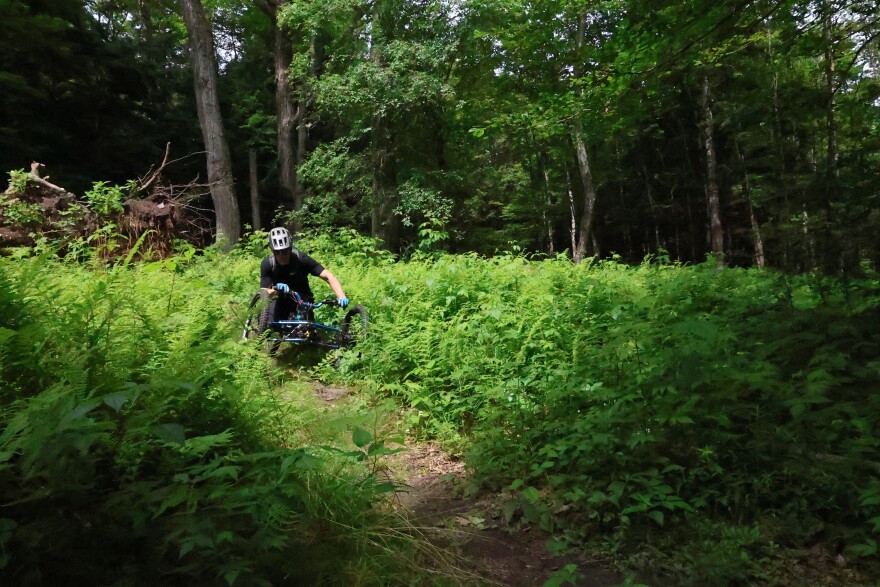
Louis Arevalo of Essex Junction is one of several adaptive athletes helping with that, most recently on some slightly overgrown trails in the Randolph Town Forest.
Zoe McDonald
/
Vermont Public
Arevalo was paralyzed in a skiing accident six years ago. An avid mountain biker before, he now rides a recumbent-style three wheeler that sits low to the ground. Arevalo pedals and steers with his arms, and gets a boost from an electric motor.
“Once you realize what these bikes are capable (of) or this equipment actually opens up, it kind of blows your mind,” he said.
But adaptive rigs like Arevalo’s are wider and heavier than regular mountain bikes, and not all trails are user-friendly.

Zoe McDonald
/
Vermont Public

Zoe McDonald
/
Vermont Public
Nick Bennette, who tested a different type of adaptive bike that day, got hung up on several tight turns.
Bennette is executive director of the Vermont Mountain Bike Association, another nonprofit spearheading efforts around the Velomont. He and others involved in the assessment have been taking detailed notes on ways to make the trails more accessible.
“Just scalloping out a bit of material on the outside of that corner,” said Bennette, pointing to the area the bike got caught. “That will allow adaptive bikes to make that corner without really changing the way the trail rides.”
This type of work is not just happening on the trails. Organizers are also trying to reduce barriers at overnight accommodations along the network.

Zoe McDonald
/
Vermont Public
This summer, contractors are turning an old office building near the trail in downtown Randolph into an ADA accessible hostel. And two remote huts along the trail in Stratton and Chittenden will have locked sheds with off-road wheelchairs so bikers don’t have to haul their own.
At the Chittenden Brook Hut, McCusker highlighted a new ramp and wider driveway.
“So if you’re an adaptive rider, you can imagine rolling right up here and you can transfer to your chair that’s available here, and then roll down the ramp and go down to the fireplace, to the privy, to make your meal,” he said.

Zoe McDonald
/
Vermont Public
Louis Arevalo stayed at the hut last summer with other adaptive riders — his first camping trip since his accident.
“It was really refreshing to have easy access to a beautifully built hut that was easy to navigate, and then have these world-class trails right out the door,” he said. “And with these Velomont trails, I can actually plan a hut-to-hut trip with other people.”
Jeff Alexander is counting on it. He’s director of strategic partnerships with Vermont Adaptive Ski and Sports, a nonprofit that helps people with disabilities access outdoor recreation.
An economic impact analysis the group commissioned estimates their programming generated more than $10 million last year.
“So the adaptive community has money, they travel, they want to travel and they want to play with everybody,” Alexander said. “We just need to level the playing field so that everyone can play together.”
Zoe Mcdonald
/
Vermont Public
-

 Indiana2 minutes ago
What made the early days of Indiana high school basketball standout?
-

 Iowa9 minutes ago
Julien Dubuque Bridge fully closed until August, free shuttle offered
-

 Kansas12 minutes ago
Police searching for missing Kansas teen in Dauphin County
-

 Kentucky17 minutes ago
Secretary of State launches statewide Kentucky Time Capsule Project commemorating America's 250th
-
Louisiana24 minutes ago
Louisiana Lottery Powerball, Pick 3 results for July 6, 2026
-

 Maine27 minutes ago
PACs should ease up on the political propaganda in Maine | Letter
-

 Maryland32 minutes ago
Maryland Lottery Powerball, Pick 3 results for July 6, 2026
-

 Michigan39 minutes ago
Michigan primary puts Democrats’ socialist strategy to the test | Opinion

