Vermont
Inside Vermont’s Radical Approach to Helping the Formerly Incarcerated Succeed


It’s a slate-gray October day in Vermont, and Leon—middle-aged, balding, in work boots and a plaid shirt—sits inside a local community justice center, a low white-clapboard building in the back of a storefront. Five other people encircle a round table with him. A bouquet of pink carnations blooms in the center.
Leon has been out of prison for going on three years. But he’s struggling, battling depression as winter closes in. Close family members died while he was locked up. His children don’t speak to him.
“That’s the real price of what I did, not what some guard says or what my parole officer thinks or the time they can give me in jail,” he tells the group.
Leon is surrounded by town volunteers who’ve committed to supporting and keeping an eye on him in his first years out. Called a Circle of Support and Accountability, or CoSA, it’s an approach to keeping those who’ve committed sexual crimes from reoffending that Vermont has built into its reentry system. (At the request of the Vermont Department of Corrections, The Appeal is not using anyone’s real name nor the name of the town in question to protect his identity and that of his victim.)
Leon keeps venting. When he was in prison, he didn’t fight back if he got punched; he was focused on staying out of trouble and getting out of prison. He says that if he goes behind bars again, he’ll fight back.
Barbara stiffens at his tone. She’s the center’s reentry coordinator and is moderating this meeting. “Do you think there’s a risk that you’re going to go back to jail right now?” she asks.
“Always a risk,” Leon replied. “Always.”
“What are the things that have helped lessen that risk?” she asks.
“Daily choices and not ever forgetting,” he says. “Seeing people who are still making really horrible, detrimental choices.”
Leah, a volunteer, says she understands how disappointing it must be to lose the connection with his kids and grandkids, which he’s talked about in past meetings. “How do you keep that disappointment from consuming you?” she asks. “What are you filling your time with?”
Leon starts to tell her about all the stuff he’s bought to fill his time—guitars, snowboards, watches, and more. Talking about new toys is a diversion tactic the group recognizes from past meetings, one he uses to avoid answering tough questions.
“We’re not doing show and tell today,” Barbara interrupts. The group laughs, and Leon starts over. He listens to music, tries to be still and quiet his mind, and focuses on managing his depression, he says.
“You know, anytime you want to ask your team to get together, as long as it’s not just to shoot the shit, they’re here for you,” Barbara says.
“And you’re still welcome to text me anytime,” adds Tina, another volunteer.
“This process really does help,” Leon says at the end of the meeting. “You can only fake it so long, and when you’re faking it, these people are going to know.”
Leon has had no reoffenses or parole violations since he left prison in late 2020, according to state records.
“Not even close,” he adds.
Vermont’s CoSAs are made up of volunteers who meet regularly with those coming out of prison after sentences for serious crimes, meeting typically once a week for a year, though at least half the groups extend beyond a year. They offer encouragement, advice, and watchful eyes, helping the person at the center, or “core member”, with goals they’ve set for moving back into the community offense-free.
Every quarter, an “outer circle”—including their probation officer, substance abuse provider, family members, and friends—gets together to share their perspectives with the impacted person.
The circles model started in Canada in 1994. But in the U.S., only Vermont and Minnesota have built CoSAs into state reentry policies.
The results have been remarkable. Studies show that nationally, the vast majority of those with a past sexual crime don’t reoffend in the first place. But several studies have found that those who go through the circles model have lower rates of any type of reoffense than those who don’t. A 2018 study of Minnesota’s program showed it yielded a benefit of about $41,000 per participant in state costs avoided–in particular cutting the expenses of reimprisoning someone and the costs borne by new victims.
In 2016, University of Vermont sociologist Kathryn Fox reported to the state legislature on a study she and two colleagues did of the state’s CoSA program. Researchers compared 139 people with convictions of any type who went through a circle and 139 who didn’t. Circle participants were half as likely to be reconvicted of some kind of felony within three to four years after release: 18 percent versus 35 percent. (Robin Wilson, a psychologist and collaborator on the study, told The Appeal that the sexual reoffense rates in both groups were so low that the researchers would have needed an even longer follow-up period to get meaningful results.)
CoSA is a radical departure from prevailing laws—public sex-offense registries and related regimes—that force registrants into isolation, unemployment, and homelessness and make them and their families targets of harassment and violence. For her 2023 book From Rage to Reason: Why We Need Sex Crime Laws Based on Facts, Not Fear, St. Francis College sociology and criminal justice professor Emily Horowitz interviewed dozens of people on registries. They reported being harassed by neighbors, having trouble finding housing and work, being shunned by family, friends, and their communities, and worse.
In South Florida, hundreds of registrants live on the streets because of rules that forbid them from living anywhere near parks, schools, daycares, and more, putting vast swaths of housing off limits. Researchers have repeatedly found these rules do nothing to prevent sexual crimes.
And 25 years of research show that sex offense registries don’t prevent repeat sexual offenses. A 2021 meta-analysis of 18 studies concluded those policies “demonstrate no effect on recidivism.”
Vermont, like other states, is required under federal law to operate a public sex offense registry. But its rules are decidedly less draconian than elsewhere. Unlike in many states, registrants aren’t forced to tell new neighbors about their registry status when they move. And there are no state-level bans on where registrants can live, unlike in the many jurisdictions where such laws force registrants into homelessness.
Vermont CoSA’s advocates are mystified as to why other states ignore its results. In conversations with The Appeal, experts and proponents said interstate community activists may need to launch their own circles to show state leaders what’s possible.
Fox, the sociologist, said some research on those who succeed after prison shows that people stop committing crimes because someone believes in them—a probation officer, a pastor, a CoSA member—and gives them the chance to create an alternative narrative: that they’re a good person who had some twists and turns along the way.
To that end, circles let core members support others in the group.
“Sometimes the core member comes in and says, ‘I came in here wanting to talk about myself today, but I can see that Tina needs CoSA today, so we’re going to focus on that,’” Barbara said.
By contrast, probation and parole tend to take a ‘don’t do this, don’t do that’ approach so they’re “not really the best mechanism for support because they generally are just measuring compliance, sadly,” Fox said.
The biggest challenge for core members might be the state registry. Having their photos and details listed publicly makes getting jobs and housing tough. Plus, the public list makes them targets for harassment and violence. Registrants have to pay $20 to $50 each week to attend mandatory sexual offending treatment groups. If they can’t get a job, they can’t pay. And if they can’t pay, they get sent back to prison.
Circles are also only part of Vermont’s alternative approach to crime.
A shift happened in the early nineties when imprisonment rates were climbing even as crime rates held steady, Derek Miodownik, DOC’s community and restorative justice executive, told The Appeal. The public was telling state leaders it was unhappy with the state spending ever more money on prisons.
After hiring a market research firm to listen to residents, the department funded community restorative justice centers. In addition to CoSAs, those centers house a system of “reparative probation,” which complements traditional probation but functions differently. For nonviolent, minor crimes, the person who offended meets with a volunteer board and negotiates an accord in which they agree to tasks—like a letter of apology to the victim, restitution, and community service—designed to help them see the effects of what they did and repair the harm to the victim.
A study by researchers from three universities concluded that, compared with standard probation, those who went through reparative probation were significantly less likely to commit a new offense of any type.
State legislators wrote restorative justice into state law in 1999, and today the Department of Corrections is administratively located within the state’s Agency of Human Services.

In CoSA parlance, Leon is his group’s “core member.” Most volunteers in his circle have experience inside the justice system: There’s Tina, a court stenographer; Samantha, who worked with adults with disabilities, including inside jails; Kyle, retired from the state’s Department of Corrections; and Leah, a business manager at a nearby university.
Their reasons for getting involved are moral and practical. “I feel like we need more people who are kind and inclusive and want to help everyone have a place in our community,” Leah said. Samantha has a son who was in prison for years. She saw how isolated he was after getting out. Tina said the lesson she took from 40 years working in courts is that a “punitive-based system doesn’t work.” And Kyle saw the need for the program when he worked in corrections: “A lot of guys get out with nothing, and we’re here to fill the gap.”
Circles are akin to a combination of Alcoholics Anonymous and small support groups. Meetings open with an icebreaker that a member brings, like “What was your favorite childhood candy?”
Then there’s a check-in. This often starts with the core member: What’s happened in the last week? What’s been tough? What’s going well? The group may discuss pressing tasks, like a core member’s progress on getting a driver’s license. At the end, they offer closing words for one another. Barbara doesn’t always facilitate, the volunteers or the core member might take a turn.
Sometimes they chuck it all and do something fun, like play a game, have a cookout, or go to an art gallery.
This day’s meeting was a bit different than a standard circle. After Leon left prison, his CoSA group met with him weekly for a few months. But in late 2018, he slipped up, violating his halfway-house rules and landing back in prison for an additional two years. When he was released, the circle took up where they left off, meeting once a week until May 2022. Leon can still ask the group to get together when he needs support, which is why the group convenes today.
Barbara, the coordinator, asks the group to think about Leon’s first circle, which ran for only a few months. How was that experience?
The group agreed Leon was overwhelmed on the outside after four years locked up, but he didn’t want to admit it.
“I don’t want to say [I was] delusional, but I still had such a jail mentality,” Leon said to the group.
In prison, people got jealous if someone had a nice watch. So once he was out, he started buying stuff to fill up his life. Buying expensive things made him feel fine. But he wasn’t.
“I didn’t commit crimes, but I didn’t feel like I was doing that great,” he said.
“You were really like, I’ve got this, and it’s great, and it’s perfect, and you just were drinking from the firehose,” Tina said.
Samantha then chimed in.
“You would get really defensive whenever we asked a question, and that would kind of shut things down,” she said.
Barbara then offered her own expertise.
“For me, there were red flags,” she said. “When that happens and it’s going on for too long, I feel like some bad thing is going to happen.”
Before Leon left prison for a second time, he said he wanted to start meeting with the CoSA group again on release. Barbara wanted to make sure he was serious. So she met with him several times on the inside. She had him write three drafts of a “success plan” in which he mapped out how he’d stay on track. By the third one, she thought he was starting to look inward and ask hard questions.
Re-starting was complicated by the pandemic. The group met on Zoom the first few times, with Leon sometimes disengaged and staring at the ceiling. But of all its programs, the Vermont Department of Corrections (DOC) wanted to keep CoSA face-to-face. Barbara said the DOC quickly built a yurt outside the center for them to meet in.
The volunteers were skeptical when they started the second time.
“We’re dropping the shit, and we’re all going to be here,” Tina remembered telling Leon on a Zoom call. “Cards on the table. I’ll put mine, you put yours, and we’re not going to do show and tell this time around.”
Still, Leon struggled in early meetings. He showed up to one high, and the group confronted him. He admitted he’d been smoking weed, a turning point because he wouldn’t have owned up to it during the first circle, Barbara said. At one of the next meetings, he told the group, “Okay, I’m ready to go. Give me the hard stuff. Let’s ask the hard questions.”
They did. Leon had been convicted of pressuring two people, including an underage teenager, into having sex. In the first round of CoSA meetings, Leon was laying blame elsewhere, complaining about the DOC, the judge, and the prosecutor. When he was locked up, other prisoners—and even guards—had praised his abuse.
The volunteers hammered away at that distortion, asking him to consider the terrible impact of the abuse on both relatives and the pressure he’d put on the woman to participate. One day Leon got it and a light bulb went off.
“I never thought about it that way,” he told the group.
Meanwhile, Barbara helped Leon get an apartment and a construction job—no easy prospect for someone on the sex offense registry. Volunteers serve as ambassadors for core members and help spread the word about what they need. Now, Leon said he is “so happy to pay my rent every month. I loved getting my first electric bill.”
What might make other states pay attention?
The circles model has two goals for core members: no secrets and no more victims.
“If that doesn’t appeal to everybody, I don’t know what does,” Barbara said.
And there’s the money: It costs between $60,000 and $80,000 a year to keep someone locked up in Vermont, she says. Circles lower reoffending, so they cut prison costs, and thus cut taxes.
To spread beyond Vermont and Minnesota, the idea might need to start with grassroots activists. Wilson, the psychologist, helped launch the first CoSA in 1994 in Canada, completed the first research on the model, and co-published a “how-to” guide in August 2022 for communities interested in starting a circles program. He believes a CoSA effort should be community-driven and managed, even if it draws state and federal dollars.
That’s what happened in Fresno, California, and Lowell, Massachusetts.
Fresno’s CoSA program was launched in 2007 by a nonprofit with a grant from the California Department of Corrections and Rehabilitation. Now run by another nonprofit, the Community Justice Center, it’s served dozens of people re-entering after prison.
Program director Jaime Leyva says since he took the job in 2022, 34 people have participated in a circle. None have reoffended, he says. Sean, a former Fresno CoSA core member, said each of the four volunteers on his CoSA team would call him on different days to check in. “They basically become your circle of real-life friends,” he says. “I went from hanging out with no one to hanging out with healthy individuals. I never thought that would be possible,” he says.
The Massachusetts CoSA project, started in 2014 by the nonprofit THRIVE Communities, has worked with at least 150 people returning to communities from prison. Last year it won a $300,000 grant from a local foundation that it will use to launch 100 additional circles, according to a local report. An award-winning 2023 documentary featuring interviews with several of its graduates now holds screenings around the country.
For her part, Barbara thinks people can start circles on their own as long as they can recruit volunteers and find space to meet.
“I mean, AA works, right?” she said. “Everybody could use a CoSA. I could use one myself.” She added later: “It’s a brilliantly simple process.”
It’s a compelling idea: individuals anywhere might seed an alternative to the existing brutal, expensive, ineffective system of banishment and public humiliation for those coming back to society after a sexual offense. Barbara said the CoSA volunteers at her center are ambassadors for restorative justice and have changed how their community thinks.
For Leon, the circle has become more than just a way to stay out of jail—it’s a permanent support network. If he were slipping, he’d call Barbara.
“I know they’re here,” he said of his circle. “You don’t feel so disconnected from the community. You become a part of the community by interacting with these people.”



Powerball, Mega Millions jackpots: What to know in case you win
Here’s what to know in case you win the Powerball or Mega Millions jackpot.
Just the FAQs, USA TODAY
The Vermont Lottery offers several draw games for those willing to make a bet to win big.
Those who want to play can enter the MegaBucks and Lucky for Life games as well as the national Powerball and Mega Millions games. Vermont also partners with New Hampshire and Maine for the Tri-State Lottery, which includes the Mega Bucks, Gimme 5 as well as the Pick 3 and Pick 4.
Drawings are held at regular days and times, check the end of this story to see the schedule.
Here’s a look at July 9, 2026, results for each game:
Winning Gimme 5 numbers from July 9 drawing
08-15-26-27-30
Check Gimme 5 payouts and previous drawings here.
Winning Pick 3 numbers from July 9 drawing
Day: 1-5-4
Evening: 6-2-8
Check Pick 3 payouts and previous drawings here.
Winning Pick 4 numbers from July 9 drawing
Day: 5-0-2-1
Evening: 2-6-7-6
Check Pick 4 payouts and previous drawings here.
Winning Millionaire for Life numbers from July 9 drawing
02-15-22-54-58, Bonus: 04
Check Millionaire for Life payouts and previous drawings here.
Feeling lucky? Explore the latest lottery news & results
Are you a winner? Here’s how to claim your lottery prize
For Vermont Lottery prizes up to $499, winners can claim their prize at any authorized Vermont Lottery retailer or at the Vermont Lottery Headquarters by presenting the signed winning ticket for validation. Prizes between $500 and $5,000 can be claimed at any M&T Bank location in Vermont during the Vermont Lottery Office’s business hours, which are 8a.m.-4p.m. Monday through Friday, except state holidays.
For prizes over $5,000, claims must be made in person at the Vermont Lottery headquarters. In addition to signing your ticket, you will need to bring a government-issued photo ID, and a completed claim form.
All prize claims must be submitted within one year of the drawing date. For more information on prize claims or to download a Vermont Lottery Claim Form, visit the Vermont Lottery’s FAQ page or contact their customer service line at (802) 479-5686.
Vermont Lottery Headquarters
1311 US Route 302, Suite 100
Barre, VT
05641
When are the Vermont Lottery drawings held?
- Powerball: 10:59 p.m. Monday, Wednesday, and Saturday.
- Mega Millions: 11 p.m. Tuesday and Friday.
- Gimme 5: 6:55 p.m. Monday through Friday.
- Lucky for Life: 10:38 p.m. daily.
- Pick 3 Day: 1:10 p.m. daily.
- Pick 4 Day: 1:10 p.m. daily.
- Pick 3 Evening: 6:55 p.m. daily.
- Pick 4 Evening: 6:55 p.m. daily.
- Megabucks: 7:59 p.m. Monday, Wednesday and Saturday.
- Millionaire for Life: 11:15 p.m. daily
What is Vermont Lottery Second Chance?
Vermont’s 2nd Chance lottery lets players enter eligible non-winning instant scratch tickets into a drawing to win cash and/or other prizes. Players must register through the state’s official Lottery website or app. The drawings are held quarterly or are part of an additional promotion, and are done at Pollard Banknote Limited in Winnipeg, MB, Canada.
This results page was generated automatically using information from TinBu and a template written and reviewed by a Vermont editor. You can send feedback using this form.
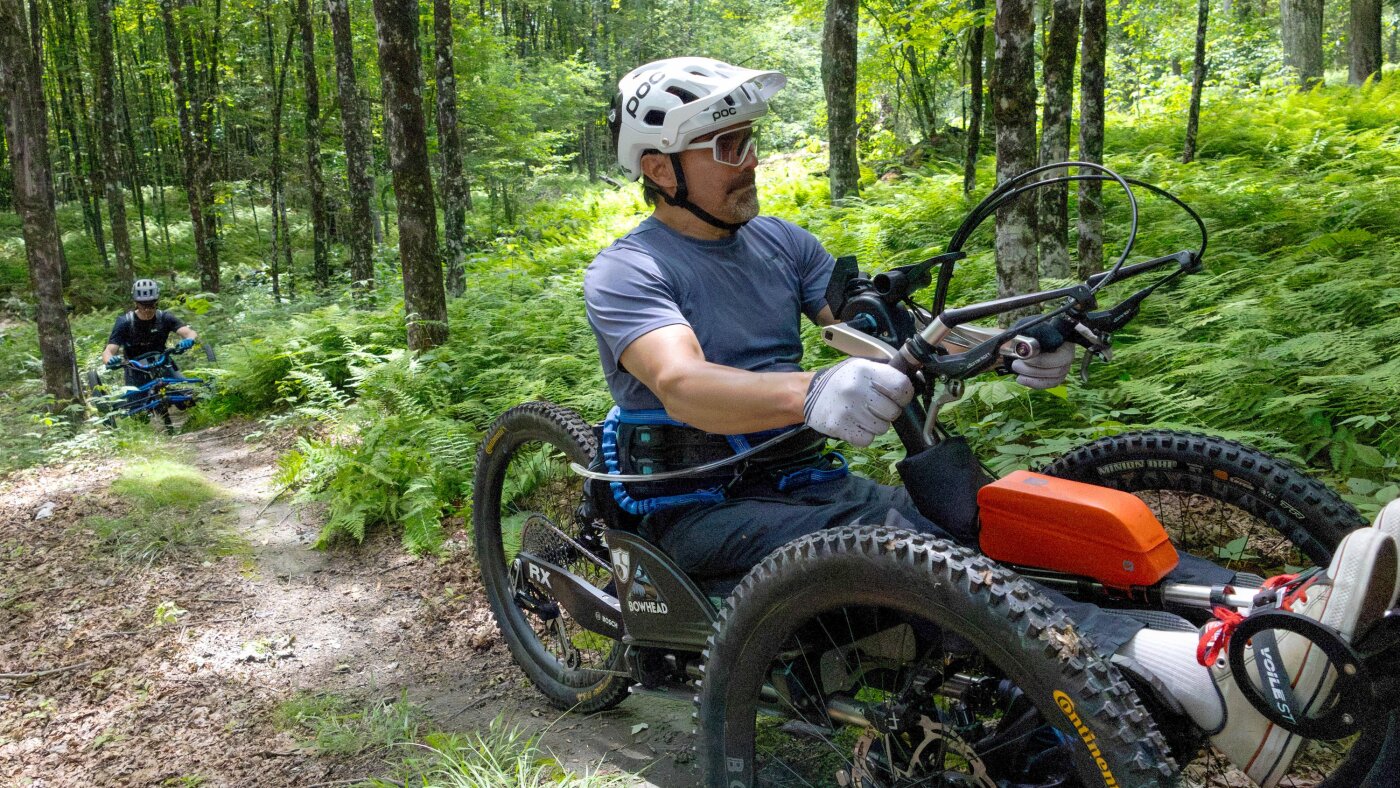
Louis Arevalo rides his adaptive mountain bike through the trails at Randolph Town Forest during an adaptive assessment on Thursday, June 25. Nick Bennette, with the Vermont Mountain Bike Association, rides behind.
Zoe McDonald/Vermont Public
hide caption
toggle caption
Zoe McDonald/Vermont Public
Mountain bike enthusiasts have been working for years on an ambitious 485-mile, multi-use trail called The Velomont that will span the length of the state.
When finished, the collaborative project will knit together existing trail networks, connect 27 communities and include huts and hostels for overnight stays.
New trail construction is finally ramping up after years spent on permits, plans and public input. And organizers say they want to make it as user-friendly as possible.
“For us, it’s not a huge lift to just be mindful when we’re trying to build trail or improve trail to think about the adaptive rider,” said Angus McCusker, the Velomont trail director with the nonprofit Vermont Huts and Trails.
McCusker is referring to the growing number of disabled athletes who mountain bike with specially designed equipment.
“The challenge,” said McCusker, “is we’re connecting to existing trail networks that were never intended for adaptive bikes. So, where we can, we’re trying to do adaptive assessments.”
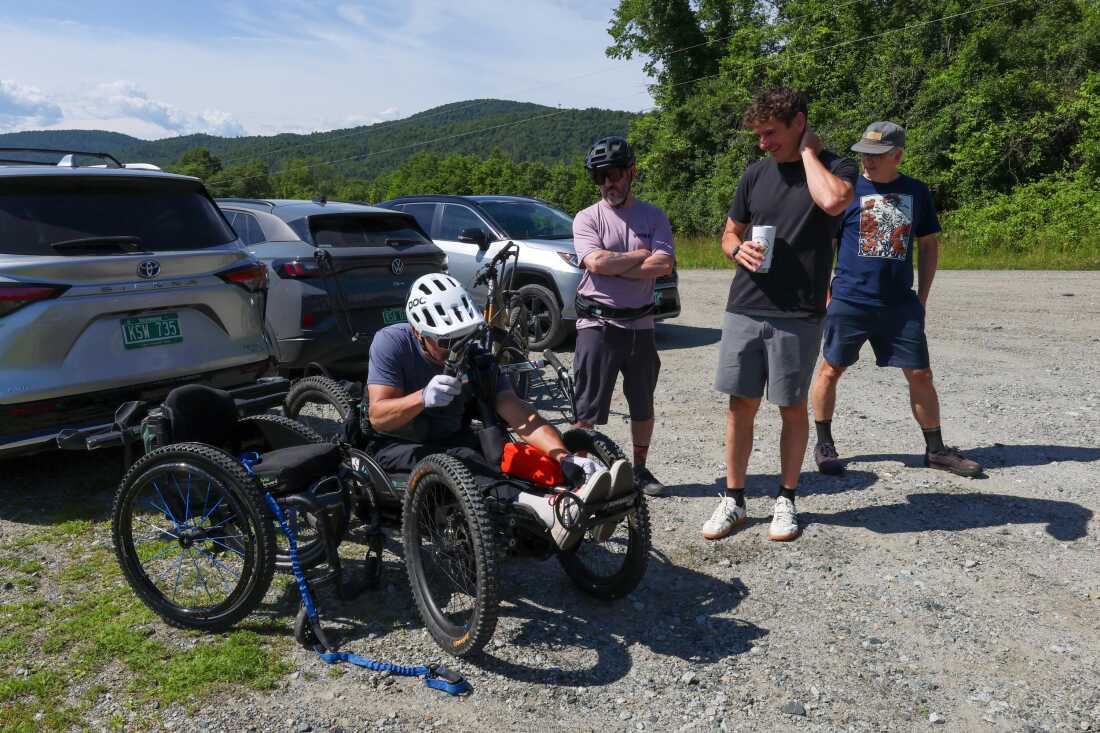
Louis Arevalo, left, straps into his adaptive mountain bike and chats with Jeff Dickson of the Vermont Mountain Bike Association, Angus McCusker with Vermont Huts and Trails, and volunteer Thatcher Hinman (all from left) ahead of a trail accessibility assessment in Randolph, Vermont, on Thursday, June 25, 2026.
Zoe McDonald/Vermont Public
hide caption
toggle caption
Zoe McDonald/Vermont Public
Louis Arevalo of Essex Junction is one of several adaptive athletes helping with that, most recently on some slightly overgrown single track trails in Randolph, a central Vermont town nestled along the eastern edge of the Green Mountains.
Arevalo pedals with his hands. He rides an electric powered recumbent-style three-wheeler that sits low to the ground. His service dog Azul chases along nearby.
“Once you realize what these bikes are capable (of) or this equipment actually opens up, it kind of blows your mind,” he said.
Arevalo was paralyzed in a skiing accident six years ago. Being able to get back on the trails has been a game changer, he said smiling.
“There’s a reason we live in the Green Mountain state. It’s because we like to get outside…you know, seeing the squirrels and chipmunks and birds… I mean, it’s life.”
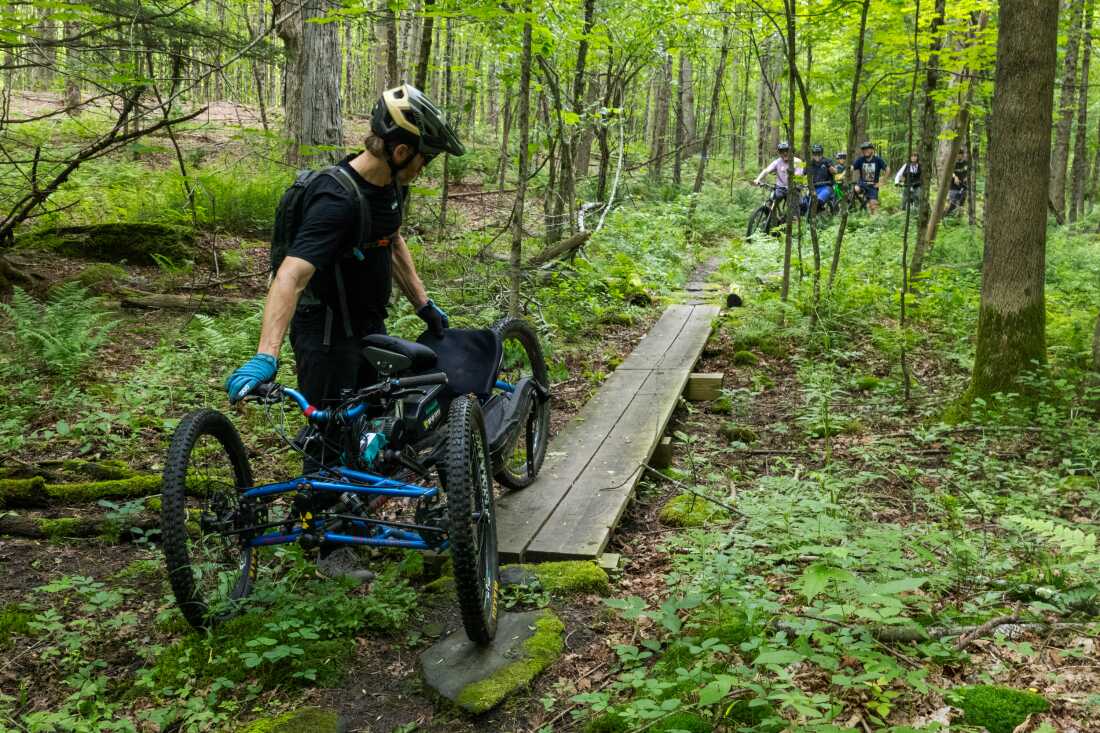
Nick Bennette, of the Vermont Mountain Biking Association, guides an adaptive bike over a narrow bridge, pointing out that other adaptive riders may have trouble getting across.
Zoe McDonald/Vermont Public
hide caption
toggle caption
Zoe McDonald/Vermont Public
But adaptive rigs like Arevalo’s are wider and heavier than regular mountain bikes, and not all trails are user-friendly.
Nick Bennette, who was testing a different type of adaptive bike, got hung up on several tight turns.
“It’s helpful to have different kinds of adaptive bikes on these tests because they all handle a little differently,” he said.
Bennette is executive director of the Vermont Mountain Bike Association, another nonprofit spearheading efforts around the Velomont. He and others involved in the assessment are taking detailed photos and notes on ways to make the trails more accessible.
“Just scalloping out a bit of material on the outside of that corner,” said Bennette, pointing to the area the bike got caught. “That will allow adaptive bikes to make that corner without really changing the way the trail rides.”
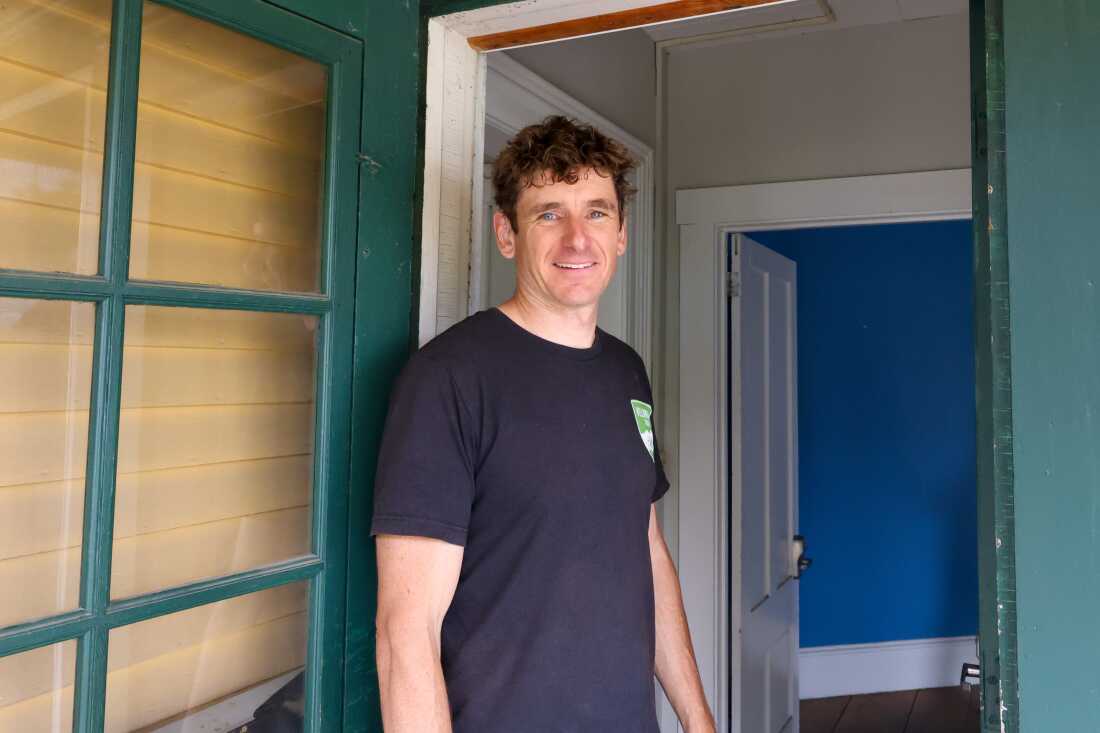
Angus McCusker with Vermont Huts and Trails is working to create accessible accommodations along the Velomont Trail, including a multi-group space in Randolph and a hut in Chittenden that has been outfitted with accessibility in mind.
Zoe McDonald/Vermont Public
hide caption
toggle caption
Zoe McDonald/Vermont Public
Contractors are also trying to reduce barriers at the trail’s overnight accommodations. This summer, contractors are building a new ADA accessible hostel in downtown Randolph.
And two remote huts along the trail will have locked sheds with off-road wheelchairs so bikers don’t have to haul their own.
At the Chittenden Brook Hut, McCusker highlighted a new ramp and wider driveway.
“So if you’re an adaptive rider, you can imagine rolling right up here and you can transfer to your chair that’s available here, and then roll down the ramp and go down to the fireplace, to the privy, to make your meal,” he said.
Louis Arevalo stayed at the hut last summer with other adaptive riders — his first camping trip since his accident.
“There was a babbling brook right there…and it was really refreshing to have easy access to a beautifully built hut that was easy to navigate, and then have these world-class trails right out the door,” he said. “And with these Velomont trails, I can actually plan a hut-to-hut trip with other people.”
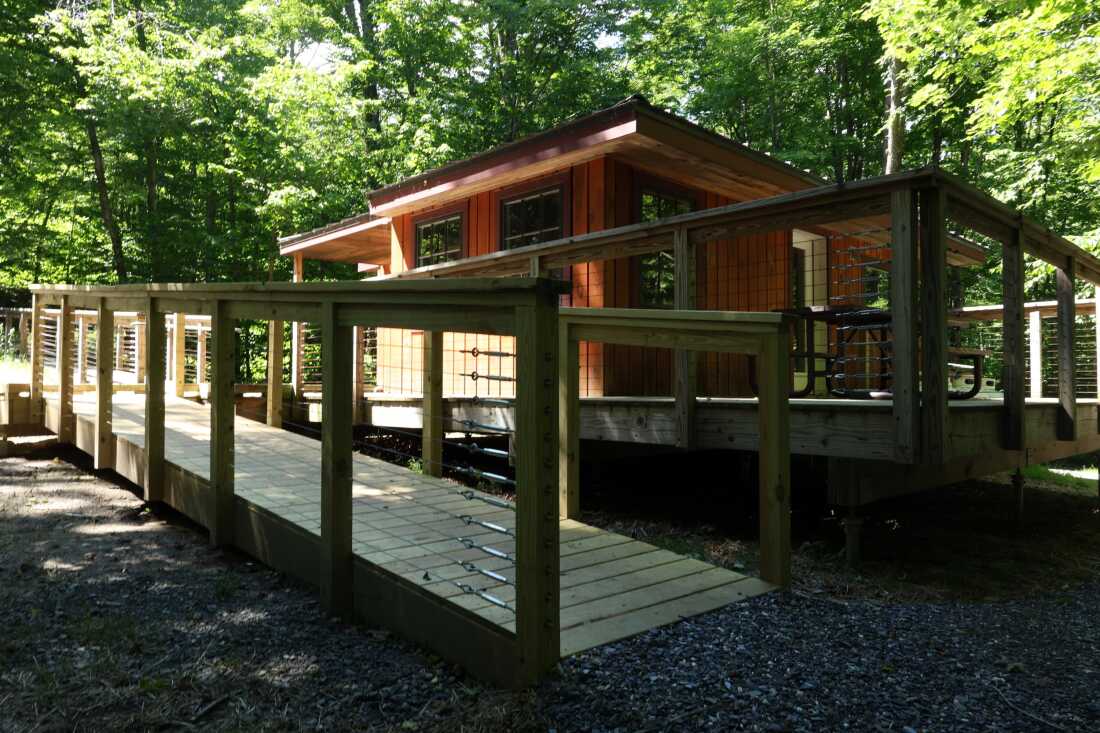
The Chittenden Brook Hut includes accessible ramps, storage for adaptive bikes and specialized off-road wheelchairs for visitors.
Zoe McDonald/Vermont Public
hide caption
toggle caption
Zoe McDonald/Vermont Public
Jeff Alexander is counting on it. He’s director of strategic partnerships with Vermont Adaptive Ski and Sports, a nonprofit that helps people with disabilities access outdoor recreation.
An economic impact analysis the group commissioned estimates their programming generated more than $10 million last year.
“So the adaptive community has money, they travel, they want to travel and they want to play with everybody,” Alexander said. “We just need to level the playing field so that everyone can play together.”
Powerball, Mega Millions jackpots: What to know in case you win
Here’s what to know in case you win the Powerball or Mega Millions jackpot.
Just the FAQs, USA TODAY
The Vermont Lottery offers several draw games for those willing to make a bet to win big.
Those who want to play can enter the MegaBucks and Lucky for Life games as well as the national Powerball and Mega Millions games. Vermont also partners with New Hampshire and Maine for the Tri-State Lottery, which includes the Mega Bucks, Gimme 5 as well as the Pick 3 and Pick 4.
Drawings are held at regular days and times, check the end of this story to see the schedule.
Here’s a look at July 8, 2026, results for each game:
Winning Powerball numbers from July 8 drawing
12-29-37-43-55, Powerball: 18, Power Play: 4
Check Powerball payouts and previous drawings here.
Winning Gimme 5 numbers from July 8 drawing
01-05-23-36-38
Check Gimme 5 payouts and previous drawings here.
Winning Pick 3 numbers from July 8 drawing
Day: 0-1-3
Evening: 2-4-0
Check Pick 3 payouts and previous drawings here.
Winning Pick 4 numbers from July 8 drawing
Day: 3-9-5-9
Evening: 9-2-0-9
Check Pick 4 payouts and previous drawings here.
Winning Megabucks Plus numbers from July 8 drawing
12-15-23-27-40, Megaball: 03
Check Megabucks Plus payouts and previous drawings here.
Winning Millionaire for Life numbers from July 8 drawing
16-18-43-48-50, Bonus: 01
Check Millionaire for Life payouts and previous drawings here.
Feeling lucky? Explore the latest lottery news & results
Are you a winner? Here’s how to claim your lottery prize
For Vermont Lottery prizes up to $499, winners can claim their prize at any authorized Vermont Lottery retailer or at the Vermont Lottery Headquarters by presenting the signed winning ticket for validation. Prizes between $500 and $5,000 can be claimed at any M&T Bank location in Vermont during the Vermont Lottery Office’s business hours, which are 8a.m.-4p.m. Monday through Friday, except state holidays.
For prizes over $5,000, claims must be made in person at the Vermont Lottery headquarters. In addition to signing your ticket, you will need to bring a government-issued photo ID, and a completed claim form.
All prize claims must be submitted within one year of the drawing date. For more information on prize claims or to download a Vermont Lottery Claim Form, visit the Vermont Lottery’s FAQ page or contact their customer service line at (802) 479-5686.
Vermont Lottery Headquarters
1311 US Route 302, Suite 100
Barre, VT
05641
When are the Vermont Lottery drawings held?
- Powerball: 10:59 p.m. Monday, Wednesday, and Saturday.
- Mega Millions: 11 p.m. Tuesday and Friday.
- Gimme 5: 6:55 p.m. Monday through Friday.
- Lucky for Life: 10:38 p.m. daily.
- Pick 3 Day: 1:10 p.m. daily.
- Pick 4 Day: 1:10 p.m. daily.
- Pick 3 Evening: 6:55 p.m. daily.
- Pick 4 Evening: 6:55 p.m. daily.
- Megabucks: 7:59 p.m. Monday, Wednesday and Saturday.
- Millionaire for Life: 11:15 p.m. daily
What is Vermont Lottery Second Chance?
Vermont’s 2nd Chance lottery lets players enter eligible non-winning instant scratch tickets into a drawing to win cash and/or other prizes. Players must register through the state’s official Lottery website or app. The drawings are held quarterly or are part of an additional promotion, and are done at Pollard Banknote Limited in Winnipeg, MB, Canada.
This results page was generated automatically using information from TinBu and a template written and reviewed by a Vermont editor. You can send feedback using this form.
-

 Movie Reviews11 minutes ago
‘Gail Daughtry and the Celebrity Sex Pass’ Review: We’re Off to Hump the Wizard
-

 World19 minutes ago
Backlash on ethanol-blend fuel intensifies in India, puts carmakers in the dock
-
Politics29 minutes ago
Crews Drape Tarp Over White House in Latest Trump Restoration
-

 Health44 minutes ago
GLP-1 Users’ Guide to Protein Snacks: Here’s What a Dietitian Actually Recommends
-
 Lifestyle59 minutes ago
‘The Invite’ is a marriage comedy with sex and heart
-

 Technology1 hour ago
I spent a week using the Trump phone — it sucks
-

 World1 hour ago
With US unleashing attacks, Iranian official threatens that the Islamic Republic will deliver a ‘hard slap’
-

 Politics1 hour ago
WATCH: Trump’s Energy chief reveals what escalating Iran tensions could mean for gas prices

