Vermont
High gas prices hit Vermonters at the pump, store and heating bill – VTDigger


More than a month into the Iran war, Vermonters are facing the strain of ballooning fuel costs as commuters wince at high prices at the pump.
“It’s painful to the pocketbook,” said David Armstrong, who works in the construction industry, as he filled his truck at a gas station in Burlington on Friday.
Armstrong commutes about 40 miles a day for work, he said, and it cost him over $123 to fill his tank, even with a discount program. That’s a steep increase from the approximately $90 he says he was paying prior to the Iran war.
Fuel costs have risen dramatically across the U.S., but in Vermont, where motorists in more rural communities must travel long distances to get to jobs or to buy essentials, prices for gas and diesel have hit especially hard.
Average gas prices in Vermont have risen to $3.99 per gallon as of April 2, and prices in northern counties like Orleans, Essex, Franklin and Grand Isle have all eclipsed $4, according to AAA’s gas price tracker.
Vermont is just below the national average of $4.08 per gallon, but compared to the rest of New England, only Connecticut has a higher average price.
American households have paid $8.4 billion more for gasoline over the past month compared to prices before the start of the war on Iran, according to analysis by congressional Democrats on the Joint Economic Committee. In response to U.S. and Israeli strikes against Iran, the country closed a vital naval passage between the Persian Gulf and the Gulf of Oman called the Strait of Hormuz, effectively cutting off much of the Middle East’s supply of crude oil and natural gas from the global market.
The average household in Chittenden County uses 575 gallons of gasoline annually, which, if calculated for a year, would cost around $2,300 if Friday’s gas prices went unchanged, according to data from the Chittenden County Regional Planning Commission. Using the approximate cost of gas a year ago, a full year’s worth would cost $1,800, meaning that Chittenden County households would see an increase of $42 a month and around a $500 bump for the year.
Vermonters, who drive more and have fewer alternatives to driving compared to most states, are more exposed to price changes, according to Greg Rowangould, director of the Transportation Research Center and associate professor in the Department of Civil and Environmental Engineering at the University of Vermont.
The Transportation Research Center studied how Vermonters reacted to the last major increase in fuel prices back in 2022 at the start of the war in Ukraine. It found that people across the spectrum, from remote rural communities to Burlington, were forced to cut down on travel. Respondents said they took fewer trips, favored closer destinations and opted to chain tasks together rather than take multiple trips for essentials.
Some drivers decided to cut back on non-essential travel, too, choosing to watch Netflix rather than going on a night out, according to Rowangould.
“There are things that people do to try to avoid the costs,” Rowangould said. “But, of course, you can’t avoid all of it.”
“We’re definitely driving less now,” Dennis DeSilvey said as he and his wife, Kathy, filled their hybrid car on Friday. After a career as a doctor, DeSilvey has to watch his budget much more closely since retiring.
Meanwhile, Sarah McNamara, who works as a substitute teacher in Burlington, said she’s considering switching to commuting by bike or bus if the high prices stick around. She said her husband, who commutes to the Champlain Islands, has started talking with coworkers about carpooling to save money.
“It’s definitely going to be a new budget item, in a different category,” McNamara said of the fuel prices.
Fuel cost increases will also hit homes using heating oil, propane and kerosene, according to Vermont Department of Public Service data.
However, Vermont’s electric utilities mainly use long-term contracts with less exposure to sudden price spikes. New England’s electric grid largely relies on natural gas, nuclear, hydro and other renewable fuel sources, avoiding an immediate impact from global crude prices, according to Philip Picotte, a utilities economic analyst at the Vermont Department of Public Service.
Disruptions in global supply — especially to liquified natural gas — will have some effect on New England’s electric prices in the medium-term, according to Picotte.
Diesel fuel in Vermont has now reached $5.80 per gallon, outpacing the national average of $5.51, according to AAA, which could hit long-haul and delivery trucks especially hard. Diesel is also a main fuel source in dairy and other farming operations throughout the state.
Fuel cost increases absorbed by local businesses would eventually be passed down to the consumer level, explained Ryan Bellavance, the president of Bellavance Trucking, which operates a fleet of nearly 100 trucks based out of Barre. Bellavance transports everything from construction materials to refrigerated food items, so increased costs could be felt across a wide range of products.
Bellavance explained that fuel is already one of their largest expenses. With the recent price increase, it now might be their largest. Compared to the start of the year, prices have increased 31 cents per mile. Multiplied across their operation, that increase quickly becomes problematic.
“It’s gonna be fine until the people stop buying, you know?” he said. “And then everything comes to a halt.”



Powerball, Mega Millions jackpots: What to know in case you win
Here’s what to know in case you win the Powerball or Mega Millions jackpot.
Just the FAQs, USA TODAY
The Vermont Lottery offers several draw games for those willing to make a bet to win big.
Those who want to play can enter the MegaBucks and Lucky for Life games as well as the national Powerball and Mega Millions games. Vermont also partners with New Hampshire and Maine for the Tri-State Lottery, which includes the Mega Bucks, Gimme 5 as well as the Pick 3 and Pick 4.
Drawings are held at regular days and times, check the end of this story to see the schedule.
Here’s a look at July 9, 2026, results for each game:
Winning Gimme 5 numbers from July 9 drawing
08-15-26-27-30
Check Gimme 5 payouts and previous drawings here.
Winning Pick 3 numbers from July 9 drawing
Day: 1-5-4
Evening: 6-2-8
Check Pick 3 payouts and previous drawings here.
Winning Pick 4 numbers from July 9 drawing
Day: 5-0-2-1
Evening: 2-6-7-6
Check Pick 4 payouts and previous drawings here.
Winning Millionaire for Life numbers from July 9 drawing
02-15-22-54-58, Bonus: 04
Check Millionaire for Life payouts and previous drawings here.
Feeling lucky? Explore the latest lottery news & results
Are you a winner? Here’s how to claim your lottery prize
For Vermont Lottery prizes up to $499, winners can claim their prize at any authorized Vermont Lottery retailer or at the Vermont Lottery Headquarters by presenting the signed winning ticket for validation. Prizes between $500 and $5,000 can be claimed at any M&T Bank location in Vermont during the Vermont Lottery Office’s business hours, which are 8a.m.-4p.m. Monday through Friday, except state holidays.
For prizes over $5,000, claims must be made in person at the Vermont Lottery headquarters. In addition to signing your ticket, you will need to bring a government-issued photo ID, and a completed claim form.
All prize claims must be submitted within one year of the drawing date. For more information on prize claims or to download a Vermont Lottery Claim Form, visit the Vermont Lottery’s FAQ page or contact their customer service line at (802) 479-5686.
Vermont Lottery Headquarters
1311 US Route 302, Suite 100
Barre, VT
05641
When are the Vermont Lottery drawings held?
- Powerball: 10:59 p.m. Monday, Wednesday, and Saturday.
- Mega Millions: 11 p.m. Tuesday and Friday.
- Gimme 5: 6:55 p.m. Monday through Friday.
- Lucky for Life: 10:38 p.m. daily.
- Pick 3 Day: 1:10 p.m. daily.
- Pick 4 Day: 1:10 p.m. daily.
- Pick 3 Evening: 6:55 p.m. daily.
- Pick 4 Evening: 6:55 p.m. daily.
- Megabucks: 7:59 p.m. Monday, Wednesday and Saturday.
- Millionaire for Life: 11:15 p.m. daily
What is Vermont Lottery Second Chance?
Vermont’s 2nd Chance lottery lets players enter eligible non-winning instant scratch tickets into a drawing to win cash and/or other prizes. Players must register through the state’s official Lottery website or app. The drawings are held quarterly or are part of an additional promotion, and are done at Pollard Banknote Limited in Winnipeg, MB, Canada.
This results page was generated automatically using information from TinBu and a template written and reviewed by a Vermont editor. You can send feedback using this form.
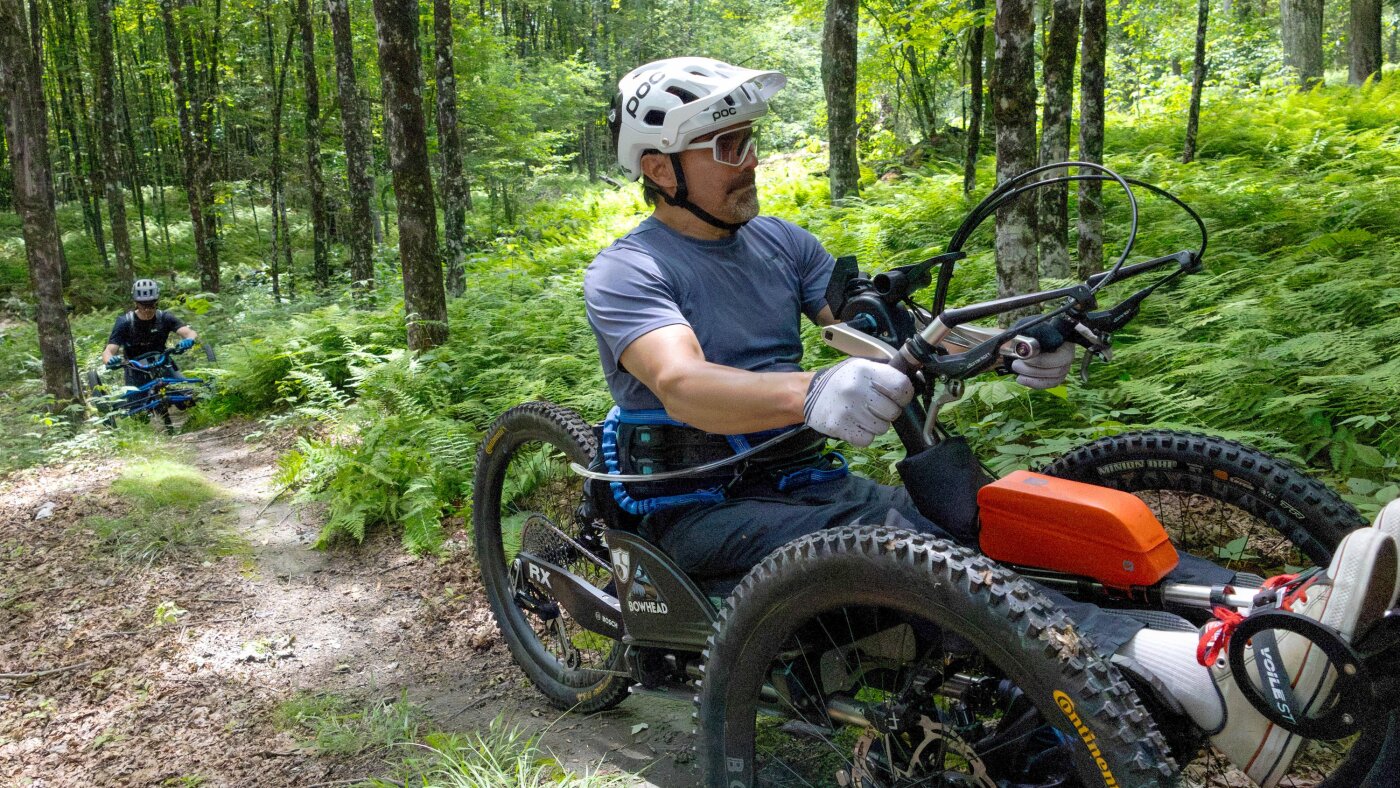
Louis Arevalo rides his adaptive mountain bike through the trails at Randolph Town Forest during an adaptive assessment on Thursday, June 25. Nick Bennette, with the Vermont Mountain Bike Association, rides behind.
Zoe McDonald/Vermont Public
hide caption
toggle caption
Zoe McDonald/Vermont Public
Mountain bike enthusiasts have been working for years on an ambitious 485-mile, multi-use trail called The Velomont that will span the length of the state.
When finished, the collaborative project will knit together existing trail networks, connect 27 communities and include huts and hostels for overnight stays.
New trail construction is finally ramping up after years spent on permits, plans and public input. And organizers say they want to make it as user-friendly as possible.
“For us, it’s not a huge lift to just be mindful when we’re trying to build trail or improve trail to think about the adaptive rider,” said Angus McCusker, the Velomont trail director with the nonprofit Vermont Huts and Trails.
McCusker is referring to the growing number of disabled athletes who mountain bike with specially designed equipment.
“The challenge,” said McCusker, “is we’re connecting to existing trail networks that were never intended for adaptive bikes. So, where we can, we’re trying to do adaptive assessments.”
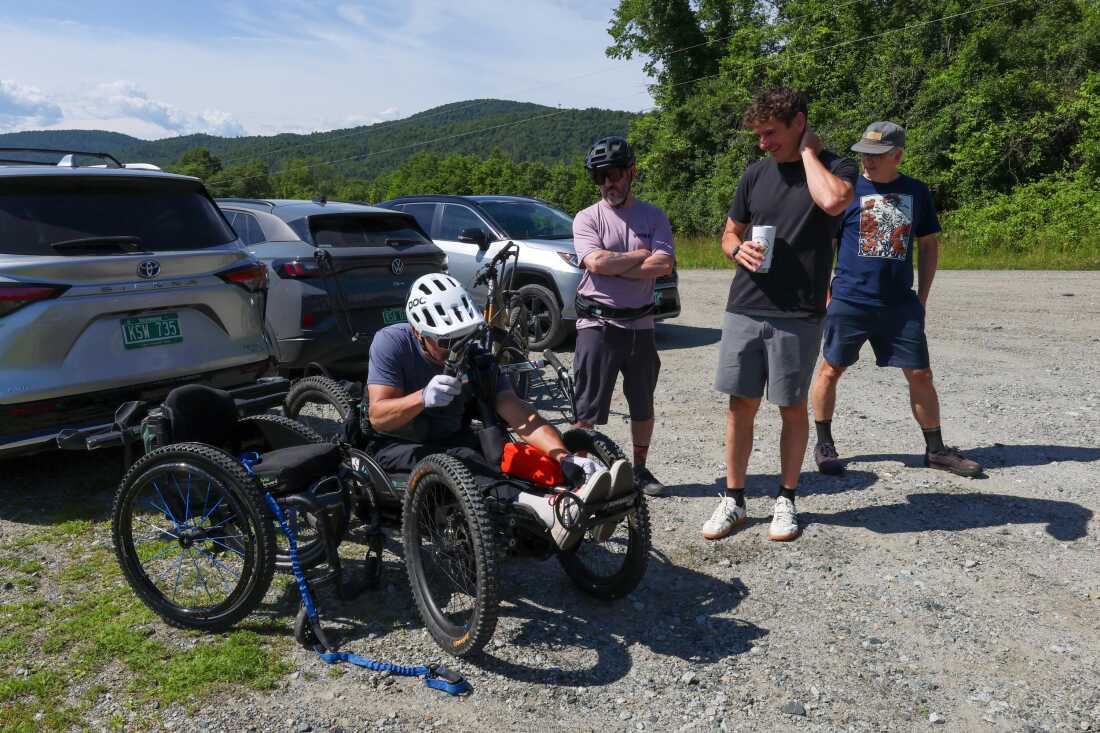
Louis Arevalo, left, straps into his adaptive mountain bike and chats with Jeff Dickson of the Vermont Mountain Bike Association, Angus McCusker with Vermont Huts and Trails, and volunteer Thatcher Hinman (all from left) ahead of a trail accessibility assessment in Randolph, Vermont, on Thursday, June 25, 2026.
Zoe McDonald/Vermont Public
hide caption
toggle caption
Zoe McDonald/Vermont Public
Louis Arevalo of Essex Junction is one of several adaptive athletes helping with that, most recently on some slightly overgrown single track trails in Randolph, a central Vermont town nestled along the eastern edge of the Green Mountains.
Arevalo pedals with his hands. He rides an electric powered recumbent-style three-wheeler that sits low to the ground. His service dog Azul chases along nearby.
“Once you realize what these bikes are capable (of) or this equipment actually opens up, it kind of blows your mind,” he said.
Arevalo was paralyzed in a skiing accident six years ago. Being able to get back on the trails has been a game changer, he said smiling.
“There’s a reason we live in the Green Mountain state. It’s because we like to get outside…you know, seeing the squirrels and chipmunks and birds… I mean, it’s life.”
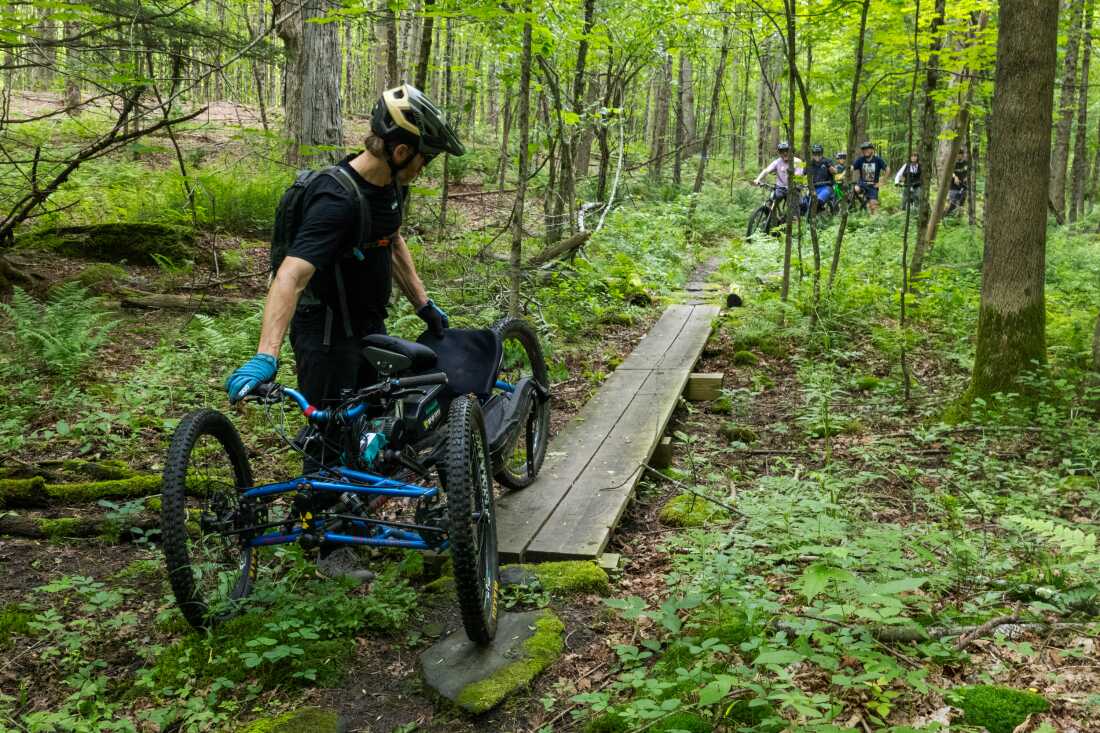
Nick Bennette, of the Vermont Mountain Biking Association, guides an adaptive bike over a narrow bridge, pointing out that other adaptive riders may have trouble getting across.
Zoe McDonald/Vermont Public
hide caption
toggle caption
Zoe McDonald/Vermont Public
But adaptive rigs like Arevalo’s are wider and heavier than regular mountain bikes, and not all trails are user-friendly.
Nick Bennette, who was testing a different type of adaptive bike, got hung up on several tight turns.
“It’s helpful to have different kinds of adaptive bikes on these tests because they all handle a little differently,” he said.
Bennette is executive director of the Vermont Mountain Bike Association, another nonprofit spearheading efforts around the Velomont. He and others involved in the assessment are taking detailed photos and notes on ways to make the trails more accessible.
“Just scalloping out a bit of material on the outside of that corner,” said Bennette, pointing to the area the bike got caught. “That will allow adaptive bikes to make that corner without really changing the way the trail rides.”
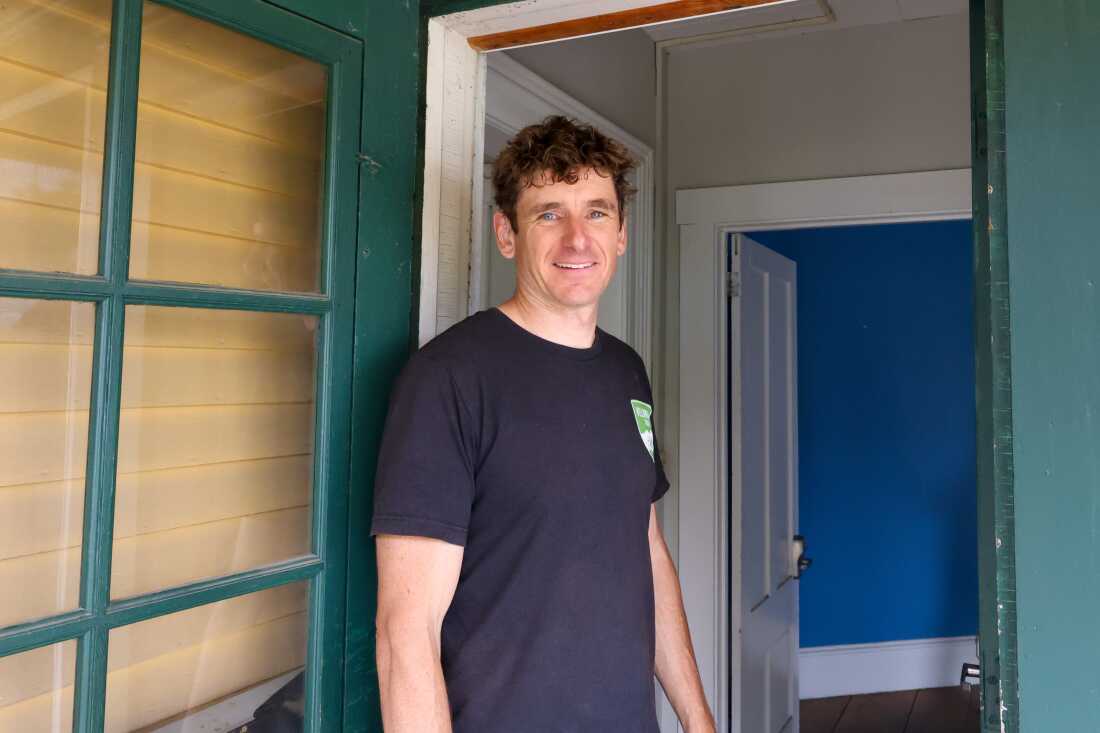
Angus McCusker with Vermont Huts and Trails is working to create accessible accommodations along the Velomont Trail, including a multi-group space in Randolph and a hut in Chittenden that has been outfitted with accessibility in mind.
Zoe McDonald/Vermont Public
hide caption
toggle caption
Zoe McDonald/Vermont Public
Contractors are also trying to reduce barriers at the trail’s overnight accommodations. This summer, contractors are building a new ADA accessible hostel in downtown Randolph.
And two remote huts along the trail will have locked sheds with off-road wheelchairs so bikers don’t have to haul their own.
At the Chittenden Brook Hut, McCusker highlighted a new ramp and wider driveway.
“So if you’re an adaptive rider, you can imagine rolling right up here and you can transfer to your chair that’s available here, and then roll down the ramp and go down to the fireplace, to the privy, to make your meal,” he said.
Louis Arevalo stayed at the hut last summer with other adaptive riders — his first camping trip since his accident.
“There was a babbling brook right there…and it was really refreshing to have easy access to a beautifully built hut that was easy to navigate, and then have these world-class trails right out the door,” he said. “And with these Velomont trails, I can actually plan a hut-to-hut trip with other people.”
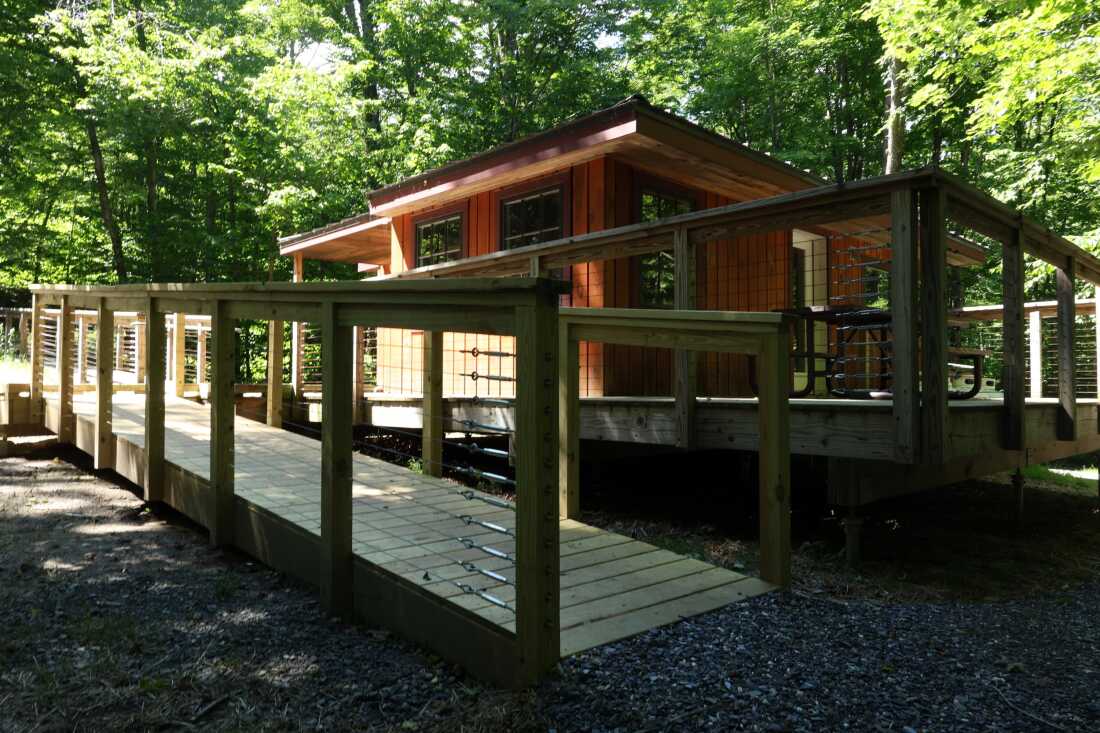
The Chittenden Brook Hut includes accessible ramps, storage for adaptive bikes and specialized off-road wheelchairs for visitors.
Zoe McDonald/Vermont Public
hide caption
toggle caption
Zoe McDonald/Vermont Public
Jeff Alexander is counting on it. He’s director of strategic partnerships with Vermont Adaptive Ski and Sports, a nonprofit that helps people with disabilities access outdoor recreation.
An economic impact analysis the group commissioned estimates their programming generated more than $10 million last year.
“So the adaptive community has money, they travel, they want to travel and they want to play with everybody,” Alexander said. “We just need to level the playing field so that everyone can play together.”
Powerball, Mega Millions jackpots: What to know in case you win
Here’s what to know in case you win the Powerball or Mega Millions jackpot.
Just the FAQs, USA TODAY
The Vermont Lottery offers several draw games for those willing to make a bet to win big.
Those who want to play can enter the MegaBucks and Lucky for Life games as well as the national Powerball and Mega Millions games. Vermont also partners with New Hampshire and Maine for the Tri-State Lottery, which includes the Mega Bucks, Gimme 5 as well as the Pick 3 and Pick 4.
Drawings are held at regular days and times, check the end of this story to see the schedule.
Here’s a look at July 8, 2026, results for each game:
Winning Powerball numbers from July 8 drawing
12-29-37-43-55, Powerball: 18, Power Play: 4
Check Powerball payouts and previous drawings here.
Winning Gimme 5 numbers from July 8 drawing
01-05-23-36-38
Check Gimme 5 payouts and previous drawings here.
Winning Pick 3 numbers from July 8 drawing
Day: 0-1-3
Evening: 2-4-0
Check Pick 3 payouts and previous drawings here.
Winning Pick 4 numbers from July 8 drawing
Day: 3-9-5-9
Evening: 9-2-0-9
Check Pick 4 payouts and previous drawings here.
Winning Megabucks Plus numbers from July 8 drawing
12-15-23-27-40, Megaball: 03
Check Megabucks Plus payouts and previous drawings here.
Winning Millionaire for Life numbers from July 8 drawing
16-18-43-48-50, Bonus: 01
Check Millionaire for Life payouts and previous drawings here.
Feeling lucky? Explore the latest lottery news & results
Are you a winner? Here’s how to claim your lottery prize
For Vermont Lottery prizes up to $499, winners can claim their prize at any authorized Vermont Lottery retailer or at the Vermont Lottery Headquarters by presenting the signed winning ticket for validation. Prizes between $500 and $5,000 can be claimed at any M&T Bank location in Vermont during the Vermont Lottery Office’s business hours, which are 8a.m.-4p.m. Monday through Friday, except state holidays.
For prizes over $5,000, claims must be made in person at the Vermont Lottery headquarters. In addition to signing your ticket, you will need to bring a government-issued photo ID, and a completed claim form.
All prize claims must be submitted within one year of the drawing date. For more information on prize claims or to download a Vermont Lottery Claim Form, visit the Vermont Lottery’s FAQ page or contact their customer service line at (802) 479-5686.
Vermont Lottery Headquarters
1311 US Route 302, Suite 100
Barre, VT
05641
When are the Vermont Lottery drawings held?
- Powerball: 10:59 p.m. Monday, Wednesday, and Saturday.
- Mega Millions: 11 p.m. Tuesday and Friday.
- Gimme 5: 6:55 p.m. Monday through Friday.
- Lucky for Life: 10:38 p.m. daily.
- Pick 3 Day: 1:10 p.m. daily.
- Pick 4 Day: 1:10 p.m. daily.
- Pick 3 Evening: 6:55 p.m. daily.
- Pick 4 Evening: 6:55 p.m. daily.
- Megabucks: 7:59 p.m. Monday, Wednesday and Saturday.
- Millionaire for Life: 11:15 p.m. daily
What is Vermont Lottery Second Chance?
Vermont’s 2nd Chance lottery lets players enter eligible non-winning instant scratch tickets into a drawing to win cash and/or other prizes. Players must register through the state’s official Lottery website or app. The drawings are held quarterly or are part of an additional promotion, and are done at Pollard Banknote Limited in Winnipeg, MB, Canada.
This results page was generated automatically using information from TinBu and a template written and reviewed by a Vermont editor. You can send feedback using this form.
-

 Technology11 minutes ago
I spent a week using the Trump phone — it sucks
-

 World14 minutes ago
With US unleashing attacks, Iranian official threatens that the Islamic Republic will deliver a ‘hard slap’
-

 Politics19 minutes ago
WATCH: Trump’s Energy chief reveals what escalating Iran tensions could mean for gas prices
-

 Health26 minutes ago
Coffee may have powerful effect on liver health, major study suggests
-

 Sports29 minutes ago
Oba Femi vs Brock Lesnar at SummerSlam is a ‘generational matchup,’ WWE legend JBL says
-
 Business41 minutes ago
Billionaire exodus? California drew 10 times more venture capital than any other state this year
-
 Entertainment44 minutes ago
Disney Channel maximalism to pop-star glam: What fans wore to Hilary Duff’s L.A. show
-
 Lifestyle49 minutes ago
L.A. Affairs: It’s hot when a man drives to me. But would this new guy make the trek from the Valley?

