Vermont
Capitol Recap: Will lawmakers draw new district lines now, or later?

Since the beginning of the 2025 legislative session, lawmakers in both the House and Senate have been working on their counterproposal to Gov. Phil Scott’s sweeping plan to overhaul public education.
But it’s become clear that the two chambers are moving in very different directions. And disagreement over how many school districts Vermont should have — and how quickly that redistricting process should happen — could squelch any grand bargains over education reform this year.
House Democrats are preparing to advance legislation that would set new parameters for school district sizes, including a minimum enrollment of 4,000 students. But instead of drawing district boundaries themselves, they plan to ask a new subcommittee on the Commission of the Future of Public Education to take the summer and fall to propose three maps, which lawmakers would take up in the next legislative session.
The House’s slower and more deliberative approach in H.454 has won the support of major public education advocacy organizations, including the Vermont-NEA. But it has frustrated the governor — and the chair of the Senate’s education committee, who has already drafted an alternate redistricting proposal.
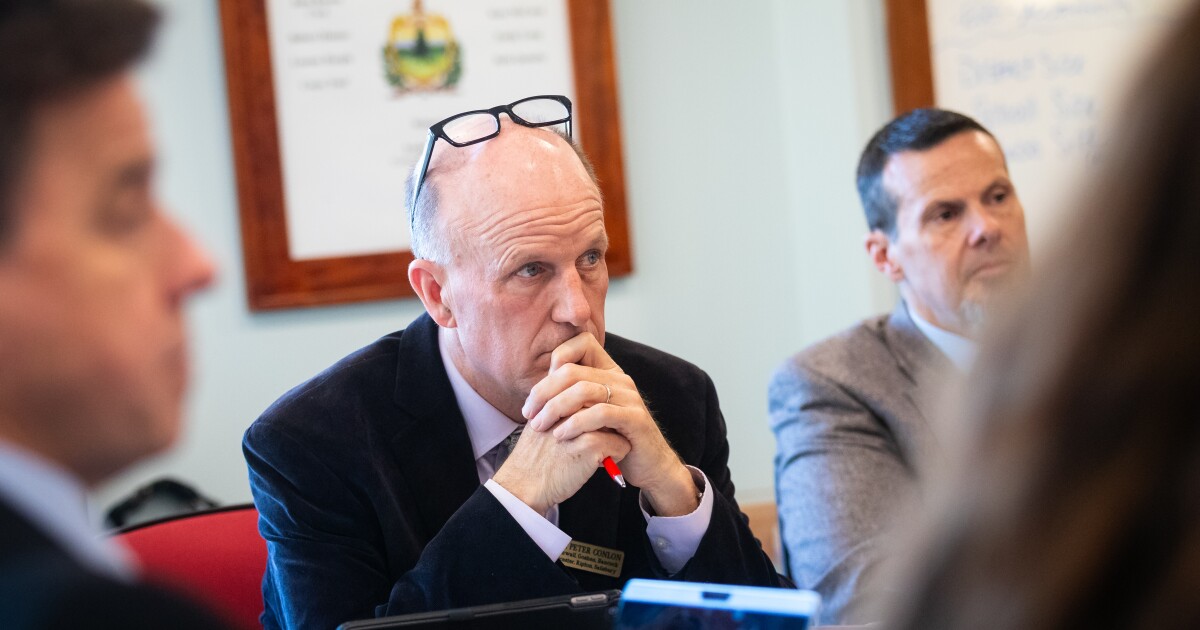
At a press conference Thursday, House Committee on Education Chair Peter Conlon defended his chamber’s approach. While it was “tempting” to act more hastily, he argued, “the chance of unintended consequences that would just have to be corrected and changed in the next session is too great.”
“We need people with the time and experience to assure, for example, that every Vermont student has access to a career and technical education center and that a district line doesn’t inadvertently stick a mountain range in the way,” the Cornwall Democrat said.
The Senate has not yet technically advanced legislation, and is waiting for the House to send over their bill. But Sen. Seth Bongartz, who chairs the Senate education committee, has already drafted a map which would carve the state into nine large governance structures: six supervisory districts and three supervisory unions. Supervisory unions act as umbrella school districts in Vermont, with one centralized administrative office and superintendent overseeing independent districts with their own school boards.
Brian Stevenson
/
Vermont Public
The Bennington Democrat said he’s open to revisions to his map — but bullish on a timeline that redraws district lines this year.
“Not getting that done this year does set the process back significantly, and that’s concerning,” Bongartz said.
Instead of operating public schools, some districts in Vermont currently offer families vouchers, or tuition, which can be used at the public or private school of their choice. Because a school district cannot offer vouchers and operate a school, choice has historically presented an obstacle to regional consolidation. Bongartz’s somewhat complicated map is an attempt to solve this problem of choice in Vermont’s complicated educational landscape — mostly by much more lightly consolidating areas in which choice districts exist in large numbers.
Bongartz’s proposal would somewhat limit choice, and eliminate it entirely in some places, including Grand Isle County. But his plan is largely crafted to preserve much of the status-quo, particularly in the towns that have traditionally sent their students to the state’s four historic academies — Burr and Burton Academy, St. Johnsbury Academy, Thetford Academy and Lyndon Institute.
Bongartz, who once sat on the board of trustees at Burr and Burton, said his map sought to maintain tuitioning practices where they were “integral to the delivery system of education in Vermont.”
At least one key constituency has made clear they do not consider the Bongartz map to be the blueprint to a grand bargain.
“We are not interested in gerrymandering to preserve vouchers,” Darren Allen, a spokesperson for the Vermont-NEA, wrote in a text.
The House’s proposal, for now, is silent on where vouchers would continue to exist. Conlon said in an interview that he wanted to preserve tuitioning where existing private schools are basically the only option — including around the historic academies. But the choice debate, he said, should be kept for next year, when he thinks lawmakers should review their redistricting options.
Scott, meanwhile, says he wants new district boundaries now, not next year.
“We were elected to make tough decisions. It’s our problem to solve and our time to solve it,” he said in a statement Thursday, adding that he would call lawmakers back to Montpelier if he didn’t think their work was done.
“I will not support adjourning this session without a bill to transition to a new funding system, establish a new governance structure that unlocks transformation, and includes a specific implementation timeline,” Scott wrote.
The Vermont Republican Party is already attempting to capitalize on the moment to recruit candidates for 2026. In a press release Friday, Vermont GOP chair Paul Dame decried House Democrats’ “surrender on education reform.”
“If Democrats continually refuse to lead on this issue, Republicans will pick up the slack,” he wrote.



MONTPELIER — After weeks of false starts and discarded plans, the House Education Committee passed an education reform proposal Thursday. But it’s a far cry from what was envisioned in last year’s landmark Act 73, and will almost certainly face political hurdles in the House, Senate and from Gov. Phil Scott’s administration.
The proposal, H.955, which passed with only Democratic support, would create study committees in seven areas of the state to facilitate voluntary mergers of the state’s 119 school districts. Rep. Peter Conlon, D-Cornwall, the House Education Committee chair, praised the committee’s work before calling the vote.
“For the field and school districts and Vermonters out there, we are respecting — I think, very much so — the different ways we deliver education in Vermont,” he said. “We are respecting local voice. We are respecting an aversion to forced mergers at the state level.”
The proposal marks a compromise after weeks of political gridlock among committee members over perennial issues like school choice and preserving local voice in rural communities.
Education reform has consumed much of the political oxygen in the Statehouse this year and last. Gov. Phil Scott, buoyed by Republican electoral gains in the November 2024 election, ushered in plans to consolidate Vermont’s 119 school districts and reform the state’s education finance system.
Leaders in both parties have endorsed plans for reform, citing the ever increasing cost of education and the need to expand access to educational opportunities.
But Thursday’s committee plan is out of step with the more ambitious ideas floated by Scott, his Agency of Education and even Conlon himself, which would have mandated school district mergers. Conlon’s initial plan in February would have forced the merger of the state’s 119 school districts into 27, each with student populations between 2,000 and 4,000.
Yet after several weeks of deadlock, the committee pivoted to a proposal with voluntary mergers. Conlon’s plan for forced mergers “didn’t get a lot of love” from colleagues or constituents, he said.
The Senate, meanwhile, continues to hammer away at the details of their own proposal, which doesn’t look likely to follow Scott’s vision for education reform either.
The House proposal has a long road ahead of it, and will likely change significantly as it proceeds through the House and Senate. Lawmakers in both chambers will scrutinize the plan’s emphasis on voluntary mergers, and question whether the plan could find the types of savings the governor has called for.
“For me, there are misses in this,” Rep. Joshua Dobrovitch, R-Williamstown, said Thursday. “I feel like we’re not actually providing the relief that our taxpayers want in a timely fashion.”
The bill will next be taken up by the House ways and means and appropriations committees.
To merge or not to merge
The House’s proposal borrows from the school redistricting task force, the body created last year to draw up school consolidation maps. That group’s recommendation last fall bucked calls for forced mergers and instead suggested new regional entities that would share services among member school districts.
The proposal advanced Thursday would overlay seven cooperative education service agencies, or CESAs, over the state’s 119 school districts and 52 governing units.
Those regional entities, already in use in southeastern Vermont, would then facilitate the sharing of services in special education, professional development, human resources and other areas for member school districts.
Grants from the Vermont Agency of Education would help stand up those agencies, and they would be managed by a board of directors appointed by member supervisory unions and supervisory districts.
Study committees would then be formed within each CESA, which would work towards a voluntary merger process for member districts. All member school districts would be required to participate in the committees.
The study committees’ work would run through 2027 and 2028. Residents in school districts queued up by the study committees for a merger would then vote on whether to merge.
The law does offer preliminary guidance for how study committees could consider merging districts.
One proposal in the legislation, for example, would have the Addison Central, Addison Northwest and Lincoln school districts merge with the Mount Abraham Unified School District.
Another would see the Franklin Northeast, Northern Mountain Valley and Missisquoi school districts merge into one.
But voters in a district in any proposed merger would have the final say under the legislation.
The legislation would also change the effective date of the foundation formula, moving it back from July 1 2028, to July 1, 2030.
Act 73 will shift spending decisions away from local districts and their communities and to the state via a foundation formula, which would then provide each school district with a set amount of money based on the number of students enrolled.
Policy v. politics
Scott and leaders in his Agency of Education have made it clear they do not support the House’s proposal.
Scott said Wednesday he was “appreciative” of lawmakers moving anything out at all, but the proposal was not something he could accept. He’s previously threatened to veto the state budget if lawmakers don’t follow through on his education reform demands.
“If we end up in the same position that we’ve ended up in years past with increasing property taxes that dysfunction won’t allow us to fix, the voters will decide what to do with that,” he said Wednesday.
Education Secretary Zoie Saunders last Friday told lawmakers in the House Education Committee that the direction of both the House and Senate’s proposals were “concerning.”
“Each of the proposals that are put forward are not fully benefiting from scale. And we know we need to move to scale,” she said. “And if we don’t, the smaller districts will be at an inherent disadvantage.”
In the end, Conlon said he was bound by the political realities in the Statehouse. He said barriers like support for school choice and local control were too difficult to clear.
“The world we are trying to maneuver and move around in is not just policy, it is also politics,” he said.
This story was republished with permission from VtDigger, which offers its reporting at no cost to local news organizations through its Community News Sharing Project. To learn more, visit vtdigger.org/community-news-sharing-project.

More than a month into the Iran war, Vermonters are facing the strain of ballooning fuel costs as commuters wince at high prices at the pump.
“It’s painful to the pocketbook,” said David Armstrong, who works in the construction industry, as he filled his truck at a gas station in Burlington on Friday.
Armstrong commutes about 40 miles a day for work, he said, and it cost him over $123 to fill his tank, even with a discount program. That’s a steep increase from the approximately $90 he says he was paying prior to the Iran war.
Fuel costs have risen dramatically across the U.S., but in Vermont, where motorists in more rural communities must travel long distances to get to jobs or to buy essentials, prices for gas and diesel have hit especially hard.
Average gas prices in Vermont have risen to $3.99 per gallon as of April 2, and prices in northern counties like Orleans, Essex, Franklin and Grand Isle have all eclipsed $4, according to AAA’s gas price tracker.
Vermont is just below the national average of $4.08 per gallon, but compared to the rest of New England, only Connecticut has a higher average price.
American households have paid $8.4 billion more for gasoline over the past month compared to prices before the start of the war on Iran, according to analysis by congressional Democrats on the Joint Economic Committee. In response to U.S. and Israeli strikes against Iran, the country closed a vital naval passage between the Persian Gulf and the Gulf of Oman called the Strait of Hormuz, effectively cutting off much of the Middle East’s supply of crude oil and natural gas from the global market.
The average household in Chittenden County uses 575 gallons of gasoline annually, which, if calculated for a year, would cost around $2,300 if Friday’s gas prices went unchanged, according to data from the Chittenden County Regional Planning Commission. Using the approximate cost of gas a year ago, a full year’s worth would cost $1,800, meaning that Chittenden County households would see an increase of $42 a month and around a $500 bump for the year.
Vermonters, who drive more and have fewer alternatives to driving compared to most states, are more exposed to price changes, according to Greg Rowangould, director of the Transportation Research Center and associate professor in the Department of Civil and Environmental Engineering at the University of Vermont.
The Transportation Research Center studied how Vermonters reacted to the last major increase in fuel prices back in 2022 at the start of the war in Ukraine. It found that people across the spectrum, from remote rural communities to Burlington, were forced to cut down on travel. Respondents said they took fewer trips, favored closer destinations and opted to chain tasks together rather than take multiple trips for essentials.
Some drivers decided to cut back on non-essential travel, too, choosing to watch Netflix rather than going on a night out, according to Rowangould.
“There are things that people do to try to avoid the costs,” Rowangould said. “But, of course, you can’t avoid all of it.”
“We’re definitely driving less now,” Dennis DeSilvey said as he and his wife, Kathy, filled their hybrid car on Friday. After a career as a doctor, DeSilvey has to watch his budget much more closely since retiring.
Meanwhile, Sarah McNamara, who works as a substitute teacher in Burlington, said she’s considering switching to commuting by bike or bus if the high prices stick around. She said her husband, who commutes to the Champlain Islands, has started talking with coworkers about carpooling to save money.
“It’s definitely going to be a new budget item, in a different category,” McNamara said of the fuel prices.
Fuel cost increases will also hit homes using heating oil, propane and kerosene, according to Vermont Department of Public Service data.
However, Vermont’s electric utilities mainly use long-term contracts with less exposure to sudden price spikes. New England’s electric grid largely relies on natural gas, nuclear, hydro and other renewable fuel sources, avoiding an immediate impact from global crude prices, according to Philip Picotte, a utilities economic analyst at the Vermont Department of Public Service.
Disruptions in global supply — especially to liquified natural gas — will have some effect on New England’s electric prices in the medium-term, according to Picotte.
Diesel fuel in Vermont has now reached $5.80 per gallon, outpacing the national average of $5.51, according to AAA, which could hit long-haul and delivery trucks especially hard. Diesel is also a main fuel source in dairy and other farming operations throughout the state.
Fuel cost increases absorbed by local businesses would eventually be passed down to the consumer level, explained Ryan Bellavance, the president of Bellavance Trucking, which operates a fleet of nearly 100 trucks based out of Barre. Bellavance transports everything from construction materials to refrigerated food items, so increased costs could be felt across a wide range of products.
Bellavance explained that fuel is already one of their largest expenses. With the recent price increase, it now might be their largest. Compared to the start of the year, prices have increased 31 cents per mile. Multiplied across their operation, that increase quickly becomes problematic.
“It’s gonna be fine until the people stop buying, you know?” he said. “And then everything comes to a halt.”

Some of Vermont’s smallest haulers were parked outside the Statehouse on Friday to drum up support for a bill that is meant to make registering these so-called mini trucks easier.
“If you asked me everything I like about this truck, I would not be able to stop talking,” said Xavier Stevens of Newport, who brought his 1995 Mazda Scrum — length, just 11 feet — all the way to State Street for the gathering, branded as Mini Truck Day. “It’s the perfect vehicle.”
About a half-dozen other tiny tow-ers lined the street alongside several similarly scaled cars. One was decorated to look like a firetruck — presumably used for putting out very small fires. Under a tent nearby, supporters handed out miniature cupcakes.
While mini-truck owners use their vehicles just like any other truck, their small size and weight, coupled with limited modern safety features, means their legality on the road varies from state to state. The trucks are manufactured in Japan and later imported to the U.S. as used vehicles.
Vermont’s Department of Motor Vehicles allows people to register mini trucks here — and indeed, some at Friday’s event had Vermont license plates. But according to Sen. Becca White, D-Windsor, who’s vice chair of the Senate Transportation Committee, owners have had varying success getting their trucks registered in practice. She said it seems to depend on which DMV location they use.
Enter a portion of this year’s miscellaneous motor vehicle bill, S.326. The legislation would create a new definition of mini trucks, also known as Kei trucks, which White said she hopes will give the DMV more clarity when someone comes in seeking to register one.
The Senate approved the DMV bill last month, and it’s now being considered in the House Transportation Committee. White said she sees “all green lights” ahead for the mini-truck provision in the other chamber.
Stevens, the mini-truck owner, is among those who wasn’t able to get his vehicle registered. Instead, he registered the truck in Montana using a limited liability company he set up in that state, he said.
His truck is painted like a helmet for his favorite NFL team, the New York Giants. It’s an ironic paint job, he acknowledged, given the truck’s small size. A sticker on the back windshield warns that its 650cc engine will work its way from zero to 60 mph … eventually.
One of the best things about Kei trucks, Stevens and others at the event said, is that they are far cheaper than the average truck sold in the U.S., but still offer a decent-sized bed and, in many cases, even have four-wheel drive. Stevens paid just $2,300 for his, including the cost of importing it from Japan.
“So many people in Vermont want a four-wheel-drive pickup truck. So, this market makes that accessible,” said Cristina Shayonye, who met her spouse when they both pulled up to an apple pie festival in Dummerston in the same model of miniature van.
These days, the couple operates a vehicle repair shop in Brattleboro that specializes in tiny vehicles. Both said that on top of the practicality, the trucks are simply a good time.
“I kind of feel like Santa Claus every time I roll up into a parking lot,” Shayonye said. “It just brightens people’s days.”
— Shaun Robinson
In the know
Friday marked the end of the first legislative week for which public access to the Statehouse was limited to a single entrance daily. A combination of Capitol Police officers and sheriff’s deputies were scanning bags and wanding down entrants daily, too. Previously, it had often been just once a week that the loading dock entrance was the only one available.
Agatha Kessler, the sergeant-at-arms, has said it was “very likely” that officials would make the single point of entry permanent before the end of this year’s session. The decision to bolster security was made, in part, over concerns stemming from the assassination of a Minnesota lawmaker and her husband last year, Kessler has said.
— Shaun Robinson
Some of Vermont’s Olympic medalists were out and about in the Statehouse on Friday, part of their celebratory homecoming after this winter’s Milan-Cortina games.
Alpine silver medalist Ryan Cochran-Siegle of Starksboro, Alpine bronze medalist Paula Moltzan of Waitsfield and two-time cross-country silver medalist Ben Ogden of Landgrove were honored in a House resolution. So were gold medalist Alpine racer Mikaela Shiffrin, who trained at Burke Mountain Academy, Stratton-trained cross-country bronze medalist Jessie Diggins, and ski big air silver medalist Mac Forehand, of Winhall.
Current and former Olympians — both medalists and competitors — toured the Golden Dome with Rep. Jed Lipsky, I-Stowe, who commended Vermont’s winter sports excellence in a floor speech.
— Ethan Weinstein
On the trail
Newbury resident Susan Culp is running as an independent for the Caledonia-Orange House seat, she announced this week. Culp serves as the Newbury Selectboard chair.
That House seat is held by Newbury Rep. Joe Parsons, who is listed on the Legislature’s website as an independent and has previously run as a Republican.
And Rep. Elizabeth Burrows, D-West Windsor, announced last month that she’s running for Senate. A vacancy in the three-seat Windsor County district opened up after Democratic Sen. Alison Clarkson said earlier this year she would not seek reelection.
— Ethan Weinstein

1 teenage girl killed, another injured in shooting at Piedmont Park, police say

Minneapolis kids ‘are not alright’ says frustrated mom over city’s recent events

Brandon McGinley forgets the costs of Pittsburgh’s growth

Borovilos ties for 11th at Augusta National Women’s Amateur

Native News Weekly (April 5, 2026): D.C. Briefs

Florida High School Football Rankings: Top 25 teams – Oct. 21

How old is Bo Nix? What to know about Oregon quarterback ahead of 2024 NFL Draft

Cleary's 21 help Le Moyne down Central Connecticut State 69-64 in OT

99th annual Pony Swim held in Virginia

Indiana Members Credit Union announced as new anchor tenant at Bottleworks District

FBI’s Patel delivers blunt warning to law enforcement attackers: ‘We’re going to put you down’

Indonesia receives bodies of peacekeepers killed in southern Lebanon
Judge halts Trump effort requiring colleges to show they don’t consider race in admissions

Trump says ‘America needs God’ in Good Friday message touting ‘resurgence of religion’
Fact check: How can a country actually withdraw from NATO?
-

 South-Carolina7 days ago
South Carolina vs TCU predictions for Elite Eight game in March Madness
-

 Miami, FL1 week ago
Jannik Sinner’s Girlfriend Laila Hasanovic Stuns in Ab-Revealing Post Amid Miami Open
-

 Education1 week ago
Video: Transgender Athletes Barred From Women’s Olympic Events
-

 Minneapolis, MN1 week ago
Boy who shielded classmate during school shooting receives Medal of Honor
-

 Vermont7 days ago
Skier dies after fall at Sugarbush Resort
-

 Politics7 days ago
Trump’s Ballroom Design Has Barely Been Scrutinized
-

 Atlanta, GA7 days ago
Fetishist ‘No Kings’ protester in mask drags ‘Trump’ and ‘JD Vance’ behind her wheelchair
-
 Entertainment3 days ago
Inside Ye’s first comeback show at SoFi Stadium