Northeast
University of Pennsylvania investigating vulgar emails sent from school account blasting ‘woke’ institution

NEWYou can now listen to Fox News articles!
The University of Pennsylvania is investigating after acknowledging that members of its community received a “highly offensive, hurtful message” that seemingly came from the school. The vulgar email in question was sent on Friday morning and appeared to be on the letterhead of the university’s Graduate School of Education.
“We got hacked,” the email’s subject line said, according to a copy obtained by Fox News Digital.
A copy of the email showed that the sender urged recipients to “stop giving” money to the university. It also attacked the school as a “dogs— elitist institution full of woke r——.”
“We have terrible security practices and are completely unmeritocratic. We hire and admit morons because we love legacies, donors and unqualified affirmative action admits,” the email read.
MICROSOFT SOUNDS ALARM AS HACKERS TURN TEAMS PLATFORM INTO ‘REAL-WORLD DANGERS’ FOR USERS
The University of Pennsylvania is investigating the origin of a fraudulent email sent to members of its campus community. (Fox News Digital)
A Penn spokesperson told Fox News Digital that the emails were “obviously” fake and “highly offensive.”
“A fraudulent email has been circulated that appears to come from the University of Pennsylvania’s Graduate School of Education. This is obviously a fake, and nothing in the highly offensive, hurtful message reflects the mission or actions of Penn or of Penn GSE. The University’s Office of Information Security is aware of the situation, and our Incident Response team is actively addressing it,” a Penn spokesperson told Fox News Digital.
The university reportedly told KYW-TV that it had not been hacked but was looking into the source of the crass message. The spokesperson did not immediately address the hacking allegation when reached by Fox News Digital.
The university put out a similar statement on Facebook in which it acknowledged emails and said the issue was being addressed.
“Fraudulent emails are currently being circulated that appear to come from a Penn Graduate School of Education account with the subject ‘We got hacked (Action Required)’ or similar,” the university wrote on Facebook. “The University’s Office of Information Security is aware of the situation, and our Incident Response team is actively addressing it.”
A sign for the University of Pennsylvania on campus on Friday, Dec. 8, 2023. (Michelle Gustafson/Bloomberg via Getty Images)
UPENN AGREES TO FOLLOW TRUMP’S MANDATE ON PROTECTING WOMEN’S SPORTS AFTER LIA THOMAS INVESTIGATION
“All of the emails are incredibly offensive and in no way reflective of Penn or Penn GSE’s mission or values. We sincerely apologize for the harm this has caused and is causing. Over and above the inconvenience of getting your inboxes spammed, these emails are hurtful and upsetting,” the university wrote on Facebook.
Elizabeth Cooper, the school’s IT help desk manager, also addressed the message in an email sent to members of Penn’s Annenberg School for Communication, The Daily Pennsylvanian, a University of Pennsylvania student newspaper, reported.
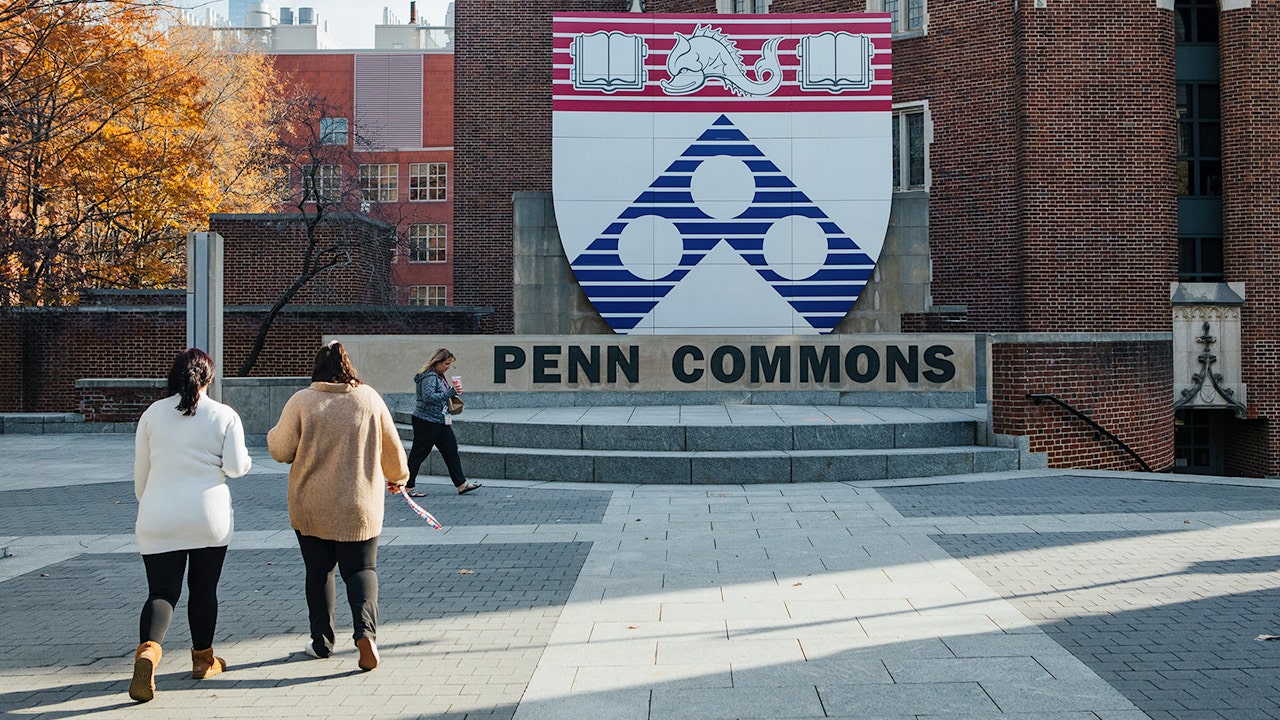
People walk by a sign reading “Penn Commons” at the University of Pennsylvania. (Michelle Gustafson/Bloomberg via Getty Images)
CLICK HERE TO DOWNLOAD THE FOX NEWS APP
“These emails are being received by individuals outside of UPenn as well,” Cooper wrote. “It appears that some email list, which is beyond our control, was accessed by malicious individuals who then sent out these messages.”
The Daily Pennsylvanian noted that the Penn Medicine Academic Computing Services and the School of Nursing’s IT services also sent out messages acknowledging the offensive email.
Read the full article from Here



The Boston Red Sox will return to action on Friday to kick off the second half of the 2026 Major League Baseball season with a doubleheader against the Tampa Bay Rays.
The last few weeks have been incredible for Boston and have really gotten the organization right back into the thick of the playoff race. Beforehand, the Red Sox looked like one of the worst teams in baseball. Now, Boston is 46-48 and has won 14 of its last 16 games. It’s why you play the games. The MLB season is long and full of ups and downs. Sure, the first few months of the season were full of many down moments for the Red Sox, but they flipped a switch, got hot, and now are right back in the mix.
Now, there are just over two weeks to go until the 2026 trade deadline and Boston should be looking to add. But who should the Red Sox be targeting? Here are four intriguing options for Craig Breslow and the Red Sox’s front office to target.
Gleyber Torres — Detroit Tigers
The former longtime New York Yankee is a member of the Detroit Tigers and was slashing .280/.395/.395 with a .790 OPS, four homers and 18 RBIs before the All-Star break. Torres is on the Injured List, but has already begun a rehab assignment. Torres has the type of right-handed pop Boston’s lineup needs. Plus, he’s just 29 years old.
Luis Arráez — San Francisco Giants
Luis Arráez isn’t a right-handed bat and doesn’t have much power, but this is a guy with three batting titles under his belt and has a shot at another one. He’s batting .330 right now and would go a long way for Boston by getting on base towards the top of the lineup.
James Wood — Washington Nationals
This would be a pipe dream type of move. Wood is under team control for four more seasons and is just 23 years old, and yet he’s already a two-time All-Star. He blasted 31 homers last year and already has 28 this season in 97 games played. If the Red Sox could get a bat like his, they’d be all set. But it would cost quite a bit to pry him from Washington.
Isaac Paredes — Houston Astros
There are few players who were connected to Boston more this past offseason than Isaac Paredes. The Astros don’t look like a team that is going to sell, but Paredes is still worth a call. Houston traded Lance McCullers Jr. to the Milwaukee Brewers on Wednesday in a salary dump.
 Add us as a preferred source on Google
Follow

Two people were arrested earlier this week following a drug bust in Downtown Pittsburgh, police said.
Pittsburgh Police said Wednesday that Kyree Hairston-Mitchell, 24, and Mya Bryant, 23, were each arrested Monday following a drug bust at a residence along Stanwix Street along with the search of two vehicles.
Police said that detectives from the bureau’s Violence Prevention Unit arrested both individuals after executing warrants and searching the home and the vehicles where they discovered a large amount of drugs, cash, and a gun.
According to police, detectives recovered $12,000 in cash, heroin, marijuana, cocaine, prescription drugs, and a handgun.
Hairston-Mitchell and Bryant are each facing numerous drug-related felony charges, according to court records.
Court documents show that Hairston-Mitchell is being held in the Allegheny County Jail after being unable to post $25,000 bail. Bryant was arraigned and released on nonmonetary bond, court records show.
Both individuals are set to face a preliminary hearing later this month.
Police said that a passenger in one of the vehicles involved in the arrests was taken into custody on a warrant out of Ohio.

See the moment a husky shields child from bear
A husky jumped into action to protect a child as a bear charged at them through the yard in Connecticut.
If you’re looking for the best barbecue restaurant in the state, you may have to drive to the state’s capital.
Business Insider identified the most beloved barbecue spot in each state, including Connecticut.
“Our list includes barbecue destinations with historical or regional significance and devoted national or local followings,” Business Insider said. “Many of the spots or their pitmasters have won major accolades, and some have appeared on mainstream TV shows.”
Business Insider’s choice for the most iconic place for barbecue in Connecticut is a specific location of a chain restaurant that has multiple stores in the Constitution State.
Here’s what Business Insider had to say about Bear’s Smokehouse Barbecue, and why it might be worth the extra trip to Hartford, Connecticut.
Bear’s Smokehouse — Hartford, Connecticut
Business Insider said the Hartford location is the most iconic Bear’s Smokehouse in Connecticut. However, Bear’s has locations in Windsor, New Haven, South Windsor, and Storrs (although that one is in a University of Connecticut Student Union).
“Local outlet Hartford Courant named Bear’s Smokehouse the best ribs and best food truck in the state,” Business Insider said. “USA Today also named it one of the best restaurants in the country in 2026 (albeit, one of the North Carolina locations).”
Chain restaurant or not, this location’s menu appears to have all the goods that make a barbecue restaurant great: beef brisket, burnt ends, pulled pork, and turkey breast, all done up in a Kansas-City style of barbecue that would make Ted Lasso proud.
They also offer some innovative takes on hearty dishes like poutine with Bear Style Poutine, which comes with fries, spicy cheese curds, brisket gravy, and your choice of meat.
You can find Bear’s Smokehouse at 25 Front St, Hartford, Connecticut.
They open at 11 a.m. on weekdays and weekends but their closing hours vary depending on the day.
Rin Velasco is a trending reporter. She can be reached at rvelasco@usatodayco.com.
-

 News30 minutes ago
Trump’s ‘American Flag Blue’ in the Lincoln Memorial pool is already gray — and the Olympic canoer ‘vandal’ is fighting his arrest | Fortune
-

 Los Angeles, Ca2 hours ago
Water main break floods West Hollywood streets, traps cars
-

 Detroit, MI2 hours ago
Detroit’s air quality early Thursday ranked as hazardous, worst in the world
-

 San Francisco, CA3 hours ago
‘It was a scene from the Titanic’: Fishermen recall rescuing passengers from sinking boat in SF Bay
-

 Dallas, TX3 hours ago
Big picture takeaways from the Dallas Mavericks first week at Summer League
-

 Miami, FL3 hours ago
“We’re going to be champions”. Argentina fans in Miami Beach celebrate team’s win against England
-

 Boston, MA3 hours ago
4 Red Sox Trade Targets to Solidify Boston’s Push for a Playoff Spot
-

 Denver, CO3 hours ago
RTD considers ending Denver’s 16th Street FreeRide shuttle due to budget issues

