Northeast
Trump plans audacious Bronx rally but congressman says his borough won't be fooled

Deep blue New York is in play.
In a major throwdown to Democrats, former President Trump will host a campaign rally in the Bronx on Thursday as he sets his sights on flipping the Empire State red this November, a situation that would have been unfathomable in 2021 when he departed the White House.
Trump’s campaign announced Friday night that Thursday’s rally will take place at 6 p.m. in Crotona Park, a 127-acre public park just blocks away from the boundary line of Rep. Alexandria Ocasio-Cortez’s district. The New York Post reports that the campaign has a permit to fit 3,500 people into the space.
The move comes on the heels of a record-breaking Trump rally that brought up to 100,000 supporters together in the Democratic stronghold of New Jersey last week.
BIDEN RETURNS TO CAMPAIGN TRAIL AS TRUMP FORCED TO REMAIN IN COURT FOR SECOND DAY OF NEW YORK HUSH MONEY TRIAL
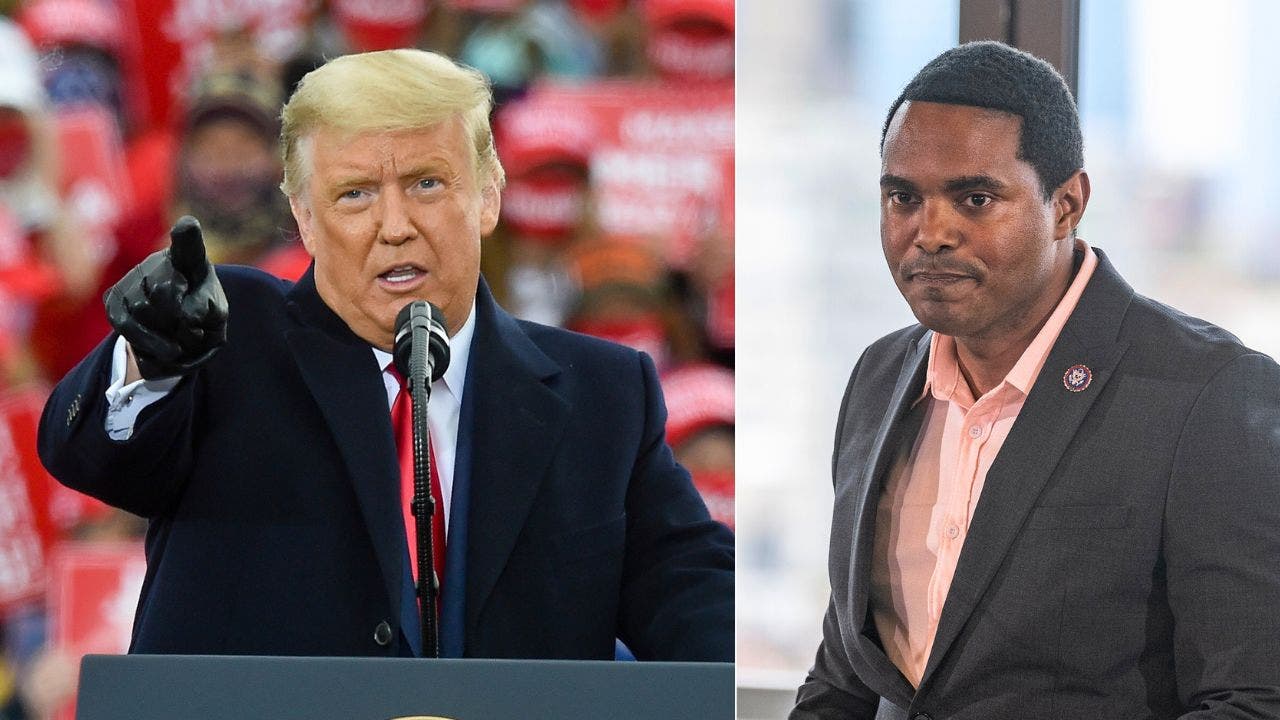
President Trump speaking and Rep. Ritchie John Torres, who said Bronx residents won’t be fooled by Trump. (Ben Hasty/MediaNews Group/Reading Eagle via Getty Images)
It will mark Trump’s first rally in the state since an upstate Buffalo event in 2016. Biden topped Trump with 76% of the city’s vote in the 2020 election. Statewide, Biden took 60.87% of the vote.
In announcing the rally, Trump’s campaign took several swipes at President Biden’s record over the last three and a half years in relation to crime and inflation.
“Both New York City and the state at large have been ravaged by monumental surges in violent crime as a direct result of Biden’s and Democrats’ pro-criminal policies,” the campaign said in the announcement. “Murders in New York City are up 23.1 percent from 2019 levels, while felony assault is up 35.4 percent. These upticks are incomprehensible and devastating.”
The campaign highlighted Trump’s fondness of the state he once called home until he switched his permanent residence to his Mar-a-Lago estate in Palm Beach, Florida in 2019. Although he has been forced back to stand trial in his “hush money” case and his defamation case with E Jean Carroll.
TRUMP PROSECUTORS’ CASE IS ‘DEAD’ AND CANNOT BE REVIVED, SAYS FORMER MICHAEL COHEN ADVISER
A billboard at a Trump rally in Wildwood declaring historical blue New Jersey is “Trump Country.” The rally is understood to have drawn nearly 100,000 people. (The Image Direct for Fox News Digital)
“The Empire State, a place near to President Trump’s heart, has been decimated by Biden,” the statement continues. “President Trump will ease the financial pressures placed on households and re-establish law and order in New York! We can Make America Great Again by tackling lawlessness head-on, ceasing the endless flow of illegal immigrants across our southern border, and reversing the detrimental effects of inflation by restoring people’s wealth.”
The rally announcement has been met with mixed responses.
Rep. Ritchie John Torres, a Democrat who represents New York’s 15th Congressional District, where the rally is being held, blasted the former president in a statement to Fox News Digital.
“The South Bronx has no greater enemy than Donald Trump, who is on a mission to dismantle the social safety net on which Bronx families depend for their survival,” Torres said. “Trump is and has always been a fraud. The South Bronx – the most Democratic area in the nation – will not buy the snake oil that he is selling.
Trump speaks during a campaign event in Wildwood, New Jersey, on May 11, 2024. (Hannah Beier/Bloomberg via Getty Images)
Many business owners in the borough, however, didn’t know that the rally would be taking place when contacted by Fox News Digital this morning.
Liz Adreu, a manager at the Bronx restaurant Chocobar Cortes, was one of those unaware but said she would “probably” vote for Trump.
Reggie O, the owner of Aduanipa African & Caribbean Grill, said he supported Trump’s policies when he was in office, although he didn’t want to say who he would be voting for, adding that he thinks there’s a very real chance that the state could be flipped at some point in the future, adding that his eatery has just opened and hasn’t been on the receiving end of any crime.
Inflation is putting many businesses under financial strain, especially after they weathered the economic storms of pandemic-era lockdowns. Families too are suffering, Trump’s campaign said.
Former President Trump talks with bodega owner Maad Ahmed during a visit to his store on April 16, 2024, in New York. (AP Photo/Yuki Iwamura)
“New Yorkers have suffered greatly thanks to Biden’s failed policies. With prices in the Empire State up by 17.5 percent since Biden took office, New York families continue to suffer from high inflation on everyday goods,” the statement reads.
Trump last month telegraphed he would be campaigning in the Big Apple when he visited Sanaa Convenience Store in Upper Manhattan. A former clerk, Jose Alba, was attacked by an ex-con there in a July 2022 incident before he infamously stabbed the perp to death in self-defense.
“We’re going to come into New York, we’re making a big play for New York,” Trump told reporters outside. “I love this city, and it’s gone so bad in the last three years, four years, and we’re going to straighten New York out.”
Read the full article from Here


Watch CBS News
Pittsburg, PA
Trash pickup schedules adjusted in Pittsburgh-area communities due to impending heat wave

Several communities in the Pittsburgh area have adjusted their trash pickup times as the region is bracing for a heat wave with temperatures and heat indexes expected to be near 100 degrees this week.
The hottest temperatures of 2026 are expected this week and by Tuesday afternoon, temperatures are anticipated to reach into the 90s. This, coupled with extremely high humidity levels, means the heat index — also known as the “feels like” temperature — will flirt with triple digits.
In Mt. Lebanon, trash and recycling pickup routes will begin earlier than normal to help keep workers safe amid the extreme heat.
“All trash and recycling should be placed at the curb the night before your scheduled collection day, as collection times may occur earlier than usual,” a notice posted on municipality’s Facebook page said.
Shaler Township said that it received an update from County Hauling that collection crews will begin their routes earlier than normal this week as well.
“Please place all trash and recycling at the curb the night before your scheduled collection day,” the township said.
In Robinson Township, trash collection will begin at 5 a.m. on Tuesday, one hour earlier than normal.
People are being asked to have their trash and recycling at the curb at least one hour prior to their normal pickup time.
Pleasant Hills Borough said it had adjusted its trash pickup schedule for earlier in the day on Friday to “help reduce employee exposure to hazardous temperatures.”
“This temporary adjustment is being made in the interest of employee health and safety,” the borough said. “We kindly ask that you help notify your residents that all trash and/or recycling should be placed at the curb the night before their scheduled collection day, as collection times may occur earlier than usual.”
In Brentwood Borough, Noble Environmental will begin earlier collection on pickup routes as well.
People are being asked to place their trash and recycling at the curb the night before their scheduled collection day.
The borough added that collection days are not changing, only the start time of the pickup routes.
“Thank you for your cooperation as crews work safely during this week’s heat wave,” the borough said.
The Library Volunteer Fire Company said that trash pickup in South Park Township is being moved earlier on Thursday.
“We kindly ask Township residents to place trash and recycling at the curb the night before Thursday, July 2nd pickup, as collection times may occur earlier than usual,” the notice said.
Connecticut
New Haven asks for retrial after jury awards Connecticut man $38M in wrongful conviction lawsuit

NEW HAVEN, Conn. — The City of New Haven is asking for a retrial after a jury awarded a Connecticut man $38 million in May for being wrongfully convicted of murder and imprisoned for 21 years.
Stefon Morant was allegedly wrongfully convicted of a double homicide in 1994. According to the New York-based law firm of Neufeld Scheck Brustin Hoffmann & Freudenberger, LLP, the jury ruled New Haven police officers and the City of New Haven were liable for his wrongful imprisonment.
The jury found that New Haven police detectives made up false evidence to frame Morant and that the city was liable for suppressing evidence favorable to criminal defendants.
A judge has issued a temporary stay, pausing any payments until the motion is resolved.
-

 Los Angeles, Ca5 minutes ago
Company has weeks to complete cleanup of Boyle Heights warehouse fire, officials announce
-

 Detroit, MI27 minutes ago
18 New Kid-Friendly Places That Opened in Metro Detroit in 2026 (So Far!)
-

 San Francisco, CA42 minutes ago
Anza expedition celebrates 250th anniversary in San Francisco
-

 Dallas, TX45 minutes ago
Preston Hollow residents oppose proposed $800 million mixed-use development in Dallas, survey reveals
-

 Miami, FL50 minutes ago
Bradley Beal to Miami Heat rumors draw skepticism
-

 Boston, MA57 minutes ago
Boston Pops surprise travelers at Logan Airport with July 4th preview performance
-

 Denver, CO58 minutes ago
Denver Broncos Crack Top 10 in NFL Uniform Rankings
-

 Seattle, WA1 hour ago
PHOTOS: Visiting all 12 stops during this year’s West Seattle Garden Tour

