Sign up for the Today newsletter
Get everything you need to know to start your day, delivered right to your inbox every morning.

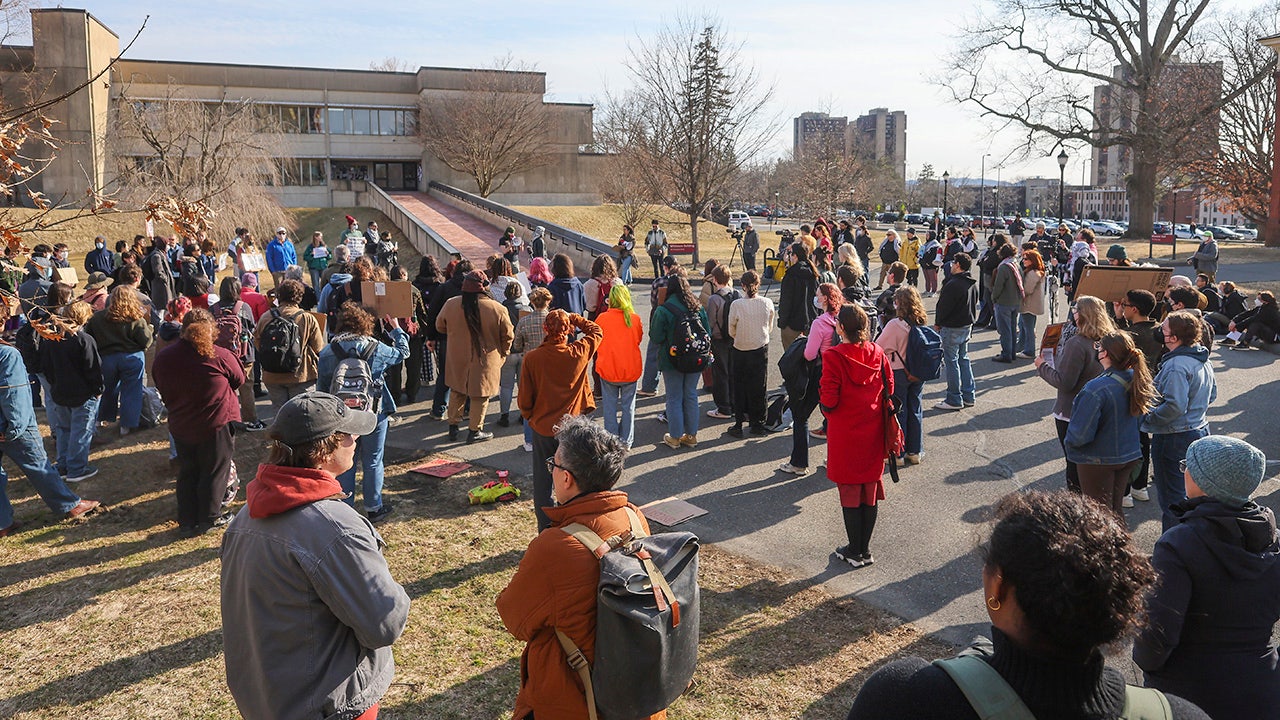
The University of Massachusetts Amherst said Friday that five international students enrolled at the school have had their visas revoked by U.S. Immigration and Customs Enforcement (ICE).
“The university has learned that, throughout the course of this week and as of tonight, five international students have had their visas revoked and student statuses terminated by the federal government,” UMass Chancellor Javier Reyes said in a letter posted to the university website.
“I regret sending this news so late on a Friday; given that we learned of some of these revocations this evening, I felt it important to share this troubling news at this time.”
CHINESE NATIONALS BANNED FROM US STUDENT VISAS UNDER NEW HOUSE GOP PROPOSAL
Reyes said the university wasn’t notified of the changes to the students’ visas, “and only became aware as a result of proactive checks in the Immigration and Customs Enforcement’s Student and Exchange Visitor Information System (SEVIS) database. We will continue monitoring SEVIS for further updates.”
UMass Amherst is the largest in the state’s public university system.
University of Massachusetts Amherst students protesting on campus in March. (Matthew J. Lee/The Boston Globe via Getty Images)
Fox News Digital reached out to UMass Amherst for comment.
Earlier this week, the president of Minnesota State University in Mankato said five international students at the university had visas revoked.
The school’s president, Edward Inch, said the school found out after running a database check of international student statuses after the detention of a Turkish student at the University of Minnesota in Minneapolis over a drunken driving conviction.
Other colleges around the country, including Arizona State, Cornell, North Carolina State, the University of Oregon, the University of Texas and the University of Colorado have also reported having international student visas revoked without notice.
University students Rumeysa Ozturk at Tufts and Mahmoud Khalil at Columbia were taken into custody by Immigration and Customs Enforcement in separate incidents last month. (Associated Press/Ted Shaffrey)
Secretary of State Marco Rubio said last week students are being targeted for involvement in protests along with others tied to “potential criminal activity.”
Early last month, Columbia student Mahmoud Khalil, was arrested for his involvement in anti-Israel protests and alleged support of Hamas.
VIDEO SHOWS ARREST OF TUFTS UNIVERSITY STUDENT FOR ALLEGEDLY SUPPORTING HAMAS
And in late March, an Iranian doctoral student at the University of Alabama, whose visa had been revoked in 2023, was arrested in the middle of the night.
Although his visa was revoked, he was told he could stay in the U.S. while he remained a student, his lawyer said.
People gather for a protest in support of Mahmoud Khalil outside a federal courthouse in Newark, N.J., March 28. Khalil’s lawyers are responding to a motion by the government to have Khalil’s case moved to Louisiana. (Stephanie Keith for Fox News Digital)
The Department of Homeland Security said the student, Alireza Doroudi, “posed significant national security concerns.”
Last month, Rumeysa Ozturk, a Turkish Ph.D. student at Tufts University in Massachusetts, was arrested by immigration officers after she wrote an anti-Israel op-ed for the campus newspaper.
The Associated Press contributed to this report.
Read the full article from Here

NEWYou can now listen to Fox News articles!
The New Hampshire man accused of opening fire inside a country club last year, killing one person, reportedly confessed to the shooting, telling investigators he aimed to kill the rich.
Hunter West Nadeau, 24, told police he carried out the shooting at a steakhouse located at the Sky Meadow Club in Nashua in an effort to retaliate against the rich because “they were not helping the poor,” according to a police affidavit obtained by The Boston Globe.
The affidavit reportedly pointed to surveillance video showing Nadeau entering the club’s main entrance around 7:17 p.m. Sept. 20, wearing a black hoodie and carrying a green backpack.
Nadeau then allegedly walked to Prime steakhouse, put on a face mask and brandished a gun, firing five shots at employee Steve Burtman, according to the affidavit.
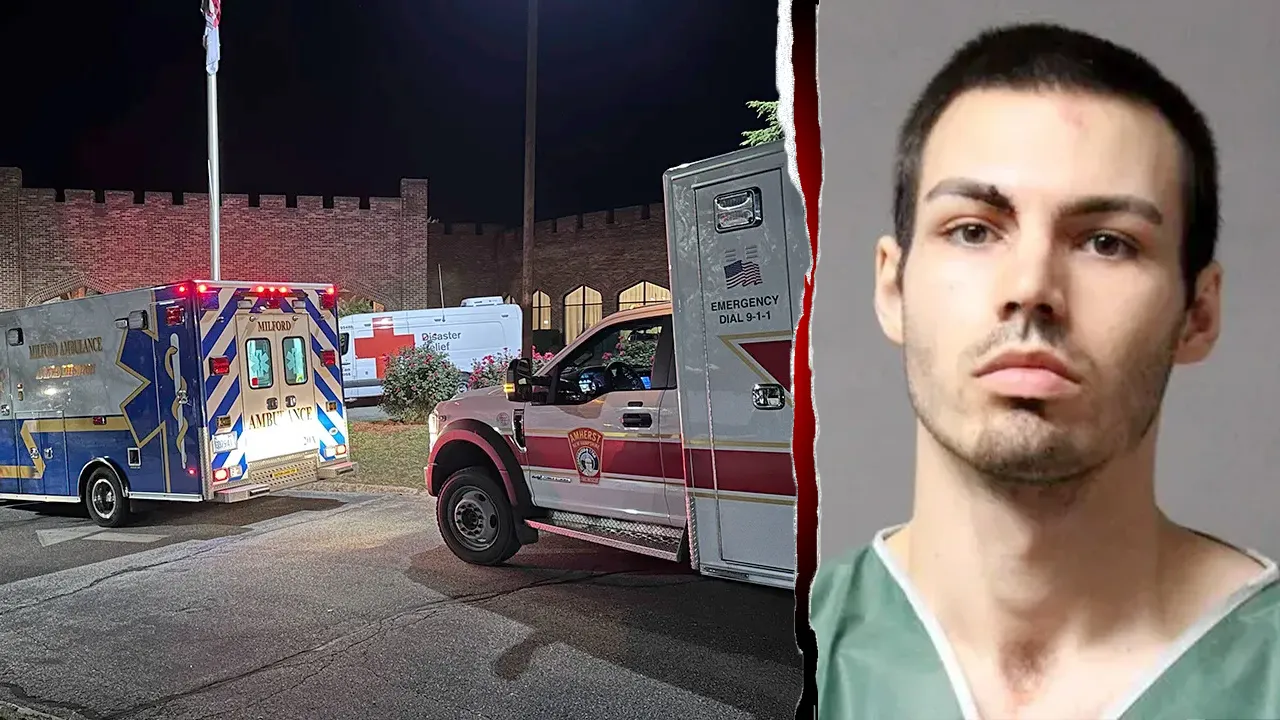
Hunter Nadeau, 24, a former employee of the Sky Meadow Club, was charged with second-degree murder in Robert Steven DeCesare’s killing. (New Hampshire Attorney General)
Burtman, who was reportedly stationed at the front desk, was struck in the face, the outlet reported. He survived his injuries.
Surveillance footage then reportedly shows Nadeau entering the restaurant and firing five more shots toward numerous patrons.
Nadeau allegedly struck and killed 59-year-old Robert Steven DeCesare, who was dining with his wife and daughter. A third patron was also injured as he allegedly fired multiple shots toward a group of individuals.
WITNESS SAYS NEW HAMPSHIRE COUNTRY CLUB SHOOTER YELLED ‘FREE PALESTINE’ DURING WEDDING VIOLENCE: AP
Ambulances are parked outside a hotel acting as a reunification center after a shooting at a country club in Nashua, N.H., Sept. 20, 2025. (AP Photo/Michael Casey)
Nadeau then “continued to shoot until he was attacked by other patrons in the restaurant, and he retreated back through the doors of the steakhouse,” the affidavit said.
A witness previously told The Associated Press Nadeau allegedly yelled “Free Palestine” as the chaos was unfolding.
Police subsequently located Nadeau on the club’s golf course, where he “was bleeding from apparent self-inflicted incised wounds to [his] arms and wrists, and made statements to the effect that he was a ‘bad guy,’” according to the filing.
He then reportedly took responsibility for the shooting, telling officers about his negative feelings toward the affluent.
BODYCAM IMAGES SHOW LUIGI MANGIONE’S MCDONALD’S ARREST AS DEFENSE CHALLENGES EVIDENCE COLLECTION
Robert “Rob” DeCesare Jr., 59, was fatally shot during a wedding at Sky Meadow Country Club in Nashua, N.H. (Charlene DeCesare)
Speaking to authorities from his hospital bed, Nadeau told investigators “he was tired of the ‘elites’ taking all the money,” according to the outlet.
Nadeau also reportedly told investigators he chose Sky Meadow because he had previously worked there and knew members were affluent.
“He said that he settled on Sky Meadow as a location because he worked there about a year ago as a server and knew that you had to have money to have a membership there,” police said, according to the Globe.
POLICE SERGEANT DENIES HEARING LUIGI MANGIONE MOTHER’S ALLEGED DAMNING STATEMENT ABOUT CEO KILLING
“He was not targeting a specific person but did not care whether he killed someone or not,” police reportedly added.
Additionally, Nadeau explained why he targeted a wedding being held at the venue at the time of the shooting, telling police “he did not want to target ‘civilians,’” according to the outlet.
At the time, the shooting came less than one year after Luigi Mangione allegedly opened fire on UnitedHealthcare CEO Brian Thompson in an apparent assassination in midtown Manhattan. Investigators have pointed to similar ideological motives behind Mangione’s alleged crimes.
CLICK HERE TO DOWNLOAD THE FOX NEWS APP
In January, prosecutors filed multiple charges against Nadeau, including first-degree murder and reckless second-degree murder, according to the New Hampshire Department of Justice.
He is being held without bail as he awaits trial.
Fox News Digital was unable to locate an attorney representing Nadeau.
Fox News Digital’s Sarah Rumpf-Whitten contributed to this report.

Read the full article from Here

Nikki Ogunnaike, the editor in chief of Marie Claire magazine, did not grow up the scion of an Anna Wintour or a Marc Jacobs.
But, she said, “my mom and dad are both very stylish people.”
They got dressed up to go to church every week in her hometown Springfield, Va. Her mother managed a Staples; her father, a CVS. “Presentation is important to them,” she said.
Since landing her first internship with Glamour magazine in college, Ms. Ogunnaike, 40, has held editorial roles there and at Elle magazine and GQ. She has been in the top post at Marie Claire since 2023.
She recently spent a Saturday with The New York Times as she prepared for Milan Fashion Week.

Health
Massachusetts health officials have confirmed the state’s first two measles cases of the year, a school-aged child and a Greater Boston adult.
The Department of Public Health announced the cases Friday, marking the first report of measles in Massachusetts since 2024.
According to health officials, the adult who was diagnosed returned home recently from abroad and had an “uncertain vaccination history.” While infectious, the person visited several locations where others were likely exposed to the virus, and health officials said they are working to identify and notify anyone affected
The child, meanwhile, is a Massachusetts resident who was exposed to the virus and diagnosed with measles out-of-state, where they remain during the infectious period. Health officials said the child does not appear to have exposed anyone in Massachusetts to measles.
The two Massachusetts cases come as the U.S. battles a large national measles outbreak, which has seen 1,136 confirmed cases nationwide so far in 2026, according to the Centers for Disease Control and Prevention.
“Our first two measles cases in 2026 demonstrate the impact that the measles outbreaks, nationally and internationally, can have here at home,” Massachusetts Public Health Commissioner Robbie Goldstein said Friday. “Fortunately, thanks to high vaccination rates, the risk to most Massachusetts residents remains low.”
Measles is a highly contagious disease that spreads through the air when an infected person sneezes, coughs, or talks. The virus can linger in the air for up to two hours and may even spread through tissues or cups used by someone who has it, according to the DPH.
Early symptoms occur 10 days to two weeks after exposure and may resemble a cold or cough, usually with a fever, health officials warned. A rash develops two to four days after the initial symptoms, appearing first on the head and shifting downward.
According to the DPH, complications occur in about 30% of infected measles patients, ranging from immune suppression to pneumonia, diarrhea, and encephalitis — a potentially life-threatening inflammation of the brain.
“Measles is the most contagious respiratory virus and can cause life-threatening illness,” Goldstein said. “These cases are a reminder of the need for health care providers and local health departments to remain vigilant for cases so that appropriate public health measures can be rapidly employed to prevent spread in the state. This is also a reminder that getting vaccinated is the best way for people to protect themselves from this disease.”
According to the DPH, people who have had measles, or who have been vaccinated against measles, are considered immune. State health officials offer the following guidance for the Measles-Mumps-Rubella (MMR) vaccine:
Get everything you need to know to start your day, delivered right to your inbox every morning.







Exclusive: DeepSeek withholds latest AI model from US chipmakers including Nvidia, sources say


Mother and daughter injured in Taunton house explosion


2026 MHSA Montana Wrestling State Championship Brackets And Results – FloWrestling


Wildfire near Gum Swamp Road in Livingston Parish now under control; more than 200 acres burned


10 acres charred, 5 injured in Thornton grass fire, evacuation orders lifted


YouTube TV billing scam emails are hitting inboxes


Stellantis is in a crisis of its own making


OpenAI didn’t contact police despite employees flagging mass shooter’s concerning chatbot interactions: REPORT