The Brewers were rained out last night! I hope you’ll forgive that instead of rewriting an entire new game discussion, I’m just going to (mostly) copy and paste what I wrote before yesterday’s game, because both teams are using the same lineups they announced last night.
Northeast
Rachel Morin's mom blasts Mayorkas' description of slain daughter after illegal immigrant suspect nabbed

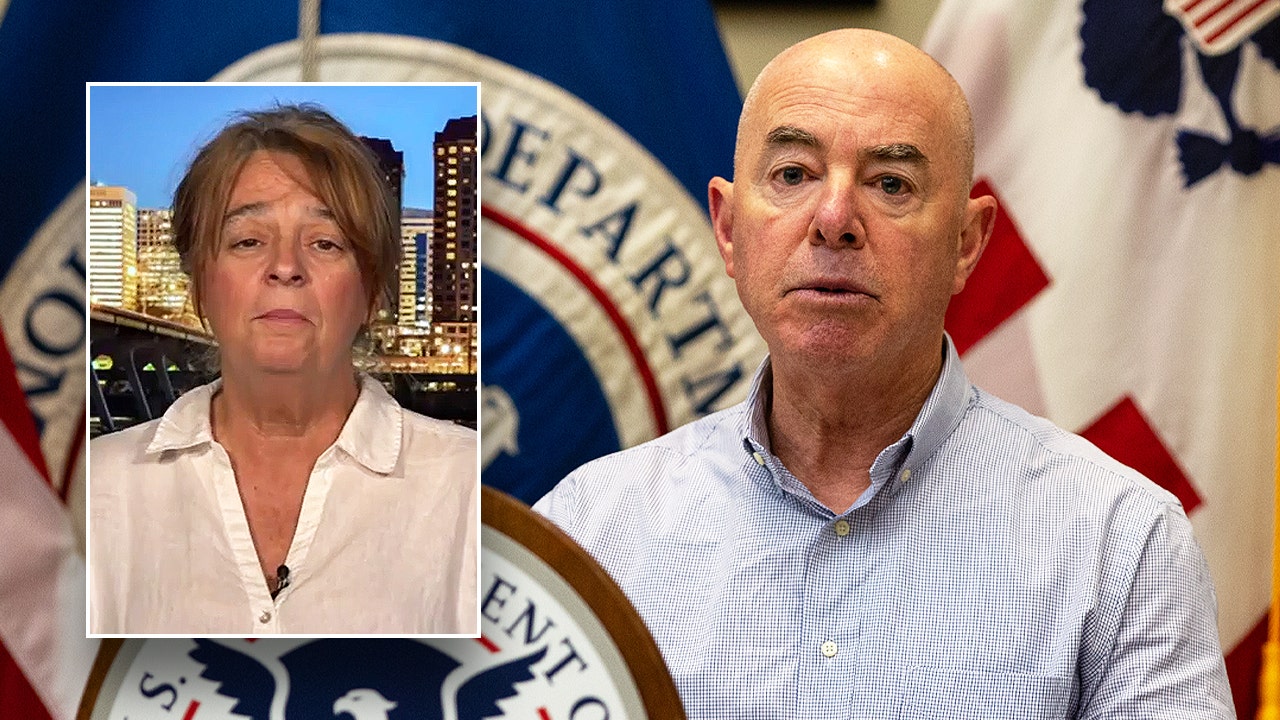
The mother of Rachel Morin – a Maryland mother of five, who was allegedly murdered by an illegal immigrant – blasted Homeland Security Sec. Alejandro Mayorkas for his depersonalization of her daughter, referring to her merely as an “individual” in a statement this week.
During a Tuesday appearance on CNN, where he was asked for his response to “critics who blame the [Biden] administration for allowing” the deaths of Americans at the hands of illegal immigrants, Mayorkas said, “First and foremost, of course our hearts break for the children, the family, the loved ones, the friends of the individual who was murdered, the woman, the mother.”
Patty Morin, Rachel’s mother, took aim at Mayorkas for his remarks during a Wednesday evening appearance on Fox News Channel, claiming the secretary’s remarks were part of a “political statement” that made her daughter “an object.”
“My reaction is that it’s a completely political statement,” Morin told “Ingraham Angle” host Laura Ingraham. “It totally depersonalizes her and makes her an object.”
BIDEN OFFERS ‘CONDOLENCES’ BUT NO SOLUTION AFTER LATEST ILLEGAL IMMIGRANT MURDER ALLEGATION
Patty Morin, Rachel’s mother, said DHS Sec. Alejandro Mayorkas’ remarks were part of a “completely political statement” that made her daughter “an object.” (Fox News/Getty Images)
Patty Morin also insisted that the Biden administration’s decision to “categorize [Rachel] as a statistic just shows how impersonal they are, and it also shows how they don’t value life.”
Mayorkas refused to take blame for Morin’s murder in the same interview with CNN on Tuesday, saying, “A criminal is responsible for the criminal act.”
“The criminal who committed this heinous act should be held accountable to the fullest extent of the law and forcefully so,” Mayorkas said at the time.
Fox News Digital reached out on Thursday to the Department of Homeland Security for a response to Patty Morin’s remarks and whether the department plans to reach out to the Morin family. Additionally, DHS was asked whether Mayorkas had used Morin’s name in other interviews.
“The Department cannot publicly comment on an ongoing criminal investigation. That said, anyone who commits a horrific and senseless crime, like the one this individual is accused of, should be prosecuted to the fullest extent under the law. Our hearts go out to Rachel Morin’s family,” a DHS spokesperson said in response.
Morin, 37, was reported missing in August by her boyfriend, who said she never returned after going out for a run on the Ma & Pa Trail, a pedestrian trail, in Bel Air, a quiet and typically safe town about 28 miles northeast of Baltimore, on August 5, 2023.
MARYLAND DEMS MOURN MOM ALLEGEDLY MURDERED BY ILLEGAL IMMIGRANT BUT BACK BIDEN’S BORDER ORDER
Victor Martinez Hernandez, 23, was arrested and accused of the murder of Rachel Morin, a 37-year-old mother of five. (Harford Co. Sheriff’s Office)
Her body was found on a trail the following day.
Victor Martinez Hernandez, the illegal migrant suspected of murdering Morin, was arrested on June 14 after a lengthy 10-month investigation into Morin’s murder. He was charged with rape and first-degree murder.
Hernandez, who has reportedly been in the U.S. since February 2023, was apprehended while “casually sitting” at a bar in Tulsa, Oklahoma. Police said he arrived in the states only a month after he allegedly murdered a young woman in El Salvador. His DNA was also linked to a March home invasion in Los Angeles where a mother and her nine-year-old daughter were assaulted, according to authorities.
The Harford County Sheriff’s Office in Maryland posted signs at Ma & Pa Trail heads on June 17, 2024, announcing the arrest in the August 2023 murder of Rachel Morin. (Harford County Sheriff’s Office/Facebook)
Hernandez was extradited to Maryland on Thursday to face charges. He was scheduled to leave Tulsa, Oklahoma, on Thursday morning and arrive at Martin State Airport between 12:30 and 1 p.m., the Harford County Police Department confirmed.
Following his arrival in Maryland, the 23-year-old was taken to the Harford County Detention Center.
Fox News’ Michael Lee, Bailee Hill and Sarah Rumpf-Whitten contributed to this report.
Read the full article from Here

Continue Reading

ABOARD THE BARCHETTA – In a prelude to history, the Tall Ships are assembling in Boston Harbor as The Eagle leads today’s flotilla to meet Old Ironsides.
It’s a day the city won’t soon forget with small boats darting in toward the majestic U.S. Coast Guard ship to snap a watery selfie.
A cool breeze is carrying the ships toward Castle Island for the parade. We’re tailing them all. I’m with Herald staff photographer Stuart Cahill as we follow the pride of nations to the docks.
A flyover is imminent as you witness the choreography planned years ahead come to life.
To our aft is the Mayflower II as it approaches Castle Island. A city tug boats nudged it into place and peeled away to shower the parade in a stream of water from its cannon.
Our past and future is forever tied to this Harbor and it is a fitting tribute today to that economic lifeline. We’re now passing Castle Island!
Two fighter jets just blasted over with the USS Constitution firing off its guns. Amazing!
Full coverage in the Herald! Today, tomorrow and forever Boston!
Reporting via Starlink on the Barchetta (which stands for “small boat,” I had to ask.)
Pittsburg, PA
Game Discussion (Let’s Try This Again): Milwaukee Brewers (59-34) @ Pittsburgh Pirates (47-47)

However, there are two new pieces of information today. The first is minor, and that’s that Garrett Stallings has been spotted in Pittsburgh and is presumably the 27th man for today’s doubleheader (he should be available in the nightcap). The second is more troubling: Kyle Harrison has been placed on the 15-day injured list with forearm tightness, with Robert Gasser getting recalled to replace him on the roster.
Harrison himself has reiterated what he said a couple of days ago: that he’s not too worried. Plus, a 15-day stint on the IL right now isn’t the worst thing in the world — 15 days from July 9 means he could be eligible to return after missing only six games on the other side of the All-Star break, and he wasn’t going to pitch this weekend anyway. It sounds like the Brewers already had some sort of plan in this respect:
Hopefully, this is just a precautionary short stint for Harrison. The Brewers have proved remarkably flexible when it comes to replacing their injured starters this season, but if Harrison is lost for a longer period, it would be a real blow.
In any case, today’s game starts at 11:05 a.m., and we’ll see you for some morning baseball! The rest of the preview, as written last night, is below.
It’s the start of the last series before the All-Star break (weather permitting) and the Brewers are in Pittsburgh to wrap things up with a three-game set with the Pirates. Brandon Sproat takes the mound for the Brewers, while first-time All-Star Braxton Ashcraft will pitch for the Pirates.
Before we get to tonight’s starters, we’ve got a transaction to tell you about. Since time is, as they say, a flat circle, the Brewers have signed Bryse Wilson to a major league deal. To make room for him, they’ve sent Drew Rom to Triple-A Nashville and they’ve designated Easton McGee for assignment.
Wilson pitched for the Brewers in 2023 and 2024, serving mostly as a long-relief, semi-mop-up option. In 2023 he had quite a nice year: in 53 outings, Wilson pitched to a 2.58 ERA and went 6-0. He struggled more in 2024, but he pitched over 100 innings in a swingman role and was slightly above league average via ERA+. However, in both seasons, Wilson vastly outperformed his peripheral numbers, and since leaving the Brewers, things have been a struggle. He made 20 appearances for the White Sox in 2025 and had a 6.65 ERA in 47 1/3 innings; in three big-league appearances in 2026 (two with the Cubs, one with the Phillies), he’s allowed seven runs, all earned, in 9 2/3 innings. Wilson’s role with the Brewers, for however long it lasts (likely not long), will surely be similar to what it was when he last pitched for them in 2024: mop-up duty. (For those who are optimists, Wilson is generally good at not walking guys, but he doesn’t really strike them out, either, and over the last couple of seasons he has been eminently hittable, with about 12.5 hits per nine innings.)
Back to tonight’s action. Sproat will look to get into the break on a high note. Sproat’s last outing was a mixture of good and bad: he was not pitching well, needed 92 pitches, and allowed eight baserunners to get through just four innings pitched. But the good news is that he was mostly able to work his way out of trouble, too, and he somehow allowed just one run in those four innings, a game which Milwaukee eventually won 3-2 against the Diamondbacks. It was an encouraging sign of maturation that he didn’t just implode when things weren’t going well. Since the beginning of June, Sproat has a very solid 3.30 ERA in 30 innings pitched, and the team is 5-1 in his starts, a stark contrast to his 6.24 ERA and 5-6 team record prior to last month.
Ashcraft has been quite good for Pittsburgh, as evidenced by his status as an All-Star injury replacement. He’s just 26 and in his second season, and he’s done nothing but pitch well since his debut in late May of last season. This year, Ashcraft is 9-3 with a 3.24 ERA (134 ERA+) and even better 3.16 FIP. He’s got sterling peripherals (10.1 K/9, 2.1 BB/9) and is a hard thrower who plays a curveball and sinker off a four-seamer that sits around 97 mph. The curveball, especially, is one of the better ones in the league.
The Brewers continue to rotate through their position players as they reach the end of this 18-games-in-17-days stretch. Christian Yelich is back in the leadoff spot, while the outfield goes Luis Lara, Garrett Mitchell, and Sal Frelick from left to right. William Contreras is behind the plate, while the infield is Joey Ortiz, Cooper Pratt, Brice Turang, and Jake Bauers.
After last night’s rainout, first pitch has been scheduled for 11:05 a.m. CT, with game two coming either at 3:05 p.m. or one hour after the end of game one, if that’s later than 3:05.
Connecticut
I moved from Connecticut to the South chasing a cheaper, simpler life. It wasn’t at all what I expected, so I moved back.

This as-told-to essay is based on a conversation with Sandra Bonola, 56, who moved from Connecticut to Charleston, South Carolina, in 2021, then to Beaufort, South Carolina, in 2023, before deciding the South wasn’t right for her. The conversation has been edited for length and clarity.
I am a native New Englander, born and raised in Connecticut. In late 2021, I started thinking seriously about moving. I’m an empty nester, and thanks to my remote job, I can work from anywhere in the country.
I was drawn to the South because people talked about it as if it were the promised land. The stories made it seem like it had better weather, cheaper homes, and a more affordable cost of living. I bought into that and told myself, “If I move to the South, I can have an easier life, and it won’t be as expensive.”
I decided to move to Charleston, South Carolina. I figured that there, I’d be outside more, near the beach, have a lower cost of living, and have access to the coast. I was also hoping for that small-town vibe and Southern charm.
I packed up the 2,500-square-foot Colonial I had lived in for 20 years and moved. I got rid of a lot of things I no longer needed and put the rest into storage.
I was really hopeful Charleston would be right for me. But about four months after moving there, I realized that almost everything I had hoped for was turning out to be the opposite.
I tested the waters in Charleston first
In Charleston, I stayed in a friend’s apartment and paid rent month to month while I decided whether I wanted to buy a home there. I’m grateful for that setup because it gave me a trial period. In those four months, I learned a lot about Charleston — and about what I actually wanted.
One of the first things I noticed was that everybody seemed to be moving there. The city was crowded, and navigating the downtown area was always challenging. Its streets were also full of traffic — it would take me up to an hour to try to get to downtown Charleston from John’s Island.
The city was also more expensive than I expected. I was somewhat insulated from housing costs because I was renting from my friend, but food, entertainment, and taxes were all much higher than I had anticipated.

Jeff Greenberg/Universal Images Group via Getty Images
The Southern charm I was hoping for also didn’t feel as I expected. Charleston has a big “going out” culture, much of which seems to revolve around where to eat or drink. That’s not really my thing. For me, the city lacked some of the creative flavor I was looking for.
The climate was another big factor. Everyone knows New England can have brutal winters, and I don’t like shoveling snow, so I was eager to get away from that. But after moving South, I realized I had traded brutal winters for brutal summers. It was just so hot.
At first, I thought I just needed time to adjust. But the more I explored Charleston, the more I realized the lifestyle I had imagined didn’t match my reality.
I was getting annoyed, then frustrated, and then I was done.
I tried the South again, but it still wasn’t for me
I didn’t feel like I had anything to lose, so I moved back to Connecticut in 2022. Instead of feeling defeated, I actually felt grateful that I had given Charleston a shot.
For a while, I rented a month-to-month beach house in Connecticut while I looked for a home to buy. But the homebuying search in New England felt bleak. I was trying to downsize, but even the smaller homes came with big-home prices. It made me feel like I might never find what I was looking for.
After house hunting for 14 months in Connecticut, I really wanted to put down roots. The idea of moving to a quieter, more affordable small town was still appealing. So in July 2023, I decided to try the South again — this time in Beaufort, South Carolina, a small town I had explored while living in Charleston.
There, I was able to purchase a beautiful three-bedroom ranch home for $425,000. It was a new build in a planned community.
The house checked a lot of boxes. It was beautiful, new, and far more affordable than what I could have bought in Connecticut. But I still didn’t feel at home in Beaufort.
Affordability is important, but you also need community
In Beaufort, it was so hot that I rarely saw or interacted with my neighbors. People would say hello and then quickly go back inside. I kept thinking, “How am I ever going to socialize here?”
I joke that I’m an OG remote worker because I started working remotely in 2008. Remote work gives you some social interaction, but you still need to get outside and make real connections with people.
I tried to put myself in situations where I could meet people. I looked for yoga classes, local events, and other activities I could join. But what I found was that many people had moved there for family or moved with a spouse, and they mostly kept to themselves.
It lacked the kind of community connection I was used to seeing in the Northeast. I kept trying to make those connections and stay open to it, but it just kept falling flat.
I tell people this story, and sometimes they understand it, and sometimes they don’t. But I knew I was done one morning when I woke up, looked at the ceiling fan in my bedroom, and thought, “I really hate that fan, and I’m losing hope for my life.”
I didn’t appreciate Connecticut’s beauty until I moved back
In 2024, I moved back to Connecticut. Right now, I’m living on the coast in an apartment inside a refurbished Civil War-era hospital. I’m on one of the top floors, so I can see the boats and the water.
I’m still searching for a home and making offers with more confidence. Home prices are high here, but prices down South are creeping up, too.
I’ve started thinking about owning in Connecticut more as an investment in both my future and my happiness. I’ve set a budget of about $800,000 for a home, though some of the homes I’ve been interested in have been closer to $650,000.
I’m seeing possibilities I didn’t see before, and that’s exciting.
Kate Stoupas/Getty Images
Being back in Connecticut has been eye-opening. I don’t think I fully appreciated its beauty until I had something to compare it to.
There’s so much opportunity here. I love the energy and the people. I’ve been taking advantage of the location, too, doing things like hopping on a train to New York to see a show or making more of an effort to connect with friends.
When I think about whether I’d move somewhere else again, I keep coming back to something a photographer once told me in Massachusetts. He had lived in Bali with his family, and I remember asking, “You lived in Bali? Why would you come to Massachusetts?”
I’ll never forget what he told me. He said, “I can go anywhere in the world from an airport, but you really have to realize the ground beneath your feet is beautiful if you choose to see it that way.”
That stayed with me. It changed the way I think about Connecticut and made me realize I needed to take the blinders off. There was beauty right at my feet — I just needed to see it.
-
 Sports7 minutes ago
Q&A: Partner, chance to play in Long Beach reignited AVP star Taylor Crabb’s Olympic fire
-

 World17 minutes ago
Moldova president nominates pro-European businessman Tofan for PM
-

 News44 minutes ago
US congressman says he was detained by armed Israeli settlers in occupied West Bank
-

 Los Angeles, Ca2 hours ago
New details emerge in fatal stabbing of boy in El Monte
-

 Detroit, MI2 hours ago
1 dead, 1 injured after two-vehicle crash at Collingwood and Belleterre in Detroit
-

 San Francisco, CA3 hours ago
4 arrested, 3 cited after brawl following Giants vs. Rockies game at Oracle Park
-

 Dallas, TX3 hours ago
Mark Cuban takes legal action against Dallas Mavericks ownership over potential new arena deal
-

 Miami, FL3 hours ago
South Florida Dirt: A timeline of the Vacchi vs. Stern legal battle

