Northeast
NYC sees rise in hate crimes, led by surging antisemitism, police data shows

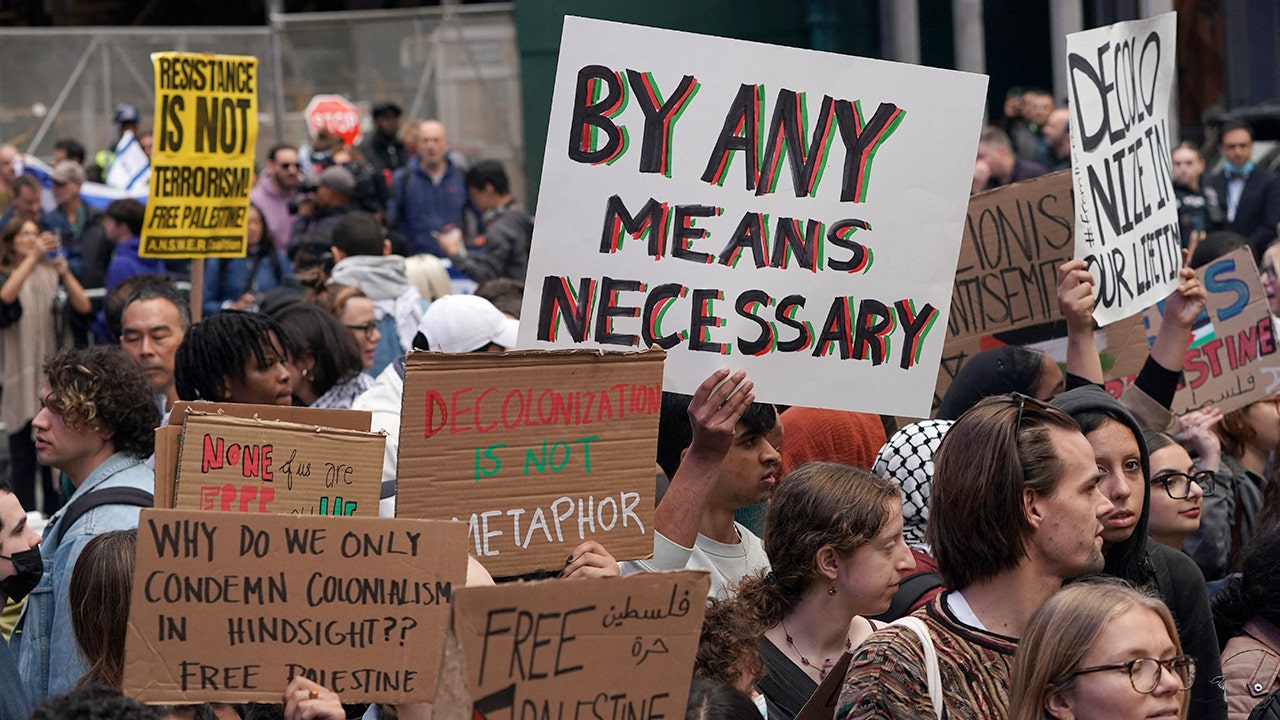
New York City crime stats show hate crimes in the Big Apple are on pace to rise for the fourth consecutive year, driven by a spike in antisemitic incidents.
There were 276 hate crime complaints in the city through May 31, the most recent data available. That’s up from 210 in 2023. Virtually the entire increase can be seen in anti-Jewish incidents, which rose from 97 to 164 in the same period.
The rise in antisemitic incidents coincided with anti-Israel demonstrations on the city’s major college campuses, including Columbia and New York universities.
“That’s no coincidence,” said Joseph Giacalone, a retired NYPD sergeant and a professor at John Jay College of Criminal Justice.
NYC PALESTINIAN MAN SENTENCED IN BRUTAL ANTISEMITIC BEATING BEFORE JUDGE EJECTS ANGRY SUPPORTERS FROM COURT
People march in support of Palestinians in New York Oct. 8, 2023, after the Palestinian militant group Hamas launched a terror attack on Israel. (Bryan R. Smith/AFP)
Antisemitic incidents have always been the most common hate crimes in New York, he said, and the recent spike comes as no surprise given the surge in campus demonstrations and widespread news coverage.
“What we’ve seen on college campuses has carried over into the street, so to speak,” he said. “People see this, they get bombarded with these images from TV and social media and then act upon it.”
Giacalone faulted university leaders for failing to address students’ complaints of antisemitism early on in the anti-Israel protests that broke out on their campuses earlier this year.
Palestinian New Yorker Mahmoud Musa appears in New York Supreme Court for sentencing in Manhattan, N.Y., Nov. 21, 2023. Musa pleaded guilty in the May 2021 attack against a Jewish man in Times Square and was sentenced to seven years in prison. (John M. Mantel for Fox News Digital)
PARENTS IN RED-LEANING SUBURBS OUTSIDE NYC GREEN-LIGHTING ARMED SECURITY AT PUBLIC SCHOOLS
“Not only did they not act, but they’re also protecting their professors that have been teaching this stuff for decades,” he said. “It’s finally come to fruition, and it plays right into the conservative hand about how colleges have brainwashed America’s youth in order to hate the country and a lot of things about it.”
At Columbia, faculty reportedly assisted student agitators by physically blocking critics from a makeshift encampment on school grounds and by forming a human chain around their keffiyeh-clad pupils. The encampment finally ended after school leaders asked the NYPD to clear out a group that barricaded the university’s Hamilton Hall building.
WATCH: NYU anti-Israel protesters form human chains as police move in
CHURCHES TURN TO ARMED VOLUNTEERS AS GUNMEN THREATEN PASTORS, WORSHIPPERS
Anti-Asian hate crimes, which became a visible problem last year for New York’s large Asian-American community, fell by half through May 31, 2024, compared to the prior year.
Citywide crime statistics fell slightly by 2.4% overall in May, led by a 21.1% decline in homicides. However, rapes, robberies, shootings and felony assaults all increased. Police attributed a significant portion of those bumps to crooks on motorized scooters who have been plaguing the city with snatch-and-grab robberies for months.
The robberies continue to present a growing threat, Giacalone said, with patterns involving scooters, defined by the city as two or more crimes sharing similarities, having quadrupled so far this year.
An anti-Israel demonstrator smashes a window at Columbia University’s Hamilton Hall, an academic building that agitators occupied April 30, 2024, in New York City. (Alex Kent/Getty Images)
HOUSE GOP LAWMAKER CALLS FOR STRIPPING COLLEGES OF TAX DOLLARS OVER ANTISEMITIC PROTESTS
The crimes continue to occur even after the Manhattan District Attorney’s Office cracked down on a robbery ring linked to the Venezuelan gang Tren de Aragua earlier this year.
“It’s a whack-a-mole situation, and if they’re not being held on bail, if they’re not being detained for [Immigration and Customs Enforcement], then all you’re doing is releasing them back out, and they even think it’s a joke, too,” Giacalone said.
Transit crime decreased by 10.6% after city and state leaders increased patrols on the subway system, revived random bag checks and called in the National Guard for assistance.
BRONX RALLYGOERS REVEAL TOP 2 ISSUES THEY BELIEVE WILL HELP TRUMP DOMINATE IN BLUE STATE
WATCH: New York straphangers weigh in on subway crime
CLICK HERE FOR THE FOX NEWS APP
“The men and women of the NYPD continue to turn the tide on overall crime in neighborhoods throughout New York City, as well as below ground in our vast subway system, by remaining nimble and strategically deploying our resources,” NYPD Commissioner Edward Caban said in a statement.
“We vow to stay in front of crime trends by directly addressing community concerns, disrupting emerging patterns and dismantling criminal networks where they operate. New Yorkers expect and deserve nothing less.”
Read the full article from Here


How can people possibly afford to live in one of the most expensive cities on the planet? It’s a question New Yorkers hear a lot, often delivered with a mix of awe, pity and confusion.
We surveyed hundreds of New Yorkers about how they spend, splurge and save. We found that many people — rich, poor or somewhere in between — live life as a series of small calculations that add up to one big question: What makes living in New York worth it?
Sara Robinson boarded a Greyhound bus from Oregon to New York City to attend Hunter College in the early 2000s, bright-eyed and eager to pick up odd jobs to fuel her dream of living there.
For a long time, she made it work. But recently, that has been more challenging than ever.
Right around her 40th birthday, Ms. Robinson began to feel financially squeezed in Brooklyn, where she had lived for years. Ms. Robinson (no relation to this reporter) was also feeling too grown to live with roommates.
“As a child,” she said, “you don’t think you’re going to have a roommate at 40.” She decided to move into a place of her own: a one-bedroom apartment in the Tompkinsville neighborhood of Staten Island.
After she moved, the preschool where she’d worked for over a decade closed. Now, she works two jobs. She is a seasonal employee for the state Office of Parks, Recreation and Historic Preservation, working from Tuesday to Saturday. And on Monday nights, she sells concessions at the West Village movie theater Film Forum, which pays $25 an hour plus tips.
Ms. Robinson, now 45, loves her job as an environmental educator at a state park on Staten Island. Her team runs the park’s social media accounts and comes up with event programming, like a recent project tapping maple trees to make syrup.
But the role is temporary. Her last stint was from June 2024 to January 2025. Then she was unemployed until August 2025. Ms. Robinson’s current contract will be up in April, unless she gets an extension or a different parks job opens up.
Ms. Robinson’s biweekly pay stubs from the parks department amount to about $1,300 before taxes. She barely felt a difference, she said, while she was out of work and pocketing around $880 every two weeks from her unemployment checks. (Her previous parks gig paid $1,100 a check.)
Living in New York’s Greenest Borough
“It used to be, ‘There’s no way I’m moving to Staten Island,’” Ms. Robinson said. “But the place is close to the water. I’m three minutes from the ferry. The rest is history.” She lives on the third floor of a multifamily house, above an art studio and another tenant. Her rent is $1,600 a month, plus $125 in utilities, including her phone bill.
“If my situation changes, I don’t know if I could find something similar,” she said. “So much of my New York life has been feeling trapped to an apartment. You get a place for a good price, and you’re like, ‘I can’t leave now.’”
Staten Island is convenient for Ms. Robinson’s parks job, but it’s become harder to justify living in a borough where she knows few people. It takes more than an hour to get to friends in Brooklyn, an especially hard trek during the winter. After four years of living on Staten Island, Ms. Robinson feels somewhat isolated.
“All my friends on Staten Island are senior citizens,” she said. “It’s great. I love it. But I do want friends closer to my age.”
One of Ms. Robinson’s friends, Ray, took her on nature walks and taught her about tree identification, sparking an interest in mycology, the study of mushrooms. This led to a productive — and free — fungi foraging hobby during unemployment. She has found all sorts of mushrooms, including, after a month of searching, the elusive morel.
The Budgeting Game
Ms. Robinson doesn’t update her furniture often, but when she does, she shops stoop sales in Park Slope or other parts of Brooklyn.
“It’s like a treasure hunt,” she said. “You could make a whole apartment off the street, off the stuff that people throw away.”
She also makes a game out of grocery shopping, biking to Sunset Park in Brooklyn or Manhattan’s Chinatown to go to stores where there are better deals. She budgets about $300 for groceries each month.
Ms. Robinson bikes almost everywhere, sometimes traveling a little farther to enter the Staten Island Railway at one of the stations that don’t charge a fare. She spends $80 a month on subway and ferry fares, and $5 a month for a discounted Citi Bike membership she gets through a credit union, though she usually uses her own bike. She is handy and does repairs herself.
There are certain splurges — Ms. Robinson drops $400 once or twice a year on round-trip airfare to Seattle, where her family lives. She also spent $100 last year to see a concert at Forest Hills Stadium in Queens.
She said she has many financial saving graces. She has no student loans and no car to make payments on. She doesn’t get health insurance from her jobs, but she qualifies for Medicaid.
She mostly eats at home, though sometimes friends will treat her to dinner. She repays them with tickets to Film Forum movies.
Nothing Beats the Twinkling Lights
Ms. Robinson’s friends often talk about leaving the city — and the country.
Two friends have their eyes set on Sweden, where they hope to get the affordable child care and social safety net they are struggling to access in New York.
Ms. Robinson can’t see herself moving elsewhere in the United States, but she is entertaining the idea of an international move if she can’t hack it on Staten Island.
Yet the pull of the city is hard for her to resist.
“I just get a rush when I’m riding the Staten Island Ferry across the bay,” she said. “You see all the little twinkling lights. It’s this feeling of, ‘everything is possible here.’”
That feeling, plus the many friendly faces Ms. Robinson sees every day — the ferry operators, the conductors on the Staten Island Railway, her co-workers at Film Forum — are what tie her to New York.
“My savings are not increasing, so there’s that,” she said. “But I’ve been OK so far. I think I’m going to figure it out.”

Applause and music echoed through the Hall of Flags at the Massachusetts State House Friday as lawmakers and community leaders gathered for the Black Excellence on the Hill and the Latino Excellence Awards.
The ceremony celebrates Black and brown residents committed to advancing economic equity.
“We’re honoring Black excellence,” said state Rep. Chris Worrell. “When we look at today, this is what it should look like. This is our house. Black people built this house, literally and figuratively.”
Honorees ranged from attorneys to former professional athletes. Nicole M. Bluefort of the Law Offices of Nicole Bluefort said she plans to use her platform to uplift others.
“I will use my advocacy skills as an attorney to move people forward,” she said.
Former NBA player Wayne Seldan Jr. talked about his journey from McDonald’s All American to a full scholarship at Kansas and a professional career.
“You always want to keep striving for continued betterment and for stuff to grow,” he said. “I don’t think there should be mountaintops. I think we should always be striving to keep building.”
The keynote address was delivered by Michelle Brown, mother of Jaylen Brown, who spoke about raising two children as a single mother and the importance of faith, discipline and education.
“There are no shortcuts. There are no guarantees,” she said. “There was faith, there was discipline, and there was a deep belief that education created mobility.”
Speakers emphasized that mobility is strengthened when communities work together for a common good. Bluefort highlighted the importance of mentorship and shared opportunity, while state Rep. Sally Kerans encouraged attendees to stand together across racial lines.
“In this moment, stand with others. Speak up. Don’t be afraid to say ‘That’s not normal.’ Be allies. Be supportive,” Kerans said.
Organizers said the ceremony was not only about recognition, but also about sustaining progress — encouraging leaders and residents alike to continue building toward a more equitable future.
Pittsburg, PA
As the NFL combine winds down, all eyes shift to Pittsburgh for the league’s next showcase event


How a Parks Worker Lives on $37,500 in Tompkinsville, Staten Island

Preview: February 28 vs. Detroit | Carolina Hurricanes

Sunset Night Market makes official return to San Francisco

Letters to the Editor – Three Cheers for a Plano fire station, Dallas Parks & Rec, voting

Miami heat: Phones are ringing off the hook as California billionaires look to drop 9 figures on homes in the 305

Florida High School Football Rankings: Top 25 teams – Oct. 21

Cleary's 21 help Le Moyne down Central Connecticut State 69-64 in OT

How old is Bo Nix? What to know about Oregon quarterback ahead of 2024 NFL Draft

99th annual Pony Swim held in Virginia

Indiana Members Credit Union announced as new anchor tenant at Bottleworks District

ICE blasts Washington mayor over directive restricting immigration enforcement

Did the EU bypass Hungary’s veto on Ukraine’s €90 billion loan?

How the federal government is painting immigrants as criminals on social media

Where Iran’s ballistic missiles can reach — and how close they are to the US

Has India’s influence in Afghanistan grown under the Taliban?
-

 World2 days ago
Exclusive: DeepSeek withholds latest AI model from US chipmakers including Nvidia, sources say
-

 Massachusetts3 days ago
Mother and daughter injured in Taunton house explosion
-

 Montana1 week ago
2026 MHSA Montana Wrestling State Championship Brackets And Results – FloWrestling
-

 Louisiana5 days ago
Wildfire near Gum Swamp Road in Livingston Parish now under control; more than 200 acres burned
-

 Denver, CO3 days ago
10 acres charred, 5 injured in Thornton grass fire, evacuation orders lifted
-

 Technology7 days ago
YouTube TV billing scam emails are hitting inboxes
-

 Technology7 days ago
Stellantis is in a crisis of its own making
-

 Politics7 days ago
OpenAI didn’t contact police despite employees flagging mass shooter’s concerning chatbot interactions: REPORT