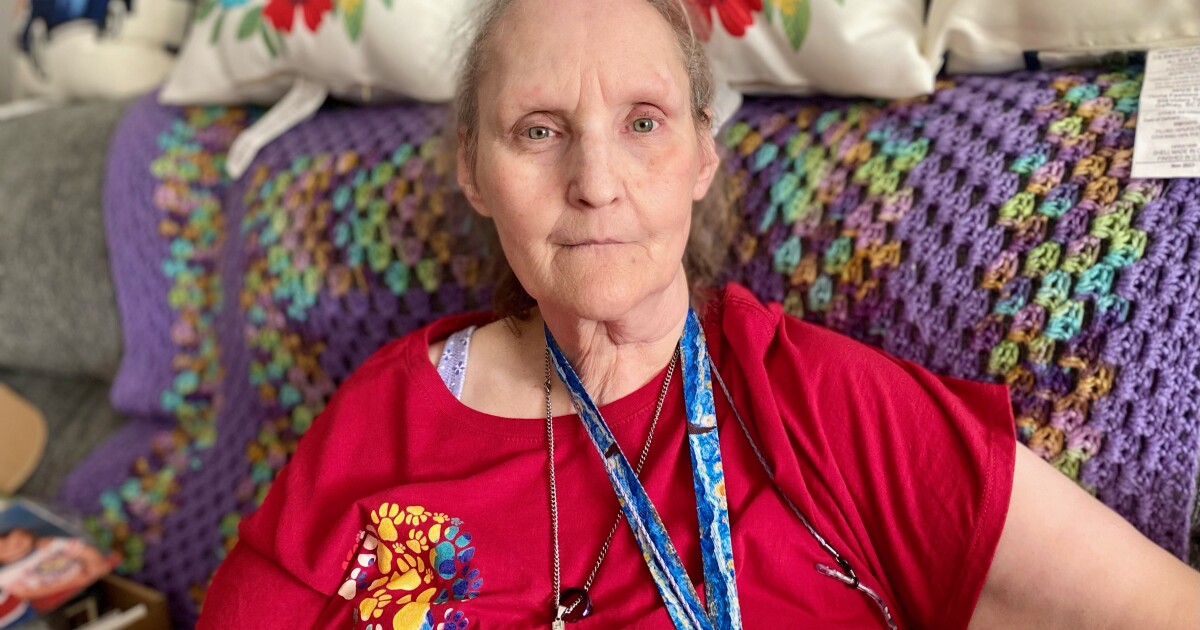
When her husband died in 2021, Lorraine Blanchard didn’t know what to do. It had been a while since she’d lived by herself, and she ended up getting sick and landing in a hospital. When she was released, she moved into a shared room in an assisted living facility.
“I felt it wasn’t my home,” she said, “and I really need to be in my own home.”
Then, Blanchard learned about Champlin Place, a new 65-unit building in Rochester. The low-income independent living community, run by Easterseals New Hampshire, is designed for seniors like her. Blanchard applied and moved in this year.
Blanchard, who has secondary Parkinson’s, gets visits from a home health aide a few times a week, catches rides to an adult day center down the street, and receives deliveries from Meals on Wheels. She can navigate her apartment with her walker. She spends time doing art projects, listening to music and hosting friends.
Advertisement
“This is the place to come,” she said during a recent interview in her apartment, surrounded by boxes of family photos. “There’s no discrimination — everyone accepts each other for who they are.”
Low-income seniors pay between around $350 and $1,400 a month for apartments in Champlin Place, a new affordable housing property in Rochester run by Easterseals.
But there’s a lot of demand for this kind of living. At Champlin Place alone, the waitlist is more than 100 people long. Across New Hampshire, about one in five people are above age 65, and the population is steadily growing older. But with rents soaring and vacant housing in short supply, seniors with limited incomes face a particular challenge: finding an apartment that’s safe, affordable and aging-ready.
The shortage of affordable housing for older adults reflects the state’s larger housing crisis. Over the last five years, median rent has increased by 36%, according to New Hampshire Housing. Marie Poole, who manages properties and facilities for Easterseals, says some people’s rents have spiked by $400 to $600 a month.
“There are lots of people in the state of New Hampshire that are paying over 50% of their gross income in rent,” Poole said. “It’s a disastrous train wreck about to happen, if anything goes wrong in their lives.”
Advertisement
RoddHersey says worrying less about paying medical and housing bills, since finding a more affordable place to live, has given him more time to pursue artwork, ministry, and time with family.
Before moving into Champlin Place, Rodd Hersey was living in a mobile home in Nottingham. He heated it with firewood that he split and stacked himself. But he was also living with lung cancer, and the wood smoke was becoming dangerous. When his family first suggested Champlin Place, he hesitated.
“You know when you’re an old horse, you don’t like new things,” Hersey said. “But I learned to adapt.”
Hersey requested an apartment with a view onto the woods. In his living room, he’s set up his painting easel by the window.
Rent at Champlin Place costs between $1,100 and $1,400 a month, including utilities. Some residents, including Hersey, receive rental assistance and pay even less.
Advertisement
“I could never have dreamt that I would be in a place that is as nice as this for what I pay,” Hersey said, gesturing towards the kitchen’s granite countertops and new appliances.
Like many senior housing properties, Hersey’s apartment is designed for easy modification in case he starts using a walker or wheelchair. The cabinets under the sink are removable; the doors, windows and cupboards are easy to open. There are communal lounge areas indoors and outdoors to relieve social isolation, and paved walkways to accommodate wheelchairs.
Poole, who manages the property, said many people tell her that worrying less about how to pay medical bills and rent frees up time for the things that give life meaning.
“There are a lot of people here who have commented about how – not only have their lives become easier, they feel a sense of calm here that they did not have before,” she said.
The scarcity of housing like Champlin Place is prompting some seniors to move prematurely into assisted living facilities and nursing homes, which can be five times as expensive as monthly rent. Others stay in their houses even when it’s no longer safe, exposing themselves to health risks and their properties to decline.
Advertisement
Betsey Andrews Parker, the CEO of the Community Action Partnership of Strafford County, said she has seen this firsthand: some seniors live out of one room because they can’t afford to heat their large homes, others can no longer reach second-floor bathrooms and resort to using a bucket instead.
“There are really thousands of residents in New Hampshire who are living this way,” she said, “and people don’t know.”
A number of non-profit organizations, such as Avesta Housing, Easterseals, and local Community Action Partnerships, have helped build and operate affordable housing units in New Hampshire. The Gafney Home, shown here, was renovated by the Strafford County Community Action Partnership.
New Hampshire Housing Director Rob Dapice said some seniors are ready to move into more accessible and affordable units, but it’s not always easy — due to high interest rates, and a shortage of smaller homes and apartments.
“In many cases, downsizing would be prohibitively expensive,” he said.
Advertisement
Thus begins a vicious cycle, Dapice said. Seniors have nowhere to move, so their larger homes and apartments never become available for younger families. Those younger families continue to rent, rather than buy, which puts more pressure on the rental market. As a result, rent for everyone continues to rise.
Betsey Andrews Parker in the historic Gafney Home in Rochester. Once renovated, the property will have a communal downstairs space, 21 affordable housing units, and a garden.
Efforts to address New Hampshire’s housing shortage have been slow to take shape at the State House. As advocates push to modify zoning rules and make it easier to build from the ground up, some organizations have turned to another strategy: retrofitting existing buildings into senior housing.
In Berlin, developers recently converted a shuttered elementary school into affordable housing. In Laconia, a historic inn became affordable housing for seniors. In Rochester, the Community Action Partnership (CAP) of Strafford County is turning a Victorian mansion called the Gafney Home into 21 small apartments.
Converting a historic property into apartment buildings is often more expensive than a new build. At the Gafney Home, preserving the historic character — oversized windows, ornate fireplaces, stained glass windows — came at a cost. And there were other hurdles: supply chain delays, and retrofitting areas to make them handicap-accessible. The project has run $2 million over budget.
Advertisement
But Andrews Parker, who’s overseeing this work, says the ordeal is worth it.
On a recent tour of the project, she stood inside a two-bedroom apartment that already has a long list of applicants. She teared up imagining who might move in next month: a senior who needs a live-in caregiver, or someone who is still caring for a grown child or grandkids.
“This is exactly the kind of housing we need,” Andrews Parker said. “We need housing that’s beautiful, that’s safe, that people can really age in place in.”
The 120-year old Gafney Home served as an assisted living facility before closing in 2019. It needed significant renovations to reopen as an apartment building.
A former New Hampshire state representative was sentenced to more than 33 years in prison for involvement in a child exploitation case — almost double the mandatory minimum.
Stacie Marie Laughton, 42, pleaded guilty to three counts of sexual exploitation of children after soliciting and receiving nude photos of three toddlers from an ex-girlfriend who worked at a daycare.
Lindsay Groves, 41, of Hudson, N.H., was sentenced to almost 22 years in prison earlier this month after pleading guilty to the same charges as well as an additional count of distribution of child pornography.
According to court documents, Groves took the photos of the victims in 2023 at Creative Minds daycare in Tyngsboro, where she was a teacher, during designated bathroom breaks and nap times.
Advertisement
She then sent the photos to Laughton, who requested the images and asked that Grove touch one of the minor’s genitals. In the conversation included in the records, the pair sexualizes the victims.
“Did the girl give you an issue,” Laughton texted after receiving the photos.
“No… the boy didn’t either,” Groves texted back.
In a sentencing memorandum, Laughton’s counsel had argued that she should receive a shorter sentence than Groves and asked for the minimum mandatory sentence, which would have 15 years for each count to be served concurrently.
“Stacie Laughton is a complex 42-year-old woman,” the memo said, noting that she was the first openly transgender woman to be elected to the New Hampshire legislature.
Advertisement
The filing described Laughton’s history of mental health, substance abuse, sexual abuse, and trauma as mitigating factors the judge should consider.
“One of the few consistencies in Ms. Laughton’s life is her challenges with mental health illnesses,” the memo said. “She began receiving mental health treatment at the age of four and has been in and out of extensive treatment programs ever since.”
The death of Laughton’s wife in 2020 and a tumultuous relationship with Groves also added to her mental health struggles, the memo said, stating that the defendant drank every day and had tried heroin for the first time leading up to her arrest.
A doctor quoted in the filing said that Laughton likely had a low IQ, tied in part to her premature birth, as well as “normal sexual interests.”
“This finding shows both how caught up Ms. Laughton was in her relationship with Groves that she participated in activity counter to this and is … an important factor in considering whether Ms. Laughton would be a future threat upon release,” the memo said.
Advertisement
The filing described Laughton’s actions as “horrendous, reprehensible, and shocking,” but said that even though the crimes were “utterly inexcusable,” she should still receive a shorter sentence than her codefendant out of a sense of justice.
However, in their own sentencing memo, federal prosecutors requested Laughton receive 40 years in prison.
“These crimes only came to light when Laughton reported them in an apparent attempt to punish Groves for ending their relationship,” prosecutors wrote. “The defendant, of course, did not disclose her own role in the creation of the imagery.”
“She ultimately admitted that she told Groves to touch one child’s penis, and claimed that she was feeding Groves’s attraction to children,” their memo said.
The prosecutors said that Laughton’s voice was the “more prominent one” in the conversation about exploiting children.
Advertisement
In addition to her prison sentence, Laughton will also serve five years of supervised release.
Massachusetts U.S. Attorney Leah Foley said in a statement that she felt the sentence fit the crime.
“The victims in this case were toddlers – children who were not yet old enough to care for themselves and, in some cases, not even fully verbal. Everyone who learns about the conduct in this case should be outraged,” United States Attorney Leah Foley said in a statement. “The sentences imposed reflect the depravity of the conduct and the seriousness of the crimes. My office will seek the most serious charges and the stiffest sentences for anyone who preys on children.”
Three people suffered injuries in a two-vehicle collision early Tuesday morning in Hooksett, New Hampshire.Courtesy of New Hampshore State
Three people suffered serious injuries Tuesday in a two-vehicle crash in Hooksett, N.H., police said.
The head-on collision happened around 5:40 a.m. on Interstate 293 northbound, State Police said.
Police said that Timothy Hubbard, 43, of Rome, Maine, was traveling south when he lost control of his car and crossed the median into oncoming traffic, police said.
Hubbard, his passenger, and the other driver were taken to hospitals to be treated for serious injuries, police said. The injures were not believed to be life-threatening.
Advertisement
Police said speed was believed to be a factor in the crash, which is under investigation.
Hannah Goeke can be reached at hannah.goeke@globe.com.
Franklin, NH – Sara Jane (Sanford) Doherty, 79, of Franklin, New Hampshire, passed away peacefully at her home on June 11, 2026. A beloved wife, mother, grandmother, and friend, Sara was born on June 5, 1947, in Hanover, New Hampshire, to Harold and Sadie (Pettengill) Sanford.
As the daughter of a U.S. Army Corps of Engineers employee, Sara spent her childhood moving throughout New England, living in New Hampshire, Massachusetts, and Connecticut. She graduated from high school in Hudson, Massachusetts, and later returned to New Hampshire, eventually settling in Franklin, where she made her home for more than forty years.
Sara built a successful career in the textile industry. She worked as a seamstress at Howland Originals before joining Star Specialty Knitting, where she began as a stitcher and, through hard work and determination, advanced to Plant Manager. She retired in 2003, and one of the greatest joys of her retirement was caring for several of her grandchildren, whom she adored.
Advertisement
Sara was a remarkably talented and creative artisan. She sewed clothing for her children when they were young and later created outfits for her grandchildren and their dolls. She was a gifted painter and artist whose extraordinary drawings and paintings brought joy to those around her. An accomplished seamstress, knitter, crocheter, cake decorator, and musician, Sara had an exceptional ability to create beauty in many forms. Her handmade gifts and treasured creations will be cherished by her family for generations to come.
Her talent for cake decorating blossomed into a successful side business that spanned more than thirty years. Sara created hundreds of stunning and imaginative cakes, including wedding and birthday cakes for her own children and grandchildren. Her passion for baking was so well known that for many years her license plate proudly read “CAKES+.”
Sara also had a remarkable gift for bringing people together. She hosted countless family reunions, each one more creative than the last. With elaborate themes, games, prizes, delicious food, and endless laughter, she created memories that her family will treasure forever. She was also known for her generous holiday gatherings, often welcoming more than thirty family members and friends into her home for Thanksgiving and Christmas celebrations. Summers brought cherished Fourth of July cookouts by Webster Lake, where Sara delighted in decorating the waterfront and gathering loved ones to enjoy the annual boat parade.
Sara’s love of giraffes was known by all who knew her. She spent years collecting hundreds of them, giving each a special “G” name. Before her passing, she shared one of her favorites, “Geebri,” with her granddaughter Sydni, who is expecting Sara’s first great-grandchild.
Her warmth, creativity, generosity, and love of family touched everyone who knew her. To say she will be missed is a vast understatement. She was truly the heart of her family.
Advertisement
Sara leaves behind her devoted husband of 43 years, Joel Doherty; her sons, Todd (Michelle) Chapman of Sanbornton, New Hampshire, and Paul (Cheryl) Chapman of Northfield, New Hampshire; her stepdaughters, Ali (Oliver) Frates of Amherst, New Hampshire, and Kate Hodge of Durham, New Hampshire; and her beloved grandchildren, Shelby, Sydni, Morgan, Owen, Duncan, Calum, Macy, and Elyse, and Step-grandchildren, Matthew, Jennifer, Eric, & Kevin.
Sara was predeceased by her parents.
Sara’s family would like to express their heartfelt thanks to Franklin VNA for their rapid and seamless response in setting up hospice, and to The Payson Center for their dedication and care, which gave us more precious time with her.
A graveside service will be held on Tuesday, June 30, 2026 at 11:00 AM in Franklin Cemetery, Thompson Park in Franklin.
For more information or to leave the family an online condolence, please visit www.smartmemorialhome.com.
Advertisement
Click here to sign the guest book or honor their memory with flowers, donations, or other heartfelt tributes