New Hampshire
NH housing production reached 20-year high in 2025, but still falls short of demand

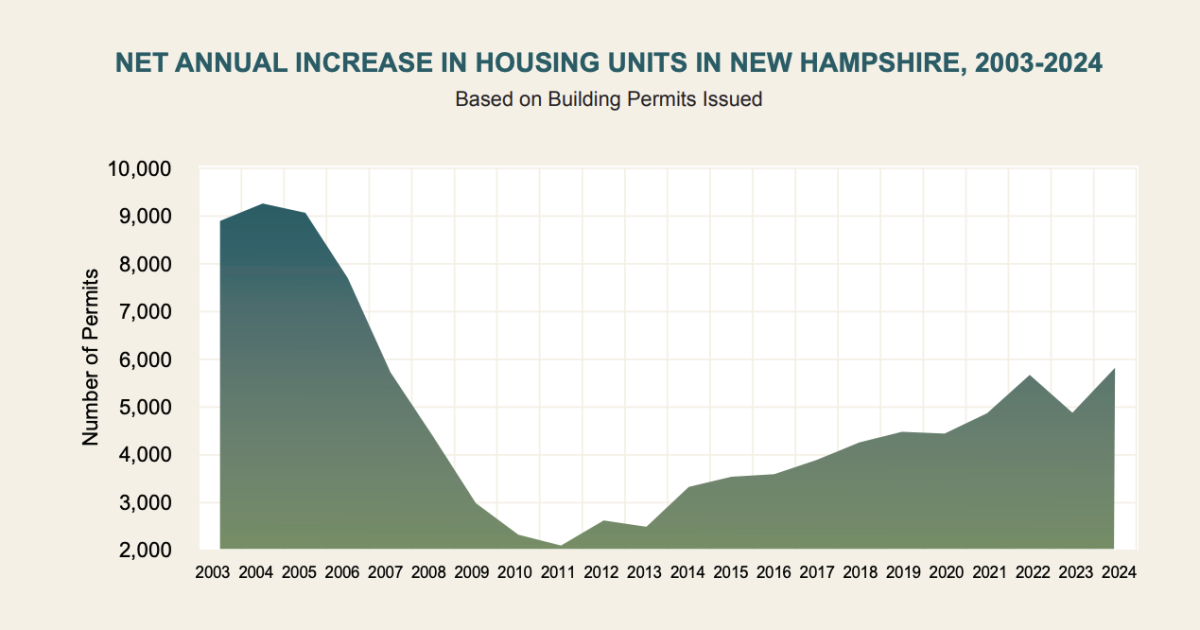
In 2025, more than 5,800 housing units were constructed in New Hampshire, the highest number since 2006, according to a new report from the state Department of Business and Economic Affairs. But despite this recent high, the report said the state has met only about 80% of its building goal between 2020 and 2025, which aims to balance the housing market by 2040.
In 2024, municipalities issued permits for 5,822 housing units. “[Assuming all permitted units were constructed in 2025,” the report said, “New Hampshire has added 25,688 housing units since 2020.” But a 2023 assessment from NH Housing said the state needed to build 32,704 housing units during that 5-year period. That would keep it on track for its 2040 goal, which calls for building 88,364 additional units between 2020 and 2040.
According to the department, 2025’s pace was only a marginal increase compared to previous years.
“We had a higher level this year, and I’m not meaning like thousands and thousands more, but it was higher this year than in the past 20 years,” said Heather Shank, director of the department’s Division of Planning and Community Development.
The state has added 4,000 housing units or more every year since 2018, according to the report.
Shank said this construction has not been spread evenly throughout the state.
“Larger communities, those that have the most infrastructure . . . produce the highest number of housing every year,” she said. “But there have been additional smaller communities that have been very pro-housing that have produced a lot of units as well, such as Lebanon or Portsmouth.”
The report found that just over 20 towns and cities, where nearly half of the state’s population lives, built nearly two thirds of the new housing in 2025. Most of the new development was concentrated in the Southern Tier or the Seacoast, with Dover, Londonderry, Manchester, Rochester and Portsmouth issuing the most building permits in 2024.
While the state overall failed to meet its five-year production goal, certain areas exceeded their local goals. The North Country Council, Strafford Regional Planning Commission, and the Upper Valley Lake Sunapee Regional Planning Commission all surpassed their building aims.
Office of Planning and Development
/
New Hampshire Department of Business and Economic Affairs
The type of housing being built in the state has evolved in recent years, according to Shank.
“The percentage of multi-family [housing] has been growing and the percentage of single-family, in terms of the whole, has been less,” she said.
According to the report, single-family permits constituted 36% of the total issued statewide, down from 46% in 2023.
In Hillsborough, Rockingham, Strafford, Merrimack, and Grafton counties, the majority of permits issued in 2024 were for multi-family housing.
The report attributes this shift to the InvestNH program, which is funded by the federal American Rescue Plan Act and primarily supported multi-family housing initiatives.
In 2025, a successful bipartisan effort helped enact new laws designed to encourage more building by loosening zoning restrictions and limiting individual towns’ local control.
This legislative session has seen myriad attempts to roll back these initiatives.


KEENE, N.H. — A Nashua woman who had a town clerk falsely certify a marriage that never happened so she could claim her late partner’s property has been sentenced to seven days in jail, placed on probation and ordered to repay thousands to his estate.
Attorney General John Formella said Wendy Leedberg‑Snow, 60, turned to Winchester Town Clerk Jim Tetreault after the death of her longtime partner, Eric Leedberg — who was born in Lowell — using the falsified license to pose as his spouse and lay claim to property from his estate, an effort prosecutors describe as an attempt to rewrite the couple’s history for financial gain.
“This case involved a deliberate effort to manipulate official government records and exploit the death of a loved one for personal financial gain,” Formella said in a press release announcing the sentencing. “Our vital records system depends on honesty and integrity, and those who seek to corrupt that system will be held accountable. I want to thank the investigators and prosecutors whose work ensured justice for the victim’s family.”
According to Leedberg’s obituary, he was 53 when he died on Oct. 12, 2023, following a two‑year battle with cancer.
In the obituary, Leedberg-Snow is described as his “significant other.”
Prosecutors said Leedberg‑Snow moved quickly after his death, relying on Tetreault’s signature to fabricate a marriage that never occurred and position herself as Leedberg’s surviving spouse.
Tetreault, who was a New Hampshire justice of the peace at the time, falsely signed the marriage license claiming he had officiated the couple’s wedding. He later admitted he never performed any ceremony for Leedberg‑Snow and Leedberg and had no personal knowledge of them ever being married.
Leedberg‑Snow used the fraudulent certificate to obtain property from Leedberg’s estate, including a pickup truck and trailer, and later attempted to influence a witness connected to the scheme.
Leedberg‑Snow pleaded guilty in Cheshire County Superior Court in Keene to felony counts of solicitation to commit vital records fraud, title fraud, theft by misapplication of property and witness tampering.
In addition to her seven‑day jail term, she must serve two years of probation, pay $4,600 in restitution, return the truck and trailer to Leedberg’s estate and comply with a suspended three‑and‑a‑half‑ to seven‑year prison sentence, which means the sentence only takes effect if she violates the conditions of her probation.
Tetreault, who continues to serve as Winchester’s town clerk and “fully cooperated with the State’s investigation,” according to prosecutors, pleaded guilty in April to notarial misconduct, a Class A misdemeanor. As part of a negotiated plea, prosecutors dropped a felony charge of vital records fraud. He was sentenced to 90 days in the house of corrections, all suspended for two years on good behavior, and ordered to pay a $1,000 fine plus a $240 penalty assessment.
He resigned his commissions as a justice of the peace and bail commissioner and agreed not to seek recommissioning as a justice of the peace or notary public during the two‑year suspension period.
Tetreault could not be reached for comment at his office number.
Follow Aaron Curtis on X @aselahcurtis, or on Bluesky @aaronscurtis.bsky.social.

SARGENT’S PURCHASE – On Saturday, personnel from multiple rescue crews teamed up to help an injured woman get off of Mt. Washington to seek medical treatment.
At approximately 7:45 AM, New Hampshire Fish and Game Department Conservation Officers were notified that a staff member at the Appalachian Mountain Club (AMC) Lakes of the Clouds Hut had taken a serious fall at the hut and was left unable to walk.
Fish and Game subsequently mobilized search and rescue personnel to come and help evacuate the young woman from her remote location.
By 10:00 AM, members of the Androscoggin Valley Search and Rescue Team (AVSAR), Pemigewassett Valley Search and Rescue Team (Pemi), AMC and Fish and Game had gathered at the Base Station of the Cog Rail. The Cog Railway generously donated room on their trains, and rescuers and equipment were given rides up Mt. Washington to the West Side Trail, which allowed for a shorter and less strenuous 1.6 mile hike than other routes.
By 11:20 AM rescuers were at the hut with the patient. The patient was subsequently packaged in a litter and prepared for an overland carryout back to the Cog tracks.
Rescue personnel made steady progress, and by 2:15 PM had made it back across West Side Trail and to the train tracks. A Cog Railway train picked up the whole rescue party and brought everyone back down the mountain. Once roadside, the patient was evaluated by personnel from Twin Mountain Fire and Rescue.
She was ultimately driven from the scene by a friend and went to Memorial Hospital in North Conway for further evaluation
and treatment of multiple injuries related to her fall. The patient was identified as Cali Turner, 26, of Willimantic, Maine.
Fish and Game would like to thank all of the people and organizations involved in this rescue effort. Through the help of everyone, the rescue was a great success and got done in a timely manner.
New Hampshire
Gilmanton Iron Works Man Accused Of Possessing Guns, Hundreds Of Grams Of Fentanyl In Hooksett, Manchester

Editor’s note: This post was derived from information provided by the Hooksett and Manchester police departments and does not constitute a conviction. This link explains how to request the removal of a name from New Hampshire Patch police reports.
Stark was arrested later by police during a motor vehicle stop in Manchester and charged with drug sale, possession, driving after revocation or suspension, and armed career criminal. He was then turned over to Hooksett police on that department’s charges, processed, declined bail, and was held at the Merrimack County Jail for future arraignment.
Decades Of Priors
Stark, according to superior court records, has more than two decades of criminal history, mostly in the Lakes Region.
In Laconia in December 2005, when he was a teen, Stark was accused of second-degree assault and felony theft. He pleaded guilty to both charges in August 2006. Stark was given work release in January 2007 and about 11 months later, was accused of violating probation. After being sentenced, he was accused of violating probation again in August 2008. A bail forfeiture hearing was held in December 2008, and a probation violation hearing was held in March 2009.
Stark was accused of controlled drug act in Laconia in December 2009, but the charge was nolle prossed in August 2010. In June 2010, he was accused of controlled drug act in Laconia, but the charge was nolle prossed in November 2010. Stark was charged with bail jumping in May 2010 and pleaded guilty a year later to the charge and received a two-to-four-year prison sentence with 113 days time served credit.
-
Vermont3 minutes ago
VT Lottery Pick 3, Pick 3 Evening results for July 12, 2026
-

 Virginia9 minutes ago
Virginia Lottery Pick 3 Night, Pick 3 Day results for July 12, 2026
-

 Wisconsin21 minutes ago
Wisconsin Lottery Pick 3, Pick 4 results for July 12, 2026
-

 West Virginia27 minutes ago
This week in West Virginia history: July 12 to 18
-

 Wyoming33 minutes ago
First Alert Weather Days through Sat. for excessive heat, possibly through Wednesday for fire danger
-

 Crypto39 minutes ago
The Tech Billionaire Takeover review – a surprisingly fun look at the crypto bros threatening democracy
-

 Finance45 minutes ago
Wedding budget: How to decide what to spend on your big day
-
Fitness51 minutes ago
Are Stamina and Endurance the Same Thing?


